Licensed under Creative Common Page 1
http://ijecm.co.uk/
DOES FINANCIAL DEVELOPMENT CREATE
ECONOMIC GROWTH? EMPIRICAL EVIDENCE
FROM DEVELOPING COUNTRIES
Nahid Kalbasi Anaraki
Fort Hays State University, Department of Economics, USA [email protected]
Abstract
The relationship between financial development and economic growth has created considerable
amount of debate with little consensus among economists, particularly on the direction of
causality between the two. Although several empirical studies have been carried out on different
countries with different techniques, the results have been very controversial. Indeed, a major
problem in several of these studies is the measurement of financial development by Credit/GDP
ratio and banking assets to GDP ratio. To address this problem, this study measures financial
development through adding private financial institutions assets such as hedge funds and
insurance companies to public banks assets to provide a more inclusive index for financial
development. The study implements Generalized Method of Moments (GMM) with annual data
for the period 1990-2017 for a sample of nine developing countries. The reason for using GMM
is to control for country specific characteristics and avoid biased results. The estimated results
suggest that financial development when measured by this inclusive index does have a
statistically significant impact on economic growth; however, corruption index plays a more
important role in shaping economic growth for our sample. The study implements Granger
Causality test to examine the causality direction between the two variables; the results suggest
that causality only runs from financial development to economic growth when we measure
financial deepening by adding private institutions assets to public banks.
Keywords: Generalized Method of Moment, financial development, sustainable economic
Licensed under Creative Common Page 2 INTRODUCTION
Several empirical studies have investigated the relationship between financial development and economic growth; while some have found a positive effect from the first variable to the second [King and Levine (1993), Demirguc-Kunt & Levine (2008), Ume, Nkwor, & Onwumere (2015)] others have found no relationship between the two [Abu -Bader, Abu-Quarn (2006), Hasan, Wachtel and Zhou (2007)]. This paper differs from previous studies because it implements different techniques and different indicators of financial development as we discuss in more detail, later. Indeed, the majority of studies have used Credit/GDP ratio and M2/GDP, while this study implements new proxies for financial development as we discuss later.
Another controversial issue among economists is the direction of causality between financial development and GDP growth. Does the causality run from financial development to sustainable growth or the other way around? The goal of this study is twofold. First, it aims to measure the effects of financial development versus macroeconomic fundaments such as debt ratio, inflation expectations, and corruption index on GDP growth. Second, it implements Granger Causality test to see whether causality runs from financial deepening to economic growth or the other way around, or is it bi-directional.
The novel feature of this study is that contrary to previous studies that use credit ratio to GDP or M2/GDP as an index of financial deepening, it implements a new indicator, which adds public assets of financial institutions and hedge funds to banking sector assets. The results of this study have important policy implications for monetary authorities because it can help them to recognize the determinants of economic growth and to improve financial deepening in order to foster economic growth. Indeed, this study contributes to finance literature in several important ways, (i) first and foremost it considers a group of developing countries that have not been covered in the previous studies, (ii) it implements a new index for measuring financial development, (iii) finally, it uses the Generalized Method of Moments (GMM) for panel data, which is preferred to time series data because it accounts for country specific characteristics and avoid biased parameters [Baltagi (2005)].
Licensed under Creative Common Page 3 LITERATURE REVIEW
During the past decades, several governments and central banks have used quantitative easing to achieve higher economic growth; however, since many of these economies have approached the liquidity trap, the efficiency of non-conventional monetary policy has been questioned. Indeed, the important question here is whether the unconventional monetary policy has a desired long-term impact on economic growth. This paper aims to measure the effects of macroeconomic fundamentals and corruption, versus financial development indicators on economic growth.
Several studies that have focused on the relationship between financial development and economic growth found evidence that financial deepening leads to more liquid markets, higher investment and faster economic growth, supporting a positive relationship between financial deepening and economic growth [King and Levine (1993), Calderon (2002), Christopoulos - Tsionas (2004), Hasan, Wachtel and Zhou (2006), Demirguc-Kunt & Levine (2008), Pradhan (2010), Rachdi-Mbarek (2011), Ume, Nkwor, & Onwumere (2015), Nyasha, Sheilla, Gwenhure, Yvonne, and Odhiambo, Nicholas (2017]; however, the causality and the issue of appropriately measuring financial depth have been ignored in several studies. The second group of studies have found no strong evidence to support long-run relationship between financial deepening and economic growth [Abu-Bader, Abu-Quarn (2006), Guptha and Rao (2018)].
For the causality between economic growth and financial deepening, studies can be categorized under three sections. First group of economists have found a bi-directional causality relationship between economic growth and financial deepening [(Chang & Wu (2012), Alrabadi & Kharabsheh (2015) when they use M2/GDP as a measure of financial deepening]. The second group have found causality runs from financial development to economic growth [Hussain, Farah, & Chakraborty, Deb Kumar (2012), Pouatwoe, Janice Tieguhong, and Piabuo Serge Mandiefe. (2017)]. And finally, the third group have found the causality runs from economic growth to financial development [Demirguc-Kunt, and Levine (2008), Alrabadi & Kharabsheh (2015) when they measure financial deepening by Credit/GDP, Okafor, Onwumere, and Chijindu (2016)]. Most recently Muyambiri, and Odhiambo (2018) have found that the relationship between the two variables seem to vary from one country to another and depends on the indicators used to measure the level of financial development as well as on the methodology used.
Licensed under Creative Common Page 4 implements Generalized Method of Moments (GMM) technique to measure the effects of economic fundamentals and corruption versus financial deepening on economic growth. The reason we implement GMM is that it is advantageous to panel data because it simply controls for country specific characteristics and avoid biased results.
Another shortcoming in the literature that has been addressed in this study is that it implements four different indicators for measuring financial deepening as proposed by Demirguc-Kunt, and Levine (2008), (i) private credits/GDP, (ii) M2/GDP, (iii) public and private banks and hedge funds assets/GDP, (iv) and finally, financial market assets/ GDP to see whether the results are affected by the choice of indicator.
RESEARCH METHODOLOGY
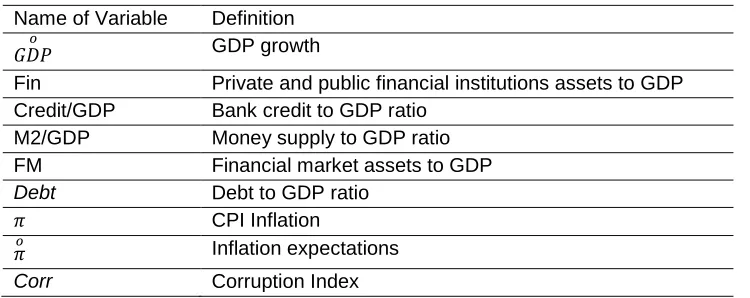
This Study used annual data from financial development data bank of the World Bank on financial deepening for nine developing countries including Algeria, Egypt, Ghana, Jordan, Lebanon, Morocco, Nigeria, Tunisia, and Senegal for the period 1990-2017. The reason we have chosen this period is to cover pre and post financial crisis of 2007-09, and to cover the structural and monetary reforms that have been carried out during the late 1990s and early 2000s in several of these countries. The data for macroeconomic variables are retrieved from International Monetary Fund website, World Economic Outlook (WEO) and data for the Corruption Index is retrieved from Transparency International. The list of dependent and independent variables in this study are summarized in Table 1.
Table 1. List of Dependent and Independent Variables Name of Variable Definition
GDP growth
Fin Private and public financial institutions assets to GDP Credit/GDP Bank credit to GDP ratio
M2/GDP Money supply to GDP ratio FM Financial market assets to GDP
Debt Debt to GDP ratio
CPI Inflation
Inflation expectations
Corr Corruption Index
Licensed under Creative Common Page 5 country specific characteristic is part of the error term, which leads to biased parameters. The third benefit of using panel data is that it overcomes the problem of cross country instrumental variable that doesn’t account for endogeniety problem, which may lead to inappropriate
interpretation on the coefficient of financial development [Baltagi (2005)]. Therefore, following Demirguc-Kunt and Levine (2008) this study implements Generalized Method of Moments (GMM) to investigate the relationship between economic growth and financial deepening.
To identify the effects of macroeconomic fundamentals versus financial deepening on economic growth the following econometric model is estimated for our sample with annual data for the period of 1990-2017. Empirical studies by Hung (2001), Venard (2013), and Thach, Doung, and Oanh (2017) show that corruption also plays an important role in shaping economic growth through political stability channel. Therefore, we include the corruption index into our growth model in addition to macroeconomic fundamentals and financial deepening. Equation 1 represents the theoretical model for effects of financial deepening on economic growth.
(Equation 1)
At margin, the effects of financial deepening, debt, inflation, and corruption index can be calculated by examining the partial derivatives of GDP growth to financial deepening, debt, inflation, inflation expectations, and corruption index.
0
oGDP
Debt
0
o
GDP
0o
o
GDP
0
oGDP
Corr
Indeed, based on the literature we expect the financial deepening have a positive impact on GDP growth, while debt, inflation, inflation expectation and corruption index are expected to have a negative impact on growth.
RESULTS
Johanson Cointegration technique
Licensed under Creative Common Page 6 Table 2. Johanson Co-integration results for variables in the growth model
Ho Eigenvalue Likelihood ratio 5% Critical value 1% Critical value
r=0 0.23 34.17** 45.15 50.17
r<1 0.31 45.14** 39.27 46.18
r<2 0.25 34.36* 31.14 35.94
r<3 0.19 40.12** 37.17 39.24
r<4 0.20 37.18** 22.56 34.18
r<5 0.18 31.15* 23.17 381.9
Note: Rejection of unit root test at five and one percent of confidence level is indicated with * and ** respectively.
Generalized Method of Moment (GMM)
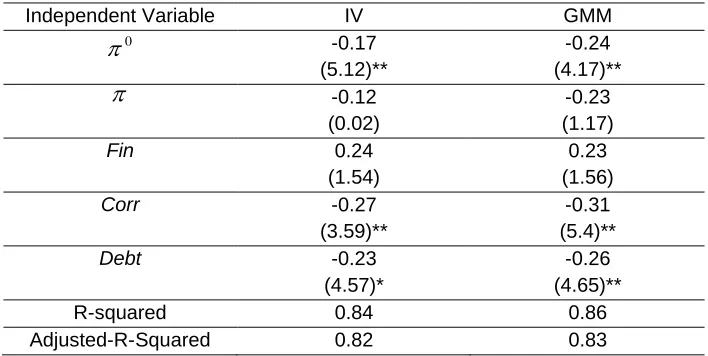
The estimated results for GMM model suggest that financial development when measured by credit/GDP ratio and M2/GDP do not have statistically significant impact on economic growth; however, when measured by adding private financial institutions and hedge funds assets to public banks and institutions (Fin) the coefficient becomes significant, highlighting the importance of measurement method (Table 3). Interestingly enough, all the independent variables are able to explain more than 85% of changes in economic growth across these developing countries. The estimated results suggest that the coefficient on Corruption Index (Corr) is negative and has the most important impact on economic growth in this group of countries, highlighting a more significant impact than financial deepening. The coefficients on inflation, inflation expectations and debt are negative and statistically significant as expected.
Table 3. The IV and estimated GMM Results for Growth
Independent Variable IV GMM
0
-0.17(5.12)**
-0.24 (4.17)**
-0.12(0.02)
-0.23 (1.17)
Fin 0.24
(1.54)
0.23 (1.56)
Corr -0.27
(3.59)**
-0.31 (5.4)**
Debt -0.23
(4.57)*
-0.26 (4.65)**
R-squared 0.84 0.86
Adjusted-R-Squared 0.82 0.83
Licensed under Creative Common Page 7 Granger Causality Tests
We use Granger Causality test between economic growth and four measures of financial deepening as proposed in the literature and introduced by Demirguc-Kunt, and Levine (2008). These measures are: (i) Credit/GDP, (ii) M2/GDP, (iii) Banking and private financial institution assets/GDP and (iv) financial market assets/GDP. The estimated results in Table 4 suggest that Credit/GDP doesn’t cause any changes in economic growth; however GDP growth causes
changes in Credit/GDP ratio. In other words, causality runs from growth to financial deepening when we use Credit/GDP ratio. When using M2/GDP as a measure of financial deepening there is no causality between the two variables. When using banks and financial institutions assets to GDP (Fin) as a measure of financial deepening it cause changes in economic growth, however, there is no effect from economic growth on financial deepening. Finally, when using financial market assets (FM) as measure of financial deepening the causality also runs from financial deepening to economic growth, and not in the opposite direction. Indeed, our results support those of Muyambiri, and Odhiambo (2018) who state the relationship between the two variables depends on the technique and measurement method.
Table 4. Granger Causality test between growth and financial deepening indices Null Hypothesis Statistics Probability Causality direction
Credit/GDP doesn’t Granger cause growth 1.56 0.34 No causality
Growth doesn’t Granger cause Credit/GDP 12.14 0.01 GDP
Credit/GDPM2/GDP doesn’t Granger cause growth 1.45 0.36 No causality
Growth doesn’t Granger cause M2/GDP 1.17 0.45 No causality
Fin doesn’t Granger cause growth 12.31 0.03 FinGDP Growth doesn’t Granger cause Fin 1.56 0.77 No causality
FM doesn’t Granger cause growth 16.85 0.002 FM
GDP Growth doesn’t Granger cause FM 1.25 0.43 No causalityCONCLUSION AND POLICY IMPLICATIONS
Using GMM method and time series data for the period 1990-2017 for a group of developing countries, the estimated results suggest that financial deepening only have a significant impact on economic growth when measured by financial institutions’ assets (including private banks
Licensed under Creative Common Page 8 The Granger Causality tests between economic growth and financial deepening indicators suggest that Credit/GDP and M2/GDP do not Granger cause economic growth, while when using banks and financial institution assets (Fin) and financial markets assets (FA) causality runs from financial deepening to economic growth. Indeed, contrary to the findings of [(Chang & Wu (2012), Alrabadi & Kharabsheh (2015)] we don’t find a bi-directional causality between
financial deepening and economic growth. Indeed, the results here support those of Muyambiri, and Odhiambo (2018) who state the relationship between the two variables depends on the technique and measurement method.
This study can be developed in several directions; one of the directions for future research on the topic is to use different techniques such as Vector Error Correction Model (VECM) and Autoregressive distributed lags (ARDL) to capture the reaction function of economic growth to financial deepening. Another issue that may be addressed in the future research is to use fixed effects random effects model to capture for the country specific characteristics.
REFERENCES
Abu-Bader, S., & Abu-Qarn, A.S. (2006). Financial Development and Economic Growth Nexus: Time Series Evidence from Middle Eastern and North Africa Countries, Monster Center for Economic Research, Discussion Paper 06-09. Alrabadi, D. & Kharabsheh, B. (2015). Financial Deepening and Economic Growth: The Case of Jordan, Journal of Accounting and Finance, 16 (6) 2016.
Baltagi, B. H. (2005). Econometric Analysis of Panel Data (John Wiley, Chichester).
Borlea, S.N., Mare, C., Achim, M.V., & Puscas, A. (2016). Direction of Causality between Financial Development and Economic Growth: Evidence for Developing Countries, Studia Universitatis Economics Series, 26 (2), PP.1-22. Calderon, C. (2002). The Direction of Causality between Financial Development and Economic Growth, Central Bank of Chile’s Working Paper No. 184.
Chang S.C., & Wu, C.H. (2012). The Relationship between Financial Deepening and Economic Growth in Taiwan. In: Zhu M. (eds) Business, Economics, Financial Sciences and Management, Advances in Intelligent and Soft Computing, Vol 143, Springer, Berlin, pp. 205-210.
Christopolus, D.K., & Tsionas, E. G. (2004). Financial Development, and Economic Growth: Evidence from Panel Unit Roots and Cointegration Tests, Journal of Development Economics, 73 (1): pp. 55-74.
Čihák, M., Demirgüç-Kunt, A., Feyen, E. & Levine, R. (2012). Benchmarking Financial Development around the World, Policy Research Working Paper 6175, World Bank, Washington, DC.
Demirgüç-Kunt, A., & Levine, R. (2008). Finance, Financial Sector Policies, and Long-Run Growth. M. Spence Growth Commission Background Paper 11, World Bank, Washington, DC.
Guptha, K.S.K., & Prabhakar, R.R. (2018). The causal relationship between financial development and economic growth: An experience with BRICS economies, Journal of Social and Economic Development, 2018 (20), pp. 308-326.
Hasan, I., Wachtel, P., & Zhou, M. (2006). Institutional Development, Financial Deepening and Economic Growth: Evidence from China, Bank of Finland, Institute for Economic Transition, BOFIT, Discussion Paper 12, 2006.
Hung, M.P. (2001). Corruption and Economic Growth, Journal of Comparative Economics 29 (1), pp. 66-79.
Licensed under Creative Common Page 9 King, R., & Levine, R. (1993) Finance, Entrepreneurship, and Growth: Theory and Evidence, Journal of Monetary Economics 32(3), December, pp. 513-542.
Levine, R., & Zervos, S. (1998) Stock Markets, Banks, and Economic Growth, American Economic Review 88, pp. 537–58.
Muyambiri, B., & Odhiambo, N. (2018). The Causal Relationship between Financial Development and Investment: A Review of Related Empirical Literature, Comparative Economic Research, Volume 21 (2).
Nyasha, S., Yvonne, G., & Odhiambo, N. (2017). The Dynamic Casual Linkage between Financial Development and Economic Growth: Empirical Evidence from Ethiopia, Journal of International Economics, Volume 70 (1), pp. 73-102. Offore-Obebresi, G., Pickson, B., & Diabah, B.R. (2017). Financial Development and Economic Growth: Additional Evidence from Ghana, Modern Economy, (8), pp. 282-297.
Okafor, I.G., Onwumere, J.U.J., & Chijindu, E.H. (2016). Financial Deepening Indicators and Economic Growth in Nigeria: A Causality and Impact Analysis, Asian Journal of Economics, Business, and Accounting 1(2), pp 1-11. Pouatwoe, J. T. & Piabuo, S.M. (2017). Financial Sector Development and Economic Growth: Evidence from Cameroon, Financial Innovation 3 (25).
Pradhan, R.P. (2010). Financial Deepening, Foreign Direct Investment, and Economic Growth: Are they Cointegrated? International Journal of Financial Research (1) pp.37-43.
Rachdi, H., & Mbarek, H.B. (2011). The Causality between Financial Development and Economic Growth: Panel Data Cointegration and GMM System Approaches, International Journal of Economics and Finance 1(2). pp. 105-112. Rajmund, M. (2011). Financial Deepening and Economic Growth in European Transition Economies, Journal of Applied Economic Sciences 2 (6) pp.177-194.
Sahay, R. Cihak, M., Diaye, P.N., & Barajas, A. (2015). Rethinking Financial Deepening: Stability and Growth in Emerging Markets, IMF Staff Discussion Note, 15/08.
Thach, N.N., Doung, M.B., & Oanh, T.T.K. (2017). Effects of Corruption on Economic Growth-Empirical Studies of Asia Countries, Imperial Journal of Interdisciplinary Research 3 (7), pp. 791-797.
Ume, K.E., Nkwor, N.N., & Onwumere, U.J.J. (2015). Measuring the Dynamics of Financial Deepening and Economic Growth in Nigeria, 1981-2013: Using Engel Granger Residual Based Approach, Journal of Economics and Finance 6(6). Pp. 82-89.