• No results found

PDF

N/A
N/A
Protected

Academic year: 2020

Share "PDF"

Copied!
12
0
0

Loading.... (view fulltext now)

Full text

(1)

Emotional Intelligence and Transformative Leadership Style of

Principals in High Schools

Ijaz Ahmad Tatlah (Affiliation: School of Social Sciences and

Humanities, Department of Education University of Management

&Technology, C-ii Johar Town Lahore, Pakistan)

Tahseen Mehmood Aslam (Affiliation: Chair Person Technology

Education, Institute of Education and Research University of the

Punjab Lahore, Pakistan)

(2)

Author (s)

Ijaz Ahmad Tatlah

Affiliation: School of Social Sciences

and Humanities, Department of

Education University of

Management &Technology, C-ii Johar

Town Lahore, Pakistan.

E-mail:[email protected]

Tahseen Mehmood Aslam

Affiliation: Chair Person Technology

Education, Institute of Education and

Research University of the Punjab

Lahore, Pakistan.

E-mail:[email protected]

Emotional Intelligence and Transformative Leadership

Style of Principals in High Schools

Abstract

Considering

the

importance

of

human

resource

development goals of today's Schools and organizations, to

address the patterns and techniques necessary for

understanding and guiding staff is one of the most effective

methods and guidance, familiarity with topics and

transformative leadership styles and management practices

is the transformative leadership style and management

skills. The purpose of the present research as a

descriptive-correlative

research

was

to

study

the

relationship

between

emotional

intelligence

and

transformative leadership style of Principals who work in

Secondary education. So five components

include

Self-awareness, Self-regulation, Motivation, Empathy and

Social skills and four styles of transformative leadership

Inspirational. Principals have high EI (Emotional

Intelligence) focus their efforts to create enthusiasm in their

team with abundant energy and refer others to move

forward. A principal’s skill in the area of human relations,

decision-making, control of subordinates and conflict

resolution are indicators of transformative leadership traits

and behaviors. Effective leaders will support and encourage

staff to model behaviors promoting collegiality and a

professional working environment.

Keywords:

Emotional Intelligence, Transformative leadership, Empathy, Inspirational

Motivation, Intellectual Stimulation

JEL Codes: C11, J12

Introduction

Most of the earlier theories have summarized

intelligence as an educational ability and have

(3)

conscientious, having moral sensitivity and

transformative

leadership

ability

were

mentioned as a separate dimension of

intelligence. Many research studies dealing

with defining intelligence, set forth that

intelligence comes to existence through

reciprocal effects of intelligence and non-

intelligence characteristics, which include

environmental skills which are to a great

extent responsible for development and change

in the present world. In 1972 federal definition

of intelligence was beyond the cognitive

ability so that transformative leadership ability

was mentioned as a separate and independent

model of intelligence (Young Lee,2006). EI

has been identified, through the popular press

and some researchers as that critical element

needed for effective transformative leadership.

In other Hand, transformative leadership,

considered one of the most recent approaches

to the investigation led to the country's few.

Theory of transformative leadership style a

theoretical framework is transformative in the

world, which has been proposed by Burns

(1978) and Bass (1985).Burns stated in 1990,

stating that leaders can use behavioral

characteristics of transformative leadership,

the performance of their followers than

expected.

The challenge with these standpoints is

twofold, (1) the study of transformative

leadership and what makes leaders effective

has been found to be much more complicated

than a single dimension like EI; and (2)

organizations have incorporated many of these

EI beliefs into their work systems and

performance expectations without researching

what some authors claim is true and

achievable (Salovey, 2003). The study of

transformative leadership, its effectiveness

and its impact on organizational performance

is a key interest to HRD (Human Resource

Development) scholars. On this basis, in this

paper we review the literature on the EI and

transformative leadership Style and We

Survey the relationship between them and

Principals in High schools.

Transformative Leadership

Accomplishing the kinds of changes needed to

integrate EI into secondary schools requires

transformative leadership: leadership that is

willing to realign structures and relationships

to achieve genuine and sustainable change.

Although there are more elements of

transformational leadership than we can

elaborate here, we can describe some key

aspects derived from education research and

stories of successes (Bencivenga & Elias, 2003;

Devaney et al., 2006; Elias & Arnold, 2006;

Elias, Arnold, & Hussey, 2003).For bringing

major changes, transformational leaders must

consider the following four styles.

Inspirational Motivation; The foundation of

transformational leadership is the promotion of

consistent vision, mission, and a set of values

to the members. Their vision is so compelling

that they know what they want from every

interaction. Transformational leaders guide

followers by providing them with a sense of

meaning

and

challenge.

They

work

enthusiastically and optimistically to foster the

spirit of teamwork and commitment.

(4)

creative. They encourage new ideas from their

followers and never criticize them publicly for

the mistakes committed by them. The leaders

focus on the “what” in problems and do not

focus on the blaming part of it. They have no

hesitation in discarding an old practice set by

them if it is found ineffective.

Idealized Influence; they believe in the

philosophy that a leader can influence

followers only when he practices what he

preaches. The leaders act as role models that

followers seek to emulate. Such leaders always

win the trust and respect of their followers

through their action. They typically place their

followers needs over their own, sacrifice their

personal gains for them, ad demonstrate high

standards of ethical conduct. The use of power

by such leaders is aimed at influencing them to

strive for the common goals of the

organization.

Individualized Consideration; Leaders act as

mentors to their followers and reward them for

creativity and innovation. The followers are

treated differently according to their talents

and knowledge. They are empowered to make

decisions and are always provided with the

needed support to implement their decisions.

Overall, research shows that the four factors of

transformative leadership Inspirational the two

styles Inspirational Motivation and Intellectual

Stimulation are of most important factors

related to the field of education.

Theoretical Background

Studies Alon and Higgins (2006) show that the

fact

that

emotional

intelligence

(EQ),

analytical intelligence (IQ), and transformative

leadership behaviors are moderated by cultural

intelligence (CQ) in the formation of global

transformative leadership success. In their

study of the relationship between emotion and

Transformative leadership, Gardner, Fischer,

and Hunt (2009) reviewed the literature of

emotional labor and authentic transformative

leadership and identified three categories of

leader emotional displays: surface acting, deep

acting and genuine emotions. “The consistency

of expressed leader emotions with affective

display rules, together with the type of display

chosen, combines to impact the leader's felt

authenticity, the favorability of follower

impressions, and the perceived authenticity of

the leader by the followers. They also explored

the influence on leader emotional labor of

contextual dimensions of the environment,

including

the

omnibus

(national

and

organizational culture, industry and occupation,

organizational structure, time) and discrete

(situational) context.

(5)

McKee (2002) posited that leaders use EI to

develop relationships that are in-sync with their

organization by forming “emotional bonds that

help them stay focused even amid profound

change and uncertainty.” Essentially, the

Teachers of the future will need to be attuned to

the big picture, and be able to think

conceptually as they transform the organization

through people and teams. They will also need

to possess strong interpersonal skills, be able to

get along with others, and exercise high levels

of intelligence and energy. Fullan (2009)

emphasized that “emotionally intelligent

leaders are aware of their own emotional

makeup, are sensitive and inspiring to others,

and are able to deal with day-to-day problems

as they work on more fundamental changes in

the culture of the organization”.

School leaders are faced with an abundance of

issues when they assume a transformative

leadership position, second only to high

expectations for systemic and transformational

change in the school system.

Meyerson, Orr and Cohen (2007) presented in

their report, Preparing School Leaders for a

Changing World, key components necessary

for exemplary principal preparation programs.

The recommendations proposed in these

reports are valid, but equally important is the

balance of training in the area of EI for an

educational leader’s success in becoming a

change agent for the improvement of

instruction. As defined by Goleman(2004), EI

is the ability to lead, recognizing four

emotional

areas:

self-awareness,

self-management,

social

awareness,

and

relationship management, each having specific

characteristics. These four cluster areas focus

on

identified

traits,

behaviors

and

characteristics of successful leaders. Research

has identified additional areas including

organizational and management skills, shared

values and beliefs, collegiality, and staff

building. In each of these areas EI is a common

theme.

Marzano (2003) highlights three principles for

effective leaders. The first revolves around the

principal functioning as a strong cohesive

force; the second is to provide strong guidance

while demonstrating respect; and the third

principle is characterized by specific behaviors

which enhance interpersonal relationships.

Principle three further establishes three

characteristics

of

importance:

optimism,

honesty,

and

consideration.

Optimism

increases teachers’ self-esteem and motivation.

“Honesty is characterized by truthfulness and

consistency between words and actions”.

(6)

Olszewski-Kubilius,

2006).

At

times

transformative leadership is viewed as a

mysterious and elusive concept. The challenge

is for individuals to look inward to achieve

effective transformative leadership (Chopra,

2002).

As Dewey advocated the teaching of the

“whole child” for maximum gains, so should

programs for transformative leadership include

the social, emotional, intellectual and physical

components. It is through the combination of

these focused areas that transference of

meaningful change will take place in our

schools. Strong transformative leadership

development

processes

are

focused

on

emotional and intellectual learning and they

build on active participatory work: action

learning and coaching, where people used

what they’re learning to diagnose and solve

real problems in their organizations.(Goleman,

Boyatzis, & McKee, 2002)So successful

schools need educational leaders who have the

abilities to facilitate sustained and lasting

change. As Fullan (2009) reiterated, “these

new educational leaders will need to have a

strong sense of moral purpose for direction and

great EI as they build relationships”. In effect,

Principals

will

not

only

need

strong

intellectual skills to be a great influence on the

school culture, but they must be able to

influence and understand relationships and the

feelings and emotions of those they serve and

lead (Moss and Ngu, 2006). The research basis

purpose, then, was to investigate the impact of

EI on Transformative leadership styles of

Principals who work in Secondary Education

in Punjab Pakistan.

Methodology

Population and sampling: Research method

was

descriptive-correlative.

Statistical

population included all teachers of high

schools of Lahore, Punjab, Pakistan. The

sample included 42 high school and 252

teachers that were chosen by proportional

stratified sampling.

Research Hypotheses

H1; There is a significant relationship between

Emotional Intelligence and transformative

leadership styles of high school principals` in

Lahore.

H2; There is a significant relationship between

Self-awareness and transformative leadership

styles of high school principals` in Lahore.

H3; There is a significant relationship between

Self-regulation and transformative leadership

styles of high school principals` in Lahore.

H4; There is a significant relationship between

EI and its components according to age and

gender.

Instruments

(7)

an Alpha Cronbach coefficient of 0.86 for this

scale

Data Analysis

To see if there is a significant relationship

between EI and the transformative leadership

styles of high school principals` in Lahore.

The Pearson correlation coefficient was used

to examine this hypothesis. The result is

reported in table 1.

As it has been shown in table 1, correlation

coefficient between EI and Inspirational

Motivation Transformative leadership style, r=

0.714 is significant at level p<0.000.

Accordingly, there is a significant relationship

between EI and Inspirational motivation

transformative leadership style. It means that

the teachers with high EI apply Inspirational

Motivation Transformative leadership style

more.

The result also shows that there is a

significant relationship between EI and

Intellectual

Stimulation

transformative

leadership style with r= -0.719 which is

significant at level p<0.000. Accordingly, there

is a negative relationship between EI and

Intellectual

Stimulation

transformative

leadership style. It means that the teachers

with high EI apply Intellectual Stimulation

transformative leadership style less. According

to the obtained results, "null hypotheses" as a

clue of no relationship between EI and the

teachers’ transformative leadership style

cannot be confirmed.

To see if there is a significant relationship

between Self-awareness and transformative

leadership

styles.

Pearson

correlation

coefficient has been used to examine this

hypothesis. The results are reported in table 2.

As it has been shown in table 2, correlation

coefficient

between

Self-awareness

and

Inspirational

Motivation

transformative

leadership style, r= 0.296 is not significant at

level p< 0/000. Accordingly, there is not a

significant

relationship

between

Self-awareness and inspirational motivation

transformative leadership style.

Also table 2 shows that there is not a

significant

relationship

between

Self-awareness and intellectual Stimulation

transformative leadership style. The Pearson

correlation coefficient between Self-awareness

and Intellectual Stimulation transformative

leadership style (r= -0.242) is significant at

level p<0/000. Accordingly, there is a negative

relationship between Self-awareness and

Intellectual

Stimulation

transformative

leadership style. Thus “null hypotheses” as a

clue of no relationship between Self-awareness

the Teachers’ Transformative leadership style

cannot be confirmed but instead the “research

hypothesis” is confirmed. It means that there is

not

a

significant

relationship

between

Self-awareness and Inspirational Motivation

styles and also Intellectual Stimulation styles.

(8)

significant relationship between Self-regulation

and inspirational motivation transformative

leadership style. It means that Teachers with

high

Self-regulation

apply

Inspirational

Motivation transformative leadership style

more.

In addition the relationship obtained from table

3 show that there is a significant relationship

between

Self-regulation

and

Intellectual

Stimulation transformative leadership style.

Pearson

correlation

coefficient

between

Self-regulation and Intellectual Stimulation

transformative leadership style (r= -0.472) is

significant at level p<0.002. Accordingly, there

is

a

negative

relationship

between

Self-regulation and Intellectual Stimulation

transformative leadership style. It means that

the managers with high Self-regulation apply

Intellectual

Stimulation

transformative

leadership style less. According to the obtained

results, "null hypotheses" as a clue of no

relationship

between

Self-regulation

the

managers' transformative leadership style

cannot be confirmed but instead “research

hypothesis” is confirmed. It means that there is

a

significant

relationship

between

Self-regulation and transformative leadership

styles.

To see if there is a significant relationship

between EI and its components according to

age and gender.

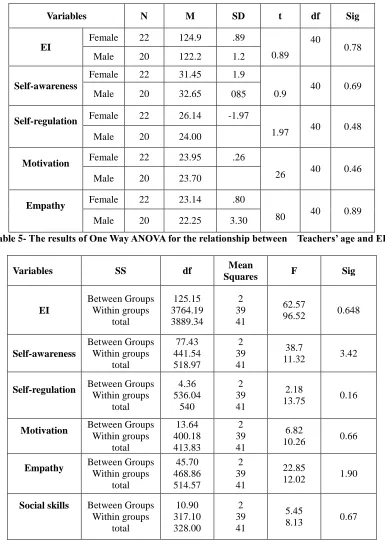
(a)

The relationship between Teachers’

gender and EI and its components At

test was used to compare the

differences between EI and its

dimensions in Teachers according to

gender. The results have been

reported in table 4.

(b)

The result of t Test showed that there

was

no

significant

relationship

between Teachers’ EI and its

components (t=0.89, sig=0.78, P <

0.05). Moreover, no relationship

between gender and EI’s components

was observed. Accordingly, the “null

hypothesis” is confirmed.

(c)

The relationship between Teachers’

age and EI and its components to find

out

the

relationship

between

Teachers’ age and EI and its

dimensions, a One Way ANOVA was

used. The results have been reported

in table 5.

The results of ANOVA reported in table 8

showed that there was no relationship between

Teachers’

EI

and

age.

F=0.648,

significance=0.528 at p<0.05 is not significant.

Just in Self-awareness the obtained F is

significant

(F=3.42,

significance=0.043,

p<0.05). Other components of EI and

Teachers’ age were not significantly different.

Accordingly, the “null hypothesis” is

confirmed and the “research hypothesis” is not

confirmed.

Conclusion

(9)

sustain trying. The findings suggest that

among organizational duties there should be

performing plans related to the EI skills. In

addition, in the process of appointing

managers and employees, EI should be

considered as one of the criteria. The high

school Teachers with emotional intelligence

can achieve the various goals like removing

the obstacles, solving the dissensions and also

improving the education outcome in school.

Based on the results of six hypotheses, it can

be concluded that the results related to

differences of EI and its componens among

high school Teachers and their gender are in

agreement with Bryan (2007), Mayer (2008),

Alavishad (2010). Golman (2002) also

believes that the gender differences have no

influence on EI. Also based on the obtained

results" null hypothesis" as a clue of no

relationship between EI and the age of high

school Teachers was confirmed. Besides

"research hypothesis" was not confirmed too.

The result is in agreement with studies carried

out by, Alavishad (2010).As the results showed,

EI characteristics have been recognized as

positive attributes in effective leaders. The

characteristics are attributes associated with

success and the frequency of the “emotional”

trait was strong, as cited by Kouzes and Posner,

(2002) Maxwell, (2004) and Sergiovanni

(2002). The question remains, how do we

prepare and mentor future administrators for

success in leading transformational change in

our school system? In order for collaboration,

response

and

mobilization

to

occur,

self-reflection on the part of the leader is the

starting point for successful relationships

within the school community. To promote

success for all students, leaders must become

acquainted with the areas related to EI and the

competencies necessary to be successful.

Educational

Transformative

leadership

programs should include EI theory as a

component for reform. Programs have been

focusing on the development of course content;

the time has come to embrace the research on

EI and provide a balanced approach.

References

Alon,I.,Higgins,

J.(2006)

Global

Transformative leadership success through

emotional and cultural intelligences Business

Horizons, 48, 501-512.

Bryan, S.P. (2007) Emotional Intelligence and

Intrapersonal Conversations. Published in

www.eiconsortium.org. The Consortium for

Research

on

Emotional

Intelligence

in

Organizations

Issues

in

Emotional

Intelligence. Pp. 1-9.

Cherniss, C. (2010) Emotional intelligence:

What is it and why it matters. Paper presented

at the annual meeting of the Society for

Industrial Organizational Psychology. Rutgers

University, Graduate School of Applied and

Professional

Psychology.

Web

site:

www.eiconsortium

Chopra, D. (2002) The soul of transformative

leadership . [Electronic version]. School

Administrator, 59(8), pp1-10

(10)

Fullan, M. (2009) Teachers as leaders in a

culture of change. ducational Transformative

leadership , 5, 16-20.

Gardner, W.L, Fischer, D., Hunt, J. (2009)

Emotional labor and Transformative leadership:

A threat to authentic city? The Transformative

leadership quarterly, 20, 466-482.

Goleman, D. (2003) Emotional intelligence:

Why it can matter more than IQ. New York:

Bantam Books.

Goleman, D. (2004) "What makes a leader?”,

Harvard Business Review, Vol. 76, 93- 104

Goleman, D., Boyatzis, R., & McKee, A.

(2002) Primal Transformative leadership :

Realizing the power of emotional intelligence.

Boston: Harvard Business School Press.

Hausman, C., Crow, G. M., & Sperry, D.

(2005) Portrait of the “ideal principal”:

Context and self. [Electronic version].NASSP

Bulletin, 84(617), 5-14.

Alavishad, Lila. (2010) Investigated the

Relationship between Emotional Intelligence

and the Heads Secondary Schools in Tehran.

MSc thesis in Shahid Beheshti University,

Faculty

of

Educational

Sciences

and

Psychology.

Kouzes, J. M., & Posner, B. Z. (2002) The

Transformative leadership challenge. San

Francisco, CA: Jossey-Bass Inc.

Mayer, J.D. (2008) Emotion, Intelligence and

Emotional Intelligence. Handbook of affect

and Social cognition (pp.30-49). Mahwah, NJ :

Lawrence and Erlbaum Association.

Marzano, R. (2003) What works in schools.

Alexandria, VA: Association for Supervision

and Curriculum Development (ASCD).

Moss, S., and Ngu, S. (2006) The Effect of

Follower Regulatory Focus and Extraversion

on transformative leadership Behavior: The

Role of Emotional ,Intelligence Journal of

Individual Differences, 27, 93-107.

Maxwell, J. (2004)

The 21 indispensable

qualities of a leader. Tennessee: Thomas

Nelson Inc.

Salovey, P.. (2003) Emotional intelligence.

Imagination, Cognition, and Personality, 9,

185-211.

Sergiovanni,

T.

J.

(2002)

Moral

Transformative leadership : Getting to the

heart of school improvement. San Francisco,

CA: Jossey-Bass Inc.

Wolff, B.S., T.A. Pescosohdob and U.V.

Druskatc(2008) Emotional Intelligence as the

basis of Transformative leadership emergence

in self- managing team. J. Leader Quar., 13:

505-522.

DOI:

10.1016/S1048-9843(02)00141-8.

(11)

Table 1 – Correlation coefficient between Emotional Intelligence and principals`

transformative leadership styles.

Emotional Intelligence

Transformative leadership Styles

Sig

r

n

0.000

0.714

42

Inspirational Motivation style

0.000

-.0719

42

Intellectual Stimulation style

Table 2 – Correlation coefficient between Self-awareness and principal's transformative

leadership

Self-awareness

Transformative leadership Styles

Sig

r

n

0.057

0.296

42

Inspirational Motivation style

0.123

-0.242

42

Intellectual Stimulation style

Table 3 – Correlation coefficient between Self-regulation and principal's transformative

leadership

Self-regulation

Transformative

leadership

Styles

n

r

Sig

0.006

0.420

42

Inspirational Motivation style

0.002

-0.472

(12)

Table 4-The results of t test for differences between EI and its dimensions in Teachers

according to gender

Variables

N

M

SD

t

df

Sig

EI

Female

22

124.9

.89

.

0.89

40

0.78

Male

20

122.2

1.2

Self-awareness

Female

22

31.45

1.9

1

0.9

40

0.69

Male

20

32.65

085

Self-regulation

Female

22

26.14

-1.97

-1.97

40

0.48

Male

20

24.00

Motivation

Female

22

23.95

.26

.

26

40

0.46

Male

20

23.70

Empathy

Female

22

23.14

.80

.

80

40

0.89

Male

20

22.25

3.30

Table 5- The results of One Way ANOVA for the relationship between Teachers’ age and EI

Variables

SS

df

Mean

Squares

F

Sig

EI

Between Groups

Within groups

total

125.15

3764.19

3889.34

2

39

41

62.57

96.52

0.648

Self-awareness

Between Groups

Within groups

total

77.43

441.54

518.97

2

39

41

38.7

11.32

3.42

Self-regulation

Between Groups

Within groups

total

4.36

536.04

540

2

39

41

2.18

13.75

0.16

Motivation

Between Groups

Within groups

total

13.64

400.18

413.83

2

39

41

6.82

10.26

0.66

Empathy

Between Groups

Within groups

total

45.70

468.86

514.57

2

39

41

22.85

12.02

1.90

Social skills

Between Groups

Within groups

total

10.90

317.10

328.00

2

39

41

5.45

Figure

Table 1 – Correlation coefficient between Emotional Intelligence and principals`
Table 5- The results of One Way ANOVA for the relationship between  Teachers’ age and EI

References

Related documents

Write a Matlab code for entering the ages of the students from keyboard, compute how many students there are in each classified groups and represent the results in bar

In addition to shedding light on generic frames (i.e., conflict, human interest, economic impact, morality, responsi- bility, and nationalization frame) we looked at the causes

The specific aim of the study was to prospectively evaluate clinicians’ knowledge, confidence, acceptance and satisfaction towards using telerehabilitation for the management

We have audited the accompanying consolidated financial statements of Joint Stock Commercial Bank “National Reserve Bank” (Open Joint Stock Company) (the “Bank”) and its

Given an input query or test scene, represented by its Scene matrix cell, an effective scene decision mod- ule is proposed to rapidly decide if the test scene matches one of

The Ardennes is a detailed account of the Battle of the Bulge authored by the military history department of the US Army.. http:

Terdapat juga penelitian yang dilakukan oleh (Sri Maryati, 2009) bahwa variabel tingkat suku bunga dan nilai tukar dollar AS berpengaruh terhadap Indeks Harga Saham

It has to be noted that the set of key elements works for a correct OHSMS implementation, in order to obtain an assessment of the organization and management model adopted