IJEDR1704116
International Journal of Engineering Development and Research (
www.ijedr.org
)
716
Experimental Study on Bubble Deck Slab using
Polypropylene balls
1K.R.Dheepan, 2S.Saranya, 3S.Aswini
1Assistant Professor, 2Assistant Professor, 3Assistant Professor 1Department of Civil Engineering,
1S.A.Engineering College, Poonamallee – Avadi Main Road, Veeraraghavapuram, Thiruverkadu Post, Chennai – 77, India
________________________________________________________________________________________________________
Abstract - Bubble deck slab is an innovatory floor system of reinforced concrete which contains spherical hollows as
concrete saving elements. It is a revolutionary method which virtually eliminates all concrete from the middle portion of a floor slab. The structural dead weight is reduced due to the non-performance of any structural function by the middle portion of the slab. High density polypropylene spherical balls replace the in-effective concrete in the center of the slab. Voids in the middle of the slab provide thermal insulation and also leads to 30 to 50% lighter slab. Bubble deck slab allows longer spans between columns supports. In this paper, flexural strength of the slab was determined by two point load test. The main aim of this study is to determine the optimum spacing and diameter of balls to achieve maximum strength. Crack pattern of bubble deck slab is also studied by varying the spacing and diameter of balls.
Keywords - Bubble deck, thermal insulation, lighter slab, flexural strength, crack pattern.
________________________________________________________________________________________________________
I. INTRODUCTION
In building constructions, slab is one of the largest structural member consuming concrete. Jorgen Bruenig in 1990’s invented the first biaxial hollow slab (now known as bubble deck slab) in Denmark. Bubble deck offers a more sustainable construction option by using less concrete than traditional concrete floor systems and also contributes less CO2 to the atmosphere
in the manufacturing process. It meets sustainability goals through the use of recycled plastic spheres. Even after the building is demolished or renovated in the future, the spheres could be recycled. By virtually eliminating the concrete part in the middle of the conventional slab it leads to 30 to 50% lighter slab which reduces the loads on the columns, walls and foundations, and of course of the entire building.
L.V. Hai et al [1] conducted study on the experimental analysis of bubble deck slab using modified elliptical balls. It was concluded that by using the hollow elliptical balls, the better load-bearing capacity in Bubble deck can be achieved. M.A. Terec et al [4] conducted study on the bubble deck floor system. It was concluded that bubble deck slab obtaining a much-improved flexural capacity and stiffness and a shear capacity of at least 70% from that of a solid slab realizing 30-50% concrete economy in comparison with the solid slab.
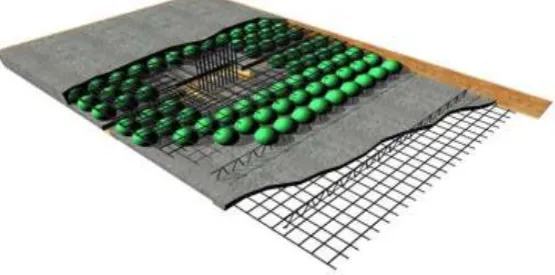
The behavior of Bubble Deck slabs is influenced by the ratio of bubble diameter to slab thickness. These bubble deck slabs have many advantages over a conventional slab. The total cost is lower, use of material is reduced, structural efficiency is enhanced, construction time is decreased and is a green technology. According to the Bubble Deck, 100 kg of concrete is replaced by 1 kg of recycled plastic. The reduction in dead load makes the long-term response more economical for the building while offsetting the slightly increased deflection of the slab. Since resistance is directly related to the depth of concrete, the shear and punching shear resistance of the bubble deck floor is significantly less than a solid deck. The typical layout of bubble deck slab is shown in figure 1.
IJEDR1704116
International Journal of Engineering Development and Research (
www.ijedr.org
)
717
II. TYPES OF BUBBLE DECK
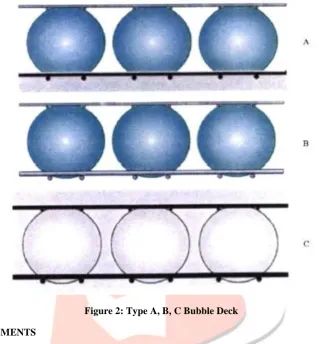
All of the Bubble Deck versions come in three forms- filigree elements, reinforcement modules, and finished planks. They are depicted in Figure 2. For all types of Bubble Deck, the maximum element size for transportation reasons is 3m.
Figure 2: Type A, B, C Bubble Deck
TYPE A – FILIGREE ELEMENTS
Bubble Deck Type A is a combination of constructed and unconstructed elements. A 60mm thick concrete layer that acts as both the formwork and part of the finished depth is precast and brought on site with the bubbles and steel reinforcement unattached. The bubbles are then supported by temporary stands on top of the precast layer and held in place by a honeycomb of interconnected steel mesh. Additional steel may be inserted according to the reinforcement requirements of the design. The full depth of the slab is reached by common concreting techniques and finished as necessary. This type of Bubble Deck is optimal for new construction projects where the designer can determine the bubble positions and steel mesh layout.
TYPE B – REINFORCEMENT MODULES
Bubble Deck Type B is a reinforcement module that consists of a pre-assembled sandwich of steel mesh and plastic bubbles, or "bubble lattice". These components are brought to the site, laid on traditional formwork, connected with any additional reinforcement, and then concreted in place by traditional methods. This category of Bubble Deck is optimal for construction areas with tight spaces since these modules can be stacked on top of one another for storage until needed.
TYPE C – FINISHED PLANKS
Bubble Deck Type C is a shop-fabricated module that includes the plastic spheres, reinforcement mesh and concrete in its finished form. The module is manufactured to the final depth in the form of a plank and is delivered on site. Unlike Type A and B, it is a one-way spanning design that requires the use of support beams or load bearing walls. This class of Bubble Deck is best for shorter spans and limited construction schedules.
III. INSTALLATIONS
IJEDR1704116
International Journal of Engineering Development and Research (
www.ijedr.org
)
718
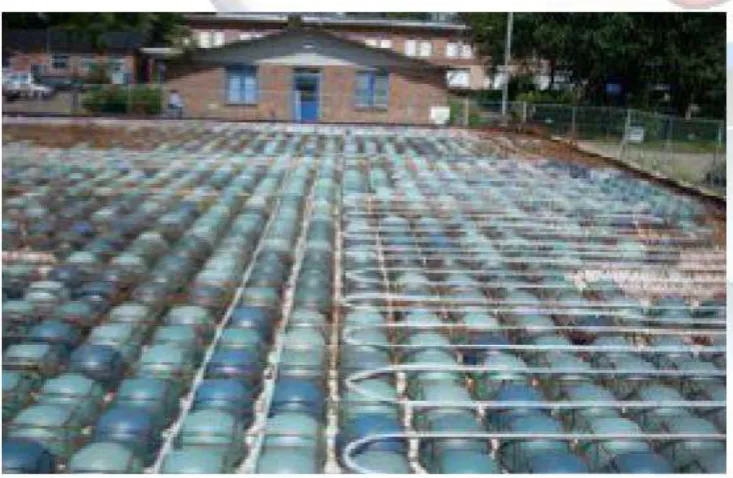
Figure 3: Installation of cooling or heating system
IV.EXPERIMENTAL DETAILS AND TEST SETUP
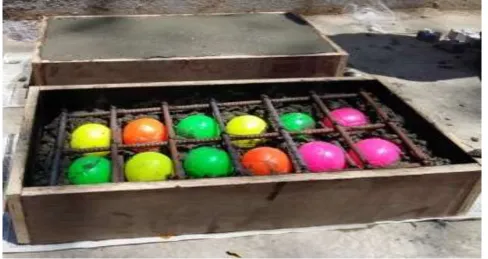
Bubble Deck is composed of three main materials - steel, plastic spheres and concrete. The steel is fabricated in two forms - meshed layers for lateral support and diagonal girders for vertical support of the bubbles. The hollow spheres are made from recycled high-density polypropylene. 60mm and 75mm diameter balls are used in bubble deck slab. Balls are arranged at a spacing of 20 mm and 30 mm. The concrete is made of Ordinary Portland cement with a maximum aggregate size of 3/4 in. No plasticizers are necessary for the concrete mixture. The arrangement of hollow spherical balls is shown in figure 4 and 5.
IJEDR1704116
International Journal of Engineering Development and Research (
www.ijedr.org
)
719
Figure 5: 75 mm diameter ball arranged at 20 mm spacing in a slab of size 600mm*300mm*100mm
Grade of cement is OPC 53. Grade of concrete is M30. Specific gravity of cement, fine aggregate and coarse aggregate is 3.15, 2.65 and 2.7 respectively. Size of coarse aggregate is 10mm. Bubble Deck slab is tested in Universal Testing Machine (UTM) as shown in Figure 6. In this experiment, two point loading principle is carried out as shown in Figure 7.
IJEDR1704116
International Journal of Engineering Development and Research (
www.ijedr.org
)
720
V.RESULTS AND DISCUSSIONS
Flexural strength of the slab is found out by the formula, F = pl/bd2 (N/mm2)
p = maximum load (kg) l = Supported length (mm) b = width of specimen (mm) d = failure point depth (mm)
Ultimate load and flexural strength of bubble deck slab for the size 600mm*300mm*125mm is given in Table 1. The diameter of the hollow spherical ball used is 75 mm. The ratio of bubble diameter to slab thickness is 0.6. Number of plastic spheres used in 20mm and 30mm spacing specimen is 12 and 10 respectively. Flexure crack is observed in all the six specimens irrespective of the change in spacing of the balls.
Table 1 – Flexural strength for 125mm depth of slab and ball diameter 75mm
Sl. No Name of the specimen Spacing between balls (mm) Ultimate load (kg) Flexural strength (N/mm2)
1 BD 1 20 6420 8.06
2 BD 2 20 6340 7.96
3 BD 3 20 6580 8.26
4 BD 4 30 7120 8.94
5 BD 5 30 6900 8.66
6 BD 6 30 6840 8.58
Ultimate load and flexural strength of bubble deck slab for the size 600mm*300mm*100mm is given in Table 2. The diameter of the hollow spherical ball used is 60 mm. The ratio of bubble diameter to slab thickness is 0.6. Number of plastic spheres used in 20mm and 30mm spacing specimen is 21 and 18 respectively. Shear crack is observed in all the six specimens irrespective of the change in spacing of the balls.
Table 2 – Flexural strength for 100mm depth of slab and ball diameter 60mm
Sl. No Name of the specimen Spacing between balls (mm) Ultimate load (kg) Flexural strength (N/mm2)
1 BD 7 20 4180 8.2
2 BD 8 20 4120 8.08
3 BD 9 20 4280 8.39
4 BD 10 30 4320 8.47
5 BD 11 30 4880 9.57
6 BD 12 30 4560 8.94
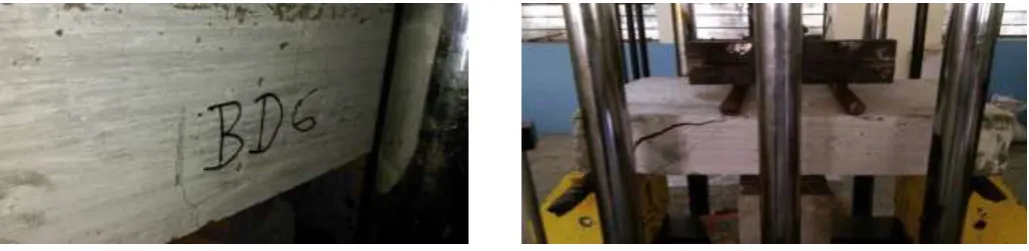
Crack pattern observed in bubble deck specimen is shown in the figure 8 and 9.
IJEDR1704116
International Journal of Engineering Development and Research (
www.ijedr.org
)
721
From this experiment, it is observed that for the bubble deck slab of thickness 125mm, the average flexural strength of the slab is 8.09 N/mm2 and 8.72 N/mm2 for specimens in which the spacing between the balls is 20mm and 30 mm respectively.For the bubble deck slab of thickness 100 mm, the average flexural strength of the slab is 8.22 N/mm2 and 8.99 N/mm2 for
specimens in which the spacing between the balls is 20mm and 30mm respectively.
VI.CONCLUSIONS
• From this study, it is understood that when the spacing between the balls increases, the flexural strength of the slab increases irrespective of change in the thickness of the slab.
• It is also observed that the flexural strength of the slab in 60mm ball diameter is higher than the flexural strength of slab in 75mm ball diameter for both 20mm and 30mm spacing of the balls.
• It is finally concluded that the optimum diameter of the hollow spherical balls that can be used in bubble deck slab for normal purposes is 60mm and the optimum spacing between the balls can be 30mm.
• There is a 35 – 50 % reduction in use of concrete which leads to reduction in self weight of slab with same flexural strength of the slab compared to the conventional slab.
• Due to the voids in the slab it has excellent thermal insulation property. Lower total cost, decreased construction time and green technology compared to conventional slab.
ACKNOWLEDGEMENT
We wish to express our sincere thanks & gratitude to our parents, teachers & all people who have helped us directly or indirectly for the completion of this project work.
REFERENCES
[1] Hai.L.V, Hung.V.D, Thi.T.M, Nguyen-thoi.T and Phuoc.N.T, “The experimental analysis of bubble deck slab using modified elliptical balls”, Hokkaido University.
[2] Sergiu Calin, Roxana Gintu and Gabriela Dascalu, “The summary of tests and studies done abroad on the bubble deck system”.
[3] Prabhu Teja. P, Vijay Kumar. P, Anusha. S, Mounika. C.H, Purna chandra Saha, “Structural behavior of bubble deck slab”, IEEE-International Conference On Advances In Engineering, Science And Management (ICAESM -2012) March 30, 31, 2012. [4] Terec.I.R, Terec.M.A, “The bubble deck floor system”.
[5] Vaignan.B, Dr.Prasad.B.S.R.K, “Analysis of voided deck slab and cellular deck slab using midas civil”.
[6] Harishma.K.R, Reshmi.K.N, ‘A study on bubble deck slab”, International Journal of Advanced Research Trends in Engineering and Technology (IJARTET) Vol. II, Special Issue X, March 2015.
[7] Subramanian. K and Bhuvaneshwari. P, “Finite Element Analysis of Voided Slab with High Density Polypropylene Void Formers”, International Journal of ChemTech Research Vol.8, No.2, pp 746-753.
[8] Amer M. Ibrahim, Nazark Ali , Wissam D. salman, “Flexural capacities of Reinforced Concrete Two-way Bubble deck slabs of Plastic Spherical Voids”, Vol. 06, No. 02, pp. 9-20.
[9] Aratishetkar and Nageshhan cheb, “An experimental study on bubble deck slab system with elliptical balls”.