142 | P a g e
COMPARATIVE ANALYSIS OF MODERN
OPTIMIZATION TECHNIQUES TO REDUCE
OVERALL GENERATION COST FOR THERMAL
GENERATING SYSTEMS
Ram Kumar Denjare¹, Amit Goswami²
¹M.TECH. (Electrical devices & power system) Research Scholar, ²Assistant professor
Department of Electrical and Electronics Engineering,
Disha Institute of Management and Technology Raipur Chhattisgarh, (India)
ABSTRACT
This paper presents the analysis of modern optimization algorithms to solve Economic Load Dispatch (ELD)
problem in thermal generating system. The optimization of systems and processes is very important to the
efficiency and economics of many science and engineering domains. Optimization problems are solved by using
rigorous or approximate mathematical search techniques The primary objectives of this paper is to develop
flexible and extensible computational framework as MATLAB environment for implementing the various
algorithms such as ABC ,IABC and SFL to solve economic load dispatch problem and analysis the Performance
of various optimization algorithms on the basis of power generation(MW),computational time(sec) ,minimum
generation cost(INR) and power loss(MW).
Keywords
: -Economic load dispatch, Optimization, Artificial Bee Colony Algorithm, Interactive
Artificial Bee Colony Algorithm, Shuffled Frog Leaping Algorithm
I.
INTRODUCTION
The economic load dispatch plays an important role in the operation of power system, and several models by
using different techniques have been used to solve these problems. Several traditional approaches, like
lambda-iteration and gradient method are utilized to find out the optimal solution of non-linear problem More recently,
the soft computing techniques have received more attention and were used in a number of successful and
practical applications. The purpose of this work is to find out the advantages of application of the evolutionary
computing technique. In this work, data has been taken from the published work in which loss coefficients are
also given with the max-min power limit and cost function. All the techniques are implemented in MATLAB
environment. This formulates the economic load dispatch (ELD) problem for finding the optimal combination of
the output power of all the online generating units that minimizes the total fuel cost, while satisfying an equality
constraint and a set of inequality constraints[1,2].
1.1
Thermal Power Plant
A thermal power plant is a plant wherein prime-mover is propelled by steam. Water is the main working fluid.
143 | P a g e
shaft of the generator. Then it passes by the turbine into the condenser and then pushed to feed the boiler whereit again heated up[3].
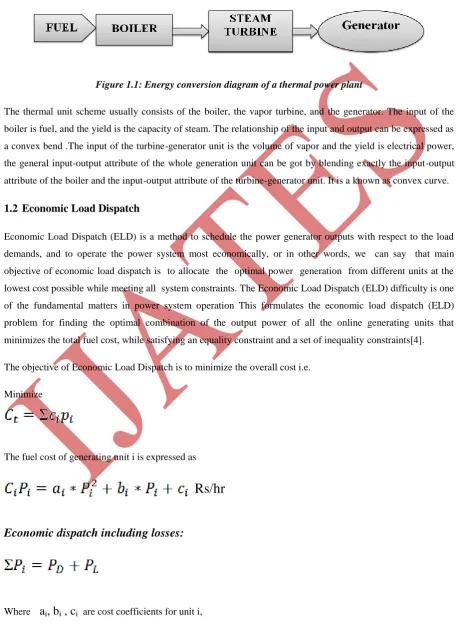
For generalization, thermal power plants can be considered as a transfer function of energy from
Figure 1.1: Energy conversion diagram of a thermal power plant
The thermal unit scheme usually consists of the boiler, the vapor turbine, and the generator. The input of the
boiler is fuel, and the yield is the capacity of steam. The relationship of the input and output can be expressed as
a convex bend .The input of the turbine-generator unit is the volume of vapor and the yield is electrical power,
the general input-output attribute of the whole generation unit can be got by blending exactly the input-output
attribute of the boiler and the input-output attribute of the turbine-generator unit. It is a known as convex curve.
1.2
Economic Load Dispatch
Economic Load Dispatch (ELD) is a method to schedule the power generator outputs with respect to the load
demands, and to operate the power system most economically, or in other words, we can say that main
objective of economic load dispatch is to allocate the optimal power generation from different units at the
lowest cost possible while meeting all system constraints. The Economic Load Dispatch (ELD) difficulty is one
of the fundamental matters in power system operation This formulates the economic load dispatch (ELD)
problem for finding the optimal combination of the output power of all the online generating units that
minimizes the total fuel cost, while satisfying an equality constraint and a set of inequality constraints[4].
The objective of Economic Load Dispatch is to minimize the overall cost i.e.
Minimize
The fuel cost of generating unit i is expressed as
Rs/hr
Economic dispatch including losses:
144 | P a g e
C
t= total cost of generationPi = power generation of ith unit plant
is the power demand
is the power loss
II.
PROPOSED METHODOLOGY
2.1
Optimization Algorithms
The proposed works are described here firstly analysis the all previous approaches in the field of economic load
dispatch then we have formulated the economic load dispatch including losses using MATLAB environment,
create a 3 generator and 6 generator problem and implemented the three optimization techniques such as
Artificial Bee Colony, Interactive Artificial Bee colony and Shuffled Frog Leaping Algorithms and find out the
result then analysis and compare this optimized result on the basis of power generation, minimum generation
cost ,power losses and computational time[5,6].
2.1.1
Artificial Bee Colony
The ABC algorithm is a swarm based, meta-heuristic method based on the model first proposed by [30] on the
foraging behavior of honey bee colonies. The model is composed of three important elements: employed and
unemployed foragers, and food The model is composed of three important elements sources. The employed and
unemployed foragers are the first two elements, while the third element is the rich food sources close to their
hive[7,8]..
The model is composed of three important elements
food sources:--its proximity to the nest it shows the concentration of energy, the position of a food source
signifies the position of a promising solution to the optimization problem, whereas the value of nectar of a food
source represents the fitness cost (quality) of the associated solution.
Employedforagers: (50%):
In ABC system, artificial bees fly around in a multidimensional search space and the employed bees choose
food sources depending on the experience of themselves.
Unemployed bees:
The onlooker bees (50%):- . It gets the information of food sources from the employed bees in the
hive and select one of the food source to gathers the nectar.
Scout bees (5-10%):- It is responsible for finding new food sources. Scout bees fly and choose the
145 | P a g e
solution to the problem under consideration. The nectar amount of the food source represents thequality or fitness of the solution.
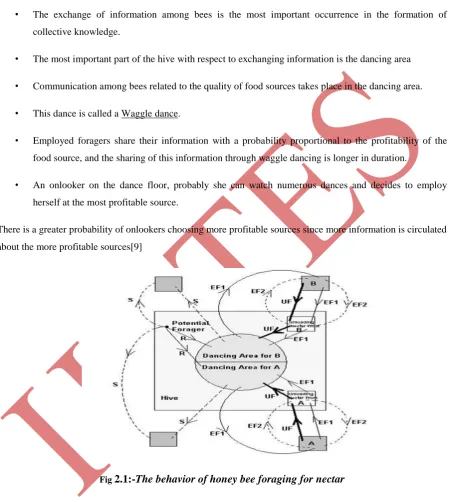
Exchange of Information among bees
• The exchange of information among bees is the most important occurrence in the formation of
collective knowledge.
• The most important part of the hive with respect to exchanging information is the dancing area
• Communication among bees related to the quality of food sources takes place in the dancing area.
• This dance is called a Waggle dance.
• Employed foragers share their information with a probability proportional to the profitability of the
food source, and the sharing of this information through waggle dancing is longer in duration.
• An onlooker on the dance floor, probably she can watch numerous dances and decides to employ
herself at the most profitable source.
There is a greater probability of onlookers choosing more profitable sources since more information is circulated
about the more profitable sources[9]
Fig
2.1:-
The behavior of honey bee foraging for nectar
2.1.2
Interactive Artificial Bee Colony
In this research, a multi-objective Interactive Artificial Bee Colony (IABC) is proposed to solve the economic
power dispatch problem. This newly technique makes ABC technique, more flexible and powerful
.
In general,the ABC algorithm works well on finding the better solution of the object function. However, the original design
of the onlooker bee’s movement only considers the relation between the employed bee, which is selected by the
146 | P a g e
Therefore, it is not strong enough to maximize the exploitation capacity. The Interactive Artificial Bee Colonyalgorithm is proposed based on the structure of ABC algorithm. By using the Newtonian law of universal
gravitation [32] described in the equation (2.1), the universal gravitations between the onlooker bee and the
selected employed bees are exploited[17,18].
(2.1)
In the equation (2.1), denotes the gravitational force heads from the object 1 tothe object 2, 𝐺 is the
universal gravitational constant, and are the masses of theobjects, represents the separation between
the objects, and denotes the unit vectorin the equation (2.2).
(2.2)
The process of the IABC can be defined in 5 steps:
Step 1. Initialization: Spray percentage of the populations into the solution spacerandomly, and then
calculate their fitness values, which are namedas the nectar amounts, where 𝑛𝑒characterizes the ratio of
employed bees to the total population. Once these populations are positioned into the solution space, they are
named as the employed bees.
Step 2. Move the Onlookers: Calculate the probability of selecting a food, select a food source to move to by
roulette wheel selection for every onlooker bees and then determine the nectar amounts of them.
Step 3. Move the Scouts: If the fitness values of the employed bees do not be improved by a continuous
predetermined number of iterations, which is called ”𝐿𝑖𝑚𝑖𝑡”,those food sources are abandoned and these bees
(employed) become the scouts. Then the scouts move.
Step 4. Update the Best Food Source Found So Far: Remember the best fitness value and the position, which
are determined by the bees.
Step 5. Termination Checking: Ascertain if the amount of the iterations fulfills the termination status. If the
termination condition is persuaded, terminate the program and output the results; else proceed back to the Step
2.
2.1.3
Shuffled Frog Leaping Algorithm
Shuffled Frog Leaping Algorithm (SFLA) is a heuristic search algorithm presented for the first time by Yusuf
and Lanes in 2003. The main purpose of this algorithm is achieving a method to solve complicated optimization
problems without any use of traditional mathematical optimization tools. the SFL algorithm is combination of
147 | P a g e
algorithm has been inspired from mimetic evolution of a group of frogs when seeking for food. In thistechnique, a solution to a given problem is presented in the form of a string, called “frog” which has been
considered as a control vector[19,20].
Procedure Of Shuffled Frog Leaping Algorithm
Step1: Generate Initial Population
An initial population of P frogs are created randomly for an S-dimensional problem. A frog i is represented by S
variables,
Step 2: Evaluate the fitness
Calculate fitness value of each frog according to the given problem. Then Record the best frog position in the
entire population.
Step 3: Sorting
The frogs are arranged in a descending order according to their fitness.
Step 4: Partition into memeplexes
the P frogs are partitioned into m memeplexes, each containing n frogs
(P = m × n).
In this procedure, the first frog moves to the first memeplex, the second frog moves to the second memeplex
and the mth frog moves to the mth memeplex, then (m + 1)th frog goes back to the first memeplex and so on.
Step 5: Memeplex Evolution
In each memeplex, the frogs with the best and the worst fitness are determined and named as Xb and Xw,
respectively. Also, the position of frog with the global best fitness among the memeplexes is identified as Xg
Step 6: Shuffling
After a defined number of memeplex evolution steps, all frogs of memeplexes are collected, and sorted in
descending order based on their fitness. Step 5 divides frogs into different memeplexes again and then step 6 is
performed.
Step 7: Check Terminal Condition
If the defined convergence criteria are satisfied or the output does not change for a specific number of iterations,
the program will be terminated and the results will be printed, and the rest of the program goes to Step 4
III.
RESULD AND DISCUSSION
In this section, the results of ELD after the implementation of proposed ABC,IABC and SFL methods
148 | P a g e
method in MATLAB R2009b. The main objective is to minimize the cost of generation of plants usingvarious optimization algorithms. We have used Artificial Bee Colony Algorithm, Interactive Artificial Bee
Colony Algorithm and Shuffled Frog Leaping Algorithm for resolving ELD problem. The performance is
evaluated with considering losses using 3 generator and 6 generator systems which are discussed below:-
CASE STUDY 1:-ECONOMIC LOAD DISPATCH FOR 3 UNIT THERMAL GENERATING SYSTEM
In this case study the loss coefficients, fuel cost and maximum and minimum power limits are given below.
The power demand is considered to be 585 (MW). The results corresponding to ABC,IABC and SFLA are
detailed in below.
COST CHARECTERESTICS
149 | P a g e
CASE STUDY 2:-ECONOMIC LOAD DISPATCH FOR 6 UNIT THERMAL GENERATING SYSTEMIn this case study the loss coefficients, fuel cost and maximum and minimum power limits are given below.
The power demand is considered to be 700 (MW). The results corresponding to ABC,IABC and SFLA are
detailed in below.
COST CHARECTERESTICS
Loss Coefficient matrix
150 | P a g e
CONCLUSION:
In this paper, the formulation and implementation of solution methods to obtain the optimum
solution of Economic Load Dispatch problem using soft computing techniques such as, ABC, IABC, SFLA
based economic were comparatively investigated for 3 unit and 6 unit thermal generating system. The results
obtained were satisfactory for all approaches but it was shown that the ABC performed better as compared to
other procedures for the minimum generation cost viewpoints. ABC shows less power loss as compared to
IABC and SFLA but IABC takes minimum computational time. Results will be in terms of the best optimized
solution, Computational time, Better convergence towards the solution etc. Study will be helpful to develop the
software for real time economic load dispatch problems
FUTURE SCOPE:-A future recommendation can be made for above proposed methods to solve ELD problems
as the use of new efficient operators to control and enhance the efficiency of instantaneous population for better
and fast convergence. Here it can be suggested that better result can be obtained by improving the fitness
function and penalty factor used in the above programming. Direction of research work can still be developed
by improving methodologies used for parent selection and fitness function. Further, the optimization result can
also be improved by using hybrid artificial intelligence technique. Hydro –thermal-nuclear power scheduling
can also be improved
REFRENCES
[1] Simon, Dec.2008. “Biogeography- Based Optimization”, IEEE transactions on Evolutionary computation, vol. 12, No. 6, pp. 702-713
[2]. Shahryar Rahnamayan, H.R. Tizhoosh, M.M.A.Salama. "Opposition based differential evolution." IEEE Congress on evolutionary computation, 2010 – 2017, 2006.
[3]. Chattopadhyay, A. Bhattacharya and P. K."Biogeography-based optimization for different economic load dispatch problems." IEEE Trans.Power Syst. vol. 25, no. 2, 1064 – 1077, May 2010
[4] K.J. Vishnu Sudhan, R.S. sraavana Kumar & A. Rathina Grace monica,” Economic load dispatch problem based biogeography algorithm”, undergraduate academic research journal (UARJ) , ISSN ,vol 1, issue 1 ,1129-2278. ,2012
[5]N.Sinha,R.Chakrabarti,andP.K.Chattopadhyay,”Evolutionary programming technicques for economic load dispatch.”IEEETrans.Evol.Comput.,vol.7,no.1,pp.83-94,Feb.2003
[6] B. N. S. Rahimullah, E.I. Ramlan and T.K.A. Rahman, “Evolutionary Approach for Solving Economic Dispatch in Power System”, In National Power Engineering Conference, vol.1, pp. 32 – 36, Dec 2003
[7] Balwant kumar, Dr. Dharmender kumar,” A Review on artificial bee colony algorithm”,
[8] D. Karaboga and B. Akay. “Artificial bee colony algorithm on training artificial neural networks”, In Signal Processing and Communications Applications, 2007. SIU 2007. IEEE 15th, pages 1–4. IEEE, 2007.
[9] Surekha P, S. Sumanthi,”solving economic load dispatch problems using differential evolution with opposition based learning”, WSEAS transaction on information science and application ,EISSN 2224-3402, vol 9 ,issue 1, January 2012
[10] Surekha P, S. Sumanthi , “An Improved differential evolution algorithm for optimal load dispatch in power system including transmission losses” ,IU JEEE, vol 11(2),1379-1390 , 2011
151 | P a g e
[12] Ganga Reddy Tankasala, “Artificial Bee Colony Optimisation for Economic Load Dispatch of a Modern Power system”, International Journal of Scientific & Engineering Research, Volume 3, Issue 1, January-2012[13]. Basturk B, Karaboga D (2006) An artificial bee colony (ABC) algorithm for numeric function optimization. IEEE Swarm Intelligence Symposium, 12–14 May ,Indianapolis
[14] Ali Hadidi, Sina Kazemzadeh Azad , Saeid Kazemzadeh Azad, “Structural optimization using Artificial Bee Colony Algorithm “, 2nd international conference on engineering optimization, vol 6-9, 2010.
[15]. Basturk B, Karaboga D (2006) An artificial bee colony (ABC) algorithm for numeric function optimization. IEEE Swarm Intelligence Symposium, 12–14 May ,Indianapolis
[16] Manish Gupta , Govind Sharma,” An Efficient Modified Artificial Bee Colony Algorithm For job Scheduling problem”, IJSCE, vol. 1,issue 6 ,ISSN 2231-2307, 2012.
[17] O. Abedinaa , D. Garmarodi , R. Rahbar , F. Javdzadeh ,” Economic Dispatch using Interactive Artificial Bee Colony Algorithm” , journal of basic and applied scientific research, ISSN 2090-4304, Vol 2(11), pp 11272-11281 , 2012
[18]. Mouti FSA, Hawary MEE (2009) Modified artificial bee colony algorithm for optimal distributed generation sizing and allocation in distribution systems. IEEE Electr Power and Energy Conf (EPEC), Montreal, pp 1–9
[19] H. Chahkandi Nejad , R. Jahani,Gh. R. Sarlak,”Applying Shuffled Frog Leaping Algorithm for EconomicLoad Dispatch of Power SystemAmerican Journal of Scientific ResearchISSN 1450-223X Issue 20(2011), pp.82-89.
[20] H. Vennila “A Modified Shuffled Frog Leaping Algorithm for Solving Combined Economic and Emission Dispatch Problems.European Journal of Scientific Research ISSN 1450-216X Vol. 85 No 2 September, 2012, pp. 262 – 270