4280
Learning Trajectory Student To Solve Problem
Based On Manipulatives
Nia Wahyu Damayanti, Purwanto, I Nengah Parta, Tjang Daniel Chandra, Putri Mega Lea Loupatty
Abstract: Learning trajectory helps teachers to design learning. Trajectory study illustrated the flow of students in problem-solving. A model of problem-solving can be solved with manipulative media. The goal of the research is to describe the learning trajectory of students in solving the question of the type of problem solving-based manipulatives media. Manipulatives used in the study was a matchstick. The methods used in this research was descriptive qualitative. The subject of research is the student class VIIIB as much as 5 group. On the research of students was given a reserved type of problem-solving that was formed of five square, then the students solve the problem with the help of manipulative media. The results showed students solved the problem began with understanding the case (understand the problem), then the students moved and arranged it (moving), students counted many displacements of matchsticks (count the moving), then the students form a match that has been compiled into a square that was instructed in the matter of (forming). Later in the final stages of students examined whether a solution has been made right (look back). The conclusion of the research is in resolving the question of the type of manipulative media-based problem solving, and there are stages of understanding the problem, moving, count the moving, forming and look back.
Index Terms: Learning Trajectory, Problem Solving, Manipulatives.
—————————— ——————————
1
INTRODUCTION
In understanding mathematics, the learning process and the level of thinking are things that need to be considered by the teacher (Clement and Sarama, 2004). Students followed developments in learning mathematics ranging from subject matter to more challenging material. When teachers understood these developments, teachers could develop learning environments that were mathematically as specific as they are useful and effective in student development (Clement and Sarama, 2009). The teacher must have a picture of the trajectory that the students traversed to achieve the expected learning goals (Harini, 2016). They were learning mathematics, required educators who could recognize mathematics and their students. Mathematics teachers must be able to prepare and support learning by planning an education (White et al., 2016). Lesson planning was a crucial component that lay within the construction of the learning trajectory, and this construction occupied in the context in which the mathematics teaching cycle is enforced (Amador and Lamberg, 2015). Learning success can also be achieved by the collaboration between the teacher and students. When the teacher refers to the learning trajectory, the teacher looked at learning representations that explain how students might be involved with assignments, reflect on tasks, and developed knowledge through work on those assignments. The way they did tasks, each other is different but has a goal that is the same results in learning. It means learning could develop. When the teacher refers to the development of learning, the teacher focuses on the representation of learning that relies on predetermined benchmarks for student achievement in class (Weber et al., 2015).
The term Learning Trajectory (LT) was first applied in the process of learning mathematics by Simon (1995). We could think of the learning trajectory as a travel route. Suppose we are going to the beach, the destination is the same towards the beach, but we can pass a different path. We could choose the best way, depending on our thinking. When we understood the route to be taken, we could solve the problems we face.
Figure 1. Ilustration For Learning Trajectory
The importance of learning trajectories in learning mathematics was to provide instructions for teachers to determine and formulate learning goals to be achieved and enable teachers to build mathematics and students' thinking so that they developed naturally. Mathematics teacher is required to understand and develop a teaching strategy in the classroom to achieve a learning goal (Damayanti, 2015) So, all goals and activities are within the capacity of student development. Each level gives the result of natural development to the next level. Finally, we recognize that previous activities provide students with mathematical development for their success in school (Clement and Sarama, 2009). Learning trajectory described the sequence of learning that must be taken and the concepts related to the material being studied so that students can learn completely. In general, the development of students' abilities starts with general things and gradually goes to abstract ideas. For each student, the learning path was different. Because there were students who are quick to understand, and some are slow. Therefore the stages that were passed are also different. Thus each student needs a different learning trajectory; of course, this will be influenced by their environment (Prayitno, 2017). Learning Trajectory has three essential parts according to ___________________________________
. Nia Wahyu Damayanti is doctoral student in Mathematics Education, Universitas Negeri Malang and lecturer in Universitas Wisnuwardhana, Indonesia. Email: [email protected],id
2. Purwanto is a lecturer in major Mathematics Education Universitas Negeri Malang, Indonesia
3. I Nengah Parta is a lecturer in major Mathematics Education Universitas Negeri Malang
4. Tjang Daniel Chandra is a lecturer in major Mathematics Education Universitas Negeri Malang, Indonesia
4281 Clements and Sarama (2009):
1. Goals: The Big Ideas of Mathematics
Learning objectives are the first part of the learning trajectory. The purpose of learning is the big ideas of mathematics, namely grouping concepts, skills that are mathematically the main thing and are interconnected, consistent with students' thinking and useful in subsequent learning.
2. Development Progressions: The Paths of Learning The second part of the learning trajectory is the level of thinking. Ranging from easy to challenging levels. That is, developments describe the typical path of students in following and developing students' understanding and skills about mathematical topics. When the teacher interacts with students, students' thinking might be different from the teacher. Instead, the teacher can know what students are doing and thinking and consider assignments that are appropriate to the student's level of thinking and try to see from the student's perspective.
3. Instructional Tasks: The Paths of Teaching
A set of assignments that are appropriate to the level of thinking and development of students is the third part of the learning trajectory. The task is designed to help students learn the ideas and skills needed to reach a level of thought. That is, as a teacher, teachers can use assignments to see students' abilities from one level to the next.
2
METHODS
The main focus of this research was mathematics learning trajectory that was made by the student. This type of research was a qualitative descriptive study that aimed to examine student learning trajectory in solving mathematical problems. The location in this study was in the university. The subjects of the study were the third-semester students in the mathematics education major. The subject completed the questions that were given, then the researchers recorded and took pictures of the work of students and conducted interviews to find out the student's learning trajectory. Data collection was carried out using tests, interviews and documentation methods. The interview method is conducted to explore information related to the subject's learning trajectory in understanding the problem and how the subject was thinking about planning in solving the problem. Documentation is done to describe the reciprocal relationship between researchers and subjects during the research process. The instruments used were questions and match sticks and tools for taking pictures. Data obtained from the work of the subject will illustrate how the subject carries out the planning that has been thought and how the subject reflects the results that have been obtained. Things that are considered unclear on the results of the subject's work can be asked during interviews. It is intended to find out complete information related to student learning trajectories. Data analysis was performed based on qualitative data analysis procedures, namely: (1) data reduction, (2) data presentation, (3) concluding. Data analysis begins with the process of selecting, centralizing, classifying, directing data in an irrelevant field that can be reflected, verified and made appropriate conclusions according to the focus of the study. The second step is to present data so that it is easier to understand and draw conclusions. Raising findings is the final step in the analysis of qualitative research data. This
conclusion is intended to describe the results of the study of the learning trajectory in solving mathematical problems.
3 RESULTS
AND
DISCUSSION
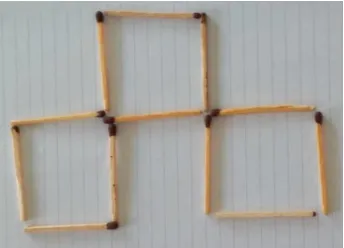
The third semester students of Wisnuwardhana University Malang were divided into 5 groups and given problem solving questions. The problem showed that there are twelve matchsticks arranged to form three square shapes. Students were instructed to form five square shapes by simply moving three matchsticks, as shown in the following question.
The figure below showed twelve toothpicks arranged to form three squares. How can you form five squares by moving only three toothpicks?
Figure 2. Ilustration For The Problem
Students began to arrange the 12 matchsticks by forming three squares and adjusting the picture to the given problem. The students' initial work was shown when arranging match sticks according to the questions.
Figure 3. Student arranged the matchstick based on given
problem
The following are the results of each student's work. Subject 1
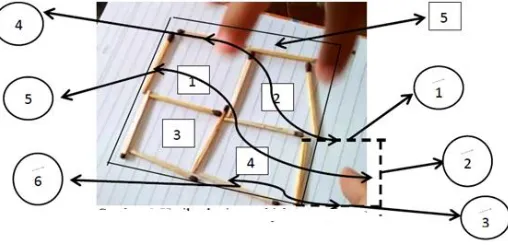
4282 Subject 1 moved four matchsticks, match number 2 was
moved to number 1, match number 4 was moved to number 3, match number 5 was moved to number 6, and match number 7 was moved to number 8. Subject submitted have found five square shapes, but after researchers looked like in picture 4, the shapes made were not square shapes. Then subject 1 repeats the match.
Figure 4. The Work Result Subject 1
In the first try subject 1 moved eight matchsticks, matchstick number 1 was moved to number 3, matchstick number 2 was moved to number 14, matchstick number 4 was moved to number 6, matchstick number 5 was moved to number 8 , matchstick No. 7 was moved to number. 9, matchstick number. 16 was moved to number. 13, matchstick number. 15 was moved to number. 11, matchstick number 12 was moved to number. 10 and formed a triangle shape. In picture 5 it is totally incompatible with what was ordered in the problem, then subject 1 tried again only to move three matchsticks and form five squares.
Figure 5. The Work Result Subject 1
Subjects moved three matchsticks, matchstick number 1 was moved to number 4, matchstick number 2 was moved to number 5 and matchstick number 3 was moved to No. 6 and showed the researchers that in Figure 4 there were only four square shapes. Subject 1 is still confused in determining the number of squares. For this reason, researchers conducted interviews. The results of the researchers' interview with subject 1 are as followed
R: "Have you moved three matchsticks?"
S1: "already" (showing the three matchsticks again already moved).
R: " what shape has been formed?"
S1: "square, but only four squares have been formed?" R: "When asked how many squares were you asked to do?"
S1: "five square, while our work is only four so one is lacking square."
R: "Was it really really only four square?" S1: "Yes, there were only four squares." R: "Try to look back at the results of your work!"
Subject 1 reexamined the results of their work, then one of the group members began to understand
S1: "Apparently there were five squares, one square was a large square, Around the square. "
All members of subject group 1 began to understand the results of their work. They managed to find five square shapes by only moving three matchsticks.
Subject 2
Figure 6. The Work Result Subject 2
Subject 2 moved six matchsticks, matchstick number 1 was moved to number 5, matchstick number 4 was moved to number 3, matchstick number 6 was moved to number 7, matchstick number 8 was moved to number 11, matchstick number 9 was moved to number 10, matchstick number 12 is moved to number 2 and conveyed that it has found five squares as in figure 7. However, the image formed is not a square. Therefore subject 3 must repeat the experiment that they did.
Figure 4. The Work Result Subject 2
4283 matchstick number 15 was moved to number 16 and formed a
star, nothing at all made square. In the problem-solving that has been given above, subject 2 was the only group that could not make five square shapes by only moving three matchsticks. In the experiments they have done, they moved the matchstick and got a star shape. Based on the results of the activities above the researchers, the path of the learning trajectory of students in solving problems based on manipulative media-based problem solving formed with the adaptation of Polya's problem-solving theory was as follows.
Diagram 1. Learning Trajectory Formed by Students
The description of each stage in the diagram above is as follows.
1. Understand the Problem
In this phase, students understand the problem given. Students read over and over, then began to arrange manipulative media in the form of matchsticks as requested in the problem.
2. Moving Matches
After students arrange matchsticks according to what was asked in the problem, students start messing about by moving the matchsticks one by one. Students try to arrange matchsticks to form a square.
3. Count the Moving
Students count the many matches that have been moved. According to the instructions in the problem, students can only move three matchsticks to form five squares where previously there were only three squares
4. Forming
After finishing counting the many matchsticks that were moved, students formed them into squares.
5. Look Back
At this stage, students re-examine the arrangement of matchsticks. Students check whether the arrangement of matchsticks that have been formed are in accordance with the instructions in the problem. If it is appropriate, it means students have been able to solve the problem, and the problem-solving process is complete. However, if at this stage, students feel there are still things that are not by the instructions requested in the problem, then students return to the stage of understanding the problem. then upper case Arabic numerals, separated by periods. Initial paragraphs after the section title are not indented. Only the initial, introductory paragraph has a drop cap.
4 CONCLUSION
The learning trajectory was used by the teacher to determine and formulate learning goals. Each student has a different learning trajectory in solving problems. With problem-solving learning, students were expected to understand the material that has been taught in mathematics education. So students solved the problems encountered. To help solve the problem using manipulatives in the form of matchsticks. Students showed the stages in solving the problem began to understand the problem (understand the problem). Students began to move and arrange with the matchstick (moving), students counted the many movements of matchsticks (count the moving), then students formed a match that has been arranged into a square which was instructed in the problem (forming). Later in the final stage, students checked whether the solution had been made right (look back).
5
REFERENCES
[1] Amador, Julie., Lamberg, Teruni., 2015, Mathematical Thinking and Learning: Learning Trajectories, Lesson Planning, Affordances, and Constraints in the Design and Enactment of Mathematics Teaching. UK: Routledge.
[2] Clements, D., and Sarama, J., 2004, Learning Trajectories in Mathematics Education. Mathematical Thinking And Learning, 6(2), 81–89.
[3] Clements, D., and Sarama, J., 2009, Learning and Teaching Early Math: The Learning Trajectories Approach. New York: Routledge.
[4] Damayanti, Nia Wahyu, et al,, 2015, Analisis Kesalahan Siswa Dalam Pemahaman Konsep Operasi Hitung Pada Pecahan, Jurnal Edutic
[5] Daro, P., et.al ., 2011, Learning Trajectories In Mathematics: A foundation for standards, curriculum, assesment, and instruction. USA: Consortium for Policy Research in Education.
[6] Harini, Asty Ridha., 2016, Lintasan Belajar Siswa Pada Materi Jajargenjang Dengan Metode Penemuan Terbimbing Melalui Penelitian Desain. Jurnal Ilmiah Pendidikan Matematika, Vol. 3, No. 5, Pendidikan Matematika, FMIPA, Universitas Negeri Surabaya.
[7] Prayitno, Lydia Lia., Kurniawan, Agus Prasetyo., 2017, Learning Trajectory Siswa dalam Memecahkan Masalah Kelipatan Persekutuan Terkecil Ditinjau dari
Kemampuan Matematika. Jurnal Review
Pembelajaran Matematika, Vol. 2 No. 1, Universitas Islam Negeri Sunan Ampel Surabaya.
4284
Problem Solving Dalam Menyelesaikan Soal Cerita Matematika di SD Al Hikmah Surabaya. JPGSD, Vol. 06, No. 03, 363-372, PGSD, FIP, Universitas Negeri Surabaya.
[9] Wahyuni, Sri., 2014, Metode Bermain Berbantuan Media Manipulatif untuk Meningkatkan Motivasi dan Hasil Belajar Siswa SD. Jurnal Pendidikan Sains, Vol. 2, No. 2, 105-113.
[10]Weber, Eric., et.al., 2015, Mathematical Thinking and Learning: Expanding Notions of ―Learning Trajectories‖ in Mathematics Education. UK: Routledge