IJEDR1803047
International Journal of Engineering Development and Research (
www.ijedr.org
)
262
A Study On The Role Of Brand Ambassadors In
Consumer Buying Behaviour Of Soft Drink
1Dr. Soniya. K, 2Mr. Santhosh Raja R 1Associate Professor, 2Assistant Professor T. John Institute of Management and Science, Bangalore
_____________________________________________________________________________________________________
Abstract - Today ‘celebrity endorsement has fascinated enormous debate on whether it really contributes to the brand building process or whether it is just another lazy tool to make the brand more visible in the mind of consumers. Although it has been observed that the presence of a well-known personality helps in solving the problem of over communication that is becoming more prominent these days, there are few undesirable impacts of this practice on the brand. Firms invest huge amounts as advertising expenditure for hiring the right celebrity. Consumers perceive the brand as having superior quality because it has been endorsed by a credible source. The present paper tries to look behind the obvious benefits that whether the consumers buy the soft drinks just because it is endorsed by their favourite and well known personality or it is just needy that they have to buy the product or its just situation. And researcher has selected 300 respondents as a sample in Calicut city and all respondents’ falls under age between 18 to 50 years. Data have been collected from both the primary and secondary source. For the primary researcher has used questionnaire. Author has also formulated few hypotheses and used percentage analysis, correlation and arithmetic mean to find out the major findings. Finally researcher could able to found the reasons and influence of the brand ambassadors and their impact on consumers buying behaviour.
Keywords - Brand Ambassadors, Buying Behaviour, Celebrity Endorsement
_____________________________________________________________________________________________________
1. INTRODUCTION
In 21st century, the marketers are formulating and implementing different strategies in order to retain existing customers and attract new customers. To communicate about the product offerings to the customers, marketers always use unique tools and techniques when compare to their competitors. Creating very different strategy by using marketing mix is one the major challenge for the present scenario. In the modern market, without brand ambassadors it’s somewhat difficult to sell the product. For brand recall, marketers select right person for right product at right place so that the brand can maintain the stability in the competitive world. The brand ambassadors will explain the process of the usage of the product and benefits out of it and why customers have to buy this product. Most of the times brand ambassadors influence on their consumers by communicating in a effective way. And the customers perceive the brand as having very superior quality just because it has been endorsed by their favourite personality and based on this customers start that endorsement as one the indicator of the superior quality for any other brand. With the help of the both brand ambassadors and the company credibility plays a very significant role in the attitude of the consumers towards the advertisement and brand recall too. But sometime over popularity of the brand ambassadors create negative response to the brand. By involving in multiple brand endorsement it may leads to create huge confusion in the minds of the customers.
1.1 BRAND AMBASSADORS: WHO OR WHAT ARE THEY?
A Brand Ambassador, as the name suggests is an Endorser of a Brand. An ambassador is a representative of the Brand that he/she endorses. In our childhood days, when there were less number of brands we had very few brand ambassadors. For example a Lalitaj for Surf, Poonam Hillon for Bajaj Almond Hair Oil, Neelam Kothari for Dabur Amla Hair Oil, Sridevi for Lux to name a few. There would have been more but they weren’t able to leave an imprint on our minds. Most probably, it did, on our parents’ and relatives’ mindset, no wonder we always got the same products in our house.
1.2 ROLE OF BRAND AMBASSADORS
With the passage of time when the liberalization took place in the 1990s, we saw a spate of companies flowing into the country with a wide range of products for the consumer. These companies didn’t want their products to fail in the market and so they had very attractive and enticing ad campaigns. But the need for more profits and market share made them spend more and more on their advertisements. There were virtual characters for some brands (Fido for 7Up), but for some they had to rope in household names to connect with the consumer and that made the companies reach out their arms to Bollywood for influential actors and actresses (Salman Khan for Pepsi) and so on.
IJEDR1803047
International Journal of Engineering Development and Research (
www.ijedr.org
)
263
completion. Bigger the player, the harder it plays. In such situation broad identity is very strong. It takes long time to make broad famous .Coca – Cola has its beginning in 1981 & since then has been one of the three most dominate players in this soft drink industry. The first patent issued for a glass blowing machine, used to produce glass bottles.1.3 INDUSTRY PROFILE
The 50-bn-rupee soft drink industry is growing now at 6 to 7% annually. In India, Coke and Pepsi have a combined market share of around 95% directly or through franchisees. Campa Cola has a 1% share, and the rest is divided among local players. Industry watchers say, fake products also account for a good share of the balance. There are about 110 soft drink producing units (60% being owned by Indian bottlers) in the country, employing about 125,000 people. There are two distinct segments of the market, cola and non-cola drinks. The cola segment claims a share of 62%, while the non-cola segment includes soda, clear lime, cloudy lime and drinks with orange and mango flavours.
The Per Capita consumption of soft drinks in India is around 5 to 6 bottles (same as Nepal's) compared to Pakistan's 17 bottles, Sri Lanka's 21, Thailand's 73, the Philippines 173 and Mexico 605. The industry contributes over Rs 12 bn to the exchequer and exports goods worth Rs 2 bn. It also supports growth of industries like glass, refrigeration, transportation, paper and sugar. The Department of Food Processing Industries had stipulated that 'contains-no-fruit-juice' labels be pasted on returnable glass bottles. About 85% of the soft drinks are currently sold in returnable bottles. There was a floating stock of about 1000 mn bottles valued at Rs 6 bn. If the industry were to abide by the new guidelines, it would have to invest in new bottles, resulting in a cost outgo of Rs 5 bn. Neither Coke nor Pepsi is in a position to invest such a large amount.
Around 400,000 tonnes of raw material would be required to replace the existing stock of bottles. Instead, the soft drink industry suggested that a seven-year moratorium be extended to the industry so that it can incorporate the change in a phased manner. There is no such mandatory requirement anywhere in the world to specifically label the glass surface of returnable bottles. The government has decided to extend the date for replacing the bottles to end-march 2006. In the meantime, the producers have shifted substantially to the use of PET bottles.
Soft and aerated drinks were considered products for the middle class and the affluent. That segregation is no more valid. Soft and aerated drinks are consumed by all except those who cannot afford to buy any drink. An NCAER study says that 91% soft drink sales are made to the lower, middle and upper middle classes. The soft drink industry has been urging the government to categorise aerated waters (soft drinks) equitably with other consumer products of mass consumption and remove special excise duty.
The industry estimates that the beverage market should grow at twice the rate of GDP growth. The Indian market should have, therefore, grown by atleast 12%. However, it has been growing at a rate of about 6%. In contrast, the Chinese market grew by 16% a year, while the Russian market expanded at almost four times the rate of growth of the Indian market.
1.4 NEED FOR THE STUDY
“Celebrity” refers to an ‘individual who is known to public, such as actors, sport figure, entertainers’ and others of the line for his or her achievement in areas other than that of the product class endorsed .the general belief among advertiser is that advertising message delivered by celebrities provide a higher degree of appeal, and attention and possibly message recall than those delivered by non celebrities. Marketers are also claim that celebrity’s affects the celebrity of the claim made and may provide a positive affect among the minds of the consumers. So considering this point this project is an attempt to know How brand ambassadors are influencing the buying behaviour of consumers and need of choosing the right ambassadors for the right product.
2. REVIEW OF LITERATURE
Numerous studies have focused on the function that brand ambassadors perform in the marketing plan and internal branding effort of a company (Livesley, 2009; O’Leary, 2010; Voight, 2007; Wragg, 2004). The term brand ambassador is commonly used interchangeably with phrases such as brand advocates, advertising spokespeople, customer evangelists and promotional models. Although they are casually used interchangeably in the media, it is important to differentiate between ambassadors who are genuine supporters and devotees of a brand, and ambassadors that are employed and trained by the company. Both payed and earned brand ambassadors (Cheyfitz, 2010) provide information about the product, service or idea, to other people, creating widespread word of mouth marketing (Belch & Belch, 2007).
IJEDR1803047
International Journal of Engineering Development and Research (
www.ijedr.org
)
264
Fitzgerald (2004) also states that too much advertising is created with insufficient attention to the brand promises an organisation can legitimately make. He continues to say that too many organisations make brand promises without making sure their internal operations are aligned to keep them. Wragg (2004) agrees with this theory, stating that above all, companies and their brand ambassadors must be trustworthy and deliver their promises to customers. Furthermore, they should engage consumers emotionally which encourage them to feel like they are valued and part of the company. This will result in positive word of mouth about the brand (Wragg, 2004). He added that ambassadors need to consistently exceed customers' expectations and create more than a simple buyer-seller relationship.OBJECTIVES OF THE STUDY
‒ To study the importance of celebrity endorsement in the promotion of a product.
‒ To find out whether celebrity endorsement constitutes for brand recall and brand awareness. ‒ To identify whether celebrity endorsement has any impact in the purchase behaviour of soft drinks. ‒ To understand the buying preference of the consumers in relation to gender.
3. RESEARCH METHODOLOGY
3.1 RESEARCH DESIGN
The Research design used in the study was descriptive research design. It includes surveys and fact-finding requires of different kinds. The major purpose of description research designs, as it exist at present. The main characteristic of this method is that the researcher has no control of our variables; he can report only what has happened or what is happening.
3.2 SAMPLE DESIGN
Sample Size 300
Sampling Technique Convenience sampling Sampling Area Calicut city.
3.3DATA COLLECTION METHOD
The researcher used interview schedule method to collect the data as primary source. Various research papers and online books, journals and available information from newspapers, are used as secondary source of data.
3.4 STATISTICAL TOOL USED
The statistical tools like Percentage analysis, Correlation and Mean analysis were used.
3.5 PERCENTAGE ANALYSIS:
Percentage method refers to a specified kind which is used in making Comparison between two or more series of data. Percentages are based on descriptive relationship. It compares the relative items. Since the percentage reduces everything to a common base and thereby allow meaning comparison..
3.6 ARITHMETIC MEAN
The arithmetic mean or average is the sum of a collection of numbers divided by the number of numbers in the collection. The collection is often a set of results of an experiment, or a set of results from a survey. The term "arithmetic mean" is preferred in some contexts in mathematics and statistics because it helps distinguish it from other means, such as the geometric mean and the harmonic mean.
3.7 CORRELATION
Correlation is a statistical measure that indicates the extent to which two or more variables fluctuate together. A positive correlation indicates the extent to which those variables increase or decrease in parallel; a negative correlation indicates the extent to which one variable increases as the other decreases.
When the fluctuation of one variable reliably predicts a similar fluctuation in another variable, there’s often a tendency to think that means that the change in one causes the change in the other.
3.8 LIMITATION OF THE STUDY
‒ The data is restricted to Calicut city. ‒ Time constraint.
‒ The analysis and interpretation is made under the assumption that data are accur
4. DATA ANALYSIS AND INTERPRETATION
4.1 TABLE SHOWING MEAN ANALYSIS
MEAN ANALYSIS OF OPINION ON CELEBRITIY ENDORSEMENTS
STATEMENT NUMBER MEAN
Do you agree that you watch advertisement frequently 300 1.94
Does your favourite celebrity give a positive image to the endorsed brand 300 2.37 Do you agree that association of celebrity lies in quality/ preference of brand 300 2.26
Celebrity endorsement helps you to recall the soft drink easily 300 2.35
IJEDR1803047
International Journal of Engineering Development and Research (
www.ijedr.org
)
265
INTERPRETATION
From the table it is inferred that respondents agree that they watch advertisement frequently (Mean value is 1.94). Respondents agree that their favourite celebrity gives a positive image on endorsed brand (Mean value is 2.37). Respondents agree that celebrity endorsement helps to recall the brand (Mean value 2.35). Respondents agree that celebrity endorsement is an effective tool of persuasion for soft drink (Mean value is 2.18,). Respondents are neither agree nor disagree that they will stop buying a brand of soft drink if the celebrity involves in unethical issues, (Mean value is 2.85), Respondents are agree that using different regional celebrity for the same brand is an effective tool( Mean value is 2.41
TABLE NO:4.2 TABLE SHOWING RANK ANALYSIS OF CELEBRITY
CELEBRITIES MEAN RANK
Deepika padkon 4.29
Ranbeer kapoor 5.29
Thamanna Bhatt 4.18
Dhanush 4.76
Sania Mirza 3.66
Asin 3.29
Kareena Kapoor 5.47
Katrina Kaif 5.06
INTERPRETATION
From the mean rank table it is inferred that film actress Asin is the most influencing celebrity since she has the highest rank of 3.29, and the next preferable celebrity is Sania.
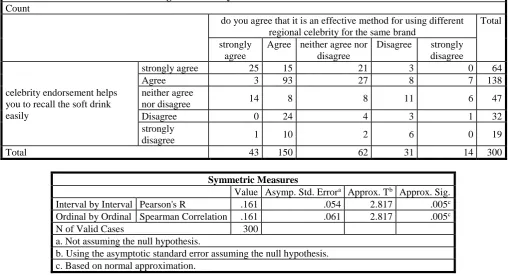
4.3 CORRELATION ANALYSIS BETWEEN CELEBRITY ENDORSEMENT HELPS YOU TO RECALL THE SOFT DRINK EASILY AND DO YOU AGREE THAT IT IS AN EFFECTIVE METHOD FOR USING DIFFERENT REGIONAL CELEBRITY FOR THE SAME BRAND
celebrity endorsement helps you to recall the soft drink easily * do you agree that it is an effective method for using different regional celebrity for the same brand Cross tabulation
Count
do you agree that it is an effective method for using different regional celebrity for the same brand
Total strongly
agree
Agree neither agree nor disagree
Disagree strongly disagree
celebrity endorsement helps you to recall the soft drink easily
strongly agree 25 15 21 3 0 64
Agree 3 93 27 8 7 138
neither agree
nor disagree 14 8 8 11 6 47
Disagree 0 24 4 3 1 32
strongly
disagree 1 10 2 6 0 19
Total 43 150 62 31 14 300
Symmetric Measures
Value Asymp. Std. Errora Approx. Tb Approx. Sig.
Interval by Interval Pearson's R .161 .054 2.817 .005c
Ordinal by Ordinal Spearman Correlation .161 .061 2.817 .005c
N of Valid Cases 300
a. Not assuming the null hypothesis.
b. Using the asymptotic standard error assuming the null hypothesis. c. Based on normal approximation.
INTERPRETATION:
The correlation value 0.161 indicates there is no relationship between these two statements ‘celebrity endorsement helps you to recall the soft drink easily’ and Do you agree that it is an effective method for using different regional celebrity for the same brand.
IJEDR1803047
International Journal of Engineering Development and Research (
www.ijedr.org
)
266
how far brand ambassador advertisements reach among customers * which product type you buy often Cross tabulation
Count
which product type you buy often Total 2 litre
bottle
1 litre bottle
1/2 litre bottle
chotta bottle
paper bottle
how far brand ambassador advertisements reach among customers
very
high 10 24 23 5 2 64
high 12 85 27 24 1 149
neutral 1 42 32 5 1 81
less 0 0 2 0 0 2
very
less 0 0 1 0 3 4
Total 23 151 85 34 7 300
Symmetric Measures
Value Asymp. Std. Errora Approx. Tb Approx. Sig.
Interval by Interval Pearson's R .157 .071 2.736 .007c
Ordinal by Ordinal Spearman Correlation .099 .058 1.717 .087c
N of Valid Cases 300
a. Not assuming the null hypothesis.
b. Using the asymptotic standard error assuming the null hypothesis. c. Based on normal approximation.
INTERPRETATION
The correlation value 0.157 indicates there is no relationship between these two statements ‘How far brand ambassador advertisements reach among customers and which product type you buy often
5. FINDINGS, SUGGESTIONS AND CONCLUSION
5.1 FINDINGS
‒ Majority (51.7%) of respondents are male.
‒ It was found that 57.66% of respondents are self employed. ‒ Majority (61.34%) of respondents are in the group of 18-25 years. ‒ It was found that 72.33% of respondents are un married.
‒ Majority (26%) of respondent’s favorite brand is 7up.
‒ It was found that 50.33% of the respondent buys 1 litter bottle normally. ‒ Majority ( 75%) of the respondent’s medium of advertisement is television.
‒ It was found that 45.33% of the respondent buys the product on the basis of quality if the celebrity is out of market. ‒ Majority (40.6%) of the respondent says that they can’t say about how long they will associate a particular celebrity to
a particular brand.
‒ It is found that 57.7% of the respondent says that there is a high chance of buying soft drink if the celebrity is out of market.
‒ It is found that 48.1% of the respondent says that brand ambassadors highly reach among customers. ‒ Majority( 48.1%) are agreeing that they are watch advertisement frequently.
‒ It is found that 34.5% of the respondent says that celebrity gives a positive image to the endorsed brand ‒ It is found that 32.9% of the respondent agrees that association of celebrity lies on quality of the brand. ‒ Majority ( 44.5%) of the respondent says that celebrity endorsement helps to recall the soft drink easily.
‒ It is found that 39% of the respondent agrees that celebrity endorsement work as an effective tool of persuasion for soft drinks.
‒ It is found that 26.8% of the respondent agrees that they will stop buying of soft drink if the celebrity involves in any unethical issues.
‒ Majority(48.8%) of the respondents agree that it is an effective method for using different regional celebrity for the same brand.
5.2 SUGGESTIONS
‒ Though the respondents agree that brand ambassadors are influencing to buy soft drinks, in case if celebrities are out of market, still consumers consume soft drink based on the quality of the soft drinks. So companies must give maximum importance to the quality of the soft drinks.
‒ Brand recalls are done mostly by the persuasion of celebrities. Hence apart from quality the company needs to adopt celebrities who are active in the market for promotions so as to give additional sales for their soft drinks.
IJEDR1803047
International Journal of Engineering Development and Research (
www.ijedr.org
)
267
‒ According to this survey it showing that Coco Cola and Pepsi have equal consumption in Calicut so to prevail in themarket they have to build good strategies.
‒ According to this survey it shows that television advertisement is the most preferable medium of advertisement so the company wants concentrate more on television advertisement so as to engage the in consumers in watching advertisement.
5.3 CONCLUSION
There is an old advertising adage which says, "The medium is the message." This is also applicable to celebrity endorsement too. In almost all the industries in the advertisement field there has been a sea change and of late there is embarrassment of celebrity endorsement. The soft drinks segment is no exception to it. There are many brands in the market and celebrity endorsement can be effectively used to establish a good brand recall and brand awareness. The companies have started understanding that celebrities can catalyse brand acceptance and provide the enormous momentum that brands require. In case of soft drink segment which has been taken for study, there are many success stories. Stories where brands in trouble were rescued after they were endorsed and taken to the general public by celebrities. Celebrity endorsement also gives new opportunities for the brand. But with much hype being made in celebrity endorsement a million dollar question arises in the minds of marketers: isn’t it time for the stockholders to start asking basic questions in brand investment. Finally, it can be conclude that brand ambassadors or celebrity endorsement is the order of the day, and it depends on the company or a brand how effectively to use it and establish brand recall brand awareness.
REFERENCES
[1] Agrawal, P., & Dubey, S. K. (2012). Impact of Celebrity Endorsement on Consumers Buying Behaviour. Global Research Analysis, 1(7), 106-108.
[2] Dan Hamilton Rice: Katie Kelting, Richard J Lutz (2012) Multiple Endorsers and Multiple Endorsement: The influence of Message repetition, Source Congruence and Involvement on Brand attitudes, Journal of Consumer Psychology,Vol.22, No.2, 249- 259.
[3] Joel R. Evans, B. B. (2003). Marketing 8e, Marketing in the 21st Century. Biztantra Publishers Delhi.
[4] Kapferer, J. N. (2004). The New Strategic Brand Management Creating and Sustaining Brand Equity Long Term. Kogan Page Publisher London.