INTERNATIONAL RESEARCH JOURNAL OF PHARMACY
www.irjponline.com
ISSN 2230 – 8407
Research Article
STABILITY INDICATING RP-HPLC METHOD DEVELOPMENT AND VALIDATION
FOR THE SIMULTANEOUS ESTIMATION OF CEFIXIME AND PARACETAMOL IN
BULK AND PHARMACEUTICAL DOSAGE FORM
Y.Anil kumar *, G. Indira Priyadarshini, Y.Sirisha
Department of Pharmacology, Department of Pharmaceutical Analysis, Hindu College of Pharmacy, Amaravathi road,
Guntur, A. P, India
Department of Pharmaceutical Analysis, Sims College of Pharmacy, India
*Corresponding Author Email: [email protected]
Article Received on: 05/02/18 Approved for publication: 23/02/18
DOI: 10.7897/2230-8407.09234
ABSTRACT
A simple, accurate precise Stability indicating RP-HPLC method for the estimation of Cefixime and Paracetamol in pure and pharmaceutical dosage form has been reported. Quantitative estimation of Cefixime and Paracetamol was done by using WATERS
HPLC 2965 SYSTEM with Auto Injector and PDA Detector on a BDS C18 column (250 mm x 4.6 mm, 5µ). A 10µL syringe was used
for injecting the samples. Data was analyzed by using Empower 2 software. UV-VIS spectrophotometer shimadzu with special bandwidth of 2mm and 10mm and matched quartz was used for measuring absorbance for Cefixime and Paracetamol solutions. The mobile phase consists of a Buffer: Acetonitrile (60:40) And at a flow rate of 1 milliliter/minute. Cefixime and Paracetamol were eluted at approximately 7 minutes. The wavelength was found to be 260nm. A linear response was observed in the concentration ranges of 20-120µg/ml with a regression coefficient of 0.999. Forced degradation studies were performed on pure sample of Cefixime and Paracetamol using acid (0.1 Normal (N) hydrochloric acid), base (0.1 N sodium hydroxide), peroxide (30% H2O2) and thermal
(105°C) conditions. The developed method was validated with respect to specificity, precision (% RSD about 0.4%), linearity (linearity
of range about 20-120 µg/mL),robustness, LOD and LOQ values were found to be 0.255 and 0.047 respectively.
Keywords: High performance liquid chromatography, Cefixime and Paracetamol
INTRODUCTION
CEFIXIME TRIHYDRATE
Cefixime is a semi synthetic, third generation cephalosporin antibiotic. Cefixime is a third-generation cephalosporin available in an oral formulation. In general, third-generation cephalosporins are more active against gram-negative species than the earlier generations of cephalosporins. Cefixime has enhanced antibacterial activity and increased stability against many of the beta-lactamases. It is commonly used in the treatment of otitis media, respiratory tract infections, and urinary tract infections caused by susceptible organisms. Cefixime is one of the only CDC-recommended oral antimicrobial agents to which
Neisseria gonorrhea has not developed significant resistance1.
PARACETAMOL
Paracetamol, also known as acetaminophen APAP, chemically named N-acetyl-p-aminophenol, is a widely used over-the-counter analgesic (pain reliever) and antipyretic (fever reducer). Acetaminophen is the name adopted for this pharmacologic agent in the U.S. (USAN) and Japan; paracetamol is approved in a variety of international venues (INN, AAN, BAN, etc.). Common trade names in English-speaking markets are Tylenol and Panadol. Paracetamol is classified as a mild analgesic. It is
and pains and is a major ingredient in
numerous cold and flu remedies. In combination with opioid analgesics, paracetamol can also be used in the management of more severe pain such as post-surgical pain and providing palliative care in advanced cancer patients. Though paracetamol is used to treat inflammatory pain, it is not generally classified as an NSAID because it exhibits only weak anti-inflammatory activity2.
Structure of paracetamol
MATERIALS AND METHODS
Cefixime and Paracetamol, Cefixime and Paracetamol tablets, HPLC grade water, acetonitrile, phosphate buffer, ammonium acetate buffer, glacial acetic acid, methanol, potassium dihydrogen phosphate buffer, tetra hydro furan, tri ethyl amine, ortho-phosphoric acid, 2N Hcl,2N NaoH,20% H2O2 etc.
INSTRUMENTATION
Quantitative estimation of Cefixime and Paracetamol was done by using WATERS HPLC 2965 SYSTEM with Auto Injector and
PDA Detector on a BDS C18 column (250 mm x 4.6 mm, 5µ). A
10µL syringe was used for injecting the samples. Data was analyzed by using Empower 2 software. UV-VIS spectrophotometer shimadzu with special bandwidth of 2mm and 10mm and matched quartz was used for measuring absorbance for Cefixime and Paracetamol solutions. Degassing of the mobile phase was done by using a shimadzu ultrasonic bath sonicator. A Shimadzu balance was used for weighing the materials3-6.
CHROMATOGRAPHIC CONDITIONS
Chromatographic separation achieved using an analytical
column,BDS (250mm 4.6mm, 5µ). Mobile phase was consisted
of Buffer: Acetonitrile (60:40). The elution was achieved isocratically at a flow rate of 1 mL/min with injection volume of 10 µL. Column temperature was maintained at 30°C and chromatograph was recorded at wavelength 260nm7.
Preparation of Sample
Preparation of standard stock solution
Accurately weighed and transferred 20mg of CEFIXIME and 25mg of PARACETAMOL working Standards into a 25ml clean dry volumetric flask, add 3/4th volume of diluent, sonicated for 5
minutes and make up to the final volume with diluents. 1ml from the above two stock solutions was taken into a 10ml volumetric flask and made up to 10ml.
Preparation of Sample Solution
RESULTS AND DISCUSSION
Method development and validation
Some important parameters like pH of the mobile phase, concentration of the acid or buffer solution, etc., were tested for a good chromatographic separation. Trials showed that mobile phase with reverse phase C18 column gives symmetric and sharp
peaks. After the optimization of chromatographic conditions,
estimation of Cefixime and Paracetamol carried out by the
developed RP-HPLC method. Standard solution of drug was
injected separately and chromatogram of Cefixime and
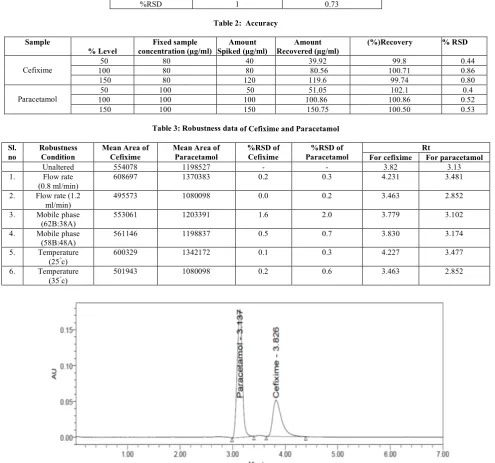
Paracetamol recorded in Figure 1Now the sample solution was
injected separately and chromatogram was recorded until the reproducibility of the peak areas were satisfactory.
Validation
HPLC method was validated according to the International Conference on Harmonization Guidelines (ICH Q2B, validation of analytical procedures, methodology). The method was validated for parameters such as system suitability, linearity, precision, accuracy, and robustness8.
Linearity
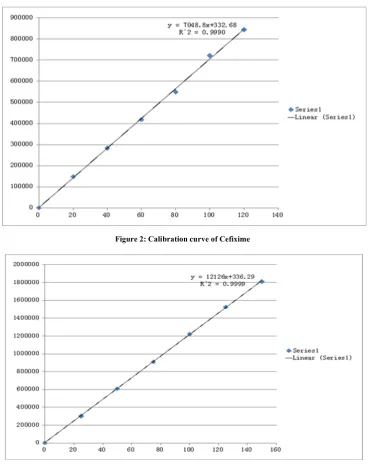
Six Linear concentrations of Cefixime (20-120ppm) and Paracetamol (25ppm to 150ppm) are prepared and Injected. Regression equation of the Cefixime and Paracetamol are found to be, y = 7048.x + 332.6, y = 12126x + 336.2. And regression co-efficient was 0.999. recorded in Figure 3.
Precision
To study precision, six replicate standard solutions of Cefixime and Paracetamol were prepared and analyzed using the proposed method. The percent relative standard deviation (% RSD) for peak responses was shown in Table 1.
Accuracy
Accuracy of the method was determined by standard addition method. A known amount of standard drug was added to the fixed amount of pre-analyzed sample solution. The standard addition method was performed at 50%, 100% and 150% level of sample solution. The resulting solutions were analyzed in triplicate at each level as per the ICH guidelines. Good recoveries were obtained for each concentration, confirming that the method was accurate and shown inTable 2.
Limit of Detection
Table 1: Results for Precision
Sl. No Cefixime Paracetamol
1 575568 1217681
2 575040 1200639
3 574412 1210933
4 566928 1205413
5 575090 1197905
6 564171 1219290
Mean 571868.2 1208644
Std. Dev. 4985.0 8832.8
%RSD 1 0.73
Table 2: Accuracy
Sample
% Level concentration (µg/ml) Fixed sample Spiked (µg/ml)Amount Recovered (µg/ml)Amount (%)Recovery % RSD
Cefixime
50 80 40 39.92 99.8 0.44
100 80 80 80.56 100.71 0.86
150 80 120 119.6 99.74 0.80
Paracetamol 50 100 100 100 100 50 100.86 51.05 100.86 102.1 0.52 0.4
150 100 150 150.75 100.50 0.53
Table 3: Robustness data of Cefixime and Paracetamol
Sl. no
Robustness Condition
Mean Area of Cefixime
Mean Area of Paracetamol
%RSD of Cefixime
%RSD of Paracetamol
Rt
For cefixime For paracetamol
Unaltered 554078 1198527 - - 3.82 3.13
1. Flow rate (0.8 ml/min)
608697 1370383 0.2 0.3 4.231 3.481
2. Flow rate (1.2 ml/min)
495573 1080098 0.0 0.2 3.463 2.852
3. Mobile phase
(62B:38A) 553061 1203391 1.6 2.0 3.779 3.102
4. Mobile phase (58B:48A)
561146 1198837 0.5 0.7 3.830 3.174
5. Temperature
(25°c) 600329 1342172 0.1 0.3 4.227 3.477
6. Temperature
(35°c) 501943 1080098 0.2 0.6 3.463 2.852
Figure 2: Calibration curve of Cefixime
Figure 3: Calibration curve of Paracetamol
Robustness
Robustness of the developed method was demonstrated by purposely altering the experimental conditions. Robustness of method was carried out with variation of mobile phase ±0.2%, flow rate ±0.2 ml/min. It indicates that there was no effect on the results, hence the developed method is said to be more robustand shown in Table 3.
Specificity
Specificity is the ability of the analytical method to measure the
System Suitability
System suitability tests were carried out on freshly prepared standard stock solution of Cefixime and Paracetamol and it was calculated by determining the standard deviation of by injecting standard solutions in six replicates at frequent time interval.
CONCLUSION
REFERENCES
1. http://www.drugbank.ca/drugs/DB00671.
2. http://www.drugbank.ca/drugs/db00316.
3. Gurudeep Chatwal and Sham Anand, Instrumental methods
of chemical analysis. Himalaya publishers, 7th ed. 1992, p.
no 2.624-2.639.
4. Skoog et al., Principles of Instrumental Analysis.
Barkhanath publishers, 8th ed. p. 973-995.
5. Hobart. H. Willard et al., Instrumental methods of analysis, CBS Publications and Distributors, New Delhi, 1st ed.
1986, p. 529-563.
6. Sethi P.D., Quantitative analysis of Drugs &
Pharmaceuticals. CBS publishers and distributors, New Delhi, 3rd ed. 2001 p. 1-120.
7. Lloyd R. Snyder et al., practical HPLC method
development. John Wiley & sons publishers, 2nd ed. p.
350-400.
8. Interna ICH of technical requirements for the registration of pharmaceuticals for human use, validation of analytical parameters; methodology adopted in 1996, Geneva.
Cite this article as:
Y. Anil Kumar et al. Stability indicating RP-HPLC
method development and validation for the simultaneous estimation of cefixime and paracetamol in bulk and pharmaceutical dosage form. Int. Res. J.
Pharm. 2018;9(2):90-94
http://dx.doi.org/10.7897/2230-8407.09234
Source of support: Nil, Conflict of interest: None Declared