Themed Section: Science and Technology
New Approach for Text Based Image Compression
B. Lakshmi Priya*1, Dr.S.S.Dhenakaran2
*1 M.Phil, scholar Department of Computer Science, Alagappa University, Karaikudi, Tamilnadu, India
2Professor, Department of Computer Science, Alagappa University, Karaikudi, Tamilnadu, India
ABSTRACT
The world is governed by internet and people’s most of their work are depending on Internet For authentication, images are most used for currency transactions. So everywhere images are used and occupy more spaces for storage. Preserve more images is becoming essential in future trends. To achieve space domination by images ,image compression is vital. Though there are several image compression techniques available, improvement over existing methods are welcome. In an attempt to improve ratio of image compression, a novice approach is tried. The proposed methodology first compresses the given image and compressed image is then transformed into ASCII file based on the pixel values. Then text compression is applied to string the size of the text file. Again the reduced text file is reverted to pixel file using ASCII character values. Finally, a compressed image is generated targeting the size of file small. The experimental result of the proposed work is achieving the intended goal.
Keywords: JPEG image, Text Compression, Image Compression , ASCII Set, Pixel Extraction.
I.
INTRODUCTIONImage compression is a type of data
compression applied to digital image to reduce the cost of storage or transmission. Image compression may be lossy or lossless. Lossless compression is preferred for historical purposes and often medical imaging, technical drawings, clip art, or comics are collected. Lossy compression methods, especially when used at low bit rates, introduce compression
artifacts. Lossy methods are especially suitable for
natural images such as photographs in applications where minor loss of data is acceptable to achieve a substantial reduction in bit rate. Lossy compression that produces negligible differences may be called visually lossless. For applying compression techniques, digitally stored images are used. Mostly TIFF, JPEG, GIF, PNG & raw image files formats are available to preserve digital images. JPEG, Joint Photographic
Experts group, is most popular image format used for Image processing. The proposed work uses JPEG image since it is small in size and web friendly and helpful for image processing.
II.
EXISTING METHODSPallavi M.Sune[1] has discussed about image classification, wavelet compression and converted into image an array format using Delphi image control tool. Image manipulate are used to show a graphical image icon, bitmap, meta document, GIF, JPEG and so on. Then an algorithm is created in Delphi to put into effect of Huffman coding.
Leon Bottou[3] has discussed about new image compression technique with “DJVu”.The compression advantages are high resolution, high quality images of scanned document in colour and the image over low speed the connections, reproducing the visual component the document, colour, fonts, pictures and paper texture.
III.
PROPOSED METHODOLOGYThis work elaborates text based image compression technique along with the existing methodologies adopted by researchers for image processing. First part of the work is done to obtain compressed form of given image. In the second step, pixels are extracted from the RGB values of compressed image. In the third part, characters are placed according to the ASCII value for pixel numbers. In the fourth step, a text file is formed with these alphanumeric characters. In the fifth step, text file is compressed using text compression algorithm. Again pixel values are extracted from the compressed text file. Finally an image is generated which is the objective of the proposed work. It is foreseen that this principle can produce a better compressed image against the existing methods.
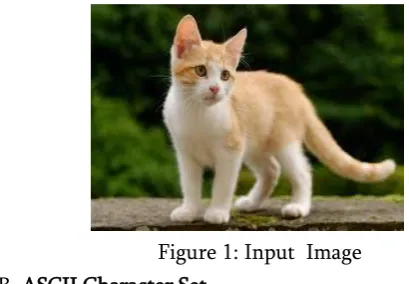
The proposed method considers a sample color image of 28.68 KB. It is then converted to grayscale image. The grayscale image is used to generate pixel values and applying ASCII characters a text file is created. Then text compression and pixel conversion to the compressed text file are used to produce required compressed image.
A. Image
JPEG –Joint Photographic Experts Group, this is the most popular one used for image formats. It is a
commonly used method of lossy
compression for digital images, particularly for those images produced by digital photography. JPEG is the most common image format used by digital
cameras and other photographic image capture
devices;along with JPEG/JFIF, it is the most common
format for storing and transmitting photographic images on the World Wide Web. JPEG supports a maximum image size of 65,535×65,535 pixels. A JPEG
image consists of a sequence of segments, each
beginning with a marker, each of which begins with a 0xFF byte followed by a byte indicating what kind of marker it is. This work uses a JPEG file for proposed compression.
Figure 1: Input Image B. ASCII Character Set
The color The ASCII character set has alphanumeric characters with a weight to each character. This set is used for converting the image’s pixel value into ASCII character in order to obtain a text file for the image.
C. Compression Process
The stages of compression process are depicted in the following diagram. It has seven stages starting from input image till yielding compressed image.
Compressed
Source image
Figure 2: Compression process
The proposed image compression starts from getting compress image to input to the proposed system. The compressed file is then transformed into grayscale image using pixel value ranging from 0 to 255. The pixel value is representing the brightness of the pixel in the grayscale image.
Figure 3: Grayscale Image
Then a text file is formed replacing each pixel value by a character of ASCII set producing required text file. Next the text file is compressed by text compression algorithm(DCT) to yield compressed text file which is again manipulated to produce a file for extracting pixel values.
TABLE I ASCII VALUES
This file is reverted to issue final compressed image.
Figure 4: Compressed Image
D. Decompression process
In the decompression process, it initiates the processing from resultant compressed image file and goes through the same intermediate process to reach original image file.
E. Evaluation Metrics
It is used to measure the quality of an image and the execution time of the algorithm. The metrics are calculated as follows:
1) Image Size:
The proposed work by novice compression technique has reduced the size of the image from 28.68 KB to 3.06 KB. The reduction rate is achieved by 88% and the proposed approach is much beneficial for JPEG image compression.
2) Algorithm Execution Time:
The algorithm uses image processing toolkit Matlab 2014 and the execution time is evaluated. It is observed on the basis of number of iterations needed for the algorithm to encrypt and decrypt an image. Time complexity is a total number of primary
Compressed
image
ASCII
character set
Text File
Pixel
Extraction
arithmetic operations occurring in the function where input variables are processed in an algorithm.
Time Complexity= K * C (1)
Time Complexity= Elapsed time is 0.596186 seconds. Where K is the total number of arithmetic operations and C is a constant depending upon the platform on which the algorithm executes.
Space complexity summarizes amount of space static memory space and dynamic data space. The dynamic space includes the space occupied by image, pixel file, text file etc and individual primitive types of data involved in solving the problem. The space complexity is usually denoted by O(S).
IV.
EXPERIMENTAL RESULTS
The text based image compression using ASCII conversion is used to reduce the image size and image storage in the secondary devices. A sample image of size 28.68 KB is considered for processing and the reduced is occupying only 458 bytes. The compression ratios of other three algorithms are depicted in Table II. The proposed compression ratio is indicating 62.2 which is seemed better to compress image file.
TABLE II. COMPARISON OF IMAGE COMPRESSION
Sl.No. Compression
Technique Compressed image size Compression Ratio 1 2 3 4 LZW Comp. Based Huffman based LZW Delta Encoding Proposed Method 50.39 MB 10.20 MB 99.42 MB 28.68 KB 4.42 4.49 12.5 458 Bytes (62.6)
V.
CONCLUSION
The proposed method for image compression is implemented in MatLab 8.4 software and the result produced by the tools is enclosed. It is seen that the proposed approach has increased the compression ratio when compared to other three methods taken for comparison.
VI.
REFERENCES
[1]. Pallavi M.Sune., “Image Compression
Techniques based On Wavelet and Huffman Coding”.International Journal of Advanced Research in Computer Science and Software Engineering,ISSN:2277 128X,Volume 3,Issue 4,April 2013.
[2]. Hema Suresh Yaragunti and T.Bhaskara
Reddy.,”Text Based Image Compression using Hexadecimal conversion”. Oriental Journal of Computer Science & Technology.ISSN:0974-6471, Vol.8,No.(3):Pgs.216-221,December 2015.
[3]. Leon Bottou,Patrick Haffner,Paul G.Howard
,Patrice simard,Yoshua Bengio,Yann
Lecun.,”High quality document image
compression with “DjVu””.Journal of Electronic Imaging.Pgs.410-425,
[email protected],Vol.7(3),July 1998.
[4]. Sidhu,Meenakshi Garg.,”Research Paper on Text
Data Compression Algorithm using Hybrid Approach”.International Journal of Computer
Science and Mobile
Computing,IJCSMC,Vol.3,ISSN
2320-088X,Issue.12,December 2014,pg.01-10.
[5]. V Mary Kiruba Rani, et al” A Mathematical
Modelling for Quality Based Ultrasound Breast
Cancer Image Using Color Properties”
Australian Journal of Basic and Applied Sciences, 10(2) Special 2016, Pages: 44-51
[6]. SShanmugasundaram and
R.Lourdusamy,”IIDBE: A Lossless Text
Compression”.International Journal of Wisdom Based Computing, Vol.1 (2), August 2011.
[7]. Mamta Rani,Vikram Singh,”An Enhanced Text
Compression System Based on ASCII Values and Huffman Coding”.International Journal of
Computer Science Trends and
Technology(IJCST)-Volume 4 Issue3,May-Jun 2016.
[8]. SShanmugasundaram and R.Lourdusamy,”A