International Ayurvedic Medical Journal, (ISSN:2320 5091) (February, 2107) 5 (2)
BRONCHIAL ASTHMA
–
A REVIEW FROM AYURVEDIC PERSPECTIVE
Gopikrishna S1, Shrinivas Acharya G2
1PhD Scholar, 2PhD Guide, Prof and HOD,
Department of Kayachikitsa, SDM College of Ayurveda, Udupi, Karnataka, India
Email:[email protected]
ABSTRACT
Bronchial asthma is a disease involving the diffuse inflammation of the airways presented with the complaints of breathlessness, cough, chest tightness and wheezing. It is caused by various variety of triggering factors. The outcome of these triggering factors is either reversible or irreversi-ble broncho constriction. Severity of the disease may vary depending upon the duration of the symp-toms, duration of the symptom free period, nature of the symptoms and associated symptoms. The diagnosis of the disease is based on thorough history, physical examination and pulmonary function tests. As per the fundamentals of Ayurveda, based on the clinical features of the disease, this is usu-ally correlated with Tamaka Swasa. The following paper illustrates the hypothesis put forth based on the comparison of findings of bronchial asthma and the symptoms mentioned in Ayurveda.
Keywords: Bronchial asthma, Tamaka Swasa
INTRODUCTION
Bronchial asthma is a disease afflicting the airways with diffuse inflammation with either reversible or irreversible nature. As per global initiative for asthma (GINA), asthma is defined as a chronic inflammatory disorder of airways which is associated with airway hy-perresponsiveness1. Airway hyperresponsive-ness refers to exaggerated bronchoconstrictor response to stimuli that have little or no effect in non-asthmatic subjects2. It leads to recurrent
episodes of wheezing, breathlessness, chest tightness and coughing, particularly at night or early morning3. The aetiology of the disease is
considered to be multifactorial. The preva-lence of bronchial asthma has increased in worldwide more than 45% since 1970s4.In the present days, the prevalence varies considera-bly within countries and between countries. It is more prevalent in the developed countries than developing countries wherein the indus-trialised life style is being adopted5. At pre-sent, this disease affects 4 – 7% of the people worldwide. The illness will be observed more frequently in males before puberty and more in females after puberty6. In India, the preva-lence of the disease is found to be around 7%
IAMJ: FEBRUARY, 2017 512 with a range from 2% to 17% in different
study populations7.
Etiological factors
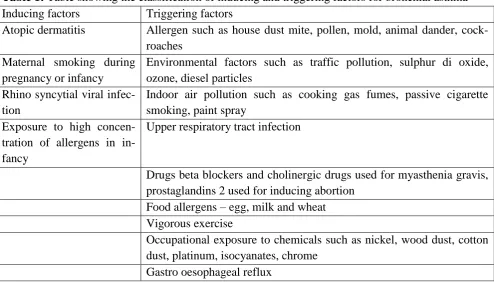
Etiological factors of bronchial asthma are of two folds inducing factors and trigger-ing factors. Inductrigger-ing factors induce bronchial asthma in susceptible individuals include ge-netic factors, obesity, viral infections in early
life, exposure to tobacco smoke. Whereas trig-gering factors provoke the symptoms of bron-chial asthma in the individuals already having bronchial asthma which include allergens, vigorous exercise, viral infections etc. Among these factors, some factors act as both induc-ing and triggerinduc-ing factors8.
Table 1: Table showing the classification of inducing and triggering factors for bronchial asthma9
Inducing factors Triggering factors
Atopic dermatitis Allergen such as house dust mite, pollen, mold, animal dander, cock-roaches
Maternal smoking during pregnancy or infancy
Environmental factors such as traffic pollution, sulphur di oxide, ozone, diesel particles
Rhino syncytial viral infec-tion
Indoor air pollution such as cooking gas fumes, passive cigarette smoking, paint spray
Exposure to high concen-tration of allergens in in-fancy
Upper respiratory tract infection
Drugs beta blockers and cholinergic drugs used for myasthenia gravis, prostaglandins 2 used for inducing abortion
Food allergens – egg, milk and wheat Vigorous exercise
Occupational exposure to chemicals such as nickel, wood dust, cotton dust, platinum, isocyanates, chrome
Gastro oesophageal reflux
The above description simulates the description of Utpadaka Hetu and Vyanjaka Hetu as discussed in Ayurveda literatures. The word Utpadaka Hetu (inducing factor) refers to the actual causative factor responsible for the manifestation of the disease where as Vyanjaka Hetu (triggering factor) refers to the provocative factor responsible for the aggrava-tion of the symptoms where in pathophysiolo-gy of the disease is dormant at that particular time10.
Jala-IAMJ: FEBRUARY, 2017 513 jamamsa sevana, Anupamamsa Sevana etc.
are considered as Vyanjaka Hetu13.
Pathology
Bronchial asthma is associated with a specific chronic inflammation of mucosa of lower airways. The airway mucosa is infiltrat-ed with activatinfiltrat-ed oesinophils and T lympho-cytes and activation of mast cells. The degree of inflammation has nothing to do with the severity of the bronchial asthma. There will be thickening of the basement membrane due to subepithelial collagen deposition. The epithe-lium of the airways is often shed or friable, with reduced attachments to the airway wall and increased number of epithelial cells in the lumen. The airway wall may be thickened and oedematous in the severe form of asthma. Oc-clusion of the small airways may be present due to the presence of mucus plug, composed of mucosal glycoproteins secreted from goblet cells and plasma proteins from bronchial ves-sels. These pathological events are found in all airways, but do not extend to lung parenchy-ma. Small airway inflammation is found in severe form of bronchial asthma14.
In Ayurveda, scattered references are present regarding the pathogenesis of Tamaka Swasa. In one context, obstructed Maruta in Pranavaha Srotas due to the increased Kapha in the Uras is responsible for the manifestation of Tamaka Swasa. In this context, the ob-structed Maruta refers to entrapped air in the lungs not the air of external environment. Pra-navaha Srotas refers to the bronchospasm. Urastha Kapha blocking the Pranavaha Sro-tas refers to mucosal oedema. This mechanism explains the acute episode of onset of bron-chial asthma15.
The next stage of Tamaka Swasa is there will be obstruction of Pranavaha Srotas manifests due to the occlusion of passages by vitiation of Kapha. This is responsible for the complete obstruction of Vata16.
In the third stage of Tamaka Swasa, first there will be Pratiloma gati of Vayu will be present. Inhaled air will be entrapped in the alveoli. This will be responsible for the con-traction of muscles of Griva and Shira. There will be further vitiation of Kapha in Pranava-ha Srotas17.
Clinical features
Clinical features of bronchial asthma vary according to the stage of the disease in a particular individual. The characteristic symp-toms of the disease are wheezing, breathless-ness and cough. Symptoms are typically worse at night and patients will be awake in early morning hours. There will be increased pro-duction of sputum which is tenacious or diffi-cult to expectorate. This disease is associated with increased ventilation and increased use of accessory muscles of respiration. The prodro-mal symptoms observed in this disease are itching under the chin, discomfort between scapulae and inexplicable fear. (The signs ob-served in bronchial asthma are expiratory and polyphonic rhonchi throughout the chest and there will be hyperinflation. The presence of hyperinflation can be predicted by the pres-ence of barrel shaped or emphysematous chest18.
IAMJ: FEBRUARY, 2017 514
Table 2: Symptoms of bronchial asthma and their interpretation in terms of Tamaka Svasa Lakshana Symptom of bronchial asthma Dosha dominance Interpretation in Ayurveda19
Running nose Kapha Pinasa
Nasal blockage Kapha Nasanaha
Wheezing Kapha Gurghuraka
Breathing discomfort Kapha and Vata Svasa
Cough Vata and Kapha Kasa
Tenacious sputum Vata and Kapha Shlemani Ucchyamane Dukhitah
Comfort after spitting the spu-tum
Vata and Kapha Tasya(shleshmasya) Vimokshante Tat kshane Sukham
Hoarseness of voice Vata Kantha Uddhwamsa
Inability to speak Vata Kricchra bhashana
Disturbed sleep Vata Shayane Nidra Na Labhate
Orthopneoa Vata Asino Labhate Soukhyam
Upward gaze Vata Utchritaksha
Sweating in the forehead Pitta Lalata sveda
Dryness of mouth Vata Vishushkasya
Frequent attacks Vata Muhu svasa
Table 3: Samprapti Ghataka of Tamaka Svasa
Factor of Samprapti Ghataka of the disease Factor involved in the disease process
Dosha Vata Kapha Pradhana and Pitta Apradhana
Dushya Rasa
Srotas Pranavaha, Rasavaha Srotas
Srotodushti Prakara Sanga, Vimargagamana
Agni Jatharagni mandya, Rasa Dhatvagni mandya
Ama Koshthastha and Dhatustha Ama
Udbhava Sthana Pitta sthana
Sanchara Sthana Sarvasharira
Vyakta Sthana Uras
Vyadhyavastha Kapha pradhana, Vata pradhana, Durbala and Balavan Rogi
Vyadhi Svabhava Chirakari, Yapya
Vyadhi bheda Adhyatmika, Doshabala Pravritta, Sharirika and Amashaya Samuttha Vikara
Rogamarga Abhyantara
Sadhyasadhyata Yapya
Analysis of Samprapti Ghataka of Tamaka Swasa
Dosha: Vata and Kapha are the bioenergies responsible for the development of clinical
(Gurghura-IAMJ: FEBRUARY, 2017 515 ka) and nasal blockage (Nasanaha) are usually
manifested due to the dominance of the Kapha Dosha; whereas hoarseness of voice (Kantha Uddhwamsa), inability to speak (Kricchra Bhashana), disturbed sleep (Shayane Nidram Na Labhate), orthopnoea (Asino Labhate Sou-khyam), upward gaze (Ucchritaksha), dryness of mouth (Vishushkasya) are manifested due to the vitiation of Vata Dosha and clinical fea-tures such as cough, breathlessness are mani-fested due to the vitiation of both Vata and Kapha Dosha21.
Dushya: If we analyse the clinical features explained in the context of Tamaka Swasa, we can predict the involvement of Rasa Dhatu in the disease manifestation. Pinasa (running nose), Nasanaha (nasal blockage), Gurghura-ka (wheezing), Kasa (cough with tenacious sputum), Swasa (breathing discomfort), the presence of Kantha Uddhwamsa (hoarseness of voice), Kricchra Bhashana (inability to speak), Shayane Na Nidram Labhate (dis-turbed sleep particularly at night), Asino Labhate Soukhyam (orthopnoea), Utchritaksha (upward gaze) and Vishushkasya (dryness of mouth) are suggestive of involvement of Rasa in the progression of the disease22.
Srotas: By analysing the clinical features of Tamaka Swasa, it is evident that the involve-ment of Pranavaha Srotas is observed from the beginning till the complete manifestation of the disease. The presence of Pinasa (run-ning nose), Nasanaha (nasal obstruction), Gurghuraka (wheezing), Svasa (breathing dis-comfort), Kasa (cough), Shleshmani Amuchyamane Dukhita (tenacious sputum comes with difficulty), Kantha Uddhwamsa (throat irritation), Kricchra Bhashana (inabil-ity to speak), Shayane Nidram Na Labhate (disturbed sleep due to breathing discomfort),
Asino Soukhyam Labhate (orthopnoea) are suggestive of the involvement of Pranavaha Srotas23. Rasavaha Srotas will be afflicted in association with Pranavaha Srotas as we ob-serve the involvement of Rasa Dhatu in the course of the disease24.
Srotodushti Prakara: By analysing the clini-cal features of Tamaka Swasa, we can come to a hypothesis that Sanga and Vimargagamana will happen during the pathogenesis in the pa-tient suffering from the illness. Inward move-ment of Prana is considered to be normal phe-nomenon in normal healthy individuals. This will be altered in the individuals which can be predicted by Nasanaha (nasal blockage), Pi-nasa (running nose) followed by Gurghuraka (wheezing). This will be further responsible for severe frequent episodes of Kasa (cough) with little tenacious sputum25,26.
Agni: As the disease is considered to be Amashaya samuttha Vikara, Jatharagniman-dya can be predicted by the prodromal symp-tom Anaha (distension of abdomen)27. Ra-sadhatvagni mandya can be predicted as there will be involvement of Hridaya is possible in a patient of Tamaka Swasa in due course of time28.
Ama: As there is weak Jatharagni (digestive fire present in the alimentary canal), we are going to suspect the presence of Ama (improp-erly processed material) in the Mahasrotas (alimentary canal). Due to the weak Rasa Dhatvagni (weak digestive fire in the plasma tissue), we are going to suspect the presence of Ama (improperly processed materials) in Rasa (plasma tissue) as well29.
IAMJ: FEBRUARY, 2017 516 will be dominant from the onset till the
com-plete manifestation of the disease in different stages). The word ‘Udbhava Sthana’ refers to the site where in a particular Dosha is pro-duced in the Koshtha (alimentary canal). This implies that the production of normal/ abnor-mal Dosha (bioenergy) starts in the Koshtha (alimentary canal). As per the fundamentals of Ayurveda, Pitta Dosha (bioenergy) will be produced in the Amashaya (stomach). Hence, Udbhava Sthana in this disease is Amashaya (stomach)30.
Sanchara Sthana: (area of movement of Dosha): The word ‘Sanchara Sthana’ refers to area of the body where in vitiated Dosha (bio-energy) will move inside the body. In case of Tamaka Swasa, clinical features observed dur-ing the course of disease suggest the involve-ment of upper part of the body initially in the pathogenesis followed by whole body in-volvement. Hence, Uras (chest) is considered to be Sanchara Sthana (area of movement of Dosha) in Tamaka Swasa31.
Vyakta Sthana (part of the body full blown symptoms of the disease seen): In case of Tamaka Swasa, the clinical features are initial-ly restricted to upper part of the body, particu-larly chest. Hence, Uras (chest) is considered to be Vyakta Sthana (parts of the body where full blown symptoms of the disease seen) in Tamaka Swasa32.
Vyadhyavastha (stage of the disease): Bron-chial asthma is an episodic illness presented with onset of cough, breathless and wheezing in paroxysms. Though the disease is not a life-threatening illness, the patients show severe air hunger due to the blockage in the airways and the proper management. Hence Vyadh-yavastha in this disease is Ashukari (producing serious complications33. Vyadhi bheda (type of
the disease): As far as the types of disease based on fundamentals of Ayurveda are con-cerned, Tamaka Swasa is a Adhyatmika Vikara (disease manifests in the patient due to deeds done by self). Among the type of Adhyatmika Vikara, it is further classified under Dosha-bala Pravritta Vikara (disease manifests in the patient due to the dominance of the Dosha or bioenergy), Sharirika Vikara (disease related to the body) and Amashayasamuttha Vikara (disease having the origin in stomach)34. This type of classification will be helpful in deter-mining the Sadhyasadhyata (prognosis) of the disease as well as planning line of treatment at a particular stage of the illness.
IAMJ: FEBRUARY, 2017 517 • First of all, based on onset of the disease, this
disease is more common in any age group and is an episodic illness characterised by breath-lessness, cough and polyphonic wheezing. This implies the disease is having the domi-nance of Vata and Kapha Dosha (bioenergy) during the progression of the disease.
• The disease is having the dominance of Vata and Kapha Dosha (bioenergy) from the com-mencement of disease till the complete mani-festation of the disease.
• Rasa Dhatu (plasma tissue) is involved in the disease process during the progression of the disease.
• Abhyantara (internal pathway of the disease) Rogamarga is mainly involved in the progres-sion of the disease. Though there is the associ-ation of the Madhyama Rogamarga in the progression of the disease.
CONCLUSION
Bronchial asthma is an episodic illness of respiratory system manifests in any age group in both genders. In childhood, male children are more frequently suffering from female children in a ratio of 2:1. The individu-als suffering from bronchial asthma are pre-sented with airway hyper responsiveness, cough, breathlessness and wheezing. By ob-serving the above clinical features, we can in-fer the involvement of Vata and Kapha Dosha in the pathogenesis of the disease in the Pra-navaha (channel involved in respiration) and Rasavaha Srotas (channel responsible for cir-culation) with the involvement of Rasa Dhatu (plasma tissue).
REFERENCES
1. Yash Pal Munjal, Surendra K. Sharma et al. API textbook of medicine. 9th edition. The as-sociation of Physicians of India, Mumbai. 2012. Vol II. p. 1704.
2. Lee Goldman, Dennis Ausiello, William P Arend, James O Armitage, David R Clam-mons, Jeffrey M Drazen et al. Cecil’s medi-cine. 23rd edition. Saunders Elsevier Publica-tions, Philadelphia, PA 19103. 2007. Vol I, p. 612
3. Yash Pal Munjal, Surendra K. Sharma et al. API textbook of medicine. 9th edition. The as-sociation of Physicians of India, Mumbai. 2012. Vol II. p. 1704.
4. Lee Goldman, Dennis Ausiello, William P Arend, James O Armitage, David R Clam-mons, Jeffrey M Drazen et al. Cecil’s medi-cine. 23rd edition. Saunders Elsevier Publica-tions, Philadelphia, PA 19103. 2007.Vol I, p. 612
5. Lee Goldman, Dennis Ausiello, William P Arend, James O Armitage, David R Clam-mons, Jeffrey M Drazen et al. Cecil’s medi-cine. 23rd edition. Saunders Elsevier Publica-tions, Philadelphia, PA 19103. 2007. Vol I, p. 612
6. Robert S Porter, Justin L Kaplan et al. The Merck Manual of diagnosis and therapy. 19th edition. Merck Sharp & Dohme Corp., A sub-sidiary of Merck & Co., Inc., Whitehouse sta-tion, NJ. 2011. p.1868.
7. Yash Pal Munjal, Surendra K. Sharma et al. API textbook of medicine. 9th edition. The as-sociation of Physicians of India, Mumbai. 2012. Vol II. p. 1704.
8. Yash Pal Munjal, Surendra K. Sharma et al. API textbook of medicine. 9th edition. The as-sociation of Physicians of India, Mumbai. 2012. Vol II. p. 1704.
IAMJ: FEBRUARY, 2017 518 10.Vijayarakshita and Srikanthadatta.
Madhuko-sha, commentary on Madhava Nidana by Madhavakara, Panchanidana Lakshanam Adhyaya, 1/5. In. Sastri Sudarshana and Upadhyaya Yadunandana. Editors. Varanasi: Chaukhambha Sanskrit Sansthan; 2000. p. 18 11.Chakrapani Datta. Ayurveda Dipika,
commen-tary on Charaka Samhita by Agnivesha. Charaka Samhita, Chikitsa Sthana, Hik-kashwasachikitsa Adhyaya, 17/8. In. Acharya YT. Editor. Varanasi: Choukhambha Ori-enalia; 2009 (reprint). p.533
12.Vijayarakshita and Srikanthadatta. Madhuko-sha, commentary on Madhava Nidana by Madhavakara, Panchanidana Lakshanam Adhyaya, 1/5. In. Sastri Sudarshana and Upadhyaya Yadunandana. Editors. Varanasi: Chaukhambha Sanskrit Sansthan; 2000. p. 18 13.Agnivesha, Charaka, Charaka Samhita,
Chikitsa Sthana, Hikkashwasachikitsa Adhyaya, 17/10-16. In. Acharya YT. Editor. Varanasi: Choukhambha Orienalia; 2009 (re-print). p.533
14.Tinsley R. Harrison, Harrison’s Principles of Internal Medicine, Dennis.L. Kasper, Eugene Braunwald, Antony S Fauci, Stephen Hauser, Dan Longo, J Larry Jameson, editors.17th edi-tion, Mc GrawHill medical publishing
divi-sion. 2008, volume 2nd. Peter J
Barnes,Asthma, page no; 1596 till 1607 15.Agnivesha, Charaka, Charaka Samhita,
Chikitsa Sthana, Hikkashwasachikitsa Adhyaya, 17/17. In. Acharya YT. Editor. Va-ranasi: Choukhambha Orienalia; 2009 (re-print). p.533
16.Agnivesha, Charaka, Charaka Samhita, Chikitsa Sthana, Hikkashwasachikitsa Adhyaya, 17/45. In. Acharya YT. Editor. Va-ranasi: Choukhambha Orienalia; 2009 (re-print). p.535
17.Agnivesha, Charaka, Charaka Samhita, Chikitsa Sthana, Hikkashwasachikitsa Adhyaya, 17/55. In. Acharya YT. Editor. Va-ranasi: Choukhambha Orienalia; 2009 (re-print). p.535
18.Tinsley R. Harrison, Harrison’s Principles of Internal Medicine, Dennis.L. Kasper, Eugene Braunwald, Antony S Fauci, Stephen Hauser, Dan Longo, J Larry Jameson, editors.17th edi-tion, Mc GrawHill medical publishing
divi-sion. 2008, volume 2nd. Peter J
Barnes,Asthma, page no; 1596 till 1607 19.Agnivesha, Charaka, Charaka Samhita,
Chikitsa Sthana, Hikkashwasachikitsa Adhyaya, 17/55-62. In. Acharya YT. Editor. Varanasi: Choukhambha Orienalia; 2009 (re-print). p.535
20.Agnivesha, Charaka, Charaka Samhita, Chikitsa Sthana, Hikkashwasachikitsa Adhyaya, 17/8. In. Acharya YT. Editor. Vara-nasi: Choukhambha Orienalia; 2009 (reprint). p.533
21.Agnivesha, Charaka, Charaka Samhita, Chikitsa Sthana, Hikkashwasachikitsa Adhyaya, 17/55-62. In. Acharya YT. Editor. Varanasi: Choukhambha Orienalia; 2009 (re-print). p.535
22.Vagbhata. Ashtanga Hridaya, Sutra Sthana, Doshadi Vijnaniya Adhyaya, 11/17. In. Shastri Paradakara Hari Sadashiva. Editor. Varanasi: Choukhambha Surbharati Prakashan; 2014. p. 185.
23.Agnivesha, Charaka, Charaka Samhita, Vimana Sthana, Srotovimana Adhyaya, 5/8. In. Acharya YT. Editor. Varanasi: Choukhambha Orientalia; 2009 (reprint). p. 250.
IAMJ: FEBRUARY, 2017 519 Choukhambha Surbharati Prakashan; 2014. p.
185.
25.Agnivesha, Charaka, Charaka Samhita, Vimana Sthana, Srotovimana Adhyaya, 5/24. In. Acharya YT. Editor. Varanasi: Choukhambha Orientalia; 2009 (reprint). p. 252.
26.Agnivesha, Charaka, Charaka Samhita, Chikitsa Sthana, Hikkashwasachikitsa Adhyaya, 17/55-62. In. Acharya YT. Editor. Varanasi: Choukhambha Orienalia; 2009 (re-print). p.535
27.Agnivesha, Charaka, Charaka Samhita, Chikitsa Sthana, Hikkashwasachikitsa Adhyaya, 17/20. In. Acharya YT. Editor. Va-ranasi: Choukhambha Orienalia; 2009 (re-print). p.533
28.Agnivesha, Charaka, Charaka Samhita, Vimana Sthana, Srotovimana Adhyaya, 5/8. In. Acharya YT. Editor. Varanasi: Choukhambha Orientalia; 2009 (reprint). p. 250.
29.Agnivesha, Charaka, Charaka Samhita, Sharira Sthana, Shareera Sankhya Sharira Adhyaya, 6/17. In. Acharya YT. Editor. Vara-nasi: Choukhambha Orientalia; 2009 (reprint). p. 333.
30.Agnivesha, Charaka, Charaka Samhita, Vimana Sthana, Roganika Vimana Adhyaya, 6/3. In. Acharya YT. Editor. Varanasi: Choukhambha Orientalia; 2009 (reprint). p. 252.
31.Agnivesha, Charaka, Charaka Samhita, Chikitsa Sthana, Grahanidosha Chikitsa Adhyaya, 15/42. In. Acharya YT. Editor. Va-ranasi: Choukhambha Orientalia; 2009 (re-print). p. 516.
32.Agnivesha, Charaka, Charaka Samhita, Chikitsa Sthana, Hikkashwasachikitsa Adhyaya, 17/55-62. In. Acharya YT. Editor.
Varanasi: Choukhambha Orienalia; 2009 (re-print). p.535
33.Agnivesha, Charaka, Charaka Samhita, Chikitsa Sthana, Hikkashwasachikitsa Adhyaya, 17/55-62. In. Acharya YT. Editor. Varanasi: Choukhambha Orienalia; 2009 (re-print). p.535
34.Sushruta, Sushruta Samhita, Sutra Sthana, Vyadhisamuddeshiya Adhyaya, 24/5. In. Acharya YT. Editor. Varanasi: Choukhambha Sanskrit Samsthan; 2009 (reprint). p. 114. 35.Agnivesha, Charaka, Charaka Samhita, Sutra
Sthana, Tisraishaniya Adhyaya, 11/48-49. In. Acharya YT. Editor. Varanasi: Choukhambha Orientalia; 2009 (reprint). p. 77.
36.Agnivesha, Charaka, Charaka Samhita, Sutra Sthana, Mahachatuspada Adhyaya, 10/11-20. In. Acharya YT. Editor. Varanasi: Choukhambha Orienalia; 2009 (reprint). p.66-67.
Source of Support: Nil
Conflict Of Interest: None Declared
How to cite this URL: Gopikrishna S & Shrinivas Acharya G: Bronchial Asthma – A Review from Ayurvedic Perspective. International Ayurvedic Medical Journal {online} 2017 {cited February, 2017} Available from: