826 | P a g e
A STUDY ON VERTICAL WIND GENERATOR
M. K. Mishra
1, G.Venkatesan
2, G.Ganesan@Subramanian
31
Professor,
2Associate Professor,
3Assistant Professor
E.G.S. Pillay Engineering College, Nagapattinam, Tamilnadu (India)
ABSTRACT
Electrical energy plays a vital role in our daily life, but the energy resources are limited and moreover costly to
generate. So that government has taken initiative effort to fulfill the requirement of energy demand especially for
agriculture purpose. Also, insists the peoples to utilize the renewable energy resources solar and wind. This system
is likely to become wide spread in the future as alternative solution for the production of electrical energy without
impacting ecosystem. There are varieties of hybrid energy systems are available but it requires frequent
maintenance and high cost.
In the existing aero-profile blade has many critics like; un even surface resultant un even rotation, voltage and high
cost etc., To overcome the drawback in the existing topology, it is required to introduce a new type of Vertical Wind
Generator accompanied with solar system because, wind is available (24 x 7) and solar for 6-8 hours which is
depends on the climate condition. In this system we introduced a new blade profile (semicircular blade profile) in
place of aero-profile. We design and tested with 3 feet diameter swept area, the output of semicircular profile is
resulted better than the aero profile system. Using vertical axis wind turbines at buildings seems favorable due
frequent wind direction changes. This experiment measures temperature, atmospheric pressure, wind speed, wind
direction, relative humidity, and evaporation.
Key Words: Vertical Wind Generator, Wind Energy, Solar Energy, Semi Circular Blade Profile
I INTRODUCTION
All over the world initiated to adopt the Renewable energy resources. Renewable energy is collected from the
natural resources, like; sunlight, wind, rain, tides, waves, and geothermal heat. The impact of renewable energy has
electricity generation, air and water heating/cooling, transportation, and rural (off-grid) energy services.
The energy scenario based on renewable contributed 19.2% to human’s global energy consumption and 23.7% to
their generation of electricity in 2014 and 2015, respectively. This energy consumption is divided as 8.9% coming
from traditional biomass, 4.2% as heat energy (modern biomass, geothermal and solar heat), 3.9% hydro electricity
827 | P a g e
Availability of energy resources depends on the geographical areas and other energy sources, which areconcentrated in a limited number of countries. Rapid deployment of renewable energy and energy efficiency is
resulting in significant energy security, climate change mitigation, and economic benefits.
While many renewable energy projects are large-scale, renewable technologies are also suited to rural and remote
areas and developing countries, where energy is often crucial in human development. As most of renewable provide
electricity, renewable energy deployment is often applied in conjunction with further electrification, which has
several benefits. In addition to that electrification with renewable energy is much more efficient therefore leads to a
significant reduction in primary energy requirements, because most renewable don't have a steam cycle with high
losses
II CLASSIFICATION OF RENEWABLE ENERGY SYSTEM
The various renewable energy sources are solar power, fuel cell generation, geo thermal power, wind power, tidal
power and bio gas.
2.1. Wind Power
Airflows can be used to run wind turbines. Areas where winds are stronger and more constant, such as offshore and
high altitude sites are preferred locations for wind farms.
2.2. Solar Energy
Solar energy, radiant light and heat from the sun, is harnessed using a range of ever-evolving technologies such as
solar heating, photovoltaic’s, concentrated solar power ,concentrator photovoltaic’s ,solar architecture and artificial
photosynthesis. Solar technologies are broadly characterized as either passive solar or active solar depending on the
way they capture, convert and distribute solar energy.
A photovoltaic system converts light into electrical direct current (DC) by taking advantage of the photoelectric
effect. Solar PV continues to improve its cost-effectiveness, and has the most potential of any renewable
technologies. Concentrated solar power systems use lenses or mirrors and tracking systems to focus a large area of
sunlight into a small beam. Commercial concentrated solar power plants were first developed in the 1980.
III HYBRID MECHANISM
Two different energy systems installed at a location to ensure continuity of electrical supply is known as hybrid
828 | P a g e
for reliability of energy supply and lower capital cost. Hybrid renewable energy systems are pretty common forremote area power generation.
3.1. Design Scenario
At present various types of wind turbine is utilized in mountains as well as in coastal areas mostly horizontal type of
wind turbine used in a specific height to generate the electrical power, but the main drawback due to installation, it
can’t installed over the roof top in urban and rural areas, because the vibration will affect the building. And also
separate steel foundation is required in a specific height (60 to 70 feet) with high installation cost. Moreover the
wind generator has to rotate in specific direction based on the wind flow direction. Sometimes it is found that, while
frequent changes in wind direction it was not rotating just vibration alone because of aero profile design. So there is
a requirement to identify any model or design which would rectify the above said issue, is most welcome for the
future power generation. It is very costly so that, there is a requirement to overcome the existing model by
introducing a vertical wind generator with a modified semi circular blade profile.
3.2. Blade Design
Designing of the blade profile is playing a vital role in power generation. Exisiting system of the blade design made
up of aero profile model. In this design the main drawback the profile having different not uniform wind frictional
force due to this the forces acting on the blade surface not uniform throughout the length causes need high wind
velocity to rotate the generator. And if the wind direction is changed it is not rotating.
In the new design we rectified the above said issue with the help of a new blade profile (semicircular). The major
advantage of this blade profile it will receive a uniform wind flow throughout the blade area which will helps to
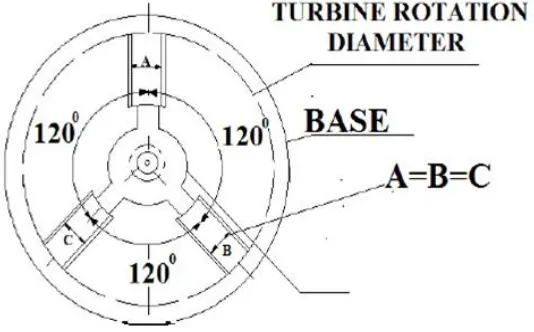
improve the efficiency of the generator at low wind velocity. In this model three blades were connected at an angle
of 1200 to each other by hub which will influence to free rotation to blade in all directions of wind flow. No need to identify the wind flow diction with the help of wind vane anemometer. It resulted that the better power generation at
low height without any vibration so that it can be installed any roof top or agriculture field. The design of the blade
is given below in Fig 1.
829 | P a g e
3.3. Hub Design
Fig. 2 Hub Design
3.4. Vertical Wind Generator
Fig. 3 Vertical Wind Generator
3.5. Hybrid System
The wind is readily available in the atmosphere throughout the day (365) but due to different climate condition it is
required to use photovoltaic (hybrid system) because it will provide good output between 9 am -4 pm .Which the
output of hybrid system can be produced more power which can restore in power bank and utilize for general
830 | P a g e
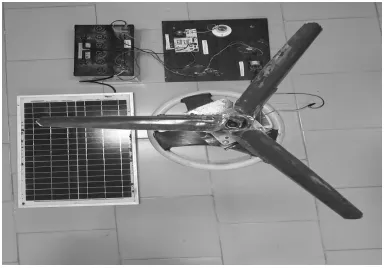
The following equipments are required to build a hybrid power generator.Experimental design the lattice power – 4 feet solar panel: 20 W
Dynamo 24 V, Battery 24V, AC –DC- AC converter:
3.6. Blade Profile
The figure shown below is indicating that vertical wind turbine generator.
Fig. 3 Experimental set up of Vertical Wind Generator
IV RESULT AND DISCUSSION
The experimental study is based on the following parameters: wind speed, Wind generator height (constant),
Humidity, Temperature, Wind velocity and all the parameters with respect to different days in this district
831 | P a g e
Table.1 Observations of Hybrid electricity generation (March – April 2017)
D
ay
s
T
ime
(Hr
s.)
Ave
rage
T
em
p
er
a
ture
(
o
C)
Ave
rage
Wi
n
d
ve
locity
(m
/s
)
Ave
rage
Hu
m
id
ity
(%)
Hybrid output
(V)
Wind
(V)
Solar
(V)
Mon-Sun
9
28
2.0
58
14
10
Mon-Sun
10
33
2.5
62
20
16
Mon-Sun
11
33
2.2
62
18
17
Mon-Sun
12
32
2.0
60
16
16
Mon-Sun
1
30
2.2
55
15
18
Mon-Sun
2
28
2.0
58
15
11
Mon-Sun
3
33
2.5
62
20
17
Mon-Sun
4
33
2.2
62
19
18
Mon-Sun
9
27
1.9
60
14
10
Mon-Sun
10
32
2.4
58
20
16
Mon-Sun
11
32
2.3
61
18
17
Mon-Sun
12
33
2.1
60
16
16
Mon-Sun
1
31
1.9
55
15
18
Mon-Sun
2
29
2.1
58
15
11
Mon-Sun
3
30
2.4
62
20
17
Mon-Sun
4
31
2.2
62
19
18
Mon-Sun
9
28
2.1
60
14
10
832 | P a g e
Mon-Sun
11
33
2.1
62
18
17
Mon-Sun
12
32
1.9
60
16
16
Mon-Sun
1
30
1.8
55
15
18
Mon-Sun
2
28
2.1
58
15
11
Mon-Sun
3
33
2.5
62
20
17
Mon-Sun
4
33
2.2
62
19
18
Mon-Sun
9
28
2.0
58
14
10
Mon-Sun
10
33
2.5
62
20
16
Mon-Sun
11
33
2.2
62
18
17
Mon-Sun
12
32
2.0
60
16
16
Mon-Sun
1
30
2.0
55
15
18
Mon-Sun
2
28
2.0
58
15
11
Mon-Sun
3
33
2.5
62
20
17
Mon-Sun
4
33
2.2
62
19
18
833 | P a g e
V CONCLUSION
The result of the experimental design of Semicircular blade profile provides better efficiency than the existing one
and not effecting by environmental factors. The performance of the vertical wind turbine shows that better hybrid
outputs as compared with the existing design. When the swept rotation is increased the efficiency of the hybrid
system is also increased.
REFERENCE
[1]Bilani, J., 1987, scaling laws for testing airfoils under heavy rain, Journal of Aircraft, vol 24, pp31-37.
[2]E.E. Iheonu, F.O. A. Akingbade, M. Ocholi Wind Resources Variations over selected sites in the West Africansub-region. Nigerian J. Renewable Energy, 10, 43-47(2002).
[3] Gustave P. Corten and Herman F. Veldkamp, 2001, Insects can halve wind turbine power, Nature: Vol 412 issue
5, 42-43.
[4]Hansman, R. J. And Barsotti, M. F., 1985, Surface wetting effects on laminar flow airfoil in simulated heavy rain, Journal of aircraft, Vol 22, pp 1042-1053.
[5]I. A. Adejumobi, A. A. Esan, and A. B. Okunuga “Discovering Potential sites for Small Hydro Power (SHP) in Nigeria”, Journal of Advanced Material Research, Trans Tech Publication, Switzerland. 18-19, 93- 97(2007) ;
(http://www.scientific.net).
[6] Klumpner, C., Al Can, B. and Hann, D., 2010. A Power Electronic Controlled Dump Load with Negligible
Harmonics for Accurate Loading Used in Testing Small Wind
[7] L, Fagbile .”Estimation of Total Solar Radiation in Nigeria Using Metrological, Nigeria Journal of Renewable Energy 1,1 -10. (1990)
[8] M. Nebel and J.P. Molly, 1992, Performance comparison of wind turbines, International Journal of Sustainable
energy, Vol 11, pp 1-19.
[9]M. Thomas (Ed) “Solar Electricity”, John Wiley and Sons Ltd, Chichester, 2nd
Edition. (2004).
[10]M.B. Olajide and J.O. Oni “Application of Solar Energy for offices and homes, Workshop Seminar Paper, International Training School and Workshop on Solar Energy, organized at University of
Agriculture, Abeokuta,9th-11 th June, 18-29. (2009),
[11] Marchman, J. F., Robertson, E. A. And Emsley, H. T., 1987, Rain effects at low Reynolds number, Journal of
aircraft, Vol 24,pp 638-644.
[12] Nicholas Cutler, Merlinde Kay, Kieran Jacka and Torben Skov Nielsen, 2007, Detecting, Categorizing and
Forecasting Large Ramps in Wind Farm Power Output Using 1267 RE&PQJ, Vol.1, No.9, May 2011
[13] R. D. Corrigan and R. D Demiglio, 1985, Effect of precipitation on wind turbine performance, NASA
834 | P a g e
[14]Roulston, M. S., Kaplan, D. T., Hardenberg, J., & Smith, L. A. (2003). Using medium-range weather forecaststo improve the value of wind energy production. Renewable Energy, 28(4), 585-602.
[15] Roy, S. B., & Pacala, S. W. (2004). Can large wind farms affect local meteorology? Journal of Geophysical
Research, 109, D19101.
[16] Roy, S. B., & Traiteur, J. J. (2010). Impacts of wind farms on surface air temperatures. PNAS, 107(42),
17899-17904.U.S. Department of Energy. (2010). How Wind Turbines Work. Retrieved April 28, 2011, from
http://www.eere.energy.gov.
[17] S. N. Walker and J. E. Wade, 1986, Effect of precipitation on wind turbine performance, DOE DE1IOO1144
[18]S.I. Iwuoha. Wind Powered Horizontal Maize Grinder, NJRE, 11, 46-57(2003). [1 0] B.K. Gupta . Wiebull Parameters for Annual and Monthly Wind Speed Distributions for Five Locations in
India, Solar Energy. 37, 469-477. (1986).
[19]Technical brief on Wind Electricity Generation: Retrieved from www.windpower.org
,(2009).
[20]Thompson, B. E., Jang, J. and Dion, J. L, 1995, Wing performance in moderate rain, Journal of Aircraft: Vol 32, pp 1034-1039.