www.orientjchem.org
An International Open Access, Peer Reviewed Research Journal
2019, Vol. 35, No.(3): Pg. 1062-1066
This is an Open Access article licensed under a Creative Commons license: Attribution 4.0 International (CC- BY). Published by Oriental Scientific Publishing Company © 2018
Mechanical Performance Efficiency and Wear Coefficient of
PLA-HAZrO
2in Bones Replacements
FAdHIL K. FARHAN
1, JAFER F. OdAH
1and AHMEd NAMAH MOHAMEd
21Al-Karkh University of Science, College of Science, Baghdad, Iraq.
2Department of Physics, College of science, Muthanna University, Al-Muthanna, Samawa, Iraq.
*Corresponding author E-mail: [email protected]
http://dx.doi.org/10.13005/ojc/350319
(Received: April 20, 2019; Accepted: June 02, 2019)
ABSTRACT
In the current study, biological polymer base polylactic acid (PLA) composites subsidized with biphasic ceramic powder (HAZrO2) was prepared and developed using active mechanical mixing
method. Hydroxyapatite (HA) with size of 52nm was mixed with zirconium dioxide with size of 42nm at 1:1 mixing proportion via ceramic ball mill (350rpm for four hours). The prepared sample was mixed with polymeric powder at (0%, 2%, 4%, 6% and 8%) weight percentage ratio. Afterwards, fluidic mixing and ultrasonic waves methods were used to synthesize the final nanocomposites. Pin-On-Disc method was used to measure wear and the results outputted high advisable nanocomposites with reactance to the cankering compared to PLA alone. Vickers microhardness investigations appear demonstrably acceptable and with exponential enhancement with the incrementing percentage ratio of reinforcing materials. In addition, Young modulus and the absorption energy tests (using Charpy method) showed a high improvement in the mechanical properties of the reinforced n-HAZrO2 powder. All the results were obtained depending on the homogeneous distribution of the nanopowder using both Scanning Electron Microscope (SEM) and Energy Dispersive X-ray (EDX) techniques.
Keywords: PLA, Bones Replacements, Wear, Biomaterials.
INTROdUCTION
A biomaterial is any substance that has been engineered to interact with biological systems for medical purposes such as treating, augmenting, repairing or replacing a tissue function of the body or a diagnostic one. Biomaterials science encompasses elements of medicine, biology, chemistry, tissue engineering and material science.
Biomaterials can be obtained from nature or
can be synthesized in the laboratory by adopting various chemical approaches using metallic components, polymers, ceramics, or composite materials.
In 1969, L. L. Hench et al., found that various types of ceramics and glasses might be joined with living bone1,2. Ceramics are nowadays used widely in medical
applications such as bone implants and dental3,4.
The ceramic-polymer compsites were a possible method of filling cavities that replace amalgams that are suspected to include effects that are toxic5.
Vitreous carbon is used as light and compatible with blood and resistant to wear. In addition, it is used as a replacement of cardiac valve. An amalgam of composite materials that are mineral-organic such as titanium or alumina dioxide with the biocompatible polymers such as PMMA or PLLA could be more prevalent in the future due to their aptitude at combining a biological activity with mechanical properties similar to those of the bone6.
Darmawati et al., designed a bone tissue based on bioceramics and bioactive glasses7.
In addition, biological responses bioactive glass ceramics to products that are ionic was demonstrated Alexander Hoppe et al.,8.
In 2014, Jaime Esteban et al., reported that zirconia ceramics showed significant enhancement over existing materials related to its resistance to wear, reduction, roughening, and biocompatibility9.
In 2016, Zou et al., reported using a zinc calcium phosphate coating on a new class magnesium biodegradable to improve the homocompatibility10.
Batool et al., was enhanced the mechanical characteristics of PMMA-ZrO2 system by increasing reinforced material (zirconia) ration compared with pure PMMA11.
The composites merge a phase of reinforcement polymer with a ceramic matrix to create materials with characteristics that are superior and new to ceramic and polymer. In this study, PLA-HAZrO2 nanocomposites were prepared using active mechanical mixing method. The mechanical characteristics were carried out on the sample that is final and can be used replacement of teeth and bones.
Theoretical part
Hardness is the force of each penetration or indentation unit area and it is widely used to investigate plastic deformation. The hardness test is very important to estimate the materials performance when scratched. There are many hardness tests used in the current study, Vickers microhardness is calculated through the equation.12
(1)
Where p is the applied load and d is the each diameter.
Mechanical impact strength of bone materials is considered as an evidence for fracture resistance and impact energy absorption. Hence, this test is applied on the bone material -PMMA and the prepared nano-composites- as standard samples of (55, 10 and 10mm) without crack.
The following equations were used to calculate the absorption energy E(J), the fracture strength (solidity) I.S and toughness strength K.S13
(2)
Where α=150o and mR=75J is the
pendulum energy.
(3)
Where A is the sample area and E is Young modulus and it was obtained through the equation
Where σ is the stress, ∈ is the strain, P is the pressure , ∆L is the change in the length of the sample and Lo is the initial length.
ExPERIMENTAL
Active mechanical mixing method was used to prepare HAZrO2 powder, where 1:1 molar ratio of
ZrO2 (42nm) and HA (52nm), which is equivalent to
64% of HA and 36% of ZrO2 as weight percent was
incorporated. About 10gm of the obtained powder divided as 6.4 g of HA and 3.6 g of ZrO2 was mixing
up with 20 ball and deposited in the ceramic crisply on a ball milling with 300rpm for 6 h (dry mixing) to get a homogenous powder. The final powder resulted from the last step was thermally treated for two h under 1000oC at 10oC/minute.
Structural properties of final sample after calcination were investigated using EDX, SEM and XRD techniques.
PLA-HAZrO2 nanocomposites. Finally, Vickers microhardness and mechanical impact strength for these composites was calculated.
RESULTS ANd dISCUSSION
Figure 1 shows the XRD pattern for the prepared powder utilized to strengthen PLA polymer.
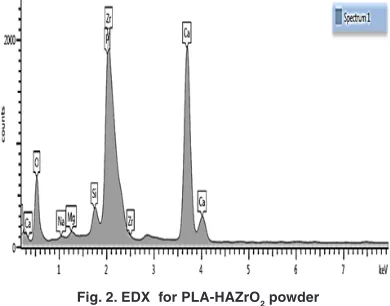
pattern, which shows the weight percentage ratios for the compound components (HAZrO2), while Ca possesses the highest weight ratio followed by Zr and P has the lowest weight ratio, consecutively such: Ca:Zr=1:55, Zr:P=1:96 and Ca:P=3:6. The oxygen ratio kept constant.
Fig. 1. xRd for PLA-HAZrO2 powder
Figure 1 shows the highest peaks at 2q=29o
and 2q=31.8o,which indicates that the elements
has interacted and formed the required compound. The peak at 2q=31.8o is an indication of HA while
ZrO2 appears at the angle 2q=51.01o. The leftover
peaks refer to form (HAZrO2) nanocomposite which resulted from the amalgamating at 400oC.
Energy dispersive by X-ray (EDX) pattern is showing in Figure 2.
Fig. 2. Edx for PLA-HAZrO2 powder
Figure (2) shows the main elements that were mixed in order to form the mixed powder have interacted with each other to form a final compound. Table (1) deduced from the EDX
Table 1: compound components (HAZrO2) weight percentage ratios
Element Wt% Wt% Sigma
O 42.81 0.82
Na 0.45 0.15
Mg 0.60 0.11
Si 1.92 0.11
P 8.26 0.32
Ca 29.78 0.51
Zr 16.19 0.74 Total: 100.00
Figure 3 Shows the scanning electron microscopy (SEM) imaging for nanobioceramics powder under 50Kx magnification
Fig. 3. SEM for PLA-HAZrO2 powder
Granular homogeneity between HA and ZrO2 is evident in SEM image, in addition to the combination between the granules to produce different figurations. SEM image emerges growing in forming granular size consequence to the calcination treatment, whereat the size was less than 80nm.
Wear coefficient or wear average is defined as loss in surface of material during the dry sliding motion because of the friction between the sample’s surface and the surface of rotation disc of the device. In this work, wear coefficient test was done for nanocomposites with PLD polymeric basic using Pin-on-Disk under standard calculation (ASTM-G99).
distribution tacitly within the polymer. Vickers microhardness at 8% percentage weight ratio of n-HAZrO2 was more 80% compared with the unreinforced base (PLA). This improvement in microhardness may be caused by blocking the pores and holes in the polymer and increasing in density of reinforced composites, these reasons lead to high resistance to the scratching and wear.
Fig. 4. Wr, Wv, Ws, and Wcoeff. for PLA-HAZrO2 powder
The experimental results accentuated that all tests are consubstantiality except Wcoeff. Which discorded from the remnant wears and the causation is the fineness in wear measuring and the implicitly of this measurement to the microhardness values and the experimental density for the preparing nanocomposites.
Figure 4 shows the enhancement in the wear with the gainfulness in percentage ratio of reinforced material (HAZrO2) due to the excess in the surface area of the powder and its high microhardness resulted from n-ZrO2 in HAZrO2 which proofed to the wear and friction.
At the ratio 4%, one can notice that all curves suffer the same downtrend for all types of wears and this may be ascribed to the power unisonous circulation within the polymer which gives surface alliterative microhardness and high resistance to the wear and corrodibility this agree with14.
Note worthiness at that all curves start to climb from the ratio 4% accessing to the maximum value then start disembarking at the ratio of 8%, this may attributed to existence some air gaps entered the samples which resulted from the conglomerates within the polymer.
Figure 5 shows Vickers microhardness as a function to the percentage weight n-HAZrO2.
The mechanical properties such Vickers microhardness is improved for the bioceramic PLA reinforced by HAZrO2, this is resulted from the consolidating material and its homogeneously
Fig. 5. Vickers microhardness for PLA-HAZrO2 powder
Stress investigation was carried out using totally machine device under the standard characteristics (ASTM) for the prepared samples with dimensions (2x2x2cm). Fig. 6 shows stress and Young modulus against the percentage weight of n-HAZrO2 for all samples.
Fig. 6. Stress and Young modulus as a function of percentage weight of n-HAZrO2
The value of stress 85MPa for PLA is subtends Y-modulus of 0.98GPa, while with reinforcing ratio of 8% both stress and Y-modulus increase to be 104.8MPa and 2.1GPa respectively. This denotes that the bioceramic powder used in the current study possesses more flexibleness than the polymer own itself, and this gives the composite material high overload-proof at load less than 104.8MPa.
Figure 7 shows the absorption energy and the fracture strength (solidity) variation with the percentage weight of n-HAZrO2 respectively.
Fig. 7. Absorption energy and fracture strength variation with the percentage weight of n-HAZrO2
(PLA). This may attributed to convert PLA from a brittle material to a solid one with high durability due to the reinforcing material which acted to improve PLA from dislocations and suddenly cleavages.
CONCLUSION
From precede; one can conclude that the active mechanical mixing method which used to prepare the bioceramic HAZrO2 powder is agreeable
way to squirreling owner mechanical and biological characteristics of the prepared powder. These characteristics were expressed at the ratio 6% and less than this ratio rapidly and then resides and diminishing at ratio more than 6%.
From the results of mechanical tests, it can educed that the omnipotence of the prepared nanocomposites to be used as redemptive instead of bones and teeth alike.
ACKNOWLEdgMENT
This research did not receive any specific grant from funding agencies in the public, commercial, or not-for-profit sectors.
Confilicts of Interest
The authors declare no confilict of interest. Figure 7 indicates that the enhancement
in the absorption energy and the fracture strength (Kc) for a prepared composites which reinforced by HAZrO2 powder compared with the base material
REFERENCES
1. Hench, L. L. J. Am. Ceram. Soc., 1991, 74, 1487. 2. Yamamuro, T.; Hench, L.L. Wilson, J. Journal
of Biomedical Materials Research banner .,
1990, 25, 903-904.
3. Muster, D. Biomaterials hard tissue repair and replacement, North-Holland., 1992.
4. Kinnari, T. J.; Esteban, J.; Gomez-Barrena, E.; Zamora, N.; Fernandez-Roblas, R.; Nieto, A.; Doadrio, J. C.; López-Noriega, A.; Ruiz-Hernández, E.; Arcos, D.; Vallet-Regí, M. Journal biomedical materials research., 2008, 89, 215-223.
5. Boch, P.; Niepce, J. C. Ceramic Materials: Processes, Properties and application, United States, ISTE Ltd., 2007.
6. Thamaraiselvi, T. V.; Rajeswari, S. Trends Biomater. Artif. Organs., 2004, 18, 9-17. 7. Younos, D. M.; Bretcanu, O.; Boccaccini, A. R.
Journal of materials science., 2008, 43 4433-4442. 8. Hoppe, A.; Güldal, N. S.; Boccaini, A. R.
Biomaterialsm., 2011, 11, 2757-2774. 9. Esteban, J.; Gomez-Barrena, E. Microbiology for
surgical infections, Academic Press., 2014, 324. 10. Mulinti, A.E. Hemocompatibility of Biomaterials
for clinical applications, Woodhead Publishing 1st Edition., 2017, 253-278.
11. Obead, B.; Farhan, K.; Mohammed, J. E. Jour.of adv. Research and controlling systems., 2018, 10. 12. Otsuka, T.; Chujo, Y. Polym. J., 2008, 40,
1157–1163.
13. Poskus, L. T.; Placido, E.; Capel Cardoso, P. E. Dent Mater., 2004, 20, 726-732.
14. Farhan, F. K.; Kadhim, M. O.; Ashour, S. J.