www.orientjchem.org
An International Open Access, Peer Reviewed Research Journal
2019, Vol. 35, No.(4): Pg. 1463-1468
This is an Open Access article licensed under a Creative Commons license: Attribution 4.0 International (CC- BY). Published by Oriental Scientific Publishing Company © 2018
Electronic And Spectral Studies of Some Five Coordinate
Complexes of Copper (II)
BIRENdRA KUMAR
1*, REKHA RANI
2, dAYANANd PRASAd
2,
PRAvEEN KUMAR SINgH
1, AMIT KUMAR
2and SHIvAdHAR SHARMA
21Department of Chemistry, Jagjiwan College, Gaya-823 001, India. 2Department of Chemistry, M. U. Bodh-Gaya-823 001, India.
* Corresponding author E-mail: [email protected]
http://dx.doi.org/10.13005/ojc/350430
(Received: June 06, 2019; Accepted: August 16, 2019)
ABSTRACT
1-phenylazo-2-nephthol has been synthesized and used for complexation with Cu(II) metal ion along with pyridine, α-picoline, β-picoline, γ-picoline and water as secondary ligands. On the basis of elemental analysis and molar conductivity complexes were formulated as CuL2X [Where L is the prime ligand i.e 1-phenyl-azo-2-nephthol and X is the secondary ligand i.e. pyridine, α-picoline,
β-picoline, γ-picoline and H2O.] The magnetic moment of these complexes (1.80-1.83 BM) indicates that these complexes are magnetically dilute. The appearance of 3 bands in the electronic spectra of complexes rules out the trigonal bipyramidal (D3h) symmetry arround Cu(II) ion in these complexes
rather the electronic spectra favours square pyramidal (C4V) symmetry of these five coordinate complexes. The highest value of 10Dq clearly indicates the greater coordinating ability of α-picoline than pyridine, β-picoline and γ-picoline.
Keywords:α-picoline, β-picoline, γ-picoline, trigonal bipyramidal [D3h], square pyramidal [C4V],
Five coordinate complexes, Magnetically dilute. INTROdUCTION
The well known story of blue proteins which have been extensively explored due to their involvement in oxygen and electron transfer in physiological reactions, is well documented1-2. Metal
ions are electron deficient while most of biological molecules like proteins, DNA, etc, are of these opposing charges leads to a general tendency to form metal ions polymers3-4. Chemical nucleaes based on
the transition metal ions, cleave DNA hydrolytically or oxydatively with or without added reductant.
Cu(II) hypyrimol complex [Cu(Hypyrimol)Cl] has been reported to cleave jX174 supercoiled DNA efficiently without any reductant and also showed high cytotoxicity toward L1210 murine Leukemia
and A2780 human, ovarian carcinoma cancer cell lines5-6. Riboflavin binding protein responsible for
active transport and storage of riboflavin in egg needed for developments also binds Cu7. Dinuclear
complexes of copper are also well known artificial metalonucleases and metaloprotenase8.Recently
Recently Day et al.,10 have reported five
coordinate Cu(II) complexes with a N, O donor Schiff-base ligand which showed their effective participation in CT-DNA binding and pBR322 DNA cleavage activities.
The interest in five coordinate complexes took root in 1974 when M. Nonoyama11 studied five
coordinate Ni(II) and Cu(II) complexes and reported their magnetic moments, infrared and electronic spectra.
Albertin et al.,12 have reported the synthesis
and properties of five coordinate Cu(II) complexes with amine ligand.Milan Melnik et al.,13 have
made a review in 2006 on five coordinate Cu(II) complexes.The review summarises the data over a good number of four and five coordinate Cu(II) complexes, mostly with square pyramidal symmetry. The interesting structural features of five coordinate complexes with either square pyramidal or trigonal bipyramidal symmetry invited our attention to five coordinate complexes. In continuation of our previous work14-17, in the present paper we report the synthesis
and spectral properties of some five coordinate Cu(II) complexes with 1-phenylazo-2-nephthol (PANH) as prime ligand and α-picoline, β-picoline, γ-picoline and water as secondary ligand.
MATERIAL ANd METHOdS
All the reagents used were of AnalR grade and were used without further purification. Benzene diazonium chloride and 2-nephthol were procured from Marc. India and copper chloride hexa hydrate (CuCl2.6H2O) was purchased from Nice. The ligand 1-phenylazo-2-nephthol (PANH)
was prepared by heating the mixture of 0.01 mole (1.425 g) of benzene diazonium chloride and 0.01 mole (1.44 g) of 2-nephthol in ethanolic solution for one hour with stirring. On cooling the solution at room temperature, a brown pericipitate appeared which was filtered and washed with alcohol several times. It was recrystallized in alcohol and dried in an electric oven at 900C. The yield was found
about 80% and its melting point was recorded 1150C. The ligand was used for complaxation with
Cu(II) by the usual method of reflux of the ethanolic solution of 0.01 mole of CuCl2.6H2O, 0.02 mole of PANH and 0.01 of the secondary ligands pyridine or α-picoline or β-picoline or γ-picoline. Pyridine, α-picoline, β-picoline and γ-picoline were used as secondary ligand. Complexes were recrystallized in 1:1 ethanol-acetone solvent. The micro analysis of carbon, hydrogen and nitrogen in ligand as well as complexes were carried out by using micro analysis technique on Carbo Erba Micro Analyzer 1108. Copper content in complexes was determined iodometrically. The molar conductivity of the complexes was measured at room temperature with its DMSO solution of 10-3 M concentration using
Toshniwal digital conductivity meter with deep type cell. The I. R. Spectra of the ligand, 1-phenylazo-2-nephthol and its Cu(II) complexes were recorded on PerkinElomer Model Arc RX1 Spectrophotometer. The magnetic susceptibility of the complexes was measured at room temperature by Gouy’s balance using CuSO4.5H2O as calibrant. The electronic
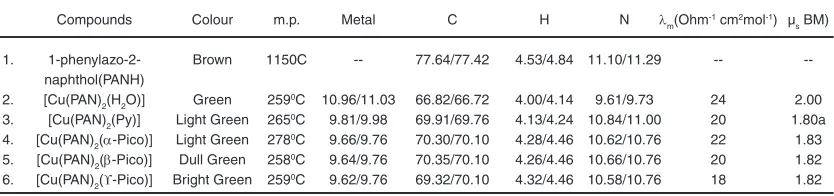
spectra of complexes were recorded on Perkin-Elmer Lambda 950 Spectrophotometer. The analytical data, magnetic moment and molar conductivity have been presented in Table 1.
Table 1: Percentage Composition (%) Found/Calculated, Molar Conductivity and Magnetic Moment
Compounds Colour m.p. Metal C H N λm(Ohm-1 cm2mol-1) µ s BM)
1. 1-phenylazo-2- Brown 1150C -- 77.64/77.42 4.53/4.84 11.10/11.29 -- --naphthol(PANH)
2. [Cu(PAN)2(H2O)] Green 2590C 10.96/11.03 66.82/66.72 4.00/4.14 9.61/9.73 24 2.00
3. [Cu(PAN)2(Py)] Light Green 2650C 9.81/9.98 69.91/69.76 4.13/4.24 10.84/11.00 20 1.80a
4. [Cu(PAN)2(α-Pico)] Light Green 2780C 9.66/9.76 70.30/70.10 4.28/4.46 10.62/10.76 22 1.83
5. [Cu(PAN)2(β-Pico)] Dull Green 2580C 9.64/9.76 70.35/70.10 4.26/4.46 10.66/10.76 20 1.82
6. [Cu(PAN)2(ϒ-Pico)] Bright Green 2590C 9.62/9.76 69.32/70.10 4.32/4.46 10.58/10.76 18 1.82
RESULT ANd dISCUSSION
The molar conductivity of complexes falls in the range of 18-24 Ohm-1 cm2mol-1, which is
indicative of non electrolytic nature of complexes18-22.
of the free ligand and complexes, some important bands of interest have been discussed here. The IR spectrum of the free ligand displays a broad band at 3200 cm-1 which may be assigned to intramolecular
hydrogen bonded phenolic group vibration.23-25 The
possibility of intramolecular H-Bond formation in the ligand may be seen from its structure.
This band disappears in the spectrum of all the complexes of Cu(II) indicating the deprotonation of phenolic O-H group and subsequent coordination through it26-28. This supposition is further confirmed
by red shift in the absorption frequency of νAr-C-O stretching vibration, from 1040 cm-1 in the spectra
of free ligand to 1050-1055 cm-1 in the spectra of
complexes29-31. The bands appearing at 1610 cm-1
(weak and sharp), 1525 cm-1 (strong and sharp) and
1480 cm-1 (medium and sharp) may be assigned to
aromatic ring vibration32-33. The weak and broad band
appearing at 1455 cm-1 in the spectra of free ligands
as well as complexes is assigned to the ring vibration of two condensed ring system i.e. naphthalene34-35.
Thus the presence of both benzene and naphthalene rings in the ligand and complexes is confirmed. A very weak band appearing at 1410 cm-1 in the
IR spectra of free ligand has reasonably been assigned to ν-N=N- stretching vibration36. This band is
found to have undergone blue shifts in the spectra of complexes wherein it absorbs at 1380-1385 cm-1. This negative shifting in stretching vibration of
–N=N- (azo) group is indicative of its involvement in coordination to Cu (II) in complexes37-38. This
coordination may further be substantiated by an increase in absorption frequency of ν-C-N stretching
which shifts from 1290 cm-1 in the IR spectrum of
free ligand to 1295-1300 cm-1 in the spectra of all
the complexes. A tacit support from such proposition may be brought out more clearly from far infrared range wherein two new vibration bands appear in the range of 490-510 cm-1 due to ν
-Cu-N and at
410-420 cm-1 due to ν
-Cu-O39-41. In addition to these
bands some new bands also appear in spectra of complexes.A broad band appearing at 1400 cm-1
with another band at 910 cm-1 are the diagnostic ( Five membered ring )
band for coordinated water42-43. The appearance
of new bands at 755-795 cm-1 is the signature of
the presence of coordinated pyridine, α-picoline, β-picoline and γ-picoline in complexes number 3, 4, 5 and 6 respectively.44-45 The graphs of FTIR
spectra of the ligand as well as its complexes have been given in Figure 1-5.
Fig. 1. IR Spectrum of 1-Phenylazo-2-Naphthol, (PNAH)
Fig. 2. IR Spectrum of Cu(PAN)2Py
Fig. 3. IR Spectrum of Cu(PAN)2(α-Pico)
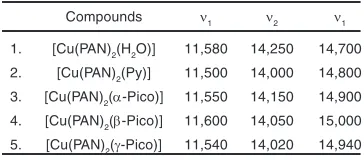
coordinate Cu(II) complexes display three bands in their electronic spectra which are given below in Table 2 with their assignment.
Assignment of these bands may be given as
below:-ν1=2B1 → 2A1
ν2=2B 1 →2B2
ν3=2B1 →2E Fig. 5. IR Spectrum of Cu(PAN)2(H2O)
The magnetic moment values of complexes fall in the range of 1.80-2.00BM, which is greater than µs for 1-unpaired electron in d9 System i.e., 1.732BM.
It shows that all the complexes are magnetically dilute. The values however couldn’t predict the geometry of complexes46-48.
From the stoichiometric formula derived from elemental analysis and molar conductivity it may be inferred that Cu(II) complexes are five coordinated, which may either be of trigonal bipyramidal symmetry (D3h) or square pyramidal geometry (C4v).49 It has
been reported that though a trigonal bipyramidal structure is eventually favoured for a five coordinate species, the energy difference between the two is in general rather small. So square pyramidal symmetry for five coordinate complexes may actually be favoured especially when ligands are large and bulki50-51.
The other major point to predict the symmetry of a five coordinate complex is that for a complex of D3h symmetry the electronic spectral bands at 10,
500-14, 600 cm-1 are observed with greater absorption
intensity of the lower energy.52-53 The five coordinate
complexes of C4v symmetry display electronic spectral
bands in the range of 11400-15000 cm-1 with greater
absorption intensity of the band of higher energy. Secondly the splitting pattern of 2D-term of d9 system.
Under the perturbation of D3h crystal field and C4v crystal field may be given as
below:-Table 2: Electronic spectral band in cm-1
Compounds ν1 ν2 ν1
1. [Cu(PAN)2(H2O)] 11,580 14,250 14,700 2. [Cu(PAN)2(Py)] 11,500 14,000 14,800 3. [Cu(PAN)2(α-Pico)] 11,550 14,150 14,900 4. [Cu(PAN)2(β-Pico)] 11,600 14,050 15,000 5. [Cu(PAN)2(γ-Pico)] 11,540 14,020 14,940
Since the ν2 is the measure of 10Dq. So 10Dq values of these complexes [Cu(PAN)2(H2O)], [Cu(PAN)2(Py)], [Cu(PAN)2(α-Pico)], [Cu(PAN)2 (β-Pico)] and [Cu(PAN)2(γ-Pico)] are 14,250, 14,000, 14,150, 14,050 and 14,020 cm-1 respectively. Since
the planner ligand PANH is the same producing the same crystal field the change in Dq value has been caused by the comparable strength of the ligand along Z-axis. The values are in good arrangement with the values reported for Cu(II) complexes of square pyramidal geometry54-56.
CONCLUSION
On the basis of the forgoing study of electronic spectra of complexes whole the Cu(ii) complexes have been found to posses square pyramidal (C4v) symmetry. The tentative structure is given as below.
ACKNOwLEdgEMENT
The authors are thankful to Dr. R. P. S. Chauhan, Professor and Head. Department of Chemistry, to allowing us the labs at University department of Chemistry and also directing
Technician Dr. Md. Alamgir to record the FTIR and Electronic spectra of complexes.
Conflicts of Interest
The authors declare no conflict of interest.
REFERENCES
1. Uhlmann, E.U.; Peymann, A. Chem. Rev., 1990, 90, 543.
2. Sigman, D.S.; Mazumdar, A.; Perkin, D.M.
Chem. Rev., 1993, 93, 2295.
3. Schreiber, S.L.; Bioorg. Med. Chem., 1998,
6, 1127.
4. Jemieson, E.R.; Lippard, S. J. Chem. Rev., 1999, 99, 2467.
5. Maheshwari, P. U.; Ray, S.; Dulk, H.; den Barends, S.; Wezel, G.; Van Kozlevcar, B.; Gamez, P.; Reedijik, J. J. Am. Chem. Soc., 2006, 128, 710.
6. Maheshwari, P. U.; Der Ster, M.V.; Smulders, S.; Brends, S.; Wezel, G.; Van. Massera, C.; Roy, S.; Dulk, H. Den.; Gamez, P.; Reedijk, J.
J. Inorg. Chem., 2008, 74, 3719.
7. Smith, S. R.; Pala, I.; Parsons, M. B. J. Inorg. Biochem., 2006,100, 1730.
8. Liu, C.; Wang, M.; Zhang, T.; Sun, H. Coord. Chem. Rev., 2004, 248, 147.
9. Bharti, S.; Chaudhary, M.; Rawat, S. P.; Sangeeta, Noorussabah, Ahmad, K.; Sharma, S. R.; Saket, S.S.; Singh, B.; Das, B.; Kumar, S. J. Indian. Chem. Soc., 2016, 93, 953. 10. Day, D.; Pal, S.; Bag, P. P.; Saha, S.; Chandraleka
S.; Dhamsekran, D.; Kole, N.; Biswas, B. J. Ind. Chem. Soc., 2015, 92, 191.
11. Nonoyama, M. Inorg. Chimi. Acta., 1975, 10, 59. 12. Albertin, G.; Bordignon, E.; Orio, A. A. J. Am.
Chem. Soc., 1975, 14, 1411.
13. Melnik, M.; Kavesova, M. Dunaj-Jurco, M.; Clive, E.; Holloway, J. Coord. Chem., 2006, 35, 182. 14. Kumar, B.; Kumar, R.; and Kumar, B. Orient.
J. Chem., 2015, 31(3), 1827.
15. Kumar, B.; Kumar, B. Kumar, S.; Kumar, D.; and Sharma, S. Orient J. Chem., 2017, 33(5), 2643. 16. Kumari, B.; Kumar, B.; Kumar, S.; Kumar, D.;
Sharma, S. Int. J. Engg. Sci. Inv., 2018, 7(5), 14. 17. Kumar, V.; Singh, R. K.; Kumari, V.; Kumar, B.;
Sharma, S. Orient. J. Chem., 2018, 34(4), 1937.
18. Kumari, P.; Prakash, S.; Prakash,, D. J. Ind. Chem. Soc., 2012, 89, 19.
19. Rama, I.; Rama Shwami, S. J. Ind. Chem. Soc., 2014, 91, 1877.
20. Kumar, B.; Kumar, B. Kumar, S.; Kumar, D.; and Sharma, S. Orient J. Chem., 2017, 33(5), 2643. 21. Kumari, B.; Kumar, B.; Kumar, S.; Kumar, D.;
Sharma, S. Int. J. Engg. Sci. Inv., 2018, 7(5), 14. 22. Kumar, V.; Singh, R. K.; Kumari, V.; Kumar, B.;
Sharma, S. Orient. J. Chem., 2018, 34(4), 1937. 23. Rahman, F.; Hiremath, B.; Basava Rajaiah, S.
M.; Jaya Kumar Oswamy, B. H. M.; Swami, M.
J. Ind. Chem. Soc., 2008, 85, 381.
24. Mahapatra, B. B.; Sarangi, A. K. J. Ind. Chem. Soc., 2009, 86, 559.
25. Kumar, D.; Shayamal, A.; Kumar, A.; Gupta, P. K.; Das, D. J. Ind. Chem. Soc., 2010, 87, 417. 26. Mishra, L. K.; Keshri, B. K. Ind. J. Chem. Sect
A., 1981, 28, 863.
27. Singh N. K. and Singh S. B., Ind. J. Chem.
Sect A. 1993, 40, 1070.
28. Raman, M.S.; Maninaram, A.; Arunachalan, S.; Krishnan ,C. J.; Chinnuswami, V. J. Ind. Chem. Soc., 2008, 85, 988.
29. Shriniwashan, R.; Verghese.;B.; Sougand, I.; Velaban, K.; Vendkatesan, R.; Rao, P. S.
Polyhedran., 2004, 23, 115.
30. Prabhakaran, R.; Krishnan, V.; Karbendu, R.; Geetha, A.; Vertognolli.; Natrajan. K. Inorg. Chem. Acta., 2006, 359, 1114.
31. Das, A. K.; Dev, D.; Bhowmik, K. R. N.; Purkayastha, R. N. D. J. Ind. Chem. Soc., 2009, 86, 76.
32. Thangadurai, T. D.; Gowri, M.; Natrajan, K. Synth. React. Inorg. Metal. Org. Chem., 2002, 32, 329. 33. Singh, M. K.,Laskar, A. D. R.; Paul, B. J. Ind.
Chem. Soc., 2008, 85, 485.
35. Chandra, S.; Jain, D.; Sarkar, A.; Anupama.
J. Ind. Chem. Soc., 2009, 220.
36. Williams, D. H.; Flemming, I. “Spectroscopic method inorganic Chemistry”, TATA Mc Graw Hill Publishing company Ltd. New Delhi, 4th
ed. Eighth reprint., 2001, 52-53.
37. Kumaran Nair, M.L.H.; Shyamla, L. J. Ind. Chem. Soc., 2009, 86, 133.
38. Balasubramanian, K. P.; Raju, V. V.; Chinnusamy, V. J. Ind. Chem. Soc., 2009, 86, 570.
39. Ahmad, I.; Akhtar, F. Ind. J. Chem., 1981, 20A, 737. 40. Raman, M. J. Ind. Chem. Soc., 2008, 85, 1082. 41. Krishnankutty, K.; Ummathur, M. D.; Saynder,
P. J. Ind. Chem. Soc., 2009, 86, 325. 42. Nakamoto, K. “Infrared spectra of Inorganic
and coordination Compounds” , John Wiley and Sons, Inc. New York., 1953, 156. 43. Saha, N.; Dutta, K. N.; Adak, A. K. Ind. J.
Chem., 1981, 20A, 744.
44. Albrecht, M. G.; Creghton, J. A. J. Amer. Chem. Soc., 1977, 99, 5215.
45. Yamada, H. Apppl. Spectros. Rev., 1981,
17, 227.
46. Sunatsuki,Y.; Motoda,Y.; Matsumoto, N.
Coord. Chem. Rev., 2002, 226, 199.
47. Roth, A.; Becher, J.; Hermann, C.; Gorla, H.; Vaughan, G.; Ritcher, M.; Klemn, D.; Plass, W. Inorg. Chem., 2006, 45, 10066.
48. Mishra, A. P.; Kumar, K. J. Ind. Chem. Soc., 2009, 86, 1150.
49. Mutterties,; Schunn. Quart. Rev. (London).,
1966, 20, 245.
50. Brewster, J. A.; Sarage, C. A.; Venanze. J. Chem. Soc., 1961, 3699.
51. Hertley, J. G.; Verangie, L. M.; Goodall, D. C.
J. Chem. Soc., 1963, 4930.
52. Nakamoto, K.; Mc Carthy, P. J., “Spectrocopy and structure of metal chelate compounds”, John Wiley and Sons Inc. New York, 1968, 117-122. 53. Bencini, A.; Gatteschi, D. Inorg. Chem., 1977,
16, 1994.
54. Hathaway, B. J.; Billing. Coord. Chem. Rev., 1970, 5, 143.
55. Hitchman, M. A. Inorg. Chem., 1974, 13, 2218. 56. Kumar, B.; Sangal, S. K.; Kumar, A. J. Ind.