SIFT: Scale Invarient Feature Transforms
for Efficient Iris Recognition
1
Payal Garg,
2Deepika Arora
1,2Dept. of Computer Science and Engineering, RPIIT, Bastara Karnal, Karnal, Haryana, India
Abstract
Iris recognition is an automated method of biometric identification that uses mathematical pattern-recognition techniques. The purpose of ‘Iris Recognition’, a biometrical based technology for personal identification and verification, is to recognize a person from his/her iris prints. In fact, iris patterns are characterized by high level of stability and distinctiveness. Each individual has a unique iris. Not even one egged twins or a future clone of a person will have the same iris patterns. It is stable over time even though the person ages. Iris recognition is the most precise and fastest of the biometric authentication methods. The iris is an externally visible, yet protected organ whose unique epigenetic pattern remains stable throughout adult life. These characteristics make it very attractive for use as a biometric for identifying individuals. The purpose of ‘Iris Recognition’, a biometrical based technology for personal identification and verification, is to recognize a person from his/her iris prints. Image matching is a fundamental aspect of many problems in computer vision, including object or scene recognition, solving for structure from multiple images, stereo correspondence, and motion tracking. The features are invariant to image scaling and rotation, and partially invariant to change in illumination and camera viewpoint. They are well localized in both the spatial and frequency domains, reducing the probability of disruption by occlusion, clutter, or noise. Large numbers of features can be extracted from typical images with efficient algorithms. In addition, the features are highly distinctive, which allows a single feature to be correctly matched with high probability against a large database of features, providing a basis for object and scene recognition. In this paper we propose SIFT based iris recognition method, For iris matching and recognition, SIFT features are first extracted from a set of reference images and stored in a database. A new image is matched by individually comparing each feature from the new image to this previous database and finding candidate matching features based on Euclidean distance of their feature vectors. The keypoint descriptors are highly distinctive, which allows a single feature to find its correct match with good probability in a large database of features. However, in a clutteredimage, many features from the background will not have any correct match in the database, giving rise to many false matches in addition to the correct ones. The correct matches can be filtered from the full set of matches by identifying subsets of keypoints that agree on the object and its location, scale, and orientation in the new image.
Keywords
Iris Recognition, Periocular Recognition, Feature Extraction, SIFT Features
I. Introduction
Prevailing methods of human identification based on credentials (identification documents and PIN) are not able to meet the growing demands for stringent security in applications such as national ID cards, border crossings, government benefits, and access control. As a result, biometric recognition, or simply biometrics, which is
based on physiological and behavioral characteristics of a person, is being increasingly adopted and mapped to rapidly growing person identification applications. Unlike credentials (documents and PIN), biometric traits (e.g., fingerprint, face, and iris) cannot be lost, stolen, or easily forged; they are also considered to be persistent and unique.
Use of biometrics is not new; fingerprints have been successfully used for over one hundred years in law enforcement and forensics to identify and apprehend criminals. But, as biometrics permeates our society, this recognition technology faces new challenges. The design and suitability of biometric technology for person identification depends on the application requirements. These requirements are typically specified in terms of identification accuracy, throughput, user acceptance, system security, robustness, and return on investment. The next generation biometric technology must overcome many hurdles and challenges to improve the recognition accuracy. These include ability to handle poor quality and incomplete data, achieve scalability to accommodate hundreds of millions of users, ensure interoperability, and protect user privacy while reducing system cost and enhancing system integrity. This chapter presents an overview of biometrics, some of the emerging biometric technologies and their limitations, and examines future challenges.
A. Face Recognition
Humans have a remarkable ability to recognize fellow beings based on facial appearance. So, face is a natural human trait for automated biometric recognition. Face recognition systems typically utilize the spatial relationship among the locations of facial features such as eyes, nose, lips, chin, and the global appearance of a face. The forensic and civilian applications of face recognition technologies pose a number of technical challenges both for static mug-shot photograph matching (e.g., for ensuring that the same person is not requesting multiple passports) to unconstrained video streams acquired in visible or near-infrared illumination (e.g., in surveillance). An excellent survey of existing face recognition technologies and challenges is available. The problems associated with illumination, gesture, facial makeup, occlusion, and pose variations adversely affect the face recognition performance. While face recognition is non-intrusive, has high user acceptance, and provides acceptable levels of recognition performance in controlled environments, robust face recognition in non-ideal situations continues to pose challenges.
B. Iris Recognition
Daugman, both the accuracy and matching speed of currently available iris recognition systems is very high. Iris recognition has been integrated in several large-scale personal identification systems (e.g., border crossing system in the United Arab Emirates). Several efforts are also being made to capture iris at a distance. However, relatively high sensor cost, along with relatively large failure to enroll (FTE) rate reported in some studies, and lack of legacy iris databases may limit its usage in some large-scale government applications.
Fig. 1: Commonly used Biometric Traits: (a) Fingerprint, (b) Face, (c) Iris, (d) Hand Shape, (e) Palmprint, (f) Ear, (g) Retina, and (h) Signature.
II. Literature Survey
Jameson Merkow et al.2010 [1] In this paper, the periocular region, the region of the face surrounding the eyes, has gained increasing attention in biometrics in recent years. This region of the face is of particular interest when trying to identify a person whose face is partially occluded. We propose the novel idea of applying the information obtained from the periocular region to identify the gender of a person, which is a type of soft biometric recognition. We gradually narrow the region of interest of the face to explore the feasibility of using smaller, eye-centered regions for building a robust gender classifier around the periocular region alone. Our experimental results show that at least an 85% classification rate is still obtainable using only the periocular region with a database of 936 low resolution images collected from the web.
Anil K. Jain et al.2010 [2] In this paper,trevailing methods of human identification based on credentials (identification documents and PIN) are not able to meet the growing demands for stringent security in applications such as national ID cards, border crossings, government benefits, and access control. As a result, biometric recognition, or simply biometrics, which is based on physiological and behavioral characteristics of a person, is being increasingly adopted and mapped to rapidly growing person identification applications. Unlike credentials (documents and PIN), biometric traits (e.g., fingerprint, face, and iris) cannot be lost, stolen, or easily forged; they are also considered to be persistent and unique. Use of biometrics is not new; fingerprints have been successfully used for over one hundred years in law enforcement and forensics to identify and apprehend criminals. But, as biometrics permeates our society, this recognition technology faces new challenges. The design and suitability of biometric technology for person identification depends on the application requirements. These requirements are typically specified in terms of identification accuracy, throughput, user acceptance, system security, robustness, and return on investment.
Karen Hollingsworthet al.2010 [3] In this paper, the periocular region is the part of the face immediately surrounding the eye, and researchers have recently begun to investigate how to use the periocular region for recognition. Understanding how humans recognize faces helped computer vision researchers develop algorithms for face recognition. Likewise, understanding how humans analyze periocular images could benefit researchers developing algorithms for periocular recognition. We presented pairs of periocular images to testers and asked them to determine whether the two images they’re from the same person or from different people. Our testers correctly determined the relationship between the two images in over 90% of the queries. We asked them to describe what features in the images they’re helpful to them in making their decisions. We found that eyelashes tear ducts, shape of the eye, and eyelids they’re used most frequently in determining whether two images they’re from the same person. The outer corner of the eye and the shape of the eye they’re used a higher proportion of the time for incorrect responses than they they’re for correct responses, suggesting that those two features are not as useful.
Damon L. Woodardet al.2010 [4] In this paper, Human recognition based on the iris biometric is severely impacted when encountering non-ideal images of the eye characterized by occluded irises, motion and spatial blur, poor contrast, and illumination artifacts. This paper discusses the use of the periocular region surrounding the iris, along with the iris texture patterns, in order to improve the overall recognition performance in such images. Periocular texture is extracted from a small, fixed region of the skin surrounding the eye. Experiments on the images extracted from the Near InfraRed (NIR) face videos of the Multi Biometric Grand Challenge (MBGC) dataset demonstrate that valuable information is contained in the periocular region and it can be fused with the iris texture to improve the overall identification accuracy in non-ideal situations.
Samarth Bharadwajet al.2010 [5] In this paper,The performance of iris recognition is affected if iris is captured at a distance. Further, images captured in visible spectrum are more susceptible to noise than if captured in near infrared spectrum. This research proposes periocular biometrics as an alternative to iris recognition if the iris images are captured at a distance. We propose a novel algorithm to recognize periocular images in visible spectrum and study the effect of capture distance on the performance of periocular biometrics. The performance of the algorithm is evaluated on more than 11,000 images of the UBIRIS v2 database. The results show promise towards using periocular region for recognition when the information is not sufficient for iris recognition.
III. Proposed Work
In this work, we attempt to mitigate some of these concerns by considering a small region around the eye as an additional biometric. We refer to this region as the periocular region. We explore the potential of the periocular region as a biometric in color images pertaining to the visible spectral band. Some of the benefits in using the periocular biometric trait are as follows:
In images where the iris cannot be reliably obtained (or used), 1.
the surrounding skin region may be used to either confirm or refute an identity. Blinking or off-angle poses are common sources of noise during iris image acquisition.
The periocular region represents a good trade-off between 2.
The periocular region can offer information about eye shape 3.
that may be useful as a soft biometric.
When portions of the face pertaining to the mouth and nose 4.
are occluded, the periocular region may be used to determine the identity.
The design of a newer sensor is not necessary as both periocular 5.
and face regions can be obtained using a single sensor.
IV. Result Analysis
A. Characteristics of MATLAB
Programming language based on matrices 1.
Slow (compared with Fortran or C) because it is an interpreted •
language, i.e. not pre-compiled.
Automatic memory management, i.e. you do not have to •
declare arrays in advance. Intuitive, easy to use. •
Compact. •
Can be converted into C code via MATLAB compiler for •
better efficiency.
Many application-specific toolboxes available. 2.
V. On shared-memory parallel computers such as the SGI Origin2000, certain operations processed in parallel autonomously when computation load warrants.
The toolboxes used for this thesis are image processing toolbox and wavlelet toolbox. These toolboxes provide engineers and scientists with an extensive suite of robust digital image processing and analysis functions. Image processing toolbox is designed to free technical professionals from the time consuming tasks of coding and debugging fundamental image processing and analysis operations from scratch. This translates into significant time saving and cost reduction benefits, enables to spend less time coding algorithms and more time exploring and discovering solutions to your problems. The toolbox supports a wide range of image processing operations, including the following:
Displaying and exploring images •
Spatial transformations •
Morphological operations •
Analyzing and enhancing images •
Linear filtering and filter design •
Neighborhood and block operations •
Image deblurring •
Region based processing •
INPUT IMAGE
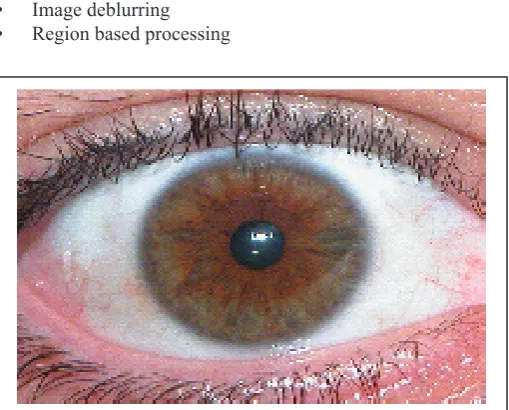
Fig. 1: Input Image taken from the UBIRIS Dataset of Person 1
Gray image
Fig. 2: Image After Grayscale Conversion, Conversion to Grayscale is done to Reduce Complexity
Fig. 3: Image Histogram of the Input Image
An image histogram is a type of histogram that acts as a graphical representation of the tonal distribution in a digital image. It plots the number of pixels for each tonal value. By looking at the histogram for a specific image a viewer will be able to judge the entire tonal distribution at a glance.
CANNY IMAGE
Fig. 4: Canny Image
Fig. 5: Iris Template of Person 1 in UBIRIS Dataset using Proposed Method
A template created by imaging an iris is compared to stored template(s) in a database. If the Hamming distance is below the decision threshold, a positive identification has effectively been made because of the statistical extreme improbability that two different persons could agree by chance (“collide”) in so many bits, given the high entropy of iris templates.
Fig. 6: Iris Mask of Person 1 in UBIRIS Dataset using Proposed Method
The goal of matching is to evaluate the similarity of two iris representations. Created templates are compared using the Hamming distance. The normalized Hamming distance used measures the fraction of bits for which two iris codes disagree. A low normalized Hamming distance implies strong similarity of the iris codes. If parts of the irises are occluded, the normalized Hamming distance is the fraction of bits that disagree in the areas that are not occluded on either image. To account for rotation, comparison between a pair of images involves computing the normalized Hamming distance for several different orientations that correspond to circular permutations of the code in the angular coordinate. The minimum computed normalized Hamming distance is assumed to correspond to the correct alignment of the two images.
Target Class
0 1
Ou
tp
ut
C
la
ss
0
1
0
0.0%
19
1.6%
0.0% 100%
16
1.3%
1170
97.1%
98.7% 1.3%
0.0% 100%
98.4% 1.6%
97.1% 2.9% Confusion Matrix
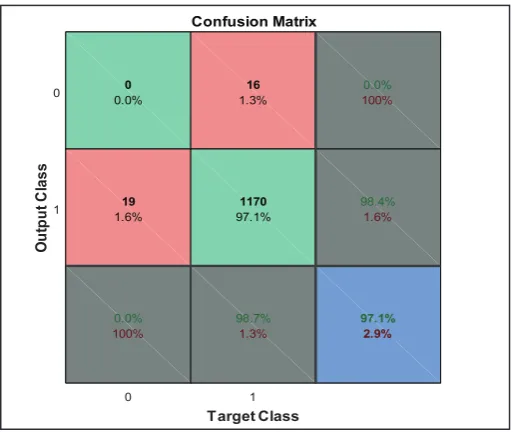
Confusion matrix usage to evaluate the quality of the output of a classifier on the iris data set. The diagonal elements represent the number of points for which the predicted label is equal to the true label, while off-diagonal elements are those that are mislabeled by the classifier. The higher the diagonal values of the confusion matrix the better, indicating many correct predictions. The figures below show the confusion matrix with and without normalization by class support size.
For Comparison database were used for the training and images for the testing purpose. The recognition accuracy was compared between the proposed method and previously reported work. The proposed method has an accuracy of 97.1% on this database.
VI. Conclusion and Future Works
Prevailing methods of human identification based on credentials (identification documents and PIN) are not able to meet the growing demands for stringent security in applications such as national ID cards, border crossings, government benefits, and access control. As a result, biometric recognition, or simply biometrics, which is based on physiological and behavioral characteristics of a person, is being increasingly adopted and mapped to rapidly growing person identification applications. Unlike credentials (documents and PIN), biometric traits (e.g., fingerprint, face, and iris) cannot be lost, stolen, or easily forged; they are also considered to be persistent and unique. Use of biometrics is not new; fingerprints have been successfully used for over one hundred years in law enforcement and forensics to identify and apprehend criminals. But, as biometrics permeates our society, this recognition technology faces new challenges. The design and suitability of biometric technology for person identification depends on the application requirements. These requirements are typically specified in terms of identification accuracy, throughput, user acceptance, system security, robustness, and return on investment.
The development of widely acceptable biometrics standards, practices and policies should address not only the problems relating to identity thefts but also ensure that the advantages of biometrics technologies reaches, particularly to the underprivileged segments of society who have been largely suffering from identity hacking. In our opinion, based on the current biometric deployments, the security, and benefits they offer far outweigh the apparent social concerns relating to personal privacy. Hong Kong identity cards should be a promising model to judge the benefits and concerns in future deployments of biometrics technologies.
It is widely expected that sensing, storage, and computational capabilities of biometric systems will continue to improve. While this will significantly improve the throughput and usability, there are still fundamental issues related to
Biometric representation, 1.
Robust matching, and 2.
Adaptive multimodal systems. 3.
These efforts along with the capability to automatically extract behavioral traits may be necessary for deployment for surveillance and many large scale identification applications.
References
[2] Anil K. Jain, Ajay Kumar,“Biometrics of next generation: An overview”, Second Generation Biometrics 12, No. 1, (2010): 2-3.
[3] Karen Hollingsworth, Kevin W. Bowyer, Patrick J. Flynn, “Identifying useful features for recognition in near-infrared periocular images”, In Biometrics: Theory Applications and Systems (BTAS), 2010 Fourth IEEE International Conference on, pp. 1-8. IEEE, 2010.
[4] Damon L. Woodard, Shrinivas Pundlik, Philip Miller, Raghavender Jillela, Arun Ross,“On the fusion of periocular and iris biometrics in non-ideal imagery,” In Pattern Recognition (ICPR), 2010 20th International Conference on, pp. 201-204. IEEE, 2010.
[5] Samarth Bharadwaj, Himanshu S. Bhatt, MayankVatsa, Richa Singh,“Periocular biometrics: When iris recognition fails”. In Biometrics: Theory Applications and Systems (BTAS), 2010 Fourth IEEE International Conference on, pp. 1-6. IEEE, 2010.
[6] Juefei Xu, Miriam Cha, Joseph L. Heyman, Shreyas Venugopalan, RamziAbiantun, Marios Savvides,“Robust local binary pattern feature sets for periocular biometric identification”. In Biometrics: Theory Applications and Systems (BTAS), 2010 Fourth IEEE International Conference on, pp. 1-8. IEEE, 2010.
[7] Jamie R. Lyle, Philip E. Miller, Shrinivas J. Pundlik, Damon L. Woodard,“Soft biometric classification using periocular region features.” In Biometrics: Theory Applications and Systems (BTAS), 2010 Fourth IEEE International Conference on, pp. 1-7. IEEE, 2010.
[8] Hui Zhang, Zhenan Sun, Tieniu Tan, Jianyu Wang,“Ethnic classification based on iris images.” In Biometric Recognition, pp. 82-90. Springer Berlin Heidelberg, 2011.
[9] Unsang Park, RaghavenderJillela, Arun Ross, Anil K. Jain. “Periocular biometrics in the visible spectrum.” Information Forensics and Security, IEEE Transactions on 6, No. 1, pp. 96-106, 2011.
[10] Karen Hollingsworth, Kevin W. Bowyer, Patrick J. Flynn,“Useful features for human verification in near-infrared periocular images”, Image and Vision Computing 29, No. 11, pp. 707-715, 2011.
[11] Gil Santos, Edmundo Hoyle,“A fusion approach to unconstrained iris recognition.” Pattern Recognition Letters 33, No. 8, pp. 984-990, 2012.
[12] Lihu Xiao, Zhenan Sun, Tieniu Tan,“Fusion of iris and periocular biometrics for cross-sensor identification.” In Biometric Recognition, pp. 202-209. Springer Berlin Heidelberg, 2012.
[13] Karen P. Hollingsworth, Shelby Solomon Darnell, Philip E. Miller, Damon L. Woodard, Kevin W. Bowyer, Patrick J. Flynn. “Human and machine performance on periocular biometrics under near-infrared light and visible light.” Information Forensics and Security, IEEE Transactions on 7, No. 2, pp. 588-601, 2012.
[14] Chun-Wei Tan, Ajit Kumar,“Human identification from at-a-distance images by simultaneously exploiting iris and periocular features.” In Pattern Recognition (ICPR), 2012 21st
International Conference on, pp. 553-556. IEEE, 2012. [15] Arun Ross, Raghavender Jillela, Jonathon M. Smereka,
Vishnu Naresh Boddeti, B. V. K. V. Kumar, Ryan Barnard, Xiaofei Hu, Paul Pauca, Robert Plemmons,“Matching highly non-ideal ocular images: An information fusion approach.” In Biometrics (ICB), 2012 5th IAPR International Conference
on, pp. 446-453. IEEE, 2012.
[16] Chandrashekhar N. Padole, Hugo Proenca,“Periocular recognition: Analysis of performance degradation factors”. In Biometrics (ICB), 2012 5th IAPR International Conference on, pp. 439-445. IEEE, 2012.
[17] Fernando Alonso-Fernandez, Josef Bigun,“Periocular recognition using retinotopic sampling and gabor decomposition”. In Computer Vision–ECCV 2012. Workshops and Demonstrations, pp. 309-318. Springer Berlin Heidelberg, 2012.
[18] Akanksha Joshi, Abhishek Kumar Gangwar, Zia Saquib,“Person recognition based on fusion of iris and periocular biometrics”. In Hybrid Intelligent Systems (HIS), 2012 12th International Conference on, pp. 57-62. IEEE, 2012.
[19] Kevin W. Bowyer, Karen P. Hollingsworth, Patrick J. Flynn,“A survey of iris biometrics research: 2008–2010”. In Handbook of iris recognition, pp. 15-54. Springer London, 2013.