A Novel Technique for Multiple Access Interference
Reduction in DS-CDMA Wireless Communications
A. Amsavalli
Department of Electrical and Electronics Engineering, Maha Barathi Engineering College
Chinnasalem, Villupurum, TN – 636201, INDIA (Affiliated to Anna University, Chennai)
K. R. Kashwan,
IEEE Member
Department of Electronics and Communication Engineering - PG, Sona College of Technology
Salem – 636005, INDIA (Affiliated to Anna University of Technology, Coimbatore)
ABSTRACT
In this paper, we present a comprehensive report on the research work focused on developing a novel concept for reducing Multiple Access Interference (MAI) in Direct Sequence – Code Division Multiple Access (DS-CDMA) systems prevailing in wireless communications. The proposed novel algorithm is developed by using the principles of artificial intelligence based on neural networks. The basic function of the algorithm is to determine interference ratio far more accurately even in the presence of very high noise in the channel. Subsequently, the simulation tests are carried out to validate the claim by using MATLAB and C++ platforms while considering higher data transfer rate, presence of AWGN and channel fading effects due to multi path reflections and diffractions. Finally performance analysis is done for bit error rate in comparison with floating point matched filter, parallel residue compensation, normalized least mean square, group-wise successive interference cancellation and partial parallel interference cancellation methods. The proposed intelligent algorithm has shown better results for bit error rate analysis.
General Terms
Wireless Communications, Neural Networks, MAI Algorithm
Keywords
DS-CDMA, MAI Cancellation, LMS, SIC, PN Sequence, ADALINE, BER.
1.
INTRODUCTION
Wireless communication has become an integral part of the modern time communication systems. Many new innovative dimensions are added every now and then by the researcher to the concepts of wireless communication systems to enhance robustness and performance in order to provide better quality of service to its users. Yet another important characteristic of modern time communication systems is digitisation. This provides better immunity against noise in channel apart from many more advantages. The CDMA communication system has all the characteristics and capabilities to take on challenges of high quality demanding and ever increasing modern time wireless communications needs.
CDMA, a widely used communication method, is based on principles of spread spectrum technique. This technique
procedure. Logical operation may be as simple as bitwise XOR. CDMA allows many transmitters to transmit simultaneously over the same channel. In other words, several users simultaneously share the same bandwidth by way of multiplexing. In CDMA system, however, the modulated spread sequence has much higher data bandwidth than the actual data has.
2.
MAI IN CDMA COMMUNICATION
The fundamental issues of MAI is based on the fact that in CDMA communication system a number of users use same frequency and bandwidth separated at receiver only due to presence of different spreading codes [1]. This implies that in CDMA, a number of transmitters are allowed to transmit simultaneously on the same channel, resulting in sharing of bandwidth by many users. This is called multiple accesses. CDMA system of communication operates just fine under ideal conditions of orthogonal and synchronised codes of all users. It, however, suffers under real time non-ideal conditions which are presence during most of the practical implementation and subsequently while the system being in operation. Due to non-ideal orthogonality and difficulty in maintaining synchronization at receiver, each user of the system gets interference from many other users attempting multiple accesses. Channel delays and frequency offset also add the interference amount. The amount of interference may vary from an insignificant level at times to very serious levels affecting the quality of the received communications adversely [2]. The interference due to multiple accesses is called MAI. It causes undesirable effects and may be grossly intolerable in asynchronous communications which normally prevails in reverse link. The mobile node located close to the base station can cause lot of interference to the mobile nodes located at a distance resulting in path loss. A large number of mobile nodes may get blocked if the power level of near mobile nodes is not managed properly. This problem is well known as near-far effect. A well designed power controlling strategy is required to equalise power level of the received signal at various mobile nodes [1]. The CDMA communication system capacity is primarily limited by the amount of the MAI presence [3]. The CDMA, however, has higher capacity in comparison to other systems, since it reuses frequency and has variable rate of transmission. Its practical and real time implementation capacity achieved is much lower than the maximum theoretical achievable capacity [4]. Communication industry still lags in employing more efficient multiuser detection receivers to increase the capacity. Multiuser detection receivers are normally more complex and lack robustness. To overcome these issues, a good amount of research has been reported by various literatures on interference cancellation and adaptive filtering techniques. The first method for interference cancellation reported in literature is based on the use of smart antenna system which is built with capability of digital signal processing. Basically, many artificial intelligence based algorithms are used to convert traditional antenna into smart antenna system, such as array antenna, beam forming antenna etc. The smart antenna system directs and controls radiation power towards only desired users and thus minimizes undesirable interference to other users. This paper has only scope of improved technique for successive interference cancellation based on smart algorithm with a goal of overall increasing the efficiency of CDMA communication system.
Fundamentally there can be two principal groups of techniques, called serial and parallel techniques, which are used quite often for reducing interference levels in CDMA. The serial scheme reduces interference in successive steps. It is considered as a better option for reducing interference due
to its compatibility with existing industrial systems, good capability of accommodating error correcting codes and its robustness with asynchronous communication types [4]. The successive interference cancellation (SIC) technique is very powerful method to reduce interference to such an extent that spectral efficiency of a channel can reach to Shannon capacity under ideal conditions [5]. There are few drawbacks in SIC that needs attention to address research in this regard. It needs that signal strength of each user be estimated. If the estimation of signal is not accurate, subsequent users will be decoded wrongly. SIC takes more time compared to parallel scheme. User power control strategy and power management is very rigorous and must be precisely done. Multipath propagation poses another big challenge to SIC as all such components must be cancelled out [6]. An improved technique for dealing with MAI uses Gaussian mixture model and maximum likelihood algorithm based receiver at an optimum computational cost [7]. Gaussian mixture model provides analytical analysis very accurately and yet free from complexities [8]. Gaussian mixture model is considered as more suitable for ultra wide band interference reduction. The model has been used recently for many applications including frequency offset estimation and MAI in time-hoping ultra wide band communications [9].
Successive cancellation scheme uses technique of cancelling interference by successively subtracting the interference from the received signals. The signal with highest power P may be detected and is removed from the received signal s(t) so that a relatively weaker signal can be detected more accurately [10]. The received signals are sequenced in particular order depending upon their strength such as in descending order of their magnitudes. ) 1 ( ... ... .... 3 2
1 p p pk
p
where Pk is the power level of kth user. Here the user-1 is
assumed with highest power. The detection of user-1 signal s1(t) is normally estimated by using matched filters and may
be given by
) 2 ( ) ( ) ( )
( 1 1 1
1 t p x t C t
s
where x1(t) is symbol detected by user-1 and C1(t) is
spreading wave for user-1. Subtracting signal strength of user-1 from received signal s(t), the input for the next stage is estimated by
)
3
(
)
(
)
(
)
(
12
t
s
t
s
t
s
The procedure is repeated for the next strongest signal continuously until all users are detected and resolved in the same order. The input to the final stage is
)
4
(
)
(
)
(
)
(
1 1
k i ik
t
s
t
s
t
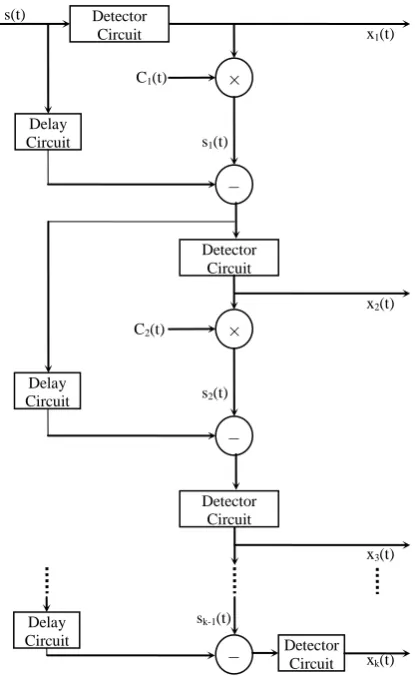
The successive interference cancellation procedure is linear function and is illustrated in Figure 1 as shown below.
The SIC can be easily implemented using hardware circuits
and thus it is very robust in nature. It, however, as mentioned earlier, has drawbacks and thus needs to be improved upon. The main limitations is regarding any detection inaccuracy happening at a particular stage which may be carried forward in a feedback loop and cumulatively cause further deterioration in the quality of the signal. It will, thus increase the interference subsequently beyond tolerable limit quickly. The recent research shows use of intelligent techniques for countering cumulative deterioration of the signals due to multiple interferences. The neural networks based techniques can handle the problem in far better way [11]. Despite many hardware solutions, the problem still exist and need to be tackled by using combination of hardware and algorithm based reduction in interference. One such technique of optical time gating is examined and found quite worthy. It, however, needs clock recovery and timing coordination. This finally leads to a very complicated and non-cost-effective receiver design [12]. The key lies in the determining that precisely
technique. The cancellation of active user will lead to the degradation of the system in terms of BER. The adaptive learning property of neural networks offers good scope for improving BER performance. The commonly used parameters to estimate reduction in SIC have been throughput and receiver complexity. There are not many references which have examined the effects of variations in the channel parameters, such as multipath, latency and estimation of errors [11]. This paper reports the simulated results of adaptive type neural network based algorithm to reduce BER in order to improve overall performance of the CDMA communication systems.
3.
PROPOSED ALGORITHM FOR MAI
CANCELLATION
We have chosen a very particular type of neural network called adaptive linear neuron (ADALINE) model for improving BER. The ADALINE is very flexible technique commonly used in error cancellation, signal processing and control systems. The ADALINE is similar to perceptron except that its transfer function is linear and not based on the rigid logic. This indicated that the output of ADALINE can have any continuous value and not merely discrete 0 and 1 as is normally found in other cases. The least mean square (LMS) learning technique is chosen for ADALINE to make it more powerful. LMS also moves the decision boundaries beyond current knowledge acquired through training and thus it is adaptive to the present conditions. An adaptive linear system, as shown in Figure 2, has been designed and validated for the simulation tests using MATLAB. It has shown good response to the variations in the incoming signals from many users simultaneously. The weights of target vectors are updated at each step on the time scale in such a way that
w0
Inputs
Fig 2: General architecture of ADALINE for reducing BER in CDMA
∑ w1
w2
w3
wk +1
x1
x2
x3
xk
Error
Target Output + –
Output
Weights ×
– Detector
Circuit
C1(t)
s1(t)
Delay Circuit s(t)
x1(t)
Detector Circuit
×
–
Detector Circuit s2(t)
C2(t)
Delay Circuit
x2(t)
x3(t)
– Detector Circuit Delay
Circuit
xk(t)
sk-1(t)
An ADALINE is a particular artificial neural network based algorithm designed to be intelligent enough to self learn from its ambience conditions and adapts itself to a given model. A simple and representative architecture of ADALINE is illustrated in Figure 2. The network outputs are generated by a linear combination of inputs and constant terms.
)
5
(
1
0
n
i i
i
x
w
w
Output
where xi are inputs detected from users and wi are weights of
the input matrix. The output of the network is finally detected signal from kth user after subtracting all other user signals as computed by the algorithm. For the kth user, the error measure of an ADALINE network can be computed as –
)
6
(
]
)
(
[
t
s
t
2e
k
k
kwhere tk is target output for kth user and e is an error.
Differentiating equation (6) with respect to the weights wi,
and using equation (5), gives-
)
7
(
]
)
(
[
2
k k ii k
x
t
s
t
w
e
To decrease ek, the weights matrix is to be updated in such a
way that updated weight is computed using-
)
8
(
]
)
(
[
k k iupdated
i
t
s
t
x
w
where η is learning rate and an arbitrary value can be assigned to it. This is very important property of self learning capability of ADALINE networks. It is linear, has distributed learning property or learning is local for each user signal and has online learning capability which means weights are updated automatically after new inputs are available to the system. The proposed system block diagram is shown in Figure 3.
The design of ADALINE module has two inputs, e1 ande2 as
shown in Figure 3, where e2 is delayed signal of e1. This
feature delayed signal e2 is deliberately chosen and
incorporated in the proposed system since ADALINE is not known to have memory and in CDMA the final output depends upon previous interference cancellation levels as
well. This additional feature works similar to the conditions where current output depends upon past states.
4.
RESULTS AND DISCUSSIONS
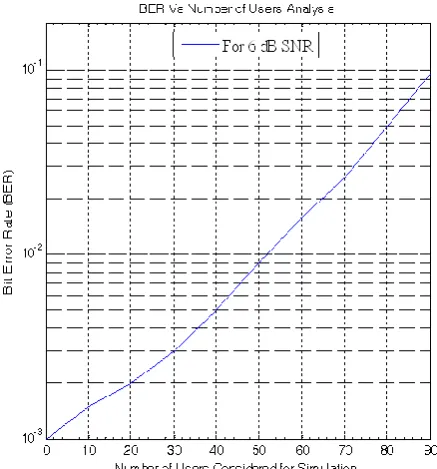
The simulation tests are carried out using MATLAB communication tool box. The first analysis is done for BER as number of users increases and thus interference also goes up. The graphical visuals are presented in Figure 4 as shown below.
The standard simulation tests are carried out at 40% of users interference cancellation level and 6 dB of signal to noise ratio is maintained. A predefined and uniform size of bits per user is used for estimating BER at receiver end. The type of channels considered are additive white Gaussian noise (AWGN) and Rayleigh fading models. Figure 4 shows BER analysis considering AWGN model. The simulations tests are carried out in MATLAB using ADALINE neural network based controller as shown its architecture in Figure 3 and C programming. The model assumed 90 users in the network simultaneously accessing the CDMA channel. As shown in Figure 4, it is clear that BER increases as the number of users increases. This is quite predictable as MAI is also expected to become more and more prominent as the number of users goes up. The simulated result analysis computation shows that if the number of users is increased from about 5 to 90, as can be seen in Figure 4, the BER is increased about 100% or in other words the BER almost doubles for the increased number of users. This computation is based on 40% interfering users cancelled out in the descending order of their signal strength.
Fig 4: BER analysis at 40% cancellation of number of interfering users
Fig 3: ADALINE based controller for CDMA
xk(t) ∑
Delay Unit
ADALINE based NN Algorithm
e1 Output
+
–
s(t)
The simulation tests are also carried out without cancelling interfering users and then a comparison is analysed. The results are illustrated in Figure 5 as shown below.
It can be easily figured out that BER increases at a quite higher rate as the number of user increases under the condition of no interfering user cancellation. This was main finding of the simulation tests. The quantitative analysis shows that the BER is higher under no cancellation of interfering user by a factor of 3.5 times at the lowest to 13 times at the highest level as the number of users increased from about 5 to 90. The computation shows that an average rate of BER is higher by about 7.8 times of the BER at 40% cancellation of number of interfering users. The both analyses are shown in Figure 4 and Figure 5 for 40% cancellation of interfering users and no cancellation of the interfering users respectively. Simulations are also done to verify the common principle that the BER decreases with increasing SNR value. This is usually expected result and is within the normal range which has shown the same trend as most of the research literature has been reporting. At a very high SNR value, for example, 20 dB and above, the BER is almost insignificant and has very low value.
The next analysis is carried out for the effect on BER due to different combination of the interfering user cancellation. This implies two separate analytical conclusions. The first, simulations are carried out by starting at no cancellation of interfering user to a 40% of cancellation of interfering users. The observations are that as cancellation of more and more
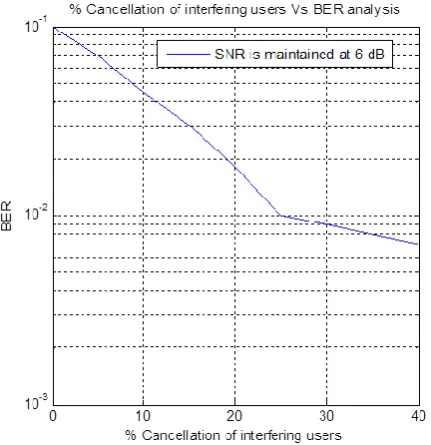
slowed down. Furthermore cancellation of interfering users causes very minimal decrease in BER. The final conclusion is that cancellation of interfering user serves the purpose to some extent only. Beyond that, it becomes insignificant on the performance improvement. It, rather, slows down the communication process and increases complexity due to increased use of algorithm. This analysis is carried out for a set of 90 users and for a fixed amount of bits per user. The trade-off needs to be reworked if any of the above mentioned parameters, such as number users and bit size per user etc. changes. The analysis of BER Vs % cancellation is depicted in Figure 6 as shown below.
Results show that at about 25% cancellation of the total interfering users, the BER is reduced significantly. Furthermore cancellation doesn’t help much. This is the threshold value at which the proposed algorithm stops cancellation process and an acceptable level of BER is reached. This optimizes the trade-off between cancellation of interfering users and acceptable BER value. This also leads to the definite conclusion that the proposed algorithm is intelligent enough to reduce delay by reaching on decision point that BER is not much going to improve further and thus stops further cancellation. In other words, it converges on reaching a predefined acceptable BER value.
The second type of analysis consists of finding out that what type of interferers would dominant in very immediate future time due to mobility of the users. Current user location may have been used to find out the signal strengths of each users attempting simultaneous access. But, users may change location immediately and probably before the transmission is completed. This needs an additional capability of the algorithm to address the issue of updating the signal strength of different users by sampling. At every sampling event the order of the users in descending order of the signal strength
Fig 6: BER Vs % cancellation of interfering users Fig 5: BER analysis without cancellation of any
analysis in this regard is under further verification and more simulations tests needs to conducted to conclude quantitatively validations. The adaptive model filters out an interference component by identifying measurable interference component of other users.
5.
CONCLUSTION
This paper analyses the BER performance of CDMA system by using an intelligent algorithm based on neural network ADALINE to perform SIC with the goal of improving the system efficiency. The simulation results have shown good confidence of newly introduced algorithm. There are improvements observed in respect of error rate and delays in the transmission process. The quantitative analyses are done to find out exact trends in the patterns of bit error and MAI cancellation using the concept of successive interference cancellation in an improved way. The % cancellation of interfering users analysis concluded that there is a good decrease in BER up to 25% of cancellation and beyond that it doesn’t improve much. The time delays are reduced due to quickly deciding to stop further cancellation once the acceptable level of BER is reached. The future work would concentrate on further improving the algorithm for updating quick online user location information and thereby reducing delays. Hardware implementation of the algorithm is another area of research and development. Optimization of the hardware configured on FPGA is also relevant and desired to establish high speed processing.
6.
AKNOWLEDGEMENT
The authors express sincere and heartfelt thanks to the respective institutions which have helped and guided for the above reported research and for providing laboratory facilities to carry out experiments and simulation tests. The authors also express their thanks and gratitude to learned faculties and experts who contributed in one or other way through technical and any other help to prepare this article report.
7.
REFERENCES
[1] Hassan Moradi, Mahdi Samie and Maryam Fallah-Pour, “An Overview of MAI Effect on the Uplink Performance of the UMTS Air Interference” in Wireless Personal Communications, Springer, vol 36, , pp. 277-289, 2006
[2] T. Ojanpera and R. Prasad, “An Overview of Third-Generation Wireless Personal Communications: A European Perspective”, IEEE Personal Communications Magazine, pp. 59-65, 1998.
[3] Y. Guo, D. McCain, J. R. Cavalaro, “Low complexity System-on-Chip VLSI Architectures of Optimal Parallel-Residue- Compensation for MAI Suppression in CDMA Systems”, in the Proceedings of International Symposium on Circuit and Systems, IEEE ISCAS 2004, Vol. 4, pp. IV 77-80, 2004.
[4] Jeffrey G. Andrews and Teresa H. Y. Meng, “Performance of Multicarrier CDMA With Successive Interference Cancellation in a Multipath Fading Channel”, IEEE Transactions on Communications, vol. 52, No. 5, pp. 811-822, May 2004.
[5] A. J. Viterbi, “Very-Low-Rate Convolutional Codes for Maximum Theoretical Performance of Spread-Spectrum Multiple-Access Channels”, IEEE Journal of Selected Areas of Communications, vol. 8, pp. 641-649, May 1990.
[6] J. Andrews and T. Meng, “ Optimum Power Control for Successive interference Cancellation with Imperfect Channel Estimation”, IEEE Transactions on Wireless Communications, vol. 2, pp. 375-383, Mar 2003.
[7] T. Erseghe and S. Tomasin, “UWB WPAN Receiver Optimization in the Presence of Multiuser Interference”, IEEE Transactions on Communication, vol. 57, No. 8, pp. 2369-2379, Aug 2009.
[8] J. Mitra and L. Lampe, “Comparison of Detectors for Multiple-Access Interference Mitigation in TH-IR UWB”, Proceedings of IEEE International Conference Ultra Wide Band, vol. 1, pp. 153-156, Sep 2008.
[9] Tomaso Erseghe and Antonio Maria Cipriano, “Maximum Likelihood Frequency Offset Estimation in Multiple Access Time-Hopping UWB”, IEEE Transactions on Wireless Communications, vol. 10, No. 7, pp. 2040-2045, July 2011.
[10]Mosa Ali Abu-Rghelff, “Introduction to CDMA Wireless Communications”, Academic Press – An imprint of Elsevier Ltd., California, USA, 2007.
[11]Santi P. Maity and Sumanta Hati, “An Adaptive SIC Technique in DS-CAMA Using Neural Network”, Procedia Engineering, Elsevier Ltd., Communication Technology and System Design, an international conference on, vol. 30, pp. 1056-1063, 2011
[12]Changjian Guo, Xuezhi Hong and Sailing He, “Elimination of Multiple Access Interference in Ultrashort Pulse OCDMA Through Nonlinear Polarization Rotation”, IEEE Transactions on Photonics Technology Letters, vol. 21, NO. 20, pp. 1484-1486, Oct 2009.
AUTHOR’S PROFILE
involved in research and development activities in her specialization areas at her current Institution
Professor Dr. K. R. Kashwan received the M. Tech. in Electronics Design and Technology and Ph.D. in Electronics and Communication Engineering from Tezpur University (Central University), Tezpur (Assam), INDIA in 2002 and 2007 respectively. Presently he is Professor and DEAN, Post Graduate Engineering Studies in the department of Electronics and Communication Engineering, Sona College of Technology (An Autonomous Institution), Salem – 636005, INDIA. He is currently member of IEEE, member of IE(I), member of Indian Society for Technical Education (ISTE) and senior member of International Association of Computer Science and Information Technology (IACSIT), Singapore.