Mobility Pattern based Method to Cut Cost in
Pervasive System
1
M. Ponvadivu, 2 Dr. S. Thabasu Kannan
1
Research Scholar, Dept. of Computer Science, Bharathiar University, Coimbatore.
2
Principal, Pannai College of Engg. & Tech., Sivagangai – 630 561, Tamilnadu, India
Abstract - With the increasing number of mobile terminals, it is a challenge how to reduce the cost and provide fast and efficient call delivery to the mobile terminals. In the existing system, the call is connected on the basis of the registration of their identity in the databases known as home location register and visitor location register. Here the mobility management is accomplished by a two-tier hierarchical architecture consisting of Home Location Register (HLR) and Visitor Location Register (VLR). It leads to a high volume of signalling traffic and it is suited up to a certain level of call to mobility ratio. The main aim of this paper is to upgrade the formula used for calculating the search cost and location updation cost. By this upgradation, the path traversed from one mobile system to other is reduced. Hence the time taken to retrieve the data is also minimized. Hence the performance can be improved.
Keywords – Mobility, Home Location, Visitor Location, Reporting Cell, Vicinity.
1.
Introduction
Global wireless networks enable mobile users to communicate regardless of their locations. One of the most important issues in location management is a highly dynamic environment, because mobile users may roam between wireless systems, network operators and geographical regions. The goal of mobility tracking or location management is to balance the registration and search operation, to minimize the cost of mobile terminal location tracking.
In this paper, we propose a mobility pattern based location tracking scheme based, which efficiently reduces the location updates and searching cost in the mobile networks. Here various formula used in the existing system has been revised to reach the objectives we have defined. Here we have updated the cost function of existing location management cost, which contains only the number of location updates and the number of paging performed. Here we have seen that the
cost of a location update is usually much higher than the cost of paging-several times higher. But in our new scheme, we have defined the number of location updates performed, the number of paging performed, the movement weight associated, the call arrival weight, the vicinity value, the total number of cells in the network, and the set of reporting cells in the network. One of the challenges in mobile computing is the tracking of the current location of users. In order to route incoming calls to appropriate mobile terminals, the network must keep track of thelocation of each mobile terminals from time to time. Mobility tracking expends the limited resources of the wireless networks.
Two simple location management strategies known are the always-update strategy and the never-update strategies. In the always-update strategy each mobile terminal performs a location update whenever it enters a new cell. As such the resources used for location update could be high. However no search operation could be required for incoming calls. On the other hand in the
never-update strategy, no location update is ever performed. Instead, when a call comes in, a search operation is conducted to find the intended user. Clearly, the overhead for the search operation could be high, but no resources could be used for the location update. These two simple strategies represent the two extremes of location management strategies, whereby one cost gets minimized and the other maximized. In practice most existing cellular systems use a combination of the above two strategies.
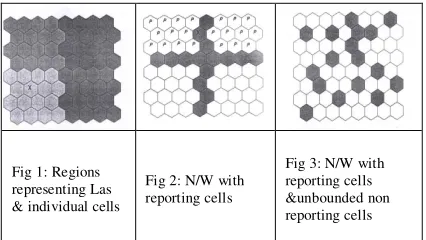
example, in the fig1, if a call arrives for user X, search is confined to the 16 cells of that Location Area. Another location management scheme is a subset of cells in the network is designated as the reporting cells (Fig2).
Each mobile terminal performs a location update only when it enters one of these reporting cells. When a call arrives, the search is confined to the reporting cell, the user last reported and the neighbouring bounded non reporting cells. For example, in the fig2, if a call arrives for user Z, the search is confined to the reporting cell the user last reported in and the non-reporting cells marked P. Obviously a certain reporting cell’s configuration leads to unbounded non reporting cells, as shown in the below figure.
2.
Location Management Cost
Location management involves two elementary operations of location update and location inquiry, as well as network interrogation operations. Clearly, a good location update strategy could reduce the overhead for location inquiry. At the same time, location updates should not be performed excessively, as it expands on the limited wireless resources.
To determine the average cost of a location management s
trategy, one can associate a cost component to each location update performed. The most common cost component used is the wireless bandwidth i.e. the wireless traffic from mobile terminals to base stations (and vice versa) during location updates and location inquiry. The total cost of the above two cost components over a period of time T, as determined by simulation can be averaged to give the average cost of a location management strategy. The following simple equation can be used to calculate the total cost of a location management strategy [3].
cos
.
LU PTotal
t
=
C N
+
N
Where
NLU - no of location updates at time
T; NP - no of paging at time T; and
C - constant representing the cost ratio of location update & paging.
It is recognized that the cost of a location update is usually much higher than the cost of pagingseveral times higher.
3.
Updated System
Today’s wireless network consists of cells. Each cell contains a base station, which is wired to a fixed wire network. These cells are usually represented as hexagonal cells resulting in six possible neighbors for each cell. In the reporting cells location management scheme, some cells in the network are designated as reporting cells. Mobile terminals perform a location update upon entering one of these reporting cells.
When calls arrive for a user, the user has to be located. Some cells in the network, however, may not need to be searched at all, if there is no path from the last location of the user to that cell, without entering a new reporting cell (a reporting cell i.e.is not the last reporting cell the user reported in).That is, the reporting cells form a “solid line” barrier, which means a user will have to enter one of these reporting cells to get to the other side
For example in fig2, a user moving from cell 4 to cell 6 would have to enter a reporting cell. As such, for location management cost evaluation purposes, the cells that are in bounded areas are first identified, and the maximum area to be searched for each cell is calculated which is described below.
We can define the VICINITY of reporting cell i as the
collection of all the cells that are reachable from a reporting cell i without entering another reporting cell as the vicinity of reporting cell i.
We can define the VICINITY VALUE of reporting cell i
that as the number of cells in the vicinity of a reporting cell i is the maximum number of cells to be searched, when a call arrives for a user whose last location is known to be cell i.
Procedure for finding Vicinity of a Reporting cell
{ //Start from a Reporting cell. For all neighbours do
{
Find the valid neighbors of the reporting cell.
If the valid neighbor is not a reporting cell and not yet visited thenmark the neighbor as visited.
Add this neighbor to the vicinity index of the Reporting cell.
Increment the vicinity number of the Reporting cell by one.
}
Fig 1: Regions representing Las & individual cells
Fig 2: N/W with reporting cells
Fig 3: N/W with reporting cells &unbounded non reporting cells
If the neighbor is a Reporting cell or a visited cell then returns zero.
}
Procedure for finding Vicinity of a Non Reporting cell
a. Take Non Reporting cell and find the Reporting cells from which this cell can be reached (OR)Take Non Reporting cell and find the Reporting cells to which it is the vicinity member.
b. Find the Maximum Vicinity value among the Identified Reporting cell.
c. Assign that value as the vicinity value of the Non Reporting cell.
As an example, in Fig2, the vicinity of reporting cell 9 includes the cells 0, 1,4,8,13,14 and cell 9 itself. The vicinity value is then 7, as there are seven cells in the vicinity. Each non reporting cell can also be assigned a vicinity value. However, it is clear that a non-reporting cell may belong to the vicinity of several reporting cells, which may have different vicinity values. For example, in fig2, a cell 4 belongs to the vicinity of reporting cells 2,5,9 and 12, with vicinity values 8,8,7 and 7 respectively. For Location Management cost evaluation purposes, the maximum vicinity value will be used. As such, in this case, the vicinity value of eight is assigned to cell 4.
Each cell is associated with a movement weight (Wmi)
and call arrival weight (Wci). The movement weight
(Wmi) represents the frequency or total number of
movements into a cell, while the call arrival weight
(Wci) represents the frequency or total number of call
arrivals within a cell. Obviously, if a cell is a reporting cell, the number of location updates occurring in that cell could be dependent on the movement weight of that cell. Further, because call arrivals result in search/paging operation, the total number of paging performed would be directly related to the call arrival weight of the cells in the network. As such, we have the following formulae for the total number of location updates and paging (performed during a period T without maintaining the mobility pattern).
L U m i
i s
N
W
∈
=
∑
;1
0
* ( )
N
P cj
j
N
W
V j
−=
=
∑
Where
NLU– no of location updates at time T;
NP– no of paging at time T;
Wmi - movement wt for cell i
Wcj-call arrival wtfor j;
v(j) - vicinity value of cell j;
N - total no of cells in the n/w, and
S - set of reporting cells in the n/w.
To calculate the location management cost of a particular reporting cells configuration (without maintaining mobility pattern)
cos
*
mi cj* ( )
Total
t
=
C W
+
W
V j
Where, C - Constant representing the cost ratio of the location update and paging.
4.
Mobility Pattern Scheme
In this scheme, a new technique is introduced, which maintains the mobility pattern (of size h) of the last visited reporting cells. The updating does not take place when the user roams within the reporting cells of his mobility pattern. That is the location information is updated when the user enters to a new reporting cell, which is not in his history. As a result, the updation cost is proportionately reduced with the value of h (no. of entries in the mobility pattern). When we increase the number of reporting cells in the mobility pattern, the location update cost is proportionately reduced.Hence the cost equation can be modified as follows,
LU mi
i s
N
NW
∈
=
∑
// Where,NWmi- the new movement wt.;
(
)
*
(
1)
mi mi
S
h
NW
W
S
−
=
−
Where h – no of reporting cells maintained in the mobility pattern; Here if h=1, the NWmiWmi.,
otherwise the NWmi will be reduced, as a result the
updating cost is reduced.
Consequently, the paging cost gets increased proportionately to the h value. Whenever the user enters into the reporting cells the previous history, the mobility pattern in the mobile is modified and does not leads to the location update.
Whenever a call arrives to the user, the user may be available within the vicinity of any one of the reporting cells in the history. This increases the number of cells to be searched. But it is only for the first time call, because after searching the user among the list of cells that can be reached from the reporting cells in the mobility pattern, the new mobility pattern which is maintained in
Eq. (2)
Eq. (3)
Eq. (4)
the mobile is updated to the server. So the next call to the user doesn’t take much number of searches.
The new paging cost equation is obtained from the new
call arrival wt. * mi
cj cj mi NW NW W W =
Search Cost for the Location updated
users: 1 0 ( ) * ( ) N Pi cj j
N NW V j
−
= =
∑
Search Cost for the non-updated users from the same
reporting cell: 1 2 0 1 ( ) * ( )* N
P cj cj
j
N W NW V j
s
−
= =
∑
−Search Cost for non-updated users from different
reporting cell: (first call)
1
3 0
( ) * ( 1) / * ( ) * / 2
N
cj cj
P j
W NW S S V j h N CallFactor − = − − =
∑
For Subsequent calls:
1 4
0
( )*( 1) / *(1 1/ )* ( )
N
P cj cj j
N W NW S S callfactor V j −
=
=
∑
− − −The call factor can be calculated as follows, if (Wcj/
Wmi)< 1 then CF =1 else CF= (Wcj/ Wmi).
Total Paging Cost:
' 1 2 3 4
P P P P P
N
=
N
+
N
+
N
+
N
;'
cos
.
LU PTotal
t
=
C N
+
N
The total paging cost is divided into four sub-components and except the third component (Np3) the other component costs are similar to the old method. As a result the increase in the paging cost is under control; hence it improves the total cost for the reporting cell configuration.
The cost function described above shows that by varying the size of the mobility pattern (h), the total cost can be reduced to some extent. If h=1 then this cost is equivalent to the old cost. So in the worst case it behaves like the old scheme and in best case, we can introduce h value so that the entire cost is reduced.
5. Conclusion
In this paper, we propose a mobility pattern based location tracking scheme based, which efficiently reduces the location updates and searching cost in the mobile networks which adapts the prediction for locating mobile users according to theirmobility patterns and call arrival frequency. Thisscheme definitely keeps hit ratio high. High hitratio minimizes total paging cost because most of the timeuser found in its prediction cell location which helps tomaintain paging cost. So the total cost also becomes less ascompare to other method. If we are using any one optimization algorithm like Genetic algorithm, ACO, PSO, Tabu search, surely we can control the total cost.
References
[1] E. A. Brewer, R. H. Katz, Y. Chawathe, S. D. Gribble, T. Hodes, G. Nguyen, M. Stemm, T. Henderson, E. Amir, H. Balakrishanan, A. Fox, V. N. Padmanabhan, and S. Seshan, “A network architecture for heterogeneous mobile computing,” IEEE Personal Communications, vol. 5, no. 5, pp. 8-24, October 2013.
[2] B. R. Badrinath, T. Imielinski, and A. Vmani. Locating strategies for personal communication networks, In Workshop on Networking of Personal Communications Applications, December 2013. [3] Amotz Bar-Noy, Ilan Kessler, and Moshe Sidi.
Mobile users: To update or not to update? In IEEE INFOCOM, volume 2, 2014.
[4] Gihwan Cho and Lindsay F. Marshall. An efficient Location and muting scheme for mobile computing environments. IEEE Journal on Selected Areas in Communications, 13(5), June 2012.
[5] Ivan Seskar et al. Rate of location area updates in cellular systems. Technical Report WINLAB-TR-29, WINLAB, Rutgers University, April 2013.
[6] N. Shivbar and J. Widom. User profile replication for fapter location lookup in mobile environments. In ACM MOBICOM, 2013.
[7] Sad Tabbane. Evaluation of an alternative location strategy for future high density wireless communications systems. Technical Report WINLAB-TR-5 1, WINLAB, Rutgers University, January 2013.
[8] Hai Xie, Sami Tabbane, arid David J. Goodman. Dynamic location area management and performance analysis. In IEEE 43rdVehicular Technology Confemnce, 2014
[9] I.F. Akyildiz, J. McNair, J.S.M. Ho, H. Uzunalioglu and W. Wang, Mobility Management in Next-Generation Wireless Systems," Proc. of the IEEE, vol.4, no.5, pp.1347-1384, October 2013.
[10] S. Tabbane, Location Management Methods for Third-Generation Mobile System,"IEEE Communication Magazine, vol.35, no.8, pp.72-84, August, 2012.
[12] J. S. M. Ho, I. F. Akyildiz, \Dynamic Hierarchical Database Architecture for LocationManagement in PCS Networks," IEEE/ACM Trans. Networking, vol.5, no.5, pp. 646-661, Oct. 2013.
[13] R. Jain, Y.B. Lin, C. Lo, and S. Mohan \A Caching Strategy to Reduce NetworkImpacts of PCS," IEEE Journal on Selected Areas in Comm., vol.12, no.8, pp.1434-1444, Oct. 2013.
[14] V. Anantharam, M. Honig, U. Madhow, and V. Wei, \Optimization of a DatabaseHierarchy for Mobility Tracking in a Personal Communications Network," PerformanceEvaluation, Vol. 20, pp. 287-300, 2014. [15] J. Li, H. Kameda and K. Li, “Optimal Dynamic
Mobility Management for PCS Networks," IEEE/ACM Trans. on Networking, vol.8, no.3, pp.319-327, June, 2013.
[16] G. Krishnamurthi, M. Azizoglu and A. K. Somani, Optimal Distributed LocationManagement in Mobile Networks," Mobile Networks and Applications, vol.6, pp.117-124, 2014.
[17] F. Akyildiz, J. S. M. Ho and Y. B. Lin, \Movement-based Location Update and Selective Paging for PCS Networks," IEEE/ACM Trans. Networking, vol.4, no.4, pp.629-636, Aug. 2012.
[18] C. Rose, Minimizing the Average Cost of Paging and Registration: A Timer-basedMethod," AVM-Baltzer J. Wireless Networks, vol.2, no.2, pp.109-116, 2013. [19] L. P. Araujo and J. R. Boisson de Marca, Paging and
Location Update Algorithms for Cellular Systems," IEEE Tran. on vehicular techonology, vol.49, no.5, pp.1606-1614,2014.
[20] C. Rose and R. Yates, \Minimizing the Average Cost of Paging Under Delay Constraints," ACM-Baltzer J. Wireless Networks., vol.1, no.2, pp.490-495, July. 2011.
Author Profile:
M. Ponvadivu, M.Sc., M.Phil., Research Scholar, Dept. of Computer Science, Bharathiar University, Coimbatore.