Proposing new Equalizer of better performance than previous ones for MIMO-OFDM Systems
524
Proposing new Equalizer of better
performance than previous ones for
MIMO-OFDM Systems
Priyanka Yadav1 and Mr. Deepak Nandal2
I. INTRODUCTION
The nonstop advancement of wireless networks has changed the perspective of trading data and seek after stimulation. It has made it conceivable to have the network in pockets through phones. The applications are not just constrained to voice communication, additionally the voice over web, web scanning, spilling media, web gaming and much more. The objective of wireless networks frameworks is to offer fast remote access at high caliber of administration.The expanding necessities of mixed media administrations and the enthusiasm of clients for web related substance lead to expanding rivalry for fast correspondences. This requires substantial data transfer capacity and the utilization of proficient transmission strategies that would coordinate the properties of wideband channels, particularly in remote environment where the channel is found to be a rare asset.MIMO-OFDM turns out to be an amazing transmission strategy in wireless areas[4].
MIMO frameworks are promising systems to build execution with adequate Bit Error Rate(BER) by utilizing various reception antennas. A MIMO-OFDM system transmits OFDM tweaked information from numerous reception antennas at the transmitter. Information transmitted with subcarriers at various reception antennas are commonly orthogonal.The collector removes diverse information stream from diverse subcarriers after OFDM demodulation and MIMO disentangling.Flat fading MIMO algorithms diminish computational requirements and make MIMO-OFDM alluring for versatile applications[6].
The MIMO-OFDM in mix turns out to be very useful, as MIMO implies more number of reception antennas which would offer larger transfer speeds and OFDM implies powerful usage of assets.The MIMO-OFDM system have expanded the ghostly proficiency, differing qualities picks up, and gives broad data transmission administration in broadly utilized WLANs and WMAN systems i.e., Wi-Fi and WiMax[4].
1 Department of Computer Science & Engineering, GJUS&T, Hisar, India
2 Department of Computer Science & Engineering, GJUS&T, Hisar, India
International Journal of Latest Trends in Engineering and Technology
Vol.(7)Issue(3), pp. 524-530
DOI:
http://dx.doi.org/10.21172/1.73.569
e-ISSN:2278-621X
Abstract-MIMO-OFDM proves to be an excellent transmission technique in wireless environments.This combination proves to be very beneficial, as MIMO means more number of antennas which would offer larger bandwidths and OFDM means effective utilization of resources.MIMO-OFDM technique has increased spectral efficiency.It provides extensive bandwidth to wireless LANs networks.The problem of ISI(Inter Symbol Interference ) occurs in MIMO-OFDM systems due to high data rates.ISI occurs because of Doppler’s Shift Effect.The transmission over such systems suffers from ISI,Multipath Fading etc.The presence of noise and ISI causes bit errors at receiver end.Hence Equalization becomes necessary to equalize these errors at receiver end.The Proposed Equalizer simulation will be performed on MATLAB to check BER at different values of SNR making it user friendly and it will result in minimized BER at improved SNR.
Keywords- BER, MIMO-OFDM,MLSE,MRC,SIC,ZF,MMSE
Proposing new Equalizer of better performance than previous ones for MIMO-OFDM Systems
524
MIMO-OFDM SYSTEM MODEL
Proposed technique uses 2x2 MIMO-OFDM as System model.In MIMO systems, a transmitter sends multiple streams
by multiple transmit antennas. The transmit streams go through a matrix channel which consists of all Tx Rx paths between the Tx transmit antennas at the transmitter and Rx receive antennas at the receiver end. Then, the receiver gets the received signal vectors by the multiple receive antennas and decodes the received signal vectors into the original information. A MIMO system is modeled as
where and are the receive and transmit vectors, respectively, and is Channel Matrix and is the noise vector,
respectively.
MIMO- OFDM
Tx
Fig. 2x2 MIMO-OFDM model
Equalize
r
MIMO- OFDM
Rx
The signal received on the first receiver antenna is
1 = h111 + h222 + ݊1 (1)
The signal received on the second receiver antenna is
2 = h211 + h222 + ݊2 (2)
y1 and y2 represents the signal received on the first and second antenna respectively,
h11 being the coefficient of channel sent by 1st transmit antenna to 1st receive antenna, h12 being the coefficient of channel sent by 2nd transmit antenna to 2nd receive antenna, h21 being the coefficient of channel sent by 1st transmit antenna to 2nd receive antenna, h22 being the coefficient of channel sent by 2nd transmit antenna to 2nd receive antenna, x1 and x2 are the original symbols,
n1 and n2 is the noise in 1st and 2nd receive antennas respectively.
Channel Matrix H is made by above equations 1 and 2.Weight Factors are updated through this Channel Matrix. y= Hx+n
where and are the receive and transmit vectors, respectively, and is Channel Matrix and is the noise
vector, respectively.
Priyanka Yadav and Mr. Deepak Nandal 525
differs very fast with time. The reason is that in the remote environment the channels which blurs consistently with time causes the adjustment in the properties of the signal envelope the covering of sub-bearers and loss of orthogonality,known as Inter Channel Interference(ICI) or Inter Symbol Interference(ISI) because of drop in force among MIMO-OFDM subcarriers[6].This causes deferrals and decrement in the error rate of the framework. The leveling procedure demonstrates to be proficient in moderating these impacts. The equalizer which performs leveling is only a channel which redesigns its weights as per the channel coefficients with the assistance of evening out calculations, in order to minimize the general Bit Error rate and enhances SNR. The equalizer is put on getting end of the channel. The exchange capacity of the equalizer is only a reverse of the channel exchange capacity.
Time-dispersive channels can cause inter symbol interference (ISI).ISI degrades the performance of the system as it leads to bit errors and reduces SNR. An equalizer attempts to mitigate ISI and thus improve the receiver's performance. Equalizers are of basically two types.
1) Linear Equalizer
2) Non Linear Equalizer
Linear equalizer has no feedback path to adapt equalizer and response is linear. Non-Linear equalizer has the feedback to adapt output of equalizer and the response is non linear.
[4]ZF(Zero Forcing)and MMSE(Minimum Mean Square Error) are the Linear Equalizers. MLSE, SIC(Successive Interference Cancellation) and DFE (Decision feedback equalizers) are Non Linear Equalizers.
II. PROPOSED TECHNIQUE
We are proposing our own equalizer which is better than other equalizers to minimize bit error rate due to ISI. This Equalization technique is proposed for Rayleigh Fading Channel.For this purpose we are proposing a Hybrid Equalizer that is made by combination of Linear Equalizers and Non Linear Equalizers such as ZF,MMSE,SIC,MLSE.MRC(Maximal Ratio Combining) is also used.
We first implemented ZF and MMSE and found that MMSE is outperforming ZF. So, we proposed an equalization technique that is the combination of those which outperformed other existing equalizers such as MMSE,SIC and MLSE.
Step1. MMSE calculates the minimum mean square error and minimize the ISI or errors.
Step2. The result of MMSE is combined to SIC.SIC performs Optimal Ordering of received signals with nulling vector.
Step3. MRC is used to enhance Diversity gain. It is good in terms of SNR and better BER.
Step4. Final stage, detection is done by using MLSE. In this Euclidian Distance is calculated for received signal vector and combination of transmitted signals over the channel.The one with minimum distance is selected as it provides maximum probability of receiving correct signal.
So,proposed equalizer is basically MMSE+SIC+MRC+MLSE. When we implement ZF equalizer we add weight function
Wzf.
ZF signal= Wzf.y
When we implement MMSE equalizer we add weight function Wmmse
MMSE signal,y1=Wmmse.y
Then,we combine MMSE signal with SIC SIC signal,S= Wsic.y1
Weight functions Wzf, Wmmse and Wsic are used for ZF,MMSE and SIC.Weight functions are used to minimize error
coefficients.
The simulations parameters are H Matrix based and simulated on MATLAB.
BER and SNR are taken as performance metrics parameters and result of Proposed technique and existing ZF and MMSE is compared. First the BER of ZF and MMSE is calculated and then for Proposed Equalizer.After that the BER performance is compared for Proposed and Existing Equalizers.
Proposing new Equalizer of better performance than previous ones for MIMO-OFDM Systems
526
Priyanka Yadav and Mr. Deepak Nandal 527
Proposing new Equalizer of better performance than previous ones for MIMO-OFDM Systems
528
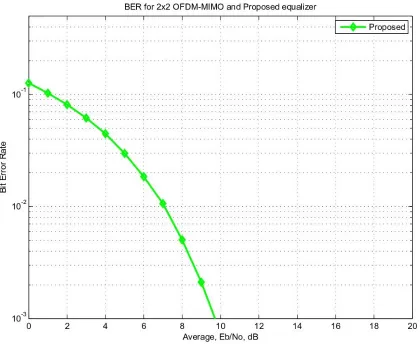
Fig 4 BER Performance for 2x2 MIMO OFDM channel using Proposed Equalizer
Priyanka Yadav and Mr. Deepak Nandal 529
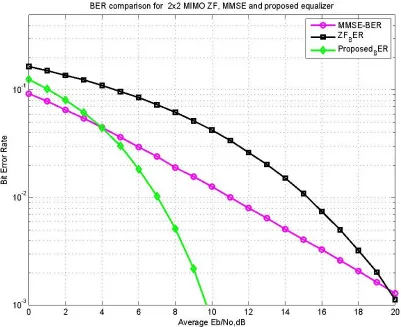
Fig.5 Comparison of BER for Zero Forcing,MMSE and Proposed Equalizer
Table .BER comparison of ZF,MMSE and Proposed Equalizers
SNR Range BER for ZF BER for MMSE BER for Proposed
20 dB 0.003 to 20 dB 0.002 to 18 dB 0.001 to 10 dB
Proposing new Equalizer of better performance than previous ones for MIMO-OFDM Systems
530
IV. CONCLUSION
We discussed the MIMO-OFDM system and occurrence of ISI(Inter System Interference) in it. The ISI degrades the performance of the system as it leads to bit errors and reduces SNR. An equalizer attempts to mitigate ISI and thus improve the receiver's performance. Different type of equalizers are used for this purpose and compared. Those which outperformed ,we combined them and introduced a new Equalization technique for better performance. With our results we have concluded that Proposed Equalizer is better than all previously used equalizers. It has reduced BER at improved SNR less than 10 dB with high receiver diversity. The simulation results are performed on MATLAB .
REFERENCES
[1] Alihemmati, R.; Kalantari, M.E., “On channel estimation and equalization in OFDM based broadband fixed wireless MAN networks,” IEEE, Advanced Communication Technology,The 7th International Conference on, pp. 224-229, 2005.
[2] Xiaojun Yuan; Junjie Ma, “Iterative equalization for MIMO systems:Algorithm design and evolution analysis,” Wireless Communications and Networking Conference on, IEEE, pp. 3974-3979, 7-10April 2013.
[3] Atapattu, Lakmali; Gayan Munasinghe Arachchige; Karla Ziri-Castro;Hajime Suzuki; Dhammika Jayalath, “Linear adaptive channel equalization for multiuser MIMO-OFDM systems”, IEEE, In Telecommunication Networks and Applications Conference (ATNAC 2012), pp. 1- 5, 2012.
[4] Navdeep Singh Randhawa, Shally Sharma, Deepak Sharma,”An Approach To Minimize BER Using Hybrid Equalization Technique in MIMO-OFDM System” in International Conference on Pervasive Computing (ICPC),2015.
[5] Sinem Coleri, Mustafa Ergen,Anuj Puri, Ahmad Bahai,” A Study of Channel Estimation in OFDM Systems”,pp. 0-7803-7467-3, 2002 IEEE.