e-ISSN: 2278-7461, p-ISSN: 2319-6491
Volume 7, Issue 6 [Jun 2018] PP: 22-29
Control Parameters Analysis Of Ultrasonic Plastic Welding
Machine By Using Neural Network
Shen-Whan Chen
1, Yu-Ju Chen
2, Huang-Chu Huang
3, Sheng-Min Huang
4,
Rey-Chue Hwang
4,*1
Department of Communication Engineering, I-Shou University, Taiwan 2Department of Information Management, Cheng-Shiu University, Taiwan
3Department of Electronic Communication Engineering, National Kaohsiung University of Science and Technology, Taiwan
4Department of Electrical Engineering, I-Shou University, Taiwan Corresponding Author: Shen-Whan Chen
Abstract:
This research aims to employ the technique of neural network (NN) into the analysis of control parameters for the ultrasonic plastic welding machine. An intelligent mechanism for the precise control of ultrasonic plastic welding process is expected to be developed. The NN technique is used to find the importance of individual control parameter of welding machine. The influence rate (IR) of each control parameter is able to be obtained by using a novel calculation method. Thus, based on such an intelligent control mechanism developed, the optimal control for the best welding process could be easily executed.Keywords:
neural network, control parameters, precise control, ultrasonic welding machine--- Date of Submission: 31-05-2018 Date of acceptance: 15-06-2018
---I. INTRODUCTION
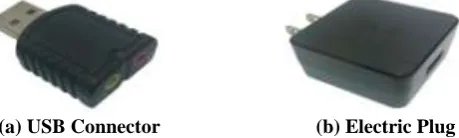
It is known that the protection of electronic product has become more and more important, especially for those products must be protected and forbidden to open. For instance, many electronic products such as the battery cases of computer, cell phone, adaptor and the connector of USB transmission line, all have such necessity. In general, in order to avoid the defective condition caused by man-made or dust, the electronic circuit and component will be covered and protected by the plastic case. The plastic case could not only protect the product and make its function work well, but also let the user can not open the case easily. Fig. 1 shows some pictures of electronic products with covered plastic cases.
(a) USB Connector (b) Electric Plug
Generally, the entire cover case of electronic product is composed of by two casings, i.e. upper casing and lower casing. The whole casing process is usually made by ultrasonic plastic welding machine which is a joining process of thermoplastic through the use of heat generated from high-frequency mechanical motion. The heat at plastic components' connected surfaces could melt the plastic material and then form a molecular bond between the connection parts. Fig. 2 shows the principle of ultrasonic plastic welding process. In fact, in the real ultrasonic plastic welding process, 1%~3% production defective rate is reasonably accepted by the technician. Because, too many possible influence factors such as welding energy, pressure, curing time, descending speed, amplitude, delay time, etc., could affect the quality of welding product. Thus, how to find the real impact on the welding quality by these factors is an important work for the welding technician. For a large amount of products, even 1% defective rate could result in a big loss to the company. Sometimes, the loss could reach to ten millions or a billion dollars per year.
In past two decades, how to improve the welding quality of ultrasonic welding machine had been studied and reported. The literatures [1-2] reported the welding qualities for different products based on different materials, [3-5] focused on the impacts caused by the different parameters during the welding process. [6-7] investigated the problems of welding controller. The reliability of the welding function for the ultrasonic energy converter is discussed in [8]. The articles [9-10] did the research about the vibration pressures, [11-15] discussed the characteristic analysis of welding machine for different plastics in different vibration frequency operations. The impact of temperature changes are presented in [16-18]. In order to find the influences to the welding quality due to the operational parameters of ultrasonic welding machine, the method of finite element analysis has also been studied in this area [19-22]. The articles [23-27] show the works to analyze the relationships and effects by the amplitude, pressure, welding time, curing time and temperature using statistical methods.
In recent years, due to the fast development of artificial intelligent (AI) technology, such as neural network (NN), fuzzy theory, genetic algorithm, etc., have been widely used in the studies of system modeling and signal processing. In which, NN is the most popular method used in the signal processing since its powerful learning capability. In this study, we aims to develop an AI welding mechanism for the precision control of ultrasonic welding machine. The whole research will focus on the analysis among the possible welding influencing factors, plastic materials and welding process. An optimal operation process based on AI technique is expected to be developed for helping the technician to do the best welding work.
II. NEURALNETWORK
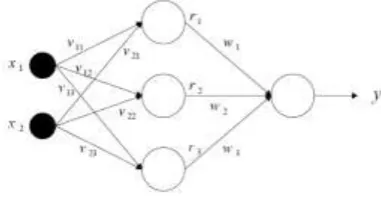
In this research, NN technique is the main tool used for constructing AI mechanism. The nonlinear relationship between input and output pairs is expected to be obtained through the efficient learning of NN. The NN structure commonly known as multi-layered feed-forward network is used in our research. The supervised NN with error back-propagation (BP) learning algorithm is taken for NN’s training [28-30]. In order to find the individual importance of each input variable to the output while NN is well-trained, a novel method will be used for calculating the influence rate (IR) [31]. Here, we use a simple three-layered NN model with size 2-3-1 to describe IR calculation method created. Its structure is shown in Fig. 3.
Figure 2: The principle of ultrasonic plastic welding process. (https://techcenter.lanxess.com)
In Fig. 3, due to the sigmoid function is an increasing function, the following relationships among the inputs (
x
1,
x
2), the outputs of hidden nodes (r1 ,r2 ,r3) and the output node (y) can be expressed as
ij i j
j v x
r
(1)
wjri
0y (2)
w
j(
v
ijx
i
j)
0y
(3)ij
v is the strength of connection between hidden node j and input node i; wj is the strength of connection between hidden node j and output node.
0 and
j are bias terms. The influence rate (IR) and the percentage influence rate (PIR) of input xi to the output y then can be defined by| ) ( ) ( ) ( | IR NT 1 k x k v k w ij i
k j
j
i
(4)
m 1 IR IR PIR i i i i (5)where, NT is the total number of input
x
i and m is the categories of input variables.III. EXPERIMENTS
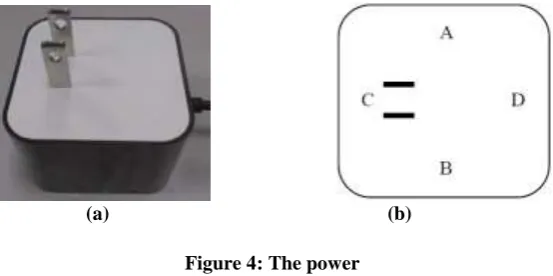
As previous description, this research aims to analyse the control parameters of ultrasonic welding machine by using NN model. The adapter shown in Fig. 4 is used as an example for this research. Fig. 4(a) shows the image of power adaptor which was produced by ultrasonic welding machine. Fig. 4(b) presents four test points A, B, C and D, which are used for testing whether the adaptor is a qualified product or not.
(a) (b)
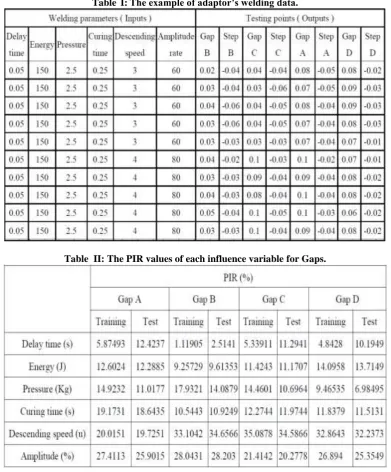
Table I shows an example of testing points, A, B, C, D, with different welding parameters. In the table, Gap means the joint spacing between upper shell and lower case. Step stands the distance of upper shell subsided in the lower case. For a good and qualified product, the measurements of Gap and Step must be within the following ranges.
Gap: 0.0 mm to 0.2 mm, Step: -0.10mm ~ 0.05mm.
Any product’s Gap or Step measurement is beyond the measurement scope, it will be treated as defective and must be re-produced.
In our research, 85 data sets were used for study. In which, 60 data sets were used for NN’s training and 25 data sets were used for testing. Eight independent NNs were used, each one is responsible for the individual Gap and Step points. The size of all NN models is 6-8-1. Table II shows the percentage influence rate (PIR) of each influence variable on the training and testing results of A, B, C, D Gaps by four NNs.
Based on Table II shown, the importance of each welding control parameter to four Gaps can be summarized as follows.
For Gap A; Amplitude > Descending speed > Curing time > Pressure > Energy > Delay time. For Gap B; Descending speed > Amplitude > Pressure > Curing time > Energy > Delay time. For Gap C; Descending speed > Amplitude > Pressure > Curing time > Energy > Delay time. For Gap D; Descending speed > Amplitude > Energy > Curing time > Pressure > Delay time.
important influencing factors for Gaps.
Similarly, the studies for four Steps by NN models were also analyzed. Table III lists the PIR values for the training and testing results of A, B, C, D Steps by four NNs. In Table III, the importance of each welding control parameter to four Steps can also be summarized as follows.
For Step A; Descending speed > Pressure > Amplitude >Curing time > Delay time > Energy. For Step B; Descending speed > Pressure > Amplitude > Delay time > Energy > Curing time. For Step C; Descending speed > Pressure > Energy > Curing time > Amplitude > Delay time. For Step D; Descending speed > Amplitude > Pressure > Energy > Delay time > Curing time.
Again, taking a summary, we conclude that descending speed, pressure and amplitude are three most important influencing factors for Steps either.
Table I:The example of adaptor’s welding data.
Table III: The PIR values of each influence variable for Steps.
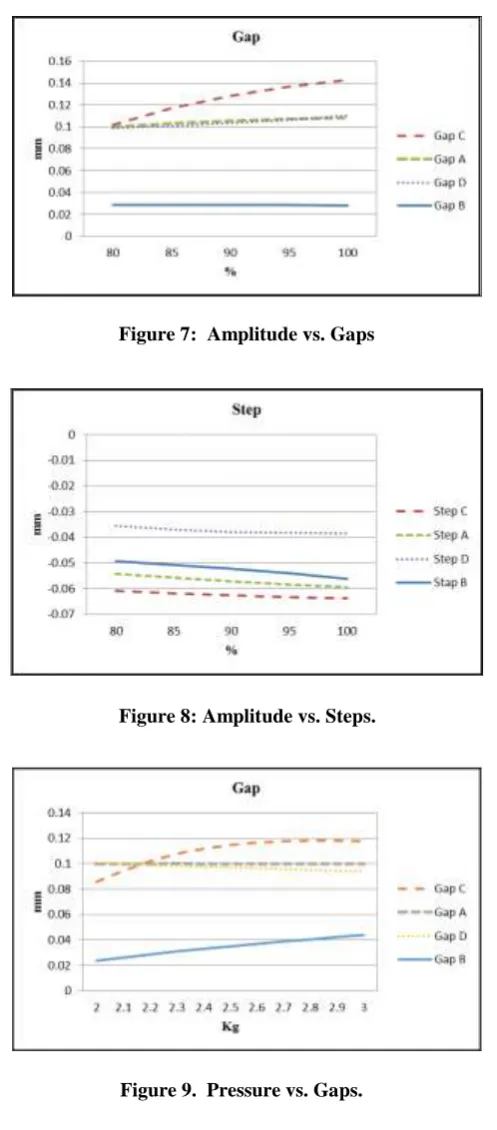
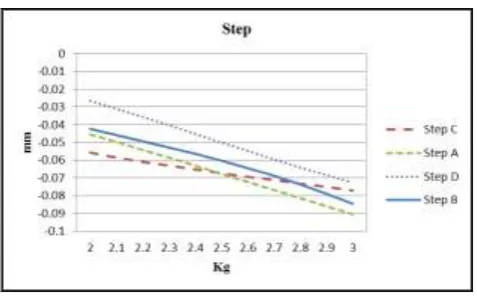
From above studies of Gaps and Steps, it is clearly found that descending speed, amplitude and pressure are three most important control parameters in the ultrasonic plastic welding process. In part of Gaps, amplitude is more important than pressure. However, in part of Steps, the condition is reversed, pressure is more important than amplitude.
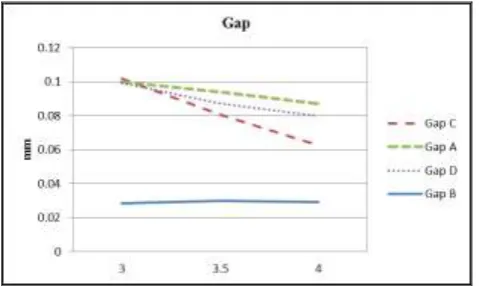
In order to see the actual influencing condition of three important factors to Gaps and Steps, respectively, the experiments of changes of Gaps and Steps versus individual parameter were performed. The results are presented in Fig. 5 to Fig. 10. From the figures shown, the effect of descending speed to Gaps and Steps is indeed greater than other two influencing factors. In addition, the effect of amplitude to Gaps is greater than pressure and the effect of pressure to Steps is greater than amplitude.
Figure 5: Descending speed vs. Gaps.
Figure 7: Amplitude vs. Gaps
Figure 8: Amplitude vs. Steps.
IV. CONCLUSION
In this research, the intelligent precise control mechanism for ultrasonic plastic welding machine is studied. An AI analyzer of control parameters for the ultrasonic plastic welding process is developed. As we know, for most of ultrasonic plastic welding works, the control process is usually based on the experience of senior technician. Sometimes, it can be called the expert system. Thus, the parameter’s adjustment of welding machine must rely on the actual operational condition and trial-and-error is still unavoidable. Thus, in our studies, the artificial NN model was used to analyze the relationships among the welding parameters and the product outputs (Gaps, Steps). It can be found that the descending speed, amplitude and pressure are three most important influencing control parameters in the real ultrasonic plastic welding process. Such an analysis has been confirmed by the online operational technician and recognized that our research results are correct. Therefore, we conclude that an AI mechanism for the optimal control of ultrasonic plastic welding process is possibly designed and developed. Such a smart mechanism could help the technician with no experience to do the best welding work easily. Based on this AI system, not only the cost of company could be reduced, but also the defective rate of product could be decreased.
V. ACKNOWLEDGEMENTS
This research was supported by the Ministry of Science and Technology, Taiwan, R.O.C. under Contracts MOST-105-2221-E-214-041.
REFERENCES
[1]. Grewell, D. ; Benatar, A. Welding of plastics: fundamentals and new developments, Intern. Polymer Processing, 2007, 22(1), pp. 43-60.
[2]. Balle, F.; Wagner, G.; Eifler, D. Ultrasonic metal welding of aluminium sheets to carbon fibre reinforced thermoplastic composites, Advanced Engineering Materials, 2009, 11(1-2), pp. 35–39.
[3]. Cavaglieri, M.; Figueiredo, F.; Cardia, F.; Dos Reis, G. Plastic welding process signature,SAE TechnicalPaper, 2012, paper 2012-36-0162.
[4]. Kazunari, A.; Masanaka, S.; Masayuki, I. ; Shigeo, M. Development of torsional-vibration systems used for high frequency ultrasonic plastic welding, in Proc. of 1995 IEEE Ultrasonics Symposium, 1995, 2, pp. 1061-1064.
[5]. Miranda, M. What happened to your ultrasonic weld quality? Plastics Technology, 2008, 54(3), pp. 51-52.
[6]. Sherry, J. R. Ultrasonic joining of plastic components utilizing a micro-computer, in Proc. of 47th Annual Technical Conference of Society of Plastics Engineers, 1989, pp. 511-513.
[7]. Grimm, R. A. Welding processes for plastics, Advanced Materials and Processes, 1995, 147(3), pp. 27-30.
[8]. Hemse, T.; Bornmann, P.; Morita, T.; Christoph, S.; Sextro, W. Reliability analysis of ultrasonic power transducers, Archive of Applied Mechanics, 2016, 86(10), pp 1707–1713.
[9]. Jiromaru, T.; Takako, U.; Kunifumi, O.; Tatsuya, A.; Tetsugi, U. Transmission conditions of vibration stresses to welding specimens of ultrasonic plastic welding using various two-vibration-system equipment, Japanese Journal of Applied Physics, Part 1, 1998, 37(5), pp. 3001-3006.
[10]. Jiromaru, T.; Yasuhiro, I.; Toshiyuki, S.; Toshiki, T.; Tetsugi, U. Welding characteristics of 90 kHz two-vibration-system ultrasonic plastic welding equipment, in Proc. of the IEEE Ultrasonics Symposium, 1994, 3, pp. 1353-1358.
[11]. Jiromaru, T.; Takako, U.; Katsuhisa, Y.; Noriyuki, I.; Tetsugi, U. Welding characteristics of ultrasonic plastic welding using two-vibration-system of 90 kHz and 27 or 20 kHz and complex vibration systems, Ultrasonics, 1998, 36(1-5), pp. 67-74.
[12]. Jiromaru, T.; Misugi, H.; Ryoko, T.; Rie O.; Tetsugi, U. Ultrasonic plastic welding using fundamental and higher resonance frequencies, Ultrasonics, 2002, 40(1-8), pp. 375-378.
[13]. Jiromaru, T.; Takako, U.; Katsuhisa, Y.; Tomoyuki, I.; Tetsugi, U. Ultrasonic plastic welding using two 27 KHz complex vibration systems, in Proc. of IEEE Ultrasonics Symposium, 1997, 1, pp. 855-860.
[14]. Jiromaru, T.; Misugi, H.; Masafumi, Y.; Hidekazu, H.; Tetsugi, U. Welding characteristics of 27, 40 and 67 kHz ultrasonic plastic welding systems using fundamental and higher-resonance frequencies, Ultrasonics, 2004, 42(1-9), pp. 131-137.
[15]. Jiromaru, T.; Misugi, H.; Masafumi, Y.; Hiroyuki, M.; Tetsugi, U. Frequency characteristics of ultrasonic plastic welding (27 kHz to 180 kHz ultrasonic plastic welding systems, JSME International Journal, Series C: Mechanical Systems, Machine Elements and Manufacturing, 2007, 49(3), pp. 634-641.
[16]. Jiromaru, T.; Misugi, H.; Masafumi, Y.; Hiroyuki, M.; Tetsugi, U. Welding characteristics and temperature rises of various frequency ultrasonic plastic welding, in Proc. of 2005 IEEE Ultrasonics Symposium, 2005, 1, pp. 707-712.
[17]. Yang, S. Q.; Dong, Z.; Yan, J. C.; Ju, J. B. Simulation on heating process in ultrasonic welding of plastics, Acta Metallurgica Sinica (English Letters), 2000, 13(1), pp. 80-83.
[18]. Zhang, Z. B.; Wang, X. D.; Luo, Y.; Zheng, Y. S.; Zhang, Y. G.; Wang, L. D. Ultrasonic welding mechanism of thermoplastics and its thermal process, Hanjie Xuebao/Transactions of the China Welding Institution, 2010, 31(11), pp. 29-32, Language: Chinese. [19]. Verderber, R. R. Implementation of algorithms for modeling ultrasonic welding, in Proc. of the 1997 ASME International
Mechanical Engineering Congress and Exposition, American Society of Mechanical Engineers, Pressure Vessels and Piping Division (Publication) PVP, 1997, 369, pp. 229-234.
[20]. Schaller, A. Design optimization of ultrasonic plastic welding equipment with the ANSYS program, in Proc. Of 4th International ANSYS Conference and Exhibition 1989, Part 1, pp. 1453-1470.
[21]. Zhang, C. B.; Li, L. J. A finite element based study of dynamic processes in ultrasonic welding, in ASM Proc. of the 8th
International Conference: Trends in Welding Research, 2009, pp. 254-257.
[22]. Andoh, E.; Kagawa, Y. Finite element simulation of a ultrasonic vibrator for plastic welding,in Proc. of IEEE 1985 Ultrasonics Symposium, 1985, pp. 563-566.
[23]. Hung, J. C.; Tsai, Y. P.; Hung, C. H. Optimization of ultrasonic plastic welding horns on amplitude uniformity, Applied Mechanics and Materials, 2012, 121-126, pp. 278-282.
[24]. Kumar, R. D.; Rani, M. R.; Elangovan, S. Design and analysis of slotted horn for ultrasonic plastic welding, Applied Mechanics and Materials, 2014, 592-594, pp. 859-863.
[25]. Kenichi, S.; Etsuzo, O.; Nobuyoshi, M.; Masao, I. Relationship between horn pressure and welding time in ultrasonic welding of plastic pipes using torsional vibration, Japanese Journal of Applied Physics, Part 1, 1999, 38(5), pp. 3302-3306.
[26]. Zeng, C.; Zhu, Z. O.; Chen, C. O.; Zhang, Y. F.; Xiong, Z. L. Temperature and stress distribution in ultrasonic metal welding, Shanghai Jiaotong Daxue Xuebao/Journal of Shanghai Jiaotong University, 2010, 44(1), pp. 54-57, Language: Chinese.
[27]. Rani, R. M.; Suresh, K. S.; Prakasan, K.; Rudramoorthy, R. A statistical study of parameters in ultrasonic welding of plastics, Experimental Techniques, 2007, 31(5), pp. 53-58.
[28]. Huang, H. C.; Hwang, R. C.; Hsieh, J. G. A new artificial intelligent peak power load forecaster based on non-fixed neural networks, International Journal of Electrical Power and Energy Systems, 2002, 24(3), pp. 245-250.
[29]. Shen C. Y.; Hsu, C. L.; Hwang, R. C.; Jeng, J. S. The Interference of humidity on a shear horizontal surface acoustic wave ammonia sensor, Sensors & Actuators: B. Chemical, 2007, 122, pp. 457-460.
[30]. Shen, C. Y.; Huang, H. C. Hwang, R. C. High-sensitive neural network ammonia sensor based on shear horizontal surface acoustic wave devices, Journal of Chemometrics, 2008, 22, pp. 548-555.
[31]. Chien, J. C. The Practical Study of Neural Network in Data Mining, Master Thesis, I-Shou University, 2013.