e-ISSN: 2278-7461, p-ISSN: 2319-6491
Volume 8, Issue 1 [January 2019] PP: 63-70
The impact of a double glassed flat plate solar water heater
collector performance
Hanan Mohammed Akbar, Suad Hassan Danook, Kamal Jalal
Northern Technical University Kirkuk Technical College Kirkuk, Iraq Northern Technical University Kirkuk Technical College) Kirkuk, Iraq Northern Technical University Kirkuk Technical College) Kirkuk, Iraq
Corresponding Author: Hanan Mohammed Akbar
ABSTRACT—
The present work proposes a design for solar thermal collectors and experimental setup procedure to evaluate the performance of double glazed solar flat plate water heater. Copper plate of 1.75 x 1m2 size was employed as absorber plates which is designed and fabricated with different geometries of absorber flat plates and v-grooved. Two glass plates of similar size are used to protect the absorber plate from heat loss to atmosphere. Performance of double glazed solar water heater for various geometries and mass flow rate (0.0041, 0.0083, 0.0125 kg/s) are performed under climatic of Kirkuk city along three months (April, May and June 2018). The heat gain of a flat plate solar collector is increased as increase in water flow rate with time along light day. Highest absorber plate temperature has been recorded with time along light day as compared to other two plate collectors. A best heat gain and thermal efficiency are observed for the double glazed flat absorber plate then the v-grooved plate and finally the square pulse plates.KEYWORDS— Double glazed solar water heater, flat plate, copper plate, v-grooved .
--- ---Date of Submission: 01-04-2019 ---Date of acceptance:15-04-2019 --- ---
I.
INTRODUCTION
A special kind of heat exchanger is a flat plate solar collector that converts the solar energy to thermal energy by using the liquids inside tubes for many industrial and domestic applications. It is widely used for supplying thermal energy at moderate temperatures. The common application of the flat plate collectors are mostly found in domestic hot water and space heating, industrial processes, vapour absorption refrigeration and air conditioning system. Therefore, due to their various applications, there is continuing endeavor of a designer to determine thermal performance of flat plate solar collectors.
The solar collector optimal design and performance of flat plate parameters studied by Farahat and Sarhaddi [1]. The evaluating of optical and thermal performance by detailed of energy and exergy analysis has been conducted. The solar collector dimensions, absorber plate area, mass flow rate, pipe’s diameter, overall loss coefficient, fluid temperature inlet and outlet were considered as variables. The solar water heating modeling installation for domestic is performed by Zehib and Chaker [2]. It was consists of a solar flat plate collector, a water storage tank, an auxiliary energy source and radiators. The accurately of thermo syphon flow rate and consequently the stratification degree of the tank on the water heater system performances. It was observed that the analysis of nodes can be used in the gain energy.
Number of researchers [3- 4] have concentrated on the development of effective design methods for solar collectors. For their analysis the cross sectional area of the absorber plate has been constant. However, the collector receives energy from the sun that is absorbed by the plate and is then transferred to the fluid. On this basis, energy transferred increases in the direction of flow energy in a plate. It is well known fact that for effective design, the profile shape of the absorber plate increases the collector performance.
change in local thickness (RPSLT). The result indicates that there is optimum fin efficiency of trapezoidal profile for constant plate volume. Chong [8] performed study of solar water heater using stationary V -trough collector. The result shown was cost effective cum easy fabricated v-trough solar collector can improve the overall performance of the solar water heater.
Ihaddadene and Ihaddadene [9] performed the effect of distance between double glazings on the performance of a solar thermal collector. Experiments were carried out on an active solar energy demonstration system. The results show that the efficiency of double glazing solar collector decreases with increasing the distance separating the two glasses. Duffie and Beckman [10] performed annual simulation to monitor the thermal performance of a direct solar domestic water heating system operated under several controlled strategies. According to the authors higher flow rate leads to higher collector efficiency factor. However, it also leads to higher mixing tank and therefore, a reduction in the overall solar water heating system efficiency. Jaisankar and Radhakrishnan [11] have performed experimental investigation of heat transfer, friction factor and theoretical performance of thermosyphon solar water heater system with helical twisted tape of various twist ratios has been performed and presented. The overall thermal performance of twisted tape collector is found to increase with increase in solar intensity. Kajavali and Sivaraman [12] have performed an analysis of single tube and a newly designed modified absorber in a parabolic trough collector. The solar energy recovery efficiency of the modified absorber was found to be higher than the single tube in the form of increased water temperature. Sae-jung and Krittayanawach [13] have determined the mathematical model and the experimental study for prediction of the temperature of hot water produced from thermosyphon solar water heater. Results are presented of storage temperature, collector temperature and thermal efficiency of the solar water heater.
Visa and Duta [14] investigated a new flat plate solar thermal collector with isosceles trapeze shape was developed and stepwise optimised focussing on the insulation the bonding between the tubes and the absorber plate. The results show that the improved contact between the tubes and the absorber plate has a significant effect on the experimental conversion efficiency, as also the tubes with larger diameters have. A self-cleaning coating applied on the outer side of the glazing and multi-coloured absorber plate is formulated and tested. Eight types of solar thermal collectors were tested and optimized. Beikircher and Möckl [15] investigated advanced insulation methods for flat plate collectors. The collector front losses have been reduced by transparent insulation materials, the rear losses by an integrated vacuum super insulation (VSI). Four front side insulations have been developed and investigated. Facão [16] determined the thermal performance of flat-plate solar collectors with riser and header arrangements. A more uniform flow distribution leads to a homogenous temperature distribution which gives higher collector efficiency. The Z distribution usually has better performance when compared to Π distribution. The design of the manifold influences the observed flow distribution. To optimize the manifold design, a correlation model was developed, based on correlations for minor pressure losses. Furthermore, the flow in this optimized geometry was simulated in 3D using the computational fluid dynamics (CFD) software code in order to confirm the results of the correlation based model. A new experimental low-intrusive technique was used to measure the flow distribution in an existing solar collector, validating the simulation results. The flow inside the absorber tubes is laminar; the major pressure loss inside riser tubes was measured using a high accuracy differential pressure transmitter, which then permits the indirect estimation of the mean velocity inside the tubes. It was the first time that this experimental methodology has been applied to analyze the flow distribution in solar collectors. The influence of the total water flow rate was analyzed. For a good flow distribution it was concluded that the outlet header manifold should have a higher diameter compared to the inlet header diameter. Usually commercialized solar collectors have the headers with same diameter.
The aim of this study is to investigate the performance of double glazed flat plate solar water heater subjected to various absorber plate geometries (flat type and v-grooved) at different mass flow rate.
II.
EXPERIMENTAL
SETUP
In order to study the performance of the solar collector , the design and manufacture of the collector is inclined to the horizontal at an angle (32.5 °) and dimensions of (1.75 x1)m . It consists of three main parts: the aluminum absorbing plate, copper pipes and glass cover. The small pipes shall be welded on the main distributor pipe from top to bottom to ensure an exemplary flow of water to plate (flat , v-corrugated)
performance of double glazed solar water heater was evaluated. The specification of device illustrated in table (1) and photograph of the experimental setup has been shown in Figure (1).
Table (1): Specification of solar collector water tank
1
The flexible pipe to exit the water 2
Plastic frame 3
Flat plat 4
The water withdrawal tube from the tank 5
The tube returns excess water to the tank 6
Water Recycling Pump 7
Water flow meter 8
The entry point of the pipe distributes water to the pipes 9
The iron base bearing the device 10
Electric motor 11
Valve safety valve 12
Water supply point for tank 13
Aluminum interior wall 14
Inner glass edge 15
Outer glass edge 16
.
A. Collectors Dimension
Dimensions of collector is set by using the perfect parameters for flat plate collector refers to other investigation and manual, Ilustrated in table (2).
B. Equations
Total radiation can be estimated form the eq ution (1)[9]
heat Removal Factors (FR)
Heat removal factor can be considered as the ratio of the heat actually delivered to that delivered if the collector plate were at uniform temperature equal to that of the entering fluid. ]10]
FR = [ ( )] ---(2) Heat Loss coefficient (UL)
UL is the overall heat transfer coefficient from the absorber plate to the ambient air. It is a complicated function of the collector construction and its operating conditions[11]
(3)
Where
C=365.9(1- 0.00883β+0.0001298× β2 ) f = (1+0.04ha – 0.0005ha2)*(1+0.091N) hw =5.7+3.8vw
Thermal Efficiency of the Collector (η)
FR FRUL
Useful heat collected for an air-type solar collector Useful heat collected for an water-type solar collector can be expressed as[11]:
Thermal Efficiency of the Collector (η)
It is the ratio of the Useful heat gain to the Total input energy[12].
= ---(6)
C. Asumption of Mathematical validation: The collector is in a steady state .
The headers cover only a small area of the collector and can be neglected. Flow through the back insulation is one dimensional.
0
10
20
30
40
50
60
9
10
11
12
13
14
15
16
Eff
ici
ency
(%)
Time(hr)
ηth(the)
ηth(exp)
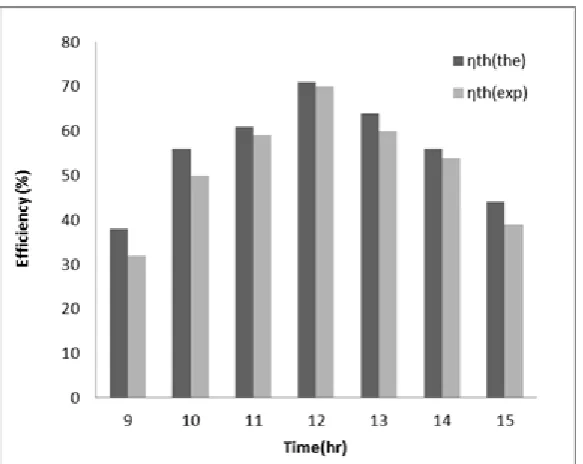
Figure 2 shows the comparison between the thermal efficiency of flat plat (0.0165kg/sec)
III.
RESULTS
AND
DISCUSSION
Figure 2 shows the comparison between theoretical and experimental flat plate solar collector. the coefficient of thermal efficiency starts increasing with sunrise hours until it reaches the highest value at midday due to increase of intensity of the radiation falling on the solar collector at flow rate 0.0165kg/sec.
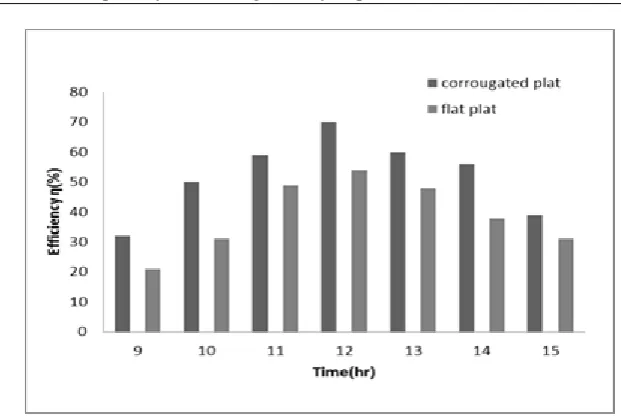
Figure 3 shows the comparison between theoretical and experimental v-corrugated plate. The coefficient of thermal efficiency starts increasing with sunrise hours until it reaches the highest value at midday due to the increasing intensity of the radiation falling on the solar collector. The reason for the surface area of v-corrugated plate is the the ability of absorbed as much solar radiation as possible on both ends and thus increase the thermal energy acquisition at flow rate 0.0165kg/sec.
Figure 4 shows the comparison between the thermal efficiency Experimental v- corrugated flat plat(0.0165kg/sec)
Figure 4 shows the comparison between experimental thermal efficiency flat plate and v-corrugated plate is higher efficiency from flat plat. The reason for the surface area of v-corrugated plate is the ability of absorption as much solar radiation as possible on both ends and thus increase the thermal energy acquisition at flow rate 0.0165kg/sec
Figure 5 shows the comparison between experimental thermal efficiency flat plate and solar radiation with time. The starts increasing with sunrise hours until it reaches its highest value at midday due to the increasing intensity of the radiation falling on the solar collector with increasing solar at 0.0165kg/sec.
Figure 6 shows the comparison between heat removal coefficient flat plat and v-corrugated plat is higher efficiency from flat plat, The starts increasing with sunrise hours until it reaches its highest value at midday due to the increasing intensity of the radiation falling on the solar collector with increasing solar at 0.0165kg/sec.
Figure 6 shows comparison between heat removal coefficient v- corrugated and flat plate (0.0041 kg /sec).
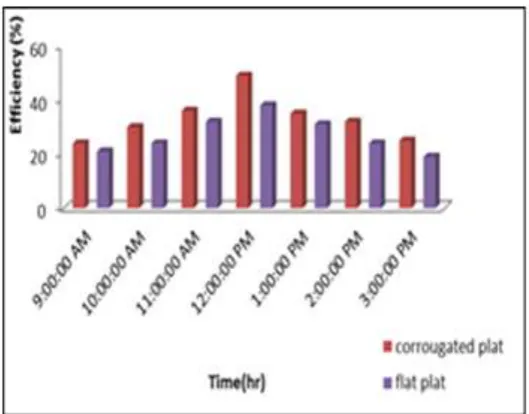
Figure 7 shows the comparison between experimental thermal efficiency flat plat and v-corrugated plat with time , the starts increasing with sunrise hours until it reaches its highest value at midday due to the increasing intensity of the radiation falling on the solar complex with increasing solar at 0.0041 kg /sec.
Figure 7 shows the comparison between the thermal efficiency v- corrugate and flat plate ( 0.0041 kg /sec).
IV.
CONCLUSION
Experiments were performed with double glazed solar water heater for the different geometric absorber plates subjected to uniform mass flow rate to find the performance of the set-up. The following conclusions were obtained from this study:
The v-corrugate absorber geometry temperature is higher than the flat geometries during experimentation. Thermal efficiency is higher for v-corrgate absorber geometries is 70% and flat plat is 54% at flow rate
0.001658 kg /sec .
REFERENCES
[1]. H.Vettivel and p.Mathiazhagan , " comparison Study of solar flat plate collector with Single and Double Glazing Systems " , 7 , (2017)
[2]. Fabio.sturckmann, "analysis of flat plat solar collector ",dept.of energy Sciences ,118,(2008).
[3]. R.C, V.K. Goel , B.C.Ray chauduri , " Experimental Investigations on Single Absorber Solar Air Heat " , Energy Convers .Mgmt , 27 , 343-349 , (1987) .
[4]. Kundu B., 2002. Performance analysis and optimization of absorber plates of different geometry for flat plate solar collector: a comparative study. Applied Thermal Engineering 22: 999-1012
[5]. R. J, a,K. N, Ramadhani B , " Effect of Glass Thiclness on performance of flat solar collector for Fruits Drying ", Hindawi publishing Corpoation , Journal of Energy,8 , (2014 ).
[6]. Dattatrat D. chincholkar and prof. P.R.Kulkarni ,"performance improvement of solar flat plat collector using formed tubes "International journal of scientific research and development , 4, 2016
[7]. Chong K.K., 2012. Study of a solar water heater using stationary v-trough collector. Renewable Energy 39: 207-215.
[8]. A. Ozsoy, S. Demirrer , N. M. Adam, " An experimental study on double glazed flat plat solar water heating system in Turkey ." In Applied Mechanics and Materials , Trans Tech Publications ,(2014 ), vol .564 , pp.204-
[9]. Duffie J.A and W.A. Beckman. 1991. Solar Engineering of Thermal Processes, 2nd edition. John Wiley and Sons, New York, USA. pp. 488.
[10]. Selvakumar .p , and Somasundaram p,"Experimental Analysis on solar Water Heater With Corrugated Absorber for Enhanced Heat Transfer ", Journal of Thermal Energy Systems , 1 ,(2016) .
[11]. A. L. Hernandez , J. E.Quinonez , "Analytical Models of Thermal Performance of Solar Air Heaters of Double–Parallel Flow and Double –pass Counter Flow ", Renewable Energy 55, 380-391, ( 2013).