IJIRT 145398
INTERNATIONAL JO URNAL OF INNOVATIVE RESEARCH IN TECHNOLOGY407
A Survey on Dynamic Community Detection based on
Distance Dynamics in Real World Network
Komal Prajapati
1, Prof. M. B. Chaudhary
21, 2
GEC Gandhinagar, Sector-28, Gujarat, India
Abstract- In today’s era, real world networks have
become quite prominent and a lot of research is getting done for making these networks valuable, by proposing helpful communities and similar interest communities to users. Moreover, due to freely available web space and interactions, there are different communities per user, making it extremely hard for highly iterative detection algorithms perform quickly and give important suggestions. Furthermore, real world networks are dynamic in nature. Along this lines, there is a requirement for dynamic community detection algorithm which can appropriately detect communities with time differs. Because it accepts the changes in network rather than static community detection algorithm. A Real world network is vital complicated network. There is a number of algorithms developed to detect communities. In this paper, we will see advantages and disadvantages of existing algorithms.
Index Terms- Communities, Dynamic community detection, Distance dynamics
I. INTRODUCTION
Community is an important feature of real world networks. Communities, also called clusters or modules, are groups of nodes which probably share common properties and/or play similar roles within the graph[8]. Community is a small or large unit or social unit who has something in common. Community Detection is a complex and meaningful process in real world network. In general, Communities of network are groups of nodes and edges. In that, nodes are much more connected to each other than to the other nodes of the network. There are number of methods for detecting communities in a network. Some algorithms for community detection like algorithms based on edge betweenness[2], modularity based[7], similarity based[11], interest based[11], based on distance
dynamics[1], and many more. Advantage of algorithm based on distance dynamics is that we get more number of communities from a network and it also accepts the changes in a network. Community detection is a broad area for research. In real world network, it is important to detect communities for getting some useful information. For example, A community of a peoples who interested in dieting and they shares the experience about them. So, if someone want to start dieting then it can get the information about it from that community.
The aim of a community detection algorithm is to divide the nodes of a network into some number of groups. The connections between nodes inside a community are much denser while the connections between communities are sparser[1]. These groups known as communities of network. For example, take a group containing a set of people, who have strong mutual relationships and weak with people outside the group. Using the community detection algorithm in real world network, one can get some meaningful and important information.
Fig. 1: Three communities in a graph, enclosed by dashed circles[8]
IJIRT 145398
INTERNATIONAL JO URNAL OF INNOVATIVE RESEARCH IN TECHNOLOGY408
we need that kind of algorithm which able to detect the community in dynamic network. Because, Dynamic community detection algorithm able to observe the changes of dynamic network. Distance Dynamics means the change of distances among the nodes in a network. It provides an intuitive image to
model the real-world network dynamics. For
example, we take a community as a group of friends. So, how we can identified it? Obviously, it is based on a relationship by the interactions between them.
II. PROBLEM DEFINITION
Real world network are dynamic in nature. So, for detecting communities from real world network, we need an algorithm which can do that very accurately and fast. Here, we will discuss about the existing methods and their advantages and disadvantages. From that one can understand that how the method works and what will be the output.
III. LITERATURE SURVEY
Now, we will see the literature review of research papers. From that one can identify that which method is better, what are the strong points and weak points of particular paper. So, we will see that one by one.
1. Dynamic Community Detection based on Distance
Dynamics[1]
This paper presents dynamic community detection algorithm - Dynamic Community Detection based on Distance Dynamics (DC3D). It use local interaction model. The increments can be treated as disturbance of networks. That can be limited by disturbing factor in local area. In this proposed algorithm, it defines many new terms like accumulated increment, disturbance factor, etc. It take advantage of local interaction model to save computing time and uncover small communities. It achieved good balance between efficiency and effectiveness. The drawback of the algorithm is that it’s lower modularity. Also it doesn’t consider different cohesiveness of each neighbor node.
2. An Adaptive Approximation Algorithm for
Community Detection in Social Network[4]
In This paper, Author propose new algorithm for community detection in social network to get some
meaningful and important information. In this paper, author proposed a community detection method that are performed based on vertex relation and their modularity. Author make this method more precise based on dynamically calculating modularity. Algorithm is adaptively checking the status of nodes and performed the community detection. Also, dynamically calculate the modularity. It cannot contain the many overlapping nodes in communities.
3. Social Community Detection based on Node Distance and Interest[11]
In this paper, Authors proposed an algorithm which clusters the nodes in social network based on their geodesic location and similarity between their interests. By calculating geodesic distance between nodes, we can get relatedness of two nodes. The proposed algorithm known as GeoSim (Geodesic locations of nodes and the Similarities between their Interests) Algorithm. It contains three stages: Mean node selected in first stage, then it calculate distances between nodes and similarities calculation and finally clustering stage. Achieves high community detection accuracy. It focus on both distance and similarity interest terms. So, for two nodes which placing in one community, both have to close to each other and have similarity interest.
4. Track ing Dynamic Community Evolution in Social
Network[12]
In this paper, proposed algorithms classify the changes and based on indicators where important events can occur. They also integrate data warehouse layer which have overview of all possible changes helpful for future analysis. The proposed algorithm known as DDCom(Data Warehouse for Dynamic Communities) algorithm. In that, first apply static community detection on initial graph for getting temporal snapshots, then identify the event, after that it builds data warehouse. Finally it enables continuous insertion of new data. It integrate data warehouse technique to improve analysis.
5. Dynamic Community Detection Algorithm based
on Hidden Mark ov Model[13]
IJIRT 145398
INTERNATIONAL JO URNAL OF INNOVATIVE RESEARCH IN TECHNOLOGY409
community detection problem to get optimal status chain in HMM considering history information and characteristics in dynamic social network. In that, it firstly find N core of every community, then get similarity between nodes. When particular node gets max probability, then put it into community to get maximum value of probability, then get optimal community. It perform effectively and accurately. It has lower performance in sparse graph and cannot get global optimization community structure without enough information.
6. Dynamic Community Detection Algorithm Based on Incremental Identification[14]
Dynamic community algorithms try to solve
problems that identifying communities of dynamic network snapshots. In this paper, it proposed DABP
(Dynamic Algorithm Based on Permanence)
algorithm which is based on incremental
identification according to vertex based metric called permanence. It incrementally analyze community ownership of partial vertices, so as to avoid reassignment of all vertices in network to their respective communities. Also it use evaluation strength metric to measure probably caused by incrementally assigning community ownership. It performs well and achieve good NMI score. It gets much lower modularity.
7. Leader-based community detection algorithm for social network s [20]
In this paper, proposed algorithm known as LBCD
(Leader Based Community Detection) which
introduced a new approach for detecting
communities. It is based on forming local
communities around nodes with great influence. For that similarity measure used mainly captures the degree of similarity between users based on their common actions at the same time it preserves relationships between nodes in the social network[20]. This algorithm consists three phases. First one is discovery of leaders then it calculate weight between nodes and finally assign nodes to communities. It improve the accuracy of real world communities and Enhances the performance. It doesn’t include more information attached to nodes, so it decrease the accuracy.
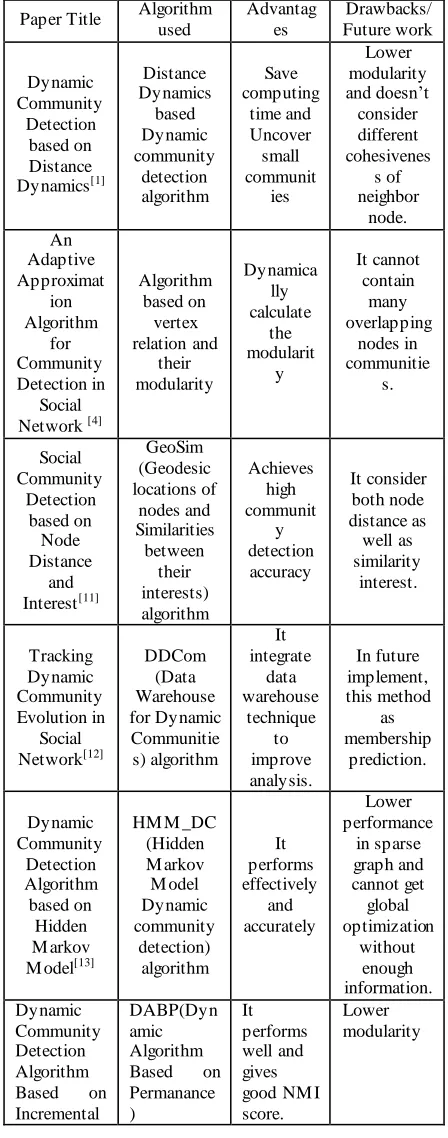
Now, in Table 1, we will see the literature survey in a tabular form. It gives clear idea about the community detection algorithms.
Table 1: Comparative Analysis of Literature Review papers
Paper Title Algorithm used Advantag es Drawbacks/ Future work Dynamic Community Detection based on Distance Dynamics[1] Distance Dynamics based Dynamic community detection algorithm Save computing time and Uncover small communit ies Lower modularity and doesn’t consider different cohesivenes s of neighbor node. An Adaptive Approximat ion Algorithm for Community Detection in Social Network [4]
Algorithm based on vertex relation and their modularity Dynamica lly calculate the modularit y It cannot contain many overlapping nodes in communitie s. Social Community Detection based on Node Distance and Interest[11] GeoSim (Geodesic locations of nodes and Similarities between their interests) algorithm Achieves high communit y detection accuracy It consider both node distance as well as similarity interest. Tracking Dynamic Community Evolution in Social Network[12] DDCom (Data Warehouse for Dynamic Communitie s) algorithm It integrate data warehouse technique to improve analysis. In future implement, this method as membership prediction. Dynamic Community Detection Algorithm based on Hidden M arkov M odel[13]
HM M _DC (Hidden M arkov M odel Dynamic community detection) algorithm It performs effectively and accurately Lower performance in sparse graph and cannot get global optimization without enough information. Dynamic Community Detection Algorithm
Based on
Incremental
DABP(Dyn amic Algorithm
Based on
Permanance ) It performs well and gives good NM I score.
IJIRT 145398
INTERNATIONAL JO URNAL OF INNOVATIVE RESEARCH IN TECHNOLOGY410
Identificatio n[14] Leader-based community detection algorithm for social networks[20]
LBCD (Leader Based Community Detection)
It improve the accuracy
of real
world communit ies. It Enhances the performan ce.
It doesn’t include more information attached to nodes, so it decrease the accuracy.
IV. CONCLUSION
Real world network are dynamic in nature, so I have decided to make an algorithm which can detect dynamic communities. For using distance dynamics based dynamic community detection algorithm get the dynamic communities from the network. In a comparison table, we can see that advantages and disadvantages of existing algorithms. So, in proposed work we try to solve problem and will make improvement in existing work. We will implement the proposed work in R programming and also will test on real world network to detect dynamic community.
REFERENCES
[1] Qian Guo , Lei Zhang , Bin Wu , Xuelin Zeng. “Dynamic Community Detection based on Distance Dynamics” International Conference on Advances in Social Networks Analysis and Mining (ASONAM), IEEE/ACM, 2016
[2] M. Girvan, M. E. J. Newman. “Community Structure in social and biological networks” Proceedings of the National Academy of Sciences of the United States of America (PNAS), 2002, 7821-7826.
[3] J. Shao, Z. Han, Q. Yang and T. Zhou, "Community Detection based on Distance Dynamics," in Proceedings of the 21st ACM
SIGKDD international conference on
Knowledge discovery and data mining, ACM, 2015, PP. 1075-1084.
[4] Kamal Sutaria, Dipesh Joshi, Dr. C. K. Bhensdadiya, Kruti Khalpada. “An Adaptive
Approximation Algorithm for Community
Detection in Social Network” 2015
International Conference on Computational
Intelligence & Communication Technology, IEEE, 2015
[5] Tao Meng, Lijun Cai, Tinqin He, Lei Chen, Ziyun Deng. “An improved community detection algorithm based on the distance dynamics”
International Conference on Intelligent
Networking and Collaboration Systems, IEEE, 2016.
[6] C.D. Manning, P. Raghavan and H. Schutze,
“Introduction to InformationRetrieval,”
Cambridge: Cambridge University Press, 1 edition, 2008.
[7] Di Zhuang. “Modularity-based Dynamic
Community Detection” JOURNAL OFLATEX CLASS FILES, VOL. 14, NO. 8, AUGUST 2015.
[8] Santo Fortunato, "Community detection in graphs," Physics Reports, vol. 486, no. 3-5, pp. 75-174,2010.
[9] Danielle S. Bassett, Mason A. Porter, Nicholas F. Wymbs, Scott T. Grafton, Jean M. Carlson, Peter J. Mucha. “Robust Detection of Dynamic Community Structure in Networks” 013142 arXiv:1206.4358 [physics.data-an], June 2012. [10] Jiawei Han and Mickeline Kamber, Data Mining:
Concepts and Techniques, 2ndEdition, Morgan Kaufmann Publishers, 2011.
[11] Mohammed Ba Hutair, Zaher Al Aghbari, Ibrahim Kamel. “Social Community Detection based on Node Distance and Interest” 3rd
International Conference on Big Data
Computing, Applications and Technologies, IEEE/ACM, 2016.
[12] Zeineb Dhouioui, Jalel Akaichi. “Tracking
Dynamic Community Evolution in Social
Network” International Conference on Advances in Social Networks Analysis and Mining (ASONAM), IEEE/ACM, 2014.
[13] Zhe Dong. “Dynamic Community Detection Algorithm based on Hidden Markov Model” International Symposium on Advances in
Electrical, Electronics and Computer
Engineering (ISAEECE), 2016.
[14] Xiaoming Li, Bin Wu, Qian Guo, Xuelin Zeng, Chuan Shi. “Dynamic Community Detection Algorithm Based on Incremental Identification” 15th International Conference on Data Mining Workshops, IEEE, 2015.
IJIRT 145398
INTERNATIONAL JO URNAL OF INNOVATIVE RESEARCH IN TECHNOLOGY411
[16] https://scholar.google.co.in/
[17] https://www.google.co.in/search?q=social+netw ork&source=lnms&tbm=isch&sa=X&ved=0ahU KEwjg1Zqm9ufXAhURTY8KHa51DkYQ_AUI CigB&biw=1349&b ih=635#img rc=_
[18] https://www.google.co.in/search?q=scientific+co llaboration+network&source=lnms&tbm=isch&s a=X&ved=0ahUKEwjmtMCr9ufXAhVEvY8KH f_kBIkQ_AUICygC&biw=1349&bih=635#imgr c =_
[19] https://en.wikipedia.org/wiki/R_(programming_l anguage)
[20] Nivin A. Helal, Rasha M. Ismail, Nagwa L. Badr, Mostafa G. M. Mostafa. “Leader-based community detection algorithm for social networks” WIREs Data Mining Knowl Discov 2017, e1213. doi: 10.1002/wid m.1213
[21] Margaret H. Dunham, S. Sridhar. “Data Mining:
Introductory and Advanced Topics” 1st
Impression, Pearson Education, 2006
[22] https://en.wikipedia.org/wiki/Mutual_informatio n
[23] Strehl A, Ghosh J. “Cluster ensembles ---a knowledge reuse framework for combining multiple partitions[J]”. The Journal of Machine Learning Research, 2003, 3: 583-617.
![Fig. 1: Three communities in a graph, enclosed by [8]](https://thumb-us.123doks.com/thumbv2/123dok_us/1394127.1650911/1.612.327.534.511.630/fig-communities-graph-enclosed.webp)