e-ISSN : 2278-067X, p-ISSN : 2278-800X, www.ijerd.com
Volume 2, Issue 7 (August 2012), PP. 19-25
Microcontroller Synthesized Function Generator
Visa M. Ibrahim
1.Oni Taiwo
2.Uyoata E. Uyoata
31,2,3Department of Electrical and Electronic Engineering, School of Engineering and Engineering Technology, Modibbo
Adamma University of Technology Yola, Adamawa State. Nigeria
Abstract––The need to ascertain the reliability and performance of electronic systems under test and in operation using electronic instruments such as the function generator cannot be over emphasized. The output responses of most electronic systems under test operation is the waveforms they generate on a scope; in consonant with the function generator waveform responses which could be in the standardized or non-standardized format. The continuous clamour for an easily re-programmable, simplified hardware, decreased power consumption, and high in performance function generation is the major set out goal of this paper. Practical results obtained show an appreciable degree of accuracy and repeatability of the system moreover, the microcontroller makes the system user-friendly.
Keywords––Microcontroller, DAC, Synthesized Function Generator
I.
INTRODUCTION
The performance of most electronic systems under test and in operation using the function generator are basically to extract vital information based on the generated signals displayed on a scope, and in some other case be used to initiate control for systems and as such there is need to inhabit special signals for such operation [1]
Various approaches have been adopted in the past, but with the ever increasing need for flexibility and user-friendliness evolves the digital synthesis approach based on the use of microcontrollers [2, 3]. The microcontroller approach; are easily re-programmable, a simplified hardware design, allow user selectivity by a matrix keypad [4]. Time varying signals in digital format are generated from the microcontroller, as it is converted into the corresponding analogue format at a high processing speed.
It is worth mentioning here that the system performance is enhanced by using a faster microcontroller and the digital to analogue converter which is the 12 or 16 bit categories [5, 6].
Practical result shows the high in performance, integrating more functions such as to generate square, ramp, sine, and triangular wave signals in the micro-controlled synthesized function generator [7]. In addition, problem on stability, accuracy, reproducibility, and the need to change external components when certain desirable parameters are to be obtained have been achieved.
II.
SYSTEM DESCRIPTION
Figure 1: system block diagram
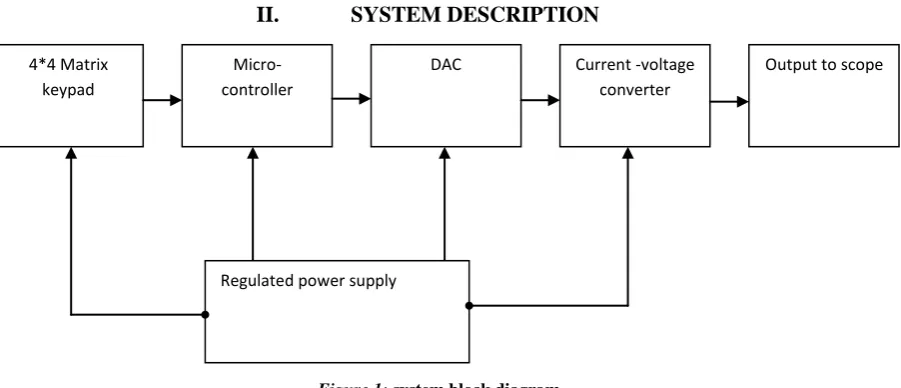
The block diagram shown in figure 1 describes the overall system. The system comprises of a 4 * 4 matrix keypad which allows user selectivity of the various waveforms at desired frequencies. The user-friendly matrix keypad sends signals in the digital format to microcontroller. The microcontroller which is the brain and control circuit behind the entire design circuitry is controlled with a written program stored into its read only memory (ROM). The co-ordination of the system’s
4*4 Matrix keypad
Micro-controller
DAC Current -voltage
converter
Output to scope
ii. Comparing the numerical value based on the calculated time delay in other to interpret it in the corresponding current train before it is being sent to the digital-analogue converter unit.
In this paper, the design utilized a circuit assembly of a digital-analogue converter, current-voltage converter and a few other basic electronic components to achieve the final generation of the waveform in the analogue format to be displayed on a scope.
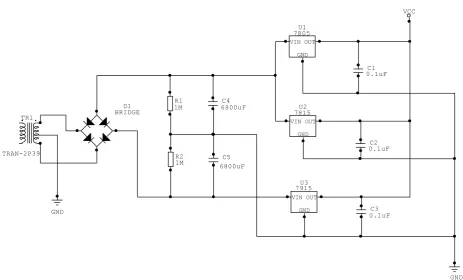
The power supply provides the voltage and current requirement for effective performance of the system. The uniqueness of this power supply is the generation for a negative rail for compensation on the digital-analogue converter.
III.
DESIGN FRAMEWORK
The design process is divided into two viz., the hardware and the software designs.
1.1 Hardware Design
1.1.1 The Microcontroller Unit
The system is designed around the Intel’s AT89s52 microcontroller. The Intel AT89s52 microcontroller is a complete computer on a single chip. This is because it has read only memory (ROM), Random Access Memory (RAM) and central processing unit (CPU) embedded in it.The AT89s52 is a low-power, high performance CMOS 8-bit microcomputer with 8k bytes of memory [8]. The device is manufactured using Atmel’s high-density non-volatile memory technology and is compatible with the industry standard 80c51 and 80c52 instruction set and pin out. The on-chip flash allows the program memory to be reprogrammed in-system or by a conventional non-volatile memory programmer. It also provides programmable timer, programmable I/O ports together with 256x8-bit RAM for use as “scratch book” and also for stack purposes [8,9]. Voltage regulation was achieved through the use of LM 7805, LM 7815 and LM 7915 regulators.
1.1.2 Interfacing Microcontroller to Coordinate the Entire System
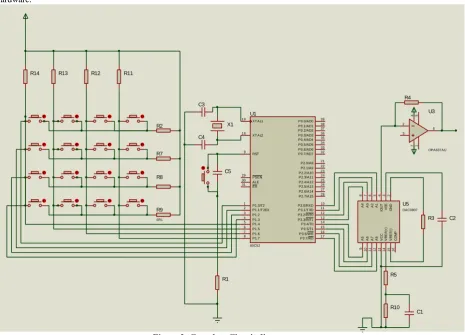
Numerical value of zeros and ones selected from the 4 * 4 matrix keypad are sent to the microcontroller through port one bit zero through port one bit seven (p1.0-p1.7). The digital format generated from the selectively on the matrix keypad is sent to the combined digital-analogue converter circuitry (DAC) which allows it to be represented in the analogue format on the scope through port two bit zero through port two bit seven (p2.0-p2.7). Figure 2 gives clearer view of this hardware.
Figure 2: Complete Circuit diagram
Figure 3: Circuit diagram for regulated power supply 1.2 Software Design
1.2.1 Software Development
The program was written in assembly language using the 8051 instruction set. Calculated parameters were carried out in other to achieve the program software development for the various waveforms generated. These and the flowchart are discussed in this paper as:
i. Development of square wave program
The square wave signal is generated by a suitable digital logic of Ton and Toff and is equivalent to the analogue output.
Figure 4: Square Waveform
Tp= Ton+ Toff = Tc
Where Tp =1F is the time period between Ton and Toff
And F = desired frequency
Ton= Toff
Tp= 2 Ton
Ton=
Tc
2
The program time delay equivalent to theTon of the square wave generated is:
VCC
GND GND
TR1
TRAN-2P39
D1 BRIDGE
C5 6800uF
C4 6800uF
C3 0.1uF C2 0.1uF C1 0.1uF
OUT
GND VIN
U3 7915
OUT
GND VIN
U2 7815
OUT
GND VIN
U1 7805
R2 1M R1 1M
V
refThe logic in generating a saw toot wave is such that once the maximum output digital logic is attained, there is a sudden drop of voltage at a negative level.
Figure 3.2: Saw tooth Waveform
Step Size =255 Vref
Where Vref = reference voltage
And Tp = Ta= 1F
Ta= time for an ascending level to achieve a step size
F = desired frequency T pdsq = step size Ta the program time delay for a generated saw tooth (Ramp) signal
iii. Development of triangular wave program
Figure 5: Triangular Waveform
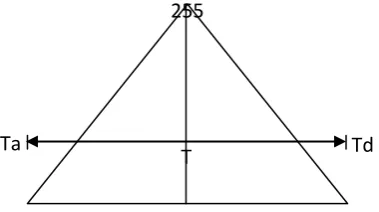
Tp = Ta+ Td
Where Tp = time period
Ta= time for ascending level
Td = time for descending level
But Tp = 2Tp
Ta = Tp
2
But also step size = 255
Vref
The program time delay to generate a triangular waveform is
TpdTR = Ta
step size orTpdTR = TaVref
255
iv. Development of sine wave program:
The technique used for the generation of sine wave as presented in this paper is the use of a look-up table where predetermined values of the sine function are calculated and loaded on a separate memory bank.
V
refT
0
Ta
T
Td
Vref
Figure 6: Sine Waveform
Vout = 2.5v + (2.5 × sin θ)
The value sent to DAC (decimal)= Vout × 255 Vref
But t = T
4
Where T = periodic time
Also T = 1
f
Where f = desired frequency; t =1 4f
The required program time delay for sine wave generation is given by T pds = Sot
Where So is the total number of samples from the look-up table.
Angle(θ) sinθ Vout voltage Mag
2.5V + (5V × sinθ)
Values sent to DAC (Dec) voltage
mag × 256
s
Hex value
Figure 3.5:system flowchart
No
No
Calculate
Calculate
DAC
No
Yes
No
No
Read wave form
Square
DAC
No Cycle
End
Initialize
Prompt
Saw
No Cycle
End
End
Train
DAC
No Cycle
Sine
DAC
No Cycle
End
Calculate
d
IV.
PERFORMANCE EVALUATION AND TESTING
Practical tests were carried out on the system performance during and after the construction. From the experimental results show a stair case appearance of the square and at a more fast processing speed for the sine wave generated.
V.
CONCLUSION
The use of the microcontroller to actualize the ever needed flexibility thereby eliminating the need of changing the hardware whenever certain desirable functions are needed have been achieved by the evolution of this design. However, with little modifications on the hardware especially with regards to the use of a 16 – bit microcontroller and 16 – bit on chip digital-analogue converter (DAC), the frequency are varied adequately with the waveform from the keypad.
BIBLIOGRAPHY
[1]. MT Abuelmatti A. RAL-Ali (1995) “Fourth Saudi Engineering conference “Department of Electrical Engineering King Fahd University of Petroleum and Minerals.
[2]. Eva Murphy (2000) “DDS Control Waveforms in Test, Measurement and Communications” Analog devices co-operation htt//www.analog.com
[3]. M.M.S Ananad (2006) Electrical Instruments and Instrumentation Technology. [4]. Dag Stranneby (1996) Digital Signal Processing and Applications
[5]. Muhammed Ali Mazidi (2nd edition) The 8051 Microcontroller and Embedded System Using Assembly and C
[6]. Thomas C. Hayes (2002) The Art of Electronics Student Manuals, Cambridge University press. [7]. Hall F. and Lister P.F (1980), Microprocessor Fundamentals, Pitman, London.