DEVELOPING A CONCEPTUAL MODEL FOR UNDERSTANDING INTERNATIONAL STUDENTS’ ENGAGEMENT WITH ASSESSMENT IN HIGHER EDUCATION. THE
IMPORTANCE OF INSTITUTIONAL PROFILES. Aneta L Hayes1, Eloise Tan2
1
Keele University, Keele, Staffordshire, ST5 5BG, UK
2
The National Forum for the Enhancement of Teaching and Learning, 19 Dawson Street, Dublin 2, Ireland
Abstract
This article will overview a two year long funded project into students’ engagement with assessment in higher education (HE) at two international universities. We will discuss various stages of the project and explain how they informed the methodological changes as well as the shift in focus on institutional profiles in analysing student engagement. Based on the data collected from participants in the universities in Ireland and Bahrain, we begin to develop a conceptual model that places institutional cultures in the centre of students’ engagement. In our research, clear differences emerged between the cohort in the Irish university and the participants in Bahrain due to different institutional profiles of these two universities. We are therefore beginning to build a model in which various aspects of these profiles are considered, proposing that it could be a useful framework for analysing student engagement with assessment.
Key words: engagement, higher education, international students, institutional profiles, framework
1. INTRODUCTION
Science Technology Engineering and Mathematics (STEM) subjects are often called the ‘gatekeepers’ of academic and financial success for students and as such there are numerous programmes worldwide to increase student enrolment and achievement within STEM subjects. The Irish university involved in this study is one example where these programmes are run. Within Ireland, the National Strategy for Higher Education raises concerns about third level students’ abilities to effectively engage with STEM subjects (DES 2011). The Strategy also calls for increased recruitment of international students, which is likely to result in an increase in the numbers of culturally and linguistically diverse students in STEM subjects. Outside Europe, where we have seen increased numbers of international branch campuses being established in the Far and Middle East, the concern seem to be focused in the same areas of student difficulties in coping with culturally and linguistically different learning environments. The second university involved in this study is an international branch campus of another Irish university established in Bahrain.
“It can be observed that a linguistic and cultural background different from the respective national one serves as a means of exclusion, of prevention from equal access [to HE]”
(Gogolin, 2000, p.123).
Gogolin’s (2000) words find many applications in the contemporary context of higher education as research has continually found that that diverse students have unique challenges of cultural adaptation that have consequences for assessment (Ho 2010; Museus & Vue 2013). We focus on the assessment process as it dominates student journeys throughout HE (Gibbs & Simpson 2004) and because students are found to adopt strategic approaches to assessment by seeking cues that will help them ‘survive’ (Hayes et al. 2015). Therefore, this research project aimed to uncover how the linguistic and cultural backgrounds of international students may affect the assessment process. Sook Lee and Anderson (2009) state that there is a connection between how students understand the world and their
academic performance. Thus there are very real consequences related to assessment for culturally and linguistically diverse students in STEM subjects.
Cultural competence is recognised as a necessary quality of educators at universities who open their doors to international students (for example: Donini-Lenhoff & Hedrick 2000). When integrated into the curriculum and when derived from students’ personal experiences, cultural competence has a potential to maximise learning and improve the ways in which universities work. Good understanding of how students’ socio-cultural and linguistic frameworks allows educators to avoid stigmatising students based on the general assumptions about their educational, cultural and ethnic background and to better address students’ learning needs (Greenholtz 2000). By focusing on the experiences of culturally diverse students with the assessment process at two HE institutions, we made contributions to building cultural competence of the lecturers at the two universities involved in the study, which advanced their and our own knowledge of expectations, experiences, and perceptions of assessment from international undergraduates.
Carroll & Ryan (2005) and Cortazzi & Jin (1997) propose that we cannot assume that our teaching and assessment practices are neutral, and therefore suitable for students from all backgrounds. In fact, much contemporary higher education literature highlights that the experiences of these practices is never the same for culturally diverse students due to different cultures, missions, modes of study, and historical legacy of institutions (Brennan & Osborne 2008). Conceptualising the gap between home and international students therefore should not be based solely on addressing the practical issues connected with studying in a foreign institution but it should also take account of the wider socio-cultural academic ways and frameworks of students (for example: Bhattacharyya 2010, Serpell 2007, Hirshy & Wilson 2002). Thus, we focused in our project on developing an understanding of students’ conventions, attitudes and ways of approaching assessment in third level education and linking them to students’ cultural framework. Our theoretical framework was based on the work of Vygotsky (1978) who proposes that individuals’ engagement in specific tasks is a mediated process informed by the interaction of social and cultural artefacts and beliefs of individuals and their environment. Assessment was seen in our project as one of those tasks.
2. INFORMATION ABOUT THE PROJECT
We report in this article on a qualitative research project, funded by 3U Partnership, that sought to gather the experiences of culturally and linguistically diverse students being assessed in STEM subjects. Student participants were recruited at two universities, from undergraduates from Medicine, Engineering, Computing, Maths, Biotechnology, Biology and Chemical Sciences. We undertook this project to enhance STEM practitioners’ knowledge of how their student population experiences assessment and to enhance practitioners’ cultural competence – a key skill for third level educators (Donini-Lenhoff & Hedrick 2000).
The project’s aim was to uncover how the linguistic and cultural backgrounds of international students may affect the assessment process. We felt we needed to know more about how to teach STEM subjects to international students in a way that sets them up for success within the constraints of our current resources. The following research questions guided our work:
1. How do the linguistic and cultural backgrounds of students mediate their engagement with the assessment process in STEM subjects?
2. What are the expectations and perceptions of assessment in STEM subjects of students from different linguistic and cultural backgrounds?
While seeking answers to the second research question, we learnt that student experiences of assessment are not uniform and that how they experience assessment does not necessarily link in linear ways to students’ socio-cultural frameworks. These findings were significant in terms of what we also concluded in relation to the first research question which suggested a complex interplay between students’ previous experiences, cultural influences and linguistic proficiency but less direct links of this interplay with how the students engaged with assessment (Tan & Hayes, forthcoming) .
In this paper, we would particularly like to focus on the first research question as the findings in relation to the role of cultural and linguistic capitals of the students informed our focus on institutional profiles and future direction of this research.
Narrative inquiry was chosen as the research approach and method of analysis because it privileges the stories and experiences of research participants and tries to understand the “personal practical knowledge” of participants (Clandinin & Connelly 2000). Narrative inquiry is a qualitative research method that uses data, usually from interviews, to gather stories about participants’ experiences. Inductive position to coding the data was adopted because of the exploratory nature of the study and interest in participants’ views and experiences.
We would like to note that a strictly thematic analysis approach would reveal different findings than a narrative inquiry approach. Participants’ individual answers were often misaligned to the larger narrative running through their interview. For example, a participant might have shared that they did not feel their Pakistani culture had any influence on how they engaged with academics, then went on to tell stories of how the pressure from their family to become a doctor/engineer was strong because that is the way it works in their culture. Using a traditional thematic analysis approach the participant’s answer that ‘No, my Pakistani culture has no influence on my academic engagements’ would be coded as ‘No cultural impact’. However the holistic approach inherent in narrative inquiry required us to consider the participant’s narrative as a whole. We therefore looked not solely at individual answers to questions, but the whole narratives participants related to throughout the interview. The example given above was common throughout analysis.
Overall, thirty interviews were conducted with participants with fifteen interviews at each research site. We chose thirty because this allowed us to target undergraduates from different programmes and it was also feasible in the allocated time of this research grant. Given that we were taking a phenomenological approach of narrative inquiry, we were aware that even a small amount of interviews could provide rich data on participants’ experiences (Baker & Edwards 2012). Below we present an overview of our findings in a report style as opposed to using full data. The full set of findings suggested that multiple influences exist in an individual’s world and that they combine in differing ways when students experience assessment. This led us to challenge the traditionally perceived links between students’ backgrounds and success in education as this diverts attention away from the practices in HE institutions towards facilitating change. Instead, we decided to focus on institutional profiles and practices which appeared to be the leading structures facilitating students’ engagement in HE (Tan & Hayes, forthcoming). The report style of what we present below helps us illustrate better how we came to undertake the change in focus on institutions and how this facilitated the methodological changes in our project.
3. FINDINGS TO DATE
Through exploring student narratives and their experiences with the new assessment in higher education, we identified key areas that intersected in varying ways and therefore had a varying influence on student engagement with assessment in HE. These areas included:
Identity and Agency
• Students were abandoning ‘their old ways’ in order to adapt, because they recognised that it wasn’t meaningful for their own reasons (professional, personal, commercial)
• Reasons behind motivations for engagement with assessment were different
• Lack of previous exposure to the Irish culture affected expectations but did not prevent students from engaging with assessment
• Differences in views of how to best engage with assessment were noted among students from the same culture. They were also different from the views in previous education contexts.
Language has not been an issue for the participants
• Students for whom English was not the first language (L2) strategically combined their language proficiency with other resources (e.g. science background knowledge), despite their L2 proficiency being below the desired linguistic threshold
• This language strategy may only be possible due to the academic nature of STEM programs,
Participants are pro-active in adapting to new forms of assessment
• Participants can recognise early on that the assessments will be ‘different from what they
• expected’
• Though they might not understand/support the pedagogical reasons behind the assessment
• they will be strategic and ‘get it done’
• Assessment had to be meaningful - participants from all cultures engaged better with assessment that was meaningful, even though it might not have been continued from the context of societal or previous institutional culture
• Institutional culture – importance of knowing the codes /nature of HE institution was directly linked to participant engagement with assessment. It was also equally important for participants from all cultures.
Diverse contexts and reasons for student mobility
• International students are a widely heterogeneous group
• ‘international’ can be a misnomer depending on their second level experience, country of residence, family origin
Participants’ previous experiences of assessment are challenged in HE
• Value of group work
• Plagiarism
Lecturers as a widely heterogeneous group
• Varying degree of ability to explain the ‘why’ of academic concepts such as plagiarism or group work
• Varying degree of cultural competence
• Varying degree of interactions with students through effective feedback, clarity of expectations and conceptualisations of learning outcomes.
• Everyday pedagogical practice of a lecturer was seen as a strong factor in students engagement with assessment
• These factors often depend on intrinsic factors to the lecturer (past experiences, decision to engage with professional development in these issues)
The role of family
• Participants’ interactions with their family tended to be the lens through which they ‘experienced/lived’ their culture.
• International students (and their families) may bring expectations of assessment that are often not discussed with lecturers
• What makes a ‘good’ grade is often misunderstood by international students and their family and can cause great amount of stress and unachievable expectations set by parents not familiar with the Irish grading system.
The different categories that emerged during the analysis process highlighted individualism of students and their strategic agencies that were intensified trough students’ personal rather than cultural motivations and characteristics. The bullet points under the first category of ‘Identity and Agency’ illustrate this, in which clear individualism of students can be noted through recognising what is most meaningful for them and how to best engage with assessment. The language experiences of the students also differed and they were not uniform in how they affected engagement. Overall, the students indicated that language was not an issue, however, how the participants dealt with language barriers was down to individual strategies. What was predominantly significant is the great level of proactivity and alertness that could be noted from the codes identified under the third category above, especially in areas where strategies from school could not be continued through to university. The meanings of assessments were not uniform either which suggested that students were not approaching their assessments through common lenses of their social or national cultures. Despite looking at their engagement through family lenses, without perhaps linking it directly to their upbringing, the students through their narratives demonstrated that there was one most significant factor for them which was being able to recognise the codes of HE institutions and uncover the ‘hidden curriculum’ (Gibbs & Simpson 2004). Through the narratives of our participants we learned that students were also actively seeking those codes and that they were equally important for individuals from all cultures. This additionally highlighted the importance of bullet points under the category of ‘Lecturers as a Widely Heterogenous Group’ where varying degrees of lecturer ability to explain, give opportunity to engage and cultural competence were perceived by the students to be affecting their engagement in most significant ways.
To be able to illustrate the different intersections of our themes above in lay terms, we developed a metaphor of ‘Kaleidoscope of Assessment Adjustment’ because we noted that different factors combine in differing ways, just like patterns in a kaleidoscope, to either inform or form a barrier to students’ engagement with assessment. We present this metaphor in Figure 1 below.
Figure 1: Kaleidoscope of Assessment Adjustment
Fig.1 and the metaphor of a ‘Kaleidoscope’ is meant to emphasize that the impact of each theme in each student’s story (indicated by circles) is not linear and cannot be easily identified , showing that the mix of themes was different for each student but that the institutional practice was always present. Some themes in Fig.1 are outside the circle boundaries (i.e. a student’s lived story) to indicate a smaller role of a particular theme in individual student’s negotiations with assessment. Fig. 1 also shows that institutional practices come together to represent the central pattern in the kaleidoscope and the central role of HE institutions in students’ engagement with assessment.
The issue of institutional practices was further conceptualised when we discovered that differences between the cohorts at the two universities began to emerge. While the role of institutional practices was equally constructed as important by all students, differences in engagement were linked, for instance, to institutional pedagogies and student profiles. Within one university, assessment is widely varied and students may experience a vast range of assessments, while at the other institution, the assessments are institutionally set with the main forms of assessment being high-stake summative examinations. This wide variety of assessments in one university could explain why participants from this university expressed more difficulties in adjusting to the assessment processes. Similarly, the profiles of students were problematized here, as the ‘ego’, social and economic capitals of students also seemed to have affected their engagement with their HE institutions. For example, in one university, the students reported greater confidence in achieving success due to values developed in specific networks and greater economic advantage of their families.
4. METHODOLOGICAL AND ANALYTICAL SHIFT
Having found clear differences between our cohorts and strong institutional influences, we adopted a methodological and analytical shift in our research. Considering that institutional practices were found to be central to student engagement, we focused on analysing the data through the prism of these practices. Our long-term goal is to develop a conceptual framework for analysing student engagement
with assessment through the lens of institutional profiles. We therefore adopted a top-down approach to analysing our data, beginning to identify various elements of these profiles from the narratives we gathered from our students. What we present in Table 1 is very provisional and the data have only been collected from two universities. We are now expanding the number of universities in the project to add to the categories that we have identifies so far and to prose a model for analysisng engagement in HE at all levels, in the form of some sort of a flexible heuristic (Jary & Parker 1994), as opposed to focusing on single experiences that often cannot be generalised.
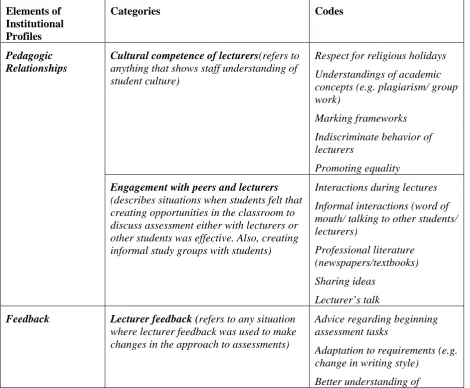
Table 1 below presents individual codes, categories and what we termed as ‘elements of institutional profiles’ constructed from student lived experiences with assessment. From these codes, due to the focus of our study on assessment, we have been able to identify characteristics related mainly to pedagogic relationships and feedback. However, broader characteristics of institutions related to socio-economic and political factors were also beginning to emerge, which were problematised by students in many narratives. For example, one student talked extensively about the new attendance policy at one of our universities. This student personally challenged the idea of implementing strict attendance rules, but at the same time, the narrative that was presented reinforced the idea that the internal functioning of universities is a mediating context for external forces connected with the location of the university and the profile of the students attending this university. We therefore believe that in order to present a comprehensive framework for student engagement, we need to take account of the internal functioning of universities together with the social, political and economic power relations that might be involved (Naidoo and Jamieson, 2005).
Table 1: Provisional Elements of an Institutional Profile
Elements of Institutional Profiles
Categories Codes
Pedagogic Relationships
Cultural competence of lecturers(refers to anything that shows staff understanding of student culture)
Respect for religious holidays
Understandings of academic concepts (e.g. plagiarism/ group work)
Marking frameworks
Indiscriminate behavior of lecturers
Promoting equality
Engagement with peers and lecturers (describes situations when students felt that creating opportunities in the classroom to discuss assessment either with lecturers or other students was effective. Also, creating informal study groups with students)
Interactions during lectures
Informal interactions (word of mouth/ talking to other students/ lecturers)
Professional literature (newspapers/textbooks)
Sharing ideas
Lecturer’s talk
Feedback Lecturer feedback (refers to any situation
where lecturer feedback was used to make changes in the approach to assessments)
Advice regarding beginning assessment tasks
Adaptation to requirements (e.g. change in writing style)
Better understanding of
expectations from assessments
Lack of feedback as a barrier
Showing how to answer MSQ/SA questions
Identifying students’ strengths and weaknesses in reviewing their assessments
Lecturer support (describes situations where students felt that being able to discuss assessments with lecturers and to approach them about it was essential because it helped them understand requirements, identify weaknesses or find ways of answering specific questions)
One to one consultancy
Approachability of lecturers
Open door policy
Reaching out to lecturers
Guiding students towards understanding assessments
Identifying students’ strengths and weaknesses to help them complete assessments
Institutionalisation of assessment
Meaningful assessment ( a variety of key events were identified in students’ narratives where students felt they engaged better because assessment was somehow meaningful (e.g. due to its purposes or nature).
Matches personal learning styles
Scaffolds students
Purposeful assessment (i.e. one that makes sense)
Life-long assessment (e.g. preparing for career or developing life-long skills)
Study just for tests
Promotes deep learning
Strategic approaches to assessment
Past papers
Variety of assessments (e.g. assessing various skills and addressing various learning styles, study approaches)
Transferability from school to university (describes situations where students referred to their past school experiences and explained how structures, types of assessment and skills development in school affected their engagement in HE)
Finding links to school
Lack of links to school
Differences in learning environments (e.g. social interaction, traditional pedagogy, etc)
Impact of school on learning habits
Finding support in background knowledge
Emphasis on different aspects of assessment (e.g. holistic vs.test-based)
Negotiating between old and new ways of assessment
Level of difficulty prevents transferability of strategies
Transparency of assessment (many critical turning points in students’ engagement with assessment were
identified when students talked about how transparency (or its lack) of assessment criteria and ambiguity of expectations affected their engagement with the new assessment in HE).
Lack of clarity in marking criteria
Lack of consistency in marking
Matching lecturer’s preferences
Differences in expectations between lecturers
Marking based on opinion
Lack of differentiation according to commitment to work (e.g. in group
assignments)
Ambiguity of marking criteria
Lack of guidelines regarding study resources
Uncovering the hidden curriculum
Socio-political contexts
External profiles (relates to factors connected with a specific locations of universities, disciplines, governance, student body, etc)
Attendance policy
Admissions criteria
Modularisation
Student support
English language support
Stakeholders
Concluding Remarks
To date, analysis points to a complex interplay between identity, agency and structure but specifically to the significant role that structure (elements of institutional profiles) plays. Clear differences emerged between the two cohorts at our universities at the level of institutional profiles, in areas such as assessment techniques, pedagogy, interaction, feedback, student profiles, disciplines and level of study. The data from the project highlighted that institutional profiles represent a point of departure for the student from their previous experiences. While we cannot influence identity or agency directly, we are beginning to understand how structure (institutional pedagogies) plays a role in student adaptation and expectations of STEM assessments. We also have evidence that these findings hold true for postgraduates.
Our analysis points to the necessity not only to build cultural competence as indicated at the start of this paper but also to build lecturers’ ability to explain rationale behind academic concepts which represent a significant turning point for students in forming new identity trajectories. We are now
working towards a conceptual model that represents this and places institutional practice and other elements of university profiles in the centre of students’ engagement with assessment. Naidoo and Jamieson (2005, p. 270) propose that the way higher education institutions operate is ‘shaped by deeply ingrained rules, cultures, values and professional protocols that revolve around the struggle for, and acquisition of, academic capital’. We believe that to help to deconstruct and explain this struggle, we need to have institutional profiles frameworks that will enable us to understand how our students engage. Naidoo and Jameison (2005) propose that sometimes students respond to structural requirements of universities because they recognise that this might be the only viable way of being. Naidoo and Jameison (2005) highlight that this might be particularly the case with elite universities, which seems to have links with the situation of many international students who tend to enrol in foreign universities for reasons related to the perceived prestige. The findings from our study have already shown that the students respond to structural requirements of our universities in ways which make them abandon their old expectations. What we need now is a framework which will help us explain what these structural requirements are.
Jary and Parker (1998) argue that in order to truly understand the role of higher education in student engagement, especially in the context of the ‘new’ mass higher education, we need to develop new models that will help institutional providers identify which aspects of their institutions promote democratic engagement of students. This equally applies to international students. Our universities therefore need a new, strong heuristic to obtain an analytical ‘fix’ on central issues in higher education today (Jary and Parker, 1998). This heuristic, however, needs to be new – that is, coming ‘from within’, because narrowly focused policies that promote ‘one best way’ downgrade the great diversity of institutions and cannot be applied transnationally (Scott, 1995). As a far as the long-term goals of this project are concerned, we intend to continue working on a conceptual model that represents this.
REFERENCES
Baker, SE & Edwards, R 2012, ‘How many qualitative interviews is enough? National Centre for Research Methods Review Papers, No. 019. University of South Hampton, NCRM.
Bhattacharyya, A 2010, ‘Learning Accounting in Globalised Australian Universities: Challenges and Way Out’, The International Journal of Learning, Vol. 17, pp. 488 – 500.
Brennan, J & Osborne, M 2008 ‘Higher Education’s Many Diversities: of students, institutions, experiences and outcomes’, Research Papers in Education, Vol 23, No. 2, pp. 179-90.
Carroll, J & Ryan, J 2005, Teaching international students: improving learning for all, Routledge, London.
Clandinin, J & Connelly, M 2000, Narrative inquiry. Jossey Bass, San Francisco.
Cortazzi, M & Jin, L 1997 ‘Communication for learning across Cultures’. In D McNamara & R Harris (Eds.), Overseas students in higher education., Routledge, London, pp. 76-90
Department of Education and Skills (DES) 2011, National Strategy for Higher Education to 2030. DES, Ireland.
Donini-Lenhoff, FG & Hedrick, HL 2000, ‘Increasing awareness and implementation of cultural competence principles in health professions education’, Journal of Allied Health, Vol. 29, No. 4, pp. 241-45.
Gibbs, G & Simpson, C 2004, ‘Conditions under which assessment supports students'
Learning’, Learning and Teaching in Higher Education, Vol. 1, pp. 3-31.
Gogolin, I 2002, ‘Linguistic and cultural diversity in Europe: a challenge for educational research and practice’, ECER Keynote. European Educational Research Journal, Vol. 1, No. 1,p. 123.
Greenholtz, J 2000, ‘Assessing cross-cultural competence in transnational education: The Intercultural Development Inventory’, Higher Education in Europe, Vol. 25, No. 3, pp. 411-416.
Hayes L,A Mansour, N & Fisher, R 2015, ‘Understanding Intercultural Transitions of Medical Students’, Int J Med Educ, Vol. 6, pp. 26-37
Hirshy, AS & Wilson, ME 2002, ‘The Sociology of the Classroom and Its Influence on Student Learning’, Peabody Journal of Education, Vol. 77, pp. 85 – 100.
Ho, R 2010, ‘Assessment of Chinese Students’ Experience With Foreign Faculty: A Case Study From a Chinese University’, Journal of Teaching in International Business, Vol. 2, pp. 156–177.
Jary, D & Parker, M 1994, The New Higher Education, Staffordshire University Press, Stoke-on-Trent.
Museua, S & Vue, R 2013, ‘Socioeconomic Status and Asian American and Pacific Islander Students' Transition to College: A Structural Equation Modeling Analysis’, The Review of Higher Education, Vol. 37, No. 1, pp. 45-76.
Naidoo, R & Jamieson, I 2005, ‘Empowering participants or corroding learning? Towards a research agenda on the impact of student consumerism in higher education’, Journal of Education Policy, Vol. 20, No. 3, pp.267-281.
Scott, P 1995, The meaning of Mass Higher Education. Open University Press, Buckingham.
Serpell, R 2007 ‘Bridging between orthodox western higher educational practices and an African sociocultural context’, Comparative Education, Vol. 43, pp. 23-51.
Sook LJ & Anderson, KT 2009, ‘Negotiating linguistic and cultural identities: theorizing and constructing opportunities and risks in education’, Review of research in education. Vol. 33, p. 181.
Tan, E & Hayes LA 2015 ‘Towards a conceptual framework of a ‘Kaleidoscope’ for understanding international students’ experiences with assessment’, Assessment and Evaluation in Higher Education, (under review)
Vygotsky, L 1978 Mind in Society: The Development of Higher Psychological Processes. Harvard University Press, Cambridge MA.