Page 155
PROMOTING AND SUPPORTING TRANSPARENT SCIENTIFIC RESULTS WITH COBISS AND CRIS SYSTEMS
Davor Bračko
IZUM – Institute of Information Science, Maribor 2000, Slovenia
Abstract
Practically all systems of financing research work to some degree deal with how to provide maximum quality of research work and how to ensure a good ratio between the invested means and the end result. As opposed to the private sector where the main indicator of success is profitability, other mechanisms to maximizing effects must be found in the public sector, whose important part is also research. One of the conditions for achieving efficiency is ensuring transparency on all levels of the system in question. This paper deals with the concept of transparency of monitoring research results with COBISS (Co-operative Online Bibliographic System and Services) and SICRIS (Slovenian Current Research Information System).
Keywords: transparency, research funding, bibliographies, researchers, research systems
1. INTRODUCTION
The basic consensus between the different stakeholders and carriers of research policies is that the support to scientific research is justified with its benefits for the society. Science should contribute to a general prosperity by fostering the economic development and improving the quality of life, and, as such, works as a driving force of modern society. Science should then be emphasised as the driving force of economic, technological and societal development, but also as an activity that discovers the new and uncovers the hidden. Scientific research can also be defined as an activity used to train top experts so that they can be employed at the most demanding and leading positions in the workforce and take on the most complex tasks in society. Evaluating scientific research as a process, intended for creating knowledge that can contribute towards achieving economic and social goals is not an easy task, because the connections between them and the results that contribute towards prosperity are very complicated and interactive. Therefore, it is so important that they are as transparent as possible. Transparency of research results contributes towards the improved efficiency in science and research. Transparency and the democracy related to it are one of the basic postulates of modern social systems of society. These systems wish to provide a wide social consensus and the legitimacy of decisions, which is why they include increasingly more interactions between various social players. One such system is the COBISS systems that enables both professionals and laymen the insight into research results and, as a result, fosters the scientific research activities of researchers.
2. MATERIALS AND METHODS
This paper is based on the use and research of the COBISS and SICRIS systems and some key contributions on this topic, published since 2006.
3. INTRODUCTION OF THE SICRIS SYSTEM
Page 156
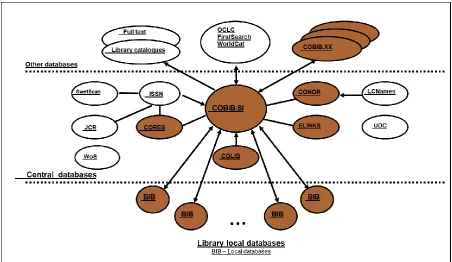
SICRIS is linked to the COBISS system, i.e. its COBIB bibliographic database; this enables an insight into researchers’ bibliographies and analyses and calculations based on the accepted methodologies. A researcher’s bibliography is an organised list of the researcher’s published works, where the valid typology of documents/works is the main classification criterion. Based on researchers’ bibliographies, the research performance of individuals and researchers is evaluated according to a special point awarding system. Because the entry of data into the bibliographies is precise and controlled, the chance of errors, otherwise quite frequent in both collections of citation indexes, is much smaller.
The researcher's code is generally appointed by the Slovenian Research Agency (SRA) to a researcher that meets the criteria for entry into the SRA register. A researcher that would like to be presented in the SICRIS information system but does not meet the criteria for entry into the SRA register (e.g. a researcher with Slovenian roots that lives abroad) can also be entered into the SICRIS system directly.
Fig. 1. COBISS system with connected databases
In the COBISS.SI system, bibliographies are maintained for all Slovenian researchers, who are registered with the Slovenian Research Agency, following a uniform methodology. This ensures rational cataloguing, a more complete registration and a better overview of research results as well as the option of using uniform criteria when evaluating research results. A researcher’s bibliography for a selected period can also be displayed in English.
Page 157
The data on projects within the SICRIS system is integrated into the European Research Information System called ERGO (European Research Gateways On-line) that links all European research systems that meet the set criteria.
The SICRIS system is characterised by the following:
proven methodology and software for managing researchers' bibliographies and evaluating research results
systematic researchers' bibliographies management following a uniform typology within the national information systems and provision of transparency of research results
high quality of bibliographic records in researchers’ bibliographies as they are created by highly skilled librarians – cataloguers
publicly accessible bibliographic database and database on research activities, which brings up the Public as an observer and consequently informal regulator
bibliography of scientific works as a data source for different operations uniform standards on which the researchers’ bibliographies are based
contains crucial information on research and the most important research results
uniform collection of researchers, research groups, organisations, programmes and projects support to the evaluation of bibliographic indicators, citations, appointment to titles at universities
(habilitation)
uniformity with European guidelines, standards and trends integration with other national research systems
connection of bibliographic records with Web of Science (WoS)/Scopus
Page 158 The following entities are currently presented in SICRIS: 999 research organisations with registered employees 1.584 research groups with registered employees 15.702 employed researchers
454 active research projects
338 active research and infrastructure projects 941 research equipment
SICRIS also enables the viewing of presentation pages of more than 500 European projects of the EU Framework Programmes directly from the Projects database within the CORDIS system. (Slovenian Current Research Information System, 2018)
Initially, data can be collected by university libraries, unless otherwise agreed upon by the competent ministries. Data entry to SICRIS is made online. Later, the updating of particular data can be taken over by individual research organizations or researchers themselves.
Procedure of Data Collection and Updating
1. Application forms are sent to SRA (Slovenian Research Agency).
2. SRA puts data into internal database.
3. Data is transferred automatically to SICRIS.
4. SRA sends to SICRIS special data (projects, programs, descriptions, summaries, …) that is not kept in the SRA internal operational database.
5. SICRIS receives requests for updating the data directly from researchers and organisations.
6. Authorized persons of SICRIS can update the internal SRA database for the majority of data.
7. The data is updated online and ready for implementation.
On the researcher level, SICRIS enables access to the representative and personal bibliographies, the evaluation of bibliographic indicators of research performance according to SRA methodology, data on citations of bibliographic records in the COBIB shared database that are linked to records in Web of Science and Scopus, and to the report of bibliographic indicators for research performance for a researcher for the appointment to titles. On the level of various research groups (employees at the organisation, in a group, programme groups, project groups, various researcher groups), it enables access to evaluation of bibliographic indicators of research performance according to SRA methodology and to the data on citations of bibliographic records in the COBIB.SI shared database that are linked to records in Web of Science and Scopus.
SICRIS uses the SRA classification of research activities that includes six fields of research, divided into areas and sub-areas. For each research area and sub-area it is possible to display the most successful researchers depending on different research performance indicators. This is currently the most complex interconnection of data from SICRIS and data from the bibliographic database.
Page 159
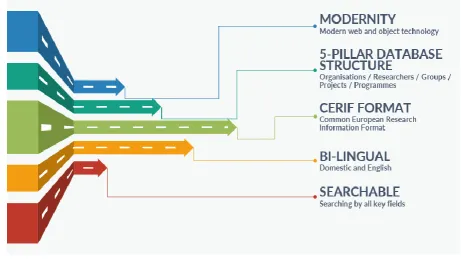
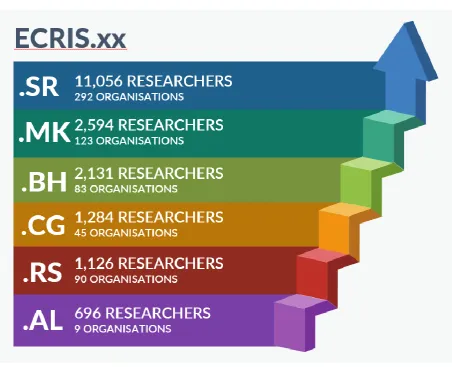
Fig. 3. E-CRIS in COBISS.net network
4. RESEARCH EVALUATION USING THE COBISS AND SICRIS SYSTEMS
Information resources for the purposes of scientific research have been electronically or digitally accessible via various specialised bibliographic databases for decades. Recently, selected resources are available in full via e-journal portals. The most important form of publishing research results are articles in renowned international scientific journals. (Južnič, 2015) Publications in scientific journals represent one of the main means of scientific communication, which means that scientific journals play a key role in systems of scientific excellence evaluation.
Libraries (mostly university libraries and special libraries) and librarians have always been important partners for the research and development community. Due to the fast development of scientific communication and the accessibility of information resources in electronic form, librarians are faced with new challenges; new ways of cooperation with the research community must be found. The shift in information behaviour and the ways of searching for and using information resources demand that information services for these users must change faster than in other areas of librarianship.
Page 160
are publications of research results; these enable the traceability and repeatability of research studies and, as such, the reliability and precision of the acquired results. Not only do both processes contribute towards the development of science but they also enable it. Scientists publish their research results primarily as articles in scientific journals. Hence, articles in renowned international scientific journals for most research areas represent the most important form of publication. Articles go through procedures of peer-review and inspection (professional reviews), top quality scientific journals only publish a small part of the articles they receive. The other part of reviewing and quality control of scientific research is linked to the frequency of other scientists using these publications; this is expressed in citing the publications, which can be measured and evaluated as citations.
Nowadays, scientific journals have two important roles in the system of scientific information and communication. The first one is publishing in scientific journals, which represents the main mode and form of scientific communication. The second one is that scientific journals play a crucial part in systems of evaluating scientific excellence. In addition to this, information acquired from scientific information resources enables the evaluation of these publications.
Research evaluation has become an important task of research activity managers and research policy-makers. Frequently it is an important part of decision-making about financing and funds allocation, which are a part of a wider research policy. The analysis of publications and, particularly, success/citations is a widely accepted tool in the processes of research performance and scientific excellence evaluation nowadays.
Every evaluation system requires adequate information, information resources and information systems. Many countries report about the active role of librarians in various processes of research evaluation at their institutions. Some recent studies and reports state that libraries and librarians can improve their status and their value at their institutions through their work and/or support in the process of research evaluation (Wong et al, 2015). In Slovenia, we decided to use a specific current research information system – SICRIS. The system was implemented in its current form in 1998, even though it had already been designed more than a decade earlier. It contains the most crucial information on research and the most significant research results (of scientific and socio-economic importance). (Južnič, 2015)
Researchers’ bibliographies within SICRIS are also linked with the citation data in two international data collections, initially only in Thomson-Reuter’s Web of Science collection, and since 2013 also in the Scopus data collection managed by Elsevier. Web of Science and Scopus are nowadays used worldwide as information resources for evaluating the scope of citations, albeit with some restrictions, as well as the quality of research activities. This differs from the original concept of use of bibliographic databases for searching for relevant information resources for research. Today, the database is mainly used for evaluating the scope of citations and the quality of published research results, as we can derive bibliometric indicators from it. Despite all its shortcomings, these are used as a replacement for the actual resonance and the latest results indicate that they are significant despite their restrictions.
5. SUPPORT TO TRANSPARENCY OF RESEARCH RESULTS
A wholesome database on scientific bibliographies was introduced in Slovenia with the intention of ensuring transparency of research policies and research results. In developed democratic systems, transparency is one of the key instruments for ensuring system legitimacy. Transparency is understood primarily as a tool for ensuring responsible behaviour by holders of public functions and the management, and for preventing or (at least) reducing the presence of corruption.
Page 161
of information enables the inclusion of interested parties, even the general public, in the process, and reduces the risk of potentially conflicting final decisions. (Demšar, 2006) In the area of public administration and public policy-making, where profitability is not the main goal, it is difficult to speak of profit or economic success as an indicator of efficiency optimization. Hence, transparency and its deriving pressure of the general public is a factor that increases efficiency. With the enabled access to all results, the latent control of the public over the use of public money is increased significantly. Being subjected to criticism regarding inefficient investments requires the actors to reach their set goals, for the sake of their own public image, as satisfactorily as possible and in line with the expectations. In the area of research financing, where a large part of activities is dependent on public financing, the accessibility of data on the content achievements of research in connection to the appointed financing is the one instrument that ensures that researchers will correctly present their research results, and, consequently, the quality of research activities will also improve. Due to the risk of the author being exposed to peer criticism or being criticized by the public, they will make sure to do their work correctly and to a high standard.
Transparency also increases the exposure to criticism. On the one hand, scientific work is subjected to criticism, which, in most cases, contributes towards valuable exchange of professional opinions and helps with familiarising yourself with the work of researchers who work in similar areas. On the other hand, the work of financiers and the responsible institutions is also under inspection due to transparency. Once all procedures and documents are presented and available to the public, the probability of criticism also increases. The question arises how to shape an adequate evaluation methodology. It is understandable that it is difficult to achieve complete consensus, especially because the financial resources are unfortunately limited, but it is important to achieve that all participants in the process agree that the procedure is transparent and predictable and that some proposals cannot be financed due to previously defined evaluation criteria. One of the crucial parts in this process is played by the information system that supports the transparency of research.
The COBISS system is a generally established system for monitoring research results in Slovenia. It contains all bibliographic units and/or metadata on bibliographic units. In the COBISS system, it is possible to monitor the research results of every individual researcher, which enables us to evaluate their achievements. The COBISS tool became particularly relevant after 1998 when bibliographies that are based on the COBISS system became the basis for evaluation procedures. Hence, it can be said that all relevant scientific achievements are entered into the library system.
The SICRIS information system is the second element in the mosaic of content transparency. It brings a list of projects, financed by SRA, along with short descriptions of content. In addition to that, SICRIS also contains the description of the most significant scientifically relevant achievements and relevant socio-economic achievements that arise from each research programme. The content part of the SICRIS system is mostly based on data that is provided by the researchers themselves (indirectly or directly when logging in, or through reports on projects/programmes), so the quality of the presentations largely depends on their eagerness and willingness to cooperate. In this context, we are certain that the public accessibility of information increases the pressure put on researchers to prepare correct and comprehensible presentations of their work.
Along with the information tools developed by IZUM, other foreign information services and indexes are also important and in use. Their usability lies primarily in the evaluation of Slovenian research compared to other countries. In this context, some restrictions that arise from the differences in research areas also apply, but the recognisability and acknowledgement of the scientific work of Slovenian researchers abroad is also an indicator of the quality of work.
Page 162
It should be emphasised that the system is not just a tool used for the evaluation of research, but it is, to a large extent, also used for self-introduction and self-promotion of researchers and research institutions that can present their research achievements to the widest audience and also to potential partners and users. The development goal of the SICRIS system is to become a useful information tool that will offer simple web services to its users, which will make their work easier but will also present a reliable image of the research activity in Slovenia.
Prompt updating and publishing all documents related to calls for tenders requires a lot of work and adjustment of internal work procedures, but we believe it to be the right path towards achieving more efficient use of public finances, which is why we will continue working towards this goal in the future. Along with the changes in work, implementing transparency elements also requires the researchers’ awareness about their importance. It is impossible to update the data that is of key importance for the system’s operation without the researchers’ active involvement. One of the priorities is to establish a partnership with researchers that should not see the transparency instruments as a “nuisance”, but as a system that makes everybody’s work easier and provides better comparability, exchange of information, peer review and, based on all this, a higher quality of research.
If we start out from the fact that transparency in the public sector can replace the motive of profit found in the private sector, providing transparency is one of the key priorities of institutions that finance public research work. If we as a country want to achieve the set Lisbon goals, where science is one of the key components, we must constantly make sure to improve the quality of research and transparency is, based on our beliefs, one of the instruments for achieving said quality.
6. DISCUSSION AND CONCLUSION
An important role, importance and responsibility in a different, more transparent system of presenting research results in Slovenia was given to librarians. Librarians must be aware of this fact and must, through their high-quality professional work, continue to prove it. The librarians’ tasks and services that support scientific research work change constantly. The classic tasks such as searching for and providing information from information resources and enabling access to them are on the decline and becoming less important and visible.
Because the entry of bibliographies is precise and controlled, the room for errors, otherwise quite frequent in both citation indexes, is much smaller. In small countries it is easier to provide systematic and precise monitoring of research results. For financiers and managers, well managed bibliographies are an important information resource. Researches that do high quality work want it to be visible and measurable, and librarians are interested in getting additional tasks and showcasing their professional skills.
Transparency, if required by the research funding organisation per se, offers a change and can steer the growth of publications containing research results, as researchers generally see transparency as a positive element which promotes their work. It is also an important promotion of the work done by librarians in research and academic libraries, as they are responsible for the data. (Demšar & Južnič, 2014)
Page 163 ACKNOWLEDGMENTS
IZUM – Institute of Information Science, Maribor 2000, Slovenia
REFERENCES
1. Demšar, F. and Južnič, P., (2014). Transparency of research policy and the role of librarians. Journal of librarianship and information science, 46(2)
2. Demšar, F. (2006). Transparentnost raziskovalne dejavnosti v sloveniji. Organizacija znanja, 2006/4, from https://www.cobiss.si/oz/HTML/OZ_2015_1_final/14/index.html
3. Institute of Information Science 2018, Slovenian Current Research Information System, Institute of Information Science Maribor, retrieved 14 June 2018, from
http://www.sicris.si/public/jqm/memo.aspx?lang=eng&opdescr=presentation&opt=6&subopt=1
4. Južnič, P. (2015). Pomen urejenih bibliografij za spremljanje in vrednotenje znanstvenoraziskovalnega dela. Organizacija znanja, 2015/1, from
https://www.cobiss.si/oz/HTML/OZ_2015_1_final/14/index.html
5. Seljak, T. and Bošnjak, A. (2006). Researchers' bibliographies in COBISS.SI. Information Services and Use, 26(4)