Page 146
TOWARDS THE CURRICULUMS ARTICULATION DURING THE PROCESS OF HIGHER EDUCATION GLOBALIZATION
Yuanyuan Liu
School of Management, Guizhou University, Huaxi, Guiyang, Guizhou, 550025, China
Abstract
Curriculums articulation is a crucial practical step to start the globalization of higher education institutions as it the key to understanding different higher education systems. This study presents a case of cooperation between Guizhou University, China and Colorado State University, USA, and the 2+2 bachelor joint cultivation program between School of Management, Guizhou University, China and Business College, Colorado State University, USA. The study shows the practical problems of the program and how they are solved by curriculums articulation. Besides, top-down management and coordinating mechanism are suggested by the study in order to better carry out program of higher education globalization.
Key words: globalization, higher education, curriculum articulation
1. INTRODUCTION
Globalization has been regarded as a process of worldwide integration of views, ideas, and other aspects of culture. Levin (2001) and Marginson (2007) define globalization as the practice of growing social interaction and connectivity among people around the world, creating economic, social, cultural, political, environmental, scientific and technological interdependence. Mitchell & Nielsen (2012) states two dimensions of globalization: spatial awareness and process of interaction, by quoting the notions from Robertson (1985) that globalization is a compacted world where time and space are compressed, Tomlison (1999) that the world is a single place serving as a common frame of reference, McLuhan (1964) that interactions arise among mass cultures creating a consciousness of 'global village', Carnoy (2005) that the essence of globalization is new ways of thinking about space and time. The integrated world economy, new information and communication technology (ICT), the knowledge network, the role of the English language (Johnstone, d'Ambrosio & Yakoboski, 2010), and transportation (Boyd & Mitchell 2005). Beerkens (2003) highlights four challenges from globalization: (1) a geographical concept distinguishing it from local, (2) a concept of authority distinguishing it from territorial sovereignty, (3) a cultural concept distinguishing it from isolation, (4) and an institutional concept distinguishing it from national. Meanwhile IMF (International Monetary Fund) (2000) identifies four basic aspects of globalization: (1) trade and transactions, (2) capital and investment movements, (3) migration and movement of people, and (4) dissemination of knowledge.
Page 147
functions to be a consumerist mentality and knowledge as a exchangeable product in an open market; Wildavsky (2010) states the global race for talents, branching out universities, the wanted 'world class' universities, the worldwide university rankings, the global expansion, for-profit institutions, and free-trade in minds as several important issues in higher education globalization; etc.
However, the world's higher education system is composed loosely by multi-ethnic higher education (Qi & Wang, 2007), but western higher education holds the core position (Duderstadt, 2010), and the developing countries set the teaching mode curriculum and targets of educating students of western higher education as standards to follow (Hu 2012). Thus there are details to pay attention to from a practical perspective of advancing higher education cross borders. And the first step is to understand different higher education systems, and thus the curriculums articulation becomes of vital importance.
2. CURRICULUMS ARTICULATION
Higher education globalization should start from a practical perspective. No matter the higher education institution is sending students or receiving students to or from which continent, the questions such as, 'What courses the students have finished and how those finished courses are similar to courses of the other institution?', 'Are contents the same if two courses titles are translated differently?', etc. Thus the first and the most crucial step is to make different higher education systems compatible, which requires curriculums articulation. There are similarities in curriculums of different higher education systems while there are also differences in curriculums.
Even in different higher education systems, the word 'curriculum' began as a Latin word whose meaning is 'a race' (to run or to proceed) or 'the course of race'. Curriculum, in the educational context, means the totality of students' experiences in terms of the instructional goals. It can be considered as a planned sequence of instruction, or a set of learning goals articulated across different levels or grades at particular points, or a planned interaction of students with the instructional content, materials, resources, or an evaluation of the educational objectives attainment and specific state on what learners should take on during specific periods, or an agreement among communities educational professionals, or a definition of 'why, what, when, where, how and with whom to learn'. Curriculum is not a simple adding up of courses. It outlines the skills, performances, attitudes, and values that students are expected to lean from schooling. It states the desired outcomes, descriptions of materials, teaching activities, learning procedures, and it is the planned sequence that should help both students and teachers attain the outcomes. Syllabus started as a Greek word whose meaning is 'a concise statement or table of the heads of discourse, the contents of a treatise, the subjects of series of lectures'. In general syllabus merely specifies what topics must be understood, what level to achieve, and a particular grade or standard to satisfy. Curriculum is based on general syllabus. En essential issue in curriculum design is the definition of prerequisites for each course. The prerequisites can be satisfied by taking particular courses, by examination, by other means, for example, working experience. Prerequisites within a course requires more detailed curriculum design and asks for serious consideration of course organization and scheduling.
Page 148
3. THE CASE OF CURRICULUMS ARTICULATION AND CREDITS TRANSFER BETWEEN DIFFERENT HIGHER EDUCATION INSTITUTIONS
3.1 Background
Globalization has been one of the most important strategy of School of Management, Guizhou University (GZU), China. School of Management has decided to cooperate with departments of foreign higher education institutions since long time ago. However, due to different educational systems, the cooperation has been stopped because of credits transfer. The first and most successful global cooperation of School of Management started from its cooperation with Business College of Colorado State University(CSU), USA in '2+2' program. It is a program of joint cultivating bachelor students that the qualified students in GZU have the chance to study in CSU for two years after their first two years in GZU. In this program, students' credits of the first two years in GZU should be transferred to CSU, and their last two years credits in CSU should also be transferred to GZU in order to check if they have finished all the required parts of the curriculum. The most important parts in the program is to make both sides' curriculums and education systems understood and reasonably accepted, and transfer credits in a rational and compatible way. Although the cooperation actually began with the cooperation between two universities (GZU & CSU), the practical step starts from the dialogue, mutual understanding of curriculums and credits transfer. In the autumn of 2011, delegation group of School of Management and representatives of GZU met delegation group of CSU in Shanghai (China) to present different curriculums and discuss problems of credits transfer and solutions.
3.2 Problems identification
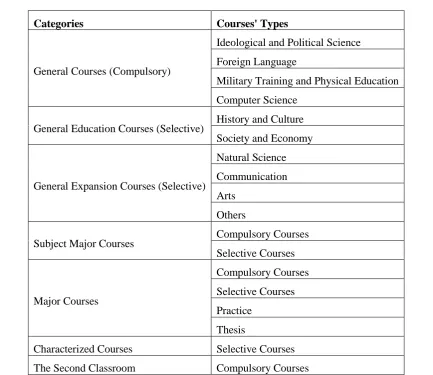
First of all, there are similarities and differences between Chinese higher education and American higher education, and there are also both similarities and differences between curriculums of GZU and CSU. The table below shows general situation of curriculum of GZU, China.
Page 149
Categories Courses' Types
General Courses (Compulsory)
Ideological and Political Science Foreign Language
Military Training and Physical Education
Computer Science
General Education Courses (Selective) History and Culture Society and Economy
General Expansion Courses (Selective)
Natural Science
Communication
Arts Others
Subject Major Courses Compulsory Courses Selective Courses
Major Courses
Compulsory Courses
Selective Courses
Practice
Thesis
Characterized Courses Selective Courses
The Second Classroom Compulsory Courses
Table 1. General curriculum of Guizhou University, China.
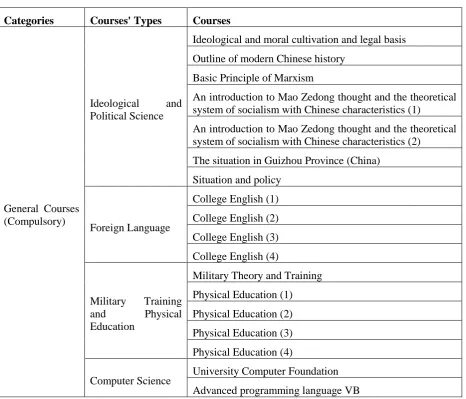
Page 150 Categories Courses' Types Courses
General Courses (Compulsory)
Ideological and Political Science
Ideological and moral cultivation and legal basis Outline of modern Chinese history
Basic Principle of Marxism
An introduction to Mao Zedong thought and the theoretical system of socialism with Chinese characteristics (1)
An introduction to Mao Zedong thought and the theoretical system of socialism with Chinese characteristics (2)
The situation in Guizhou Province (China)
Situation and policy
Foreign Language
College English (1)
College English (2) College English (3)
College English (4)
Military Training and Physical Education
Military Theory and Training Physical Education (1)
Physical Education (2)
Physical Education (3)
Physical Education (4)
Computer Science University Computer Foundation Advanced programming language VB
Table 2. Category expansion of 'General Courses (Compulsory)'
Page 151 3.3 Solutions
The meeting and discussion of delegation groups from both sides are the results of mutual understanding and call for solutions to differences for a better cooperation. Thus mutual understanding and equal rights are the basic of higher education globalization practice. Only with mutual understanding, respect to differences and equal rights may the other solutions effective in solving the practical problem in credits transfer and curriculums articulation.
Course description is the rational for credits transfer. In order to match the courses with different titles but similar or the same contents, course description is used to present the syllabus of the courses to make each side understand what exactly are in the courses. Judging the courses not only by their titles but also their syllabus. In this regard, School of Management shows respect and sincerity for the cooperation and have all their Chinese curriculum and syllabus translated into English. And CSU also respects and accepts the differences.
The nature of the courses is the basic principle for credits transfer. The course of 'College English' has partly been accepted as the course 'writing' by CSU and the course of 'Outline of modern Chinese history' has also partly been accepted as the course 'world history'. The reality is that many of the compulsory courses from GZU side are not available in the CSU side but the course nature of the courses are general course, which should be transferred as general course from the CSU side, and CSU accepts those courses partly as courses for 'humanity courses', which is reasonable and equal.
On line defense of thesis is promoted by GZU. As there is no counterpart requirement of thesis and defense in CSU, GZU promote students' on line defense opportunity after they submitting their thesis. Information Technology has played an important role in globalization of higher education and provides both students and administrators with convenience and possibilities to deal with remote problems and thus make the students' performance evaluation rational.
4. DISCUSSIONS
Top-down management is important during the process of higher education globalization. First, the higher education institution should integrated globalization as a part of its strategy as long as the institution decides to engage in globalization. Second, the top-down management style is much more effective in problem solving. Curriculums articulation of this study is only one part of higher education globalization, but the case presented in this study well demonstrated the effectiveness of top-down management in problem solving. Third, top-down management style will provide with rational and practical solutions to specific problems. Last but not least, top-down management is effective in resources allocation and supportive in program promotion.
Coordinating mechanism is helpful and necessary during the process of higher education globalization. For one thing, there should be coordinators from both sides for communication and mutual understanding. To better promote higher education globalization program, coordinators are the roles connecting two sides and exchanging needs and requirements. For the other, students need coordinators to guide them how their courses and credits will be understood and transferred into the other system so that students man have a guiding map in their minds once they decide to participate in the program to study abroad.
5. CONCLUSION
Page 152
Curriculums are the ways by which higher education institutions convey their educational ideas and philosophy. By setting and balancing general courses and core courses, and developing characterized courses meeting students' features and interests, higher education institutions are developing their unique curriculums.
Curriculums are mirrors reflecting the social needs and cultures of different nations. The curriculum design should start with diagnosis of needs, the needs from the society, the needs from the economy, the needs from the industries, and the needs from the students. Thus curriculums are the best illustration to reflect nations' situation and background. Different country has different situation, so curriculums from different countries or different education systems cannot be the same. Curriculums articulation is the very way for mutual understanding of educational systems.
ACKNOWLEDGEMENTS
This work is one of Yuanyuan Liu's research results of the project ' The Research of Higher Education Globalization of Guizhou Province' of Guizhou Provincial Education Department, partly supported by Karst Region Development Strategy Research Center, and the project number is JD2014028.
REFERENCES
Ben Wildavsky 2010. The great brain race: How global universities are reshaping the world, Princeton University Press, Princeton & Oxford, 2010, xiii, pp. 1-240.
Changying Hu 2012. 'The impacts of higher education globalization on Chinese universities'. Higher Education of Social Science, Vol. 3, No. 2, 2012, pp. 7-13, CSCanada.
Chaoyu Guo 2011. 'Higher education in a global society. D. Bruce Johnstone, Madeleine B. d'Ambrosio and Paul J. Yakoboski, 2010, 224 PP.$99.00 (cloth). ISBN: 978-1-84844-752-3, BOOK REVIEW'. Higher Education (2011) 62:259-261, Springer Science + Business Media B.V.
D. Bruce Johnstone, Madeleine B. d' Ambrosio & Paul J. Yakoboski 2010. Higher Education in a Global Society, Edward Elgar Pub, 2010.
Douglas E. Mitchell & Selin Yildiz Nielsen 2012. 'Internationalization and Globalization in Higher Education'. Globalization-Education and Management Agendas-edited by Hector Cuadra-Montiel, INTECH, 2012.
E. Beerkens 2003. 'Globalization and Higher Education Research'. Journal of Studies in International Education, Vol. 7, No. 2, pp. 128-148.
M. Carnoy 2005. 'Globalization, educational trends and the open society'. Paper presented at Open Society Institute Education Conference: Education and Open Society: A Critical Look at New Perspectives and Demands. Budapest, Hungary.
M. McLuhan 1964. Understanding media: The extensions of man. New York.
James Duderstadt 2010. 'Innovation and development of universities in the trends of information technology and globalization'. Open Education Research, 16(2), 4-8.
J. S. Levin 2001. Globalizing the community college: strategies for change in the twenty-first century (1st ed.). New York: Palgrave.
J. Tomlison 1999. Globalization and Culture. The University of Chicago Press. P. G. Altbach 2004. 'Higher Education Crosses Borders'. Change 36(2): 19-24.
Page 153
Education in the 21st Century Seminar (February 5-7) Gregynog, Wales.
S. Slaughter & G. Rhoades 2004. Academic capitalism and new economy: markets, state and higher education. Baltimore, MD: Johns Hopkins University Press.