INDIVIDUAL EXPRESSION IN THE VISUAL ARTS AND MUSIC FOR UNLOCKING OF STUDENT'S CREATIVE POTENTIAL
Daiga Kālēja- Gasparoviča, Irina Direktorenko
Riga Teacher Training and Educational Management Academy, Imantas 7 līnija 1, Riga, Latvia
Abstract
According to the needs of society, raises the point of view of teachers' creative approach to promoting students' creativity, which depends on the teacher's ability to capture the world around them artistically and to be open to new things. This indicates that the need to build the visual arts and music study process, where one can engage all students, regardless of artistic talent; which would facilitate students' creativity, which encourages students, future teachers, flexibly capture professional challenges and manifold possibilities of personal life. The research is related to the promotion of students’ creativity, based on the potential of the concept of creativity.
The research problem: the promotion of creativity of students, future teachers, in higher education from disclosing personal business approach to the visual arts and music students as personally meaningful creativity development opportunities. The research problem is determined by the contradiction between the creative personality development as an aim of education and lack of resources pedagogical to ensure it.
Key words: creativity potential, personally important activity, creative self-expression through visual arts and music, individual expression
INTRODUCTION
In psychology, there is a creative personality theory of diversity - different perceptions of its guiding principles / dampening forces, structure and psychological diversity of creative personality. Creativity psychology focuses on human personalities’ integrative whole essence.
Concept of Creativity related potential, which includes all aspects of the promotion, pointing to the creation of the product concerned views from the individual and the social significance of the creative achievements. Creativity is defined as the totality of factors responsible for creative product found in unrealized individuals, process and environment (Runco, 2009). Definition expresses opinion that corresponds to the context of the study, that everyone has a potential for creativity, and it is encouraged, in tune with the concept of humanistic context that human creativity is innate natural phenomenon arising from the psyche of the primary processes (primary creativity), and is an important individual's self-esteem, in relation toward reality and productivity (Мaslow, 1973).
Describing the potential for creativity, like the research of creative personality has emphasized, important is the process, where modern studies (Moran, John-Steiner, 2003) based on L.Vigotsky development concept of internalization and externalization processes and symbolic forms of identity and culture relationships. Internalization process is associated with the acquisition of personal cultural heritage as a creative act; externalization process is the creative act, emotional and cognitive character-based design, synthesis, expression of materializing ideas, emotions, beliefs and culture (Moran, John-Steiner, 2003). Theory emphasizes the natural and purposeful creative potential promotion (Runco, 2009). Targeted promotion of the creative potential of the individual is emphasized for internal motivation, sensitive to the social environment (Amabile, 2007).
The purpose of research: Theoretically analyze students, future teachers, pedagogical conditions for promotion of creativity potential in visual arts and music during the university study process.
The subject of research: students' creativity potential in the studies.
Methods of research: theoretical analysis (analysis of scientific literature publications in pedagogy).
1. PERSONAL ACTIVITY APPROACH IN ACQUIREMENT OF VISUAL ARTS AND
MUSIC STUDIES FOR PROMOTION OF STUDENTS’ CREATIVE POTENTIAL
Creativity potential can be identified by two types of factors: the individual has the inherent quality of creativity and creativity potential influencing factors that characterize favorable context for the creative expression. Creative potential is the product responsible factors that are found unrealized in the individual, in the process and environment (Runco, 2009). This indicates that the potential exists in everyone and it is possible to foster it through targeted pedagogical activity. Due to the problem, it has to encourage purposefully in organized educational process of art studies in university.
Context of humanistic concepts emphasizes the idea that the aim of personal development is to maintain a propensity to grow and self-realization; the essence of human life and the goal is the empowerment, the realization of creative potential, self-expression (Мaslow, 1973).
Accordingly can be raised hypothetical assertions that providing visual arts and music for students as personally meaningful learning activities, unleashing an emotional experience, students will be encouraged creativity potential. Pedagogical subjective component of the study is related to the student, future teacher, creativity fostering process, where the prerequisite is new knowledge, skills, attitudes, reflection gained for a new need for creative self-expression.
In the context of a constructivist approach to the most important findings of the study process, its’ targeted organization, it should be emphasized that learning is an active, creative, personally important activity. According to the humanistic pedagogical approaches, pedagogical action is determined to organize the teaching process in the studies in order to create creative potential to promote a positive educational environment conditions and to support the students' desire to express themselves in creative activities. These requirements correspond to the personal activity approach that is focused on learning and interaction between (Vygotsky, 1991), defining learning as a focused, motivated action that determines the productivity of the same characteristics of the student and the teacher helps the student to work, learning to move internal mental activity. Activity-oriented visual arts and music in the study process, learning is a student activity based process which, has been brought under control in co-operation between lecturers and students. Action-oriented teaching methods and the student's own self-expression through artistic creative activity is considered to be a persistent source of interest throughout the visual arts and music in the study process.
In above mentioned didactic approach the foreseen personal learning significance and authenticity is one of the potential of creativity to foster psychological preconditions: the active individual's own activity - the personal perception of the world around us and interpretation of new knowledge and the construction of meanings by using different types of reflections. This approach also provides a special educator's role to be implemented in the visual arts and music studies:
• promoter of activity, which suggests students for personally meaningful activities; coordinator of activities, counselor, assistant, which contributes to the student's creative potential of artistic expression;
• manager who directs student's reflection to analyze the artistic creative process and its results in the created material;
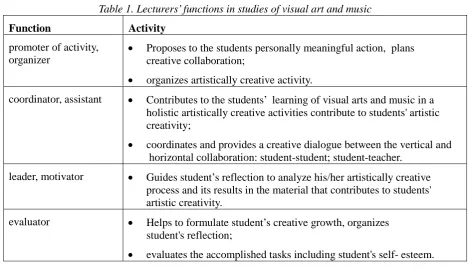
• evaluator who formulates students' creative growth (see Table 1).
For the study process to become more complex, diverse, teacher respects students' different learning styles, as well as social and cultural differences, taking care of all students to be involved in artistic creativity, to make it more relevant to students, revealing their potential for creativity. Thus, the teacher requires artistic, analytical, conceptual, communication and management skills.
Table 1. Lecturers’ functions in studies of visual art and music
Function Activity
promoter of activity, organizer
• Proposes to the students personally meaningful action, plans creative collaboration;
• organizes artistically creative activity.
coordinator, assistant • Contributes to the students’ learning of visual arts and music in a holistic artistically creative activities contribute to students' artistic creativity;
• coordinates and provides a creative dialogue between the vertical and horizontal collaboration: student-student; student-teacher.
leader, motivator • Guides student’s reflection to analyze his/her artistically creative process and its results in the material that contributes to students' artistic creativity.
evaluator • Helps to formulate student’s creative growth, organizes student's reflection;
• evaluates the accomplished tasks including student's self- esteem.
The most important means of the action are the human interaction, human personally relevant and varied activities. Its determination impacts the level of organizational performance. Humanistic pedagogy and human psychology concepts determines the lecturers’ teaching principles, emphasizing the need to enable students to:
• to get through the learning / study process as significant for themselves;
• to acquire the content of the visual arts and music in artistically creative activities that are important for the student;
• to integrate in interaction with the teacher, without losing their autonomy.
These pedagogical principles raise professional requirements for the teacher: a need to be trained for organization of the studies in visual arts and music, competent professional, who makes up a creative, positive, meaningful interaction with students; possessing professional confidence, attitude towards the students, one-self, ones work; lecturer's personal traits: initiative, responsibility, empathy, ambition, tolerance, professional freedom, courage to take risks etc. Lecturer’s professional criteria in is interaction, its nature is the condition of the educational process that is seen as a mean of achievement of educational goals in union with cognitive functioning in the study process of visual arts and music.
In this context, one could characterize the pedagogical vertical collaboration of visual art and music studies:
• situation assessment and coordination based on individual interests and needs;
• the expression of attitudes, emotions and expression of a new experience, which makes the process personally meaningful;
• creativity, creative thinking animation; • relaxing action / cooperation.
According to the personal approach that gives the potential for the promotion of creativity in the context of an emphasis on the process approach (Runco, 2009; Csikszentmihalyi, 2002), in which there are the influence (stimulating and hindering) factors; theoretical approaches in the context of personal motivation emphasizes stimulating creativity options to enjoy the process instead of the achievements resulting product (Zimmerman, 2010; Sternberg, 2010; Norris, 2011); discover the interest to play, solve related issues, generate original ideas (Starko, 2010).
During the purposefully organized process of self-expression in visual arts and music studies student expresses his feelings and emotions, self-awareness and the world around them, develop a sense of individuality and freedom.
Free expression approach in the creation (the process of self-expression) corresponds to primary creativity defined by Maslow, that is is spontaneous, playful, enthusiastic and uncritical (Маslow, 1973). Teacher's role in this approach related to student performance and encouraging freedom (disengagement) creating an atmosphere.
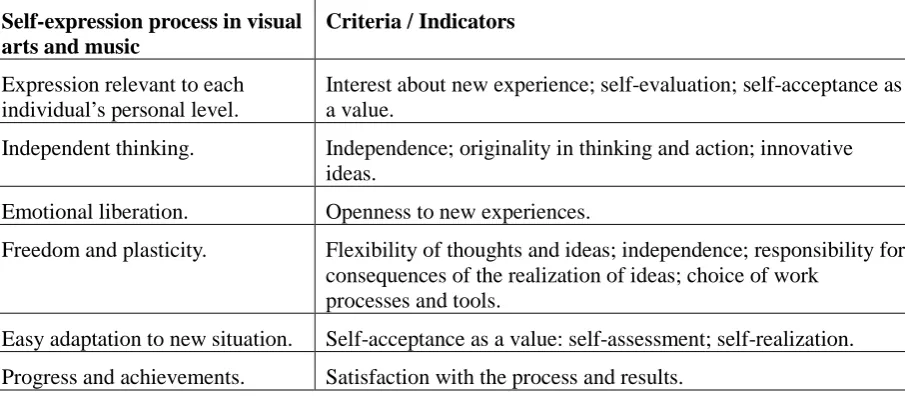
Table 2. Relevance of pedagogical results results in the process of self-expression in the visual arts and music to student’s creativity criteria
Self-expression process in visual arts and music
Criteria / Indicators Expression relevant to each
individual’s personal level.
Interest about new experience; self-evaluation; self-acceptance as a value.
Independent thinking. Independence; originality in thinking and action; innovative ideas.
Emotional liberation. Openness to new experiences.
Freedom and plasticity. Flexibility of thoughts and ideas; independence; responsibility for consequences of the realization of ideas; choice of work
processes and tools.
Easy adaptation to new situation. Self-acceptance as a value: self-assessment; self-realization. Progress and achievements. Satisfaction with the process and results.
From the point of view of research problem significant is the recognition that if students are involved in the process in accordance with these rules, one gets ideas easily and freely, artistically creative works succeed expressive and original. This fact confirms the idea of purposefully organized process of teaching and pedagogical importance of students' creative potential, creating a pedagogical relationship: engaging in creative artistic process of learning the visual arts and music studies focused on detailed rules of the game, encourages students’ artistic creativity, where ideas come up easily and work becomes artistically expressive, original. If the students' artistic activity takes place easily, without conscious effort, the original idea of creation takes place as ease of playing, and then the visual arts and music learning process studies contribute to a student's self-esteem, confidence in their own abilities, courage, in order to develop creative personality inherent properties. Moving away from deliberate mind-control, the student gets a full pre-personal subconscious ability. From the point of view of the research problem of this approach is valuable because in this process the student is aware of itself as a value is generated for a new creative experience motivates creative self-expression, as a result, the creativity potential of the students is encouraged.
Based on the above mentioned, can be defined students' creativity enhancing university study process in the visual arts and music: important for purposefully organized personality evolving lecturer-student interaction, which is implemented in the course of a student's creative self-expression, which is geared towards the promotion of students' creativity (Kalēja-Gasparoviča, 2012).
Learning the content of visual art and music in artistically creative activities during the studies with an emphasis on student self-expression, students are able to:
1) to acquire / learn individual components important for the personality: know oneself, discover abilities, interests, needs and values of the person;
2) learn the language of visual art and music, materials and techniques, the student creates a self-important artistic creative work, gets to know and evaluate the process of idea creation / development / implementation. Impulses of the process of self-expression are emotional impulse, choice of artistic means, and their combinations, which defines pedagogical principles.
By acquiring the content of visual arts and music during creative self-expression process, the student adapts such creativity skills as creative intuition, rich imagination, divergent thinking, inspiration, plasticity of psyche, unconscious and over conscious action; according to the theory of humanistic psychology, student’s creativity skills, that can be expressed in thoughts and emotions, originality in thinking and action, innovation, courage and daring ability etc.
As a problem related can be mentioned several stages of the creative process: the origin of idea, gestation, realization, testing and and creativity as a process in progress (Zimmerman, 2010). Table 3 shows the relation between the stages and the visual arts and music study process subjective components, which confirms the theory of pedagogical activity of visual art and music studies the psychological basis for learning.
Table 3. Creative self-expression process and the creative process stage connections in visual arts and music content acquisition studies
Stages of creation process Acquisition stages of visual arts The origin of idea happens on a broad background
of motivation when the creative impulse activity happens.
Release and development of emotions –
methodological approach, origin of the impulse, criteria of purposeful activity, collection of the information, creation of the idea (inspiration sources).
Gestation of the intention (carrying, incubation). The stage can be varied according to the duration and
psychological processes. This is due to intense awareness activity.
Purposeful development of the perception of art– development and realization of ideas (choice of artistic means). Stages–direct perception exercises, expressive techniques, analog and intuitive techniques. Metamorphoses technique (change, modification, new
applications), familiarizing (artistic abilities and skills).
Realization of intention is a responsible stage, that shows how human’s thoughts and observations from subjective phenomena turns to be objectively perceived. It doesn’t exclude the possibility that during working process the intention can change. While realizing the intention, activates
consciousness, and actualizes subconsciousness, the overconsciousness turns off, the thinking and imagination works precisely, appears the most
Experience in the process of visual arts and music as a value – persistent motivation to implement ideas, perseverance and faith effort. Realizes the individual's subjective phenomena (thoughts, application of ideas, observations) transformations of other objectively perceptible images. Appears the attitude toward acquisition of the visual arts in the studies. Self-knowledge and development of the individuality. The
appropriate realization of the intention. In this stage the regular work, perseverance
and faith effort is necessary.
creative process and artistic experience (pleasure of the action, conscious and unconscious
interaction). Development of creative abilities. Inspiration verification – improvement of the
completed work, repair, comparison of the work performed with the goal set at the beginning.
Possibility of implementation of self-realization during the creativity process - evaluation of the personal contribution (person) and benefit (product), quality of the creative action (process). Motivation for the creation, new challenges, personal sense of learning visual arts and music. Experience of free, personally meaningful activities. Creative experience.
2. RELEASE AND DEVELOPMENT OF EMOTIONS
From the point of view of promotion of the creativity important is the idea of the concept of humanistic psychology that a person can realize ones self-fulfillment only if one has a positive attitude toward him/herself, self-recognition, without which self-development is not possible, self-realization, individualization, self-revelation (Jung, 1961). Self-acceptance is hindered by inferiority complex, based on a flawed self-esteem, but during th creativity process and changes the attitude people's attitude towards themselves and the world around us, life in general (Jung, 1961). Self-evaluation reflects in which stage an individual self-esteem, own sense of value and positive attitude towards everything is developed that is included in the individual “I ” sphere, low self-esteem means dissatisfaction with oneself, a negative attitude towards own personality. According to the concept of humanistic psychology, individual creates himself a subjective view of him/herself, as a result one stays in bias power and hinders individual development (Jung, 1961; Мaslow, 1973).
Pedagogical relation looms out ahead, if during the studies of arts, the action of the student is personally important, releases an emotional experience that facilitates the change of attitude.
On the other hand, a positive attitude towards everything that I am part of, in the individual sphere, changes students' attitude towards themselves, which leads to confidence in their own abilities. In the context of the research that indicates that the pedagogical work of visual art and music studies facilitates students’ release of emotions from previously experienced stereotypical attitudes towards themselves, their abilities, because “I” is based in a true creative potential, which allows an individual to be truthful, unlimited and free.
The principle of the game in creation of pedagogical environment and playing with art materials, ideas, liberates emotionally and creates the possibility for the student to express his/her spontaneous true “I”. This approach determinates that student is ready to take a risk, get involved in unusual, unpredictable and apparently useless activities. According to M. Csiksentmihalyi (Csiksentmihalyi, 2002), flow – the sense of flow, which is a special person's mental status during the creative inspiration and the creative process, where students can feel at ease, determination, focus, enjoy the activity, the process of reconciliation between the offered challenge and abilities. The individual principle of self-movement is emphasized as a basis of creative process of the preparation phase: it forms the motivation to be open and tolerant towards the new and unknown and to enrich the creative experience; man realizes himself in a diverse activity (Vygotsky, 1991).
One of the creative personality characteristics is the liberation or spontaneity of internal properties because everything we do best, we do unconsciously and easily (Jung, 1961; Csikszentmihalyi, 2002). In this context, the importance of emotional relaxation in the studies of artistically creative process is emphasized, as a result a student becomes motivated and open to new experiences.
Internal relax in visual art and music is possible to realize in individual expression, which is a respectable fact during artistically creative self-expression studies. The notion of expression in the art is explained as forces of expressiveness, feelings and emotions. Creativity potential as a human innate natural phenomenon arises directly from the psyche of the primary processes and is important for an
individual's attitude towards reality, self-esteem and productivity. Artistic creativity in psychology distinguishes between two types of artwork creation orientations: introvert orientation, where for the artist is evident in the work process by which regularities what result (product will be achieved; extrovert orientation, where the work will occur outside of the artist’s will (Jung, 1961). It corresponds to A. Maslow’s creativity characterizing three categories - primary, secondary and integrated (Maslow, 1973), where the sources of primary creativity and idea generation process itself is rooted in the deepest layers of human psyche; secondary creativity promotes for the individual to use productively critical and analytical skills; integrated creativity merges primary and secondary creativity, resulting a beneficial innovation.
The true value of expressive activity also accepts the recognition of K. G. Jung that the extrovert orientation of the art work is a truly creative process that is not dependent on the artistic will (Jung, 1961). Imagination arising spontaneously is creative, new ideas and attitudes appear in it, is an embodiment of spontaneous ideas (Jung, 1961)
This defines that individual’s self-movement in acquisition of visual arts and music is to be realized by encouraging students for individual expression, artistic expression, self-expression. The previously analyzed confirms the idea of the hypothesis that student’s creativity potential of visual arts and music studies will be facilitated if the teacher provides a creative dialogue in vertical collaboration studies during the educational process by encouraging student’s self-image and freedom.
3. ART AS A VALUE IN ARTISTICALLY CREATIVE PROCESS
Creative process is related to the specific experiences: both the involvement of the stream, being understood as a joyful sense of action when a student's attention is completely devoted to the activity that makes one forget about “I” and revelations caused delight and surprise (Csiksentmihalyi, 2002). During the creative activities in the visual arts and music students have the opportunity to experience themselves as an autonomous personality, assuming free, independent decisions and making independent choices, thus strengthening confidence in their own abilities, confidence, self-sufficiency, perseverance and energy-related activities; opportunity to implement a strong personal commitment, freedom from psychological blockade.
Despite the fact that art is caused by an act of imagination, it can create a real experience, gaining the opportunity to participate in activities extramural and a variety of life forms through which it is possible to detect human emotions diversity and breadth (Sternberg, 2010). Experience is a self-experienced act and closely connected with the life of a whole (Gadamer, 2002). From this it can be concluded that the experience of the student taking part in the visual arts and music learning process, is needed as a student’s creativity potential incentive condition.
From the above mentioned it can be put forward the idea that artistic creative activity caused by artistic experience changes student's inner world. Adopting the visual arts and music content in artistically creative activities, student can gain the emotional initiative, which encourages to re-evaluate one’s past experience, reveal a strong individual creativity potential.
In the development of creative personality the notion of self-realization/self-empowerment is related to the individual’s creative potential realization and meaningful life correlation: the more people realize their creative potential, the more will be the point in his life (Maslow, 1973).
Since the concept of creative self-expression is closely related to the creative process, then it constitutes a pedagogical framework for students’ creativity as a visual arts component of the study process.
Offering a visual, technical and functional diversity in visual art and music studies, provide students ample opportunities for individual self-expression, because methodological development of the professional knowledge and skills (visual arts and musical language training, equipment, techniques, contexts) is necessary for the student's sense of competence, which poverty is a psychological barrier, and the student refuses to engage artistically creative activity.
In Pedagogical collaboration lecturer raises a questions about personal investment (personality) and benefits (of the creative process results in the material), quality of creative activities (process), motivating students for creativity, new challenges, discovering personal meaning of learning the visual arts and music learning, opportunities for self-expression. In the creativity process, student receives a free, personally significant operating experience, and are encouraged students’ positive creativity changes.
Since future teachers (students) have to become aware of artistic images and subsequently produce them in the course of their artistic and creative practice, it is necessary to consider the concept of an artistic image and means of artistic expressiveness in arts.
The technology for artistic and creative training of future teachers includes the assessment of the creative product and creative activity. In our case assessment was provided for literary musical compositions, music and dance, theatrical performance, musically artistic and other products and compositions.
RESULTS OF THE RESARCH
Lecturer's action, based on theoretical concepts, focuses on a systematic creative dialogue between horizontal and vertical collaboration so the learning for students of visual art and music becomes personally significant activity and release emotional experiences, independently carries out artistic creativity, experiences the visual arts and music process as a value. Therefore, the teacher provides the student the choice of the objective components - subject, content, creative process, visual and technical resources, artistic sense and provides support for new creative experience enriching. For the process to take place, is needed a positive experience of students’ artistic creative activity, adoption of artistically creative process, setting of a subjective goal; planning skills, analysis of experience, choice of artistic means.
For the lecturer it is important to understand and accept that in this artistic / expressive process students express visually and musically their emotions feelings, experiences, confirm the values, gain complete freedom, power and responsibility experience. Educator's role in this approach relates to the students' artistically creative activity, and encouraging, creating an atmosphere of freedom (disengagement).
CONCLUSIONS
1. Unlocking the emotions and developing the components of the educational process of visual art and music studies are related to students’ performance subjective goal – motivation (engage or not to engage) in learning process of visual art and music. Personal significance of students’ performance, psychological comfort defines this objective. Emotional liberation leads the student to be opened to new experience, contributes to his sense of purpose, the interests and the need to achieve this goal. 2. An individual can realize his/her self-fulfillment only if one has a positive attitude toward him/herself. Creativity in the development of an important component of a recognition, self-determination, without which self-development, individualization, self-revelation, self-realization, self-expression is not possible. Erroneous self-esteem consists of an inferiority complex, which hinders self-acceptance but changes in the productive creativity process people's attitudes towards themselves, the world around us and life in general
3. Creativity is an embodiment of spontaneous ideas. The spontaneity of the process of creating ideas promotes creative thinking and individual plasticity, manifested in thinking and action; individual expression contributes to the emergence of new ideas.
4. The objective of creativity development is to maintain an individual's propensity to grow and realize oneself in the context of the research challenges related to students’ motivation for artistically creative self-expression and promotion creativity of ones potential.
5. Visual arts and music acquisition studies are offered as a purposeful, personally significant learning process and in accordance with the personal approach to teaching process in visual arts studies to organize according to the student's self-development in unity with the free, creative, purposefully organized co-operation, based on the targeted process of student's activity, development, self-assessment, self-regulation.
6. Educational recommendations during the educational process in the organization are: encouraging students' creative self-expression through visual arts and music, choose inspiring pedagogical communication, creativity in the challenging techniques (expression, game, fitting in and indulgence to the process).
REFERNCES
Csikszentmihalyi, M. (2002). Flow: The Classic Work on How to Achieve Happiness, Rider, London 314 p.
Gadamers, H. G. (2002). Skaistā aktualitāte: māksla kā spēle, simbols un svētki. (Beautiful actuality: the art of the game, and a symbol of celebration.) Zvaigzne ABC, Rīga, 128 lpp. (Latvian).
Jung, C.G. (1961). Memories, Dreams, Reflections. NY: Vintage Books.
Kālēja-Gasparoviča, D. 2012, ”Faciliation of Students’ Creativity in Visual Arts Education”, PhD thesis, Latvian University of Riga, 78lpp.
Maslow, H.A. (1973). Psychologie des Seins. (Psychology of Being.) Ein Entwurf//Kindler Verlag, München, (German).
Norris, J. (2011). Towards the Use of the "Great Whell" as a Model in Determining the Quality and Merit of Arts-based projects (Researsch and Instruction). Internatiomal Journal of Education&the Arts, 12 (SI 1,7).
Runco, M. A. (2009). Parsimonious Creativity and its Measurement. The International Conference „Can Creativity be Measured? ”.
Starko, A. J. (2010). Creativityin the Classroom: Schools of Curious Delight, 4 th Ed. New York: Routledge.
Sternberg, R. (2010). Creativity is a Choice, Retrieved from http://www.slideshare.net/UTDslides/sternberg-creativity-is-a-decision-3415440
Zimmerman, E. (2010). Lowenfeld Lecture. Creativity and Art Education: A Personal Journey in Four Acts http://www.arteducators.org/research/LowenfeldLecture_2010_EnidZimmerman.pdf
Выготский, Л. С. (1991). Воображение и творчество в детском возрасте. (Imagination and creativity in childhood.) Просвещение. Москва, 90 c.(Russian).