Clim. Past, 9, 267–287, 2013 www.clim-past.net/9/267/2013/ doi:10.5194/cp-9-267-2013
© Author(s) 2013. CC Attribution 3.0 License.
EGU Journal Logos (RGB)
Advances in
Geosciences
Open Access
Natural Hazards
and Earth System
Sciences
Open Access
Annales
Geophysicae
Open Access
Nonlinear Processes
in Geophysics
Open Access
Atmospheric
Chemistry
and Physics
Open Access
Atmospheric
Chemistry
and Physics
Open Access
Discussions
Atmospheric
Measurement
Techniques
Open Access
Atmospheric
Measurement
Techniques
Open Access
Discussions
Biogeosciences
Open Access Open Access
Biogeosciences
DiscussionsClimate
of the Past
Open Access Open Access
Climate
of the Past
Discussions
Earth System
Dynamics
Open Access Open Access
Earth System
Dynamics
Discussions
Geoscientific
Instrumentation
Methods and
Data Systems
Open Access
Geoscientific
Instrumentation
Methods and
Data Systems
Open Access
Discussions
Geoscientific
Model Development
Open Access Open Access
Geoscientific
Model Development
DiscussionsHydrology and
Earth System
Sciences
Open Access
Hydrology and
Earth System
Sciences
Open Access
Discussions
Ocean Science
Open Access Open Access
Ocean Science
Discussions
Solid Earth
Open Access Open Access
Solid Earth
Discussions
The Cryosphere
Open Access Open Access
The Cryosphere
Discussions
Natural Hazards
and Earth System
Sciences
Open Access
Discussions
Tephrostratigraphic studies on a sediment core from Lake Prespa
in the Balkans
M. Damaschke1, R. Sulpizio2,3, G. Zanchetta4, B. Wagner1, A. B¨ohm1, N. Nowaczyk5, J. Rethemeyer1, and A. Hilgers6 1Institute of Geology and Mineralogy, University of Cologne, Z¨ulpicher Straße 49a, 50674 Cologne, Germany
2Dipartimento di Scienze della Terra e Geoambientali, University of Bari, via Orabona 4, 70125 Bari, Italy 3IDPA-CNR, via Mario Bianco 9, Milan, Italy
4Dipartimento di Scienze della Terra, University of Pisa, via S. Maria 53, 56126 Pisa, Italy
5German Research Centre for Geosciences GFZ, Section 5.2 – Climate dynamics and landscape evolution,
Telegrafenberg C321, 14473 Potsdam, Germany
6Institute of Geography, University of Cologne, 50923 Cologne, Germany
Correspondence to: B. Wagner ([email protected])
Received: 10 August 2012 – Published in Clim. Past Discuss.: 12 September 2012
Revised: 18 December 2012 – Accepted: 18 December 2012 – Published: 30 January 2013
Abstract. A detailed tephrostratigraphic record, which dates
back to Marine Isotope Stage (MIS) 5b (ca. 91 kyr), has been established from a 17.76 m long core (Co1215) from Lake Prespa (Macedonia, Albania and Greece). A total of eleven tephra and cryptotephra layers (1 to PT0915-11) were identified, using XRF scanning, magnetic sus-ceptibility measurements, and macro- and microscopic in-spection of the sediments. The major element composition of glass shards and/or micro-pumice fragments indicates that the tephras and cryptotephras originate from the ex-plosive volcanism of Italy. Eight tephra and cryptotephra layers were correlated with specific volcanic eruptions: the AD 512 eruption of Somma-Vesuvius (1438 cal yr BP), the Mercato eruption of Somma-Vesuvius (8890±90 cal yr BP), the Tufi Biancastri/LN1-LN2 eruption of the Campi Fle-grei (14 749±523 cal yr BP and 15 551±621 cal yr BP), the SMP1-e/Y-3 eruption of the Campi Flegrei (30 000– 31 000 cal yr BP), the Campanian Ignimbrite/Y-5 eruption of the Campi Flegrei (39 280±110 cal yr BP), the SMP1-a event of IschiSMP1-a IslSMP1-and (SMP1-around 44 000 cSMP1-al yr BP) SMP1-and the Green Tuff/Y-6 eruption of Pantelleria Island (around 45 000 cal yr BP). One tephra could be attributed to the volcanic activity of Mount Etna, but probably represents an unknown eruption at ca. 60 000 cal yr BP. Cryptotephras PT0915-6 and PT0915-10 remain unclassified so far, but according to the presented age-depth model these would have been deposited around 35 000 and 48 500 cal yr BP,
respectively. Some of the tephras and cryptotephras are recognised for the first time in the Balkan region. The tephrostratigraphic work provides important information about ash dispersal and explosion patterns of source volca-noes and can be used to correlate and date geographically distant paleoenvironmental and archaeological archives in the central Mediterranean region. Moreover, the tephrostrati-graphic work in combination with radiocarbon and electron spin resonance (ESR) dating is a precondition for paleocli-matic reconstructions inferred from the sediment succession Co1215.
1 Introduction
Fig. 1. (a) Map showing the location of Lake Prespa in the northeastern Mediterranean region and the distribution of Quaternary Italian volcanoes, (b) map showing the coring location of core Co1215, and (c) hydro-acoustic profile across the lake (A−A0) showing the coring location with recovery depth of Co1215, the Y-5 tephra and the Pleistocene/Holocene transition (P/HT) (modified after Wagner et al., 2012a).
first arrived during the Late Pleistocene in the Balkans (e.g., Trinkaus et al., 2003; Soficaru et al., 2006).
The Balkan Peninsula is considered to be a promising region for distal tephrostratigraphic studies in the Mediter-ranean region, as it is located ca. 600–800 km downwind of most Italian volcanoes which were active during the Late Quaternary (e.g., Peccerillo, 2005). In addition, the Balkan Peninsula hosts several ancient lakes (i.e., Ohrid, Prespa, Do-jran, Shkodra), which have been shown to be good archives for distal tephra deposits (e.g., Wagner et al., 2008; Sulpizio et al., 2009; Caron et al., 2010; Vogel et al., 2010).
Already published tephrostratigraphic data from lakes Prespa and Ohrid is summarised by Sulpizio et al. (2010). Whilst the records from Lake Ohrid contain 10 tephras and cryptotephras for the last ca. 136 000 cal yr BP, only 3 have been found in the last ca. 40 000 cal yr BP of Lake Prespa. The aim of this paper is to improve and extend the exist-ing tephrostratigraphic record of Lake Prespa by investigat-ing a 17.76 m long sediment core. For this purpose, high-resolution X-ray fluorescence (XRF) scanning techniques combined with magnetic susceptibility (MS) measurements and macro- and microscopic screening of sediments were used to identify tephra and cryptotephra bearing horizons. Correlation of the tephras and cryptotephras to known erup-tions, i.e., proximal and distal deposits, can improve the knowledge of the volcanic history in the central Mediter-ranean region and can unravel hitherto unknown eruptions.
It also can help to establish a reliable chronology for pale-oenvironmental reconstructions based on Lake Prespa sedi-ments, which is needed for a comparison of regional climate variations.
2 Regional setting
Lake Prespa (40◦460–41◦000N, 20◦540–21◦070E) is located at an altitude of 844 m a.s.l. (above sea level) and shared be-tween Macedonia, Albania and Greece (Fig. 1). It has a sur-face area of 254 km2, a maximum water depth of 48 m and
Table 1. Radiocarbon dates from core Co1215, Lake Prespa, with depth, sample number, material, radiocarbon age and calendar age for each sample (modified after Wagner et al., 2012a). The radiocarbon ages were calibrated into calendar years before present (cal yr BP) with 2σ ranges using CALIB Version 6.1.0 (Stuiver and Reimer, 2011). The uppermost sample (ETH-40050) from 0.04–0.06 m depth was calibrated using CALIBomb (Reimer et al., 2004) with the Levin.14c dataset (Levin and Kromer, 2004).
Sample Depth Materia 14C Age Calendar Age
(m) (yr BP) mean
(cal yr BP)
ETH-40050 0.04–0.06 shell (Dreissena presbensis) −1190±30 (−15)±1 COL1030 0.42–0.44 plant (Carex sp.) 715±28 670±23 ETH-40051 0.74–0.76 plant (Phragmites australis) 2080±35 2065±80 ETH-40052 0.74–0.76 bulk organic matter 3095±35 3311±73 COL1031 1.04–1.06 bulk organic matter 6003±28 6854±77 ETH-40054 1.28–1.30 bulk organic matter 7055±40 7891±70 ETH-40055 1.46–1.47 bulk organic matter 8205±40 9155±127 ETH-40056 1.66–1.68 plant (Phragmites australis) 8755±35 9751±125 ETH-40057 1.66–1.68 bulk organic matter 9090±35 10 242±50 ETH-40059 1.84–1.85 bulk organic matter 9840±35 11 240±40 ETH-40060 2.12–2.14 fish remain 10 837±132 12 814±260 ETH-40062 2.14–2.16 fish remain 11 466±121 13 357±249 ETH-40063 2.14–2.16 bulk organic matter 11 005±40 12 887±187 COL1032 3.01–3.03 plant (aquatic) 14 056±71 17 159±301 ETH-40064 6.33–6.35 plant remains 26 345±105 31 009±202 ETH-40065 7.28–7.29 plant remains 33 075±210 37 760±808
3 Material and methods
Core Co1215 (40◦5705000N, 20◦5804100E) was recovered in autumn 2009 and summer 2011 from the central-northern part of Lake Prespa. A seismic survey indicated an undis-turbed sediment succession at the coring location (Fig. 1, Wagner et al., 2012a). Core recovery was performed from a floating platform, using a gravity corer for undisturbed surface sediments and a 3 m long percussion piston corer (UWITEC Co. Austria) for deeper sediments. Correlation of the individual core segments to a 17.76 m long composite core is described in detail in Wagner et al. (2012a).
High-resolution X-ray fluorescence (XRF) measurements were carried out using an ITRAX core scanner (COX Ltd) at the University of Cologne, with a Mo-tube set to 30 kV and 30 mA, and a Si-drift chamber detector. XRF scanning was performed in 2 mm steps with an analysis time of 10 s per measurement. Variations in heavy element counts (Rb, Sr) caused by variations in X-ray source power and due to tube alternation were normalised for coherent scattering (Hoff-mann, 2006). Magnetic susceptibility (MS) measurements were obtained every 1 mm using a Bartington MS2E spot-reading sensor first attached to a MS2 control unit, integrated into a 2nd generation split-core logger (scl-2.3) designed at the Helmholtz Centre Potsdam GFZ. Total carbon (TC) and total inorganic carbon (TIC) were determined with a DIMA-TOC 200 (DIMATEC Co.). Total organic carbon (DIMA-TOC) was calculated by the difference between TC and TIC.
Radiocarbon dating with accelerator mass spectrometry (AMS) was carried out by the Laboratory of Ion Beam
using a60Co-Source at the Centre of Nuclear Medicine at the University of D¨usseldorf. Several specimens of Dreissena sp. shells were combined in order to obtain sufficient material for dating. In total three individual samples were analysed: sample K-5800 from the core segment from 2009 (14.63– 14.58 m), and K-5835 and K-5836 from the shell layer in 14.88–14.58 m in the core segment from 2011. ESR mea-surements were carried out using a Bruker ESP 300E X-band spectrometer at a frequency of 9.8 GHz, with a microwave power of 25.3 mW (Schellmann and Kelletat, 2001; Schell-mann et al., 2008). The field modulation amplitude was 0.5 G with centre field at 3495 G, scan width was 40 G, scan time 21 s and 5 scans in total. The equivalent dose was derived from the analysis of the dating signal atg= 2.0006±0.0001 (Schellmann and Kelletat, 2001). A detailed explanation of the ESR dating method is given by Gr¨un (1989), Schellmann and Kelletat (2001) and Schellmann et al. (2008). All rele-vant parameters for ESR age calculation are summarised in Tables 2 and 3.
Potential tephra layers were initially identified by visi-ble inspection of the core halves. Non-visivisi-ble tephra layers, i.e., cryptotephras, were identified based on suspicious hori-zons from XRF scanning and MS measurements or micro-scopic inspections of selected sediment sections. About 3 g of sediment from every 2 cm was pre-treated with hydro-gen peroxide (∼15 %) to remove organic matter and sub-sequently washed and sieved at 125 and 40 µm. Samples with abundant glass shards, pumice or scoria fragments were mounted on epoxy resin beads. They were additionally pol-ished to avoid compositional variations due to surface alter-nation processes. Major element analyses on at least 10 glass shards or pumice fragments were performed using an EDAX-DX micro-analyser (EDS) mounted on a Philips SEM 515 at the University of Pisa. Operating conditions were ad-justed at 20 kV acceleration voltage, 100 s live counting, 10– 9 A◦ beam current, beam diameter 200–500 mm and 2100– 2400 shots per second, with ZAF correction (Z: atomic num-ber; A: absorption; and F: fluorescence). The ZAF correction procedure does not include natural or synthetic standards for reference and requires the analyses normalisation at a given value, which is chosen at 100 %. Instrument calibration and performance are given by Marianelli and Sbrana (1998). Sev-eral trials for comparing the performance of the Pisa SEM-EDS with wave dispersion spectroscopy (WDS) have been extensively discussed by Cioni et al. (1997), Marianelli and Sbrana (1998), Caron et al. (2010), Sulpizio et al. (2010) and Vogel et al. (2010).
Identified tephras and cryptotephras were named accord-ing to their origin (PT for Prespa Tephra), the year of core re-covery (2009) and the last two identification digits of the core Co1215. The description of the tephras and cryptotephras is based on their macro- and microscopic features as well as on chemical composition. In order to classify chemical compo-sitions of analysed glass shards and pumice fragments the total alkali vs. silica (TAS) diagram (Le Bas et al., 1986)
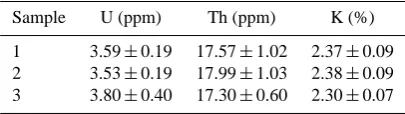
Table 2. Radionuclide contents of bulk sediment samples from three different core segments. All analysis was done by high-resolution gamma-ray spectrometry with samples 1 and 2 (core from 2011) measured at the Cologne lab., and sample 3 (core from 2009) anal-ysed at the VKTA lab., Dresden. All errors represent the 1-σlevel. For dose rate calculation the mean values were used.
Sample U (ppm) Th (ppm) K (%)
1 3.59±0.19 17.57±1.02 2.37±0.09 2 3.53±0.19 17.99±1.03 2.38±0.09 3 3.80±0.40 17.30±0.60 2.30±0.07
was used. Microphotographs of the tephras and cryptotephras were taken using a Canon PowerShot G10 digital camera mounted on a stereomicroscope.
4 Results
4.1 Lithostratigraphy
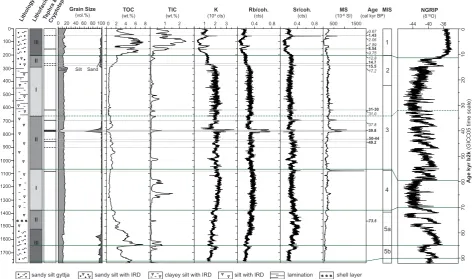
Core Co1215 is comprised of three major lithofacies, which differ in colour, sediment structure, grain size, organic and carbonate content, element counts (K, Rb, Sr) and amplitude of MS (Fig. 2).
The base of core Co1215 between 17.76–15.22 m depth is formed by lithofacies III, which is characterised by an olive-brown to brown colour and massive, probably bio-turbated sediments. The grain size composition is domi-nated by clayey silt with a frequent occurrence of fine sand. TOC is relatively high (between 2–8 wt. %), but varies dis-tinctly throughout this lithofacies, with maxima at 17.56 and 16.38 m depth and minima at 16.58 and 16.08 m depth. The high organic content correlates with relatively low detri-tal clastic material (K). TIC is low (<0.5 wt. %), except of the horizon between 16.80–16.12 m depth, where distinct maxima occur (Fig. 2). Plant and shell remains are absent (Table 1).
The core section between 15.22–13.70 m depth is formed by lithofacies II. This lithofacies has a grey-olive to light brown colour and consists of massive, probably bioturbated sediments. The grain size composition is dominated by silt with a sporadic occurrence of coarse sand and gravel grains. TOC is low (1–3 wt. %), which corresponds with high K. TIC is very low (<0.1 wt. %), except of the horizon between 14.63–14.58 m depth, where shell fragments of Dreissena sp. were found. According to ESR dating, the shell fragments have a mean age (n= 3) of 73 570±7740 yr (Table 3).
Table 3. Parameters for dose rate calculation, total dose rates, equivalent dose values and ESR ages. All errors represent the 1-σ level.
Lab. code Depth (m) U (ppm) Dose rate Equivalent dose ESR age
[shells, ICP-MS] (Gy kyr−1,∗) (Gy) (kyr)
K-5800 14.58–14.63 0.08±0.01 1.36±0.10 100.2±11.2 73.9±9.9 K-5835a 14.70–14.88 0.06±0.01 1.36±0.10 93.71±2.03 68.9±5.1 K-5836a 14.58–14.70 0.06±0.01 1.36±0.10 114.41±6.73 84.1±7.8
∗Calculation of dose rates includes the following parameters and assumptions: alpha-efficiency value 0.10±0.02, thickness
before and after surface etching 0.82/0.75 mm, an average water content of 47±4.7 % (weight water/wet sediment), calculation of the cosmic dose contribution is based on the actual sampling depth including additional shielding through a water column.
0
100
200
300
400
500
600
700
800
900
1000
1100
1200
1300
1400
1500
1600
1700
Tephra & Cryptotephra Lithofacies Lithology
Depth
(cm)
Grain Size (vol.%) 0 20 40 60 80 100 0
Clay Silt Sand
Age kyr b2k
(GICC05 time scale)
III
II
I
III II
I
II
1.43 8.54 14.7 15.5
31-30
39.8 50-44 49.2
73.5 0.67 7.89
17.2
31.0 9.75 12.8
5b 5a 4
sandy silt gyttja sandy silt with IRD clayey silt with IRD silt with IRD lamination shell layer
TOC
(wt.%) (wt.%)TIC (10³ cts)K Rb/coh.(cts) Sr/coh.(cts) (10MS-6 SI) MIS
1
2
3 Age (cal kyr BP)
2.06
37.8
2 4 6 8 1 2 1 2 3 0.4 0.8 0.4 0.8 500 1500
NGRIP (δ18O)
-44 -40 -36
10
80
70
60
50
40
30
20
90
0
Fig. 2. Lithology, lithofacies, tephras and cryptotephras, grain size distribution, total organic carbon (TOC), total inorganic carbon (TIC), K, Rb, Sr counts from X-ray fluorescence (XRF) scanning with heavy element counts (Rb, Sr) normalised for coherent scattering (Hoff-mann, 2006), magnetic susceptibility (MS), radiocarbon ages (italics), ESR mean age (italics and bold) and tephra/cryptotephra ages (bold) from core Co1215 in comparison with the marine isotope stages (MIS) 1–5 (Bassinot et al., 1994) and the oxygen isotope dataset from NGRIP (North Greenland Ice Core Project members, 2004) based on the Greenland Ice Core Chronology 2005 (GICC05) time scale (GICC05modelext, 2010 and references therein). GICC05 ages are given in units of b2k (years before 2000 AD). Green lines indicating tie points of core Co1215 with NGRIP-GICC05.
except of two maxima at 12.52 and 11.74 m depth. K is sta-ble on a high level. MS has a distinct peak at 10.79 m depth. According to previous studies (Wagner et al., 2012a), this horizon was deposited during glacial times.
The core section between 10.66–6.62 m depth is formed by lithofacies II again, with up to 1.5 wt. % TOC and generally very low TIC. A conspicuous horizon between 7.84–7.65 m depth is characterised by a relatively coarse grain-size com-position, a more brownish colour, a minimum in TOC and
maxima in TIC, K, Rb, and MS (Fig. 2). A radiocarbon age of a plant remain from 7.29 m depth indicates that this core section was deposited around 37 000 cal yr BP (Table 1).
Fig. 3. Selected microphotograph of the investigated tephras and cryptotephras: (a) greenish to light brownish micro-pumice frag-ments of PT0915-1, (b) thin and transparent glass shards of PT0915-2, (c) white vesicular glass shard with sick septa of PT0915-3, (d) highly vesicular, white micro-pumice and white to brown glass shards of PT0915-5, (e) 100 % transparent glass shards and highly vesicular micro-pumice of PT0915-7, (f) highly vesic-ular glass shards of PT0915-8, (g) transparent to light brown thick bubble-walled (partly Y-shaped) glass shards of PT0915-9, (h) sco-ria fragments with black phenocrysts of PT0915-11.
Radiocarbon ages of plant remains from 3.03 and 6.33 m depth (Table 1) indicate that this part of the core was de-posited around the Last Glacial Maximum.
The core section between 2.92–2.04 m comprises sedi-ments of lithofacies II again, but with a distinctly increased sand content. Radiocarbon ages from 2.16–2.12 m depth (Ta-ble 1) indicate a Late Pleistocene deposition of this core section.
The uppermost 2.04 m of core Co1215 are formed by litho-facies III. TOC and TIC vary distinctly, which is also indi-cated in clastic material and MS (Fig. 2). All radiocarbon ages from this section indicate Holocene ages (Table 1).
4.2 Tephra and cryptotephra description
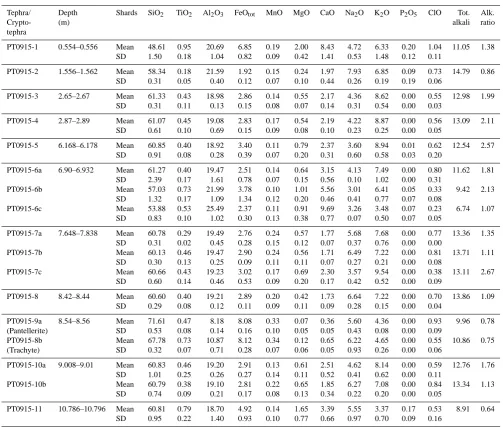
Six tephra layers (visible by naked eye) and five cryptotephra layers (non-visible by naked eye) were recognised in core Co1215 (Table 4; Fig. 2). Exact thicknesses are only given for tephra layers, since cryptotephras did not form distinct horizons and are dispersed in the sediment. However, peaks in the MS or XRF data allow a rough estimation of the thick-ness of some cryptotephras.
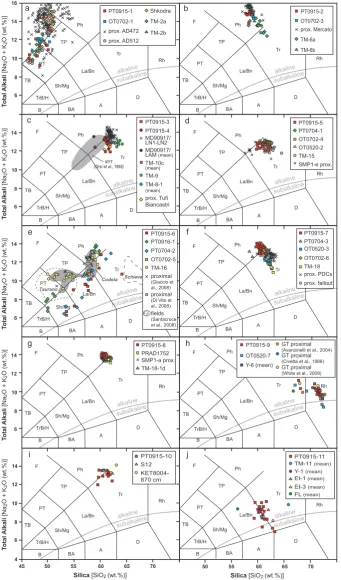
Cryptotephra PT0915-1 (0.554–0.556 m depth) is charac-terised by peaks in MS, K, Rb and Sr values (Fig. 2), which span ca. 2 mm. It is characterised by non-vesicular greenish to light brownish pumice fragments (Fig. 3). Plotted in the TAS diagram, it shows a main glass shard population with phonotephritic composition, a second population with teph-riphonolitic composition, and rare glass shards with foiditic composition (Fig. 4a). The geochemical composition reveals very low silica contents (SiO2<50 wt. %) and high
CaO-contents (CaO between 7 and 11 wt. %) (Table 4).
Tephra PT0915-2 (1.556–1.562 m depth) is 6 mm thick and characterised by peaks in K and Rb values (Fig. 2), and by highly vesicular micro-pumice fragments and trans-parent glass shards. Micro-pumice fragments show spheri-cal or elongate vesicles, whereas glass shards are completely glassy with thick septa or platy shape (Fig. 3). Tephra compo-nents have a maximum grain size of 400 µm. Tephra PT0915-2 indicates a fairly homogenous Na-phonolitic composition (Fig. 4b).
Cryptotephras PT0915-3 (2.650–2.670 m depth) and PT0915-4 (2.87–2.89 m depth) were recognised through mi-croscopic analyses of washed and sieved sediments. PT0915-3 is more abundant in white highly vesicular micro-pumice fragments with elongate vesicles, whereas PT0915-4 com-prises white vesicular glass shards with sick septa (Figs. 3 and 5). Tephra components have a maximum grain size of 400 µm. Both cryptotephras show an almost identical ho-mogenous alkali-trachyte composition (Fig. 4c). Notable are high SiO2 (>60 wt. %) and low CaO (about 2 wt. %)
con-tents. MgO contents are between 0.4–0.7 wt. % (Table 4). Tephra PT0915-5 (6.168–6.178 m depth) shows peaks in K, Sr and MS values (Fig. 2) and has a thickness of 1 cm. It is abundant in highly vesicular, white micro-pumice and transparent, white to brown glass shards. Glass shards show mainly elongate pipe vesicles or conchoidal fractures (Fig. 3). The maximum grain size of tephra components is 600 µm. Glass chemistry is homogenous trachytic (Fig. 4d). Notable is the high potassic affinity (K2ONa2O; Table 4).
Tephra PT0915-6 (6.900–6.932 m depth) shows peaks in MS, Rb and Sr values (Fig. 2) and has a thickness of 3.2 cm. Glass shards are rare and indicate a heterogeneous composi-tion when plotted in the TAS diagram (Fig. 4e). Three com-positional groups can be distinguished: (1) trachytes with SiO2>60 wt. %, (2) latites with 55<SiO2<60 wt. % and
(3) shoshonites with SiO2<55 wt. % and high Al2O and
alkaline subalkaline alkaline subalkaline alkaline subalkaline alkaline subalkaline alkaline subalkaline alkaline subalkaline alkaline subalkaline alkaline subalkaline subalkaline alkaline alkaline subalkaline
Silica [SiO2 (wt.%)]
45 50 55 60 65 70 4
6 8 10 14
Silica [SiO2 (wt.%)]
50 55 60 65 70 6 8 10 12 14 6 8 10 12 14 16 6 8 10 12 14 6 8 10 12 14 Total Alkali [Na 2
O + K
2
O (wt.%)] 12
Total
Alkali
[Na
2
O + K
2 O (wt.%)] Total Alkali [Na 2
O + K
2 O (wt.%)] Total Alkali [Na 2
O + K
2 O (wt.%)] Total Alkali [Na 2
O + K
2 O (wt.%)] D A BA B TB PT TrB/H Sh/Mg La/Bn Tr TP Ph Rh F D A BA B TB PT TrB/H Sh/Mg La/Bn Tr TP Ph Rh F D A BA B TB PT TrB/H Sh/Mg La/Bn Tr TP Ph F D A BA B TB PT TrB/H Sh/Mg La/Bn Tr TP Ph F D A BA B TB PT TrB/H Sh/Mg La/Bn Tr TP Ph Rh F D A BA B TB PT TrB/H Sh/Mg La/Bn Tr TP Ph Rh F D A BA B TB PT TrB/H Sh/Mg La/Bn Tr TP Ph Rh F A BA B TB PT TrB/H Sh/Mg La/Bn TP Ph F D A BA B TB PT TrB/H Sh/Mg La/Bn Tr TP Ph Rh F TB Rh D Tr Rh BA B PT TrB/H Sh/Mg La/Bn TP Ph Rh F Tr D A a prox. AD472 prox. AD512 Shkodra TM-2b TM-2a OT0702-1 PT0915-1 b prox. Mercato TM-6a TM-6b OT0702-3 PT0915-2 NYT (Orsi et al., 1995) c
MD90917/ LN1-LN2 MD90917/ LAM (mean)
prox. Tufi Biancastri TM-9 TM-10c (mean) PT0915-4 PT0915-3 TM-8-1 (mean) d SMP1-e prox. TM-15 OT0520-2 OT0702-4 PT0704-1 PT0915-5 Schiava Taurano Codola e proximal (Di Vito et al., 2008) proximal (Giaccio et al., 2008) TM-16 fields (Santacroce et al., 2008) OT0702-5 PT0916-1 PT0704-2 PT0915-6 PT0704-3 f prox. PDCs TM-18 OT0520-3 prox. fallout OT0702-6 PT0915-7 g SMP1-a prox. PRAD1752 TM-18-1d PT0915-8 h GT proximal (White et al., 2009) GT proximal (Avanzinelli et al., 2004)
Y-6 (mean) OT0520-7 PT0915-9
GT proximal (Civetta et al., 1988)
PT0915-10 i
KET8004-870 cm S12
FL (mean) Et-3 (mean) Et-1 (mean) PT0915-11 j
TM-11 (mean) Y-1 (mean)
Table 4. Average major element glass composition (normalised to 100 %) of investigated tephras and cryptotephras from Lake Prespa core Co1215. The full dataset is given in Table S1 in the Supplement.
Tephra/ Depth Shards SiO2 TiO2 Al2O3 FeOtot MnO MgO CaO Na2O K2O P2O5 ClO Tot. Alk.
Crypto- (m) alkali ratio
tephra
PT0915-1 0.554–0.556 Mean 48.61 0.95 20.69 6.85 0.19 2.00 8.43 4.72 6.33 0.20 1.04 11.05 1.38
SD 1.50 0.18 1.04 0.82 0.09 0.42 1.41 0.53 1.48 0.12 0.11
PT0915-2 1.556–1.562 Mean 58.34 0.18 21.59 1.92 0.15 0.24 1.97 7.93 6.85 0.09 0.73 14.79 0.86
SD 0.31 0.05 0.40 0.12 0.07 0.10 0.44 0.26 0.19 0.19 0.06
PT0915-3 2.65–2.67 Mean 61.33 0.43 18.98 2.86 0.14 0.55 2.17 4.36 8.62 0.00 0.55 12.98 1.99
SD 0.31 0.11 0.13 0.15 0.08 0.07 0.14 0.31 0.54 0.00 0.03
PT0915-4 2.87–2.89 Mean 61.07 0.45 19.08 2.83 0.17 0.54 2.19 4.22 8.87 0.00 0.56 13.09 2.11
SD 0.61 0.10 0.69 0.15 0.09 0.08 0.10 0.23 0.25 0.00 0.05
PT0915-5 6.168–6.178 Mean 60.85 0.40 18.92 3.40 0.11 0.79 2.37 3.60 8.94 0.01 0.62 12.54 2.57
SD 0.91 0.08 0.28 0.39 0.07 0.20 0.31 0.60 0.58 0.03 0.20
PT0915-6a 6.90–6.932 Mean 61.27 0.40 19.47 2.51 0.14 0.64 3.15 4.13 7.49 0.00 0.80 11.62 1.81
SD 2.39 0.17 1.61 0.78 0.07 0.15 0.56 0.10 1.02 0.00 0.31
PT0915-6b Mean 57.03 0.73 21.99 3.78 0.10 1.01 5.56 3.01 6.41 0.05 0.33 9.42 2.13
SD 1.32 0.17 1.09 1.34 0.12 0.20 0.46 0.41 0.77 0.07 0.08
PT0915-6c Mean 53.88 0.53 25.49 2.37 0.11 0.91 9.69 3.26 3.48 0.07 0.23 6.74 1.07
SD 0.83 0.10 1.02 0.30 0.13 0.38 0.77 0.07 0.50 0.07 0.05
PT0915-7a 7.648–7.838 Mean 60.78 0.29 19.49 2.76 0.24 0.57 1.77 5.68 7.68 0.00 0.77 13.36 1.35
SD 0.31 0.02 0.45 0.28 0.15 0.12 0.07 0.37 0.76 0.00 0.00
PT0915-7b Mean 60.13 0.46 19.47 2.90 0.24 0.56 1.71 6.49 7.22 0.00 0.81 13.71 1.11
SD 0.30 0.13 0.25 0.09 0.11 0.11 0.07 0.27 0.21 0.00 0.08
PT0915-7c Mean 60.66 0.43 19.23 3.02 0.17 0.69 2.30 3.57 9.54 0.00 0.38 13.11 2.67
SD 0.60 0.14 0.46 0.53 0.09 0.20 0.17 0.42 0.52 0.00 0.09
PT0915-8 8.42–8.44 Mean 60.60 0.40 19.21 2.89 0.20 0.42 1.73 6.64 7.22 0.00 0.70 13.86 1.09
SD 0.29 0.08 0.12 0.11 0.09 0.11 0.09 0.28 0.15 0.00 0.04
PT0915-9a 8.54–8.56 Mean 71.61 0.47 8.18 8.08 0.33 0.07 0.36 5.60 4.36 0.00 0.93 9.96 0.78
(Pantellerite) SD 0.53 0.08 0.14 0.16 0.10 0.05 0.05 0.43 0.08 0.00 0.09
PT0915-8b Mean 67.78 0.73 10.87 8.12 0.34 0.12 0.65 6.22 4.65 0.00 0.55 10.86 0.75
(Trachyte) SD 0.32 0.07 0.71 0.28 0.07 0.06 0.05 0.93 0.26 0.00 0.06
PT0915-10a 9.008–9.01 Mean 60.83 0.46 19.20 2.91 0.13 0.61 2.51 4.62 8.14 0.00 0.59 12.76 1.76
SD 1.01 0.25 0.26 0.27 0.14 0.11 0.52 0.41 0.62 0.00 0.11
PT0915-10b Mean 60.79 0.38 19.10 2.81 0.22 0.65 1.85 6.27 7.08 0.00 0.84 13.34 1.13
SD 0.74 0.09 0.21 0.17 0.08 0.13 0.34 0.22 0.20 0.00 0.05
PT0915-11 10.786–10.796 Mean 60.81 0.79 18.70 4.92 0.14 1.65 3.39 5.55 3.37 0.17 0.53 8.91 0.64
SD 0.95 0.22 1.40 0.93 0.10 0.77 0.66 0.97 0.70 0.09 0.16
Tephra PT0915-7 (7.648–7.838 m depth) shows signifi-cant peaks in MS, K and Rb values (Fig. 2). The 19 cm thick layer is composed of almost 100 % glass shards and micro-pumice. The glass shards are transparent to brown and have an elongated to platy shape, whereas micro-pumice fragments are highly vesicular (Fig. 3). Tephra components have a maximum grain size of 600 µm. The distinct bimodal glass composition ranges from trachytic to phonotrachytic (Fig. 4f).
Cryptotephra PT0915-8 (8.420–8.440 m depth), which has been identified microscopically, comprises transparent glass shards and some highly vesicular micro-pumice fragments. Glass shards have conchoid to irregular shapes and a max-imum grain size of 500 µm (Figs. 3 and 5). When plot-ted in the TAS diagram, the major glass composition is
homogenous phonolitic with a slight shift towards the tra-chytic field (Fig. 4g). Notable is a very low alkali ratio around 1 wt. % (Table 4).
Tephra PT0915-9 (8.540–8.560 m depth) does not indicate peaks in MS, K and Rb values (Fig. 2). It has been identified through macroscopic and microscopic inspection. The 2 cm thick tephra layer comprises transparent to light brown elon-gated and thick bubble-walled (partly Y-shaped) glass shards (Figs. 3 and 5) with a maximum grain size of 400 µm and rhyolitic to trachytic composition (Fig. 4h). As the rhyolites of PT0915-9 have∼71 wt. % SiO2,∼8 wt. % Al2O3and 7–
8 wt. % FeO (Table 4), they can be classified as pantellerites (cf. Macdonald, 1974).
100 μm
100 μm
200 μm 500 μm
200 μm 200 μm
a b
e d
c
f
Fig. 5. Selected scanning electron microscope (SEM) photographs of the investigated tephras and cryptotephras: (a) vesicular micro-pumice fragments and glass shards of PT0915-3, (b) vesicular micro-pumice of PT0915-4, (c) highly vesicular glass shards of PT0915-8, (d) thick-walled (Y-shaped) glass shards of PT0915-9, (e–f) square phenocrysts in porphyritic scoria of PT0915-11.
Sr values. Glass shards are rare and poorly preserved. The glass composition is trachytic to phonolitic (Fig. 4i). Two geochemical groups can be defined, one with low alkali ratio (<1.5 wt. %) and another one with high alkali ratio (>1.5 wt. %) (Table 4).
Tephra PT0915-11 (10.786–10.796 m depth) shows a sig-nificant peak in MS, a minor peak in Sr values (Fig. 2), and spans 1 cm. It comprises non-vesicular and blocky, light grey to grey scoria fragments with a porphyritic texture (Figs. 3 and 5). The glass composition ranges from trachyan-desitic (benmoreitic) to trachytic (Fig. 4j). A high Na-affinity (Na2O>K2O; Table 4) is notable.
5 Discussion and interpretation
All tephras and cryptotephras in core Co1215 indicate alka-line affinity (Fig. 4). The only known source with mainly alkaline volcanism in the surrounding of Lake Prespa are the volcanic districts of the Italian Peninsula, which also would match with predominant westerly winds in the re-gion. Volcanic products of the Aegean area (e.g., Greece, Santorini) and Central Anatolia (e.g., Turkey) show mainly calc-alkaline affinity (e.g., Keller et al., 1990; Druitt et al., 1995; Paterne et al., 2008) and those of Germany (Eifel vol-canic district) and France (Massif Central) have never been recorded close to the study area (e.g., Van den Bogaard, 1995; Schmincke et al., 1999; Walter-Simonnet et al., 2008; Riede et al., 2011). Traces of the Vedde Ash from Iceland were recently found in the Lake Bled, Slovenia (Lane et al., 2011a), but not yet on the Balkan Peninsula. Two out of eleven tephras and cryptotephras (9 and PT0915-11) are unambiguously correlated with the volcanic activi-ties of Mount Etna and Pantelleria Island, reinforcing the hypothesis that Italian volcanoes are the sources of tephras and cryptotephras in core Co1215. The other 9 tephras and
K2
O/Na
2
O
Na2O+K2O (wt.%) 0
0.5
4 6 8 10 12 14 16 18 1.0
1.5 2.0 2.5 3.0 3.5
a
c d
e b
PT0915-1 PT0915-2 PT0915-3 PT0915-4
PT0915-9 PT0915-5 PT0915-6 PT0915-7 PT0915-8
PT0915-10 PT0915-11
Fig. 6. Na2O + K2O vs. K2O/Na2O diagram (modified after Keller
et al., 1978; Wulf, 2001; Calanchi and Dineli, 2008), showing the geochemical discrimination between the different volcanic provinces of Italy (dotted lines): (a) Aeolian Island, (b) Mount Etna, (c) Pantelleria Island, (d) Ischia Island, (e) Campanian Area (includ-ing Campi Flegrei and Somma Vesuvius) and investigated tephras and cryptotephras of core Co1215 from Lake Prespa.
cryptotephras in core Co1215 have a composition suggest-ing the Campanian area as most probable source (Fig. 6). However, the correlation of tephras and cryptotephras with proximal Campanian counterparts is very complex, because the geochemical composition can be similar among different volcanic sources (e.g., Campi Flegrei vs. Somma-Vesuvius, Sulpizio et al., 2003, 2010).
5.1 PT0915-1/AD 512
the Holocene is the Somma-Vesuvius (e.g., Ayuso et al., 1998; Santacroce et al., 2008). The composition of PT0915-1 overlaps the mafic “tail” of the 472 AD (Pollena) eruption (Rosi and Santacroce, 1983) (Fig. 4a). Sulpizio et al. (2005) distinguished three main eruptive phases for the 472 AD eruption. Only the climactic phase shows more mafic and less evolved composition, such as that found in PT0915-1. So far, distal deposits of the 472 AD eruption have been detected in the sediments of Lake Shkodra (SK19; Sulpizio et al., 2009), Sulmona Basin (SUL1-5; Giaccio et al., 2009) and Lago Grande di Monticchio (TM-2a and TM-2b; Wulf et al., 2004). When plotted in the TAS-diagram (Fig. 4a), TM-2b and SK19 cluster well in the majority-field of 472 AD prox-imal deposits, whereas the tephra TM-2a indicates a closer affinity to PT0915-1. Wulf et al. (2004) correlated the TM-2a with the 512 AD eruption, a subplinian explosive event fol-lowing the 472 AD eruption (Cioni et al., 2011). In the Lake Ohrid sediments nearby, cryptotephra OT0702-1 has been as-sumed to be a mixture of the 472 and 512 AD eruptions (Vo-gel et al., 2010; Wagner et al., 2012b) and matches well with cryptotephra PT0915-1. As the sedimentation rate is simi-larly low in Lake Prespa, a mix of both eruption events in a single horizon rather than two distinct layers cannot be ruled out. For a better discrimination between both events, the geo-chemical compositions of proximal and distal deposits were plotted in the alkali vs. alkali ratio diagram (Fig. 7). Although the composition of AD 512 overlaps slightly the distribution field of 472 AD, PT0915-1 seems to indicate a better corre-lation with the 512 AD proximal and TM-2a distal deposits. Therefore, PT0915-1 has been tentatively correlated to the 512 AD event (Santacroce et al., 2008; Cioni et al., 2011), even though the differentiation between the 472 and 512 AD is difficult, because they have a very similar fingerprint and the information in historic records is rare. The recognition of 512 AD volcanic products in the Balkan region significantly enlarges the area of tephra distribution to the east.
5.2 PT0915-2/Mercato
The microscopic characteristics and the distinctive homoge-nous phonolitic glass chemistry of tephra PT0915-2 sug-gest a correlation with the Mercato eruption from Somma-Vesuvius (e.g., Mele et al., 2011). The correlation is also sup-ported by the stratigraphic position between the two radio-carbon samples ETH-40054 (7891±70 cal yr BP) and ETH-40056 (9751±125 cal yr BP) (Table 1). The Mercato erup-tion was one of the largest plinian eruperup-tions of Somma-Vesuvius (Santacroce et al., 2008). The fallout products were mainly dispersed towards the east and were recognised in several cores from the Adriatic Sea (Paterne et al., 1988; Lowe et al., 2007; Calanchi and Dinelli, 2008), in Lago Grande di Monticchio (TM-6 tephra, Wulf et al., 2004 and L4 tephra, Narcisi, 1996), and in cores from the Ionian Sea (Caron et al., 2008). According to the TAS diagram, the TM-6 tephra seems to cluster broader compared to tephra
K2
O/Na
2
O
Na2O+K2O (wt.%)
0 0.5 1.5 2 2.5 3 3.5
6 8 10 12 14 16 18 20 22 24 1
proximal AD472 proximal AD512 Shkodra TM-2a TM-2b OT0702-1 PT0915-1
Fig. 7. Na2O + K2O vs. K2O/Na2O diagram showing the
geochem-ical discrimination between the 472 AD and 512 AD eruption (prox-imal deposits; Santacroce et al., 2008; Table S2 in the Supplement). For comparison, data of distal deposits (Shkodra, Sulpizio et al., 2009; OT0702-1, Vogel et al., 2010; TM-2, Wulf et al., 2004; Ta-ble S2 in the Supplement) are also presented. Cryptotephra PT0915-1 favours correlation with 5PT0915-12 AD and TM-2a.
PT0915-2 (Fig. 4b), which might be a result of multiple ex-plosive phases of the Mercato eruption (Mele et al., 2011). Tephra layer TM-6 is split into TM-6-a at the top represent-ing the final stage of the eruption and TM-6-b at the basal part, which has been correlated to the main phase of the Mercato eruption (Wulf et al., 2004). The latter tephra has a closer affinity to PT0915-2 from Lake Prespa. The Mercato tephra was also recognised in the sediment cores of the Island of Mljet, where it shows a bimodal composition similar to the Monticchio TM-6a and TM-6b tephras (Jahns and van den Bogaard, 1998). In Lake Ohrid, cryptotephra OT0702-3 indi-cated a similar phonolitic composition compared with tephra PT0915-2, and was also ascribed to the Mercato eruption (Vogel et al., 2010). Several radiocarbon ages are available for the Mercato eruption. Santacroce et al. (2008) reported an age of 8890±90 cal yr BP obtained from soil organic fractions, while Zanchetta et al. (2011) provided an age of 8540±50 cal yr BP obtained from charcoal below the prox-imal fallout deposits. The varve chronology of Lago Grande di Monticchio indicated an age of 9680±480 cal yr BP for the TM-6-b tephra layer (Wulf et al., 2004). The stratigraphic position of PT0915-2 ca. 10 cm above sample ETH-40056 (9751±125 cal yr BP; Table 1) and ca. 27 cm below sample ETH-40054 (7891±70 cal yr BP; Table 1) favours the age of 8890±90 cal yr BP suggested by Santacroce et al. (2008), however, a precise chronological information for PT0915-2 cannot be given based on the radiocarbon ages in core Co1215.
5.3 PT0915-3 and PT0915-4/LN1 and LN2 (Tufi
Biancastri)
PT0915-3 and PT0915-4 suggest that they originate from the Campanian area (Fig. 6). The stratigraphic position of both cryptotephras between the radio-carbon samples ETH-40060 (12 814±260 cal yr BP), ETH-40062 (13 357±249 cal yr BP), ETH-40063 (12 887±187 cal yr BP) and sample Col1032 (17 159 ±301 cal yr BP) (Table 1) implies a Late Pleistocene age. One of the largest eruptions in the considered time interval is the Neapolitan Yellow Tuff (NYT) eruption from the Campi Flegrei (Rosi and Sbrana, 1987), which occurred based on conventional radiocarbon measurements around 12 300 yr BP (uncalibrated; Alessio et al., 1971) and based on 40Ar/39Ar measurements at 14 900 yr (Deino et al., 2004). NYT products include a wide range of composition, which spans from phonolitic to trachytic and from latitic to tephriphonolitic (e.g., Orsi et al., 1992, 1995; Scarpati et al., 1993; Siani et al., 2004; Wulf et al., 2004). Since cryp-totephras PT0915-3 and PT0915-4 do show homogenous trachytic glass composition and are found as two discrete layers suggesting two independent eruptions, a correlation with the NYT event is unlikely. This is supported by only marginal geochemical similarity with the more evolved part of NYT products (Figs. 4 and 8). Pre-NYT deposits were reported in proximal (e.g., Orsi et al., 1996; Pappalardo et al., 1999), medial (Di Vito et al., 2008) and distal areas (Siani et al., 2004; Wulf et al., 2004). The older products are highly evolved trachytes that become geochemically more similar to the less evolved NYT rocks with time (Pappalardo et al., 1999; Pabst et al., 2008). This transition is explained with magma withdrawal from a deep, trachytic parent magma chamber, which fed the pre-NYT eruptions and a three-layered NYT magma chamber erupted during the large NYT event.
Only a few tephra layers preceding the NYT-tephra were identified in distal sites so far. The oldest correspond to the Lagno Amendolare eruption (15 430±190 cal14C yr BP; Andronico, 1997) and are followed by those related to the Tufi Biancastri eruption (14 600±60040Ar/39Ar yr; Pap-palardo et al., 1999; Zanchetta et al., 2000). Lagno Amen-dolare and Tufi Biancastri deposits were recognised in sedi-ment records from the Adriatic Sea (core MD90917; LAM, LN1 and LN2, respectively; Siani et al., 2004) and in Lago Grande di Monticchio (TM-10 and TM-9, respectively; Wulf, 2001; Wulf et al., 2004, 2008).
When plotted in the K2O and SiO2 vs. CaO diagrams
(Fig. 8), TM-10c seems to match the composition of PT0915-3 and PT0915-4 relatively well. The TM-10 tephra-sequence is dated between 15 550±780 and 15 030±750 cal yr BP (Wulf et al., 2008). The Lagno Amendolare tephra from the marine core, however, does not show any compositional similarity with PT0915-3 and PT0915-4. Nevertheless, the LN1 and LN2 tephras, which have been correlated with Tufi Biancasti, overlap well with the composition of PT0915-3 and PT0915-4 (Figs. 4 and 8). Radiocarbon dating pro-vided ages of 12 660±110 yr BP (14 749±523 cal yr BP)
and 12 870±100 yr BP (15 551±621 cal yr BP) for LN1 and LN2, respectively (Siani et al., 2004). In the Lago Grande di Monticchio succession TM-9 represents the lowermost tephra of Tufi Biancastri deposits (Wulf, 2001) and has a varve-supported age of 14 560±730 cal yr BP (Wulf, 2001; Wulf et al., 2004, 2008). Although cryptotephras PT0915-3 and PT0915-4 plot outside the majority field of TM-9 (Figs. 4 and 8), they are relatively similar with the uppermost tephra in this tephra unit, labelled as TM-8-1 (S. Wulf, personal communication, 2012). Due to these geochemical similari-ties, we tentatively correlate PT0915-3 and PT0915-4 with the late stage of the Tufi Biancastri eruption from the Campi Flegrei. As the ages for the LN1 and LN2 tephras provided by Siani et al. (2004) are in good agreement with ages given by Pappalardo et al. (1999), we propose that PT0915-3 has a best age of 14 749±523 cal yr BP and PT0915-4 has a best age of 15 551±621 cal yr BP. Core Co1215 provides the first recognition of Tufi Biancastri products in the Balkan area and greatly enlarges their area of dispersal to the east.
5.4 PT0915-5/Y-3
The distinct homogenous alkali-trachytic composition of tephra PT0915-5 and the stratigraphic position above a ra-diocarbon dated plant remain at 6.35 m depth (ETH-40064; 31 009±202 cal yr BP; Table 1) suggest a correlation with the Y-3 tephra (Keller et al., 1978; Zanchetta et al., 2008). The most probable proximal counterpart for the Y-3 tephra is the SMP1-e eruption from the Campi Flegrei (Di Vito et al., 2008; Zanchetta et al., 2008). PT0915-5 overlaps well with the composition of SMP1-e proximal deposits (Fig. 4d). Radiocarbon dates achieved from charcoals underlying the proximal fallout deposits of SMP1-e suggest a maximum age of 30 670±230 cal yr BP (Di Vito et al., 2008), which is in good agreement with a 40Ar/39Ar age obtained on sanidine crystals from proximal deposits (30 300±200 yr; Pappalardo et al., 1999). Wulf et al. (2004) correlated the TM-15 tephra in the Lago Grande di Monticchio succes-sion with the Y-3 tephra and suggested a varve-supported age of 27 260 cal yr BP (Wulf et al., 2006). Zanchetta et al. (2008) proposed a most probable age range between 30 000–31 000 cal yr BP, which corresponds well with the stratigraphic position of PT0915-5 in relation to the radio-carbon age of sample ETH-40064 (Table 1).
The recognition of the Y-3 tephra in core Co1215 confirms previous findings from the north-western part of Lake Prespa (PT0704-1, Wagner et al., 2010) and in Lake Ohrid (OT0520-2, Wagner et al., 2008; JO-187, Caron et al., 2010; OT0700-1, Lindhorst et al., 2010; OT0702-4, Vogel et al., 2010).
5.5 PT0915-6/Unknown
7 7.5 8 8.5 9 9.5 10
1 2 3 4 5 6
K2O
CaO
PT0915-3 TM10a PT0915-4 TM10b TM10c TM10d
K2
O
(wt.%)
CaO (wt.%)
SiO
2
(wt%)
54 56 58 60 62
8
2 4 5 6
9
64
2 3 4 5 3
52
7 10
50
MD90917/NYT MD90917/LAM
(mean)
MD90917/LN1-LN2 TM-9
PT0915-3 PT0915-4
TM-8-1 (mean) TM-10a
TM-10b
TM-10c TM-10d
Fig. 8. K2O vs. CaO and SiO2vs. CaO diagrams (modified after Pabst et al., 2008) showing the geochemical discrimination between NYT
and pre-NYT deposits (dotted lines – NYT, Orsi et al., 1995; 8-1, Wulf, personal communication, 2012; 9, Wulf et al., 2004; TM-10a–d, Wulf et al., 2004, 2008; LAM, LN1–LN2 and NYT, Siani et al., 2004; Table S2 in the Supplement) and investigated cryptotephras PT0915-3 and PT0915-4. Both favour correlation with pre-NYT deposits.
et al., 2010). Wagner et al. (2010) correlated PT0704-2 ten-tatively with the Codola eruption (∼33 000 cal yr BP; Gi-accio et al., 2008), while Sulpizio et al. (2010) proposed correlation with the activity of Vulcano (Aeolian Island), even though he cannot link the tephra to a specific erup-tion. A correlation of PT0915-6 with the volcanic activity of Vulcano (Aeolian Island) is possible according to the al-kali vs. alal-kali ratio (Fig. 6). The stratigraphic position of tephra PT0915-6 below the Y-3 tephra (suggesting>30 000– 31 000 cal yr BP) and between the radiocarbon ages of sam-ples ETH-40064 (31 009±202 cal yr BP, Table 1) and ETH-40065 (37 760±808 cal yr BP, Table 1) suggests a correla-tion with the widespread Codola erupcorrela-tion. The most reliable age for the Codola eruption comes from radiocarbon dating of foraminifera directly below the Codola tephra in a ma-rine core from the Tyrrhenian Sea (34 270±870 cal yr BP; Paterne et al., 1999), which agrees with the age window sug-gested by Giaccio et al. (2008). However, PT0915-6 partly shows a different compositional trend compared to proxi-mal (e.g., Di Vito et al., 2008; Giaccio et al., 2008; San-tacroce et al., 2008) and most distal (e.g., TM-16, Wulf et al., 2004; OT0702-5, Vogel et al., 2010) deposits, which are correlated with Codola (Fig. 4e). This could be explained by a lack of information, i.e., origin, dynamics, dispersal, and composition of Codola (e.g., Santacroce, 1987; Sulpizio et al., 2003; Di Vito et al., 2008; Giaccio et al., 2008; San-tacroce et al., 2008). Considering the time interval, other po-tential sources for PT0915-6 are the eruptions of Schiava (Di Vito et al., 2008) and Taurano (Santacroce et al., 2008). Tau-rano was supposed to be one potential source of cryptotephra PT0916-1, which was found in a core from the lateral part of Lake Prespa (Sulpizio et al., 2010). However, the prod-ucts of Schiava and Taurano have significantly different geo-chemical fingerprints compared with PT0915-6 (Fig. 4e), which makes their correlation unlikely. Due to the lack of
unambiguous correlation with known eruptions, the source of cryptotephra of PT0915-6 cannot be clearly defined so far.
5.6 PT0915-7/Y-5
The trachytic to phonotrachytic glass composition and the al-kaline affinity indicates that the Campanian area is the source of tephra layer PT0915-7 (Fig. 6). Moreover, the thickness of PT0915-7 (19 cm) and the trimodal composition of glass shards are particular fingerprints of the well-known Campa-nian Ignimbrite (CI) eruption from the Campi Flegrei (e.g., Orsi et al., 1996; Civetta et al., 1997; Giaccio et al., 2008). The CI eruption is one of the largest explosive eruptions of the Mediterranean region (Pyle et al., 2006) and can be sub-divided into an early phase with the most-evolved de-posits and a final phase related to the caldera collapse with less-evolved deposits (e.g., Civetta et al., 1997; Pappalardo et al., 1999). The different eruptive phases comprised dif-ferent zones of a strongly zoned trachytic magma chamber (Fedele et al., 2007), which is seen in three different al-kali ratios (Table 4). The CI eruption was correlated with the distal tephra layer Y-5 in cores from the Tyrrhenian and Ionian Seas (Keller et al., 1978; Paterne et al., 1988), the TM-18 tephra layer in Lago Grande di Monticchio (Wulf et al., 2004), and with tephras from Lake Prespa (PT0704-3; Wagner et al., 2010) and Lake Ohrid (OT0520-(PT0704-3; Wag-ner et al., 2008, OT0702-6; Vogel et al., 2010). According to the Lago Grande di Monticchio varve chronology, the Y-5/TM-18 deposits have an age of 36 770 cal yr BP (Wulf et al., 2006). Laser40Ar/39Ar technique on single sanidine crys-tals proposed ages of 37 100±400 yr (Deino et al., 1994) and 41 200±2100 yr (Ton-That et al., 2001). The most ac-curate age of the CI/Y-5 eruption is based on a single crystal
40Ar/39Ar dating of proximal deposits (39 280±110 yr BP,
The Y-5 tephra is the most significant tephra in the cen-tral Mediterranean region and extends further to the east and northeast up into Russia (Pyle et al., 2006; Fedele et al., 2008; Giaccio et al., 2008; Fig. 9). It has been used as a major chrono-stratigraphic marker for the Upper Pleistocene (e.g., Narcisi, 1996; St. Seymour et al., 2004) and the onset of Heinrich event 4 (Ton That et al., 2001; Giaccio et al., 2006) in paleoclimatic and archeological studies.
5.7 PT0915-8/SMP1-a
The distinct homogenous trachyphonolitic composition of cryptotephra PT0915-8 indicates the Campanian area, partic-ularly Ischia Island as its source (Fig. 6). Very few descrip-tions of pre-CI proximal deposits exist (Di Vito et al., 2008), which range in composition from phonolitic to trachytic (Pappalardo et al., 1999). Di Vito et al. (2008) described one proximal fallout deposit termed as SMP1-a, which was re-covered on the Sorrentina Peninsula. PT0915-8 and proxi-mal SMP1-a deposits match notably well in the geochemi-cal characteristics (Fig. 4g). SMP1-a products are phonolitic, straddle the trachytic field and show an alkali ratio around 1, which would argue for an origin from Ischia Island (Poli et al., 1987; Crisci et al., 1989). Distal SMP1-a products have been found in sediment cores from the Tyrrhenian and Adri-atic Seas (C14, Paterne et al., 1988; Sulpizio et al., 2003; PRAD1752, Bourne et al., 2010) and in Lago Grande di Monticchio (TM-18-1d, Wulf et al., 2006). All match well with the geochemical characteristics of SMP1-a proximal de-posits and PT0915-8 (Fig. 4g).
According to the Lago Grande di Monticchio varve chronology TM-18-1d has an age of 37 360 cal yr BP and was deposited only 590 years before the CI (Wulf et al., 2006). The relatively large distance between PT0915-7/Y-5 and PT0915-8 does not support the correlation of PT0915-8 with the TM-18-1d/SMP1-a eruption. However, according to Di Vito et al. (2008) the age of the SMP1-a eruption varies between 39 000–51 000 cal yr BP.
The recognition of the SMP1-a tephra in Lake Prespa is the first finding of the tephra in the Balkan region and the most distal occurrence of this tephra so far. The distance of about 600 km between Ischia Island and Lake Prespa suggests that the SMP1-a eruption was probably of high magnitude and ash dispersal occurred mainly to the east.
5.8 PT0915-9/Y-6
The distinct pantelleritic glass composition of tephra PT0915-9 indicates that the peralkaline volcano of Pantel-leria Island is the source of this tephra, as this is the only known volcanic district in the Mediterranean region produc-ing such a pantelleritic composition durproduc-ing the Late Quater-nary (Mahood and Hildreth, 1986). Correlation of PT0915-9 to the widespread “green ignimbrite” eruption, also known as “Green Tuff” (Orsi and Sheridan, 1984) is obvious, because
N 50°
40°
20°
E 10° 30°
Castelcivita
200 km Campi
Flegrei PrespaLake
Crvena Stijena Temnata
Franchthi
Kostenki
Serino
Haua Fteah
Fig. 9. Map showing the distribution of the Campanian Ign-imbrite/Y5 tephra (green field), based on terrestrial/marine (white circles) and archaeological (yellow stars) sites; modified after Fedele et al. (2003, 2008). Archaeological sites refer to Vitaliano et al. (1981), Paterne (1992), Sinitsyn (2003), Giaccio et al. (2006), Lane et al. (2011b) and Morley and Woodward (2011).
their geochemical composition ranges from pantelleritic to trachytic (Civetta et al., 1988; Avanzinelli et al., 2004; White et al., 2009) (Fig. 4h). The “Green Tuff” has been corre-lated with the marine tephra layer Y-6 from Ionian Sea cores (Keller et al., 1978), which is commonly used as well-defined stratigraphic marker for the central Mediterranean region (e.g., Narcisi and Vezzoli, 1999). The Y-6 tephra was already identified in the Lake Ohrid record (OT0702-7, Vogel et al., 2010). Although the geochemical characteristics allow an un-ambiguous correlation of tephra PT0915-9 with the Green Tuff/Y-6 eruption, exact age assignments are lacking. Ac-cording to K/Ar dating, ages between 50 800±3600 yr to 44 500±3100 yr (e.g., Cornette et al., 1983; Civetta et al., 1984; Mahood and Hildreth, 1986) are given, which are in good agreement with the interpolated stratigraphical age of ca. 45 000 yr BP for the marine marker tephra Y-6 (Keller et al., 1978).
The recognition of the Green Tuff/Y-6 deposits in both lakes suggests that the main ash distribution was towards the east.
5.9 PT0915-10/Unknown
with the distal tephra S12 recovered from the San Grego-rio Magno basin in southern Italy (Fig. 4i; Munno and Pet-rosino, 2007). The S12 was correlated with an 87 000 yr old tephra in a core from the Tyrrhenian Sea (KET 8004, Pa-terne, 1985), much older than supposed by the stratigraphic position of PT0915-10 only 46 cm below the Green Tuff/Y-6 tephra and well above the ESR-dated horizon with a mean age of 73 570±7740 yr (Table 1). As there is no lithologi-cal indication for a hiatus in core Co1215 from Lake Prespa (Wagner et al., 2012a), the correlation of PT0915-10 with the S12 tephra is questionable. In the estimated time frame there are numerous tephra layers in the Lago Grande di Monticchio record with similar composition as PT0915-10 (S. Wulf, per-sonal communication, 2012). However, the poorly preserved and rare glass shard content of PT0915-10 does not allow for an unambiguous correlation with the known regional tephra deposits at present.
5.10 PT0915-11/Etna
The benmoreitic composition and the Na-affinity (Na2OK2O) of tephra PT0915-11 is a typical
chem-ical imprint of the volcanic activity of Mount Etna, which is the only known source of Na-alkaline volcanism during the Late Quaternary in the Mediterranean region (e.g., Cristo-folini and Romano, 1982; Coltelli et al., 2000; Branca et al., 2004). Although the geochemical correlation of PT0915-11 to the few described Etnean distal tephra deposits (e.g., Keller et al., 1978; Paterne et al., 1988, 2008; Wulf et al., 2004; Wagner et al., 2008; Sulpizio et al., 2009; Vogel et al., 2010) is obvious, its stratigraphic position between Y-6 and the ESR-dated shell layer (73 570±7740 yr; Table 1) does not allow a chronological correlation with known distal deposits (Fig. 4j).
Proximal deposits of Mount Etna can be divided into five stratigraphic units (from bottom to top Unit A–E; Coltelli et al., 2000; Del Carlo et al., 2004), with age determinations derived from radiocarbon dating of included charcoals and palaeosols (Kieffer, 1970; Guest et al., 1984; Chester et al., 1987; Coltelli et al., 2000) or from K/Ar dating of interbed-ded lavaflows (Gillot et al., 1994). Overall, Unit A describes the oldest pyroclastic unit (>100 ka) with basaltic to hawai-itic composition. Units B (100–80 ka) and D (15.5–15 ka) show benmoreitic to trachytic composition, while interbed-ded Unit C (80–16 ka) has a basaltic to mugearitic compo-sition. The youngest unit, Unit E (13 ka-present), comprises basaltic deposits (Coltelli et al., 2000). The benmoreitic com-position of PT0915-11 would correspond with Units B or D. Unit D can be excluded, as it is much too young for the strati-graphic position of PT0915-11. Likewise, Unit B is much too old, and no mass-wasting structures or erosional surfaces are reported in the lithological succession of core Co1215 from Lake Prespa (Wagner et al., 2012a). Reworking of tephra could have occurred and might explain a correlation with older eruptions (e.g., Boygle, 1999; Gudmundsd´ottir et al.,
2011). However, PT0915-11 is fairly abundant in scoria frag-ments, it shows a well-defined peak in MS and a narrow clus-ter in geochemical compositions and, therefore, it is consid-ered as in situ (primary) tephra derived from a single source. A correlation of PT0915-11 with Unit C is likely according to its stratigraphic position between Y-6 and the ESR-dated shell layer. The apparent geochemical mismatch is probably due to major unconformities and erosional surfaces in Unit C between ca. 80 000 and 45 000 yr (Coltelli et al., 2000). A potential source of PT0915-11 could be the large caldera col-lapse, with the release of large volumes of benmoreitic pyro-clastica, around 60 000 yr (Chester et al., 1985; Gillot et al., 1994), but the lack of robust data from proximal and distal deposits makes an unambiguous correlation of PT0915-11 with a known eruption of Mount Etna impossible at present.
6 Core chronology and sedimentation rates
Based on identified tephra and cryptotephra layers, radiocar-bon ages, ESR dating and on comparison with marine as well as ice core records, a reliable stratigraphic and chronological framework can be constructed for core Co1215 from Lake Prespa (Fig. 10).
The uppermost part of core Co1215 is chronologically well constrained from radiocarbon dating and tephrostratig-raphy (Fig. 10). Aufgebauer et al. (2012) discussed in detail the chronology of core Co1215 for the last 17 000 cal yr BP. Overall, 10 radiocarbon dates and 2 tephras/cryptotephras define the Holocene sequence of core Co1215, which com-prises the uppermost 2.04 m. The Holocene sedimentation is characterised by high but fluctuating TIC and TOC, ab-sence of ice rafted detritus (IRD) and a mean sedimenta-tion rate of 0.13 mm yr−1 (Fig. 10). The good age control is a precondition for the definition of short-term events in core Co1215, such as the 8.2 cooling event (Aufgebauer et al., 2012; Wagner et al., 2012a), and allows correlation with other datasets, such as the oxygen isotope dataset from NGRIP (North Greenland Ice Core Project members, 2004) based on the Greenland Ice Core Chronology 2005 (GICC05) time scale (GICC05modelext, 2010 and references therein) (Fig. 2).
The Pleistocene/Holocene transition is characterised by distinct changes in the lithology and by significant shifts in the pollen, which are related to short-term climate changes, such as Younger Dryas and B¨olling/Aller¨od (Aufgebauer et al., 2012; Panagiotopoulos et al., 2012). This transition is also well constrained by three radiocarbon dates and the pre-NYT deposits (Tufi Biancastri), which indicate that the Holocene/Pleistocene transition zone is located between 2.92–2.04 m depth (Fig. 2).
0.13
0.21
0.20
0.14
0.28
0.18 minimum age
maximum age PT0915-1/AD 512
PT0915-2/Mercato
PT0915-3/LN1 (T.B.)
PT0915-5/Y-3 PT0915-6/unknown
PT0915-7/Y-5
PT0915-8/SMP1-a PT0915-9/Y-6
PT0915-10/unknown
PT0915-11/Etna PT0915-4/LN2 (T.B.)
ESR ages
(1) 73 900 ± 9900 yr (2) 68 900 ± 5100 yr (3) 84 100 ± 7800 yr
73 570 ± 7740 yr
15 0
100
200
300
400
500
600
700
800
900
1000
1100
1200
1300
1400
1500
1600
10 5
0 20 25 30 35 40 45 50 55 60 65 70 75 80 85
1700
Depth
(cm)
Age (cal kyr BP)
90 95 100
Tephra & Cryptotephra Lithofacies Lithology
III
II
I
III II
I
II
5b 5a 4 1
2
3 MIS
sandy silt gyttja sandy silt with IRD clayey silt with IRD silt with IRD lamination shell layer
Fig. 10. Age-depth model and calculated sedimentation rates (mm yr−1) for the composite core Co1215 from Lake Prespa. Lithology, lithofacies, tephras and cryptotephras, marine isotope stages (MIS) 1–5 (Bassinot et al., 1994) are also shown. The age-depth model is based on tephrostratigraphy (black and grey squares), radiocarbon dates (grey circles), an error-weighted mean ESR age of a shell layer at 14.58– 14.63 m depth (grey triangle), and tie points resulting from the correlation with the oxygen isotope dataset from NGRIP-GICC05 (grey stars) (Fig. 2). Chronological tie points were interpolated on a linear basis, whereby dotted black lines indicate maximum and minimum ages. Grey lines show literature age-ranges proposed for tephras and cryptoptephras, whereas dotted grey lines and grey squares represent age-ranges and ages developed within the presented age-depth model for tephras and cryptotephras.
(MIS) 2 (Bassinot et al., 1994). Age control in this part of the core is given by the plant remain from 3.03 m depth (Table 1; 17 159±301 cal yr BP), and, further downcore, by tephra PT0915-5/Y-3 at 6.17 m depth and radiocarbon sam-ple ETH-40064 from 6.33 m depth, indicating ages around 30 000 and 31 000 cal yr BP. Based on these ages, a mean sed-imentation rate of 0.21 mm r−1can be calculated for the up-per lithofacies I or the up-period around the Last Glacial Maxi-mum. An increased sedimentation rate at this period confirms earlier studies (Wagner et al., 2010) and can be explained by higher soil erosion during glacial periods due to the existence of local glaciers in the catchment (Belmecheri et al., 2009; Ribolini et al., 2011).
The sequence between 6.33 and 10.66 m depth com-prises most of lithofacies II and chronologically constrained
that the decrease of TOC at 10.66 m depth corresponds to the onset of Dansgaard-Oeschger interstadial 17 at 59.4 kyr in the oxygen isotope dataset from NGRIP-GICC05, a mean sedimentation rate of 0.14 mm yr−1can be calculated for the lithofacies II section below the Y-5. The calculated sedimen-tation rate suggests an age of ca. 44 000 cal yr BP for cryp-totephra PT0915-8/SMP1-a, which almost averages the age estimations provided by Di Vito et al. (2008) (Fig. 10). It would also provide an age of ca. 45 000 cal yr BP for tephra PT0915-9/Y-6, which matches well with the age suggested by Keller et al. (1978) and the minimum ages suggested by Cornette et al. (1983), Civetta et al. (1984) and Mahood and Hildreth (1986). An age of ca. 48 500 cal yr BP can be pro-posed for cryptotephra PT0915-10, which is of an unknown origin so far (Fig. 10).
The chronology of the sequence below 10.66 m depth in core Co1215 is less well constrained. The only indepen-dent chronological tie point in this part of the core comes from the ESR dating of a shell layer at 14.58–14.63 m depth, which provided a mean age of 73 570±7740 yr (Ta-ble 1). Linear interpolation between the presumed age of 59.5 kyr at 10.66 m depth and the ESR-dated horizon implies a mean sedimentation rate of 0.28 mm yr−1 and an age of ca. 60 000 cal yr BP for tephra PT0915-11 (Fig. 10), which was attributed to an unknown eruption of Mount Etna. The relatively high sedimentation rate corresponds with low or-ganic matter content and increased erosion, such as presumed for full glacial conditions during MIS 4. The sedimentation rate and the age-depth curve are supported by an increase of TOC at 13.70 m depth, which can be correlated with the end of Dansgaard–Oeschger interstadial 19 around 70 kyr in the oxygen isotope dataset from NGRIP-GICC05 (Fig. 2).
The chronology of the core section below the ESR-dated shell layer cannot be defined by independent chronologi-cal tie points. However, the lithology and increasing TOC to values similar to those of the Holocene (Fig. 2) imply that the lowermost part of the core was deposited during warmer climate of MIS 5. Peaks in TOC at 16.38 and 17.56 m depth can be correlated with Dansgaard-Oeschger interstadi-als 21 and 22 and, therefore, to ages of ca. 85 and 90 kyr, respectively (Figs. 2 and 10). Overall, the sedimentation rate through this section of the core can be calculated to 0.18 mm yr−1(Fig. 10). Extrapolation of this sedimentation rate provides an age of ca. 91 000 cal yr BP for the core base. A basal age of <100 cal kyr BP corresponds well with the tephrostratigraphy observed from Lake Ohrid. In sediment sequences from this lake, three tephras of>100 cal kyr BP were found (X-5, 101.6 kyr; X-6, 108.4 kyr; P-11, 131 kyr; Vogel et al., 2010), which were not observed in core Co1215 from Lake Prespa.
The comparison of core Co1215 with sediment records from Lake Ohrid indicates that sedimentation rates in both lakes during glacial and interglacial conditions are differ-ent (Caron et al., 2010; L´ezine et al., 2010; Vogel et al., 2010). While the records from Lake Ohrid indicate higher
sedimentation rates during interglacials compared to glacial periods, core Co1215 from Lake Prespa shows contrary sedimentation conditions. A possible explanation is the dif-ference in the catchment. Lake Ohrid is mainly fed by wa-ter from karst aquifers, whereas the small streams feeding Lake Prespa originate in a geologically diverse catchment (Matzinger et al., 2006). For Lake Ohrid, the water from the surrounding limestone mountain ranges (Popovska and Bonacci, 2007) is rich in Ca2+ and HCO−3 ions and trig-gers carbonate precipitation in the lake during warm peri-ods. The carbonate content during these periods can be up to 80% of the total sediments (Wagner et al., 2008) and, there-fore, increases the sedimentation rate significantly. In con-trast, sedimentation rates in Lake Prespa apparently are more controlled by vegetation cover and erosion changes in the catchment (Aufgebauer et al., 2012).
7 Conclusions
The study of a sediment core Co1215 from Lake Prespa and the correlation with other records, including Lake Ohrid, im-proves the tephrostratigraphy of the Balkans. Eleven tephra and cryptotephra layers were recognised, nine of which could be attributed to Italian volcanic activities during the Late Pleistocene and Holocene. The majority of the identified tephras and cryptotephras was produced by Campanian vol-canoes, particularly Campi Flegrei, Somma-Vesuvius and Ischia Island, and are mostly well constrained in terms of their chronology (PT0915-1/AD512; PT0915-2/Mercato; PT0915-3 and PT0915-4/both Tufi Biancastri; PT0915-5/Y-3; PT0915-7/Y-5; PT0915-8/SMP1-a). The age range of SMP1-a is wide, but according to our age-depth model PT0915-8 would have been deposited at 44 000 cal yr BP. Two tephras have been assigned to eruptions of Pantel-leria Island 9/Y-6) and Mount Etna (PT0915-11/unknown) and attain, according to our age-depth model, the ages of 45 000 and 60 000 cal yr BP, respectively. Two tephras, PT0915-6 and PT0915-10, which remain unidenti-fied at present, were deposited at 35 000 and 48 500 cal yr BP, respectively.
better understanding of the motivation and driving factors of early hominids migration from Africa to Europe. On the other hand, the finding of tephras and cryptotephras in arche-ological sites and sedimentarche-ological records is indispensable for the reconstruction of tephra dispersal.
Supplementary material related to this article is
available online at: http://www.clim-past.net/9/267/2013/ cp-9-267-2013-supplement.zip.
Acknowledgements. The study was funded by the German
Re-search Foundation (DFG) and forms part of project B2 of the CRC 806 “Our Way to Europe – Culture-Environment Interaction and Human Mobility in the Late Quaternary”. We would like to thank our colleagues at the Hydrobiological Institute in Ohrid for logistic support during the field campaigns in 2007, 2009 and 2011. We thank the PRIN2009 project (R. Sulpizio) for their support at the University of Pisa, Italy. R. Santacroce and S. Wulf are greatly acknowledged for revising the manuscript and constructive comments.
Edited by: K.Reicherter
References
Alessio, M., Bella, F., Improta, S., Belluomini, G., and Cortesi, C.: University of Rome carbon-14 dates IX, Radiocarbon, 13, 395– 411, 1971.
Andronico, D.: La Stratigrafia dei prodotti dell’eruzione di Lagno Amendolare (Phlegrean Fields, Napoli), Atti. Soc. Toscana Sci. Nat., Mem., Serie A, 104, 165–178, 1997.
Aufgebauer, A., Panagiotopoulos, K., Wagner, B., Schaebitz, F., Viehberg, F. A., Vogel, H., Zanchetta, G., Sulpizio, R., Leng, M. J., and Damaschke, M.: Climate and environmental change in the Balkans over the last 17 ka recorded in sediments from Lake Prespa (Albania/F.Y.R. of Macedonia/Greece), Quatern. Int., 274, 122–135, 2012.
Avanzinelli, R., Bindi, L., Menchetti, S., and Conticelli, S.: Crys-tallization and genesis of peralkaline magmas from Pantelleria volcano, Italy: An integrated petrological and crystal-chemical study, Lihos, 73, 41–69, 2004.
Ayuso, R. A., De Vivo, B., Rolandi, G., Seal, R. R., and Paone, A.: Geochemical and isotopic (Nd-Pb-Sr-O) variations bearing on the genesis of volcanic rocks from Vesuvius, Italy, J. Volcanol. Geoth. Res., 82, 53–78, 1998.
Bassinot, F. C., Labeyrie, L. D., Vincent, E., Quidelleur, X., Shack-leton, N. J., and Lancelot, Y.: The astronomical theory of climate and the age of the Brunhes-Matuyama magnetic reversal, Earth Planet. Sc. Lett., 126, 91–108, 1994.
Belmecheri, S., Namiotko, T., Robert, C., von Grafenstein, U., and Danielopol, D. L.: Climate controlled ostracods preservation in Lake Ohrid (Albania, Macedonia), Palaeogeogr. Palaeocl., 277, 236–245, 2009.
Bourne, A. J., Lowe, J. J., Trincardi, F., Asioli, A., Blockley, S. P. E., Wulf, S., Matthews, I. P., Piva, A., and Vigliotti, L.: Distal tephra record for the last ca. 105,000 years from the core PRAD 1–2 in
the central Adriatic Sea: implications for marine tephrostratigra-phy, Quaternary Sci. Rev., 29, 3079–3094, 2010.
Boygle, J.: Variability of tephra in lake and catchment sediments, Svinavatn, Iceland, Global Planet. Change, 21, 129–149, 1999. Branca, S., Coltelli, M., and Groppelli, G.: Geological evolution
of Etna volcano, in: Mt. Etna, edited by: Bonaccorso, A., Cal-vari, S., Coltelli, M., Del Negro, C., and Falsaperla, S., Volcano Laboratory, Geoph. Monog., Series 143, American Geophysical Union, Washington, DC, 49–63, 2004.
Calanchi, N. and Dinelli, E.: Tephrostratigraphy for the last 170 ka in sedimentary successions from the Adriatic Sea, J. Volcanol. Geoth. Res., 177, 81–95, 2008.
Calanchi, N., Cattaneo, A., Dinelli, E., Gasparotto, G., and Luc-chini, F.: Tephra layers in Late Quaternary sediments of the cen-tral Adriatic Sea, Mar. Geol., 149, 191–209, 1998.
Caron, B., Siani, G., Paterne, M., Santacroce, R., Sulpizio, R., and Zanchetta, G.: Land–sea correlation paleoclimatic records using tephra layers: The case of Sapropel S1 in Central Mediterranean, in: Oxygen Isotopes as Tracers of Mediterranean Climate Vari-ability, Linking Past, Present and Future, edited by: Roberts, N., Zanchetta, G., and Jones, M., ESF MedCLIVAR workshop, 11– 13 June 2008, University of Pisa, p. 36, 2008.
Caron, B., Sulpizio, R., Zanchetta, G., Siani, G., and Santacroce, R.: The Late Holocene to Pleistocene tephrostratigraphic record of Lake Ohrid (Albania), Cr. Geosci., 342, 453–466, 2010. Chester, D. K., Duncan, A. M., Guest, J. E., and Kilburn, C. R.
J. (Eds.): Mount Etna, The anatomy of a volcano, Chapman and Hall London, 1–404, 1985.
Chester, D. K., Duncan, A. M., and Guest, J. E.: The pyroclastic deposits of Mount Etna volcano, Sicily, Geol. J., 22, 225–243, 1987.
Cioni, R., Marianelli, P., and Santacroce, R.: Thermal and compo-sitional evolution of the shallow magma chambers of Vesuvius: evidence from pyroxene phenocrysts and melt inclusions, J. Geo-phys. Res., 103, 18277–18294, 1997.
Cioni, R., Bertagnini, A., Andronico, D., Cole, P. D., and Mundula, F.: The 512 AD eruption of Vesuvius: Complex dynamics of a small scale subplinian event, B. Volcanol., 73, 789–810, 2011. Civetta, L., Cornette, Y., Crisci, G., Gillot, P. Y., Orsi, G., and
Re-quejo, C. S.: Geology, geochronology and chemical evolution of the island of Pantelleria, Geol. Mag., 121, 541–562, 1984. Civetta, L., Cornette, Y., Gillot, P. Y., and Orsi, G.: The eruptive
his-tory of Pantelleria (Sicily Channel) in the last 50 ka, B. Volcanol., 50, 47–57, 1988.
Civetta, L., Orsi, G., Pappalardo, L., Fisher, R. V., Heiken, G., and Ort, M.: Geochemical zoning, mingling, eruptive dynamics and depositional processes – the Campanian Ignimbrite, Campi Fle-grei caldera, Italy, J. Volcanol. Geoth. Res., 75, 183–219, 1997. Coltelli, M., Del Carlo, P., and Vezzoli, L.: Stratigraphic constrains
for explosive activity in the past 100 ka at Etna volcano, Italy, Int. J. Earth Sci., 89, 665–677, 2000. <