R E S E A R C H A R T I C L E
Open Access
Developing comparative effectiveness
studies for a rare, understudied pediatric
disease: lessons learned from the CARRA
juvenile localized scleroderma consensus
treatment plan pilot study
Suzanne C. Li
1,2*, Robert C. Fuhlbrigge
3, Ronald M. Laxer
4, Elena Pope
4, Maria F. Ibarra
5, Katie Stewart
6,
Thomas Mason II
7, Mara L. Becker
8, Sandy Hong
9, Fatma Dedeoglu
10, Kathryn S. Torok
11, C. Egla Rabinovich
8,
Polly J. Ferguson
12, Marilynn Punaro
6, Brian M. Feldman
4, Tracy Andrews
13, Gloria C. Higgins
14and For the CARRA
Registry Investigators
Abstract
Background:We designed and initiated a pilot comparative effectiveness study for juvenile localized scleroderma
(jLS), for which there is limited evidence on best therapy. We evaluated the process we used, in relation to the specific protocol and to the general task of identifying strategies for implementing studies in rare pediatric diseases.
Methods:This was a prospective, multi-center, observational cohort study of 50 jLS patients initiating treatment,
designed and conducted by the jLS group of the Childhood Arthritis and Rheumatology Research Alliance (CARRA) from 2012 to 2015. A series of virtual and physical meetings were held to design the study, standardize clinical assessments, generate and refine disease activity and damage measures, and monitor the study. Patients were initiated on one of three standardized methotrexate-based treatment regimens (consensus treatment plans, CTPs) and monitored for 1 year. An optional bio-banking sub-study was included.
Results:The target enrollment of 50 patients was achieved over 26 months at 10 sites, with patients enrolled into
all CTPs. Enrolled patients were typical for jLS. Study eligibility criteria were found to perform well, capturing patients thought appropriate for treatment studies. Minor modifications to the eligibility criteria, primarily to facilitate recruitment for future studies, were discussed with consensus agreement reached on them by the jLS group. There were marked differences in site preferences for specific CTPs, with half the sites treating all their patients with the same CTP. Most patients (88%) completed the study, and 68% participated in the bio-banking substudy.
(Continued on next page)
© The Author(s). 2019Open AccessThis article is distributed under the terms of the Creative Commons Attribution 4.0 International License (http://creativecommons.org/licenses/by/4.0/), which permits unrestricted use, distribution, and reproduction in any medium, provided you give appropriate credit to the original author(s) and the source, provide a link to the Creative Commons license, and indicate if changes were made. The Creative Commons Public Domain Dedication waiver (http://creativecommons.org/publicdomain/zero/1.0/) applies to the data made available in this article, unless otherwise stated.
* Correspondence:[email protected] 1
Joseph M. Sanzari Children’s Hospital, Hackensack University Medical Center, Imus PC337, 30 Prospect Ave, Hackensack, NJ 07061, USA
2Hackensack Meridian School of Medicine at Seton Hall University, Clifton, NJ,
USA
(Continued from previous page)
Conclusions:We demonstrate the feasibility of our approach for conducting comparative effectiveness research in
a rare pediatric disease. Multi-center collaboration by dedicated investigators who met regularly was a key factor in the success of this project. Other factors that facilitate these studies include having a sufficient number of investigators to enroll in each regimen, and streamlining study approval and management.
Keywords:Juvenile localized scleroderma, Comparative effectiveness trial, Study design, Consensus treatment plan, Methotrexate, Corticosteroids, Assessment tools
Background
Pediatric rheumatology encompasses many diseases, which vary greatly in their clinical features, prevalence, and patho-physiology. Identifying effective therapies for patients with rare and complex disorders is challenging, requiring collab-orative effort and innovative trial design [1–4]. Juvenile localized scleroderma (jLS) is a rare pediatric rheumatic dis-ease, with an estimated annual incidence of 1–3 per 100,000 children [5,6]. Within the cross-sectional Childhood Arth-ritis and Rheumatology Research Alliance (CARRA) Legacy registry of pediatric rheumatology patients in North Amer-ica, 386 patients with jLS were enrolled between 2010 and 2014 compared to 6607 with juvenile idiopathic arthritis, 1217 with childhood systemic lupus erythematosus, and 688 with juvenile dermatomyositis [7,8].
Lack of consensus on methods of assessment, logistical difficulties in enrollment, and limited funding are among the factors making randomized clinical treatment trials (RCT) difficult in rare childhood rheumatic diseases. As an alternate way to advance knowledge of best care, CARRA has endorsed and supported comparative effect-iveness research studies [3]. This method of prospective observational research allows multiple centers to collect-ively study patient outcomes during the course of rou-tine patient care, enabling a larger number and wider range of patients to be studied at a lower cost than the typical RCT. In this type of design, statistical analyses that account for potential confounders are key. Com-parative effectiveness research also allows optimized reg-imens of commonly used treatments for rare diseases to be reliably compared to newer medications. With these goals in mind, consensus treatment plans (CTPs) and pilot comparative effectiveness studies have been devel-oped and published by CARRA investigators for several diseases including systemic juvenile idiopathic arthritis and systemic lupus proliferative nephritis [3, 9, 10]. The process we used to develop and implement a pilot com-parative effectiveness study in jLS may be useful as a model for implementing such studies in other rare diseases.
Treatment of jLS is particularly difficult to study be-cause of variability in clinical subtypes (including plaque morphea, linear scleroderma, Parry Romberg syndrome,
pansclerotic morphea, and mixed forms), lesion severity and location, and the character and severity of extracuta-neous manifestations (including joint contractures, hemia-trophy of limbs, facial hemiahemia-trophy, ocular dysfunction, and seizures) [11–13]. Although schemata to measure skin changes in jLS have been developed and validated [14], training is required to establish accuracy and reliability of scoring features such as skin thickening [15].
Treatments for pediatric rheumatic diseases are typically studied in adults before being investigated in children. How-ever, major differences between adult and juvenile onset lo-calized scleroderma, including subtype predominance, frequency and character of extracutaneous manifesta-tions, and typical disease duration indicate that pediatric-specific trials are needed [13]. While there is evidence of shared pathogenesis between LS and systemic sclerosis (SSc) [16, 17], optimal treatment for SSc has also not been determined, and it is far from certain that best treatment for jLS would be the same.
The overall goals of this pilot study were to test the methodology for a larger comparative effectiveness study of jLS within CARRA, and to demonstrate the feasibility of a larger study. The current manuscript describes only part of the CTP pilot study; namely, the planning process, development and post-study evaluation of enrollment cri-teria, success of enrollment as related to problems with study initiation, the persistence of patients in the study, the three treatment plans, and the standardization of clin-ical assessment tools for data collection. Subsequent man-uscripts will focus on the findings of the study including demographics of participants, performance of the clinical assessments, response to treatments, and quality of life measures.
Methods
Aim and study design
The jLS workgroup of CARRA has been working to optimize treatment strategies for juvenile localized sclero-derma, with comparative effectiveness studies viewed as a possible means for accomplishing this task. To evaluate the feasibility of conducting comparative effectiveness studies of jLS and other rare pediatric diseases, and identify strategies for implementing such studies, the jLS workgroup con-ducted a pilot prospective, multi-center, observational co-hort study of 50 juvenile LS patients with active disease between 2012 and 2015. The CARRA Legacy Registry was used to house the data. Given the nature of the pilot, the relative rarity of the disease, and the size of the patient population treated at the participating institutions, a sample of 50 patients, enrolled over 12 months, was considered to be adequate to demonstrate feasibility and evaluate the data collection methods and assessment tools created by the study investigators [21,22]. The data collected by this pilot was intended to allow determination of whether a larger, more comprehensive study could be conducted, to inform the sample size calculation for such a study, and to deter-mine how the study assessments and data collection could be improved. The patient eligibility criteria for this study are detailed in Table1, with LS subtypes defined by Padua criteria [23].
Study meetings
Fifteen investigators (14 pediatric rheumatologists and 1 pediatric dermatologist from 10 CARRA sites in the US and Canada) were involved in the development and conduct of this study. All participated in a series of virtual and physical meetings to complete the study design, develop standardized activity and dam-age measures, and generate disease assessment tools. An initial face-to-face meeting was held in May 2012, where the case report forms (CRFs) were finalized and a workshop was conducted to standardize clinical assessment among the participating investigators. Dr.
Thomas Medsger Jr., an authority in scleroderma, led a training session on skin thickness scoring with adult patient volunteers. A reliability and validity study of the cutaneous activity and damage measures devel-oped for this project was conducted using 13 jLS pa-tient volunteers. A discussion was held at the end of the workshop to address scoring questions.
Monthly teleconference meetings were held through-out the period of the study to enhance site involvement and enrollment, ensure consistency of study proce-dures, and assess and remedy problems as they arose. The PI (SL) offered two call times in most months, in order to accommodate the schedules of all investiga-tors, and distributed summaries of the discussions to all investigators. Nine additional face-to-face meetings were held before, during and after the study, mostly occurring at the annual meetings of CARRA and/or the American College of Rheumatology, which the majority of study in-vestigators attend on an annual basis. A final face-to-face meeting was held in May 2015 to evaluate the performance of developed criteria and measures, based upon available study data.
Development of disease assessment tools
To conduct successful comparative effectiveness studies, highly sensitive disease assessment tools are needed to identify potentially small but significant differences in the relative efficacy of treatment regimens under study. Since there is a large variation in the availability of expert assess-ment using technology-based tools (such as the computer-ized skin score, infrared thermography, laser Doppler flow, Doppler ultrasound, and magnetic resonance im-aging) among centers worldwide (reviewed in [24,25]), we decided to use a manual assessment tool that could be taught to pediatric rheumatologists and dermatologists. Two previously described LS severity measures, LoSSI and mLoSSI, served as basis for development of the assessments used in this study [14,26,27]. Additional var-iables were added based upon their identification as activ-ity variables in another CARRA jLS group prospective study [28]. All of these studies were discussed by the investigators to define the cutaneous measures for use in this study, with≥80% consensus required for all items.
To increase standardization of scoring, with parent/pa-tient permission we developed an atlas of photographs (scoring atlas) demonstrating all scoring levels for each visually scored lesion features, including those on differ-ent Fitzpatrick skin tone types. At numerous on-line and face-to-face meetings, investigators discussed and came to consensus agreement on which photos to include in the atlas [20]. Face-to-face meetings were used to review modules of the extracutaneous measures developed to confirm consensus agreement, train investigators on use, and to review photos relevant to the scoring variables for inclusion in the scoring atlas.
Treatment plans
We studied 3 methotrexate-based CTPs, designed accord-ing to best available evidence, current treatment practices of CARRA members, and consensus methodology [20]. The three CTPs all utilized the same weekly dose of methotrexate (1 mg/kg/weekly dose, maximum 25 mg), with subcutaneous dosing preferred. The CTPs were: methotrexate monotherapy (CTP A), methotrexate with intravenous CS (CTP B, pulse methylprednisolone either once weekly for the first 12 weeks or on three consecutive days per month for the first 3 months, each dose 30 mg/kg with a maximum of 1000 mg/dose); methotrexate with oral CS (CTP C, prednisone or prednisolone, initial 2 mg/ kg/day, maximum 60 mg, divided bid for 2–4 weeks, then tapered to 1 mg/kg/day divided bid by 8 weeks, 0.5 mg/kg/ day by 16 weeks, 0.25 mg/kg/day by 24 weeks, and off by 48 weeks). There was no plan for tapering or discontinu-ing methotrexate, as it was intended to be continued throughout the study. Folic or folinic acid supplementa-tion was recommended. The choice of CTP was made jointly by the participating parent/patient and physician (Fig.1). Since this was an observational study rather than a treatment trial, physicians could change treatment dur-ing the study as considered appropriate. Patients were
Table 1Working jLS Study Entry Criteria: Inclusion, Exclusion, and Active Disease criteria
Inclusion Criteria:
1. Localized scleroderma diagnosed by a Pediatric Rheumatologist or Pediatric Dermatologist according to Padua Preliminary Classification
criteria; these criteria exclude eosinophilic fasciitis [23]
2. Fulfill active disease criteria:
a. Either at least one item from Active disease criteria Group 1, or two from Group 2
3. Moderate to high disease severity that warrants systemic therapy in the opinion of the treating physician
a. Includes all subtypes that involve deeper tissue, extensive skin involvement, and/or extracutaneous involvement
4. Age < 18 years at onset of disease
5. Age < 21 years at onset of treatment
Exclusion criteria:
1. Treated with systemic corticosteroids in the prior 2 weeks
2. Treated with methotrexate or mycophenolate mofetil within the prior 3 monthsa
3. Another defined systemic rheumatic disease (e.g., systemic sclerosis)
4. Intolerance to study medications
Working Active Disease criteria (used for Pilot Consensus Treatment Plan study)a
Group 1:
1. New lesion(s) within the prior 3 months, documented by cliniciana
2. Extension of an existing lesion within the prior 3 months, documented by cliniciana
a. Lesion extension observed in serial photographs or tracings, or detecting > 30% difference in lesion size (maximum length x width).
3. Documentation of active or progressive deep tissue involvementa
a. Can be by clinical examination, photographs, MRI, or ultrasound
4. Erythema of moderate or severe level in lesion or an erythematous lesion border
a. Erythema scoring level based upon LS Scoring Atlas
5. Violaceous lesion or border color
a. Can range from lilac ring to deep violaceous color
Group 2:
1. Patient or parent report of new lesion OR extension of existing lesion occurring within the prior 3 monthsa
a. This criterion ONLY applies for new patients (i.e., first visit to clinician’s office).
2. Erythema of mild level
a. Erythema scoring level based upon LS Scoring Atlas
3. Moderate or severe induration of lesion bordera
a. Assessed according to modified Rodnan Skin Scoring (mRSS) levels [15]
4. Tactile warmth of the lesion
a. Examiner appreciation of temperature difference based upon comparison to control site (unaffected contralateral site if available).
Table 1Working jLS Study Entry Criteria: Inclusion, Exclusion, and Active Disease criteria(Continued)
5. Worsening hair loss in scalp, eyebrow, or eyelashes; documented by cliniciana
6. Elevated creatine kinase level in the absence of other sourcea
7. Lesion biopsy showing active disease (based upon
pathologist report. Typically would be presence of lymphocytes, plasma cells, eosinophils, or other white blood cell)
Study entry criteria used for the jLS Consensus Treatment Plan (CTP) Pilot study
These criteria were previously developed [20] for the purpose of directing comparative effectiveness studies in jLS and were not intended to qualify or disqualify patients for any specific treatment. The LS Scoring Atlas was generated by the LS workgroup of CARRA and contains photographs of patient lesions demonstrating the different visible scored features; > 80% consensus agreement by workgroup members was required for the photograph to be included in the atlas [20]
a
labeled as drop-outs if they withdrew their consent for study participation, did not return for or have study forms completed at follow-up study visits, or self-discontinued study medications before the 9- month visit. Patients were labeled as having a major deviation from the study proto-col if they discontinued the study medication for more than 2 weeks, or used a systemic immunomodulator that was not included in the CTP. The latter type of major de-viation was considered also to be a treatment failure (the requirement of additional systemic immunomodulator other than specified by their starting CTP).
Study visits
To avoid inter-rater scoring variability, a given patient was evaluated by the same physician at all study visits. Data collection was performed during regular clinic visits at baseline, and at 2, 4, 6, 9, and 12 months, with a recommended window of +/−1 month, following initi-ation of treatment. We planned this large visit window to improve study retention and reduce scheduling diffi-culties associated with conducting research in busy clinics. Skin activity scoring (modified localized sclero-derma severity index [mLoSSI] [14, 29] and localized scleroderma cutaneous activity measure [LSCAM], a
measure developed by CTP study group [20]) and phys-ician global assessment of disease activity (PGA-A) were collected at each study visit. Skin damage scoring, PGA-Damage, morbidity scoring, and health related quality of life (HRQoL) measures were captured at 0, 6, and 12 month visits. Collected HRQoL assessments included vis-ual analog or Likert scale questions, PedsQL™ generic, PedsQL™ rheumatology, PedsQL™ Family Impact, child-hood dermatology life quality index, and childchild-hood health assessment questionnaire [30–34].
All study participants were entered into the CARRA Legacy Registry, which captured standard information common to pediatric rheumatic diseases, and the major-ity of scored LS variables. Study data not captured in the Legacy registry were entered into a dedicated electronic database to evaluate the new assessment tools and cri-teria, and to determine the necessary minimum data set. Using the second database limited the expense associ-ated with use of CARRA Legacy Registry, while enabling capture and testing of all study items.
Biobanking
For optional biobanking, blood was collected at study entry, 6 months, and 12 months. Specimens were processed for
Fig. 1Screen failure and CTP selection reasons. Reasons for screen failures: There was a total of 23 screen failures, with 12 patients not meeting
inclusion or meeting exclusion criteria, and 11 not consented for other reasons.“Not feasible”refers to family not consenting because of visit
schedule or travel time required to reach to study site. Reasons for choice of CTP: The number of patients treated with each of the CTPs is shown in bold text below the CTP. The physician and patient/family jointly decided upon which CTP to use, and could choose more than one reason for their selection. The reasons for CTP selection are listed, and in the same row the corresponding number (%) of patients enrolled for each
reason within each of the three CTPs is shown. Not shown are concerns about patient compliance (n= 1, CTP B, 4%), or insurance issues (n= 0).
serum, plasma, peripheral blood mononuclear cells, RNA and DNA, and stored at University of Pittsburgh for future study of disease markers. Phlebotomy and shipping supplies were provided by the University of Pittsburgh.
Regulatory and contract requirements
This study was conducted within the CARRA Legacy regis-try, with contracting required at each site with the Duke Clinical Research Institute for site payment for data and blood collection. Data identified only by subject number were analyzed at Hackensack University Medical Center, the coordinating center, under ethics approval number for Pro00001481. Individual participating centers obtained their own ethics/institutional review board approvals to en-roll patients and collect specimens. Informed consent/ assent was obtained per site protocol, and no compensation was given to participants.
Statistical analysis
Descriptive statistics were used to summarize data on study enrollment and contract completion, study visit times, and evaluate active disease criteria. Detailed patient characteris-tics, adequacy of sample size, CTP performance, and treat-ment outcomes will be presented in separate manuscripts.
Results
Study enrollment
All 15 investigators from the 10 sites enrolled patients (1–9 per site). All patients fulfilled inclusion criteria and
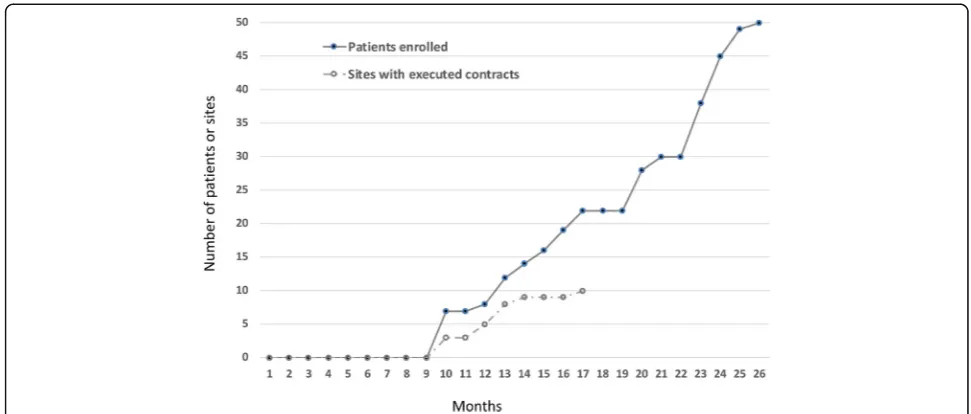
did not fulfill any exclusion criteria, as defined in Table1. IRB and contract approval for the first site occurred at 10 months, and for the final site at the 17th month following study initiation (Fig.2). Enrollment was com-pleted within 16 months following the first site ap-proval, and within 9 months following the final site approval. Thus, due to administrative delays, full enroll-ment was not achieved until 26 months from study ini-tiation, and we did not meet our initial goal of full enrollment within 1 year .
Of 73 total patients screened, 23 were not enrolled; 12 because the patient was not eligible (Fig. 1). The most common reason for ineligibility was use of MTX within the past 3 months (n= 5). (During this interval, at least two patients were having a disease flare while off MTX but could not be enrolled.) Another 11 patients met inclu-sion criteria but were not enrolled, most commonly be-cause of study visit schedule and/or travel distance (n= 5), or because of patient and/or parent refusal (n= 4). One patient/parent refusal was because the family wanted to be treated with a lower dose of MTX than specified in the CTPs; the other 3 were for unstated reasons, with sites queried but unable to furnish additional information. There were no screen failures related to physician prefer-ence for a non-CTP treatment regimen.
The general demographics of enrolled patients was similar to published pediatric LS cohorts, with the ma-jority being female (70%), white (92%), and non-Hispanic (82%) [13]. Forty-one of the 50 enrolled patients (82%)
had new onset jLS. The remaining 9 had received systemic therapy for jLS in the past and presented with relapse of disease off treatment. Although enrollment of these previ-ously treated patients may have increased the heterogen-eity of treatment responses, comparison of efficacy of the different CTPs was not a primary goal.
Performance of active disease criteria
Previously developed active disease criteria for eligibility in a treatment study (Table1[20]) were evaluated in this pilot study (Fig.3). The active disease criteria consist of two categories of features with active disease defined by the presence of a single feature from Group 1, or two or more features from Group 2. All screened patients con-sidered appropriate to treat with systemic immunosup-pressants fulfilled at least one active disease criteria group (Group 1 or Group 2, Table1). Forty-two (84%) of patients fulfilled Group 1 criteria, while 8 (16%) fulfilled only Group 2. The most commonly fulfilled criteria were erythema and new lesion for both groups (Fig. 3). No significant differences were found between patients who fulfilled Group 1 versus those who fulfilled only Group 2 criteria for physician global assessment of disease activity
(4 vs. 6, respectively), baseline LS cutaneous activity measure score (6.5 vs. 4), disease duration (15 month vs. 11.5 months), or disease subtype (mostly linear for both groups).
Initial enrollment into the three CTPs: reasons for choice
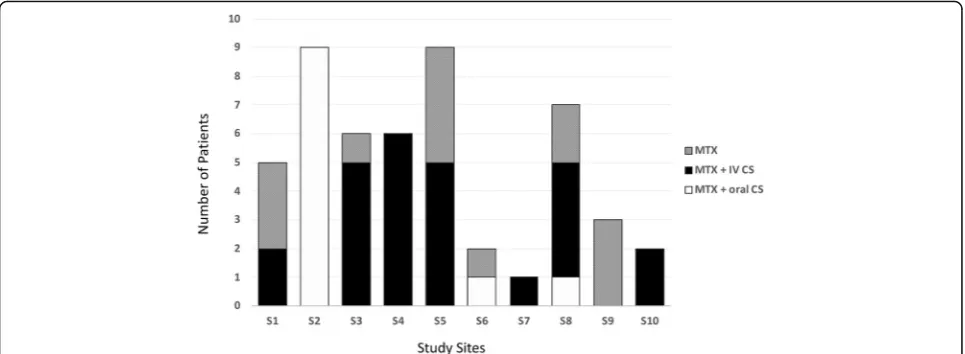
Investigators enrolled patients in all three of the CTPs (Figs.1and4). Not surprisingly, individual site investigators showed strong preferences in choice of CTP (Fig.4). Nine of 10 centers used only 1 or 2 of the treatment plans avail-able. The most common reason for MTX monotherapy (CTP A) selection was concerns about adverse events, followed by “works best” and“better tolerated.”The most common reason for selection of a corticosteroid and MTX therapy (CTP B or C) was also that it“works best”(Fig.1).
Persistence in the study
During the trial, 44 (88%) of the participants remained in the study, while 6 (12%) were considered drop-outs. Rea-sons for dropping out included the family doubting the need or effectiveness of treatment resulting in withdrawal from the study (n= 1) or stopping the medication before the 9 month study visit (n= 1), data not being collected
Fig. 3Activity criteria for study inclusion. To be eligible for the study, patients had to fulfill at least 1 criterion from Group 1, or at least 2 criteria
from Group 2 (see Table1). The X axis indicates the number of patients, with the number of patients who fulfilled each criterion shown at the
end of each bar. Overall 42 (84%) of patients fulfilled at least 1 of the Group 1 criteria, many of whom also fulfilled Group 2 criteria. Eight (16%) of
patients fulfilled only Group 2 criteria.“New lesion”appears in both groups: In Group 1, new lesion must have been documented by physician or
physician review of patient photographs. In Group 2, new lesion was not documented by physician, but was reported by patient/parent.“Erythema”
after the baseline visit due to not being recognized as a study patient at a satellite clinic [n= 1], patient switching care to a non-study physician, either an adult rheumatolo-gist or pediatric rheumatolorheumatolo-gist located closer to the fam-ily (n= 2), and unknown (n= 1, site queried but unable to furnish reason for drop-out.).
Most participants completed either 5 or 6 of the six scheduled visits (74%). The proportion completing 4, 3, 2, or 1 visit were 10, 4, 2, and 6% respectively. Seventy-nine percent of visits were completed within the 1 month of target window. Completion of the study was defined as the patient remaining on prescribed treatment and com-pleting at least the 9-month visit. Based on this definition, 88% of patients completed the study.
Post-study evaluation of eligibility criteria
A more critical evaluation of the performance of the inclu-sion and excluinclu-sion criteria (Table 1) was conducted near the end of the study to determine if there should be any modifications for their use in future studies. All modifica-tions for future studies required agreement by ≥80% of the investigators. Based on this review, elevated CK was eliminated as an active disease criterion because it was rarely selected and assignment of etiology was considered potentially problematic. Several criteria for active disease were combined to make a single criterion for disease ex-tension to simplify use of the criteria (Table2, italics, com-pare to Table1). The presence of a waxy white or yellow lesion was added as a criterion (Table 2) because it was identified as an active feature in another prospective study [28], but since data analysis for that study was not finished
until the after this CTP pilot was already underway, we chose not to add waxy white or yellow as an activity criter-ion during the course of the CTP. We have tested its asso-ciation with active disease in the CTP data set, which will be described in a subsequent manuscript.
In addition, the group decided to shorten the required wash-out time after treatment with MTX or mycopheno-late from 3 months to 1 month for entry into future studies. The impetus behind this decision was the observation that at least 2 patients followed by the investigators experienced recurrence of active disease 1–2 months after stopping MTX but could not be enrolled in the study. Pharmacoki-netic studies have shown that MTX polyglutamates in red blood cells have elimination half-lives of ranging from 1.2– 4.3 weeks, with median times for MTX polyglutamates to become undetectable ranging from 4 to 10 wks [35]. Thus, it appeared likely that some patients may flare quickly fol-lowing discontinuation of MTX. Based on the known pharmacokinetics of MMF, showing an even shorter aver-age elimination half-life for mycophenolic acid (8.5 h) and its glucuronide 13 h) [36], we opted to use 1 month as our minimum washout time for MMF as well. The revised eligi-bility criteria recommended for future jLS treatment studies are shown in Table 2, with italics indicating changes as compared to Table1.
Biobanking
Thirty-six (72%) participants/parents consented to bio-banking. All three requested samples were collected for 21 patients, 2 samples for 7 patients, and 1 sample for 8 pa-tients. Reasons for failure to complete collection of
Fig. 4CTP selection by study site. The CTPs selected for the study patients at each study site are shown. Each of the 10 participating CARRA sites
is indicated by a different number following the letter“S”(S1-S10). The columns show the number of patients enrolled into each CTP at each site.
biobanking samples included blood collection being done at non-affiliated facilities per patient/family preference, lack of facilities at satellite clinics to collect and process samples for mailing, lack of study coordinators to attend to specimen collection and processing, and inability to draw labs at Friday clinics because the biobanking site could not receive samples on a Saturday.
Discussion
We report here the successful development and enroll-ment of a pilot comparative effectiveness study for jLS, a rare pediatric rheumatic disease for which there is no proven best treatment regimen. In addition to assessing feasibility, the purpose of this pilot study was to identify how subsequent studies could be improved, and to evalu-ate new assessment tools. We reached our enrollment goal of 50 jLS patients, and found that the demographics of our study participants were typical for this disease. How-ever, total enrollment time was 26 months, or more than a year longer than expected, with contract issues being the major reason for delay.
The high degree of agreement on the use of these CARRA CTPs for treating jLS patients is demonstrated by there being no screen failures related to physician prefer-ence for a non-CTP regimen for treatment. The limited number of screen failures due to refusal demonstrates that patients and parents are willing to participate in compara-tive effeccompara-tiveness research, and the low drop-out rate (12%) indicates that these CTPs were generally tolerable to pa-tients and families. As with most clinical studies, the visit and travel schedule precluded several patients from partici-pating, and led some participants to miss study visits. Nonetheless, a relatively high proportion of patients, 44 of 50 (88%), completed the study.
Bio-banked specimens aligned with detailed clinical in-formation are valuable resources for future research in disease pathogenesis and treatment, even more so in rare diseases because they are so difficult to acquire. We demonstrated that bio-banking is feasible in clinic-based comparative effectiveness studies, though several centers were unable to collect or ship specimens at all of the assigned visits, for reasons as given in results. Of 36 patients who contributed to the optional biobanking sub-study, only 21 (58%) provided all three samples per protocol. It will be important in future studies to work on reducing the logistic barriers to sample collection. Nonetheless, the samples collected in this pilot are of significant value to this community of investigators.
One aspect of comparative effectiveness research that reduces barriers to enrollment is that investigators and study patients can choose among standardized treatment options. We noted that sites showed distinct preferences in their choice of CTP, with half the sites treating all of their study patients with the same CTP, and only one
Table 2Revised jLS Study Entry Criteria: Inclusion, Exclusion, and Active Disease criteria
Inclusion Criteria:
1. Localized scleroderma diagnosed by a Pediatric Rheumatologist or Pediatric Dermatologist according to Padua Preliminary Classification criteria; these criteria exclude eosinophilic fasciitis [23]
2. Fulfill active disease criteria:
a. Either at least one item from Active disease criteria Group 1 or two from Group 2
3. Moderate to severe disease severity that warrants systemic therapy in the opinion of the treating physician
a. Includes all subtypes that involve deeper tissue(s), extensive skin involvement, and/or extracutaneous involvement
4. Age < 18 years at onset of disease
5. Age < 21 years at onset of treatment
Exclusion criteria:
1. Treated with systemic corticosteroids in the prior 2 weeks
2. Treated with methotrexate or mycophenolate mofetil within the prior4 weeks
3. Another defined systemic rheumatic disease (e.g., systemic sclerosis)
4. Intolerance to study medications
Revised Active Disease criteria
Group 1:
Developing comparative effectiveness studies
1.New, larger, or deeper lesion that developed within the past 3 months associated with erythema, violaceous color, and/or skin thickening. Disease extension must be documented by one of the following
a.Clinical exam
b.Measurements or tracings
c.Photographs (may be provided by family)
d. Imaging: MRI, ultrasound, CT, 3D imager
2. Erythema of moderate or severe level
a. Erythema scoring level based upon LS scoring atlas
3. Violaceous color
a. Can range from lilac ring to deep violaceous color
Group 2:
1. Erythema of mild level
a. Erythema scoring level based upon LS scoring atlas
2. Waxy white or yellow lesion
a.These lesions have white or yellowish appearance with smooth, waxy feeling
b.They are associated with skin thickening (induration)
3. Skin thickening of lesion
a. Assessed according to modified Rodnan Skin Scoring (mRSS) levels [15]
4. Tactile warmth of the lesion
a. Examiner appreciation of temperature difference based upon comparison to control site (unaffected contralateral site if available).
5. Worsening hair loss on scalp or face
6. Inflammation within lesion identified on tissue biopsy
site using each of the three CTPs. Part of this lack of variation in intra-center treatment choice may be due to the small numbers enrolled by some centers. In the ab-sence of definitive efficacy studies to provide guidance, physicians may tend to base treatment decisions on their own observational history and/or what they have been taught, rather than on evidence of efficacy. In addition, the rarity of jLS means that many physicians have lim-ited experience with treating jLS. Given the lack of data regarding comparative efficacy, the observation that the reasons for selection of any of the three CTPs were “It works best”or“It is what I/my group always does,” high-light the need for better data.
Our previously developed inclusion and exclusion criteria, including activity criteria for eligibility in a treatment study, seemed to perform well. However, post-study review and consensus agreement led to some modifications of these cri-teria to potentially increase eligibility of patients to enroll in future treatment studies, and to simplify their use (compare Table2italicized text to Table1).
Conclusions
We were able to design and fully enroll a pilot prospective, multicenter, 1-year observational cohort study of three stan-dardized methotrexate-based treatment regimens (CTPs) for juvenile localized scleroderma, an uncommon and understudied childhood disease. This pilot study allowed us to evaluate the performance of the study inclusion and ex-clusion criteria, to propose modifications of those criteria, and to consider protocol changes likely to improve future treatment studies of jLS.
Specifically,“lessons learned”that will help with design of further comparative effectiveness research appeared to fall within the following four general categories:
(1) Investigator commitment and effective communication: A committed, cohesive, and enthusiastic group of investigators who are willing to re-think pre-existing assumptions about treatments and methods of evaluation, and who participate in frequent, detailed, well-planned meetings to discuss the protocol, are most likely to be successful in designing and completing difficult studies.
(2) Number and variability of participating
investigators/sites. Despite the lack of definitive information, investigators showed strong
preferences in their treatment choices. Therefore, it is important to have a sufficient number of investigators with different treatment preferences to adequately enroll in all treatment arms of a comparative effectiveness study. It may be advisable to survey investigators as to their treatment preferences in advance to assess if
additional investigators/sites are needed to ensure a balanced distribution of patients across the treatment arms.
(3) Support of professional organizations.
Encouragement, logistical and financial support, and infrastructure from a larger organization were extremely valuable for many aspects of this study, including resources for collection and analysis of data, and facilitating multiple face-to-face meetings of the investigators. Other valuable support for this study included standardization of biospecimen collection and processing protocols to ensure consistency of samples, and optimize their value for future translational studies. As pediatric rheumatology is a rare subspecialty, most pediatric rheumatology centers have few providers and limited staff support, so that backing and support from larger professional organizations is important for the success of clinic-based studies.
(4) Institutional administrative challenges. We achieved our target enrollment of 50 jLS patients, but enrollment took more than a year longer than expected due to contract issues with participating medical institutions. Efficient and rational review processes by individual or shared IRBs/Ethics Committees and institutional contracts offices are essential for timely enrollment in medical research studies.
Our description of the elements that supported com-pletion of this study, and some of the problems that we encountered in the course of the study, may be of bene-fit to other clinicians wishing to develop comparative effectiveness research studies for other rare diseases.
Abbreviations
bid:Two times per day dosing; CARRA: Childhood Arthritis and
Rheumatology Research Alliance; CK: Creatine kinase; CS: Corticosteroid; CTP: Consensus treatment plan; HRQoL: Health related quality of life; jLS: Juvenile localized scleroderma; kg: Kilograms; LoSSI: Localized scleroderma skin severity index; LS: Localized scleroderma; LSCAM: Localized scleroderma cutaneous activity measure; mg: Milligrams; mLoSSI: Modified localized scleroderma skin severity index; MMF: Mycophenolate mofetil;
MTX: Methotrexate; PedsQL™: Pediatric Quality of Life™; PGA-A: Physician
global assessment of disease activity; PGA-D: Physician global assessment of disease damage; PO: Oral; RCT: Randomized clinical trial; Rx: Treatment; SSc: Systemic sclerosis; USA: United States of America
Acknowledgements
Authors’contributions
SCL, RCF, RML, EP, MFI, KS, TM, MLB, SH, FD, KST, CER, PJF, MP, and GCH contributed to the design of the work, and data acquisition or interpretation. BMF contributed to the design of the work. TA analyzed and interpreted the patient data. All authors read and approved the final manuscript.
Funding
This study was primarily supported by an innovative research grant from the Arthritis Foundation (PI: SL). CARRA provided additional funding for data analysis (publication grant, PI: SL) and in-kind resources to support manage-ment and maintenance of the registry for the study, online meetings, and face-to-face meetings at annual meetings of CARRA and ACR. Support for biobanking was provided by independent funding The Nancy Taylor
Foun-dation for Chronic Diseases Inc. [PI: KT, Children’s Hospital of Pittsburgh
Pediatric Scleroderma Fund].
The CARRA Legacy Registry was supported by a grant from National Institute of Arthritis and Musculoskeletal and Skin Diseases of the National Institutes of Health under award Number RC2AR058934. The content is solely the responsibility of the authors and does not necessarily represent the official views of the National Institutes of Health. The CARRA Legacy Registry was also supported by CARRA, Friends of CARRA, the Arthritis Foundation, and the Duke Clinical Research Institute.
Availability of data and materials
The datasets generated and/or analyzed during the current study are available from the CARRA Legacy registry on application of a reasonable request.
Ethics approval and consent to participate
Each participating site (n= 10) obtained institutional Review Board (Ethics
committee) approval for both the study itself and the informed consent form, which included our intent to publish the results of the study and measures to protect confidentiality. Informed consent/assent was obtained per site protocol, and no compensation was given to participants. The
written consent form was signed by either the patient, or by the patient’s
parent/guardian with written or verbal assent of the patient as appropriate for age. Data identified only by subject number were analyzed at Hackensack University Medical Center, the coordinating center, under ethics approval number for Pro00001481.
Consent for publication
Included in parent/patient consent for study.
Competing interests
The authors declare that they have no competing interests.
Author details
1Joseph M. Sanzari Children’s Hospital, Hackensack University Medical Center, Imus PC337, 30 Prospect Ave, Hackensack, NJ 07061, USA.2Hackensack Meridian School of Medicine at Seton Hall University, Clifton, NJ, USA. 3University of Colorado- Denver and Children’s Hospital Colorado, Denver, CO, USA.4University of Toronto and The Hospital for Sick Children, Toronto, Canada.5Children’s Mercy, Kansas City, MO, USA.6Texas Scottish Rite Hospital and UT Southwestern, Dallas, TX, USA.7Mayo Clinic, Rochester, MN, USA. 8Duke University School of Medicine, Durham, NC, USA.9University of Iowa
Stead Family Children’s Hospital, Iowa City, IA, USA.10Boston Children’s Hospital, Boston, MA, USA.11UPMC Children’s Hospital of Pittsburgh, Pittsburgh, PA, USA.12University of Iowa Carver College of Medicine, Iowa City, IA, USA.13Rutgers School of Public Health, Rutgers University, Newark, NJ, USA.14The Ohio State University and Nationwide Children’s Hospital, Columbus, OH, USA.
Received: 30 April 2019 Accepted: 8 July 2019
References
1. Ruperto N, Giannini E, Pistorio A, Brunner H, Martini A, Lovell D. Is it time to
move to active comparator trials in juvenile idiopathic arthritis?: a review of
current study designs. Arthritis Rheum. 2010;62:3131–9.
2. Lovell D, Ruperto N, Giannini E, Martini A. Advances from clinical trials in
juvenile idiopathic arthritis. Nat Rev Rheumatol. 2013;9:557–63.
3. Ringold S, Nigrovic P, Feldman B, Tomlinson G, von Scheven E, Wallace C, et
al. The childhood arthritis and rheumatology research Alliance consensus treatment plans: toward comparative effectiveness in the pediatric
rheumatic diseases. Arthritis Rheumatol. 2018;70:669–78.
4. Balevic S, Becker M, Cohen-Wolkowiez M, Schanberg L. Clinical trial Design
in Juvenile Idiopathic Arthritis. Pediatr Drugs. 2017;19:379–89.
5. Herrick A, Ennis H, Bhushan M, Silman A, Baildam E. Incidence of childhood
linear scleroderma and systemic sclerosis in the UK and Ireland. Arthritis
Care Res. 2010;62:213–8.
6. Peterson L, Nelson A, Su W, Mason T, O'Fallon W, Gabriel S. The
epidemiology of morphea (localized scleroderma) in Olmstead County
1960-1993. J Rheumatol. 1997;24:73–80.
7. Beukelman T, Kimura Y, Ilowite N, Mieszkalski K, Natter M, Burrell G, et al.
The new childhood arthritis and rheumatology research Alliance (CARRA) registry: design, rationale, and characteristics of patients enrolled in the first 12 months. Pediatr Rheumatol Online J. 2017;15:30.
8. Wu E, Li S, Torok K, Virkud Y, Fuhlbrigge R, Rabinovich E, et al. Baseline
description of the juvenile localized scleroderma subgroup from the childhood arthritis and rheumatology research Alliance legacy registry. ACR
Open Rheumatol. 2019;1:119–24.
9. Kimura Y, Grevich S, Beukelman T, Morgan E, Nigrovic PA, Mieszkalski K, et
al. Pilot study comparing the Childhood Arthritis & Rheumatology Research Alliance (CARRA) systemic juvenile idiopathic arthritis consensus treatment plans. Pediatr Rheumatol Online J. 2017;15:23.
10. Cooper JC, Rouster-Stevens K, Wright TB, Hsu JJ, Klein-Gitelman MS, Ardoin
SP, et al. Pilot study comparing the childhood arthritis and rheumatology research alliance consensus treatment plans for induction therapy of juvenile proliferative lupus nephritis. Pediatr Rheumatol Online J. 2018;16:65.
11. Zulian F, Vallongo C, Woo P, Russo R, Ruperto N, Harper J, et al. Localized
scleroderma in childhood is not just a skin disease. Arthritis Rheum. 2005;52:
2873–81.
12. Torok KS. Pediatric scleroderma: systemic or localized forms. Pediatr Clin N
Am. 2012;59:381–405.
13. Li SC. Scleroderma in children and adolescents: localized scleroderma and
systemic sclerosis. Pediatr Clin N Am. 2018;65:757–81.
14. Arkachaisri T, Vilaiyuk S, Li S, O'Neil KM, Pope E, Higgins GC, et al.
The localized scleroderma skin severity index and physician global assessment of disease activity: a work in progress toward development of localized scleroderma outcome measures. J
Rheumatol. 2009;36:2819–29.
15. Czirják L, Nagy Z, Aringer M, Riemekasten G, Matucci-Cerinic M, Furst D, et
al. The EUSTAR model for teaching and implementing the modified Rodnan
skin score in systemic sclerosis. Ann Rheum Dis. 2007;66:966–9.
16. Milano A, Pendergrass SA, Sargent JL, George LK, McCalmont TH, Connolly
MK, et al. Molecular subsets in the gene expression signatures of scleroderma skin. PLoS One. 2008;3:e2696.
17. Mirizio E, Marathi A, Hershey N, Ross C, Schollaert K, Salgado C, et al.
Identifying the signature immune phenotypes present in pediatric localized
scleroderma. J Invest Dermatol. 2019;139:715–8.
18. Zulian F, Martini G, Vallongo C, Vittadello F, Falcini F, Patrizi A, et al.
Methotrexate treatment in juvenile localized scleroderma: a randomized,
double-blind, placebo-controlled trial. Arthritis Rheum. 2011;63:1998–
2006.
19. Li SC, Feldman BM, Higgins GC, Haines KA, Punaro MG, O'Neil KM.
Treatment of pediatric localized scleroderma: results of a survey of north
American pediatric rheumatologists. J Rheumatol. 2010;37:175–81.
20. Li SC, Torok KS, Pope E, Dedeoglu F, Hong S, Jacobe HT, et al.
Development of consensus treatment plans for juvenile localized scleroderma: a roadmap toward comparative effectiveness studies in juvenile localized scleroderma. Arthritis Care Res (Hoboken). 2012;64:
1175–85.
21. Browne R. On the use of a pilot sample for sample size determination. Stat
Med. 1995;14:1933–40.
22. Lancaster G, Dodd S, Williamson P. Design and analysis of pilot studies:
recommendations for good practice. J Eval Clin Practice. 2004;10:307–12.
23. Laxer RM, Zulian F. Localized scleroderma. Curr Opin Rheumatol. 2006;
18:606–13.
24. Lis-Swiety A, Janicka I, Skrzypek-Salamon A, Brzezinska-Wcislo L. A
systematic review of tools for determining activity of localized scleroderma in paediatric and adult patients. J Eur Acad Dermatol
25. Li S, Pope E. Localized Scleroderma. In: Petty R, Laxer R, Lindsley C, editors. Cassidy's Textbook of Pediatric Rheumatology. 7th ed.
Philadelphia: Elsevier; 2016. p. 406–17.
26. Arkachaisri T, Pino S. Localized scleroderma severity index and global
assessments: a pilot study of outcome instruments. J Rheumatol. 2008;
35:650–7.
27. Kelsey CE, Torok KS. The localized scleroderma cutaneous assessment tool:
responsiveness to change in a pediatric clinical population. J Am Acad
Dermatol. 2013;69:214–20.
28. Li SC, Li X, Pope E, Stewart K, Higgins GC, Rabinovich CE, et al. New features
for measuring disease activity in pediatric localized scleroderma. J
Rheumatol. 2018;12:1680–8.
29. Torok KS, Arkachaisri T. Methotrexate and corticosteroids in the treatment of
localized scleroderma: a standardized prospective longitudinal single-center
study. J Rheumatol. 2012;39:286–94.
30. Varni JW, Seid M, Kurtin PS. PedsQL 4.0: reliability and validity of the
Pediatric Quality of Life Inventory version 4.0 generic core scales in healthy and patient populations. Med Care. 2001;39:800.
31. Varni J, Seid M, Smith Knight T, Burwinkle T, Brown J, Szer IS. The PedsQL in
pediatric rheumatology: reliability, validity, and responsiveness of the pediatric quality of life inventory generic Core scales and rheumatology module. Arthritis Rheum. 2002;46:714.
32. Varni J, Sherman S, Burwinkle T, Dickinson P, Dixon P. The PedsQL family
impact module: preliminary reliability and validity. Health Qual Life Outcomes. 2004;2:55.
33. Singh G, Athreya B, Fries J, Goldsmith D. Measurement of health
status in children with juvenile rheumatoid arthritis. Arthritis Rheum. 1994;37:1761.
34. Lewis-Jones M, Finlay A. The Children's dermatology life quality index
(CDLQI): initial validation and practical use. Br J Dermatol. 1995;132:
942–9.
35. Dalrymple JM, Stamp LK, O'Donnell JL, Chapman PT, Zhang M, Barclay ML.
Pharmacokinetics of oral methotrexate in patients with rheumatoid arthritis.
Arthritis Rheum. 2008;58:3299–308.
36. Ettenger R, Bartosh S, Choi L, Zhu W, Niederberger W, Campestrini J, et al.
Pharmacokinetics of enteric-coated mycophenolate sodium in stable
pediatric renal transplant recipients. Pediatr Transplant. 2005;9:780–7.
Publisher’s Note