Publicly Accessible Penn Dissertations
Spring 5-17-2010
Mindful Learning: Children’s Developing Theory
of Mind and Their Understanding of the Concept
of Learning
Zhenlin Wang
University of Pennsylvania, [email protected]
Follow this and additional works at:http://repository.upenn.edu/edissertations
Part of theDevelopmental Psychology Commons, and thePre-Elementary, Early Childhood, Kindergarten Teacher Education Commons
This paper is posted at ScholarlyCommons.http://repository.upenn.edu/edissertations/157
For more information, please [email protected].
Recommended Citation
Wang, Zhenlin, "Mindful Learning: Children’s Developing Theory of Mind and Their Understanding of the Concept of Learning" (2010).Publicly Accessible Penn Dissertations. 157.
Understanding of the Concept of Learning
Abstract
Applying self-regulated learning in early childhood classrooms assumes that children are metacognitive learners by default, an assumption which is deeply flawed. The theoretical advancement in theory of mind development provides new perspectives in understanding the challenges young children are facing in comprehension of mental states in learning. The present study proposed that theory of mind development is critical for children to engage in mindful learning, which refers to the learning during which the learner is consciously aware of own mental states and the changes in them, both motivational and epistemic mental states. This dissertation launched an investigation of children’s developing understanding of learning as a process of mental representational change from a theory of mind framework. The goal was to pinpoint the mental properties that are essential to children’s understanding of learning, examine their relationship with theory of mind ability including false belief understanding, and outline the developmental trajectory of mindful learning during preschool and early elementary school years. Six studies focused on children’s understanding of knowledge change in learning, children’s understanding of beliefs about knowledge state in learning, and children’s understanding of learning intention. Simple stories concerning various learning scenarios were designed to address children’s understanding of the concept of learning. The results found that vi young children first understood learning as a behavior independent of knowledge change. Changes in children’s understanding of learning were correlated with their emerging theory of mind ability, and developed through preschool and early elementary school years. Around the time of school entry, children began to appreciate that learning is a representational knowledge change in the mind, and people decide whether to learn based on their belief about knowledge state. They also began to understand that learning intention is often related to learning outcome; however, intention is neither a sufficient nor a necessary condition for learning. Based on the data on a theory of mind battery and those from the literature, it was suggested that children in different cultures might develop theory of mind understanding via different routes. The theoretical implication of mindful learning was discussed in relation with theory of mind, metacognition, and personal epistemology. The practical implication of mindful learning was discussed in the context of early childhood pedagogy and curriculum as well as school readiness.
Degree Type
Dissertation
Degree Name
Doctor of Philosophy (PhD)
Graduate Group
Education
First Advisor
Douglas A. Frye
Subject Categories
Developmental Psychology | Pre-Elementary, Early Childhood, Kindergarten Teacher Education
THEIR UNDERSTANDING OF THE CONCEPT OF LEARNING
Zhenlin Wang
A DISSERTATION
in
Education
Presented to the Faculties of the University of Pennsylvania in Partial Fulfillment of the Requirements for the
Degree of Doctor of Philosophy
2010
Supervisor of Dissertation:
_________________________________________ Douglas A. Frye, Associate Professor of Education
Graduate Group Chair:
_________________________________________ Stanton, E. F. Wortham, Professor of Education
Dissertation Committee:
Douglas A. Frye, Associate Professor of Education Diana Slaughter-Defoe, Professor of Education
Mindful learning: Children’s developing theory of mind and their understanding of the
concept of learning
COPYRIGHT
2010
iii
Having the opportunity working with Dr. Douglas Frye is a privilege. His insight
and dedication inspired and sustained this project; and his unremitting support made my
doctorate education at Penn a valuable and enjoyable experience. He never loses patience
on me, no matter how hard I try. A keen researcher, a devoted mentor, and most of all, to
cite the most insightful Ms. Evelyn Jordan, a true gentleman, Doug is my role model.
I want to thank other members of my committee, Dr. Kimberly Wright Cassidy
and Dr. Diana Slaughter-Defoe, for their constructive suggestions to the project and for
making the process easy for me.
This project traveled three cities across two continents over the last four years.
Thank the children, parents, teachers, and the participants in Philadelphia, Chong Qing,
and Hong Kong. They made this happen.
Thank Prof. Li Hong from Southwest University of China for giving me the
opportunity to work in his lab. Thank Liao Yu, Zhang Ting, Zheng Yueru, Sun Xinyi,
Yang Jiemin, Wu Zelian, Yan Xiaofang, Penny Yuk Hong Lik, Crystal Lam Kit Ying,
Tsang Ching Yin, Luan Xinchang, and Candy Lo Ying Shan for their assistance in data
collection. Thank Prof. Doris Cheung Pui Wah, Dr. Dora Ho Choi Wa, and Ms. Edith
Leung Yuk Lan for arranging data collection sites in Hong Kong.
Thank Dr. Margalit Ziv for productive feedback to the experimental design of the
study; and Dr. Elizabeth Woodburn and John Knutsen for their helpful inputs at the early
iv
Institute of Education and Small Scale Research Fund of the Department of Early
Childhood Education, the Hong Kong Institute of Education.
On a personal note, I want to thank my parents for everything they have done for
me. I am certain they will not read this acknowledgement since they do not understand
English. Yet they call every week to check in with my progress, which drives me crazy at
times. But I know they are among the few people who really care about this project.
I dedicate this dissertation to my husband, Chongwei Wang, who has been my
fellow researcher, my statistics tutor, my psychiatrist, my cheer leader, my financial
sponsor, my full time driver, my best friend, and my soul mate over the years. Thank you,
for being there for me. If my presence and my work mean something, it is because of you.
v
MINDFUL LEARNING: CHILDREN’S DEVELOPING THEORY OF MIND AND
THEIR UNDERSTANDING OF THE CONCEPT OF LEARNING
Zhenlin Wang
Supervisor: Douglas A. Frye
Applying self-regulated learning in early childhood classrooms assumes that
children are metacognitive learners by default, an assumption which is deeply flawed.
The theoretical advancement in theory of mind development provides new perspectives
in understanding the challenges young children are facing in comprehension of mental
states in learning. The present study proposed that theory of mind development is critical
for children to engage in mindful learning, which refers to the learning during which the
learner is consciously aware of own mental states and the changes in them, both
motivational and epistemic mental states. This dissertation launched an investigation of
children’s developing understanding of learning as a process of mental representational
change from a theory of mind framework. The goal was to pinpoint the mental properties
that are essential to children’s understanding of learning, examine their relationship with
theory of mind ability including false belief understanding, and outline the developmental
trajectory of mindful learning during preschool and early elementary school years. Six
studies focused on children’s understanding of knowledge change in learning, children’s
understanding of beliefs about knowledge state in learning, and children’s understanding
of learning intention. Simple stories concerning various learning scenarios were designed
vi
Changes in children’s understanding of learning were correlated with their emerging
theory of mind ability, and developed through preschool and early elementary school
years. Around the time of school entry, children began to appreciate that learning is a
representational knowledge change in the mind, and people decide whether to learn based
on their belief about knowledge state. They also began to understand that learning
intention is often related to learning outcome; however, intention is neither a sufficient
nor a necessary condition for learning. Based on the data on a theory of mind battery and
those from the literature, it was suggested that children in different cultures might
develop theory of mind understanding via different routes. The theoretical implication of
mindful learning was discussed in relation with theory of mind, metacognition, and
personal epistemology. The practical implication of mindful learning was discussed in the
vii
Abstract v
List of Tables xi
List of Figures xii
CHAPTER ONE: Introduction 1
1.1 Metacognition and Self-Regulated Learning 2
1.1.1 The Concepts 2
1.1.2 Metacognition and Achievement 4
1.1.3 The Origin of Metacognitive Self-Regulation 6
1.2 Mindful Learning from a Theory of Mind Perspective 7
1.2.1 Theory of Mind (ToM) 7
1.2.2 ToM Measure 9
1.2.3 Mindful Learning 11 1.2.4 Mindful Learning from a ToM Perspective 12
1.2.5 Mindful Learning and Personal Epistemology 16
1.3 Implications of Mindful Learning 17
1.3.1 Early Childhood Curriculum and Pedagogy 18
1.3.2 School Readiness 19
CHAPTER TWO: Literature Review 21
2.1 Children’s Learning 21
2.1.1 Infants’ and Toddlers’ Learning 21
2.1.2 Young Children’s Learning 22
2.2 Children’s Talk about Mental States and Learning 23
2.2.1 Desire and Belief 23
2.2.2 Learning and Teaching 25
2.3 Children’s Understanding of Knowledge Source 27
2.3.1 Firsthand Experience 27
2.3.2 Secondhand Information 29
2.3.3 Inference 31
2.4 Children’s Understanding of Knowledge State Change 33
2.4.1 Remembering Previous Mental States 33
2.4.2 Behavioral Learning versus Factual Learning 35
2.5 Epistemic Egocentrism in Children’s Understanding of
Knowledge Change 36
2.5.1 Over-attributing Mental States to Naive Others 37
2.5.2 Over-attributing Knowledge to Previous or Future Selves 39
2.6 Children’s Understanding of Knowledge and Belief in
Teaching and Learning 40
2.7 Children’s Understanding of Learning Intention 42
2.7.1 Children’s Understanding of Intention 42
viii
3.2 Outline of the Six Studies 49
3.3 ToM Measure 51
CHAPTER FOUR: Study 1: Knowledge Change 53
4.1 Design 53
4.2 Participants 55
4.3 Materials 55
4.4 Procedures 56
4.5 Results 58
4.5.1 Learning 58
4.5.2 Prediction 59
4.5.3 Relation between Learning and Prediction 60
4.6 Discussion 61
CHAPTER FIVE: Study 2: Genuine Knowledge Change 64
5.1 Design 64
5.2 Participants 66
5.3 Materials and Procedures 66
5.4 Results 66
5.4.1 Knowledge 66
5.4.2 Learning 69
5.4.3 Prediction 71
5.4.4 Relation between Learning and Prediction 72
5.4.5 Correlation between Learning / Prediction and ToM in
Study 1 and Study 2 72
5.4.6 Adults’ data 75
5.5 Discussion 76
CHAPTER SIX: Study 3: Content Familiarity 79
6.1 Design 79
6.2 Participants 81
6.3 Materials and Procedures 81
6.4 Results 81
6.4.1 Comparison between Coincidence and Discovery 82
6.4.2 Difference between Familiar and Unfamiliar Learning Contents 85
6.4.3 Correlation between Learning and ToM 85
6.5 Discussion 86
6.6 General Discussion for Study 1 to Study 3 88
CHAPTER SEVEN: Study 4: Belief and Knowledge State 91
7.1 Design 91
7.2 Participants 93
ix
7.4.2 Learning Necessity 96
7.4.3 Learning Intention 97
7.4.4. Relation between Intention and Necessity 99
7.4.5 Correlation between Intention / Necessity and ToM 100
7.5 Discussion 101
CHAPTER EIGHT: Study 5: Knowledge, Ignorance, and False Belief 103
8.1 Design 103
8.2 Participants 104
8.3 Materials 104
8.4 Procedures 105
8.5 Results 106
8.5.1 Consistency across Three Content Domains 106
8.5.2 Single Prediction Questions 108
8.5.3 Forced Choice Prediction Questions 111
8.5.4 Correlation between Intention / Necessity and ToM 112
8.6 Discussion 113
8.7 General Discussion for Study 4 and Study 5 116
CHAPTER NINE: Study 6: Learning Intention 118
9.1 Design 118
9.2 Participants 120
9.3 Materials 121
9.4 Procedures 121
9.5 Results 122
9.5.1 Intention 122
9.5.2 Learning 124
9.5.3 Relation between Learning and Intention 125
9.5.4 Correlation between Learning / Intention and ToM 126
9.6 Discussion 127
CHAPTER TEN: Theory of Mind Scale 131
10.1 Sample Descriptions 131
10.2 Five-Item Guttman Scale 133
10.3 Five-Item Rasch Model 136
10.4 Discussion 140
10.4.1 Challenge to the Cultural Universality Claim 141
10.4.2 Culturally Specific ToM Development 143
CHAPTER ELEVEN: General Discussion 149
11.1 The Development of Mindful Learning 149
11.2 Mindful Learning and ToM Development 153
x
Appendix A: Theory of Mind Scale 160
Appendix B: An example of the tasks of Study 1 168
Appendix C: An example of the tasks of Study 2 169
Appendix D: An example of the tasks of Study 3 170
Appendix E: An example of the tasks of Study 4 174
Appendix F: An example of the tasks of Study 5 176
Appendix G: An example of the tasks of Study 6 182
xi
Table 4.1 Task specifications of Study 1 54
Table 4.2 Latin Square design of Study 1 55
Table 5.1 Task specifications of Study 2 66
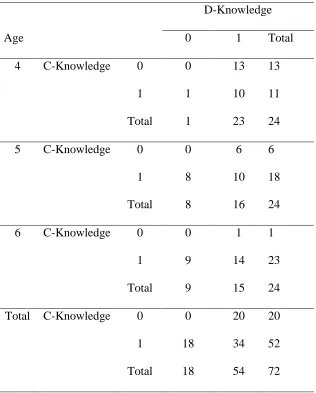
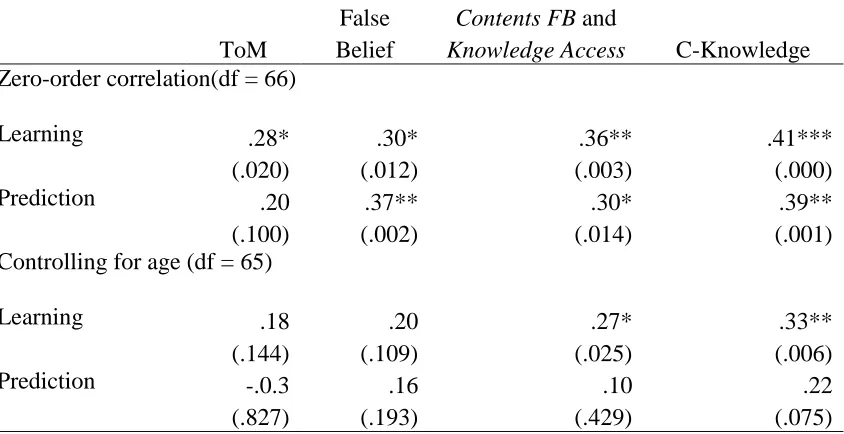
Table 5.2 Crosstabulation of D-Knowledge and C-Knowledge by age in Study 2 69 Table 5.3 Correlations between ToM indicators and Learning / Prediction in
Study 1 and Study 2 74
Table 6.1 Correlations between ToM indicators and forced choice Learning
questions in familiar and unfamiliar tasks in Study 3 86
Table 7.1 Task specifications of Study 4 92
Table 7.2 Correlations between ToM indicators and Intention / Necessity
predictions in Study 4 100
Table 8.1 Means of Necessity and Intention predictions by age in Study 5 106 Table 8.2 Correlations between ToM indicators and forced choice Intention /
Necessity predictions in Study 5 113
Table 9.1 Task specifications of Study 6 119
Table 9.2 Differences between Learning and Intention questions in Study 6 125 Table 9.3 Crosstabulation of PI-NL Learning and Intention questions by age
in Study 6 126
Table 9.4 Correlations between ToM indicators and Learning / Intention
questions in Study 6 127
Table 10.1 Chong Qing (CQ) and Hong Kong (HK) sample’s descriptions 131 Table 10.2 Passing rates on ToM items from CQ and HK sample as well as
other samples from the literature 133
Table 10.3 Passing rates on Contents FB and Hidden Emotion by age in CQ
and HK sample 134
Table 10.4 Item and person measure summary and fit statistics for 5-item
Rasch model in CQ sample 137
Table 10.5 Item and person measure summary and fit statistics for 5-item
Rasch model in HK sample 138
Table 10.6 Item measures from CQ and HK sample as well as other samples
xii
Figure 4.1 Percentage of correct responses by age for Learning questions
in Study 1 59
Figure 4.2 Percentage of correct responses by age for Prediction questions
in Study 1 60
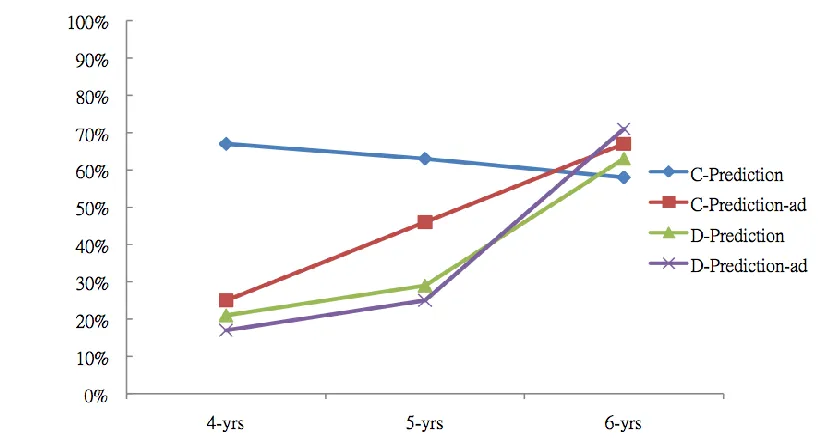
Figure 5.1 Percentage of correct responses by age for Knowledge questions
in Study 2 67
Figure 5.2 Percentage of correct responses by age for Learning questions
in Study 2 70
Figure 5.3 Percentage of correct responses by age for Prediction questions
in Study 2 71
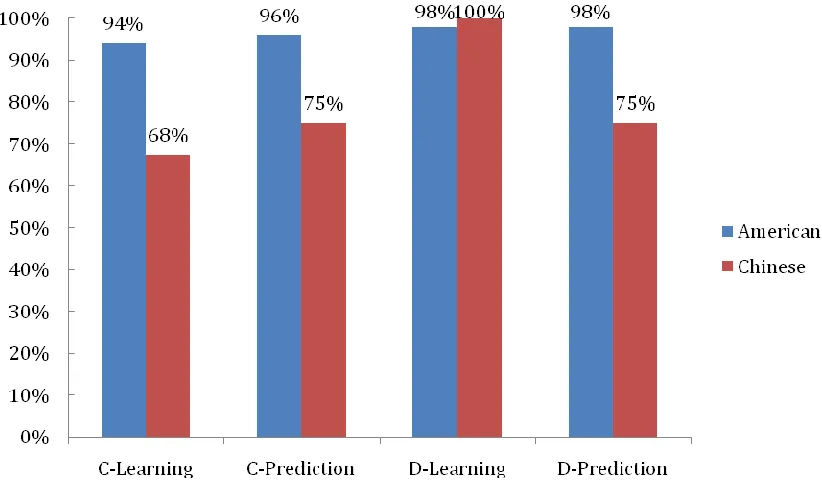
Figure 5.4 Average percentage of correct responses for Learning and Prediction
questions of both American and Chinese adults 76
Figure 6.1 Average percentage of correct responses by age for Knowledge
questions in Study 3 83
Figure 6.2 Average percentage of correct responses by age for Learning
questions in Study 3 84
Figure 6.3 Means of forced choice Learning questions by age in familiar and
unfamiliar tasks in Study 3 85
Figure 7.1 Percentage of correct responses by age for Belief questions
in Study 4 96
Figure 7.2 Percentage of correct responses by age for Necessity questions
in Study 4 97
Figure 7.3 Percentage of correct responses by age for Intention questions
in Study 4 98
Figure 7.4 Percentage of correct responses by age for Intention questions
adjusted based on Belief questions in Study 4 99
Figure 8.1 Average percentage of correct responses by age for Necessity
questions in Study 5 109
Figure 8.2 Average percentage of correct responses by age for Intention
questions in Study 5 110
Figure 8.3 Average percentage of correct responses by age for Intention and
Necessity forced choice questions in Study 5 112
Figure 9.1 Percentage of correct responses by age for Intention questions
in Study 6 123
Figure 9.2 Percentage of correct responses by age for Learning questions
CHAPTER ONE
Introduction
The teacher was playing a number game with children in a preschool classroom. She needed a child as the ―helper‖ to give prizes to the kids who recognized the number on a card correctly. Bobby was very enthusiastic to be the helper and hand out prizes. The problem was that Bobby did not know any
numbers. He simply gave everyone a prize no matter whether they were correct or not. When he was reminded that he could only give a prize when it was the correct number, Bobby said: ―It doesn’t matter, they know the numbers.‖
As odd as it seems, this is a real life example of classroom teaching and learning
in preschool. Unfortunately, there is no learning taking place here. For Bobby, ―knowing
the numbers‖ simply means one can call out a number, any number, to be exact. Such a
physicalized idea of knowing (Miscione, Marvin, O’Brien, & Greenberg, 1978; Piaget,
1929) fails to recognize knowledge is part of our mentality and ―doing‖ does not equal to
―knowing.‖ The consequence of such failure is that Bobby and his classmates missed a
learning opportunity to gain new knowledge about numbers.
Knowledge is a form of mental representation that reflects an accurate relation
between the mind and the external physical world. Mental representation is not a copy of
the reality (Wellman, 1990); therefore it may or may not reflect the reality accurately.
When mental representation is distorted or inaccurate, it becomes false belief. Only the
mental process that leads to the acquisition of an accurate representation of the reality,
i.e., knowledge, can be classified as learning. To a certain extent, learning new
knowledge ―depends on an understanding of the representational change‖ (Gopnik &
Astington, 1988, p. 26), since ―[i]t is hard to imagine teaching someone who was unable
Bobby is an example of a learner who is yet to reach the stage of mindful learning.
Children absorb information from the outside world constantly from early on. However,
it is arguable whether the early change in skills and behaviors is learning in terms of
conscious mental processing. A person who is not consciously aware of one’s own
knowledge change and mental effort in learning can nevertheless acquire new knowledge.
Yet, only a learner with explicit understanding of the mental changes in learning is able
to effectively monitor, direct, and control his or her own learning and therefore maximize
the benefit from teaching activities such as the above mentioned episode. Although there
is evidence that young children, even infants, have an implicit awareness of others’
mental states and can use that information to facilitate their own learning (Baldwin, 1995;
Birch & Bloom, 2002; Bloom & Tinker, 2001; Diesendruck,Markson, & Bloom, 2003;
Harris, 2007; Meltzoff, 2005; Sabbagh & Baldwin, 2001; Saylor & Troseth, 2006;
Tomasello & Farrar, 1986), little is known about children’s explicit understanding of the
mental activities and processes during learning.
1.1 Metacognition and Self-Regulated Learning
1.1.1 The Concepts
While there is little research focusing directly on children’s explicit understanding
of mental properties of learning, the learners’ awareness and control over learning
process have been the focus of the research on metacognition and self-regulated learning
for several decades. Despite the fact that it has been part of the everyday discourse in
educational psychology for quite a while, it is difficult to give a unanimous definition to
metacognition. According to Flavell (1979, 1987), metacognition consists of both
knowledge is the knowledge about cognitive processes, including knowledge of person
variables, task variables, and strategy variables. Knowledge of person variables refers to
general knowledge about how we learn and process information, as well as specific
knowledge of one's own learning process. Knowledge of task variables refers to
knowledge about the task characteristics, along with the awareness of the processing
demands of the task. Finally, knowledge of strategy variables refers to knowledge of both
cognitive and metacognitive strategies. Metacognitive experience is the comprehension
and implementation of strategies for goal attainment.
Another widely cited framework for metacognition was proposed by Brown
(1978). Her framework also suggested two components of metacognition: knowledge of
cognition and regulation of cognition. Knowledge of cognition is the understanding of
one’s own memory and the way one learns. Paris and colleagues (Paris, Cross, & Lipson,
1984) suggested the knowledge component of metacogntion includes three aspects:
declarative knowledge, which is the knowledge about one’s general processing abilities;
procedural knowledge, which is the knowledge of how to successfully solve problems;
and conditional knowledge, which is the knowledge such as when to employ certain
strategies. The regulation of cognition refers to constructs such as planning, monitoring,
and evaluation of learning.
Metacognition is mostly discussed in the context of learning, referring to the
concept of self-regulated learning. Paris and Newman (1990) defined self-regulated
learning as learning that involves planfulness, control, reflection, competence, and
independence. Zimmerman (1998) defined self-regulation as self-directedness and
relationship between metacognition and self-regulated learning, again, is disputable. To
some, self-regulation is a subcategory of metacognition. Flavell’s metacognitive
experience and Brown’s regulation of cognition contain elements of self-regulation.
Borkowski (1996) described three interrelated aspects of metacognition: knowledge,
judgments and monitoring, and self-regulation, the first of which overlaps with Flavell’s
(1979) knowledge about person, task, and strategy. Judgments and monitoring refer to the
processes occurring while performing a task, such as a feeling of knowing, or
comprehension monitoring. Self-regulation refers to adapting strategies and skills to meet
the changing demands.
Other theorists such as Zimmerman (1995), however, argued that self-regulation
covers more ground than metacognition, mainly motivational components such as
self-efficacy. As a result, people tend to distinguish metacognition and self-regulation in
pragmatic terms when they use the two as distinct concepts. For example, Kuyper, van
der Werf, and Lubbers (2000) defined metacognition as the use of cognitive and
metacognitive strategies in learning, i.e., the control over learning process; and
self-regulation as the motivational and behavioral aspects of learning, i.e., the control over the
learning behavior.
1.1.2 Metacognition and Achievement
Students’ metacognitive development is crucial to academic success (McCormick,
2003). On the one hand, good schooling should be the ―hotbeds of metacognitive
development‖ (Flavell, 1987, p. 27), since it provides the opportunity for self-conscious
learning. Instructional studies (Boulware-Gooden, Carreker, Thornhill, & Joshi, 2007;
benefited students’ metacognitive development. On the other hand, metacognitive
self-regulation significantly predicted later school achievement in longitudinal studies (Nota,
Soresi, & Zimmerman, 2004; but see Kuyper et al., 2000, for counter evidence), since
―students who can self-regulate cognitive, motivational, and behavioral aspects of their
academic functioning are more effective as learners‖ (Nota et al., 2004, p. 198).
Swanson (1990) found that metacognitive knowledge compensated for lower
overall aptitude level in problem solving. He picked 4th and 5th grade students with
either high or low aptitude measure scores and gave them a metacognitive questionnaire
and problem solving tasks. The metacognitive question included 17 questions about
person variables (such as ―Ryan is 5 years old and knows all about dinosaurs. Ryan’s
father does not know a lot about dinosaurs. If both Ryan and his father read a book about
dinosaurs, who would remember the most? Why?‖), task variables (such as ―A group of
individuals was going to solve a problem on a computer. One individual owns a computer
at home. Do you think the ability to solve the problem will be easier or harder for
someone who does not own a computer? Why?‖), and strategy variables (such as ―How
do children figure out things, like how to do something?‖). He found that
high-metacognitive individuals outperformed low-high-metacognitive individuals in problem
solving regardless of their overall aptitude level. The high-metacognitive/low-aptitude
children performed significantly better than low-metacognitive children with higher
overall aptitude scores. The results suggested that metacognitive knowledge and aptitude
are two distinctive constructs and the metacognitive knowledge is more closely related to
1.1.3 The Origin of Metacognitive Self-Regulation
Research on metacognitive development mainly focused on older children,
adolescence, and adults (Georghiades, 2004). According to classic Piagetian theory, the
ability to reflect on one’s own cognition requires formal operational thoughts (Brown,
1987; Piaget, 1976), which explains why young children could hardly benefit from
metacognitive instructions (Adey, Shayer, & Yates, 1989). However, children’s
―developing sense of the self as an active cognitive agent and as the causal centre of
one’s own cognitive activity‖ (Flavell, 1987, p. 26) might be one of the changes that
contribute to children’s acquisition of metacognition. As Kuhn suggested, ―understanding
knowledge as the product of human knowing is a critical first step in the development of
epistemological thinking‖ (Kuhn, 2000a, p. 178).
Research on children’s theory of mind (ToM) development (for reviews, see
Astington, 1993; Carpendale & Lewis, 2006; Flavell, 1999; Flavell & Miller, 1998; Frye
& Moore, 1991; Mitchell & Riggs, 2000; Perner, 1991; Wellman, 1990) provides just
such a conceptual framework in understanding the emergence of metacognition in
children. Focusing on children’s understanding of how the mind works, ToM research
breaks ground for the inquiry of the origins of understanding the mental characteristics of
learning (Kruger & Tomasello, 1996; Olson & Brunner, 1996). It is argued that
mindreading ability develops prior to metacognition (Carruthers, 2009). A longitudinal
study (Lockl & Schneider, 2007) found that children’s ability to attribute false belief at 3
and 4 years of age predicted their metamemory ability at 5 years of age, controlling for
language abilities. The authors argue that the representational ToM is the precursor of
contribute to better metacognitive monitoring and regulation. A study with preschool
children found moderate correlation between metacognitive regulation and early ToM
development (Sperling, Walls, & Hill, 2000). The next section turns into the discussion
of the impact of ToM on children’s understanding of learning.
1.2 Mindful Learning from a Theory of Mind Perspective
1.2.1 Theory of Mind (ToM)
ToM research in developmental psychology deals with the origins of children’s
comprehension of mental states. Children are credited with ToM if they understand that,
firstly, mind exists and people have mental states such as knowledge, belief, desire, and
intention; and secondly, causality exists between mental processes and actions and
people’s behavior can only make sense in a framework of mental state attribution.
Mentality is not transparent to children. It takes several years for children to learn that
people have mental states that are different from their own, or inconsistent with the
physical reality. One influential account (Wellman & Woolley, 1990) suggested that by
the third year of life children acquire a desire psychology that helps them to make sense
of people’s actions in desire terms. However, it is not until the age of 5 do children begin
to use belief psychology to understand the epidemic mental states such as belief,
knowledge, and ignorance, and use desire-belief reasoning to explain behaviors.
A sizable portion of ToM research has been focused on the understanding of false
belief. In Wimmer and Perner’s (1983) original study, children were told stories about
chocolate being put in one location with a boy named Maxi present and then relocated to
another with Maxi absent. Questions were asked about Maxi’s knowledge state, such as
ignorance), where he thought the chocolate was (the character’s false belief), and where
he would look for the chocolate (prediction of actions). A comprehensive meta-analysis
(Wellman, Cross, & Watson, 2001) showed that false belief understanding developed
during preschool period between 3 to 5 years of age (but see Onishi & Baillargeon, 2005
on babies’ understanding of false belief, also see Perner & Ruffman, 2005 for
counterargument).Three-year-olds would consistently respond that Maxi knew where the
chocolate was and would look for it at the new location. By 5 years of age children began
to understand that without the perceptual access, Maxi was ignorant of the true location,
or held a false belief about it. This line of research demonstrates children’s initial
thoughts of what knowledge is and how knowledge changes. Knowledge and false belief
are both mental representations. The difference is that while knowledge is justified belief,
false belief is not. The studies in false belief are especially informative because they
reveal the development in children’s understanding of the verifiable mental
representation in knowledge construction, as well as the representational change in its
relation with the reality.
Children’s understanding of their own knowledge state change developed around
the same time as their understanding of other people’s knowledge state. Gopnik and
Astington (1988) showed children a candy container and asked what they thought was
inside. Then the actual contents were revealed. Surprisingly, they turned out to be pencils
instead of candies. Children were then asked what they initially thought was inside.
Five-year-olds could correctly remember their first response, but 3-Five-year-olds tended to say
they knew there were pencils inside before seeing the actual contents. When they were
tended to say pencils. In addition to confirming that younger children have trouble
understanding the relation between knowledge formation and perceptual access, this
result also suggests younger children have trouble keeping track of changes in their own
knowledge. Gopnik and Astington (1988) brought attention to the implication of
children’s understanding of representational change for teaching and learning. To benefit
from instructions and gain new knowledge, the learner needs to represent his or her own
past knowledge states and be aware of being wrong or ignorant, without which, there is
no basis to understand that learning has occurred.
1.2.2 ToM Measure
Based on a meta-analysis of ToM measures, Wellman and Liu's (2004) developed
a battery of five tasks measuring the developmental sequence of ToM. From the easiest to
the most difficult, the five tasks are: 1) Diverse Desires--the child judges that the self and
another have different desires about the same object; 2) Diverse Beliefs--the child judges
that the self and another have different beliefs about the same object, when the veracity of
the belief is unknown to the child; 3) Knowledge Access--the child sees what is in a box
and judges the knowledge of another who has not seen the contents of the box; 4)
Contents False Belief--the child judges another’s false belief about what is in a distinctive
container when the child knows what is in the container; 5) Hidden Emotion--the child
judges that a person can have one emotion internally but can display a different emotion
externally. An optional sixth task, Explicit False Belief--the child judges another’s false
belief about the location of an object when the child knows the true location, shares the
Data from the sample of 75 children indicated the five tasks formed a Guttman
scale with high reproducibility (Green's coefficient of reproducibility = .96, values
greater than .90 indicate scalable items) and acceptable scalability (Green’s coefficient of
scalability = .56. This index tests whether the observed coefficient of reproducibility is
greater than chance alone, values greater than .50 are significant) (Green, 1956). Sixty
out of the 75 children fit the sequence of the five-item scale exactly. The scale score
correlated with age in months with r(75) = .64, p < .001. A Rasch model based on item
response theory revealed same sequence in the difficulty level of 5 tasks, with roughly
evenly spread item scale scores. The items fit the scale well.
The advantage of using a battery of tasks instead of a single false belief task as an
index of mental state understanding is that the battery captures a broader construct of
ToM development and provides a scale or continuum on children’s understanding of
different mental states. Although normative data are yet to be obtained for this scale,
Wellman and Liu’s (2004) battery reveals a progressive understanding of ToM in
typically developing Western children. Replications using this scale were obtained from
samples of autistic and deaf children and normally developing children from other
countries (Peterson, Wellman, & Liu, 2005; Wellman, Fang, Liu, Zhu, & Liu, 2006).
Roughly the same difficulty sequence was found in those samples, with two exceptions:
Chinese children passed the Knowledge Access task earlier than the Diverse Belief task
(Wellman et al., 2006); and autistic children passed the Hidden Emotion task earlier than
1.2.3 Mindful Learning
As defined by social psychologist Ellen Langer (1989, 1997), mindfulness
emphasizes the quality of awareness and being reflective. Langer argues that the concept
of mindfulness/mindlessness has broad implications in everyday behavior, including
learning. However, instead of focusing on the conceptual foundation of learning, that is,
the representational change, Langer’s idea of mindful learning focuses on the general
cognitive resource allocation such as attention and executive control. The term
mindfulness has since been adopted by psychiatrists and mental health professionals in
referring to the fully-present-in-the-moment meditation and self-regulation of attention
(Bishop et al., 2004; Siegel, 2007).
Salomon and Globerson (1987) extended the idea of mindfulness into learning
and transfer. They recognize that the ―volitional, metacognitively guided employment of
non-automatic, usually effortful processes‖ (p. 625) in learning is the mid-level construct
that can bridge what people actually learn and what they could possibly learn. By taking
the ―high road of learning‖ (p. 630), mindfulness compensates for automatic skill
employment and maximizes the learning potential. In Salomon and Globerson’s term,
mindfulness refers to metacognitive traits, capacities, and strategy use.
Mindful learning in the present study draws inspiration from Langer’s original
work, yet distinguishes itself from the previous meanings. Similar to Langer’s concept,
mindful learning addresses not the behavioral aspects of learning, but the higher level
thinking in learning. Nonetheless, unlike Langer’s emphasis on mental effort allocation
or clinical psychologists’ emphasis on insight and openness, mindful learning in this
The present study proposes that mindful learning is a prerequisite of
metacognition. Children need to appreciate learning as a mental process before they can
progress to learn how to monitor and control their own learning. Mindful learning
addresses the issue of knowledge and learning from a ToM perspective that is prior to
metacognitive monitoring and regulation of learning. To some extent, mindful learning
overlaps with the knowledge aspects in the metacognition research (Kuhn, 1999, 2000a;
Wellman, 1985), especially with the knowledge of person variables in Flavell’s
terminology. However, mindful learning does not simply focus just on general person
variables, but specifically on mentality, which concerns more fundamental aspects in
children’s understanding of learning that provide the building blocks for their later
engagement in metacognitive learning.
1.2.4 Mindful Learning from a ToM Perspective
Traditionally, learning theory has been focused on explicit cognitive strategies,
language comprehension, and the like. The mind is rather seen as a file cabinet or a
container that stores knowledge (Bereiter, 2002). Folk expressions in English, such as in
the back of somebody’s mind, on somebody’s mind, or off the top of somebody’s mind all
refer the mind as a location instead of an agent. Such a physicalized idea of the mind fails
to see the mind as an active, self-propelled, and motivated driving force in learning. Yet,
learning as knowledge change, at least in terms of the declarative knowledge (Bloom,
1956) or factual propositions (Ryle, 1949), requires an active mental involvement.
The process has to do with how the information enters our minds through
attention and intention, and forms propositional representations such as belief and
the brain-as-a-container, it rather means developing a new view of mind that constructs
knowledge (Olson & Katz, 2001). Only when a learner is consciously aware of one’s
own mental states and the changes in them, both motivational and epistemic mental states,
could he or she realize the knowledge deficit and the necessity to learn; therefore become
teachable.
ToM as a ―core human cognition…shapes human thoughts and learning‖
(Wellman, 2004, p. 2). It is one of the essential evolutionary achievements, if not the
most important one (Tomasello & Rakoczy, 2003), that make us human. Through
facilitating the transmission of information among individuals and from generation to
generation, ToM has been attributed to the construction of our culturally embedded social
mind (Bjorklund, 2002; Premack & Premack, 1996; Whiten, 1999). The ability to view
people as intentional agents distinguishes human learning from other animals’. For
example, it is suggested that true imitation, in which the observer understands the
intention of the demonstrator, may be limited to humans and (perhaps) the great apes
(Whiten, 1998). Only when the learner takes an intentional stance (Dennett, 1987), could
she understand: ―Why is mommy moving her hands about with those long strings in that
way? Because she is trying to show me how to tie my shoelaces‖ (Bjorklund & Bering,
2002, p. 359).
Current interests in understanding the mental properties of learning focus on
categorizing pedagogy based on the mental involvement of the teacher and the learner, as
well as the teacher’s concept of the learner’s mind (Kruger & Tomasello, 1996; Olson &
Brunner, 1996; Premack & Premack, 1996). For children to benefit from self-regulated
matters. Only recently have researchers begun to explore what children themselves know
about the mental processes involved in teaching and learning (e.g., Frye & Ziv, 2005;
Sobel, Li & Corriveau, 2007; Ziv & Frye, 2004).
Understanding the knowledge change is the first step in mindful learning.
―Learning, …is defined as a change in long-term memory‖ (Kirschner, Sweller, & Clark,
2006, p. 75). What has been learned becomes part of the learner’s knowledge. The learner
learns something if her knowledge state changes from not knowing to knowing; she does
not learn if otherwise. Unless the learner forgets, she would not experience learning the
same knowledge again.
What distinguishes knowledge from behavior is that knowledge is a mental
property. A behavioral marker often is the explicit expression of knowledge. For example,
a person can write a letter O because she knows how to write it. However, a person who
does not know how to write a letter O can nevertheless draw a circle that perfectly
resembles the letter O. A behavior that resembles the explicit expression of knowledge
without the mental representation does not count as knowing. And the process leading to
such a behavior without genuine knowledge change does not count as learning either. A
mindful learner should be able to distinguish learning from behaviors without
representational change.
A mindful learner understands one may or may not have a true belief about one’s
own knowledge state; but it is the belief, not the actual knowledge state, that determines
the learning intention. A person would only try to learn when she knows about her
ignorance; she would not try to learn, though, when she assumes she knows while in fact
subject matter, only it is not justified. Maxi in Wimmer and Perner’s (1983) chocolate
story had an initial belief about the location of the chocolate, which became outdated
after he came back from outside of the room. It is certain that at least Maxi’s first reaction
back in the room would not be trying to open each and every one of the containers,
cupboards, or any other hiding places looking for the chocolate. Since he already had that
knowledge, as outdated as it was, he would only go straight ahead to the location he
thought it was.
Another kind of false belief is to underestimate actual knowledge. When a person
does not know she actually knows, she might set out to learn something, which turns to
be unnecessary. For example, at times one may find herself can actually sing a song, but
the title of the song simply does not register. When being asked whether she could sing a
song with the particular title, the person is most likely to say no. Such a false belief about
the knowledge state may lead to the intention to learn the song, only to find out later it
would not be necessary.
Unlike teaching, in which both the awareness of knowledge difference and
intention to teach are necessary (Frye & Ziv, 2005), knowledge change is the necessary
and sufficient condition for learning. For learning to happen, the learning intention is not
necessarily required. On the one hand, people learn through intentional practice, imitation,
and paying attention to the teacher’s instructions. When learning is accompanied with
intention, the learner is aware of the learning process and has control over. On the other
hand, a learner can gain new knowledge without a learning intention, either through pure
discovery or through implicit learning. For example, a person might resist learning a song
According to Searle (1983), intention is causally self-referential, meaning a causal
relation exists between intention and the intended result. In this case, however, using the
causally self-referential framework alone to explain learning could even lead to a
mistaken understanding that since the person actually learned the song, he must have
intended to do so at the first place. Only a mindful learner acknowledges the multifaceted
effect of intention on learning and understands intention is neither a sufficient nor a
necessary condition of learning.
To summarize, children become mindful learners when they understand that
learning is the representational change from ignorance to knowing; actions resembling a
learning event without the knowledge change do not count as learning. They also need to
know that the learner’s belief about one’s own knowledge state determines whether or
not one would try to learn; therefore the intention would seem contradictory to the actual
knowledge state in the case of false belief. Mindful learners further recognize the
complex causal relationship between the learning intention and the learning outcome and
understand intention is neither a sufficient nor a necessary condition of learning.
1.2.5 Mindful Learning and Personal Epistemology
Research in personal epistemology (Burr & Hofer, 2002; Kuhn & Weinstock,
2002) explores people’s thoughts on knowledge construction and belief. Inspired by the
inquiry into the nature of knowing and knowledge, people in this area are interested in
topics such as ―beliefs about the definition of knowledge, how knowledge is constructed,
how knowledge is evaluated, where knowledge resides, and how knowing occurs‖ (Burr
children’s mental state understanding. The two research streams found themselves
merging on the topic of children’s confusion on false belief.
―Understanding knowledge as the product of human knowing is a critical first step
in the development of epistemological thinking…‖ (Kuhn, 2000a, p.178). By the age of 3,
children have some appreciation of people being knowers. At the age of 4, a milestone
achievement emerges when children realize that people’s behavior is guided by their
desires and beliefs, which might be different from their own. Kuhn (1999) categorized
the levels of epistemological thinking before and after children achieve false belief
understanding as the realist level and the absolutist level. The realist level of
epistemological thinking perceives people’s assertions as copies of an external reality;
whereas the absolutist level sees the assertions as either correct or incorrect
representations of the reality. The transition from the realist level to the absolutist level is
a decisive moment in the development of epistemological thinking. It indicates the
―transition from simple, unconscious, unreflective knowing about the world to a
second-order, or metacognitive, reflection on the knowing claims of self and others‖ (Kuhn &
Weinstock, 2002, p. 126). In other words, the achievement of false belief understanding
marks an important milestone of children’s personal epistemological thinking.
1.3 Implications of Mindful Learning
Psychologist Kurt Lewin once said, ―There is nothing so practical as a good
theory" (1951, p.169). Indeed, much theoretical advancement has provided foundations
for effective educational programs and techniques to help children learn better. However,
―Great Divide‖ (Kuhn & Dean, 2004) between the developmental cognitive psychology
and the educational practice frustrates both theorists and practitioners.
1.3.1 Early Childhood Curriculum and Pedagogy
Constructivist theory in education heavily criticizes the discipline-oriented,
knowledge transferring teaching and learning; and promotes child-centered, knowledge
constructive, society oriented, preparing-for-life education. Various proposals emerge
under the influence of constructivism, such as constructivist learning (Jonassen, 1991;
Steffe & Gale, 1995), discovery learning (Anthony, 1973; Bruner, 1961), problem-based
learning (Barrows & Tamblyn, 1980; Schmidt, 1983), inquiry-based learning (Papert,
1980; Rutherford, 1964), experiential learning (Boud, Keogh, & Walker, 1985; Kolb &
Fry, 1975), active learning (Harmin & Toth, 2006; Simons, 1997), and self-regulated
learning (Zimmerman, 1990). A number of the curricula and pedagogies designed based
on the constructivist teaching and learning theories are oriented to young children, such
as the High/Scope’s Plan-Do-Review learning model (Epstein, 2003; Vogel, 2001), and
the K-W-L learning model (Ogle, 1986).
As fashionable as they are, it remains an empirical question though whether the
level of metacognitive demands of these child-centered, self-regulated learning models is
suitable for preschool children (Frye & Wang, 2008). It has been argued that until they
understand people as mental agents with thoughts and beliefs, children could not develop
internal private dialogues and self-regulating speeches that are essential for metacognitive
strategies (Tomasello, Kruger, & Ratner, 1993). Yet the application of self-regulated
learning in early education seems to assume that mental state understanding is a default in
For example, the K-W-L model is being introduced to early childhood education
as early as preK. It highlights three cognitive steps in self-regulated learning: accessing
what I Know, determining what I Want to learn, and recalling what I did Learn, hence
K-W-L. Over the years, attempts had been made to modify the K-W-L model to better
represent the metacognitive learning processes (e.g., Bender & Larkin, 2003; Korstelnik,
Soderman, & Whiren, 1999; Sampson, 2002). Now the K-W-L model is one of the most
popular teaching models in early childhood education. To reach the goals of
self-regulated learning such as the K-W-L model, however, the learner is expected to be fully
equipped with concepts and skills to understand what learning is and to monitor, regulate,
and evaluate one’s own learning. The learner needs to be aware of his or her own
ignorance and knowledge change, to identify the knowledge source and plan and monitor
the learning process, and to keep track of when, where, and how their knowledge
changed.
The apparent disconnection between the goal of the model and the ability of its
intended target reflects a limited understanding of children’s metacognitive readiness and
educability. Research in mindful learning will explore the depth and scope of children’s
understanding of knowledge and learning, from which the distance to self-regulated
learner could be measured.
1.3.2 School Readiness
Mindful learning might as well revise the definition of school readiness. The U.S.
National Educational Goals of 1989 (National Education Goals Panel, 1999) emphasizes
the importance of preparing children to ―start school ready to learn‖ (p. 1). Despite a
attention has been focused on preparation in specific content areas, primarily those of
early literacy and early mathematics. Progress had been made recently in the relation
between school readiness and children’s regulatory capacity, specifically emotional
regulation and executive control (Blair, 2002; Howse, Calkins, Anastopoulos, Keane, &
Shelton, 2003; Howse, Lange, Farran, & Boyles, 2003). People argue that young
children’s behavioral self-regulation (Blair, 2002; Kuhn, 2000b), especially the ability to
resist distractions (Howse et al., 2003), is part of the starting point of self-regulated
learning and is critical to school success.
Nevertheless, the connection between conceptual mental state understanding and
school readiness is brought into attention only recently (Astington, 1998; Astington &
Pelletier, 2005; Watson, 1996). According to Astington (1998), mental state
understanding helps children to succeed in school through numerous ways, such as
representational capacity, language ability, narrative understanding and literacy,
intentional learning and objective knowledge, social competence and collaborative
learning, as well as the first steps in scientific reasoning. The current account opens up
the possibility that an understanding of what learning is may also be an important
component of school readiness. If part of the success of formal schooling depends on
both the teacher and student having some awareness of the overall point of the activity,
the change in understanding should be an advantage for entry to school. Research in
children’s mindful learning would shed light on how early curricula should prepare
children to better adapt the institutionally oriented, highly structured formal classroom
CHAPTER TWO
Literature Review
2.1 Children’s Learning
2.1.1 Infants’ and Toddlers’ Learning
Mental state understanding is important for children’s learning even before they
become mindful learners. It is argued that infants have an innate understanding of people
as goal-directed agents (Gergely, 2001; Premack, 1990), which enables them to interpret
and imitate other people’s actions through projecting their own goals (Meltzoff, 2005,
2007, Meltzoff & Moore, 1983, 1997). At the end of the first year of life, infants begin to
engage in object-directed interactions with people such as shared-attention and social
referencing, indicating they now can share a psychological relation to an object with
others (Baldwin & Moses, 1996; Moore, 1996.). By 18 to 24 months, toddlers acquire the
understanding of the so-called motivational mental states, such as desire and intention
(Bartsch & Wellman, 1995; Meltzoff, 1995). The newly acquired skills enable them to
learn new words from other people’s speech using their desire, eye-gaze attention, and
communicative intention as clues (Akhtar & Tomasello, 2000; Baldwin, 1995; Bloom &
Tinker, 2001; Diesendruck et al., 2003; Hollich, Hirsh-Pasek & Golinkoff, 2000; Saylor
& Troseth, 2006; Tomasello & Farrar, 1986).
Even though babies exhibit implicit mind reading abilities, it is important to
differentiate the biologically primary abilities present in early years from the advanced
biological secondary abilities (Geary, 1995). From an evolutionary developmental
perspective, natural selection leaves human infants with a cognitive skill set necessary
experiences shape the biological secondary abilities through years of rigorous education
that is uniquely human. For example, early knowledge of numbers (Lipton & Spelke,
2003, 2004; Wynn, 1992) and oral language (Pinker, 1997) provide the core foundations
for cognitive development, but it is the secondary abilities like arithmetic and reading
that hold the stake for surviving in the modern human society. The primary abilities are
arguably ―hardwired‖ and come natural to babies; the secondary abilities, however, are
―painstakingly bolted on‖ (Pinker, 1997, p. ix). If ―prepared learning‖ (Bjorklund &
Pellegrini, 2002) is based on biological primary mind reading abilities, mindful learning
is arguably based on biological secondary mind reading abilities and develops late in
life.
2.1.2 Young Children’s Learning
More complicated mind reading abilities represented by false belief understanding
emerge between 3 and 5 years of age. Children at this age begin to comprehend that
people have a mental representation of the world, which might or might not match up
with the reality (Wellman, 1990). The acquisition of the so-called epistemic mental
states such as belief and knowledge (Bartsch & Wellman, 1995; Moses & Flavell, 1990)
benefits children’s learning in multiple ways. For example, Sabbagh and Baldwin (2001)
examined the effect of knowledge state on young children’s word learning. Three- and
4-year-olds were taught two novel words by a speaker who expressed either knowledge
or ignorance about the words’ referents. They found that both 3- and 4-year-olds learned
the new word when the speaker was knowledgeable about the word, but did not learn
the new word when the speaker was ignorant of the word’s meaning. In contrast, only
based on experience when the speaker expressed uncertainty. Four-year-olds, but not
3-year-olds, learned the new word from the knowledgeable yet hesitant speaker.
This line of study turned out to be quite productive in showing the impact of
epistemic mental states on young children’s learning. Following Sabbagh and Baldwin
(2001), Birch and Bloom (2002) found 4- and 5-year-olds showed sensitivity to the
speakers’ knowledge when learning an individual’s name. Harris and associates
(Clement, Koenig, & Harris, 2004; Corriveau, Pasquini, & Harris, 2005; Harris, 2007;
Koenig, Clement, & Harris, 2004; Koenig & Harris, 2005) found that 4-year-olds
showed advanced discrimination over 3-year-olds between a trustworthy informant and
an untrustworthy informant while seeking information; they endorsed information from
the trustworthy informant more often. The differentiated preference for people who have
more and accurate information indicates an awareness of individual specific knowledge.
2.2 Children’s Talk about Mental States and Learning
2.2.1 Desire and Belief
Children begin to talk about desire before they talk about belief. Wellman and
Lagattuta (2004) reviewed children’s psychological explanation of actions and suggested
that belief explanation developed later than desire explanation. Older children, but not
younger ones, often cited the characters’ belief, knowledge, or ignorance when
explaining behaviors, especially when there was a false belief. Younger children, on the
other hand, used desire to explain people’s actions, even anomalous actions. For example,
Jimmy wanted milk on his cereal but mistakenly poured orange juice on it. Young
children tended to explain the situation as Jimmy ―wanted‖ orange juice. In fact, belief
(Bretherton & Beeghly, 1982; Shatz, Wellman, & Silber, 1983). Not until the age of 4 do
children precisely distinguish these verbs from each other (Johnson & Maratsos, 1977;
Moore, Bryant, & Furrow, 1989; Moore & Furrow, 1991; Naigles, 2000).
Using a simulation paradigm, Papafragou, Cassidy, and Gleitman (2007) asked
both adults and 3- to 5-year-olds to watch videotaped stories. At the end of each clip, the
story character summarized the story using one sentence with a nonsense verb. The task
was to replace the nonsense word with a real verb. They found that children, and adults to
some extent, preferred an action verb over a mental verb. Even when they did use mental
verbs, they chose a desire verb more often than a belief verb. When the story concerned a
false belief, however, both adults and children used more belief verbs, compared to true
belief stories. This study suggests that mental verbs, especially belief verbs, are a late
achievement in children’s verb learning.
Children’s talk about their own learning reflects their understanding of the
learning concept. Bartsch, Horvath, and Estes (2003) analyzed longitudinal data of
natural language transcripts of five children from 2 to 7 years old, as well as their
caretakers’. A total of 760 utterances concerning teach and learn, including 329 target
term uses and related references by children, and 431 by adults, were analyzed. They
found children talked more with their parents about what was learned, and who
learned/taught than they did about when, how, and where learning occurred. Children
talked about their own learning most of the time, rarely mentioning the sources of
knowledge other than the teacher. Behavioral learning was mentioned more than factual
learning. Sobel et al. (2007, study 1) analyzed the same data, but using only 91 utterances
spontaneous learn and teach utterances emerged at roughly the same time, 36 months and
41 months, respectively. Children produced equal numbers of learn and teach utterances.
As rare as the spontaneous learn and teach utterances were, they did increase between the
age of 3 and 5. The analysis also found children talked less about desire to learn or the
relation between desires and learning as they grew older.
2.2.2 Learning and Teaching
When talking about their school experiences, children tend to use behavioral
markers to describe learning. Thorpe et al. (2004) interviewed 31 children in preparatory
classes and 27 in year one classes in Australia. They found children’s idea of learning
involved a particular set of behavioral characteristics not involving ―thinking,‖ such as
―listen to the teacher,‖ and ―sit up… so you can learn more.‖ The authors noted that
―[t]hese conceptions of learning are of concern in current teaching/learning contexts
where active, self-regulated construction of knowledge is advocated‖ (p. 111).
Pramling (1988) interviewed children from 3 to 8 years of age in Sweden. The
what and how aspects of learning were examined through two questions: 1. ―Tell me
something you have learned;‖ 2. ―How did you go about learning that?‖ The results
suggested a stage theory of learning understanding. During preschool years, most
children understood learning as behavioral change, i.e., learning to do. At this stage, the
content to be learned was usually a skill, an activity, or a behavior. Only limited
percentage of preschool children understood learning as representational change:
learning to know the world. Children at this second stage began to talk about facts or
knowledge as an intellectual property. Only in elementary school did children begin to
As for the question of how children think learning comes about, Pramling found
at the first stage, children failed to distinguish doing from learning to do. They saw
learning as the activity itself, rather than a goal of gaining new information. Later,
children began to talk about learning by growing older. Finally at the third stage, children
began to think learning occurred by experience or a deliberate process, either by external
influence, i.e., ―someone telling you,‖ or by personal experience. Further, the idea that
knowledge was being transferred from someone to self was much more prevalent than
that one could learn from personal experiences by exploring situations, settings, and
engaging in activities. The latter required children to see self as a goal-directed active
learner, which Pramling suggested was not present in preschool. Pramling’s study
revealed that children’s concept of learning shifted from focusing on the acquisition of
new behaviors to including the acquisition of new factual information during late
preschool years.
A similar developmental transition was found in children’s talk about teaching.
Astington and Pelletier (1996) implied that children who passed false belief task
conceptualized teaching as ―telling;‖ whereas younger children who had not achieved
false belief understanding conceptualized teaching as ―showing.‖
The late emergence of belief verbs and children’s talking about teaching and
learning in action terms suggest that children’s understanding of learning focuses on the
behavioral and action aspects before they begin to appreciate that learning concerns
knowledge and belief. This transition happens sometime during preschool and early
2.3 Children’s Understanding of Knowledge Source
Knowledge comes from different sources: one learns though firsthand experience,
reliable testimony, or through inferential reasoning. Existing literature suggests it is a
developmental process for children to learn how to keep track of the sources of their
knowledge.
2.3.1 Firsthand Experience
Studies have shown that children younger than the age of 4 are yet to establish the
casual link between perceptual access and knowing (Mossler, Marvin, & Greenberg,
1976; Perner & Ogden, 1988; Wimmer, Hogrefe, & Perner, 1988). Mossler et al. (1976)
found that 3-year-olds failed to understand someone who did not hear a statement was
ignorant in relation to someone who did, suggesting they did not understand the causal
relation between hearing and knowing. A similar conclusion was reached in the case of
visual perception. Wimmer et al. (1988) presented a box to pairs of children; one out of
each pair had the chance to see inside of the box. Three-year-olds, and even some
4-year-olds, could not understand that their partner who had not seen the content of the box did
not know what was inside. However, this phenomenon only exists in epistemic mental
states. Using a similar paradigm to that in Wimmer et al.’s (1988) study, Perner and
Ogden (1988) told children two parallel stories, one of which was about two children
who were ignorant about the content of a box and only one of them looked inside the box;
the other was about two children who were hungry and only one was allowed to eat his
food. They found young children’s judgment of who was hungry was better than their