The Impact of a Clinic-Based Literacy Intervention on Language
Development in Inner-City Preschool Children
Alan L. Mendelsohn, MD*; Leora N. Mogilner, MD‡; Benard P. Dreyer, MD*; Joel A. Forman, MD‡; Stacey C. Weinstein*; Monica Broderick‡; Karyn J. Cheng*; Tamara Magloire‡; Taska Moore‡; and
Camille Napier‡
ABSTRACT. Objective. To determine the effect of a clinic-based literacy intervention on the language devel-opment of preschool children.
Methods. A convenience sample of families present-ing to 2 urban pediatric clinics for well-child care met the following criteria: the family was Latino or black and English- or Spanish-speaking; the child was 2 to 5.9 years old, with no neurodevelopmental disability, at a gesta-tional age of 34 weeks or more, and not attending kin-dergarten. Participants at the first clinic (intervention group) were exposed to a literacy support program, based on Reach Out and Read (ROR), during the previous 3 years. At the second clinic (comparison group), a similar program started 3 months before the study. Parent-child reading activities were measured using the READ Sub-scale of the StimQ. Language development was mea-sured using the One-Word Expressive and Receptive Pic-ture Vocabulary Tests, and was performed in the child’s primary language.
Results. A total of 122 study participants (49 interven-tions and 73 comparisons) met inclusion criteria and completed all measures. Intervention and comparison families were similar for most sociodemographic vari-ables. Intervention families reported reading together with their children approximately 1 more day per week. Intensity of exposure to ROR (measured by total number of contacts with the program) was associated with in-creased parent-child reading activities, as measured by the StimQ-Read Subscale (r ⴝ 0.20). Intervention chil-dren had higher receptive language (mean: 94.5 vs 84.8) and expressive language (mean: 84.3 vs 81.6). After ad-justing for potential confounders in a multiple regres-sion analysis, intervention status was associated with an 8.6-point increase (95% confidence interval [CI]: 3.3, 14.0) in receptive language (semipartial correlation [SR]coeffi-cientⴝ0.27), and a 4.3-point increase (95% CI: 0.04, 8.6) in expressive language (SR ⴝ 0.17). In a similar multiple regression, each contact with ROR was associated with an adjusted mean 0.4-point increase (95% CI: 0.1, 0.6) in receptive score, and an adjusted mean 0.21-point increase (95% CI: 0.02, 0.4) in expressive score.
Conclusions. ROR is an important intervention, pro-moting parental literacy support and enhancing language development in impoverished preschool children.
Inte-gration of literacy promoting interventions such as these into routine pediatric health care for underserved popu-lations can be recommended. Pediatrics 2001;107:130 – 134;preschool children, literacy, child development, social environment, parent-child relations.
ABBREVIATIONS. ROR, Reach Out and Read; SES, socioeco-nomic status; SR, semipartial correlation coefficient; SD, standard deviation; CI, confidence interval.
I
mpoverished inner-city children are at increased risk of language delay, compared with their mid-dle class and upper midmid-dle class peers.1Although the cause is multifactorial, impoverished verbal in-teractions between parents and children are known to play an important role.2Parent-child reading ac-tivities represent a particularly rich source of verbal interactions. In fact, when different activities such as playtime, mealtime, dressing, and reading have been compared, the greatest quantity and quality of lan-guage interaction have been found during parent-child reading activities.3It is, therefore, not surpris-ing that parent-child readsurpris-ing activities have been found to be correlated with later child outcomes such as oral language development, reading ability, and school performance.4 –9Over the last 2 decades, educators and psycholo-gists have viewed the enhancement of parent-child reading activities as a means to improve language development and school performance, and have de-signed interventions to increase both the quantity and the quality of parent-child reading activities. Research has documented the beneficial effects of these programs. In one intervention program in rural Illinois, distribution of books and information about reading to families of children preparing to enter kindergarten was associated with decreased place-ment into low reading groups in first grade.10 In another intervention program in Suffolk County, Long Island, Whitehurst et al randomized families to a 4-week intervention consisting of training parents in dialogic reading, an approach that is believed to enhance the parent-child verbal interactions that oc-cur during reading. This intervention was found to be associated with improvement in both expressive and receptive language.11
More recently, pediatric visits have been viewed as a unique opportunity to increase parent-child read-ing activities because of the regularity of medical From the *Department of Pediatrics, New York University School of
Med-icine and Department of Pediatrics, Bellevue Hospital Center, New York, New York; and ‡Department of Pediatrics, Mount Sinai School of Medicine, New York, New York.
Received for publication Apr 5, 2000; accepted Jul 27, 2000.
Reprint requests to (A.L.M.) New York University School of Medicine, Department of Pediatrics, 550 First Ave, New York, NY 10016. E-mail: [email protected]
visits and the importance that parents place on ad-vice given by their physician. Reach Out and Read (ROR), developed and implemented by Zuckerman, Needlman, and Klass at Boston City Hospital, Bos-ton, Massachusetts, is an intervention program that integrates promotion of parent-child reading activity into the pediatric care of children 5 years old and younger.12This program consists of a waiting room program, anticipatory guidance about literacy devel-opment given by providers, and distribution of age appropriate children’s books at each visit. ROR has subsequently been replicated in pediatric clinics across the United States. Research on ROR and other clinic-based programs has documented a significant effect on the frequency of parent-child reading activ-ities.13–15However, there has been only 1 published study addressing the effect of these programs on child language outcomes.16 In this report, we dem-onstrate an enhancement of language in inner-city preschool children participating in ROR.
METHODS Study Sample
Study participants were enrolled at 1 of 2 inner-city general pediatric clinics during July and August 1998. Each clinic provides service to a similar population, which is poor and undereducated, with a preponderance of Latino immigrants. However, at 1 clinic (intervention clinic), an ROR intervention program had been in place for 3 years. At the other clinic (comparison clinic), a similar intervention had begun only 3 months before the study.
Convenience samples of families presenting for general pedi-atric routine well-child care to each institution were enrolled in the study. Inclusion criteria were: child 2 to 5.9 years old, not yet attending kindergarten, gestational age 34 weeks or more, normal birth history, no known neurodevelopmental disability (eg, visual or hearing impairment, static encephalopathy), no severe chronic disease (eg, cardiac disease, human immunodeficiency virus in-fection), and receipt of well-child care at the institution; family either Latino or black ethnicity with either English, Spanish or bilingual English-Spanish as the primary language(s) spoken in the home; and primary caretaker available for interview on day of presentation. Although the populations in each of the clinics are made up of a large number of ethnic groups, Latinos and blacks together make up⬎85% of registered families. The number of families in any other specific ethnic group (eg, white, Native American, East Asian, and South Asian) is extremely small. We were therefore concerned that we would not be able to control for cultural differences that might confound our results, and did not enroll children whose ethnicity was other than Latino or black. If 2 children in the same family who were both within the age range of the study presented at the same time, only the older child was enrolled.
At the time of enrollment, families were asked if they would participate in a study assessing parent-child activities in their homes. They were not told about our specific interest in literacy. At each institution,⬍5 families refused to participate. All who refused to participate did so because of concerns about time constraints, specifically that participation would cause either de-lay in seeing their provider, or difficulty in keeping other appoint-ments. No incentives were given for participation.
Institutional review board approval was obtained separately at each institution. Parents provided informed consent before partic-ipation in the study.
Intervention
The intervention, based on the ROR program, consisted of 4 components:
1. While families waited to see their pediatrician, volunteers and/or staff members sat with children on large playmats and modeled reading activities.
2. While families waited to see their pediatrician, volunteers and/or staff members approached families and discussed the importance of reading.
3. Pediatricians counseled families about the importance and fun of reading.
4. Pediatricians distributed developmentally appropriate books to families at each American Academy of Pediatrics (AAP)-rec-ommended well-child visit.
All pediatric clinic providers, including pediatric housestaff, attendings, and nurse practitioners, were trained and participated in the program. Training was performed during 1-hour seminars that provided background about parent-child interaction, lan-guage and literacy development, selection of developmentally appropriate books for children of different ages and developmen-tal levels, and strategies for the incorporation of anticipatory guid-ance about literacy into the delivery of well-child care. These seminars were repeated for the incoming housestaff each year, along with annual follow-up sessions with all clinic providers.
Data Obtained
Demographic data were collected by parent interview, and included child’s age, gender, ethnicity, gestational age, birth rank, birth history, medical history, developmental history, and atten-dance in preschool/day care; parental age, education, marital status, country of origin, and employment status; and family’s ethnicity, receipt of government aid (including Aid to Families With Dependent Children or Medicaid) and history of homeless-ness. The family’s Hollingshead four factor socioeconomic status17
(SES) was determined based on parental education and occupa-tion. In addition, parents were asked whether they found reading to be easy, a little difficult, or very difficult, and whether they believed that they needed help with reading. Parents were con-sidered to have a reading problem if they reported that they did not find reading easy or if they reported that they needed help with reading.
Intensity of exposure to the literacy intervention was also col-lected by parent interview. Parents were asked to recall the num-ber of times that the family had received counseling or books, or had participated in modeled reading activities at the clinic. These were added together to determine the total number of literacy-promoting contacts. For example, a family reporting 2 episodes of modeled reading, 1 episode of receiving counseling in the waiting room, 2 episodes of receiving counseling from the pediatrician, and receipt of 3 books would be considered to have had 8 literacy-promoting contacts.
Next, parents were interviewed to assess parent-child reading activities, using the READ Subscale of StimQ.18StimQ is an
office-based scale measuring cognitive stimulation in the home environ-ment. Information obtained from the StimQ READ Subscale in-cludes frequency of reading activities, and number and variety of books that parents read to their children, as well as a total score. Measures of the child’s receptive and expressive language were obtained using the Receptive One-Word Picture Vocabulary Test19
and theExpressive One-Word Picture Vocabulary Test.20The One-Word Picture Vocabulary Testis available using the same vocabu-lary in both English and Spanish. Each test was given in the child’s preferred language; if the child was bilingual, both languages were used during the testing procedure.
Data were collected by 6 research assistants. To ensure the reliability of the data collected, the research assistants were trained together over a 2-week period. During that time, all data collection was directly supervised by 2 of the investigators, until reliability was achieved for each of the 6 research assistants for all measures. Periodic observation of the research assistants was per-formed throughout the study period to ensure continued reliabil-ity of data collection. Research assistants were not blinded to study hypotheses. However, research assistants measuring child’s receptive and expressive language were blinded to results of all other measures.
Statistical Analyses
com-parison group based on their location of primary care, and were compared with respect to outcome measures byt test. Second, because we were interested in determining whether there was a dose-effect related to quantity of exposure to ROR, we also as-sessed the effect of the intervention using parental report of liter-acy promoting contacts (defined above) as the measure of expo-sure. Pearson correlations were performed for these analyses. In each case, multiple regression analysis was then used to measure the association between the intervention and these outcomes after adjusting for potentially confounding variables.21Variables were
considered to be potential confounders and included in the re-gression analyses if they were related to either intervention group membership or to language outcome with P ⬍ .20. A power analysis showed that in a multivariate model adjusting for 10 potential confounders, 100 participants would be needed to have 90% power to detect a semipartial correlation (SR) coefficient of 0.3 between intervention status and language outcome. Finally, we performed analyses in which potential confounders adding little to the model were eliminated using backward stepwise regres-sion.21Starting with the regression model described above, which
included intervention group membership and all potential con-founders, variables contributing little to the simultaneous regres-sion model (ie, withPⱖ.20) were sequentially removed, leaving only those variables with potentially important contributions to the model (ie, withP⬍.20).
RESULTS
A total of 138 families were enrolled in the study, including 55 families in the intervention group and 83 families in the comparison group. Sixteen of these families (6 of 55 in the intervention group and 10 of 83 in the comparison group, Yates corrected 2 ⫽ 0.00, P ⫽ .99) had incomplete language measures. Therefore, 122 of 138 (88.4%) of enrolled families with complete data were used in the analyses that follow.
The 49 intervention families and 73 comparison families were very similar with respect to most vari-ables (Table 1). SES, for example, was exactly the same in both groups. No statistically significant dif-ferences were noted between the 2 groups. However, families in the intervention group were somewhat more likely to be Latino, were more likely to be recent immigrants, were less likely to have children in preschool or day care, were less likely to have the
father of the child living at home, and had mothers who were less likely to have graduated high school. Each of these characteristics were controlled for in the multiple regression analysis.
Families in the intervention clinic had received a mean standard deviation (SD) of 4.0 (4.0) books, compared with 0.5 (0.8) books at the comparison site (t⫽7.2;P⬍.001). Families in the intervention clinic reported that their doctors had discussed reading with them 3.0 (3.9) times, compared with 1.7 (2.7) times at the comparison clinic (t⫽2.3;P⫽.03). Mean (SD) total literacy promoting contacts at the interven-tion site was 13.1 (10.5), compared with 2.3 (3.0) at the comparison site (t⫽8.3;P⬍.001).
Outcomes are compared for the 2 groups in Table 2. Frequency of reading was reported to be approx-imately 1 day per week higher in the intervention group (t⫽2.1,P⫽.04). Families in the intervention group reported that they had in their homes 5 more children’s books that they read to their children and had higher overall reading activities, as measured by the StimQ-READ Subscale, than families in the com-parison group; these differences did not reach statis-tical significance. However, when we assessed the effect of the intervention using parental report of literacy promoting contacts as the measure of expo-sure, total literacy-promoting contacts were statisti-cally significantly related to overall reading activi-ties, as measured by the StimQ-Read Subscale (r ⫽
0.20;P⫽ .03).
In unadjusted analysis, receptive vocabulary score was 9.7 (95% confidence interval [CI]: 4.5,15.0) points higher in the intervention clinic (t⫽ 3.7;P ⬍ .001). Expressive vocabulary was 2.7 (95% CI: ⫺1.7, 7.1) points higher in the intervention clinic, but this did not reach statistical significance (t ⫽ 1.2; P ⫽ .23). However, when we restricted the analysis to Latino families (n⫽ 86), both receptive and expressive vo-cabulary were significantly better in the intervention group. For receptive vocabulary, the difference was 10.5 points (95% CI: 4.8, 16.3;t⫽ 3.7;P ⬍ .001); for expressive vocabulary, the difference was 5.3 points (95% CI: 0.3, 10.3;t⫽ 2.1;P ⫽.04).
Multiple regression analysis was performed in-cluding all 10 variables that were related to either intervention clinic status or to vocabulary score with
P ⬍ .20, and therefore considered to be potential confounders: child’s age, gestational age, birth rank, attendance in preschool/day care, ethnicity;
moth-TABLE 1. Characteristics of Intervention and Comparison Families*
Intervention (n⫽49)
Comparison (n⫽73)
P†
Child
Age (y) 4.0 (1.0) 3.9 (1.0) .59 Female gender 49.0% 39.7% .41 Gestational age (wk) 39.7 39.2 .08 Preschool/day care 49.0% 59.7% .36 Birth rank 1.9 (1.1) 1.8 (1.1) .79 Parent
Immigrant 30.6% 26.0% .73
High school graduate 57.1% 62.5% .60 Reading problem 38.8% 41.1% .95 Family
SES 4.2 (0.9) 4.2 (0.8) .81
Ethnicity .11
Latino 79.6% 64.4%
Black 20.4% 35.6%
English spoken in home 55.1% 71.2% .10 Father in household 42.9% 46.6% .83
Homeless 16.3% 16.4% .99
Government assistance 93.8% 96.2% .91 * Data are presented as mean (SD) or percent.
†PValue based onttest or2as appropriate.
TABLE 2. Outcome Measures* Intervention
(n⫽49)
Comparison (n⫽73)
P†
Parent-child reading
Days/wk reads 4.6 (2.3) 3.7 (2.5) .04 Children’s books 28.5 (21.3) 23.4 (20.7) .18 StimQ-READ 12.7 (4.1) 11.8 (4.5) .28 Language development
Receptive vocabulary‡ 94.5 (12.7) 84.8 (15.2) ⬍.001 Expressive vocabulary§ 84.3 (12.9) 81.6 (11.5) .23 * Data are presented as mean (SD) or percent.
†Pvalue based onttest.
‡ Receptive One-Word Picture Vocabulary Test.
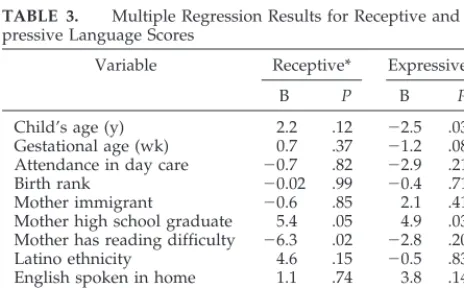
er’s education, country of origin, reading problem, family’s language spoken in the home, and home-lessness. As shown in Table 3, in multiple regression analyses adjusting for these 10 potential confound-ers, families attending the intervention clinic had statistically significantly higher receptive and ex-pressive language scores. Intervention families had an adjusted mean receptive language score of 93.9, compared with 85.2 in comparison families (95% CI of the difference: 3.3, 14.0; SR⫽0.27;P⫽.002). The adjusted mean expressive language score for the in-tervention group was 85.2, compared with 80.9 for comparison families (95% CI of the difference: 0.04, 8.6; SR ⫽0.17;P⫽ .048). The effect of the interven-tion was equivalent to a 6-month improvement in receptive language and a three month improvement in expressive language.
In addition, we performed analyses in which po-tential confounders adding little to the model were eliminated using backward stepwise regression. For receptive language, intervention families scored 9.0 points higher than comparison families (95% CI: 4.0, 14.1; SR⫽ 0.29; P ⫽ .001), adjusting for child’s age and ethnicity and mother’s education and reading problem. For expressive language, intervention fam-ilies scored 4.5 points higher than comparison fami-lies (95% CI: 0.3, 8.7; SR⫽0.18;P⫽.036), adjusting for child’s age and gestational age, mother’s educa-tion and reading problem, and family’s language spoken in the home and homelessness.
Finally, we sought to determine if any measurable dose-effect existed between quantity of literacy-pro-moting contacts and degree of improvement in lan-guage development. Adjusting for the same con-founders used above, multiple regression analyses were performed in which receptive and expressive language were the dependent variables, using total number of literacy-promoting contacts as the main predictor variable. Each literacy-promoting contact was associated with an adjusted mean 0.4 (95% CI: 0.1, 0.6)-point increase in receptive score (P ⫽ .02), and an adjusted mean 0.2 (95% CI:⫺0.02, 0.4)-point increase in expressive score (P⫽ .07).
DISCUSSION
Children born in poverty are at high risk for lan-guage delay, which in turn may lead to difficulties with reading and at school.1,2 ROR is a pediatric primary care-based low-intensity intervention that seeks to ameliorate this risk through increasing read-ing activities in the home, thereby givread-ing poor chil-dren some of the same opportunities now enjoyed by their middle class peers.
The hypothesis underlying ROR is that pediatri-cians can intervene to improve the home literacy environment of poor children, and thereby alter pre-school language development, as well as later read-ing ability and school motivation and performance. Although the effect of ROR on the home literacy environment has been previously well-documented, there is less evidence concerning the effects on lan-guage outcomes.
At Boston City Hospital, Needlman et al showed that previous receipt of a book was associated with higher frequency of literacy orientation (defined as identifying reading as a favorite activity or reporting that parent-child reading activities had occurred dur-ing the previous 24 hours).13 The effect was most pronounced in families receiving public assistance. In a randomized, controlled trial performed in Prov-idence, Rhode Island, Golova, High, and their co-workers also showed that participation in a clinic-based literacy intervention was associated with increased frequency of parent-child reading activities and increased child-centered literacy orientation (de-fined as identifying reading as a favorite activity or as part of the bedtime routine).14 Consistent with these other studies, our results show that families participating in ROR read together more frequently with their children.
Furthermore, our study provides evidence that ROR has a beneficial effect on child language devel-opment. Using a standardized, objective measure, we have shown that ROR exposure is associated with gains in both receptive and expressive language. These gains are large enough to be clinically relevant, with the potential to lead to a decrease in the inci-dence of preschool language delay. In addition, the effect was found to be dose-related, with each addi-tional ROR contact associated with an incremental improvement in language development.
The only other published study to look at the effect of clinic-based literacy interventions on language outcomes was recently published by High et al.16In that study, intervention parents reported increased expressive and receptive vocabulary in their 18- to 25-month-old children, as compared with controls. The results of our study, taken together with these results, demonstrate that ROR can have a significant impact on preschool language development.
Given our study design, a possible limitation exists in that unmeasured differences between the 2 clinic populations could have accounted for some of the differences in language development that we attrib-uted to ROR. In fact, it is unlikely that this was the case. The 2 clinics were very similar sociodemo-graphically, with virtually identical Hollingshead
TABLE 3. Multiple Regression Results for Receptive and Ex-pressive Language Scores
Variable Receptive* Expressive†
B P B P
Child’s age (y) 2.2 .12 ⫺2.5 .03 Gestational age (wk) 0.7 .37 ⫺1.2 .08 Attendance in day care ⫺0.7 .82 ⫺2.9 .21 Birth rank ⫺0.02 .99 ⫺0.4 .71 Mother immigrant ⫺0.6 .85 2.1 .41 Mother high school graduate 5.4 .05 4.9 .03 Mother has reading difficulty ⫺6.3 .02 ⫺2.8 .20 Latino ethnicity 4.6 .15 ⫺0.5 .83 English spoken in home 1.1 .74 3.8 .14 Homeless ⫺0.6 .87 ⫺4.7 .11 Child attends intervention
clinic
8.6 .002 4.3 .048
B indicates unstandardized regression coefficients. * Overall regression:F⫽2.8;P⫽.003.
SES and percentages of families receiving govern-ment aid. If anything, the intervention clinic partici-pants might have been at higher risk based on a somewhat lower high school graduation rate and a higher percentage of recent immigrants. Therefore, any differences between the 2 groups would have served to decrease the measured effect size. Conse-quently, when we accounted for differences between the 2 groups (either by multiple regression modeling or by restricting analysis to the Latino subgroup), the measured effect of the program increased.
Another limitation of this study was the reliance on parental report for reading activities in the home as well as degree of exposure to the intervention, leading to potential for recall bias. In the case of parental report of reading activities, the instrument that we used was the StimQ, which has been shown to be reliable and valid in similar situations.18
A third limitation was the lack of blinding of re-search assistants to either the study hypotheses or the site in which assessments were performed. How-ever, research assistants measuring child’s receptive and expressive language were blinded to results of all other measures.
Although the effects of ROR are extremely prom-ising, it is still possible that more intensive ap-proaches may be warranted. It should be noted that even in the intervention group, children still scored lower than the US sample on which the test was developed.19,20This was particularly true for expres-sive language, for which the intervention group ad-justed mean score was 85.2, almost 15 points below the expected mean score of 100. In a study by Hart and Risley,2the factor that best predicted expressive language was the quantity and quality of language used by parents in their interactions with their child. It may be that the ROR intervention may improve primarily the quantity rather than the quality of ver-bal interactions between parent and child. More in-tensive interventions such as Whitehurst’s dialogic reading may be required for more dramatic improve-ments in expressive language than were demon-strated here.11
Preschool language development is known to be an important predictor of school age reading achievement.2Although ROR has an important im-pact on preschool language development, further study will be needed to determine if ROR can im-prove outcomes beyond the preschool period, such as reading ability and school performance.
CONCLUSION
In summary, ROR is an important intervention, promoting parental literacy support and enhancing language development in impoverished preschool children. Integration of ROR into routine pediatric health care is indicated.
ACKNOWLEDGMENTS
We thank Children of Bellevue, Inc, the Dreyfus Corporation, Bellevue Hospital Center, Kids of NYU, and the Department of
Pediatrics of New York University School of Medicine for their support of Children of Bellevue’s Reach Out and Read program. We thank the Mount Sinai Auxiliary Board, the Children’s Center Foundation, the Kekst Corporation, and the Department of Pedi-atrics of the Mount Sinai School of Medicine for their support of Mount Sinai’s Reach Out and Read program. We would like to thank the pediatric housestaff and faculty, and the ROR staff and volunteers at both institutions for their enthusiasm and dedica-tion. Also, we would like to thank Linda van Schaick, Trish Magee, and the Reach Out and Read Coalition of Greater New York for their leadership in the advancement of ROR in the New York City metropolitan area. Finally, we would like to thank the Reach Out and Read National Center for its ongoing support and guidance.
REFERENCES
1. Parker S, Greer S, Zuckerman B. Double jeopardy: the impact of poverty on early child development.Pediatr Clin North Am.1988;35:1227–1240 2. Hart B, Risley TR.Meaningful Differences in the Everyday Experience of
Young American Children. Baltimore, MD: Paul Brookes Publishing Company; 1995
3. Hoff-Ginsberg E. Mother-child conversation in different social classes and communicative settings.Child Dev.1991;62:782–796
4. Wells G. Preschool literacy-related activities and success in school. In: Olson DR, Torrance N, Hilyard A, eds.Literacy, Language, and Learning. New York, NY: Cambridge University Press; 1985:229 –255
5. Durkin D.Children Who Read Early: Two Longitudinal Studies.New York, NY: Teachers College Press; 1966
6. Payne AC, Whitehurst GJ, Angell AL. The role of home literacy envi-ronment in the development of language ability in preschool children from low-income families.Early Child Res Q.1994:427– 440
7. Moon C, Wells G. The influence of home on learning to read.J Res Reading.1979;2:53– 62
8. Weinberger J. A longitudinal study of children’s early literacy experi-ences at home and later literacy development at home and school.J Res Reading.1996;19:14 –24
9. Senechal M, LeFevre J, Thomas EM, Daley KE. Differential effects of home literacy experiences on the development of oral and written language.Reading Res Q.1998;33:96 –116
10. McCormick CE, Mason JM. Intervention procedures for increasing pre-school children’s interest in and knowledge about reading. In: Teale WH, Sulzby E, eds.Emergent Literacy: Writing and Reading.Norwood, NJ: Ablex Publishing Corporation; 1986:90 –115
11. Whitehurst GJ, Falco FL, Lonigan CJ, et al. Accelerating language de-velopment through picture book reading.Dev Psychol.1988;24:552–559 12. Klass P, Needlman R, Zuckerman B.Reach Out and Read Program Man-ual.2nd ed. Boston, MA: Reach Out and Read National Center, Boston Medical Center; 1999
13. Needlman R, Fried LE, Morley DS, Taylor S, Zuckerman B. Clinic-based intervention to promote literacy.Am J Dis Child.1991;145:881– 884 14. Golova N, Alario AJ, Vivier PM, Rodriguez M, High PC. Literacy
promotion for Hispanic families in a primary care setting: a random-ized, controlled trial.Pediatrics.1999;103:993–997
15. High P, Hopmann M, LaGasse L, Linn H. Evaluation of a clinic-based program to promote book sharing and bedtime routines among low-income urban families with young children.Arch Pediatr Adolesc Med. 1998;152:459 – 465
16. High PC, LaGasse L, Becker S, Ahlgren I, Gardner A. Literacy promo-tion in primary care pediatrics: can we make a difference?Pediatrics. 2000;105:927–934
17. Hollingshead AB.Four Factor Index of Social Status. New Haven, CT: Yale University; 1975
18. Dreyer BP, Mendelsohn AL, Tamis-LeMonda CS. Assessing the child’s cognitive home environment through parental report: reliability and validity.Early Dev Parenting.1996;5:271–287
19. Gardner MF.Receptive One-Word Picture Vocabulary Test. Novato, CA: Academic Therapy Publications; 1985
20. Gardner MF.Expressive One-Word Picture Vocabulary Test (Revised). No-vato, CA: Academic Therapy Publications; 1990
DOI: 10.1542/peds.107.1.130
2001;107;130
Pediatrics
Camille Napier
Weinstein, Monica Broderick, Karyn J. Cheng, Tamara Magloire, Taska Moore and
Alan L. Mendelsohn, Leora N. Mogilner, Benard P. Dreyer, Joel A. Forman, Stacey C.
Inner-City Preschool Children
The Impact of a Clinic-Based Literacy Intervention on Language Development in
Services
Updated Information &
http://pediatrics.aappublications.org/content/107/1/130
including high resolution figures, can be found at:
References
http://pediatrics.aappublications.org/content/107/1/130#BIBL
This article cites 11 articles, 1 of which you can access for free at:
Subspecialty Collections
http://www.aappublications.org/cgi/collection/school_health_sub School Health
vices_sub
http://www.aappublications.org/cgi/collection/community_health_ser Community Health Services
http://www.aappublications.org/cgi/collection/bright_futures_sub Bright Futures
_sub
http://www.aappublications.org/cgi/collection/community_pediatrics Community Pediatrics
following collection(s):
This article, along with others on similar topics, appears in the
Permissions & Licensing
http://www.aappublications.org/site/misc/Permissions.xhtml
in its entirety can be found online at:
Information about reproducing this article in parts (figures, tables) or
Reprints
http://www.aappublications.org/site/misc/reprints.xhtml
DOI: 10.1542/peds.107.1.130
2001;107;130
Pediatrics
Camille Napier
Weinstein, Monica Broderick, Karyn J. Cheng, Tamara Magloire, Taska Moore and
Alan L. Mendelsohn, Leora N. Mogilner, Benard P. Dreyer, Joel A. Forman, Stacey C.
Inner-City Preschool Children
The Impact of a Clinic-Based Literacy Intervention on Language Development in
http://pediatrics.aappublications.org/content/107/1/130
located on the World Wide Web at:
The online version of this article, along with updated information and services, is
by the American Academy of Pediatrics. All rights reserved. Print ISSN: 1073-0397.