[Jung-Hoon
et al.
, 5(6): June, 2018]
ISSN 2349-0292
Impact Factor 3.802
GLOBAL JOURNAL OF ADVANCED ENGINEERING TECHNOLOGIES AND
SCIENCES
A BASIC STUDY FOR DEVELOPMENT OF BUILDING INTEGRATED SMALL
WIND TURBINE SYSTEM
Ju. Jung-Hoon
*1, Jeong. Jin-Woo
2& Lee. Keon-Ho
3*1,2&3
Department of Living and Built Engineering Research Korea Institute of Civil Engineering and
Building Technology
DOI: 10.5281/zenodo.1293403
ABSTRACT
This study is a basic study on the development of compact wind power generation system with integrated buildings. With the proliferation of high - rise residential buildings and the necessity to take measures to solve the energy consumption problem, the application of photovoltaic facilities in the city center is very limited. In order to increase the application rate of new renewable energy, we intend to solve this problem through the development of compact wind power generation system integrated with buildings. In this study, we investigated the necessity to develop the technology development potential and applicability, and confirmed the possibility of building integrated small wind power generation system to be developed through the performance evaluation of the revolving speed.
KEYWORDS: Building integrated, Wind Turbine, Velocity, Revolution per minute
INTRODUCTION
With the spread of high-rise residential building since the late 1990s, measures to solve the energy consumption problems are needed. For high-rise buildings, it is regulated that the usage ratio for new and renewable energy is more than 3% and the proportion of new and renewable energy in high-rise buildings will become important in the future. There was limitation to applying photovoltaic generating facilities in the urban area since daily power generation of solar energy which is the most universally applied new and renewable energy is about 3.5 hours and large area is required to generate 1kW.
There is more possibility than other types of buildings as difference of altitude of high-rise buildings and the wind environment can be utilized, stack effect is generated at the air duct that penetrates the building due to the nature of high-rise building, and constant speed of airflow can be formed. In addition, as a technology that utilizes exhaust fans installed in the existing residential buildings, the roof top exhaust fan requires 1 kitchen, and 2 bathrooms based on 85㎡ high-rise apartment house, and in case of 6 housing in a single floor, a total of 18 exhaust fans are required.
Therefore, in this study, through examination of possibility, applicability of technical development for the development of building integrated small wind turbine system, the appropriateness of development was reviewed and through performance evaluation of RPM (Revolution per minute), the objective was to confirm the possibility of building integrated small wind turbine system development that was intended for development.
Consideration of the existing study
Patents regarding the existing domestic technology were considered for the development of building integrated small wind turbine system, and each content is as follows. The existing domestic and overseas research results regarding small wind turbine system are approached based on power generation on the surface of the ground, and the power generation efficiency above 10m from the surface of the ground is low and the price is high.
In the existing domestic technologies, there were independent type and exhaust connected type for the root top applied small wind turbine system, however, there has been no attempt to integrate them with the existing building parts. In order to understand the difference between the development product intended for development and the existing domestic technologies, trends of domestic technology patents were analyzed accordingly.
[Jung-Hoon
et al.
, 5(6): June, 2018]
ISSN 2349-0292
Impact Factor 3.802
In the basic research for the application of small wind turbine system combined ventilator in super high-rise apartment by Jeonga Park et al. (2011), it is similar in that the study applies the existing wind turbine system by utilizing the roof top exhaust of super high-rise apartment, however, there is a difference in that this technology applies the existing exhaust fan by designing and developing power generating motors and blades.Subheading should be 10pt Times new Roman, justified.Wind environment analysis of apartment houses
Generally, Photovoltaic (PV) is easily applied in places comprised of low-rise buildings secured with wide area. Moreover, in urban areas, it is applied to the higher floors of a building with no surrounding distractions. There are many things to consider when installing photovoltaic system since the height of urban buildings varies and it is sensitive to surrounding hazards and directions. Therefore, there is a limitation on applying roof top area in the high floors of a building and the efficiency for the building integrated photovoltaic (BIPV) is low. On the contrary, the environment of small wind turbine system that is intended to be developed has constant wind strength and the power generation efficiency is high if the frequency of the wind is secured. For urban area, although there is infiltration wind, efficiency is low since it is not constant. In addition, the installation of wind turbine system requires high pillars from the surface of the ground and there are difficult aspects in application due to the possibility of complaints since loud noise and vibration are generated.
However, application of small wind turbine system is possible since wind velocities are high in the high-rise buildings and the temperature difference of outdoor and indoor constantly generates buoyancy. Accordingly, high-rise buildings can provide favorable environment irrelevant of other distractions and directions.
(A) Experiment Overview of Exhaust Wind Speed
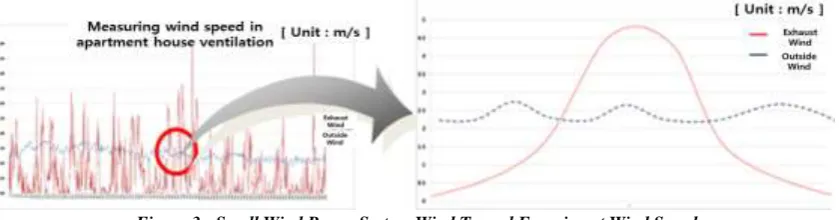
In order to examine the applicability of technical development product, the wind speed of the roof top of 20-floor ○○ Apartment in Il-san was measured, and the wind speed measurement experiment was conducted from January, 2017 to March, 2017 (winter season). Table 1,2 shows the overview of the experiment.
Table 1. Outline of wind velocity measurement of apartment house ventilation
Architectural Overview
Building name Apartment House of ○○at Ilsan
Location 166, Deoksan-ro, Ilsanseo-gu, Goyang-si, Gyeonggi-do, Republic of Korea
Building scale 20th floor
Completion time 2005
Pilot application
site
Implementation
plan Rooftop vent of apartment house
Picture
Table 2. Overview of apartment house wind speed measurement
Experiment to measure wind velocity in apartment house exhaust
Apartment
house height 20th Floor
Measuring position
Rooftop vent of apartment house
Measurement
period Jan~Mar. 2017
Measurement element
Exhaust velocity
[Jung-Hoon
et al.
, 5(6): June, 2018]
ISSN 2349-0292
Impact Factor 3.802
As a result of wind speed measurement of apartment exhaust from January, 2017 to March, 2017, we were able to confirm that change in wind velocities varies and the wind with the speed of 1.5~2.0m/s from the exhaust constantly comes up. Therefore, since it is equipped with a constant wind environment from the most important required elements in wind turbine system, we were able to confirm the applicability of the technical development product. The following figure 1 shows the result of the exhaust experiment at the apartment.Figure 1 : Experimental results of air velocity measurement
BIWT Technology Development
BIWT OverviewBuilding integrated small wind turbine system which is the technical development product is applicable to the roof top exhausts of the high-rise buildings and apartment houses and the technical overview is shown in figure 2 as follows.
Figure 2 : Technology Development Small-sized Wind Power System Integrated Building
(A) Overview
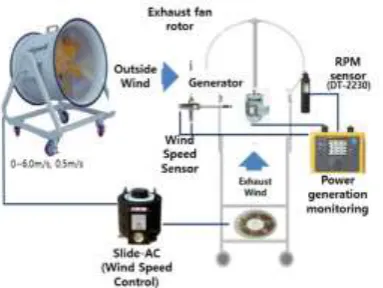
In order to develop the building integrated small wind turbine system which is the technical development product, performance evaluation of the exhaust fan which is applied to the existing exhaust was conducted. For the performance evaluation of the small wind turbine system, artificial wind tunnel test system was manufactured and performance evaluation of RPM (Revolution per minute) was conducted. In addition, the artificial wind tunnel test was conducted in 0.5m/s units through calibration of wind velocities and exhaust winds based on the apartment house exhaust wind experiment. The performance evaluation of small wind turbine system is shown in figure 3, 4, Table 3 as follows.
[Jung-Hoon
et al.
, 5(6): June, 2018]
ISSN 2349-0292
Impact Factor 3.802
Figure 4 : Small Wind Power System Artificial Wind Tunnel Experiment Device
Table 3. Summary of Performance Evaluation of Small Wind Power System
Performance Evaluation of Small Wind Power System
Ourside wind speed range 0.0 ~ 12.0m/s
Exhaust wind speed range 0.0 ~ 4.0m/s
Wind speed range unit 0.5m/s
(B) Direction of the Development
In order to find the direction of the development by component elements of the small wind turbine system which is the technical development product, ready-made generating motor and rotary system are applied to the existing exhaust fan and RPM performance was measured. RPM performance experiment was conducted by classifying the case as follows. Table 4 below shows the overview of the experiment.
Table 4. Rotational performance test conditions
Rotational performance test conditions(RPM)
Case 1 Case 2 Case 3
Existing exhaust fan
Existing exhaust fan + Generator(50W)
Existing exhaust fan + Generator(50W) + Inner Blade(Rotor System)
(B-1) RPM result of Case 1 (the existing exhaust)
Case 1(the existing exhaust fan) was experimented by setting the RPM in 0.5m/s units, the wind velocities in the range of 0.0 ~ 12.0m/s, and the exhaust wind in the range of 0.0 ~ 4.0m/s. The result of the existing exhaust fan RPM performance experiment is shown in figure 5 as follows.
[Jung-Hoon
et al.
, 5(6): June, 2018]
ISSN 2349-0292
Impact Factor 3.802
When only the exhaust wind was applied, the exhaust fan started to rotate at the point exceeding 0.5m/s and when only the wind velocity was applied, the exhaust fan started to rotate at the point exceeding 0.5m/s. In addition, when the experiment was conducted with the combination of the wind velocity and the exhaust wind, the exhaust fan started to rotate at the exhaust wind over 0.5m/s, and the wind velocity over 0.5m/s. When the wind speed is low, the point when the existing exhaust fan started to rotate changed according to the difference of the exhaust winds but we were able to confirm that the rotation speed increased only with the influence of the wind velocity regardless of the exhaust speed when the wind velocity is over 7m/s. Moreover, by looking at the existing exhaust fan RPM performance result graph, we were able to confirm that the influence of the exhaust wind was evident where the wind velocity was less than 4m/s.(B-2) RPM result of Case 2(the existing exhaust fan + generator)
Fig 6. which is the result of the existing exhaust fan RPM performance experiment shows that when only the exhaust wind was applied, the exhaust fan started to rotate at the point exceeding 1.0m/s, and when only the wind velocity was applied, the exhaust fan started to rotate at the point exceeding 1.5m/s.
Figure 6 : Case 2 – RPM - Result
In addition, when the experiment was conducted with the combination of the wind velocity and the exhaust wind, the exhaust fan started to rotate at the exhaust wind over 0.5m/s, and the wind velocity over 1.0m/s. When the wind speed is low, the point when the existing exhaust fan started to rotate changed according to the difference of the exhaust winds but we were able to confirm that the rotation speed increased only with the influence of the wind velocity regardless of the exhaust speed when the wind velocity is over 11.5m/s.
(B-3) RPM result of Case 3(the existing exhaust fan + generator + internal blade)
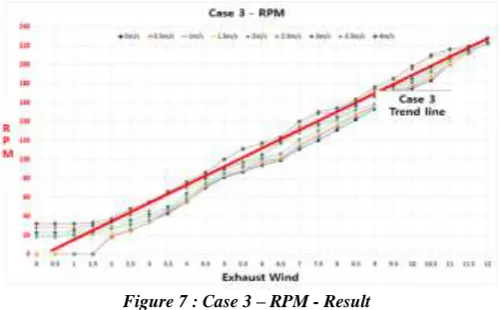
Fig. 7 shows the result of Case 3, and when only the exhaust wind was applied, the exhaust fan started to rotate at the point exceeding 1.5m/s, and when only the wind velocity was applied, the exhaust fan started to rotate at the point exceeding 1.5m/s.
Figure 7 : Case 3 – RPM - Result
[Jung-Hoon
et al.
, 5(6): June, 2018]
ISSN 2349-0292
Impact Factor 3.802
difference of the exhaust winds but there was almost no influence of the exhaust wind when the wind velocity was over 11.0m/s and we were able to confirm that the rotation speed increased only with the influence of the wind velocity.Figure 8 : Trend line comparison by case (RPM)
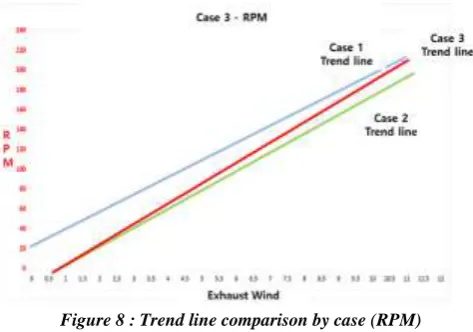
As a result of comparing the RPM trend lines of case 1,2,3, shown in Fig. 8, it is judged that there are a lot of lacking aspects to enhancing the performance of the technical development products utilizing the ready-made products. Therefore, for the performance enhancement of the technical development products, it is considered that development of customized generating motors and rotary systems is inevitable.
CONCLUSION
The purpose of this study is to develop technologies for building-integrated small wind turbine system that meets the high-density development, the feature of domestic urban buildings, in which securing operability and generation are possible in low wind speed that is utilized in high-rise buildings/apartment houses. The result is as follows.
1. The technical development product is classified into 3 parts: rotating part, generating part, fixed part. The top rotating part is divided into an exhaust fan, an internal vertical exhaust blade, and a central axis, the generating part is divided into a generator and a controller, and the fixed part is divided into a fixed-vertical duct blade and a lower part fixation, etc.
2. (B)As a result of measuring the RPM performance utilizing ready-made motors and blades to the existing exhaust fans to find direction of the development, it is considered that development of customized generating motors and rotary systems for the technical development products is inevitable as there are a lot of lacking aspects to enhancing the performance of the technical development products utilizing the ready-made products
ACKNOWLEDGEMENTS
This research was supported by the Research Grant from KICT through the Korea Agencyfor Infrastructure Technology Advancement funded by the Ministry of Land, Infrastructure and Transport of theKorean government (project No. 20180032-001).
REFERENCES
[1] Park, J. h., Kim, J. W., Jang, H. J., Park, J. C., and Hwang, J. H.,A Basic Study on Application of small Wind Power System Combined Ventilator in Super High-rise Apartment (1), Journal of the Korean Solar Energy Society, Vol. 31, No. 3, pp. 126-132, 2011.
[2] Park, Y. H., Park, J. H., Park, J. C., Rhee, E. K., A Study on the Application of Small Wind Turbine System in Super High-rise Building ,Korean Journal of Air-Conditioning and Refrigeration Engineering, Vol. 25, No. 4, pp. 187-193, 2013.
[3] Kang, S. Y., A Study on the application strategies of wind power system in apartment complex. MS thesis, Chubg-ang University, Seoul, Korea, 2002.