Open Access
Research
A linear programming approach for estimating the structure of a
sparse linear genetic network from transcript profiling data
Sahely Bhadra
1, Chiranjib Bhattacharyya*
1,2, Nagasuma R Chandra*
2and I
Saira Mian
3Address: 1Department of Computer Science and Automation, Indian Institute of Science, Bangalore, Karnataka, India, 2Bioinformatics Centre, Indian Institute of Science, Bangalore, Karnataka, India and 3Life Sciences Division, Lawrence Berkeley National Laboratory, Berkeley, California 94720, USA
Email: Sahely Bhadra - [email protected]; Chiranjib Bhattacharyya* - [email protected]; Nagasuma R Chandra* - [email protected]; I Saira Mian - [email protected]
* Corresponding authors
Abstract
Background: A genetic network can be represented as a directed graph in which a node corresponds to a gene and a directed edge specifies the direction of influence of one gene on another. The reconstruction of such networks from transcript profiling data remains an important yet challenging endeavor. A transcript profile specifies the abundances of many genes in a biological sample of interest. Prevailing strategies for learning the structure of a genetic network from high-dimensional transcript profiling data assume sparsity and linearity. Many methods consider relatively small directed graphs, inferring graphs with up to a few hundred nodes. This work examines large undirected graphs representations of genetic networks, graphs with many thousands of nodes where an undirected edge between two nodes does not indicate the direction of influence, and the problem of estimating the structure of such a sparse linear genetic network (SLGN) from transcript profiling data.
Results: The structure learning task is cast as a sparse linear regression problem which is then posed as a LASSO (l1-constrained fitting) problem and solved finally by formulating a Linear
Program (LP). A bound on the Generalization Error of this approach is given in terms of the Leave-One-Out Error. The accuracy and utility of LP-SLGNs is assessed quantitatively and qualitatively using simulated and real data. The Dialogue for Reverse Engineering Assessments and Methods (DREAM) initiative provides gold standard data sets and evaluation metrics that enable and facilitate the comparison of algorithms for deducing the structure of networks. The structures of LP-SLGNs estimated from the INSILICO1, INSILICO2 and INSILICO3 simulated DREAM2 data sets are comparable to those proposed by the first and/or second ranked teams in the DREAM2 competition. The structures of LP-SLGNs estimated from two published Saccharomyces cerevisae
cell cycle transcript profiling data sets capture known regulatory associations. In each S. cerevisiae
LP-SLGN, the number of nodes with a particular degree follows an approximate power law suggesting that its degree distributions is similar to that observed in real-world networks. Inspection of these LP-SLGNs suggests biological hypotheses amenable to experimental verification.
Published: 24 February 2009
Algorithms for Molecular Biology 2009, 4:5 doi:10.1186/1748-7188-4-5
Received: 30 May 2008 Accepted: 24 February 2009 This article is available from: http://www.almob.org/content/4/1/5
© 2009 Bhadra et al; licensee BioMed Central Ltd.
Conclusion: A statistically robust and computationally efficient LP-based method for estimating the topology of a large sparse undirected graph from high-dimensional data yields representations of genetic networks that are biologically plausible and useful abstractions of the structures of real genetic networks. Analysis of the statistical and topological properties of learned LP-SLGNs may have practical value; for example, genes with high random walk betweenness, a measure of the centrality of a node in a graph, are good candidates for intervention studies and hence integrated computational – experimental investigations designed to infer more realistic and sophisticated probabilistic directed graphical model representations of genetic networks. The LP-based solutions of the sparse linear regression problem described here may provide a method for learning the structure of transcription factor networks from transcript profiling and transcription factor binding motif data.
Background
Understanding the dynamic organization and function of networks involving molecules such as transcripts and pro-teins is important for many areas of biology. The ready availability of high-dimensional data sets generated using high-throughput molecular profiling technologies has stimulated research into mathematical, statistical, and probabilistic models of networks. For example, GEO [1] and ArrayExpress [2] are public repositories of well-anno-tated and curated transcript profiling data from diverse species and varied phenomena obtained using different platforms and technologies.
A genetic network can be represented as a graph consisting of a set of nodes and a set of edges. A node corresponds to a gene (transcript) and an edge between two nodes denotes an interaction between the connected genes that may be linear or non-linear. In a directed graph, the ori-ented edge A →B signifies that gene A influences gene B. In an undirected graph, the un-oriented edge A - B encodes a symmetric relationship and signifies that genes A and B may be co-expressed, co-regulated, interact or share some other common property. Empirical observa-tions indicate that most genes are regulated by a small number of other genes, usually fewer than ten [3-5]. Hence, a genetic network can be viewed as a sparse graph, i.e., a graph in which a node is connected to a handful of other nodes. If directed (acyclic) graphs or undirected graphs are imbued with probabilities, the result is proba-bilistic directed graphical models and probaproba-bilistic undi-rected graphical models respectively [6].
Extant approaches for deducing the structure of genetic networks from transcript profiling data [7-9] include Boolean networks [10-14], linear models [15-18], neural networks [19], differential equations [20], pairwise mutual information [10,21-23], Gaussian graphical mod-els [24,25], heuristic approachs [26,27], and co-expres-sion clustering [16,28]. Theoretical studies of sample complexity indicate that although sparse directed acyclic graphs or Boolean networks could be learned, inference
would be problematic because in current data sets, the number of variables (genes) far exceedes the number of observations (transcript profiles) [12,14,25]. Although probabilistic graphical models provide a powerful frame-work for representing, modeling, exploring, and making inferences about genetic networks, there remain many challenges in learning tabula rasa the topology and proba-bility parameters of large, directed (acyclic) probabilistic graphical models from uncertain, high-dimensional tran-script profiling data [7,25,29-33]. Dynamic programing approaches [26,27] use Singular Value Decomposition (SVD) to pre-process the data and heuristics to determine stopping criteria. These methods have high computa-tional complexity and yield approximate solutions.
This work focuses on a plausible, albeit incomplete repre-sentation of a genetic network – a sparse undirected graph – and the task of estimating the structure of such a net-work from high-dimensional transcript profiling data. Since the degree of every node in a sparse graph is small, the model embodies the biological notion that a gene is regulated by only a few other genes. An undirected edge indicates that although the expression levels of two con-nected genes are related, the direction of influence is not specified. The final simplification is that of restricting the type of interaction that can occur between two genes to a single class, namely a linear relationship. This particular representation of a genetic network is termed a sparse lin-ear genetic network (SLGN).
profil-ing platform used coupled with the stochastic nature of gene expression [35] leads to variation in measured abun-dance values. Thus, the ability to estimate parameters in a robust manner should increase confidence in the structure of an LP-SLGN estimated from noisy transcript profiles. An additional benefit of the approach is that the LP for-mulations can be solved quickly and efficiently using widely available software and tools capable of solving LPs involving tens of thousands of variables and constraints on a desktop computer.
Two different LP formulations are proposed: one based on a positive class of linear functions and the other on a gen-eral class of linear functions. The accuracy of this LP-based approach for deducing the structure of networks is assessed statistically using gold standard data and evalua-tion metrics from the Dialogue for Reverse Engineering Assessments and Methods (DREAM) initiative [36]. The LP-based approach compares favourably with algorithms proposed by the top two ranked teams in the DREAM2 competition. The practical utility of LP-SLGNs is exam-ined by estimating and analyzing network models from two published Saccharomyces cerevisiae transcript profiling data sets [37] (ALPHA; CDC15). The node degree distri-butions of the learned S. cerevisiae LP-SLGNs, undirected graphs with many hundreds of nodes and thousands of edges, follow approximate power laws, a feature observed in real biological networks. Inspection of these LP-SLGNs from a biological perspective suggests they capture known regulatory associations and thus provide plausible and useful approximations of real genetic networks.
Methods
Genetic network: sparse linear undirected graph representation
A genetic network can be viewed as an undirected graph, = {V, W}, where V is a set of N nodes (one for each gene in the network), and W is an N × N connectivity matrix encoding the set of edges. The (i, j)th element of the
matrix W specifies whether nodes i and j do (Wij ≠ 0) or
do not (Wij = 0) influence each other. The degree of node n, kn, indicates the number of other nodes connected to n and is equivalent to the number of non-zero elements in row n of W. In real genetic networks, a gene is regulated often by a small number of other genes [3,4] so a reason-able representation of a network is a sparse graph. A sparse graph is a graph parametrized by a sparse matrix W, a matrix with few non-zero elements Wij, and where most nodes have a small degree, kn < 10.
Linear interaction model: static and dynamic settings
If the relationship between two genes is restricted to the class of linear models, the abundance value of a gene is treated as a weighted sum of the abundance values of other genes. A high-dimensional transcript profile is a vec-tor of abundance values for N genes. An N × T matrix E is the concatenation of T profiles, [e(1),..., e(T)], where e(t) = [e1(t),..., eN(t)]®and en(t) is the abundance of gene n in profile t. In most extant profiling studies, the number of transcripts monitored exceeds the number of available profiles (N ŬT).
In the static setting, the T transcript profiles in the data matrix E are assumed to be unrelated and so independent of one another. In the linear interaction model, the abun-dance value of a gene is treated as a weighted sum of the abundance values of all genes in the same profile,
The parameter wn = [wn1,..., wnN]®is a weight vector for gene n and the jth element indicates whether genes n and j
do (wnj ≠ 0) or do not (wnj = 0) influence each other. The
constraint wnn = 0 prevents gene n from influencing itself at the same instant so its abundance is a function of the abundances of the remaining N - 1 genes in the same pro-file.
In the dynamic setting, the T transcript profiles in E are assumed to form a time series. In the linear interaction model, the abundance value of a gene at time t is treated as a weighted sum of the abundance values of all genes in the profile from the previous time point, t - 1, i.e., . There is no constraint wnn = 0 because a gene can influence its own abundance at the next time point.
As described in detail below, the SLGN structure learning problem involves solving N independent sparse linear regression problems, one for each node in the graph (gene in the network), such that every weight vector wn is sparse.
The sparse linear regression problem is cast as an LP and uses a loss function which ensures that the weight vector is resilient to small changes in the training data. Two LPs are formulated and each formulation contains one user-defined parameter, A, the upper bound of the l1 norm of the weight vector. One LP is based on a general class of lin-ear functions. The other LP formulation is based on a pos-itive class of linear functions and yields an LP with fewer variables than the first.
e t w e t
t w
n nj j
j N
n
nn
( ) ( )
( )
=
=
= =
∑
10
w eT
where
(1)
Simulated and real data
DREAM2 In-Silico-Network Challenges data
A component of Challenge 4 of the DREAM2 competition [38] is predicting the connectivity of three in silico net-works generated using simulations of biological interac-tions. Each DREAM2 data set includes time courses (trajectories) of the network recovering from several exter-nal perturbations. The INSILICO1 data were produced from a gene network with 50 genes where the rate of synthesis of the mRNA of each gene is affected by the mRNA levels of other genes; there are 23 different perturbations and 26 time points for each perturbation. The INSILICO2 data are similar to INSILICO1 but the topology of the 50-gene net-work is qualitatively different. The INSILICO3 data were produced from a full in silico biochemical network that had 16 metabolites, 23 proteins and 20 genes (mRNA concentrations); there are 22 different perturbations and 26 time points for each perturbation. Since the LP-based method yields network models in the form of undirected graphs, the data were used to make predictions in the DREAM2 competition category UNDIRECTED-UNSIGNED. Thus, the simulated data sets used to esti-mate LP-SLGNs are an N = 50 × T = 26 matrix (INSILICO1), an N = 50 × T = 26 matrix (INSILICO2), and an N = 59 × T = 26 matrix (INSILICO3).
S. cerevisiae transcript profiling data
A published study of S. cerevisiae monitored 2,467 genes at various time points and under different conditions [37]. In the investigations designated ALPHA and CDC15, measurements were made over T = 15 and T = 18 time points respectively. Here, a gene was retained only if an abundance measurement was present in all 33 profiles. Only 605 genes met this criterion of no missing values and these data were not processed any further. Thus, the real transcript profiling data sets used to estimate LP-SLGNs are an N = 605 × T = 15 matrix (ALPHA) and an N = 605 × T = 18 matrix (CDC15).
Training data for regression analysis
A training set for regression analysis, , is created by generating training points for each gene from the data matrix E. For gene n, the training points are . The ith training point consists of an
"input" vector, xni = [x1i,..., xNi] (abundances values for N genes), and an "output" scalar yni = xni (abundance value for gene n).
In the static setting, I = T training points are created because both the input and output are generated from the same profile; the linear interaction model (Equation 1) includes the constraint wnn = 0. If en(t) is the abundance of
gene n in profile t, the ith training point is x
ni = e(t) =
[e1(t),..., eN(t)], yni = en(t), and t = 1,..., T.
In the dynamic setting, I = T - 1 training points are created because the output is generated from the profile for a given time point whereas the input is generated from the profile for the previous time point; there is no constraint wnn = 0 in the linear interaction model. The ith training
point is xni = e(t - 1) = [e1(t - 1),..., eN(t - 1)], yni = en(t), and t = 2,..., T.
The results reported below are based on training data gen-erated under a static setting so the constraint wnn = 0 is imposed.
Notation
Let denote the N-dimensional Euclidean vector space and card(A) the cardinality of a set A. For a vector x = [x1,..., xN]®in this space, the l2 (Euclidean) norm is the
square root of the sum of the squares of its elements,
; the l1 norm is the sum of the absolute values of its elements, ; and the l0 norm is the total number of non-zero elements, ||x||0 = card({n|xn ≠ 0; 1 ≤n ≤N}). The term x ≥ 0 signifies that every element of the vector is zero or positive, xn ≥ 0, ∀n ∈ {1,..., N}. The one- and zero-vectors are 1 = [11,..., 1N]®
and 0 = [01,..., 0N]®respectively.
Sparse linear regression: an LP-based formulation
Given a training set for gene n
the sparse linear regression problem is the task of inferring a sparse weight vector, wn, under the assumption that gene-gene interactions obey a linear model, i.e., the abun-dance of a gene n, yni = xn, is a weighted sum of the abun-dances of other genes, .
Sparse weight vector estimation l0 norm minimization
The problem of learning the structure of an SLGN involves estimating a weight vector such that w best approximates y and most of elements of w are zero. Thus, one strategy for obtaining sparsity is to stipulate that w should have at most k non-zero elements, ||w||0 ≤ k. The value of k is equivalent to the degree of the node so a biologically plausible constraint for a genetic network is ||w||0 ≤ 10. {n n}N=1
n= ni yni iI
=
{(x , )} 1
N
x 2 2
1 =
∑
= xnn N
x 1
1 =
∑
=|xn|n N
n={(xni,yni) |xni∈N;yni∈;i=1,..., }I (2)
Given a value of k, the number of possible choices of pre-dictors that must be examined is NC
k. Since there are many
genes (N is large) and each choice of predictor variables requires solving an optimization problem, learning a sparse weight vector using an l0 norm-based approach is prohibitive, even for small k. Furthermore, the problem is NP-hard [39] and cannot even be approximated in time
where is small positive quantity.
LASSO
A tractable approximation of the l0 norm is the l1 norm [40,41] (for other approximations see [42]). LASSO [34] uses an upper bound for the l1 norm of the weight vector, specified by a parameter A, and formulates the l1 norm minimization problem as follows,
This formulation attempts to choose w such that it mini-mizes deviations between the predicted and the actual val-ues of y. In particular, w is chosen to minimize the loss function . Here, "Empirical Error" is used as the loss function. The Empirical Error of a graph is , where
. The user-defined parameter A controls the upper bound of the l1 norm of the weight vector and hence the trade-off between sparsity and accuracy. If A = 0, the result is a poor approximation, as the most sparse solution is a zero weight vector, w = 0. When A = ∞, deviations are not allowed and a non-sparse w is found if the problem is fea-sible.
LP formulation: general class of linear functions
Consider the robust regression function f(.; w). For the general class of linear functions, f(x; w) = w®x, an element of the parameter vector can be zero, wj = 0, or non-zero, wj
≠ 0. When wj > 0, the predictor variable j makes a positive contribution to the linear interaction model, whereas if wj < 0, the contribution is negative. Since the representation of a genetic network considered here is an undirected graph and thus the connectivity matrix is symmetric, the interactions (edges) in a SLGN are not categorized as acti-vation or inhibition.
For the general class of linear functions f(x; w) = w®x, an element of the weight vector w should be non-zero, wj ≠ 0. Then, the LASSO problem
can be posed as the following LP
by substituting w = u - v, ||w||1 = (u + v)®1, |vi| = ξi + and vi = ξi - . The user-defined parameter A controls the upper bound of the l1 norm of the weight vector and thus the trade-off between sparsity and accuracy. Problem (4) is an LP in (2N + 2I) variables, I equality constraints, 1
inequality constraints and (2N + 2I) non-negativity con-straints.
LP formulation: positive class of linear functions
An optimization problem with fewer variables than prob-lem (4) can be formulated by considering a weaker class of linear functions. For the positive class of linear func-tions f(x; w) = w®x, an element of the weight vector w
should be non-negative, wj ≥ 0. Then, the LASSO problem (Equation 3) can be posed as the following LP,
Problem (5) is an LP with (N + 2I) variables, I equality constraints, 1 inequality constraints, and (2N + 2I) non-negativity constraints.
In most transcript profiling studies, the number of genes monitored is considerably greater than the number of profiles produced, N ŬI. Thus, an LP based on a restrictive 2log1−eN
minimize
subject to T
w w x w , | | . v i i I
i i i
v v y A =
∑
+ = ≤ 1 1L w i i yi I
( )=
∑
=1|w xT − | 1
1
N∑nN= Empiricalerror(n)
Empiricalerror n yni f ni n
i I I
( )=1
∑
=| − ( ; ) |1 x w
minimize
subject to T
w w x w , | | . v i i I
i i i
v v y A =
∑
+ = ≤ 1 1 (3) minimizesubject to T
u v
u v x
, , , * * * ( ) ( ) (
x x x x
x x
i i i
I
i i i yi
+ − + − = =
∑
1 uu v 1
u v + ≤ ≥ ≥ ≥ ≥ ) ; ; * T A i i 0 0 0 0 x x (4)
xi* xi*
minimize
subject to T
T w w x w 1 w , , * * * ( )
x x x x
x x
i i i
I
i i i yi
A + + − = ≤ ≥ =
∑
1 0 0 0 0xi ≥ ;xi*≥ .
positive linear class of functions and involving (N + 2I) variables (Problem (5)) offers substantial computational advantages over a formulation based on a general linear class of functions and involving (2N + 2I) variables (Prob-lem (4)). LPs involving thousands of variables can be solved efficiently using extant software and tools.
To estimate a graph , the training points for the nth gene,
, are used to solve a sparse linear regression problem posed as a LASSO and formulated as an LP. The outcome of such regression analysis is a sparse weight vector wn
whose small number of non-zero elements specify which genes influence gene n. Aggregating the N sparse weight vectors produced by solving N independent sparse linear regression problems [w1,..., wN], yields the matrix W that parameterizes the graph.
Statistical assessment of LP-SLGNs: Error, Sparsity and Leave-One-Out (LOO) Error
The "Sparsity" of a graph is the average degree of a node
where ||wn||0 is the l0 norm of the weight vector for node
n.
Unfortunately, the small number of available training points (I) means that the empirical error will be optimistic and biased. Consequently, the Leave-One-Out (LOO) Error is used to analyze the stability and generalization performance of the method proposed here.
Given a training set = [(xn1, yn1),..., (xnI, ynI)], two modified training sets are built as follows
• Remove the ith element:
• Change the ith element: , where (x', y') is any point other than one in the training set
The Leave-One-Out Error of a graph , LOO Error, is the average over the N nodes of the LOO error of every node. The LOO error of node n, LOOerror( ), is the average over the I training points of the magnitude of the discrep-ancy between the actual response, yni, and the predicted linear response, ,
The parameter of the function is
learned using the modified training set .
A bound for the Generalization Error of a graph
A key issue in the design of any machine learning system is an algorithm that has low generalization error.
Here, the Leave-One-Out (LOO) error is utilized to esti-mate the accuracy of the LP-based algorithm employed to learn the structure of a SLGN. In this section, a bound on the generalization error based on the LOO Error is derived. Furthermore, a low "LOO Error" of the method proposed here is shown to signify good generalization.
The generalization error of a graph , Error, is the average over all N nodes of the generalization error of every node, Error( ),
The parameter wn is learned from as follows,
The approch is based on the following Theorem (for details, see [43]),
Theorem 1. Given a training set S = {z1,..., zm} of size m, let the modified training set be Si = {z
1,..., zi-1, , zi+1,..., zm},
where the ith element has been changed and is drawn from
the data space Z but independent of S. Let F = Zm → be any
measurable function for which there exists constants ci (i = 1,...,
m) such that
n
Sparsity= =
= =
∑
∑
1 1
1
0 1
N kn N
n N
n n
N
w (6)
n
ni
n ni yni
\= \{(x , )}
ni
n ni yni y
= \{(x , )}∪( , )x′ ′
n
n
f\i(xni;wn\i)=w\niTxni
LOO Error=
= −
=
∑
1
1
1
N LOO
LOO
I y f
error n n
N
error n ni i ni
( )
( ) | \( ;
x wnni
n I
\) | =
∑
1
(7)
wn\i f\i(xni;wn\i)
n\i
n
Error =
=
= −
=
∑
1
1
N Error Error E l f y
l f y y
n n
N
n n
( )
( ) [ ( ; , )] ( ; , ) |
x
x wnnTx|
(8)
n
w w x
w
n
t i ni ni
I
I l y
=
≤
∑
=arg min ( ,( , ))
|| ||1
1
1
(9)
′
zi
′
zi
Elsewhere [44], the above was given as Theorem 2.
Theorem 2. Consider a graph with N nodes. Let the data
points for the nth node be
where (xni, yni) are iid. Assume that ||xni||∞ ≤ d and |yni| ≤ b. Let
and y = f(x; w) = w®x. Using techniques from [44], it can be stated that for 0 ≤δ≤ 1 and with probability at least 1 - δ over a random draw of the sample graph ,
where t is the l1 norm of the weight vector ||w||1. LOO Error and Error are calculated using Equation 7 and Equation 8 respectively.
PROOF. "Random draw" means that if the algorithm is run
for different graphs, one graph from the set of learned graphs is selected at random. The proposed bound of gen-eralization error will be true for this graph with high prob-ability. This term is unrelated to term "Random graph" used in Graph Theory.
The following proof makes use of Holder's Inequality.
A bound on the Empirical Error can be found as
Let Error( ) be the Generalization Error after training
with . Then using Equation 11
Let Error( ) be the Generalization Error after training with . Then using Equation 13
If LOOerror( ) is the LOO error when the training set is
, then using Equation 11 and Equation 12,
Thus, the random variable (Error - LOO Error) satisfies the condition of Theorem 1. Using Equation 14 and Equation 15, the condition is
sup F S F S c
P F S E F S
S Z Z
i i s s m i e e e , | ( ( ) ( ( ) | , [( ( ) [ ( )]) ] ′ − ≤ − ≥ ≤ z
then ee ci
i m − =
∑
2 2 1 2 e / . ={(xni,yni) |;xni∈N;yni∈;i=1,..., }I
f :N→
Error LOO Error td td b I ≤ + +⎛ + ⎝⎜ ⎞ ⎠⎟ ⎛ ⎝⎜ ⎞ ⎠⎟ 2 6 1 1 2 ln d (10)
yni f xni n yni f i ni ni
n ni ni ni
n − − − ≤ − ≤ − ∞ ( ; ) | | ( ; ) | | ( \ \ \
w x w
w x w x
w w
T T
n ni ni
n d td \) . 1 1 2 2 x w ∞ ≤ ≤ (11)
max(| ( ; ) |) | | | |
.
y f x y
b b td
ni ni n ni n ni
n ni
− ≤ +
≤ +
≤ + ∞
w w x
w x
T 1
(12)
n\i n\i
| ( ) ( ) |
| [| ( ; ) |] [| ( ;
\
\ \
Error Error
E y f E y f
n ni
n i n
n n
−
= − x w − − x w ii
ni ni n ni
i
ni n i
y f x y f
td ) |] | ( ; ) | | ( ; ) . \ \ ≤ − − − ≤ ∞
w x w
2
(13)
ni
ni
Error Error
Error Error Error
n ni
n ni ni
( ) ( )
( ( ) ( \)) ( ( \)
−
= − − −EError
Error Error Error Error
n i
n ni ni ni
( )) ( ) ( \) | | ( \) ( ≤ − + − )) .
≤ 4td
(14)
ni
ni
| ( ) ( ) |
| (| \( ; \) | |
LOO LOO
I y f y
error n error in
ni j nj nj ni
−
= 1 − x w − −ff
y f y f
i j
nj ni j j i
ni i nj ni ni i ni
\ \
\ \ \
( ; ) |)
(| ( ; ) | | (
x w
x w x
≠
∑
+ − − ′ − ′ ;; ) |) | | | ( ; ) ( ; ) | (| \ \ \ \ \ \ wx w x w
ni
j
nj nj i j nj i jn j i
ni
I f f
y f ≤ − + − ≠
∑
1 iini ni ni i ni ni
nj ni j j
y f I ( ; ) | | ( ; ) |) | | | ( ) | \ \ \ \ \
x w x w
w w x
− ′ − ′
≤ 1 − T
jj i
b td
Where Errori is the Generalization of graph and LOO
Errori is LOO Error of graph when the ith data points for
all genes are changed. Thus, only a bound on the expecta-tion of the random variable (Error - LOO Error) is needed. Using Equation 11,
Hence, Theorem 1 can be used to state that if Equation 16 holds, then
By equating the right hand side of Equation 17 to δ
Given this bound on the generalization error, a low LOO Error in the method proposed here signifies good generalization. h
Implementation and numerical issues
Prototype software implementing the two LP-based for-mulations of sparse regression was written using the tools and solvers present in the commercial software MATLAB [45]. Software is available in "Additional file 1" named as "LP-SLGN.tar". It should be straightforward to develop an implementation using C and R wrapper functions for
lpsolve [46], a freely available solver for linear, integer and mixed integer programs. The outcome of regression anal-ysis is an optimal weight vector w. Limitations in the numerical precision of solvers means that an element is never exactly zero but a small finite number. Once a solver finds a vector w, a "small" user-defined threshold is used to assign zero and non-zero elements. If the value pro-duced by a solver is greater than the threshold wj = 1, oth-erwise wj = 0. Here, a cut-off of 10-8 was used.
The computational experiments described here were per-formed on a large shared machine. The hardware specifi-cations are 6 × COMPAQ AlphaServers ES40 with 4 CPUs per server with 667 MHz, 64 KB + 64 KB primary cache per CPU, 8 MB secondary cache per CPU, 8 GB memory with 4 way interleaving, 4 * 36 GB 10 K rpm Ultra3 SCSI disk drive, and 2*10/100 Mbit PCI Ethernet Adapter. How-ever, the programs can be run readily on a powerful PC. For the MATLAB implementation of the LP formulation based on the general class of linear functions, the LP took a few seconds of wall clock time. An additional few sec-onds were required to read in files and to set up the prob-lem.
Results and discussion
DREAM2 In-Silico-Network Challenges data
Statistical assessment of LP-SLGNs estimated from simulated data
LP-SLGNs were estimated from the INSILICO1, INSILICO2, and INSILICO3 data sets using both LP formulations and different settings of the user-defined parameter A which controls the upper bound of the l1 norm of the weight
vec-tor and hence the trade-off between sparsity and accuracy. The results are shown in Figure 1. For all data sets, smaller values of A yield sparser graphs (left column) but Sparsity comes at the expense of higher LOO Error (right column). Higher A values produce graphs where the average degree of a node is larger (left column). The LOO Error decreases with increasing Sparsity (right column). The maximum Sparsity occurs at high A values and is equal to the number of genes N.
LP-SLGNs based on the general class of linear functions were estimated using the parameter A = 1. For the INSILICO1 data set, the Sparsity is ~10. For the INSILICO2 data set, the Sparsity is ~13. For the INSILICO3 data set, the Sparsity is ~35.
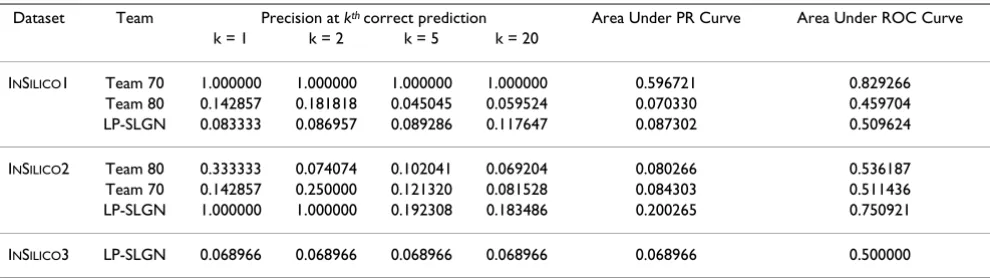
The learned LP-SLGNs were evaluated using a script pro-vided by the DREAM2 Project [38]. The results are shown in Table 1. The INSILICO2 LP-SLGN is considerably better
than the network predicted by Team80, Which team is the top-ranked team in the DREAM2 competition (Challenge 4). The INSILICO1 LP-SLGN is comparable to the predicted network of Team70, the top ranked team, but better than that of Team 80, the second-ranked team. Team rankings
sup | ( ) ( ) |
|
,( , ) xy
i i
Error LOO Error Error LOO Error
Error E
− − −
≤ − rrrori LOO Error LOO Errori
n ni
n
N Error Error
| | |
(| ( ) ( ) |
+ −
= −
=
1
1 1 1 1 6 6 N
errori n error ni
n N LOO LOO N td b I t
∑
∑
+ − ≤ ⎛ + ⎝⎜ ⎞ ⎠⎟ = = | ( ) ( ) |) d d b I + . (16) E Error[ LOO Error]
( (| ( ; ) | | \( ; \
−
= 1 1 − − −
N I yni f ni n yni f i
ni ni
x w x w )) |))
. i n n N td = =
∑
∑
≤ 1 1 2P[((Error LOO Error)] [Error LOO Error]) ]
exp
− − − ≥
≤ −
+
E
I td b
e e 2 2 6 II ⎛ ⎝⎜ ⎞ ⎠⎟ ⎛ ⎝ ⎜ ⎜ ⎜ ⎜ ⎜ ⎞ ⎠ ⎟ ⎟ ⎟ ⎟ ⎟ 2 . (17)
P Error[ <LOO Error+ +⎛ + ] ( ). ⎝⎜ ⎞ ⎠⎟ ⎛ ⎝⎜ ⎞ ⎠⎟ ≥ − 2 6 1 2 1
td td b I
I ln
Quantitative evaluation of the INSILICO network models Figure 1
are not available for the INSILICO3 dataset. The predicted networks by LP-SLGN can be found in "Additional file 2" named as "Result.tar".
S. cerevisae transcript profiling data
Statistical assessment of LP-SLGNs estimated from real data
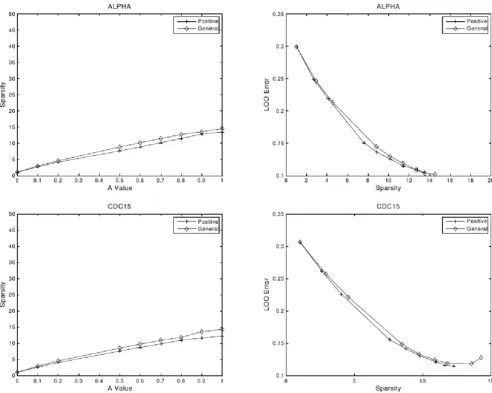
LP-SLGNs for the ALPHA and CDC15 data sets were esti-mated using both LP formulations and different settings of the user-defined parameter A. The learned undirected graphs were evaluated by computing LOO Error (Equa-tion 7), a quantity indicating generaliza(Equa-tion performance, and Sparsity (Equation 6), a quantity based on the degree of each node. The results are shown in Figure 2. LP formu-lations based on a weaker positive class of linear functions (cross) and a general class of functions linear (diamond) produce similar results. However, the formulation based on a positive class of linear functions can be solved more quickly because it has fewer variables. For both data sets, smaller A values yield sparser graphs (left column) but sparsity comes at the expense of higher LOO Error (right column). For high A values, the average degree of a node is larger (left column). The LOO Error decreases with the increase of Sparsity (right column). The maximum Spar-sity occurs at high A values and is equal to the number of genes N. The minimum LOO Error occurs at A = 1 for ALPHA and A = 0.9 for CDC15; the Sparsity is ~15 for these A values. The degree of most of the nodes in the LP-SLGNs lies in the range 5–20, i.e., most of the genes are influenced by 5–20 other genes.
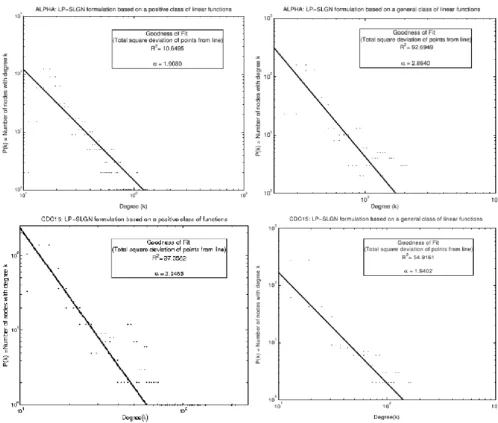
Figure 3 shows logarithmic plots of the distribution of node degree for the ALPHA and CDC15 LP-SLGNs. In each case, the degree distribution roughly follows a straight line, i.e., the number of nodes with degree k fol-lows a power law, P(k) = βk-αwhere β, α ∈ R. Such a
power-law distribution is observed in a number of
real-world networks [47]. Thus, the connectivity pattern of edges in LP-SLGNs are consistent with known biological networks.
Biological evaluation of S. cerevisiae LP-SLGNs
The profiling data examined here were the outcome of a study of the cell cycle in S. cerevisiae [37]. The published study described gene expression clusters (groups of genes) with similar patterns of abundance across different condi-tions. Whereas two genes in the same expression cluster have similarly shaped expression profiles, two genes linked by an edge in an LP-SLGN model have linearly related abundance levels (a non-zero element in the con-nectivity matrix of the undirected graph, wij ≠ 0). The ALPHA and CDC15 LP-SLGNs were evaluated from a bio-logical perspective by manual analysis and visual inspec-tion of LP-SLGNs estimated using the LP formulainspec-tion based on a general class of linear functions and A = 1.01.
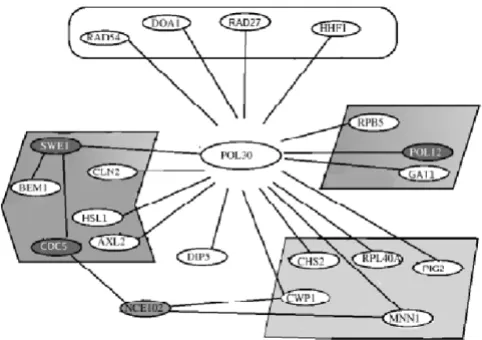
Figure 4 shows a small, illustrative portion of the ALPHA and CDC15 LP-SLGNs centered on the POL30 gene. For each the genes depicted in the figure, the Saccharomyces Genome Database (SGD) [48] description, Gene Ontol-ogy (GO) [49] terms and InterPro [50] protein domains (when available) are listed in "Additional file 3" named as "Supplementary.pdf". The genes connected to POL30 encode proteins that are associated with maintenance of genomic integrity (DNA recombination repair, RAD54, DOA1, HHF1, RAD27), cell cycle regulation, MAPK sig-nalling and morphogenesis (BEM1, SWE1, CLN2, HSL1, ALX2/SRO4), nucleic acid and amino acid metabolism (RPB5, POL12, GAT1), and carbohydrate metabolism and cell wall biogenesis (CWP1, RPL40A, CHS2, MNN1, PIG2). Physiologically, the KEGG [51] pathways associ-ated with these genes include "Cell cycle" (CDC5, CLN2, SWE1, HSL1), "MAPK signaling pathway" (BEM1), "DNA polymerase" (POL12), "RNA polymerase" (RPB5),
"Ami-Table 1: Comparison of the networks – undirected graphs – produced by three different approaches: the LP-based method proposed here, and techniques proposed by the top two teams of the DREAM2 competition (Challenge 4).
Dataset Team Precision at kth correct prediction Area Under PR Curve Area Under ROC Curve k = 1 k = 2 k = 5 k = 20
INSILICO1 Team 70 1.000000 1.000000 1.000000 1.000000 0.596721 0.829266
Team 80 0.142857 0.181818 0.045045 0.059524 0.070330 0.459704 LP-SLGN 0.083333 0.086957 0.089286 0.117647 0.087302 0.509624
INSILICO2 Team 80 0.333333 0.074074 0.102041 0.069204 0.080266 0.536187
Team 70 0.142857 0.250000 0.121320 0.081528 0.084303 0.511436 LP-SLGN 1.000000 1.000000 0.192308 0.183486 0.200265 0.750921
INSILICO3 LP-SLGN 0.068966 0.068966 0.068966 0.068966 0.068966 0.500000
nosugars metabolism" (CHS2), "Starch and sucrose metabolism" (RAD54), "High-mannose type N-glycan biosynthesis" (MNN1), "Purine metabolism" (POL12, RPB5), "Pyrimidine metabolism" (POL12, RPB5), and "Folate biosynthesis" (RAD54).
The learned LP-SLGNs provide a forum for generating bio-logical hypotheses and thus directions for future experi-mental investigations. The edge between SWE1 and BEM1 indicates that the transcript levels of these two genes exhibit a linear relationship; the physical interactions sec-tion of their SGD [48] entries indicates that the encoded proteins interact. These results suggests that cellular and/ or environmental factor(s) that perturb the transcript
lev-els of both SWE1 and BEM1 may affect cell polarity and cell cycle. NCE102 is connected to genes involved in cell cycle regulation (CDC5) and cell wall remodelling (CWP1, MNN1). A recent report indicates that the tran-script level of NCE102 changes when S. cerevisiae cells expressing human cytochrome CYP1A2 are treated with the hepatotoxin and hepatocarcinogen aflatoxin B1 [52]. Thus, this uncharacterized gene may be part of a cell cycle-related response to genotoxic and/or other stress.
Studies of the yeast NCE102 gene may be relevant to human health and disease. The protein encoded by NCE102 was used as the query for a PSI-BLAST [53] search using the WWW interface to the software at NCBI and
Quantitative evaluation of the S. cerevisiae network models Figure 2
default parameter settings. Amongst the proteins exhibit-ing statistically significant similarity (E-value << 1e - 05) were members of the mammalian physin and gyrin fami-lies, four-transmembrane domain proteins with roles in vesicle trafficking and membrane morphogenesis [54]. Human synaptogyrin 1 (SYNGR1; E-value ~ 1e - 28) has been linked to schizophrenia and bipolar disorder [55].
Conclusion
Like this work, a previous study [17] framed the question of deducing the structure of a genetic network from tran-script profiling data as a problem of sparse linear
regres-sion. The earlier investigation utilized SVD and robust regression to deduce the structure of a network. In partic-ular, the set of all possible networks was characterized by a connectivity matrix A defined by the equation A = A0 +
CV®. The matrix A0 computed from the data matrix E via SVD can be seen as the best, in the l2 norm sense, connec-tivity matrix which can generate the data. The matrix V is the right singular vectors of E. The requirement of a sparse graph was enforced by choosing the matrix C such that most of the entries in the matrix A are zero. An approxi-mate solution to the original equation was obtained by posing it as a robust regression problem such that CV®=
Node degree distribution of the S. cerevisiae network models Figure 3
-A0 was enforced approximately. This new regression problem was solved by formulating an LP that included an l1 norm penalty for deviations from equality. In con-trast, the solution to the sparse linear regression problem proposed here avoids the need for SVD by formulating the problem directly within the framework of LOO Error and Empirical Risk Minimization and enforcing sparsity via an upper bound on the l1 norm of the weight vector, i.e., the original regression problem is posed as a series of LPs. The virtues of this LP-based approach for learning the struc-ture of SLGNs include (i) the method is tractable, (ii) a sparse graph is produced because very few predictor vari-ables are used, (iii) the network model can be para-metrized by a positive class of linear functions to produce LPs with few variables, (iv) efficient algorithms and resources for solving LPs in many thousands of variables and constraints are widely and freely available, and (v) the learned network models are biologically reasonable and can be used to devise hypotheses for subsequent experi-mental investigation.
Another method for deducing the structure of genetic net-works framed the task as one of finding a sparse inverse covariance matrix from a sample covariance matrix [56]. This approach involved solving a maximum likelihood problem with an l1-norm penalty term added to encour-age sparsity in the inverse covariance matrix. The algo-rithms proposed for this can do no better than O(N3).
Better results were achieved by incorporating prior infor-mation about error in the sample covariance matrix. In
contrast, the LP-based approach to the sparse linear regression problem avoids calculation of a covariance matrix and does not require prior knowledge. Further-more, the approach proposed here can learn networks with thousands genes in a few minutes on a personal com-puter.
The quality and utility of the learned LP-SLGNs could be enhanced in a number of ways. The network models examined here were estimated from transcript profiles that were subject to minimal data pre-processing. Appro-priate low-level analysis of profiling data is known to be important [57] so estimating network models from suita-bly processed data would improve both their accuracy and reliability. The biological predictions were made by visual inspection of a small portion of the LP-SLGNs and in an ad-hoc manner. Hypotheses could be generated in a sys-tematic manner by exploiting statistical and topological properties of sparse undirected graphs. For example, a fea-ture that unites the local and global aspects of a node is its "betweenness", the influence the node has over the spread of information through the graph. The random-walk betweenness centrality of a node [58] captures the propor-tion of times a node lies on the path between other nodes in the graph. Nodes with high betweenness but small degree (low connectivity) are likely to play a role in main-taining the integrity of the graph. Betweenness values could be computed from a weighted undirected graph cre-ated from an ensemble of LP-SLGNs produced by varying the user-defined parameter A. Given a variety of LP-SLGNs estimated from data, the cost of an edge could be equated with the frequency with it appears in the learned network models. For the profiling data analyzed here, genes with high betweenness and low degree may have important but unrecognized roles in the S. cerevisae cell cycle and hence correspond to good candidates for experimental investiga-tions of this phenomenon.
The weighted sparse undirected graph described above could serve as the starting point for integrated computa-tional – experimental studies aimed at learning the topol-ogy and probability parameters of a probabilistic directed graphical model, a more realistic representation of a genetic network because the edges are oriented and the statistical framework provides powerful tools for asking questions related to the values of variables (nodes) given the values of other variables (inference), handling hidden or unobserved variables, and so on. However, estimating the topology of probabilistic directed graphical model representations of genetic networks from transcript profil-ing data is challengprofil-ing [59]. Genes with high betweenness and low degree could be targeted for intervention studies whereby a specific gene would be knocked out in order to determine the orientation of edges associated with it (see, for example, [60]). A variety of theoretical improvements
The local environment of POL30 in the S. cerevisiae network models
Figure 4
are possible. An explicit model for uncertainty in tran-script profiling data could be used to formulate and then solve robust sparse linear regression problems and hence produce models of genetic networks that are more resil-ient to variation in training data than those generated using the Huber loss function considered here. Expanding the class of interactions from linear models to non-linear models is an important research topic.
Competing interests
The authors declare that they have no competing interests.
Authors' contributions
SB, CB and ISM conceived and developed the computa-tional ideas presented in this work. SB and CB formulated the optimization problems, wrote the software and per-formed the experiments. NC analyzed the data with con-tributions from the other authors. All authors read and approved the final version of the manuscript.
Note
1http://mllab.csa.iisc.ernet.in/html/users/sahely/
Network_yeast.html
Additional material
Acknowledgements
ISM was supported by grants from the U.S. National Institute on Aging and U.S. Department of Energy (OBER). CB and NC are supported by a grant from MHRD, Government of India.
References
1. GEO [http://www.ncbi.nlm.nih.gov/geo/]
2. ArrayExpress [http://www.ebi.ac.uk/arrayexpress/]
3. Arnone MI, Davidson EH: Hardwiring of Development: Organi-zation and function of Genomic Regulatory Systems. Devel-opment 1997, 124:1851-1864.
4. Guelzim N, Bottani S, Bourgine P, Képès F: Topological and causal structure of the yeast transcriptional regulatory network. Nature Genetics 2002, 31:60-63.
5. Luscombe NM, Babu MM, Yu H, Snyder M, Teichmann SA, Gerstein M: Genomic analysis of regulatory network dynamics reveals large topological changes. Nature 2004, 431:308-312.
6. Jordan M: Graphical models. Statistical Science 2004, 19:140-155. 7. Spirtes P, Glymour C, Scheines R, Kauffman S, Aimale V, Wimberly F:
Constructing Bayesian Network models of gene expression networks from microarray data. Proceedings of the Atlantic Sym-posium on Computational Biology, Genome Information Systems & Technol-ogy 2000.
8. Jong HD: Modeling and Simulation of Genetic Regulatory Sys-tems: A Literature review. Journal of Computational Biology 2002,
9:67-103.
9. Wessels LFA, Someren EPA, Reinders MJT: A comparison of genetic network models. Pacific Symposium on Biocomputing '01
2001, 6:508-519.
10. Andrecut M, Kauffman SA: A simple method for reverse engi-neering causal networks. PubMed Journal of Physics A: Mathematical and General(46) .
11. Liang S, Fuhrman S, Somogyi R: Reveal, a general reverse engi-neering algorithm for inference of genetic network architec-tures. Pac Symp Biocomput 1998:18-29.
12. Akutsu T, Miyano S, Kuhara S: Identification of genetic networks from a small number of gene expression patterns under the Boolean network model. Pacific Symposium on Biocomputing 1999,
4:17-28.
13. Shmulevich I, Dougherty E, Kim S, Zhang W: Probabilistic Boolean Networks: a rule-based uncertainty model for gene regula-tory networks. Bioinformatics 2002, 18:261-274.
14. Friedman N, Yakhini Z: On the sample complexity of learning Bayesian networks. PubMed Conference on Uncertainty in Artificial Intelligence 1996:272-282.
15. D'Haeseleer P, Wen X, Fuhrman S, Somogyi R: Linear modelling of mrna expression levels during cns development and injury. Pacific Symposium on Biocomputing '99 1999, 4:41-52.
16. Someren E, Wessels LFA, Reinders M: Linear Modelling of genetic networks from experimental data. Proceedings of the eighth inter-national conference on Intelligent Systems for Molecular Biology
2000:355-366.
17. Yeung M, Tegnér J, Collins J: Reverse engineering gene networks using singular value decomposition and robust regression. Proc Natl Acad Sci USA 2002, 99:6163-6168.
18. Stolovitzky G, Monroe D, Califano A: Dialogue on Reverse-Engi-neering Assessment and Methods: The DREAM of High-Throughput Pathway Inference. Annals of the New York Academy of Sciences 2007, 1115:1-22.
19. Weaver D, Workman C, Stormo G: Modelling regulatory net-works with weight matrices. Pacific Symposium on Biocomputing '99 1999, 4:112-123.
20. Chen T, He H, Church G: Modelling gene expression with dif-ferential equations. Pacific Symposium on Biocomputing '99 1999,
4:29-40.
21. Butte A, Tamayo P, Slonim D, Golub T, Kohane I: Discovering func-tional relationships between RNA expression and chemo-therapeutic susceptibility using relevance networks. Proc Natl Acad Sci USA 2000, 97:12182-12186.
22. Basso K, Margolin A, Stolovitzky G, Klein U, Dalla-Favera R, Califano A: Reverse engineering of regulatory networks in human B cells. Nature Genetics 2005, 37:382-390.
23. Margolin AA, Nemenman I, Basso K, Wiggins C, Stolovitzky G, Dalla Favera R, Califano A: ARACNE: an algorithm for the recon-struction of gene regulatory networks in a mammalian cellu-lar context. BMC Bioinformatics. BMC Bioinformatics 2006,
7(Suppl 1):.
24. Schäfer J, Strimmer K: An empirical Bayes approach to inferring large-scale gene association networks. Bioinformatics 2005,
21:754-764.
25. Friedman N: Inferring Cellular Networks Using Probabilistic Graphical Models. Science 2004, 303(5659):799-805.
26. Andrecut M, Kauffman SA: On the sparse reconstruction of gene networks. PubMed Journal of computational biology .
Additional file 1
The codes of LP-SLGN are available here.
Click here for file
[http://www.biomedcentral.com/content/supplementary/1748-7188-4-5-S1.tar]
Additional file 2
Predicted networks obtained for InSilico and Yeast dataset using LP-SLGN are available here.
Click here for file
[http://www.biomedcentral.com/content/supplementary/1748-7188-4-5-S2.tar]
Additional file 3
Information about the proteins encoded by the genes depicted in Fig-ure 4. For each gene, the Saccharomyces Genome Database (SGD) [48] description, Gene Ontology (GO) [49] terms and InterPro [50] protein domains are listed (when available).
Click here for file
Publish with BioMed Central and every scientist can read your work free of charge
"BioMed Central will be the most significant development for disseminating the results of biomedical researc h in our lifetime."
Sir Paul Nurse, Cancer Research UK
Your research papers will be:
available free of charge to the entire biomedical community
peer reviewed and published immediately upon acceptance
cited in PubMed and archived on PubMed Central
yours — you keep the copyright
Submit your manuscript here:
http://www.biomedcentral.com/info/publishing_adv.asp
BioMedcentral
27. Andrecut M, Huang S, Kauffman SA: Heuristic Approach to Sparse Approximation of Gene Regulatory Networks. Journal of Computational Biology 2008, 15(9):1173-1186.
28. Akutsu T, Kuhara S, Maruyama O, Miyano S: Identification of Gene Regulatory Networks by Strategic Gene Disruptions and Gene Overexpressions. SODA 1998:695-702.
29. Murphy K, Mian I: Modelling gene expression data using Dynamic Bayesian Networks. 1999 [http://www.cs.berkeley.edu/ ~murphyk/Papers/ismb99.ps.gz]. Tech. rep., Division of Computer Science, University of California Berkeley
30. Murphy K: Learning Bayes net structure from sparse data sets. 2001 [http://http.cs.berkeley.edu/~murphyk/Papers/bayesBN learn.ps.gz]. Tech. rep., Division of Computer Science, University of California Berkeley
31. Friedman N, Linial M, Nachman I, Pe'er D: Using Bayesian Net-works to Analyze Expression Data. Journal of Computational Biol-ogy 2000, 7:601-620.
32. Imoto S, Kim S, Goto T, Aburatani S, Tashiro K, Kuhara S, Miyano S:
Bayesian Networks and Heteroscedastic for nonlinear mod-elling of Genetic Networks. Computer Society Bioinformatics Con-ference 2002:219-227.
33. Hartemink A, Gifford D, Jaakkola T, Young R: Using Graphical Models and Genomic Expression Data to Statistically Vali-date Models of Genetic Regulatory Networks. In Pacific Sympo-sium on Biocomputing 2001 (PSB01) Edited by: Altman R, Dunker A, Hunter L, Lauderdale K, Klein T. New Jersey: World Scientific; 2001:422-433.
34. Tibshirani R: Regression shrinkage and selection via the lasso. Journal of the Royal Statistical Society, Series B :267-288.
35. Kaern M, Elston T, Blake W, Collins J: Stochasticity in gene expression: from theories to phenotypes. Nature Review Genet-ics 2005, 6:451-464.
36. DREAM Project [http://wiki.c2b2.columbia.edu/dream/index.php/ The_DREAM_Project/DREAM2_Data]
37. Eisen M, Spellman P, Brown P, Bottstein D: Cluster Analysis and display of genomewide expression patterns. Proceedings of the National Academy of Sciences of the USA 1998, 95:14863-14868. 38. Scoring Methodologies for DREAM2 [http://wiki.c2b2.colum
bia.edu/dream/data/
golstandardScoring_Methodologies_for_DREAM2.doc]
39. Amaldi E, Kann V: On the approximability of minimizing nonzero variables or unsatisfied relations in linear systems. Theoretical Computer Science 1998.
40. Chen SS, Donoho DL, Saunders MA: Atomic Decomposition by Basis Pursuit. Tech. Rep. Dept. of Statistics Technical Report, Stan-ford University; 1996.
41. Donoho DL, Elad M, Temlyakov V: Stable recovery of sparse overcomplete representations in the presence of noise. IEEE Trans Inform Theory 2004, 52:6-18.
42. Weston J, Elisseff A, Schölkopf B, Tipping M: Use of the Zero-Norm with Linear Models and Kernel Methods. Journal of Machine Learning Research 2003, 3:.
43. McDiarmid C: On the method of bounded differences. In Survey in Combinatorics Cambridge University Press; 1989:148-188. 44. Bousquet O, Elisseeff A: Stability and Generalization. Tech. rep.,
Centre de Mathematiques Appliquees; 2000.
45. MATLAB [http://www.mathworks.com/products/matlab/] 46. Lpsolve [http://packages.debian.org/stable/math/lp-solve] 47. Newman M: The physics of Networks. Physics Today 2008. 48. SGD [http://www.yeastgenome.org/]
49. GO [http://www.geneontology.org/] 50. InterPro [http://www.ebi.ac.uk/interpro/] 51. KEGG [http://www.genome.jp/kegg/pathway.html]
52. Guo Y, Breeden L, Fan W, Zhao L, Eaton D, Zarbl H: Analysis of cellular responses to aflatoxin B(1) in yeast expressing human cytochrome P450 1A2 using cDNA microarrays. Mutat Res 2006, 593:121-142.
53. BLAST [http://www.ncbi.nlm.nih.gov/Education/BLASTinfo/ information3.html]
54. Hubner K, Windoffer R, Hutter H, Leube R: Tetraspan vesicle membrane proteins: synthesis, subcellular localization, and functional properties. Int Rev Cytol 2002, 214:103-159.
55. Verma R, Kubendran S, Das SSK, Jain , Brahmachari S: SYNGR1 is associated with schizophrenia and bipolar disorder in south-ern India. J Hum Genet 2005, 50:635-640.
56. Banerjee O, Ghaoui LE, d'Aspremont A, Natsoulis G: Convex opti-mization techniques for fitting sparse Gaussian graphical models. ICML '06 2006:89-96.
57. Rubinstein B, McAuliffe J, Cawley S, Palaniswami M, Ramamohanarao K, Speed T: Machine Learning in Low-Level Microarray Anal-ysis. SIGKDD Explorations 2003, 5:.
58. Newman M: A measure of betweenness centrality based on random walks. PubMed 2003 [http://aps.arxiv.org/abs/cond-mat/ 0309045/].
59. Friedman N, Koller D: Being Bayesian about network struc-ture: a Bayesian approach to structure discovery in Bayesian Networks. Machine Learning 2003, 50:95-126.