R E S E A R C H
Open Access
Effect of context exposure after fear
learning on memory generalization in mice
Ayano Fujinaka
1†, Ruoshi Li
1†, Masanobu Hayashi
1, Deependra Kumar
1, Gopakumar Changarathil
1, Keisuke Naito
1,
Kousuke Miki
1, Taihei Nishiyama
1, Michael Lazarus
1, Takeshi Sakurai
1,2, Nohjin Kee
3, Satomi Nakajima
4,
Szu-Han Wang
5and Masanori Sakaguchi
1*Abstract
Background:The conditions under which memory generalization occurs are not well understood. Although it is believed that fear memory generalization is gradually established after learning, it is not clear whether experiences soon after learning affect generalization.
Results:Using a contextual fear conditioning paradigm in mice, we found that fear memory generalization occurred when mice were exposed to a familiar, unconditioned context soon after fear learning.
Conclusions:Our results suggest that the familiarity of contexts and the timing of their exposure influences memory generalization, which increases our understanding of the mechanisms of generalization.
Keywords:Fear memory, Generalization
Background
One definition of memory generalization is the occurrence of learned responses in circumstances that differ from those prevailing during memory acquisition [1]. Although memory generalization can be beneficial if it is balanced with discrimination, in patients with post-traumatic stress disorder, for example, over-generalization can lead to more frequent reminders of the traumatic events, which can hamper quality of life [2]. Therefore, understanding the conditions under which memory generalization occurs would not only advance memory research but could also contribute to the development of better treatments for pa-tients who show over-generalization [3, 4].
The contextual fear conditioning (CFC) paradigm in rodents has been extensively used to investigate the mechanisms of memory generalization. In a standard CFC protocol, a rodent associates a specific context with an electric foot shock and thus shows a freezing re-sponse when it is exposed to the same context in which it received the foot shock. If a freezing response also oc-curs in contexts that were not associated with shock,
this can indicate that the animal generalized (i.e., failed to discriminate) among contexts [5–11].
Some brain regions that are involved in memory generalization have been identified [5–8, 12–17]. In addition, several predisposing factors occurring both be-fore and after fear learning are known to contribute to generalization [10, 18, 19]. However, the conditions that influence memory generalization shortly after fear learn-ing remain to be clarified. Here, we provide evidence that re-experiencing a familiar context soon but not long after fear learning increases memory generalization.
Results
Context exposure soon after training induces generalization of contextual fear memory
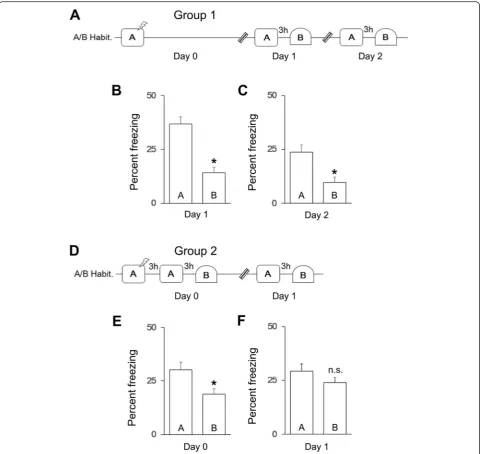
First, we examined whether mice in Group 1 (Fig. 1a,n = 15) discriminate between contexts A and B (Additional file 1: Figure S1) 24 h after training in context A. We found that mice exhibited an increase in freezing in con-text A after training (Ahabituation< Aday1, paired t-test,
t(14) = 9.3, p< 0.0001, data not shown). Mice also showed greater freezing in context A than in context B on both day 1 and day 2 (Fig. 1b–c, context × day ANOVA, main effect of context, F(1,14) = 64.3, p< 0.01; post-hoc analysis, Aday1> Bday1, pairedt-test,t(14) = 7.5,
* Correspondence:[email protected]
†Equal contributors
1International Institute for Integrative Sleep Medicine (WPI-IIIS), University of
Tsukuba, Tsukuba, Japan
Full list of author information is available at the end of the article
© 2016 Fujinaka et al.Open AccessThis article is distributed under the terms of the Creative Commons Attribution 4.0 International License (http://creativecommons.org/licenses/by/4.0/), which permits unrestricted use, distribution, and reproduction in any medium, provided you give appropriate credit to the original author(s) and the source, provide a link to the Creative Commons license, and indicate if changes were made. The Creative Commons Public Domain Dedication waiver (http://creativecommons.org/publicdomain/zero/1.0/) applies to the data made available in this article, unless otherwise stated. Fujinakaet al. Molecular Brain (2016) 9:2
p< 0.001, Aday2> Bday2, paired t-test, t(14) = 6.6, p< 0.001), although some degree of forgetting was observed across days (context × day interaction, F(1,14) = 11.93,p < 0.01, main effect of day,F(1,14) = 23.5,p< 0.005; post-hoc analysis, Aday1> Aday2, paired t-test, t(14) = 9.3, p< 0.001). These results suggest that context exposure 24 h after training does not induce memory generalization.
Next, we examined whether exposure to contexts A and B at an earlier time point after training induces generalization in mice in Group 2 (Fig. 1d, n= 30). We found that mice exhibited an increase in freezing in
context A after training (Ahabituation< Aday0, paired t-test,
t(29) = 9.9,p< 0.0001, data not shown). Although mice ex-hibited higher levels of freezing in context A than in con-text B on both day 0 and day 1 (Fig. 1e–f, context × day ANOVA, main effect of context, F(1,29) = 16.7, p< 0.01), the pattern of freezing exhibited by mice in Group 2 on day 1 differed from that exhibited by mice in Group 1 on day 2 (compare Fig. 1f to c, group × context ANOVA, group × context interaction,F(1,43) = 4.1,p< 0.05). Specif-ically, whereas mice in Group 1 discriminated between contexts on day 2, mice in Group 2 showed generalization
on day 1 (Fig. 1f, post-hoc analysis, Aday1≅Bday1, pairedt -test, t(29) = 2.0, p> 0.05), indicating that the timing of context exposure after training affects generalization.
Furthermore, we found that generalization between contexts depends on habituation to the contexts before training, as the pattern of freezing on day 1 differed be-tween mice in Group 2 and mice in Group 8 (compare Fig. 1f and Additional file 1: Figure S2C, group × context ANOVA, group × context interaction, F(1,38) = 7.0, p< 0.05), which did not receive habituation (Additional file 1: Figure S2A-C, context × day ANOVA, main effect of context,F(1,9) = 29.2,p< 0.01, main effect of day,F(1,9) = 8.9, p< 0.05; post-hoc analysis, Aday0> Bday0, paired t -test,t(9) = 2.3, p< 0.05, Aday1> Bday1, paired t-test,t(9) = 3.3, p< 0.01). Together, these results suggest that mem-ory generalization depends on the familiarity and timing of context exposure after training.
Exposure to a familiar context soon after training induces generalization of contextual fear memory
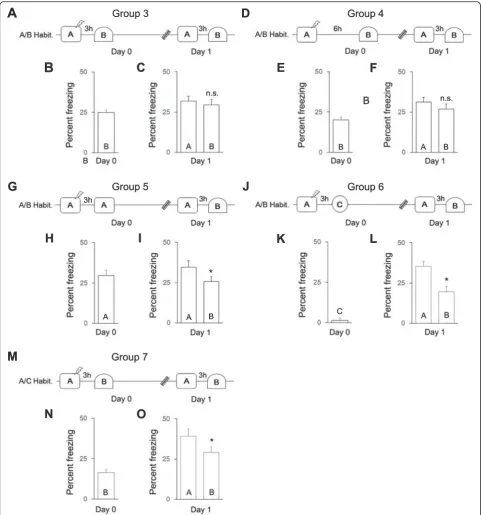
We further examined which aspects of context expos-ure induce memory generalization. We exposed mice in Group 3 (Fig. 2a, n= 12) to the familiar, uncondi-tioned context B 3 h after training and examined whether generalization occurred on day 1. The level of freezing in context B on day 0 was similar between mice in Group 3 and mice in Group 2 (compare Figs. 2b and 1e, independent samplest-test,t(40) = 1.9,
p> 0.05), suggesting that exposure to context A on day 0 did not affect the freezing response to context B on day 0. Also, mice in Group 3 exhibited comparable levels of freezing in contexts A and B on day 1 (Fig. 2c, paired t-test, t(11) = 0.70, p> 0.05), similar to that ob-served for mice in Group 2 on day 1 (compare Fig. 2c and 1f, group × context ANOVA, group × context interaction, F(1,40) = 0.4, p> 0.05), indicating that ex-posure to a familiar context 3 h after training results in generalization. Furthermore, when the order of context exposure on day 1 was reversed for mice in Group 9 (i.e., context B before context A; Additional file 1: Fig-ure S3A), generalization was still observed when con-text exposure occurred soon after training (Additional file 1: Figure S3C, Aday1≅Bday1, paired t-test, t(11) = 0.6, p> 0.05), similar to that observed for mice in Group 3 (compare Additional file 1: Figure S3C and 2C, group × context ANOVA, group × context inter-action,F(1,22) = 0.01,p> 0.05), indicating that memory generalization is unaffected by testing order.
Mice in Group 4 (Fig. 2d,n= 12) were exposed to con-text B 6 h after training (i.e., the same delay as in Group 2). Again, mice exhibited comparable levels of freezing in contexts A and B on day 1 (paired t-test,t(11) = 1.1,
p> 0.05), indicating that exposure to a familiar context 6 h after training also results in generalization.
Generalization did not occur when the conditioned and unconditioned contexts were highly dissimilar (Additional file 1: Figure S1, contexts A and C; Additional file 1: Figure S4, Group 10; Additional file 1: Figure S4C, Aday1> Cday1, paired t-test, t(12) = 6.8, p< 0.01). However, generalization still occurred when habituation time was reduced (Additional file 1: Figure S5, Group 11; Additional file 1: Figure S5C, Aday1≅Bday1, paired t-test, t(11) = 1.4,
p> 0.05), when habituation occurred 1 week before train-ing (Additional file 1: Figure S6, Group 12; Additional file 1: Figure S6C, Aday1≅Bday1, paired t-test,t(10) = 0.5, p> 0.05), and when habituation occurred only in the uncondi-tioned context (Additional file 1: Figure S7, Group 13; Additional file 1: Figure S7C, Aday1≅Bday1, paired t-test,
t(10) = 1.4, p> 0.05). Together, these results suggest that exposure to a familiar, unconditioned context soon after learning (i.e., within 6 h) induces memory generalization.
Next, we examined whether exposure to the condi-tioned context 3 h after training induces generalization in mice in Group 5 (Fig. 2g,n= 12). Although mice in Group 5 showed more freezing in context A than in context B on day 1 (Fig. 2i, pairedt-test, t(11) = 1.9,p< 0.05), the level of discrimination on day 1 was similar to that of Group 3 (compare Fig. 2i and c, group × context ANOVA, group × context interaction,F(1,40) = 0.4,p> 0.05), suggesting that exposure to a pre-habituated conditioned context soon after learning induces modest generalization.
Furthermore, we examined whether exposure to a novel context 3 h after training induces generalization. Mice in Group 6 (Fig. 2j,n= 10) were habituated to con-texts A and B and then exposed to a novel and highly dissimilar context C after training. These mice exhibited a low level of freezing in context C on day 0 (Fig. 2 k) compared to mice in context B, Group 3 on day 0 (com-pare Fig. 2b and k, independent samples t-test, t(20) = 9.5, p < 0.01). They also showed greater freezing in con-text A than in concon-text B on day 1 (Fig. 2l, paired t-test,
t(9) = 3.4, p< 0.005), in contrast to mice in Group 3 on day 1 (compare Fig. 2l and c, group × context ANOVA, group × context interaction, F(1,20) = 5.6, p< 0.05), sug-gesting that exposure to a novel, dissimilar context soon after training does not induce generalization. Mice in Group 7 (Fig. 2m,n= 12) were habituated to contexts A to C and then exposed to a novel but similar context B after training. These mice showed less freezing in context B on day 0 compared with mice in Group 3 (compare Fig. 2n and b, independent samplest-test,t(22) = 1.8,p< 0.05), indicating a reduced freezing response to an un-familiar context after training. However, although mice in Group 7 exhibited greater freezing in context A than in context B on day 1 (Fig. 2o, pairedt-test,t(11) = 2.0, p< 0.05), the level of discrimination on day 1 was similar between mice in Group 7 and mice in Group 3 (compare Fig. 2o and c, group × context ANOVA, group × context
interaction,F(1,22) = 1.6,p> 0.05), suggesting that expos-ure to a novel but similar context soon after learning in-duces modest generalization.
Finally, as further support for our findings that expos-ure to a familiar context soon after learning induces generalization, we calculated discrimination indices for
mice in Groups 1–7 (Additional file 1: Figure S8) [6, 8]. We found that mice in Groups 1 and 6 showed equiva-lently high discrimination indices (post-hoc analyses, independent-samplest-test,t(23) = 1.3,p> 0.05), whereas all other groups of mice showed lower discrimination indices than mice in Group 1 (group ANOVA, main
effect of group,F(6,96) = 4.0, p< 0.01; post-hoc analyses, independent-samplest-tests,ps< 0.05).
Discussion
We identified two important factors influencing whether fear memory generalizes to a non-fearful context. We found that both the timing of context exposure after fear learning and the familiarity of those contexts affect whether fear memory generalizes to a neutral context in which no aversive events happened. Specifically, our find-ings suggest that exposure to a familiar, unconditioned context soon after learning (i.e., within 6 h) but not long after learning (i.e., 24 h) induces memory generalization.
Recently, a considerable amount of evidence suggests that memory retrieval can trigger a second wave of consoli-dation processes that can either render the original mem-ory liable to disruption [20] or strengthen the original memory [21]. This process is called memory reconsolida-tion [22, 23]. From this perspective, one could consider that the generalization observed in Group 2 was due to ex-posure to a neutral context (i.e., context B) during the time window when the memory of a fearful context (i.e., context A) was being retrieved and reconsolidated (i.e., after re-exposure to context A after training). However, retrieval of a fearful memory does not appear to be a necessary condi-tion for generalizacondi-tion. That is, mice in Groups 3 and 4 ex-hibited generalization even though they were not re-exposed to context A after training. Also, mice in Group 1 did not show generalization even though they were ex-posed to context A after training. Therefore, it is more likely that exposure to a familiar but neutral context during the time window of initial fear memory consolidation (Group 3 and 4) or an interaction between initial consoli-dation and reconsoliconsoli-dation soon after learning (Group 2) leads to fear memory generalization.
After fear conditioning in one context, a fearful re-sponse to a second context could occur through two pos-sible routes. First, a fearful or threatening event could also occur in the second context that was initially neutral. Sec-ond, no explicit threats may occur in the second context, but a fear memory could generalize from the first context. For the first route, the formation of a contextual fear memory initially requires activation of N-methyl-D-aspar-tate (NMDA) receptors [24, 25], but the formation of a second fear memory in a different context is insensitive [26] or less sensitive to the inhibition of NMDA receptors in mice [27] and rats [28]. Therefore, it would be interest-ing to know whether the second route also requires activa-tion of NMDA receptors.
Generally, longer intervals between learning and treat-ments delivered after learning render those treattreat-ments less effective in altering memories [29, 30], which appears to hold true for the fear memory generalization observed in the present study. This time-limited effectiveness of
treatments that alter fear memory is also found in‘ behav-ioral tagging’, which occurs when weak training produces long-term memories when paired with an arbitrary behav-ioral event that induces protein synthesis [31–33]. How-ever, there are at least two differences between behavioral tagging and memory generalization. First, behavioral tag-ging addresses how a memory is formed and later expressed within a single context, whereas memory generalization addresses how a memory that was origin-ally formed in one context is later expressed in a second context. Second, the novelty of the intervention is neces-sary for behavioral tagging [32], whereas it is not essential for memory generalization, as found in the present study. However, it would be interesting for future studies to in-vestigate whether these phenomena share overlapping mechanisms.
Conclusions
Mice exhibit generalized fear responses after exposure to a familiar, unconditioned context soon after a fearful ex-perience. These findings increase our understanding of the conditions under which fear memory generalization occurs.
Methods Animals
Mice (C57BL/6; Jackson Laboratory) were bred in our colony at the University of Tsukuba and maintained on a 12-h light/dark cycle (lights on 9 am-9 pm) with ad libi-tum access to food and water. All mice were group-housed at 2–4 mice/cage, and only male mice were used in the experiments. Before behavioral experiments, all mice were handled for 2 min twice per day for 5 days. All experiments were performed during the light cycle and conducted in accordance with the Science Council of Japan’s Guidelines for Proper Conduct of Animal Ex-periments. Experimental protocols were approved by the Animal Care and Use Committee at the University of Tsukuba.
CFC
The contexts used in the CFC experiments were as pre-viously described [8] with some modifications (Add-itional file 1: Figure S1). Context A consisted of a stainless steel conditioning chamber (31 × 24 × 21 cm; MED Associates) containing a stainless steel grid floor. The grid floor was composed of bars (3.2 mm diameter) spaced 7.9 mm apart that allowed the delivery of electric shocks. Underneath the grid floor was a stainless steel drop pan, which was lightly cleaned with 75 % ethanol that also provided a background odor. The front, top, and back of the chamber were made of clear acrylic, and the two sides were made of aluminum panels. Context B was similar to context A except that the floor and sides of the
chamber were covered in white plastic sheets, and a piece of cardboard with a blue and white rectangular pattern was affixed to the front wall. Context C consisted of a cir-cular glass chamber (22 cm diameter) and a cardboard floor covered with the same bedding material as used in the home cages. Ethanol odor was not used in contexts B and C.
All mice received 3 consecutive days of habituation to allow familiarization to contexts A, B, or C prior to CFC (except for mice in Group 8, which did not receive ha-bituation). During each habituation session, mice were individually placed in a context for 5 min (except for mice in Group 11, which were placed in a context for 1 min) and then returned to their home cages. Habitu-ation consisted of two sessions per day (except for mice in Group 13, which received one session per day). The inter-session interval within days was approximately 3 h. The sequence of habituation sessions was pseudorando-mized (e.g., for A/B habituation, mice were exposed to context B and then context A on day−3, context A and then context B on day−2, and context B and then con-text A on day −1). For some mice (Groups 7 and 10), context C was used in place of context B, but other ex-perimental parameters (i.e., timing, exposure duration, etc.) were the same.
One day after habituation (day 0; except for mice in Group 12, which were trained 1 week after habitu-ation), mice underwent a training session, which con-sisted of receiving one electrical foot shock (0.5 mA, 2 s) 3 min after being placed in context A. Mice were returned to their home cages 2 min after the shock. After training, mice underwent multiple testing ses-sions at various time points, during which they were exposed to contexts A, B, or C for 3 min. The pres-ence of freezing in the testing contexts was used as a behavioral index of a context-fear association [34]. Freezing behavior was measured using an automated scoring system (Actimetrics), which digitized the video signal at 4 Hz and compared frame-by-frame changes in mouse position.
Freezing data were subject to statistical analysis. Ana-lysis of variance (ANOVA) or paired t-tests were used for within-group comparisons to determine the condi-tioning effect (e.g., freezing in context A before vs. after conditioning) and presence of context discrimination (e.g., freezing in context A vs. context B or C). Shapiro-Wilk tests were performed using SPSS software (IBM) to ensure that freezing data did not violate the assumption of normality for pairedt-tests. Mixed-design ANOVA or independent samples t-tests were used for between-group comparisons. For mice in Groups 1, 2, and 8, t -tests were accompanied by repeated measures ANOVA. Type I error was set at 0.05. Data are shown as mean ± standard error.
Additional file
Additional file 1: Figure S1.Front view of contexts A, B, and C. Pictures of contexts A (A), B (B), and C (C). Context A is similar to context B but dissimilar to context C.Figure S2.No fear generalization without habituation sessions. (A) Experimental timeline for mice in Group 8 (n= 10). Freezing in each context on (B) day 0 and (C) day 1. The double diagonal line in the timeline indicates a change in day, and the lightning bolt indicates the foot shock. Post-hoc analysis result: *p< 0.05.Figure S3.Fear generalization without dependency on test order. (A, D) Experi-mental timelines for mice in Group 9 (n= 12). Freezing in each context on (B) day 0 and (C) day 1 after training. A/B Habit. indicates habituation to contexts A and B before training. The double diagonal line in the time-lines indicates a change in day, and the lightning bolt indicates the foot shock. Post-hoc analysis result: n.s. = not significant.Figure S4.Fear dis-crimination after exposure to a familiar but highly dissimilar context. (A) Experimental timeline for mice in Group 10 (n= 13). Freezing in each context on (B) day 0 and (C) day 1 after training. A/C Habit. indicates ha-bituation to A and C before training. The double diagonal line in the timeline indicates a change in day, and the lightning bolt indicates the foot shock. Post-hoc analysis result: *p< 0.01.Figure S5.Fear generalization with shorter habituation sessions. (A) Experimental time-lines for mice in Group 11 (n= 12). Freezing in each context on (B) day 0 and (C) day 1 after training. A/B Habit. indicates habituation to contexts A and B before training. The double diagonal line in the timeline indicates a change in day, and the lightning bolt indicates the foot shock. Post-hoc analysis result: n.s. = not significant.Figure S6.Fear generalization with habituation sessions 1 week before training. (A) Experimental time-line for mice in Group 12 (n= 11). Freezing in each context on (B) day 0 and (C) day 1 after training. A/B Habit. indicates habituation to contexts A and B before training. The double diagonal line in the timeline indicates a change in day, and the lightning bolt indicates the foot shock. Post-hoc analysis result: n.s. = not significant.Figure S7.Fear generalization with habituation only to context B. (A) Experimental timeline for mice in Group 13 (n= 11). Freezing in each context on (B) day 0 and (C) day 1 after training. B Habit. indicates habituation to context B before training. The double diagonal line in the timeline indicates a change in day, and the lightning bolt indicates the foot shock. Post-hoc analysis result: n.s. = not significant.Figure S8.Discrimination indices. Discrimination index was calculated as (freezingcontextA- freezingcontextB)/max(freezingcontextA, freezingcontextB). The index is based on day 2 data for Group 1 and day 1 data for all other groups. Post-hoc analyses results: *p< 0.05, n.s. = not significant. (PDF 1217 kb)
Abbreviations
CFC:Contextual fear conditioning; NMDA: N-methyl-D-aspartate.
Competing interests
The authors declare that they have no competing interests.
Authors’contributions
Conceived of and designed the experiments: MS SHW. Performed the experiments: AF RL MH DK GC KN KM TN NK TS NK MS. Contributed tools: ML. Analyzed the data: MS SHW. Wrote the paper: MS SHW TS SN. All authors read and approved the final manuscript.
Acknowledgements
We thank Dr. Katherine Akers for critical comments on the manuscript. This work was partially supported by the World Premier International Research Center Initiative from the Japan Ministry of Education, Culture, Sports, Science, and Technology (MEXT); Japan Society for the Promotion of Science Grants-in-Aid for Scientific Research (KAKENHI grant numbers 26115502 and 25116530); Brain Science Foundation; Research Foundation for Opto-Science and Technology; Kato Memorial Bioscience Foundation; and Japan Founda-tion for Applied Enzymology to MS. University of Tsukuba to DK.
Author details
1International Institute for Integrative Sleep Medicine (WPI-IIIS), University of
Tsukuba, Tsukuba, Japan.2Department of Molecular Neuroscience and
Japan.3University of Toronto, Toronto, Canada.4Department of Adult Mental
Health, National Center of Neurology and Psychiatry, National Institute of Mental Health, Tokyo, Japan.5Centre for Clinical Brain Sciences, University of
Edinburgh, Edinburgh, UK.
Received: 1 June 2015 Accepted: 30 December 2015
References
1. Dudai Y. Memory from A to Z. Oxford: Oxford University Press; 2002. 2. Kostek JA, Beck KD, Gilbertson MW, Orr SP, Pang KC, Servatius RJ, et al.
Acquired equivalence in U.S. veterans with symptoms of posttraumatic stress: reexperiencing symptoms are associated with greater generalization. J Trauma Stress. 2014;27(6):717–20.
3. Lissek S, Biggs AL, Rabin SJ, Cornwell BR, Alvarez RP, Pine DS, et al.
Generalization of conditioned fear-potentiated startle in humans: experimental validation and clinical relevance. Behav Res Ther. 2008;46(5):678–87. 4. Bowers ME, Ressler KJ. An Overview of Translationally Informed Treatments
for Posttraumatic Stress Disorder: Animal Models of Pavlovian Fear Conditioning to Human Clinical Trials. Biol Psychiatry. 2015;78(5):E15–27. 5. McHugh TJ, Jones MW, Quinn JJ, Balthasar N, Coppari R, Elmquist JK, et al.
Dentate gyrus NMDA receptors mediate rapid pattern separation in the hippocampal network. Science. 2007;317(5834):94–9.
6. Arruda-Carvalho M, Sakaguchi M, Akers KG, Josselyn SA, Frankland PW. Posttraining ablation of adult-generated neurons degrades previously acquired memories. J Neurosci. 2011;31(42):15113–27.
7. Nakashiba T, Cushman JD, Pelkey KA, Renaudineau S, Buhl DL, McHugh TJ, et al. Young dentate granule cells mediate pattern separation, whereas old granule cells facilitate pattern completion. Cell. 2012;149(1):188–201. 8. Wang SH, Teixeira CM, Wheeler AL, Frankland PW. The precision of remote
context memories does not require the hippocampus. Nat Neurosci. 2009;12(3):253–5.
9. Winocur G, Moscovitch M, Sekeres M. Memory consolidation or transformation: context manipulation and hippocampal representations of memory. Nat Neurosci. 2007;10(5):555–7.
10. Biedenkapp JC, Rudy JW. Context preexposure prevents forgetting of a contextual fear memory: implication for regional changes in brain activation patterns associated with recent and remote memory tests. Learn Mem. 2007;14(3):200–3.
11. Houston FP, Stevenson GD, McNaughton BL, Barnes CA. Effects of age on the generalization and incubation of memory in the F344 rat. Learn Mem. 1999;6(2):111–9.
12. Lissek S, Bradford DE, Alvarez RP, Burton P, Espensen-Sturges T, Reynolds RC, et al. Neural substrates of classically conditioned fear-generalization in humans: a parametric fMRI study. Soc Cogn Affect Neurosci. 2014;9(8):1134–42. 13. Xu W, Sudhof TC. A neural circuit for memory specificity and generalization.
Science. 2013;339(6125):1290–5.
14. Wiltgen BJ, Zhou M, Cai Y, Balaji J, Karlsson MG, Parivash SN, et al. The hippocampus plays a selective role in the retrieval of detailed contextual memories. Curr Biol. 2010;20(15):1336–44.
15. Bakker A, Kirwan CB, Miller M, Stark CE. Pattern separation in the human hippocampal CA3 and dentate gyrus. Science. 2008;319(5870):1640–2. 16. Leutgeb JK, Leutgeb S, Moser MB, Moser EI. Pattern separation in the
dentate gyrus and CA3 of the hippocampus. Science. 2007;315(5814):961–6. 17. Wiltgen BJ, Silva AJ. Memory for context becomes less specific with time.
Learn Mem. 2007;14(4):313–7.
18. Pole N, Neylan TC, Otte C, Henn-Hasse C, Metzler TJ, Marmar CR.
Prospective prediction of posttraumatic stress disorder symptoms using fear potentiated auditory startle responses. Biol Psychiatry. 2009;65(3):235–40. 19. Suendermann O, Ehlers A, Boellinghaus I, Gamer M, Glucksman E. Early heart
rate responses to standardized trauma-related pictures predict posttraumatic stress disorder: a prospective study. Psychosom Med. 2010;72(3):301–8. 20. Nader K, Schafe GE, Le Doux JE. Fear memories require protein synthesis in the
amygdala for reconsolidation after retrieval. Nature. 2000;406(6797):722–6. 21. Lee JL. Memory reconsolidation mediates the strengthening of memories
by additional learning. Nat Neurosci. 2008;11(11):1264–6. 22. Nader K, Hardt O. A single standard for memory: the case for
reconsolidation. Nat Rev Neurosci. 2009;10(3):224–34.
23. Wang SH, Morris RG. Hippocampal-neocortical interactions in memory formation, consolidation, and reconsolidation. Annu Rev Psychol. 2010;61:49–79. C1-4.
24. Miserendino MJ, Sananes CB, Melia KR, Davis M. Blocking of acquisition but not expression of conditioned fear-potentiated startle by NMDA antagonists in the amygdala. Nature. 1990;345(6277):716–8.
25. Rodrigues SM, Schafe GE, LeDoux JE. Intra-amygdala blockade of the NR2B subunit of the NMDA receptor disrupts the acquisition but not the expression of fear conditioning. J Neurosci. 2001;21(17):6889–96. 26. Sanders MJ, Fanselow MS. Pre-training prevents context fear conditioning
deficits produced by hippocampal NMDA receptor blockade. Neurobiol Learn Mem. 2003;80(2):123–9.
27. Tayler KK, Lowry E, Tanaka K, Levy B, Reijmers L, Mayford M, et al. Characterization of NMDAR-Independent Learning in the Hippocampus. Front Behav Neurosci. 2011;5:28.
28. Wang SH, Finnie PS, Hardt O, Nader K. Dorsal hippocampus is necessary for novel learning but sufficient for subsequent similar learning. Hippocampus. 2012;22(11):2157–70.
29. Squire LR, Davis HP. The pharmacology of memory: a neurobiological perspective. Annu Rev Pharmacol Toxicol. 1981;21:323–56.
30. McGaugh JL. Memory–a century of consolidation. Science. 2000;287(5451):248–51. 31. Moncada D, Viola H. Induction of long-term memory by exposure to
novelty requires protein synthesis: evidence for a behavioral tagging. J Neurosci. 2007;27(28):7476–81.
32. Ballarini F, Moncada D, Martinez MC, Alen N, Viola H. Behavioral tagging is a general mechanism of long-term memory formation. Proc Natl Acad Sci U S A. 2009;106(34):14599–604.
33. Wang SH, Redondo RL, Morris RG. Relevance of synaptic tagging and capture to the persistence of long-term potentiation and everyday spatial memory. Proc Natl Acad Sci U S A. 2010;107(45):19537–42.
34. Blanchard RJ, Blanchard DC. Crouching as an index of fear. J Comp Physiol Psychol. 1969;67(3):370–5.
• We accept pre-submission inquiries
• Our selector tool helps you to find the most relevant journal • We provide round the clock customer support
• Convenient online submission • Thorough peer review
• Inclusion in PubMed and all major indexing services • Maximum visibility for your research
Submit your manuscript at www.biomedcentral.com/submit