www.atmos-meas-tech.net/3/1723/2010/ doi:10.5194/amt-3-1723-2010
© Author(s) 2010. CC Attribution 3.0 License.
Measurement
Techniques
A sensitivity analysis of Ring effect to aerosol properties
and comparison to satellite observations
T. Wagner1, S. Beirle1, T. Deutschmann2, and M. Penning de Vries1
1Max-Planck-Institute for Chemistry, Mainz, Germany
2Institute for Environmental Physics, University of Heidelberg, Heidelberg, Germany Received: 24 July 2010 – Published in Atmos. Meas. Tech. Discuss.: 19 August 2010 Revised: 7 December 2010 – Accepted: 10 December 2010 – Published: 16 December 2010
Abstract. In this study we explore the sensitivity of satellite
observations of the Ring effect (at various wavelengths) to at-mospheric aerosol properties. Compared to clouds, aerosols have a rather weak influence on the Ring effect, thus the re-quirements on the accuracy of the measurements and the ra-diative transfer simulations are high. In this study, we show that for moderate and high aerosol optical depth (AOD), Ring effect observations are sensitive enough to yield information not only on the AOD, but also on the absorbing properties of aerosols and the aerosol layer height. The latter two quan-tities are especially important for the determination of the radiative effects of aerosols.
Our investigations are based on observations by the satel-lite instrument SCIAMACHY on ENVISAT (2004–2008) and on model simulations using the Monte-Carlo radiative transfer model McArtim. In addition to the Ring effect we investigate the impact of aerosols on the absorptions of the oxygen molecule (O2) and dimer (O4) as well as the radi-ance. In general good consistency between measured and simulated quantities is found. In some cases also systematic differences occurred, which are probably mainly related to the strong polarisation sensitivity of the SCIAMACHY in-strument.
Our study indicates that Ring effect observations have im-portant advantages for aerosol retrievals: they can be anal-ysed with high accuracy in various wavelength ranges; and depending on the wavelength range, they show different sen-sitivities on aerosol properties like single scattering albedo, optical depth or layer height. The results of this study are of particular interest for future aerosol inversion algorithms for
Correspondence to: T. Wagner
satellite instruments with reduced polarisation sensitivity and smaller ground pixels, capable of measuring the Ring effect with higher accuracy.
1 Introduction
The Ring effect describes the so-called “filling-in” of solar Fraunhofer lines in the spectra of scattered sun light com-pared to direct sun light observations. It was first observed by Shefov (1959) and Grainger and Ring (1962). Today, it is commonly agreed that rotational Raman scattering on atmo-spheric molecules is the dominant source for the Ring effect (e.g. Kattawar et al., 1981; Solomon et al., 1987). The extent of the filling-in of Fraunhofer lines depends on the number of molecular scatter events, and hence, on the presence and properties of clouds and aerosols. The dominant effect of clouds and aerosols is that they shield the atmosphere below and thus reduce the probability of the observed photons being scattered by air molecules. The occurence of Raman scatter-ing therefore generally decreases with increasscatter-ing cloud alti-tude. Several algorithms for the determination of cloud top pressure from satellite observations of the Ring effect were developed in recent years and were successfully applied to observations from the TOMS, GOME, and OMI instruments (Park et al., 1986; Joiner et al., 1995, 2002, 2004, 2010; Joiner and Bhartia, 1995; de Beek et al., 2001; Joiner and Vasilkov, 2006; van Deelen et al., 2008).
1724 T. Wagner et al.: Sensitivity of Ring effect to aerosol properties In principle, aerosols influence atmospheric radiative
transfer in a similar way as clouds do, but the influence of aerosols is usually much weaker, because aerosols usually have much smaller optical depth (AOD) and are typically located close to the surface. Another important difference between clouds and aerosols is that especially in the UV aerosols can absorb a significant fraction of the solar radi-ation.
Three basic effects of aerosols can be distinguished (see also Fig. 1)
a. Albedo effect
Due to the enhanced scattering caused by the aerosol particles, the light path lengths in the lower atmosphere are increased compared to the aerosol-free case. Since this effect is very similar to the influence of an increased surface albedo it is often referred to as albedo effect. As we will show later, the influence of the albedo effect on the Ring effect is fundamentally different compared to that on the absorptions of O2and O4(see also Sect. 4.3). It should be also noted that, in contrast to the effect of clouds, in the presence of aerosols the backscattered ra-diance can be even smaller than for the aerosol-free case (for strongly absorbing aerosols with a single scattering albedo smaller than about 0.8).
b. Shielding effect
Additional aerosol scattering shields the atmosphere be-low, leading to a decrease of the strength of the Ring effect and also of trace gas absorptions like those of O2 and O4.
c. Aerosol absorption
For strongly absorbing aerosols in many cases the shielding effect can become especially strong, because radiation from below the aerosol layer is partly absorbed by the aerosols. Also the atmospheric light path lengths are reduced by aerosol absorption.
In this paper, we systematically investigate the effects of aerosols on various retrieved quantities: besides the Ring ef-fect at different wavelengths, also the absorptions of O2and O4, and on the measured radiance are investigated. Since the observed quantities also strongly depend on the satel-lite’s viewing geometry, the effects of viewing angle and so-lar zenith angle are also investigated. It should be noted that similar initial studies have been conducted by Vasilkov and co-workers (2006).
Whenever possible, we use both, measurements and model simulations to determine the dependencies of the observed quantities on aerosol properties and viewing geometry. This is performed for the effects of AOD, aerosol layer height, viewing angle and solar zenith angle. The influence of the aerosol single scattering albedo (SSA) and asymmetry pa-rameter (g) is investigated only by radiative transfer simula-tions.
Figures
A B C D
Fig. 1 Basic effects of aerosols on the atmospheric radiative transfer. Albedo effect: compared to an aerosol-free atmosphere (A), in the presence of aerosols the effective earth’s albedo is increased leading to a higher probability of the observed photons to have ‘seen’ the lower atmosphere (B). Shielding effect: additional scattering by aerosols causes a reduction of the light path lengths below the aerosol layer (C). In contrast to clouds, aerosols with single scattering <1 may also absorb a substantial fraction of the solar photons (D).
Fig. 1. Basic effects of aerosols on the atmospheric radiative trans-fer. Albedo effect: compared to an aerosol-free atmosphere (A), in the presence of aerosols the effective earth’s albedo is increased leading to a higher probability of the observed photons to have “seen” the lower atmosphere (B). Shielding effect: additional scat-tering by aerosols causes a reduction of the light path lengths be-low the aerosol layer (C). In contrast to clouds, aerosols with single scattering<1 may also absorb a substantial fraction of the solar photons (D).
The paper is organised as follows: in Sect. 2 information on the SCIAMACHY instrument and the algorithms for the retrieval of the Ring effect, the O2and O4absorptions, and the normalised radiance is presented. Section 3 introduces the radiative transfer model, which is used for the simula-tion of the measured quantities. In Sect. 4, the modelled and measured dependencies of the Ring effect and O2 and O4 absorptions on the observational geometry (solar zenith an-gle and viewing anan-gle) and aerosol properties (AOD, SSA,
g, and layer height) are discussed. Section 5 presents a sum-mary of the main findings of our study and an outlook on future applications.
2 Instrument and data analysis
We chose observations of the satellite instrument SCIA-MACHY on ENVISAT (Burrows et al., 1995, Bovensmann et al., 1999) for this study, because it provides continuous spectra of the earth shine radiance with moderate spectral resolution. Thus the Ring effect can be analysed with high accuracy in different spectral ranges. In addition, absorptions by O4and O2can be analysed.
It should be noted that continuous spectra with moderate spectral resolution are also available from other satellite in-struments like GOME-1 on ERS-2, GOME-2 on METOP, and OMI on AURA. Of these instruments, OMI would be the most suitable for the analysis of the Ring effect, due to its high spatial resolution and the fact that it is almost in-sensitive to polarisation. However, because the instrument’s spectral range ends at 500 nm, no measurement of the O2 absorption in the red and near IR spectral range is possible. We therefore used SCIAMACHY for this study, as it has the next-best spatial resolution.
2.1 SCIAMACHY instrument
In 2002 the SCanning Imaging Absorption SpectroMeter for Atmospheric ChartographY (SCIAMACHY) (Burrows et al., 1995; Bovensmann et al., 1999) was launched on board of ENVISAT. It consists of a set of eight spectrome-ters that simultaneously measure sunlight reflected from the Earth’s surface and atmosphere. SCIAMACHY’s eight spec-tral windows cover the wavelength range between 240 nm and 2380 nm with moderate spectral resolution (0.2–1.2 nm full width at half maximum, FWHM). The satellite oper-ates in a nearly polar, sun-synchronous orbit at an altitude of about 800 km with a local equator crossing time at approx-imately 10:00 a.m. While the satellite orbits in an almost north-south direction, the SCIAMACHY instrument scans the surface in the perpendicular, east-west direction during daytime. Global coverage is achieved after 6 days at the equator. At higher latitudes better coverage is achieved be-cause of the partial overlap of neighbouring orbits. SCIA-MACHY operates in different viewing modes: nadir, limb, and occultation. In the standard operation mode, alternat-ing limb and nadir measurements are performed. In this study, only nadir observations with a ground pixel size of 30×60 km2are used. Due to this rather coarse spatial reso-lution, the probability for cloud contamination is rather high (Krijger et al., 2007). This constitutes an important limitation for the retrieval of aerosol properties from SCIAMACHY.
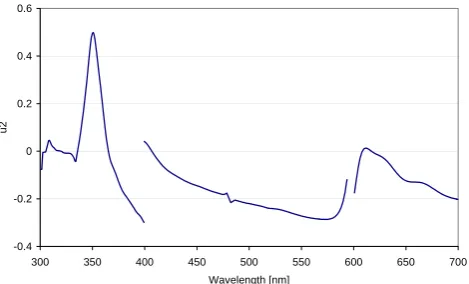
Another important property of the SCIAMACHY instru-ment is its strong polarisation sensitivity. As shown in Fig. 2, this sensitivity varies with wavelength and is especially high in the UV spectral range. Because the spectral features of polarisation and the Ring effect are highly correlated (see e.g. Aben et al., 2003), the retrieval of the Ring effect is af-fected by the (varying) degree of polarisation of the measured scattered sun light. This problem is further complicated by the fact that the polarisation sensitivity of SCIAMACHY also changes with time.
2.2 Data analysis
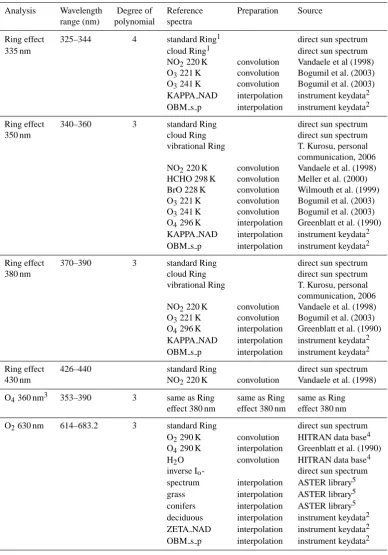
The raw satellite spectra are analysed using differential op-tical absorption spectroscopy (DOAS, see Platt and Stutz, 2008). For the analysis of the Ring effect and of O2 and O4 absorption, we selected spectral intervals in which the relevant reference spectrum shows strong and characteristic spectral features. In addition, spectra of all other relevant spectral features in the respective wavelength ranges (trace gas absorptions, Ring spectra, and instrumental features) are included in the spectral fitting procedure. To account for broad band spectral dependencies of surface reflection and scattering on aerosols and cloud particles, a low order poly-nomial is included. The specific settings and the reference spectra for the different spectral analyses are summarised in Table 1 and described in detail in the following sub-sections.
-0.4 -0.2 0 0.2 0.4 0.6
300 350 400 450 500 550 600 650 700
Wavelength [nm]
u2
Fig. 2 Illustration of the wavelength dependent polarisation sensitivity of the SCIAMACHY instrument. Displayed is the so-called u2-vector, the ratio of the Müller matrix elements for one polarisation direction and unpolarised light [Slijkhuis et al., 1999]. The u2 vector is based on the version 3.1 keydata [Noël et al., 2005].
Fig. 2. Illustration of the wavelength dependent polarisation sensi-tivity of the SCIAMACHY instrument. Displayed is the so-called
u2-vector, the ratio of the M¨uller matrix elements for one polarisa-tion direcpolarisa-tion and unpolarised light (Slijkhuis et al., 1999). Theu2 vector is based on the version 3.1 keydata (No¨el et al., 2005).
2.2.1 Ring effect analysis
The analysis of the Ring effect is performed in four differ-ent fitting windows in the UV and the blue part of the spec-trum, where the filling-in of the solar Fraunhofer lines is particularly strong. The different analyses are referred to as 335 nm, 350 nm, 380 nm, and 430 nm, according to the centre of the chosen wavelength range, as given in Table 1. Apart from the different wavelength ranges, also different choices of reference spectra are used. For the analyses at 335 nm, 350 nm, and 380 nm more than one Ring spectrum was included in the spectral fitting procedure: in addition to the “standard” Ring spectrum, calculated for a pure Rayleigh scattering atmosphere, a second Ring spectrum representa-tive for the presence of clouds and aerosols was included (for details see Wagner et al., 2009a). For the analyses at 350 nm and 380 nm, a Ring spectrum for vibrational Raman scattering in water was also included (Vasilkov et al., 2002; Vountas et al., 2003). Since these additional Ring spectra show a high degree of correlation to the “standard” Ring spectrum, they were ortho-normalised with respect to the standard Ring spectrum prior to the spectral fitting proce-dure. This ortho-normalisation was performed for the differ-ent wavelength ranges in such a way that at the wavelengths of interest (335 nm, 350 nm, 380 nm) the amplitudes of the ortho-normalised Ring spectra have their minimum. Thus the fit coefficient of the standard Ring spectrum directly yields the strength of the Ring effect (Wagner et al., 2009a).
1726 T. Wagner et al.: Sensitivity of Ring effect to aerosol properties
Table 1. Overview on the selected parameters for the different spectral analyses.
Analysis Wavelength Degree of Reference Preparation Source
range (nm) polynomial spectra
Ring effect 325–344 4 standard Ring1 direct sun spectrum
335 nm cloud Ring1 direct sun spectrum
NO2220 K convolution Vandaele et al (1998) O3221 K convolution Bogumil et al. (2003) O3241 K convolution Bogumil et al. (2003) KAPPA NAD interpolation instrument keydata2 OBM s p interpolation instrument keydata2
Ring effect 340–360 3 standard Ring direct sun spectrum
350 nm cloud Ring direct sun spectrum
vibrational Ring T. Kurosu, personal
communication, 2006 NO2220 K convolution Vandaele et al. (1998) HCHO 298 K convolution Meller et al. (2000) BrO 228 K convolution Wilmouth et al. (1999) O3221 K convolution Bogumil et al. (2003) O3241 K convolution Bogumil et al. (2003) O4296 K interpolation Greenblatt et al. (1990) KAPPA NAD interpolation instrument keydata2 OBM s p interpolation instrument keydata2
Ring effect 370–390 3 standard Ring direct sun spectrum
380 nm cloud Ring direct sun spectrum
vibrational Ring T. Kurosu, personal
communication, 2006 NO2220 K convolution Vandaele et al. (1998) O3221 K convolution Bogumil et al. (2003) O4296 K interpolation Greenblatt et al. (1990) KAPPA NAD interpolation instrument keydata2 OBM s p interpolation instrument keydata2
Ring effect 426–440 standard Ring direct sun spectrum
430 nm NO2220 K convolution Vandaele et al. (1998)
O4360 nm3 353–390 3 same as Ring same as Ring same as Ring
effect 380 nm effect 380 nm effect 380 nm
O2630 nm 614–683.2 3 standard Ring direct sun spectrum
O2290 K convolution HITRAN data base4 O4290 K interpolation Greenblatt et al. (1990)
H2O convolution HITRAN data base4
inverse Io- direct sun spectrum
spectrum interpolation ASTER library5
grass interpolation ASTER library5
conifers interpolation ASTER library5 deciduous interpolation instrument keydata2 ZETA NAD interpolation instrument keydata2 OBM s p interpolation instrument keydata2
1see Sct. 2.2.1
2http://www.iup.physik.uni-bremen.de/sciamachy/SCIA CAL/rad cal.html
3For simplicity the two band analysis (360 nm and 380 nm) is referred to as 360 nm analysis throughout the study, the O
4cross section was scaled by 1.3 (see Wagner et al., 2009b;
Cl´emer et al., 2010).
4Rothman et al. (2004) 5http://speclib.jpl.nasa.gov/
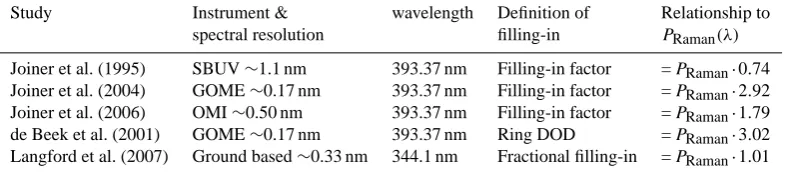
Table 2. Relationship between the Raman scattering probability (RSP) and other definitions of the filling-in (see also Wagner et al., 2009a)
Study Instrument & wavelength Definition of Relationship to
spectral resolution filling-in PRaman(λ)
Joiner et al. (1995) SBUV∼1.1 nm 393.37 nm Filling-in factor =PRaman·0.74 Joiner et al. (2004) GOME∼0.17 nm 393.37 nm Filling-in factor =PRaman·2.92 Joiner et al. (2006) OMI∼0.50 nm 393.37 nm Filling-in factor =PRaman·1.79 de Beek et al. (2001) GOME∼0.17 nm 393.37 nm Ring DOD =PRaman·3.02 Langford et al. (2007) Ground based∼0.33 nm 344.1 nm Fractional filling-in =PRaman·1.01
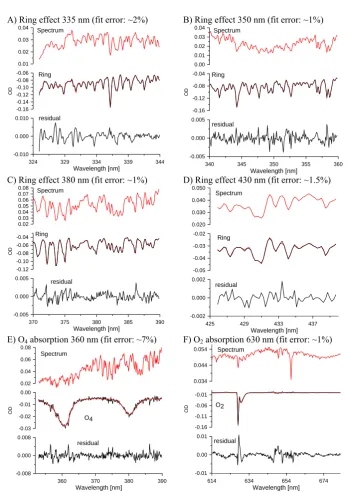
dependence of the amplitude of the Ring effect is small and thus only one Ring spectrum was included. These simpli-fied settings allowed a very stable and fast algorithm. This algorithm should, however, be used only over the continents, because the Ring spectrum for vibrational Raman scattering in water was not included. Examples of the different Ring analyses are presented in Fig. 3.
The derived fit coefficient of the normalised Ring spec-trum directly yields the so-called Raman scattering proba-bility (RSP; see Wagner et al., 2009a), which describes the probability for an observed photon to have been Raman-scattered on air molecules in the atmosphere (see also Eq. 3). The advantage of using the RSP compared to other defini-tions for the strength of the Ring effect (see e.g. Joiner et al., 1995a,b; deBeek et al., 2001; Langford et al., 2007) is that it is independent on the specific choice of a Fraunhofer line and in particular also on the spectral resolution of the instrument. The RSP is directly proportional to the filling-in calculated from other definitions of the filling in and can be easily converted into these definitions (for details see Wagner et al., 2009a). Conversion factors for selected definitions of the filling in are given in Table 2.
Another advantage of the RSP is that it can directly be compared to the results of the radiative transfer simulations (the fit coefficient of the normalised Ring spectrum, see Sect. 3).
The uncertainty (standard deviation) of the retrieved Ring results is calculated from the fit residuals of the spectral anal-ysis. For the Ring analyses this uncertainty is very small (typically between 1% and 2%). As mentioned before, for SCIAMACHY observations the Ring effect analysis might by systematically affected by the polarisation sensitivity of the instrument. Thus the errors derived from the fit residuals are probably a lower limit of the actual accuracy of the SCIA-MACHY Ring effect retrievals. However, for satellite instru-ments, which are not sensitive to polarisation (like e.g. OMI), the fit errors represent the true accuracy of the Ring retrieval. Expressed as Raman scattering probability (RSP) the accu-racy of Ring effect analyses ranges between about 0.0003 for 430 nm and 0.001 for 335 nm.
2.2.2 O4analysis
The analysis of the O4 absorption is performed in the UV and includes two absorption bands (at 360 nm and 380 nm). In principle, O4 absorption bands in the visible part of the spectrum could also be used (see e.g. Greenblatt et al., 1990). In this study we did not analyse further O4bands, be-cause at 477 nm the SCIAMACHY instrument suffers from strong spectral features due to its polarisation sensitivity (see Fig. 2), which interfere with the O4analysis. At larger wave-lengths (577 nm, 630 nm), spectral interference with strong absorptions of O2, O3, and H2O can lead to problems. These problems might be solved in future analyses by using satellite instruments without pronounced spectral polarisation sensi-tivities and improved absorption cross sections for the atmo-spheric O2and H2O absorptions.
The spectral analysis yields the so-called slant column density (SCD), the trace gas concentration integrated along the atmospheric light paths. For the comparison with radia-tive transfer simulations, the O4SCD is divided by the ver-tically integrated O4concentration (vertical column density, VCD), which is calculated from standard temperature and pressure profiles (United States Committee on Extension to the Standard Atmosphere, 1976). In our study, an O4VCD of 1.3×1043molec2/cm5was used (for the units of the O4 column density, see e.g. Greenblatt et al., 1990). The ratio between SCD and VCD yields the air mass factor (AMF):
AMF =SCD/VCD (1)
It can be directly compared to the AMF derived from the ra-diative transfer modelling (see Sect. 3). It should be noted that for the O4 analysis the selected wavelength range in-cludes not only the absorption band at 360 nm but also the weaker absorption band at 380 nm. This extended wave-length range was chosen to minimise fit uncertainties (which are typically on the order of 5% to 10%). An example for the spectral analysis is presented in Fig. 3.
1728 T. Wagner et al.: Sensitivity of Ring effect to aerosol properties A) Ring effect 335 nm (fit error: ~2%)
324 329 334 339 344
Wavelength [nm]
0.01 0.02 0.03 0.04
-0.16 -0.14 -0.12 -0.10 -0.08 -0.06
OD
-0.010 0.000 0.010
Spectrum
Ring
residual
B) Ring effect 350 nm (fit error: ~1%)
340 345 350 355 360
Wavelength [nm]
0.00 0.01 0.02 0.03 0.04
-0.16 -0.12 -0.08 -0.04
OD
-0.005 0.000 0.005
Spectrum
Ring
residual
C) Ring effect 380 nm (fit error: ~1%)
370 375 380 385 390
Wavelength [nm]
0.02 0.03 0.04 0.05 0.06 0.07 0.08
-0.12 -0.10 -0.08 -0.06 -0.04
OD
-0.005 0.000 0.005
Spectrum
Ring
residual
D) Ring effect 430 nm (fit error: ~1.5%)
425 429Wavelength [nm]433 437
0.020 0.030 0.040 0.050
-0.05 -0.04 -0.03 -0.02
-0.002 0.000 0.002
Spectrum
Ring
residual
E) O4 absorption 360 nm (fit error: ~7%)
360 370 380 390
Wavelength [nm]
0.02 0.04 0.06 0.08
-0.03 -0.02 -0.01 0.00
OD
-0.008 0.000 0.008
Spectrum
O4
residual
F) O2 absorption 630 nm (fit error: ~1%)
614 634 654 674
Wavelength [nm]
0.034 0.044 0.054
-0.16 -0.11 -0.06 -0.01
OD
-0.01 0.00 0.01
Spectrum
O2
residual
Fig. 3 Fit results of the spectral analyses of the Ring effect in different wavelength ranges (A to D) and the O2 and O4 absorptions (E, F). In each graph, the top panels show the measured
raw spectra; the middle panels show the respective reference spectra (red) and the retrieved signature from the spectral analysis (black); the bottom panels show the spectral residuals.
Fig. 3. Fit results of the spectral analyses of the Ring effect in different wavelength ranges (A–D) and the O2and O4absorptions (E, F). In each graph, the top panels show the measured raw spectra; the middle panels show the respective reference spectra (red) and the retrieved signature from the spectral analysis (black); the bottom panels show the spectral residuals.
between 360 nm and 380 nm), no exact agreement between measurements and radiative transfer simulations can be ex-pected. Additional discrepancies can be caused by the uncer-tainty of the O4cross section and its temperature dependence (see e.g. Wagner et al., 2009b and Cl´emer et al., 2010).
2.2.3 O2analysis
The O2absorption is analysed at 630 nm; details of the anal-ysis can be found in Wagner et al. (2007). An example of the spectral analysis is shown in Fig. 3. The uncertainty of the spectral analysis is typically about 1%. Like for the O4 anal-ysis, we calculated AMFs from the measured O2SCDs using Eq. (1). For the O2VCD a value of 4.68×1024molec/cm2 is used, calculated from pressure and temperature profiles of
the US standard atmosphere (United States Committee on Extension to the Standard Atmosphere, 1976). Because of the limited spectral resolution of the SCIAMACHY instru-ment, the strong and fine-structured atmospheric O2 absorp-tion can not be fully resolved. Thus a non-linear relaabsorp-tion- relation-ship between the measured absorption (optical depth) and the atmospheric slant column density arises, which is typically referred to as saturation, see e.g. Wagner et al. (2003). In this study we did not correct the saturation effect for the ob-served O2absorptions, but instead applied a respective cor-rection for the results of the radiative transfer simulations (see Sect. 3).
It should be noted that also the O2A band (around 760 nm) could be used for the retrieval of aerosol properties (e.g. Kop-pers et al., 1997; Stephens and Heidinger, 2000; Heidinger and Stephens, 2000; Boesche et al., 2008; Dubuisson et al., 2009). An important advantage of O2 A band observations is that because of the strong absorption they can in principle be analysed with high accuracy (although a rather high ac-curacy of about 1% is also achievable for the O2absorption at 630 nm, see Fig. 3). Another advantage is that depending on the absorption strength of individual lines the light ob-served by the satellite has “seen” different altitude layers of the atmosphere, making O2A band measurements especially sensitive to the vertical profile (Koppers et al., 1997). How-ever, because of the much stronger absorption compared to 630 nm, no simple DOAS retrieval can be performed for the O2A band. Thus we did not include an analysis of the O2A band in this study.
It should be noted that the retrieval of information on aerosols close to the surface is mainly based on the weaker parts of the O2A band, for which the observed light has ac-tually penetrated into the near-surface layers of the atmo-sphere. To compare the potential of O2 A band observa-tions for aerosol retrievals to the results for O2absorptions at 630 nm, we included radiative transfer results for the weaker parts of the O2A band in this study (see Sect. 3).
2.2.4 Analysis of the normalised radiance
The SCIAMACHY observations provide spectra of the ra-diance (I) scattered by the atmosphere and reflected by the Earth’s surface and of the direct solar irradiance (F). From these measurements the normalised radiance can be calcu-lated according to the following formula:
Inormalised =
I · π
F (2)
Here it should be noted that in many studies the definition of the normalised radiance also considers the effect of changing solar position (by dividingInormalised in Eq. 2 by the cosine of the solar zenith angle). In this study we did not apply such a correction, because we are interested in the direct de-pendence of the (normalised) radiance on aerosol properties (instead of the dependence of the albedo at the top of the atmosphere).
Rayleigh scattering
hνin= hνout
Raman scattering
hνin
≠
hνoutAerosol scattering
hνin= hνout
Surface reflection
hνin= hνout
surface Rayleigh
scattering
hνin= hνout
Raman scattering
Aerosol scattering
hνin= hνout
Surface reflection
hνin= hνout
hνin
≠
hνoutsurface
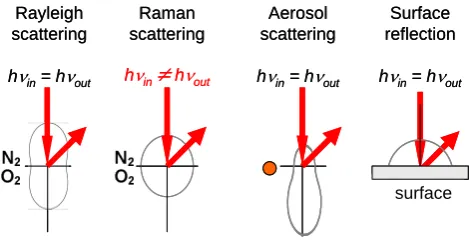
Fig. 4 Angular dependence of different types of scattering and reflection. Compared to Rayleigh scattering and aerosol scattering the angular dependence of rotational Raman scattering is weak. Thus, for a scattering angle of 90° the relative contribution of Raman scattering (and thus the Ring effect) is strongest.
Fig. 4. Angular dependence of different types of scattering and re-flection. Compared to Rayleigh scattering and aerosol scattering the angular dependence of rotational Raman scattering is weak. Thus, for a scattering angle of 90◦the relative contribution of Raman scat-tering (and thus the Ring effect) is strongest.
We extracted the normalised radiance for most of the wavelengths for which also the Ring effect and the O2 ab-sorption were analysed: 335 nm, 350 nm, 380 nm, 430 nm, 630 nm. For the extraction of the normalised radiance from SCIAMACHY (including the correction of the polarisation dependence of the instrument), the so-called M¨uller-matrix approach was used (Lichtenberg et al., 2006).
3 Radiative transfer simulations
The radiative transfer simulations are performed using the full spherical Monte-Carlo radiative transfer model McAr-tim (Deutschmann, 2009; Deutschmann and Wagner, 2008). The model allows the simulation of ensembles of individual photon trajectories for a given atmospheric situation. From these trajectories the probability of the modelled photons for certain interactions with atmospheric constituents or with the Earth’s surface are determined. The scattering events are modelled individually, according to their respective scatter-ing cross sections and phase functions (see Fig. 4). Interac-tion with the Earth’s surface is treated as a Lambertian re-flection for a specified ground albedo. In addition to elas-tic processes (the reflection at the surface, Rayleigh scatter-ing at molecules, and scatterscatter-ing on aerosol and cloud parti-cles), also rotational Raman scattering events are simulated, allowing to model the Ring effect with McArtim (Wagner et al., 2009a). The simulation results of McArtim were in de-tail compared to other studies (for radiances and AMFs, see Wagner et al., 2007; for the Ring effect, see Wagner et al., 2009a), and good agreement was found.
1730 T. Wagner et al.: Sensitivity of Ring effect to aerosol properties which are relevant for this study. Fortunately, as was shown
by Landgraf et al. (2004) (see also discussion in Spurr et al., 2008), that the strength of the filling-in is only weakly af-fected by the neglect of polarisation, because the phase func-tion for Raman scattering depends only weakly on polarisa-tion, and because in the UV a Raman-scattered photon has typically also undergone Rayleigh-scattering events before or after the Raman scattering event. Thus, systematic errors of the elastic and inelastic contributions of the observed radi-ance are similar and mainly cradi-ancel out when the ratio (i.e. the filling in) is calculated.
Our model differs from the model used by Landgraf et al. (2004): instead of the Raman scattered radiance, the prob-ability of an observed photon to have undergone Raman scat-tering is simulated. Nevertheless, the same arguments hold also for our model: the probability for Rayleigh scattering and that for Raman scattering are affected in the same way by the neglect of polarisation; thus for the calculation of the Raman scattering probability these errors almost cancel out. This rationale is supported by the good quantitative agree-ment of our model results with results of other models (see Wagner et al., 2009a).
Various model runs are performed for different atmo-spheric scenarios (different aerosol loads and optical prop-erties) and viewing geometries (varying solar zenith angles, viewing angles and relative azimuth angles). The surface albedo was set to 5% for the UV and blue spectral range and to 10% and 20% for 630 nm and 758 nm, respectively (see e.g. Herman and Celarier et al., 1997; Koelemeijer et al., 2003; Kleipool et al., 2008).
Note that no specific aerosol models were used in our study to describe the aerosol properties and especially their wavelength dependencies. Instead we simply varied the aerosol optical properties separately for each wavelength: the single scattering albedo (SSA), asymmetry parameter (g, us-ing a Henyey-Greenstein approximation of the aerosol phase function; Henyey and Greenstein, 1941), and vertical pro-files of the aerosol extinction. In this way the relationship between these optical properties and the measured quanti-ties can be directly investigated. In cases where simula-tion results are directly compared to observasimula-tions, the wave-length dependence of the aerosol optical depth (lower values at larger wavelengths) is taken into consideration.
As described in detail in Sect. 4.7, the Ring effect, and the O2absorption depend only relatively weakly on the asymme-try parameter (compared to the dependence on other aerosol properties). Thus in most cases, we used a fixed value forg
of 0.68 (see e.g. Dubovik et al., 2002). Nevertheless, espe-cially for the radiance and the O4absorptions, part of the dif-ferences between observations and model simulations might be caused by deviations of the truegfrom the assumed value of 0.68. The sensitivity of the observed quantities on the SSA and g are investigated in Sects. 4.6 and 4.7.
From the model simulations, the observed normalised ra-diances, the AMFs for O4and O2(see Eq. 1), and also the
Raman scattering probability (RSP) are obtained (see also Sect. 2.2.1):
RSP = NRaman
Ntotal
(3) Here NRaman describes the number of simulated photons which have undergone at least one rotational Raman scatter-ing event and andNtotalthe total number of simulated pho-tons.
Note that for simplicity, the O2AMFs were modelled as-suming that O2 behaves like a weak atmospheric absorber (optical depth<<1), instead of modelling the actual strong and fine-structured atmospheric O2 absorption. To correct for these assumptions, a subsequent saturation correction was applied to the simulated O2AMFs for 630 nm (see Wag-ner et al., 2003 and Grzegorski, 2009), before being com-pared to the measured O2AMF.
4 Sensitivity studies
In this section, we explore the general dependencies of the Ring effect, the O2and O4absorptions, and the normalised radiances on the observation geometry (solar zenith angle and viewing angle) and aerosol properties (AOD, SSA, g, and layer height).
4.1 Dependence on the solar zenith angle
The interpretation of aerosol effects on satellite observations depends critically on the correct consideration of the obser-vational geometry, especially the dependencies on the solar zenith angle (SZA) and the viewing angle of the instrument. In this sub-section the dependence on SZA is investigated.
In Figs. 5 and 6 observations of the Ring effect, the O4 and O2 absorption, and the normalised radiance over Bei-jing for cloud-free conditions are shown as a function of the time of year. In addition, the modelled SZA dependencies for aerosol-free conditions are shown.
In general, the observed SZA dependence is well de-scribed by the model. But also the influence of aerosols can be seen by comparing measured and modelled results: for the observed Ring effect and O2absorptions, most val-ues are smaller than the model results (where aerosol-free conditions are assumed). This indicates the importance of the shielding effect on the measured quantities. For the O4 absorptions also many observations with higher values com-pared to the model simulations are found. Here, the albedo effect becomes important (see Sect. 1). For the observed nor-malised radiances, as expected, in most of the observations the radiances are higher than the model results, which can be explained by the additional scattering by aerosol particles. In Sect. 4.4 we will use the simulated values (for aerosol-free conditions) to remove the SZA dependence from the obser-vations of the Ring effect and O4and O2absorptions.
0 0.01 0.02 0.03 0.04 0.05 0.06 0.07 0.08
Ring effect (RSP) 335 nm
Time
Mar Apr May Jun Jul Aug Sep Oct
0 0.01 0.02 0.03 0.04 0.05 0.06 0.07 0.08
Ring ef
fe
c
t (RSP) 350 nm
Time
Mar Apr May Jun Jul Aug Sep Oct
0 0.01 0.02 0.03 0.04 0.05 0.06 0.07 0.08
R
ing effect (R
S
P
) 380 nm
Time
Mar Apr May Jun Jul Aug Sep Oct
0 0.01 0.02 0.03 0.04 0.05 0.06 0.07 0.08
Ring effect (
R
SP)
430 nm
Time
Mar Apr May Jun Jul Aug Sep Oct
0 0.2 0.4 0.6 0.8 1 1.2 1.4 1.6 1.8 2
O4
AM
F
360 nm
Time
Mar Apr May Jun Jul Aug Sep Oct
0 0.5 1 1.5 2 2.5 3
O2
AM
F
630nm
Time
Mar Apr May Jun Jul Aug Sep Oct
Fig. 5. Seasonal variation (March to October) of the Ring effect and O2 and O4 absorption over Beijing. The measurements include only cloud-free observations. The magenta lines represent the result of radiative transfer simulations (see Sect. 3) for aerosol-free conditions. For 630 nm the surface albedo was set to 10%; for all other wavelengths it was set to 5%.
Fig. 5. Seasonal variation (March to October) of the Ring effect and O2and O4absorption over Beijing. The measurements include only cloud-free observations. The magenta lines represent the result of radiative transfer simulations (see Sect. 3) for aerosol-free conditions. For 630 nm the surface albedo was set to 10%; for all other wavelengths it was set to 5%.
We also simulated the SZA dependence of the Ring ef-fect and the O2 and O4 absorption for various assumed aerosol optical properties (see Fig. A1 of the Appendix). For these quantities, a systematic increase with increasing SZA is found for all wavelengths, which is a result of two effects:
a. Effect of scattering phase function (see Fig. 4)
For singly scattered photons, the scattering angle is determined by the viewing angle and the SZA. For a nadir looking instrument the scattering angle is given by 180◦-SZA. Because of the different phase functions for Raman scattering and elastic scattering processes (see Fig. 4, also Kattawar et al., 1981) the probability for Raman scattering (and thus the strength of he Ring ef-fect) increases towards high SZA. For the absorptions of O4and O2, the effect of scattering angle is of minor importance.
b. Effect of atmospheric path length
The atmospheric light path lengths also increase with increasing SZA, which leads to an increased probability for molecular scattering and absorption. The light path
effect is especially important for the O2and O4 absorp-tions.
It is interesting to note that the relative dependence of the Ring effect and the O2 and O4 absorptions on the SZA is similar for all chosen aerosol scenarios. This behaviour al-lows a rather simple correction of the SZA dependence (see Sect. 4.4).
4.2 Dependence on the viewing angle
In addition to the SZA, the viewing angle of the instrument can also have an important effect on the observed quanti-ties. Note that in this study the viewing angle is defined with respect to the horizon: nadir observations are indicated by a viewing angle of −90◦; viewing angles>−90◦ indicate viewing angles towards the east and viewing angles<−90◦ indicate viewing angles towards the west.
1732 T. Wagner et al.: Sensitivity of Ring effect to aerosol properties
0 0.05 0.1 0.15 0.2 0.25 0.3 0.35 0.4
Radiance 350 nm
Time
Mar Apr May Jun Jul Aug Sep Oct
0 0.05 0.1 0.15 0.2 0.25 0.3 0.35 0.4
Radi
anc
e 350 nm
Time
Mar Apr May Jun Jul Aug Sep Oct
0 0.05 0.1 0.15 0.2 0.25 0.3 0.35 0.4
Radiance 380 nm
Time
Mar Apr May Jun Jul Aug Sep Oct
0.00 0.05 0.10 0.15 0.20 0.25 0.30 0.35 0.40
Radi
anc
e 440 nm
Time
Mar Apr May Jun Jul Aug Sep Oct
0 10 20 30 40 50 60 70 80
SZ
A [°]
Time
Mar Apr May Jun Jul Aug Sep Oct
0.00 0.05 0.10 0.15 0.20 0.25 0.30 0.35 0.40
Radi
anc
e 630 nm
Time
Mar Apr May Jun Jul Aug Sep Oct
Fig. 6 Seasonal variation (March to October) of the normalised radiances over Beijing. The measurements include only cloud-free observations. The magenta lines represent the result of radiative transfer simulations (see Sect. 3) for aerosol-free conditions. Also shown is the seasonal variation of the SZA (lower left panel). For 630 nm the surface albedo was set to 10%; for all other wavelengths it was set to 5%.
Fig. 6. Seasonal variation (March to October) of the normalised radiances over Beijing. The measurements include only cloud-free obser-vations. The magenta lines represent the result of radiative transfer simulations (see Sect. 3) for aerosol-free conditions. Also shown is the seasonal variation of the SZA (lower left panel). For 630 nm the surface albedo was set to 10%; for all other wavelengths it was set to 5%.
– Cloud contamination has to be avoided, since usually
the effects of clouds are much larger than those of aerosols.
– Areas with high surface elevation should be avoided,
be-cause the Ring effect and O2 and O4 absorptions also depend on the terrain height.
– Scenes with high AOD should be avoided to minimise
uncertainties of radiative transfer simulations caused by imperfect knowledge of the aerosol properties.
– Observations over oceans should be avoided, because
sun glint also has a strong effect on the observed quan-tities; also water absorption and vibrational Raman scat-tering might complicate the interpretation of the results. Based on these conditions we identified a few well suited SCIAMACHY observations, of which one example, in East-ern Europe on 17 September 2006, is shown in Fig. 7. Also displayed are the locations of the SCIAMACHY observa-tions for which the viewing angle dependence is investigated (red box). For these observations the sky was completely cloud-free, and also the aerosol load was rather low: from
Fig. 7 MODIS RGB image over Eastern Europe on September 17, 2006. On this day, the sky was almost cloud-free and very low AOD (below 0.1 in the UV) were measured by an AERONET station in Minsk (marked with a blue circle). The red lines indicate the location of two west-east scanning sequences of the SCIAMACHY instrument on that day. Red dots in the figure indicate MODIS fire counts, but they are ignored here. The observed Ring effect, O4 and O2 absorption, as well as the normalised radiances for these measurements are shown
in Figs. 8 and 9.
Fig. 7. MODIS RGB image over Eastern Europe on 17 Septem-ber 2006. On this day, the sky was almost cloud-free and very low AOD (below 0.1 in the UV) were measured by an AERONET sta-tion in Minsk (marked with a blue circle). The red lines indicate the location of two west-east scanning sequences of the SCIAMACHY instrument on that day. Red dots in the figure indicate MODIS fire counts, but they are ignored here. The observed Ring effect, O4 and O2absorption, as well as the normalised radiances for these measurements are shown in Figs. 8 and 9.
0.00 0.02 0.04 0.06 0.08
-130 -110 -90 -70 -50
Viewing angle [°]
Ring effect (RSP)
.
Ring_335 Reihe3 335 nm
Measurements Model results
0.00 0.02 0.04 0.06 0.08
-130 -110 -90 -70 -50
Viewing angle [°]
Ri
ng ef
fe
ct
(RS
P
)
.
Ring_350 Reihe3 350 nm
Measurements Model results
0.00 0.02 0.04 0.06 0.08
-130 -110 -90 -70 -50
Viewing angle [°]
Ring effect (RSP)
.
Ring_380 Reihe1 380 nm
Measurements Model results
0.00 0.02 0.04 0.06 0.08
-130 -110 -90 -70 -50
Viewing angle [°]
Ri
ng ef
fe
ct
(RS
P
)
.
Ring_430 Reihe1 430 nm
Measurements Model results
0.0 0.5 1.0 1.5 2.0 2.5
-130 -110 -90 -70 -50
Viewing angle [°]
AMF
O4_360 Reihe2
O4 AMF 360nm
Measurements Model results
0.0 0.5 1.0 1.5 2.0 2.5
-130 -110 -90 -70 -50
Viewing zenith angle [°]
AMF
O2_630 Reihe1
O2 AMF 630nm
Measurements Model results
Fig. 8 Observed (blue dots) and modelled dependency of the Ring effect and the O4 and O2 absorption on the viewing angle for selected cloud-free observations (results of two consecutive SCIA scans) over Eastern Europe (September 17., 2006, see Fig. 7). The deviations of the measured O4 and O2 absorptions from the simulated values are probably related to variations of the surface albedo. For the radiative transfer calculations the following parameters were assumed: surface albedo: 3%, the aerosol layer: 0-1km; aerosol SSA: 0.95; g: 0.68, AOD: 0.05 (630 nm) and 0.1 (all other wavelengths). A viewing angle of –90° indicates nadir viewing geometry. Note that the simulated O2 AMFs were corrected for the saturation effect (see section 3).
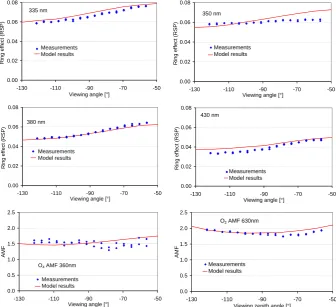
Fig. 8. Observed (blue dots) and modelled dependency of the Ring effect and the O4and O2absorption on the viewing angle for selected cloud-free observations (results of two consecutive SCIAMACHY scans) over Eastern Europe (17 September 2006, see Fig. 7). The devi-ations of the measured O4and O2absorptions from the simulated values are probably related to variations of the surface albedo. For the radiative transfer calculations the following parameters were assumed: surface albedo: 3%, the aerosol layer: 0–1 km; aerosol SSA: 0.95; g: 0.68, AOD: 0.05 (630 nm) and 0.1 (all other wavelengths). A viewing angle of−90◦indicates nadir viewing geometry. Note that the simulated O2AMFs were corrected for the saturation effect (see Sect. 3).
AERONET observations at Minsk AOD of 0.1 and 0.05 in the UV and red spectral range were observed, respectively. These values for AOD were used in the radiative transfer simulations. Red dots in Fig. 7 indicate fire counts by the MODIS instrument, but these are not relevant to our study.
Figure 8 shows the results of the SCIAMACHY obser-vations of the Ring effect and the O4 and O2 absorption, together with results of the radiative transfer simulations. For these simulations, the SZA and viewing geometry cor-responding to the SCIAMACHY observations were used.
As expected, the Ring effect observations show a system-atic dependence on the viewing angle, which in general is in good agreement with the radiative transfer simulations. However, one exception is found for the Ring effect observa-tions at 350 nm, which depend only slightly on the viewing angle. This finding is not yet fully understood, but is proba-bly an artefact related to the strong polarisation sensitivity of the SCIAMACHY instrument around 350 nm (see Fig. 2).
Also for the O2and O4absorptions an overall good agree-ment between observations and modelling results is found.
The differences for the eastern pixels of the SCIAMACHY swath are probably caused by the very low values of the sur-face albedo at these locations (see Fig. 7). Additional un-certainties might be caused by the fact that the bi-directional reflection function over vegetation is probably not well de-scribed by a Lambertian reflector.
1734 T. Wagner et al.: Sensitivity of Ring effect to aerosol properties
0 0.05 0.1 0.15 0.2 0.25 0.3
-130 -110 -90 -70 -50
Viewing angle [°]
N
o
rmalis
ed R
adianc
e 335 nm
.
336nm Reihe2 Measurements Model results
0 0.05 0.1 0.15 0.2 0.25 0.3
-130 -110 -90 -70 -50
Viewing angle [°]
Normalised Radiance 350 nm
.
350nm Reihe1 Measurements Model results
0 0.05 0.1 0.15 0.2 0.25 0.3
-130 -110 -90 -70 -50
Viewing angle [°]
N
o
rmal
is
ed R
adi
anc
e 380 nm
.
380nm Reihe1 Measurements Model results
0 0.05 0.1 0.15 0.2 0.25 0.3
-130 -110 -90 -70 -50
Viewing angle [°]
Normalised Radiance 430 nm
.
430nm Reihe1 Measurements Model results
0 0.05 0.1 0.15 0.2 0.25 0.3
-130 -110 -90 -70 -50
Viewing angle [°]
Norm
alis
ed Radianc
e 630 nm
.
630nm Measurements Model results
Fig. 9 Observed (blue dots) and modelled dependency of the normalised radiance on the viewing angle for selected cloud-free observations (results of two consecutive SCIA scans) over Eastern Europe (September 17, .2006, see Fig. 7). For the radiative transfer calculations the following parameters were assumed: surface albedo: 3%, the aerosol layer: 0-1km; aerosol SSA: 0.95; g: 0.68, AOD: 0.05 (630nm) and 0.1 (all other wavelengths). A viewing angle of – 90° indicates nadir viewing geometry.
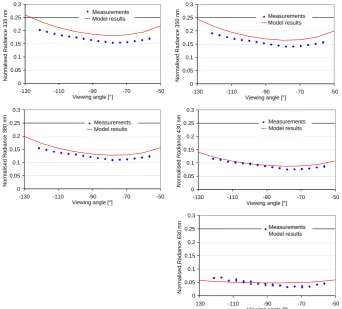
Fig. 9. Observed (blue dots) and modelled dependency of the normalised radiance on the viewing angle for selected cloud-free observations (results of two consecutive SCIA scans) over Eastern Europe (17 September 2006, see Fig. 7). For the radiative transfer calculations the following parameters were assumed: surface albedo: 3%, the aerosol layer: 0–1 km; aerosol SSA: 0.95;g: 0.68, AOD: 0.05 (630 nm) and 0.1 (all other wavelengths). A viewing angle of−90◦indicates nadir viewing geometry.
albedo (3%) for the simulations might be still too high: like for the O4 and O2 absorptions, especially low values in the eastern part of the swath are found, indicating a very low surface albedo. It is interesting to note that from the MODIS observations over this region even small, negative AOD are retrieved on that day (MODIS GIOVANNI prod-uct from the NASA Goddard space flight center web site: http://aeronet.gsfc.nasa.gov/cgi-bin/bamgomas interactive).
In addition to this case study, we investigated the view-ing angle dependence of the observed quantities in a more systematic way using radiative transfer simulations for vari-ous assumed aerosol properties. The results are presented in detail in Figs. A2 and A3 of the Appendix. One important finding is that unlike for the SZA dependence, very different dependencies are found for the various quantities. They also differ in strength and direction for different aerosol proper-ties.
4.3 Dependence on the surface albedo
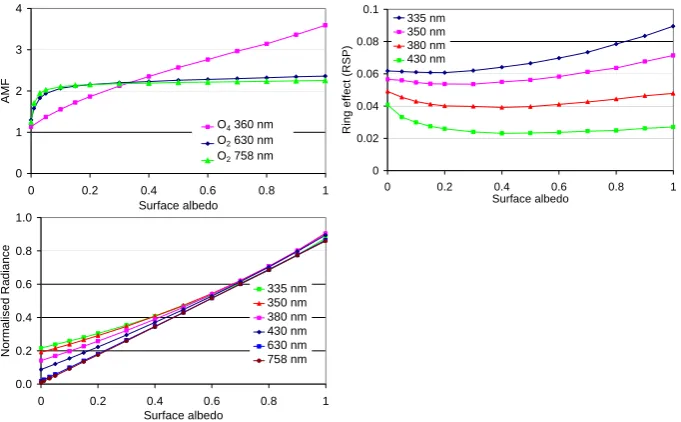
Figure 10 shows the dependence of the Ring effect, the O2and O4absorptions and the normalised radiance on the
surface albedo. For the Ring effect and the gas absorptions quite different dependencies are found. For low albedo (be-low about 0.2 to 0.5, depending on wavelength) the strength of the Ring effect decreases with increasing surface albedo. For larger albedo values, the Ring effect increases; the strongest increase is found for the smallest wavelengths. These findings can be explained by the dependence of the probability for multiple Rayleigh scattering on the surface albedo. For low surface albedo, an increase of the surface albedo has a relatively small effect on the probability for mul-tiple scattering, but a relatively large effect on the fraction of observed photons which have been (elastically) reflected from the earth’s surface. Thus for low albedo the probability of the observed photons having undergone a Raman scatter-ing event decreases with increasscatter-ing surface albedo.
For larger values of the surface albedo, the increase of the probability for multiple Rayleigh scattering (and thus also the probability for Raman scattering) with increasing surface albedo becomes the dominant effect. Since the probability for Rayleigh scattering increases towards small wavelengths, the effect of the surface albedo on the probability for mul-tiple Rayleigh scattering is largest for small wavelengths.
0 1 2 3 4
0 0.2 0.4 0.6 0.8 1
Surface albedo
AMF
Reihe2 Reihe1 Reihe3
O4 360 nm
O2 630 nm
O2 758 nm
0 0.02 0.04 0.06 0.08 0.1
0 0.2 0.4 0.6 0.8 1
Surface albedo
Ri
ng ef
fe
c
t (
R
SP)
Reihe1 Reihe2
Reihe3 Reihe4 335 nm 350 nm 380 nm 430 nm
0.0 0.2 0.4 0.6 0.8 1.0
0 0.2 0.4 0.6 0.8 1
Surface albedo
Normalised Radiance
Reihe4 Reihe3 Reihe2 Reihe1 Reihe5 Reihe6 335 nm 350 nm 380 nm 430 nm 630 nm 758 nm
Fig. 10 Dependence of the Ring effect, the O2 and O4 absorption and the normalised radiance on the surface albedo. The calculations are performed for SZA of 30° and a viewing angle of -90° (nadir geometry) and no aerosols present.
Fig. 10. Dependence of the Ring effect, the O2and O4absorption and the normalised radiance on the surface albedo. The calculations are performed for SZA of 30◦and a viewing angle of−90◦(nadir geometry) and no aerosols present.
For small wavelengths even the maximum Raman scatter-ing probability is found for a surface albedo of 1. Also the transition from decrease to increase of the Raman scattering probability with increasing surface albedo occurs at smaller albedo values.
Note that for the Ring effect retrievals in the UV and blue spectral range, usually the surface albedo is small (except over snow and ice). Thus an increase of the surface albedo (or the albedo effect of aerosols) will usually lead to a de-crease of the Ring effect.
For the O2 and O4absorptions a systematically different behaviour is found. For all wavelengths a systematic in-crease with increasing surface albedo is observed. For the O4absorption at 360 nm this increase is almost linear with increasing surface albedo. For the O2absorptions at longer wavelengths, a strong increase is found for small albedo (be-low about 10%) but for larger albedo only a slight further increase is found. These differences are caused by the strong wavelength dependence of Rayleigh scattering.
The difference of the dependencies of the Ring effect and the O2and O4absorptions on surface albedo is a very inter-esting finding and indicates a fundamental advantage of Ring effect observations for the retrieval of aerosol (and cloud) properties. For observations of the O2 and O4absorptions the shielding effect and the albedo effect of aerosols have different signs and thus can partly cancel each other, leading to an ambiguity in the interpretation of these observations. In contrast, for Ring effect observations, both the shielding effect and the albedo effect typically lead to a decrease of the strength of the Ring effect (with the strongest decreasing albedo effect at small wavelengths).
Besides the general albedo effect on observations of the Ring effect and the O2and O4absorptions, interaction of the photons with the earth’s surface can have more subtle effects on the retrieved quantities. For example, in the red spectral range, reflection by vegetation causes spectral structures in the range of a few nanometers which can interfere with at-mospheric absorption structures (e.g. the O4absorption band at 630 nm; see Wagner et al., 2007). Fortunately, the O2 ab-sorption at the same wavelength is almost not affected by these spectral structures.
A different kind of spectral interference can occur for ob-servations over oceans. Especially in regions with very clear waters, vibrational Raman scattering affects the observed ra-diances (Vasilkov et al., 2002; Vountas et al., 2003). Fortu-nately, as was shown by Vountas et al. (2003), the spectral signatures of rotational Raman scattering on air molecules and of vibrational Raman scattering on water molecules show important differences. Thus both effects can in general well be distinguished in the spectral analysis. Nevertheless, some systematic effects might remain over clear oceanic re-gions, especially in cases of low signal to noise. However, effects of vibrational Raman scattering in water are not im-portant for this study, because only observations over land are considered.
1736 T. Wagner et al.: Sensitivity of Ring effect to aerosol properties at 630 nm, the albedo over vegetation is typically lower than
over most other surfaces; at 760 nm it is typically higher than over most other surfaces. These dependencies complicate the interpretation of observations at these wavelengths. Also the albedo values of 10% and 20% used in the radiative trans-fer simulations for the wavelengths at 630 nm and 758 nm, respectively, might differ substantially from the true albedos for these wavelengths. This should be taken into considera-tion for the interpretaconsidera-tion of comparisons between measure-ments and observations.
4.4 Dependence on aerosol optical depth
In this section the dependence of the Ring effect, the O2 and O4absorption and the normalised radiance on the AOD is investigated. For that purpose, SCIAMACHY observa-tions over Beijing were selected. There, often high AOD are found, which allows the study of the effect of aerosols over a large range of AOD. For the characterisation of the AOD we use AERONET data from the station “Beijing” (39.97◦N, 116.37◦S, http://aeronet.gsfc.nasa.gov/new web/index.html; see also Holben et al., 2001). This station provides the best temporal coverage over the selected period from 2004 to 2008. From the AERONET measurements the average AOD during one hour around the time of the SCIAMACHY over-pass are calculated. The AOD at 440 nm and 675 nm was directly measured, whereas the AOD at 350 nm was calcu-lated from the other wavelengths based on the ˚Angstr¨om co-efficient retrieved for the longer wavelengths. Note that this interpolation can be subject to relatively large uncertainties (e.g. Krotkov et al., 2005). Only measurements of the AOD, for which the standard deviation during the one hour interval was less than 0.3 (at 440 nm) were considered.
The satellite observations were selected according to the following criteria:
– To avoid any influence of bright surfaces due to snow
or ice we selected SCIAMACHY observations only for the period from March to September.
– We ensured that the observed scenes were
cloud-free from visible inspection of true color images from almost simultaneous observations (time differ-ence 0.5 to 1 h) of the MODIS instrument (MODIS on TERRA, images obtained from NASA/GSFC, MODIS Rapid Response, http://aeronet.gsfc.nasa.gov/cgi-bin/ bamgomas interactive). If in the MODIS images any clouds or cloud fragments were observed at the loca-tion of the SCIAMACHY observaloca-tions, these observa-tion was classified as cloud-contaminated.
– Only SCIAMACHY measurements with the centre of
the ground pixel within±0.15◦latitude and±0.30◦ lon-gitude around the AERONET station were considered.
In total for the selected period (2004–2008) about 55 pairs of AERONET/SCIAMACHY observations over Beijing ful-filled the selection criteria.
Before comparing the satellite and ground-based data, the effects of varying SZA and viewing geometry have to be con-sidered. The SZA dependence is corrected by simply divid-ing the observational data by the model results (simulated for aerosol-free scenario) for the respective SZA (see Figs. 5 and 6). For the viewing angle dependence, no such procedure can be performed, because the viewing angle dependence varies systematically with aerosol properties (see Figs. A2 and A3 in the Appendix). Thus we decided to consider only SCIAMACHY observations for the western and centre part of the swath (viewing angles<−81◦), for which the view-ing angle dependence is relatively small (Fig. A2 in the Ap-pendix). After applying this additional criterion, 37 pairs of AERONET/SCIAMACHY observations were left. Finally, the observations are also corrected for a linear long-term trend (the results of a regression line fitted for the period 2004–2008 were subtracted).
It should be noted that in order to minimise computational effort, the AERONET AOD was not taken at exactly the same wavelength as the SCIAMACHY observations. For the ob-servations of the Ring effect and the O4absorption in the UV, the AOD at 350 nm was chosen, whereas for the Ring effect observation at 430 nm and the O2absorption at 630 nm, the AOD at 440 nm and 675 nm were taken, respectively. For the comparison to the model simulations, this choice of wave-lengths has low impact.
In Fig. 11 (right) the correlation analysis for the observed normalised radiance versus the AOD from the AERONET station is shown. In the left part the results of the radiative transfer simulations are shown. To allow a direct compar-ison between observations and model simulations, also the radiative transfer results were normalised with respect to the values for aerosol-free scenarios (the radiative transfer re-sults without normalisation are shown in Figs. A4 and A5 in the Appendix). As expected, increasing normalised radi-ances are found for increasing AOD. The strongest (relative) increase occurs at large wavelengths because there the influ-ence of molecular scattering is much weaker due to the strong wavelength dependence of Rayleigh-scattering. From the comparison between observations and simulations we con-clude that the aerosol over Beijing is typically weakly ab-sorbing with an SSA of about 0.9 in the UV and about 0.95 at 630 nm.
The correlation analyses of the observations of the Ring ef-fect and the O4and O2absorptions versus the AOD from the AERONET station are shown in the right column of Fig. 12. In the left column of Fig. 12, the respective (normalised) sim-ulation results are presented.
For the Ring effect observations, a negative dependence on the AOD is found for all wavelengths; the strength of this dependence increases towards larger wavelengths. A similar tendency is also found in the model simulations. However,
0.0 0.5 1.0 1.5 2.0
0 1 2 3 4
Nor
m
. Radiance 335 nm
.
0 1 2 3 4
0.0 0.5 1.0 1.5 2.0
slope: 0.087 r2: 0.41
0.0 0.5 1.0 1.5 2.0
0 1 2 3 4
Nor
m
. Radiance 350 nm
.
0 1 2 3 4
0.0 0.5 1.0 1.5 2.0
slope: 0.112 r2: 0.49
0.0 0.5 1.0 1.5 2.0
0 1 2 3 4
Norm. Radiance 380 nm
.
0 1 2 3 4
0.0 0.5 1.0 1.5 2.0
slope: 0.156 r2: 0.62
0.0 0.5 1.0 1.5 2.0
0 1 2 3 4
Norm. Radi
anc
e 430 nm
.
0 - 1km, SSA: 1.0 0 - 1km, SSA: 0.9 0 - 1km, SSA: 0.8 0 - 4km, SSA: 1.0
0 - 4km, SSA: 0.9 0 - 4km, SSA: 0.8
0 1 2 3 4
0.0 0.5 1.0 1.5 2.0
slope: 0.301 r2: 0.71
0.0 0.5 1.0 1.5 2.0
0 0.5 1 1.5 2 2
Norm. Radiance 630 nm
.
.5
Aerosol OD
0 1 20.0 0.5 1.0 1.5 2.0
slope: 0.438 r2: 0.68
p
Aerosol OD
Fig. 11 Observed (right) and simulated (left) dependence of the normalised radiance on the
AOD. The data are normalised to the values modelled for an AOD of 0 (see text). The
calculations are performed for SZA of 30° and a viewing angle of -90° (nadir). The aerosol
asymmetry parameter was assumed to be 0.68. For 630 nm the surface albedo was set to 10%;
for all other wavelengths it was set to 5%.
Fig. 11. Observed (right) and simulated (left) dependence of the normalised radiance on the AOD. The data are normalised to the values modelled for an AOD of 0 (see text). The calculations are performed for SZA of 30◦and a viewing angle of−90◦(nadir). The aerosol asymmetry parameter was assumed to be 0.68. For 630 nm the surface albedo was set to 10%; for all other wavelengths it was set to 5%.
the slope of the modelled dependencies strongly depends on the varied aerosol properties, single scattering albedo and layer height. For short wavelengths, an increase of the Ring effect is even found for purely scattering aerosols at low al-titude. In contrast, for large wavelengths a decrease of the Ring effect is found for all assumed aerosol scenarios.
1738 T. Wagner et al.: Sensitivity of Ring effect to aerosol properties
0.5 0.7 0.9 1.1 1.3
0 1 2 3 4
RSP 335 nm
.
Ring effect 335
0 1 2 3 4
0.5 0.7 0.9 1.1
1.3 slope: -0.018
r2: 0.17
0.5 0.7 0.9 1.1 1.3
0 1 2 3
R
S
P
350 nm
.
Ring effect 350
4
0 1 2 3 4
0.5 0.7 0.9 1.1
1.3 slope: -0.022
r2: 0.35
0.5 0.7 0.9 1.1 1.3
0 1 2 3
RSP 380 nm
.
Ring effect 380 nm
4 0 1 2 3 4
0.5 0.7 0.9 1.1
1.3 slope: -0.039
r2: 0.44
0.5 0.7 0.9 1.1 1.3
0 1 2 3 4
RSP 430 nm
. 0 - 1km, SSA: 1.00 - 1km, SSA: 0.9 0 - 1km, SSA: 0.8 0 - 4km, SSA: 1.0
0 - 4km, SSA: 0.9 0 - 4km, SSA: 0.8
Ring effect 430 nm
0 1 2 3 4
0.5 0.7 0.9 1.1
1.3 slope: -0.051
r2: 0.56
0.5 0.7 0.9 1.1 1.3
0 1 2 3 4
O4
AMF 360nm .
0 1 2 3 4
0.5 0.7 0.9 1.1 1.3
slope: 0.032 r2: 0.13
0.5 0.7 0.9 1.1 1.3
0 0.5 1 1.5 2 2.
O2
AMF 630nm
5
Aerosol OD
0 1 20.5 0.7 0.9 1.1 1.3
slope: -0.008 r2: 0.01
Aerosol OD
Fig. 12 Observed (right) and simulated (left) dependence of the Ring effect and the O
2and O
4absorptions on the AOD. The data are normalised to model results for an AOD of 0 (see text).
The calculations are performed for SZA of 30° and a viewing angle of -90° (nadir). The
aerosol asymmetry parameter was assumed to be 0.68. For 630 nm the surface albedo was set
to 10%; for all other wavelengths it was set to 5%.
Fig. 12. Observed (right) and simulated (left) dependence of the Ring effect and the O2and O4absorptions on the AOD. The data are normalised to model results for an AOD of 0 (see text). The calculations are performed for SZA of 30◦and a viewing angle of−90◦(nadir). The aerosol asymmetry parameter was assumed to be 0.68. For 630 nm the surface albedo was set to 10%; for all other wavelengths it was set to 5%.
0 0.01 0.02 0.03 0.04 0.05 0.06 0.07
0 1 2 3 4 5
Layer height [km]
Ring eff
e
ct
(RSP) 335 nm
Reihe1 Reihe2 Reihe3 Reihe4 OD: 1, SSA: 0.8 OD: 1, SSA: 1.0 OD: 4, SSA: 0.8 OD: 4, SSA: 1.0
0 0.01 0.02 0.03 0.04 0.05 0.06 0.07
0 1 2 3 4 5
Layer height [km]
Ring ef
fe
c
t (RS
P
) 350 nm
0 0.01 0.02 0.03 0.04 0.05 0.06 0.07
0 1 2 3 4 5
Layer height [km]
Ring ef
fe
c
t (RSP) 380 nm
0 0.01 0.02 0.03 0.04 0.05 0.06 0.07
0 1 2 3 4 5
Layer height [km]
Ring effec
t (RSP) 430 nm
0 0.5 1 1.5 2 2.5
0 1 2 3 4 5
Layer height [km]
O
4 AM
F
360 nm
0 1 2 3
0 1 2 3 4 5
Layer height [km] O2
AMF
630 nm
-1 0 1 2
O2
AMF
758 nm
630 nm
758 nm
Fig. 13 Dependence of the Ring effect and the O2 and O4 absorptions on the aerosol layer height (the x-axis indicates the upper boundary of the aerosol layer; the lower boundary is the surface). The calculations are performed for SZA of 30° and a viewing angle of -90° (nadir). The aerosol asymmetry parameter was assumed to be 0.68. For 758 nm the surface albedo was set to 20%, for 630 nm to 10%, and for all other wavelengths to 5%.
Fig. 13. Dependence of the Ring effect and the O2and O4absorptions on the aerosol layer height (the x-axis indicates the upper boundary of the aerosol layer; the lower boundary is the surface). The calculations are performed for SZA of 30◦and a viewing angle of−90◦(nadir). The aerosol asymmetry parameter was assumed to be 0.68. For 758 nm the surface albedo was set to 20%, for 630 nm to 10%, and for all other wavelengths to 5%.
For the O4 absorption at 360 nm, a systematic increase with increasing AOD is found. This indicates that for the O4absorptions the albedo effect of aerosols usually domi-nates over the shielding effect. For the O2 absorptions at 630 nm almost no dependence on the AOD is found, indicat-ing that the albedo effect and shieldindicat-ing effect broadly cancel each other.
In general, the correlations between the satellite data and AOD from the sun photometer observations are rather low (correlation coefficientsr2<0.6). However, this is not too surprising, because the satellite observations do not only de-pend on the AOD, but also on the layer height and the single-scattering albedo. Also remaining influences of the view-ing angle dependence and the horizontal heterogeneity of the aerosol properties might cause part of the variability.
4.5 Dependence on aerosol layer height
Figure 13 presents the dependence of the Ring effect and O2 and O4absorptions on the aerosol layer height derived from radiative transfer simulations. Here, for almost all quantities and aerosol scenarios a negative dependence is found. For
the Ring effect this negative dependence is strongest at short wavelengths. At larger wavelengths other aerosol parame-ters, like SSA and AOD also start playing a role.
A similar dependence exists for the O4 absorptions at 360 nm, where for all combinations of SSA and AOD de-creasing values are found with inde-creasing aerosol layer height.
The O2 absorptions show a slightly different behaviour. Only absorbing aerosols cause a decrease with increasing layer height. For purely scattering aerosols, the O2 absorp-tions are almost independent on the aerosol layer height. We also simulated the dependence of the normalised radiance for the scenarios shown in Fig. 13; these results are shown in Fig. A6 in the Appendix.