R E V I E W
Open Access
How much do we know about the coupling of
G-proteins to serotonin receptors?
Matteo Giulietti
1†, Viviana Vivenzio
2†, Francesco Piva
1*, Giovanni Principato
1, Cesario Bellantuono
2and Bernardo Nardi
2Abstract
Serotonin receptors are G-protein-coupled receptors (GPCRs) involved in a variety of psychiatric disorders. G-proteins, heterotrimeric complexes that couple to multiple receptors, are activated when their receptor is bound by the appropriate ligand. Activation triggers a cascade of further signalling events that ultimately result in cell function changes. Each of the several known G-protein types can activate multiple pathways. Interestingly, since several G-proteins can couple to the same serotonin receptor type, receptor activation can result in induction of different pathways. To reach a better understanding of the role, interactions and expression of G-proteins a literature search was performed in order to list all the known heterotrimeric combinations and serotonin receptor complexes. Public databases were analysed to collect transcript and protein expression data relating to G-proteins in neural tissues. Only a very small number of heterotrimeric combinations and G-protein-receptor complexes out of the possible thousands suggested by expression data analysis have been examined experimentally. In addition this has mostly been obtained using insect, hamster, rat and, to a lesser extent, human cell lines. Besides highlighting which interactions have not been explored, our findings suggest additional possible interactions that should be examined based on our expression data analysis.
Keywords:G-Proteins, Serotonin receptors, Protein expression, Nomenclature
Introduction
In normal physiology, the neurotransmitter serotonin (5-hydroxytryptamine, 5-HT) and its receptors regulate behaviours such as aggressiveness, anxiety, sex, sleep, mood, learning, cognition and memory. They are involved in numerous disease states, including depression, anxiety, social phobia, schizophrenia, mania, autism, drug addiction, obesity, obsessive-compulsive, panic and eating disorders. Therefore serotonin receptors are the target of a variety of pharmaceutical drugs. With the exception of the 5-HT3 receptor, a ligand-gated ion channel, serotonin receptors are a group of membrane-bound G-protein-coupled receptors, which, by means of G-proteins, activate intracellular path-ways to produce an excitatory or inhibitory response [1].
G-proteins are heterotrimers consisting of three subunits: Gα, Gβ and Gγ; they are located on the inner plasma
membrane, from which they induce GPCR activation.
The Gβand Gγsubunits form an inseparable complex,
theβγcomplex [2]. In the absence of receptor stimulation
the Gαsubunit binds guanosine diphosphate (GDP) and
theβγcomplex, and remains dissociated from the
recep-tor. Binding of the ligand to the GPCR domain outside the cell induces conformational changes of the intracel-lular GPCR domain, giving rise to GPCR coupling to the
G heterotrimer. Consequently, the Gα protein exchanges
GDP for guanosine triphosphate (GTP), causing
dissoci-ation of the GTP-bound α-subunit from theβγ complex
and their separation from the activated receptor. Gα and βγtherefore activate a cascade of further signalling events that finally result in a change in cell function. The process is terminated with GTP hydrolysis to GDP by Gα[3].
Various Gα families have been described: they can
activate different pathways or even exert opposite effects on the same pathway. In general, the 5-HT1 (1A, 1B, 1D, 1E, 1F) receptor family and 5-HT5 receptors couple with Gαi/o protein family to inhibit adenylate ciclase (AC) activity, reducing the intracellular cyclic adenosine
* Correspondence:[email protected] †Equal contributors
1
Department of Specialized Clinical Sciences and Odontostomatology, Polytechnic University of Marche, Ancona, Italy
Full list of author information is available at the end of the article
© 2014 Giulietti et al.; licensee BioMed Central Ltd. This is an Open Access article distributed under the terms of the Creative Commons Attribution License (http://creativecommons.org/licenses/by/4.0), which permits unrestricted use, distribution, and reproduction in any medium, provided the original work is properly credited. The Creative Commons Public Domain Dedication waiver http://creativecommons.org/publicdomain/zero/1.0/) applies to the data made available in this article, unless otherwise stated.
monophosphate (cAMP) level whilst the Gαs family 5-coupled to HT4, 5-HT6 and 5-HT7 receptors triggers a pathway that leads to AC activation and cAMP produc-tion. The 5-HT2 (2A, 2B, 2C) receptor family couple with Gαq/11 proteins and stimulate the activity of phospholipase C (PLC) increasing the intracellular inositol trisphosphate (IP3), diacyl-glycerol (DAG) and Ca2+ levels [1]. However
Gαq can also indirectly alter cAMP production, by
decreasing Gαs protein abundance [4] or by activating
adenylate cyclase 8 (ADCY8) by the PLC/Ca2+/calmodulin pathway [5]. Moreover, the Gαi/o family induces a decrease in intracellular cAMP levels through AC inhibition.
The Gβand Gγsubunits are closely associated forming aβγcomplex that can be separated only by denaturation,
except in cases when the complex involves β5, whose
bond to γ subunits is much weaker. At variance with
previous studies, theβγcomplex does not remain inert
after dissociation from theαsubunit, but plays a key role both in the inactive and in the active receptor state
[6]. The βγ complex has the following functions: i) it
is required for optimal receptor-G-protein interaction, because it enhances ligand affinity and receptor-G-protein coupling, hence G-protein activation [7]; ii) its subunit composition affects receptor-G-protein coupling specifi-city [8,9]; iii) it activates specific pathways regardless
of the type of Gα subunit involved [10]. The role of γ
subunits is to transport the βγ complex from the
endo-plasmic reticulum to the plasma membrane. Although allγproteins share this property, translocation kinetics differs widely among subunits, ranging from 10 sec of the fastest, γ9, to several minutes of the slowest, γ3 [11]. It may be hypothesized that theγ subunits allowing fast translocation are associated with human serotonin receptors with a quicker turnover.
Review
Many G-protein isoforms, huge number of possible heterotrimers
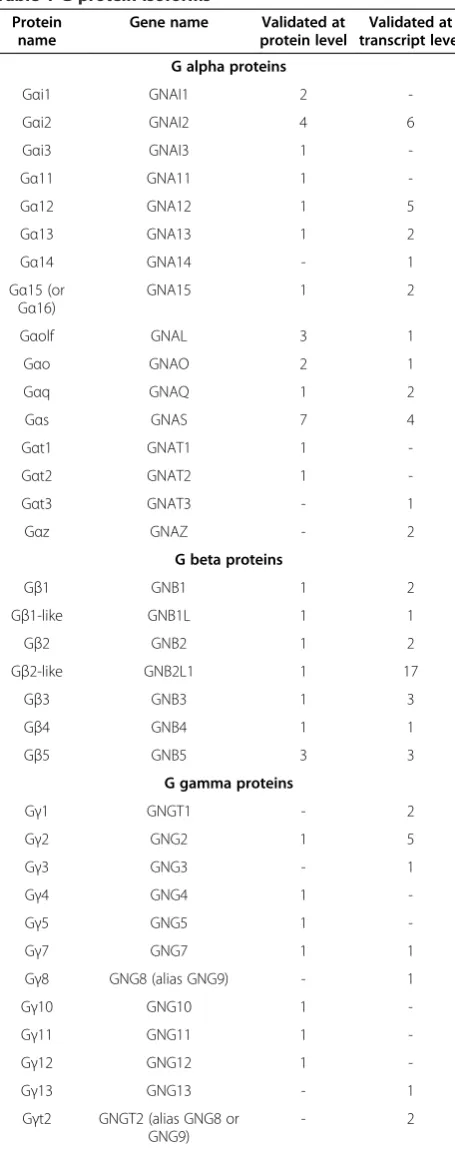
We have explored UniProt (www.uniprot.org) and Entrez Gene (www.ncbi.nlm.nih.gov/gene) databases to establish how many protein isoforms are currently known for each G-protein subtype (Table 1). For example, we have found 10 isoforms of the Gαi2 subtype. Generally, the isoforms do not derive from new gene loci but from different gene expression regulation of the main transcript. In particular, they are due to alternative splicing, use of alternative tran-scription start sites (TSS) and alternative start codons. All these detailed data are reported in Additional file 1 along with some annotations. In brief, we found many more protein isoforms than expected: Gα, Gβ, and Gγproteins may actually be as many as 53, 38, and 20, respectively, raising the potential heterotrimers to about 40,000 combi-nations. Most of the isoforms we reported are shorter and lack one or more functional domains compared to
Table 1 G-protein isoforms
Protein name
Gene name Validated at protein level
Validated at transcript level
G alpha proteins
Gαi1 GNAI1 2
-Gαi2 GNAI2 4 6
Gαi3 GNAI3 1
-Gα11 GNA11 1
-Gα12 GNA12 1 5
Gα13 GNA13 1 2
Gα14 GNA14 - 1
Gα15 (or Gα16)
GNA15 1 2
Gαolf GNAL 3 1
Gαo GNAO 2 1
Gαq GNAQ 1 2
Gαs GNAS 7 4
Gαt1 GNAT1 1
-Gαt2 GNAT2 1
-Gαt3 GNAT3 - 1
Gαz GNAZ - 2
G beta proteins
Gβ1 GNB1 1 2
Gβ1-like GNB1L 1 1
Gβ2 GNB2 1 2
Gβ2-like GNB2L1 1 17
Gβ3 GNB3 1 3
Gβ4 GNB4 1 1
Gβ5 GNB5 3 3
G gamma proteins
Gγ1 GNGT1 - 2
Gγ2 GNG2 1 5
Gγ3 GNG3 - 1
Gγ4 GNG4 1
-Gγ5 GNG5 1
-Gγ7 GNG7 1 1
Gγ8 GNG8 (alias GNG9) - 1
Gγ10 GNG10 1
-Gγ11 GNG11 1
-Gγ12 GNG12 1
-Gγ13 GNG13 - 1
Gγt2 GNGT2 (alias GNG8 or GNG9)
- 2
For each human G-protein, it is shown the number of the related isoforms subdivided by the validation status, according to UniProt. Note that, GNA15 is the homolog gene encoding the murine Gα15 and the human Gα16 [13].
Giuliettiet al. Molecular Brain2014,7:49 Page 2 of 15
the reference isoforms, so they could have a reduced functional activity. In particular, the shorter Gαsubtype
isoforms lack GTP domains, the Gβs lack WD domains
whereas the Gγs have no alterations lying in their func-tional domains. Surprisingly, up till now, many isoforms have not yet been confirmed at protein level according to UniProt, so we looked for this information in the literature. Unfortunately, the papers merely report the name of the investigated G-protein and do not specify its particular isoform. We also found nomenclature inaccuracies, which are probably due to the former names
of G-protein: for example when the authors write “the
Gαq protein” it is unclear whether they mean GNAQ
(Gαq) or the entire family including alsoGNA11(Gαq11),
GNA14 (Gαq14), or GNA15 (Gαq15 also Gαq16); simi-larly, “Gαi protein” may indicate GNAI1 (Gαi1), GNAI2
(Gαi2), orGNAI3(Gαi3). The same applies to“Gβγ”[12]. The nomenclature is not univocal even in some databases.
For example, in UniProt GNG8 is also called GNG9,
andGNGT2 is also calledGNG8 orGNG9; therefore a
paper examiningGNG9could refer either toGNG8or to
GNGT2. To overcome this ambiguity, the authors should indicate the protein or gene identifier or protein sequence.
How heterotrimer composition affects 5-HT receptor behaviour
The mechanisms underpinning formation of one hetero-trimer rather than another are poorly understood, but post-translational modifications of G-proteins and of membrane environments are likely to be involved [14]. Nonetheless heterotrimer composition is critical, because it determines what pathway is activated. For example, activation of 5-HT1A receptor inhibits basal phosphoinositide hydrolysis in the dorsal raphe nucleus but not in the hippocampus, most likely due to different heterotrimer compositions in the two tissues [15]. Moreover a single heterotrimer can activate multiple pathways simultaneously, because some Gαproteins have multiple effects. For example, some Gαi/ o family proteins inhibit AC leading to intracellular cAMP reduction, whereas others can also inhibit Ca2+or activate K+ channels [16]. To complicate matters further, the same serotonin receptor can couple to different heterotrimers [7,17,18]; the same ligand may therefore simultaneously activate multiple pathways but be unable to regulate a spe-cific one. The mechanism appears to be irrational, since a single switch (receptor) is unlikely to be able to control a large number of lights (pathways).
Ligand-receptor binding affinity affects G-protein-receptor affinity andvice versa, as described inSpodoptera frugiperda Sf9 cells [7]. Such affinity also depends on heterotrimeric composition; for example, coupling of Gαi3 to 5-HT1A or 5-HT1B receptor was more effective than that of Gαi2 and Gαo in enhancing agonist [3 H]-5-HT affinity [14].
Since a variety of psychiatric disorders and/or drug responses are held to be related to altered ligand-receptor affinity, association studies have mainly explored receptor and downstream effector polymorphisms to explain the genetic basis of such different phenotypes [19-26]. How-ever, given that G-proteins can affect ligand affinity, their variations should also be considered in association studies. For these reasons it is important to gain insights into the role, the interactors and the expression of G-proteins in determining cell responses as a consequence of receptor activation.
The observations that in some GPCRs the G-protein complex can modulate receptor activity state and that the transition from active to inactive state depends on
the Gα subunit associated with the receptor make the
study of G-proteins even more intriguing [14]. In other words, GPCRs can switch from inactive to active even in the absence of binding to an agonist. This mechanism is still poorly understood and may have important patho-logical as well as physiopatho-logical implications. In particular significant activation even without serotonin has been described with coupling of Gαz to 5-HT1A receptor, but not to the other 5-HT1 receptors [27].
Finally, a scenario is emerging where different G-protein combinations can bind the same receptor type, conferring a different ligand affinity and activating several pathways. This warrants investigation of the heterotrimeric combi-nations that may form in humans, their distribution in different tissues, and the differences in ligand binding affinity among the heterotrimers resulting from binding of one receptor type and various G-proteins.
How many couplings between 5-HT receptors and G-proteins are known
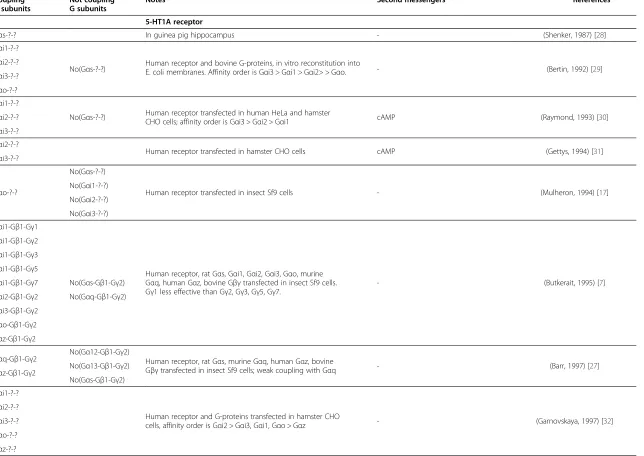
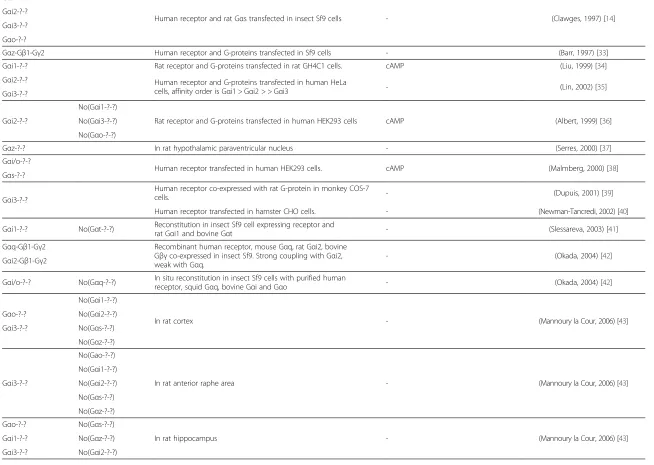
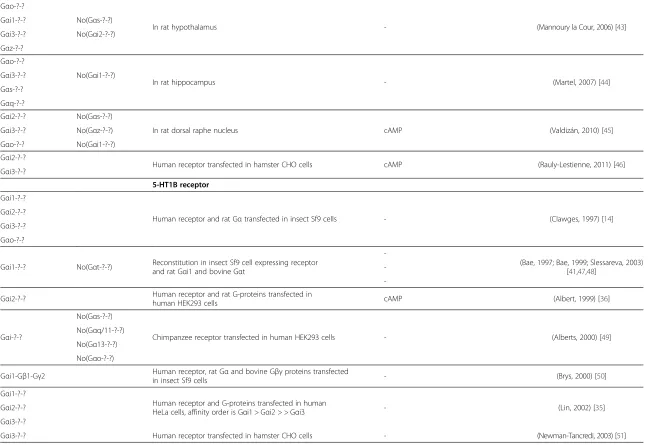
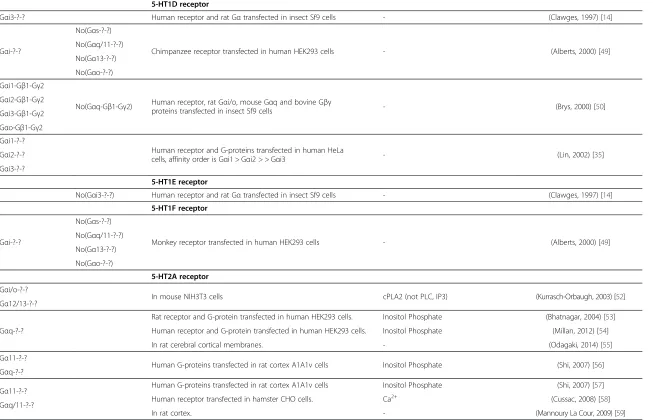
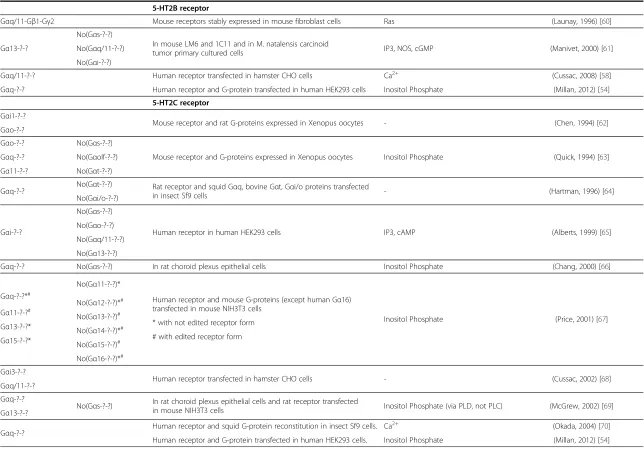
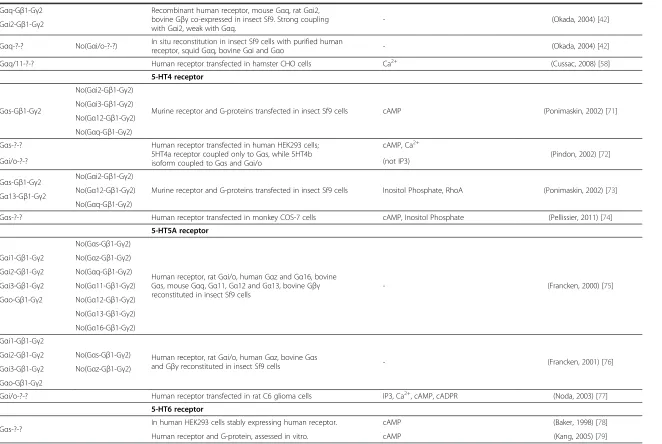
In order to find out what is known about heterotrimer associations with serotonin GPCRs, we have performed a literature search. The papers specifically addressing receptor-G-protein complexes were scanty, therefore data were available for quite a small number of complexes out of the possible thousands. Table 2 presents an exhaustive list of all known combinations of the three types of G-proteins and their associations with serotonin receptors in human neural tissues or in similar models. In particular, for each receptor, we have reported the experimentally assessed complexes formed with the G-proteins, the tissues or contexts where the complexes were deter-mined and their references. We have also annotated the couplings assessed as not present along with the particular experimental context. The 5-HT1p and 5-HT3 receptors were excluded, because the former is expressed in the nervous enteric system (not the central nervous system), the latter because it is a serotonin-gated ion channel not coupled to G-proteins, whereas 5-HT5B is
Giuliettiet al. Molecular Brain2014,7:49 Page 3 of 15
Table 2 Assessed couplings between G-proteins and serotonin receptors
Coupling G subunits
Not coupling G subunits
Notes Second messengers References
5-HT1A receptor
Gαs-?-? In guinea pig hippocampus - (Shenker, 1987) [28]
Gαi1-?-?
No(Gαs-?-?) Human receptor and bovine G-proteins, in vitro reconstitution intoE. coli membranes. Affinity order is Gαi3 > Gαi1 > Gαi2> > Gαo. - (Bertin, 1992) [29] Gαi2-?-?
Gαi3-?-?
Gαo-?-?
Gαi1-?-?
No(Gαs-?-?) Human receptor transfected in human HeLa and hamster
CHO cells; affinity order is Gαi3 > Gαi2 > Gαi1 cAMP (Raymond, 1993) [30] Gαi2-?-?
Gαi3-?-?
Gαi2-?-?
Human receptor transfected in hamster CHO cells cAMP (Gettys, 1994) [31] Gαi3-?-?
Gαo-?-?
No(Gαs-?-?)
Human receptor transfected in insect Sf9 cells - (Mulheron, 1994) [17] No(Gαi1-?-?)
No(Gαi2-?-?)
No(Gαi3-?-?)
Gαi1-Gβ1-Gγ1
Human receptor, rat Gαs, Gαi1, Gαi2, Gαi3, Gαo, murine Gαq, human Gαz, bovine Gβγtransfected in insect Sf9 cells. Gγ1 less effective than Gγ2, Gγ3, Gγ5, Gγ7.
- (Butkerait, 1995) [7]
Gαi1-Gβ1-Gγ2
Gαi1-Gβ1-Gγ3
Gαi1-Gβ1-Gγ5
Gαi1-Gβ1-Gγ7 No(Gαs-Gβ1-Gγ2)
Gαi2-Gβ1-Gγ2 No(Gαq-Gβ1-Gγ2)
Gαi3-Gβ1-Gγ2
Gαo-Gβ1-Gγ2
Gαz-Gβ1-Gγ2
Gαq-Gβ1-Gγ2 No(Gα12-Gβ1-Gγ2) Human receptor, rat Gαs, murine Gαq, human Gαz, bovine
Gβγtransfected in insect Sf9 cells; weak coupling with Gαq - (Barr, 1997) [27] Gαz-Gβ1-Gγ2 No(Gα13-Gβ1-Gγ2)
No(Gαs-Gβ1-Gγ2)
Gαi1-?-?
Human receptor and G-proteins transfected in hamster CHO
cells, affinity order is Gαi2 > Gαi3, Gαi1, Gαo > Gαz - (Garnovskaya, 1997) [32] Gαi2-?-?
Gαi3-?-?
Gαo-?-?
Gαz-?-?
Giulietti
et
al.
Molecular
Brain
2014,
7
:49
Page
4
o
f
1
5
http://ww
w.molecularb
rain.com/co
Table 2 Assessed couplings between G-proteins and serotonin receptors(Continued)
Gαi1-?-?
Human receptor and rat Gαs transfected in insect Sf9 cells - (Clawges, 1997) [14] Gαi2-?-?
Gαi3-?-?
Gαo-?-?
Gαz-Gβ1-Gγ2 Human receptor and G-proteins transfected in Sf9 cells - (Barr, 1997) [33]
Gαi1-?-? Rat receptor and G-proteins transfected in rat GH4C1 cells. cAMP (Liu, 1999) [34]
Gαi2-?-? Human receptor and G-proteins transfected in human HeLa
cells, affinity order is Gαi1 > Gαi2 > > Gαi3 - (Lin, 2002) [35] Gαi3-?-?
Gαi2-?-?
No(Gαi1-?-?)
Rat receptor and G-proteins transfected in human HEK293 cells cAMP (Albert, 1999) [36] No(Gαi3-?-?)
No(Gαo-?-?)
Gαz-?-? In rat hypothalamic paraventricular nucleus - (Serres, 2000) [37]
Gαi/o-?-?
Human receptor transfected in human HEK293 cells. cAMP (Malmberg, 2000) [38] Gαs-?-?
Gαi3-?-?
Human receptor co-expressed with rat G-protein in monkey COS-7
cells. - (Dupuis, 2001) [39]
Human receptor transfected in hamster CHO cells. - (Newman-Tancredi, 2002) [40]
Gαi1-?-? No(Gαt-?-?) Reconstitution in insect Sf9 cell expressing receptor and
rat Gαi1 and bovine Gαt - (Slessareva, 2003) [41]
Gαq-Gβ1-Gγ2 Recombinant human receptor, mouse Gαq, rat Gαi2, bovine Gβγco-expressed in insect Sf9. Strong coupling with Gαi2, weak with Gαq.
- (Okada, 2004) [42]
Gαi2-Gβ1-Gγ2
Gαi/o-?-? No(Gαq-?-?) In situ reconstitution in insect Sf9 cells with purified human
receptor, squid Gαq, bovine Gαi and Gαo - (Okada, 2004) [42]
No(Gαi1-?-?)
In rat cortex - (Mannoury la Cour, 2006) [43]
Gαo-?-? No(Gαi2-?-?)
Gαi3-?-? No(Gαs-?-?)
No(Gαz-?-?)
Gαi3-?-?
No(Gao-?-?)
In rat anterior raphe area - (Mannoury la Cour, 2006) [43]
No(Gαi1-?-?)
No(Gαi2-?-?)
No(Gαs-?-?)
No(Gαz-?-?)
Gαo-?-? No(Gαs-?-?)
In rat hippocampus - (Mannoury la Cour, 2006) [43]
Gαi1-?-? No(Gαz-?-?)
Gαi3-?-? No(Gαi2-?-?)
Giulietti
et
al.
Molecular
Brain
2014,
7
:49
Page
5
o
f
1
5
http://ww
w.molecularb
rain.com/co
Table 2 Assessed couplings between G-proteins and serotonin receptors(Continued)
Gαo-?-?
In rat hypothalamus - (Mannoury la Cour, 2006) [43]
Gαi1-?-? No(Gαs-?-?)
Gαi3-?-? No(Gαi2-?-?)
Gαz-?-?
Gαo-?-?
In rat hippocampus - (Martel, 2007) [44]
Gαi3-?-? No(Gαi1-?-?)
Gαs-?-?
Gαq-?-?
Gαi2-?-? No(Gαs-?-?)
In rat dorsal raphe nucleus cAMP (Valdizán, 2010) [45]
Gαi3-?-? No(Gαz-?-?)
Gαo-?-? No(Gαi1-?-?)
Gαi2-?-?
Human receptor transfected in hamster CHO cells cAMP (Rauly-Lestienne, 2011) [46] Gαi3-?-?
5-HT1B receptor
Gαi1-?-?
Human receptor and rat Gαtransfected in insect Sf9 cells - (Clawges, 1997) [14] Gαi2-?-?
Gαi3-?-?
Gαo-?-?
Gαi1-?-? No(Gαt-?-?) Reconstitution in insect Sf9 cell expressing receptorand rat Gαi1 and bovine Gαt
-(Bae, 1997; Bae, 1999; Slessareva, 2003) [41,47,48]
-Gαi2-?-? Human receptor and rat G-proteins transfected in
human HEK293 cells cAMP (Albert, 1999) [36]
Gαi-?-?
No(Gαs-?-?)
Chimpanzee receptor transfected in human HEK293 cells - (Alberts, 2000) [49] No(Gαq/11-?-?)
No(Gα13-?-?)
No(Gαo-?-?)
Gαi1-Gβ1-Gγ2 Human receptor, rat Gαand bovine Gβγproteins transfected
in insect Sf9 cells - (Brys, 2000) [50]
Gαi1-?-?
Human receptor and G-proteins transfected in human
HeLa cells, affinity order is Gαi1 > Gαi2 > > Gαi3 - (Lin, 2002) [35] Gαi2-?-?
Gαi3-?-?
Gαi3-?-? Human receptor transfected in hamster CHO cells - (Newman-Tancredi, 2003) [51]
Giulietti
et
al.
Molecular
Brain
2014,
7
:49
Page
6
o
f
1
5
http://ww
w.molecularb
rain.com/co
Table 2 Assessed couplings between G-proteins and serotonin receptors(Continued)
5-HT1D receptor
Gαi3-?-? Human receptor and rat Gαtransfected in insect Sf9 cells - (Clawges, 1997) [14]
Gαi-?-?
No(Gαs-?-?)
Chimpanzee receptor transfected in human HEK293 cells - (Alberts, 2000) [49] No(Gαq/11-?-?)
No(Gα13-?-?)
No(Gαo-?-?)
Gαi1-Gβ1-Gγ2
No(Gαq-Gβ1-Gγ2) Human receptor, rat Gαi/o, mouse Gαq and bovine Gβγ
proteins transfected in insect Sf9 cells - (Brys, 2000) [50] Gαi2-Gβ1-Gγ2
Gαi3-Gβ1-Gγ2
Gαo-Gβ1-Gγ2
Gαi1-?-?
Human receptor and G-proteins transfected in human HeLa
cells, affinity order is Gαi1 > Gαi2 > > Gαi3 - (Lin, 2002) [35] Gαi2-?-?
Gαi3-?-?
5-HT1E receptor
No(Gαi3-?-?) Human receptor and rat Gαtransfected in insect Sf9 cells - (Clawges, 1997) [14]
5-HT1F receptor
Gαi-?-?
No(Gαs-?-?)
Monkey receptor transfected in human HEK293 cells - (Alberts, 2000) [49] No(Gαq/11-?-?)
No(Gα13-?-?)
No(Gαo-?-?)
5-HT2A receptor
Gαi/o-?-?
In mouse NIH3T3 cells cPLA2 (not PLC, IP3) (Kurrasch-Orbaugh, 2003) [52] Gα12/13-?-?
Gαq-?-?
Rat receptor and G-protein transfected in human HEK293 cells. Inositol Phosphate (Bhatnagar, 2004) [53]
Human receptor and G-protein transfected in human HEK293 cells. Inositol Phosphate (Millan, 2012) [54]
In rat cerebral cortical membranes. - (Odagaki, 2014) [55]
Gα11-?-?
Human G-proteins transfected in rat cortex A1A1v cells Inositol Phosphate (Shi, 2007) [56] Gαq-?-?
Gα11-?-? Human G-proteins transfected in rat cortex A1A1v cells Inositol Phosphate (Shi, 2007) [57]
Gαq/11-?-? Human receptor transfected in hamster CHO cells. Ca
2+
(Cussac, 2008) [58]
In rat cortex. - (Mannoury La Cour, 2009) [59]
Giulietti
et
al.
Molecular
Brain
2014,
7
:49
Page
7
o
f
1
5
http://ww
w.molecularb
rain.com/co
Table 2 Assessed couplings between G-proteins and serotonin receptors(Continued)
5-HT2B receptor
Gαq/11-Gβ1-Gγ2 Mouse receptors stably expressed in mouse fibroblast cells Ras (Launay, 1996) [60]
Gα13-?-?
No(Gαs-?-?)
In mouse LM6 and 1C11 and in M. natalensis carcinoid
tumor primary cultured cells IP3, NOS, cGMP (Manivet, 2000) [61] No(Gαq/11-?-?)
No(Gαi-?-?)
Gαq/11-?-? Human receptor transfected in hamster CHO cells Ca2+ (Cussac, 2008) [58]
Gαq-?-? Human receptor and G-protein transfected in human HEK293 cells Inositol Phosphate (Millan, 2012) [54]
5-HT2C receptor
Gαi1-?-?
Mouse receptor and rat G-proteins expressed in Xenopus oocytes - (Chen, 1994) [62] Gαo-?-?
Gαo-?-? No(Gαs-?-?)
Mouse receptor and G-proteins expressed in Xenopus oocytes Inositol Phosphate (Quick, 1994) [63] Gαq-?-? No(Gαolf-?-?)
Gα11-?-? No(Gαt-?-?)
Gαq-?-? No(Gαt-?-?) Rat receptor and squid Gαq, bovine Gαt, Gαi/o proteins transfected
in insect Sf9 cells - (Hartman, 1996) [64]
No(Gαi/o-?-?)
Gαi-?-?
No(Gαs-?-?)
Human receptor in human HEK293 cells IP3, cAMP (Alberts, 1999) [65] No(Gαo-?-?)
No(Gαq/11-?-?)
No(Gα13-?-?)
Gαq-?-? No(Gαs-?-?) In rat choroid plexus epithelial cells Inositol Phosphate (Chang, 2000) [66]
Gαq-?-?*#
No(Gα11-?-?)*
Human receptor and mouse G-proteins (except human Gα16) transfected in mouse NIH3T3 cells
Inositol Phosphate (Price, 2001) [67] Gα11-?-?#
No(Gα12-?-?)*#
* with not edited receptor form Gα13-?-?*
No(Gα13-?-?)#
# with edited receptor form Gα15-?-?*
No(Gα14-?-?)*#
No(Gα15-?-?)#
No(Gα16-?-?)*#
Gαi3-?-?
Human receptor transfected in hamster CHO cells - (Cussac, 2002) [68] Gαq/11-?-?
Gαq-?-?
No(Gαs-?-?) In rat choroid plexus epithelial cells and rat receptor transfected
in mouse NIH3T3 cells Inositol Phosphate (via PLD, not PLC) (McGrew, 2002) [69] Gα13-?-?
Gαq-?-? Human receptor and squid G-protein reconstitution in insect Sf9 cells. Ca
2+ (Okada, 2004) [70]
Human receptor and G-protein transfected in human HEK293 cells. Inositol Phosphate (Millan, 2012) [54]
Giulietti
et
al.
Molecular
Brain
2014,
7
:49
Page
8
o
f
1
5
http://ww
w.molecularb
rain.com/co
Table 2 Assessed couplings between G-proteins and serotonin receptors(Continued)
Gαq-Gβ1-Gγ2 Recombinant human receptor, mouse Gαq, rat Gαi2, bovine Gβγco-expressed in insect Sf9. Strong coupling with Gαi2, weak with Gαq.
- (Okada, 2004) [42]
Gαi2-Gβ1-Gγ2
Gαq-?-? No(Gαi/o-?-?) In situ reconstitution in insect Sf9 cells with purified human
receptor, squid Gαq, bovine Gαi and Gαo - (Okada, 2004) [42]
Gαq/11-?-? Human receptor transfected in hamster CHO cells Ca2+ (Cussac, 2008) [58]
5-HT4 receptor
Gαs-Gβ1-Gγ2
No(Gαi2-Gβ1-Gγ2)
Murine receptor and G-proteins transfected in insect Sf9 cells cAMP (Ponimaskin, 2002) [71] No(Gαi3-Gβ1-Gγ2)
No(Gα12-Gβ1-Gγ2)
No(Gαq-Gβ1-Gγ2)
Gαs-?-? Human receptor transfected in human HEK293 cells; 5HT4a receptor coupled only to Gαs, while 5HT4b isoform coupled to Gαs and Gαi/o
cAMP, Ca2+
(Pindon, 2002) [72]
Gαi/o-?-? (not IP3)
Gαs-Gβ1-Gγ2 No(Gαi2-Gβ1-Gγ2)
Murine receptor and G-proteins transfected in insect Sf9 cells Inositol Phosphate, RhoA (Ponimaskin, 2002) [73] Gα13-Gβ1-Gγ2 No(Gα12-Gβ1-Gγ2)
No(Gαq-Gβ1-Gγ2)
Gαs-?-? Human receptor transfected in monkey COS-7 cells cAMP, Inositol Phosphate (Pellissier, 2011) [74]
5-HT5A receptor
No(Gαs-Gβ1-Gγ2)
Human receptor, rat Gαi/o, human Gαz and Gα16, bovine Gαs, mouse Gαq, Gα11, Gα12 and Gα13, bovine Gβγ reconstituted in insect Sf9 cells
- (Francken, 2000) [75]
Gαi1-Gβ1-Gγ2 No(Gαz-Gβ1-Gγ2)
Gαi2-Gβ1-Gγ2 No(Gαq-Gβ1-Gγ2)
Gαi3-Gβ1-Gγ2 No(Gα11-Gβ1-Gγ2)
Gαo-Gβ1-Gγ2 No(Gα12-Gβ1-Gγ2)
No(Gα13-Gβ1-Gγ2)
No(Gα16-Gβ1-Gγ2)
Gαi1-Gβ1-Gγ2
Human receptor, rat Gαi/o, human Gαz, bovine Gαs
and Gβγreconstituted in insect Sf9 cells - (Francken, 2001) [76] Gαi2-Gβ1-Gγ2 No(Gαs-Gβ1-Gγ2)
Gαi3-Gβ1-Gγ2 No(Gαz-Gβ1-Gγ2)
Gαo-Gβ1-Gγ2
Gαi/o-?-? Human receptor transfected in rat C6 glioma cells IP3, Ca2+, cAMP, cADPR (Noda, 2003) [77]
5-HT6 receptor
Gαs-?-? In human HEK293 cells stably expressing human receptor. cAMP (Baker, 1998) [78] Human receptor and G-protein, assessed in vitro. cAMP (Kang, 2005) [79]
Giulietti
et
al.
Molecular
Brain
2014,
7
:49
Page
9
o
f
1
5
http://ww
w.molecularb
rain.com/co
Table 2 Assessed couplings between G-proteins and serotonin receptors(Continued)
5-HT7 receptor
Gαs-?-? No(Gαi-?-?) In human HEK293 cells stably expressing human receptor cAMP, Ca2+/calmodulin (Baker, 1998) [78]
Gαs-?-? No(Gαq/11-?-?) Human receptor transfected in murine LM cells cAMP (Adham, 1998) [80] No(Gαi-?-?)
Gαs-?-?
No(Gαo-?-?) Human receptor transfected in human HEK293 cells,
affinity order is Gαs > Gαi = Gαq/11 cAMP (Alberts, 2001) [81] Gαi-?-?
No(Gα13-?-?) Gαq/11-?-?
Gαs-Gβ1-Gγ2 No(Gαi2-Gβ1-Gγ2) Murine receptor and G-proteins transfected in
insect Sf9 cells RhoA, Cdc42 (NOT Rac1) (Kvachnina, 2005) [82] Gα12-Gβ1-Gγ2 No(Gα13-Gβ1-Gγ2)
No(Gαq-Gβ1-Gγ2)
Gαs-Gβ1-Gγ2 No(Gαq-Gβ1-Gγ2) Murine receptor and G-proteins transfected in
insect Sf9 cells cAMP (Kvachnina, 2009) [83]
Gα12-Gβ1-Gγ2 No(Gαi-Gβ1-Gγ2) No(Gα13-Gβ1-Gγ2)
“?”means that the particular Gβor Gγprotein has not be identified in the reference paper.“-”means that the second messenger has not be assessed in the reference paper. Note: unfortunately some papers reported Gαi/o, Gαi, or Gαq/11 without further distinction.Abbreviations:RhoA: Ras homolog gene family, member A; Cdc42: cell division control protein 42; Rac1: Ras-related C3 botulinum toxin substrate 1; cADPR: cyclic adenosine diphosphoribose; PLD: phospholipase D; NOS: nitric-oxide synthase; cGMP: cyclic guanosine monophosphate; cPLA2: cytosolic phospholipases A2.
Giulietti
et
al.
Molecular
Brain
2014,
7
:49
Page
10
of
15
http://ww
w.molecularb
rain.com/co
a pseudogene in humans according to EntrezGene and the related protein is absent in UniProt.
Many papers have addressed G-protein combinations with 5-HT1A, 5-HT1B, 5-HT2A and 5-HT2C while only one or two papers refer to 5-HT1E, 5-HT1F or 5-HT6. The experimental models usually involve transfection of
human genes into Spodoptera frugiperdaSf9 cells, since
they express low levels of mammalian G-proteins, thus avoiding competition with endogenously expressed G-proteins in [35S]GTPγS binding assay [16].
However, to extend these findings to humans is not necessarily correct. For example, the poor coupling of
Gαq to 5-HT1A and 5-HT2C could be due to a large
portion of the expressed but inactive Gαq [84], maybe
because Gαq is not post-translationally modified by pal-mitoylation in Sf9 as in humans [85]. Other authors have used hamster, mouse and human cells transfected with rat, mouse and bovine constructs. The main methods used to assess the compositions of the heterotrimers are immunoprecipitation and western blot analysis, the bind-ing with radio-ligands and FRET (Förster Resonance Energy Transfer) by using fluorescent ligands.
For the majority of serotonergic receptors, coupling data are available only in relation to Gα family proteins
without specifying which Gβ and Gγ were coupled.
However, the few data on Gβ and Gγ only concerned
Gβ1 with Gγ2. Gαproteins coupled to receptors are the most commonly studied G-proteins, because they are held to indicate the pathway activated by receptor stimulation. In contrast, Gβ and Gγ proteins are believed merely to play a structural role, that is to stabilize the receptor com-plex, but they actively participate in signal transduction by activating specific pathways.
We also annotated the second messengers activated downstream G-proteins, when these data were available in the related paper, since they allow to take into account
the converging effect of various Gα proteins and the
antagonistic/additive effects of Gβγ.
Investigation methods for the assessment of G-protein activation
We have shown that G-protein heterotrimers recruited by serotonin receptors have been evaluated experimentally. This dearth of data is mainly due to the cumbersome methods used to identify the heterotrimers involved in the effects of ligands and to some technical limitations. In fact, to assess the receptor-mediated G-protein activation, both indirect and direct assays are available [16]. Indirect methods, in spite of their good sensitivity, are focused on measuring concentrations of second messengers but the evaluation of these data can be complicated since most receptors can activate different G-proteins.
In particular, since Gαs and Gαi/o proteins activate or inhibit AC respectively, their activation can be indirectly
detected determining intracellular adenosine triphosphate (ATP) conversion into cAMP. It is measured using [α-32P] ATP as the enzyme substrate or using cAMP antibodies. These methods cannot follow quick fluctuations as they are based on static measurements after cell lysis. In the case of the AC inhibiting Gαi/o proteins, another problem regards the too low dynamic ranges of inhibition detec-tion. To deal with this specific problem, chimeric Gαi/o proteins were developed, but they do not exactly mimic the natural G-proteins.
To test ligand efficacy on Gαq/11-coupled receptors,
[3H]IP3 concentration as product of PLC activity can
be measured using [3H]PIP2 (phosphatidyl inositol 4,5-bisphosphate) substrate. Alternatively, antibodies can be used, but, since IP3 has a short half life, it is preferred to detect its stable metabolite inositol-1-phosphate (IP1),
although this is a more downstream product. Also Ca2+
concentration, by dyes generating fluorescence upon binding of free Ca2+, can be determined to assess Gαq/11 activation, although these probes can influence calcium levels and kinetics. Moreover, Ca2+-sensitive photoproteins, as aequorin, can detect calcium in specific cell compart-ments by fusion with targeting sequences. This approach is not so sensitive and consists of laborious procedures, such as fusion protein production, transfection and assay calibration.
Gα12/13 activation can be assessed by determining Rho guanine nucleotide exchange factors (RhoGEFs) by im-munoblotting, a not highly sensitive technique. Moreover,
since RhoGEFs are activated also by Gαq/11, there are
crosstalk problems that can be partially overcome by small interfering RNA (siRNA) knockdown.
To directly and quantitatively assess the Gα protein
activation, [35S]GTPγS binding assay is employed. Upon Gα subunit activation, it binds the mimic substrate, so remaining blocked in the active form as it cannot hydrolyze
this substrate. The blocked Gα can be measured after
isolation and it can be immunoprecipitated to identify the specific Gαsubunit. However, this approach is mainly suitable to evaluate Gαi/o-coupled receptor activation. This assay can be effectively combined with the use of drugs stimulating or inhibiting specific G-proteins, for example, Pertussis toxin (PTX), Mastoparan, Mastoparan-S, Cholera toxin, Suramin, Pasteurella multocida toxin (PMT). Alternatively, it is possible to use G-protein-deficient mice or gene silencing by siRNA, although studies have to take into account the cellular compensa-tory mechanisms that alter the expression level of other G-proteins. An exhaustive review of these and other techniques was made by Denis et al. [16].
Moreover, cause of GTPase-accelerating proteins (GAPs) that accelerate GTPase activity of Gα-protein subunits,
the measuring of GTPase activity in vivo and in vitro
differ. In addition, forin vivostudies, methods having a
Giuliettiet al. Molecular Brain2014,7:49 Page 11 of 15
subsecond time resolution for GTP hydrolysis must be adopted [86,87].
Heterotrimers activation effects
It would be important to consider the synergic effects of the entire activated heterotrimer in order to evaluate ligand effects, drug efficacy and side effects such as hal-lucination onset. For this reason, we annotated also the second messengers during literature revision. Unfortu-nately, as can be seen in Table 2, few studies assessed the coupling of all the heterotrimer subunits and few of them assessed the second messengers. Regarding these cases, only Gβ1γ2 were present, so it was not possible
to verify if and how different Gβγ combinations can
affect Gαinduced pathways. In general, the physiological significance of the different Gβγ pairs is unclear, since they participate in complex interactions with receptors, Gαsubunits and effectors [6].
A more detailed description of the pathway downstream G-proteins was performed by Millan et al. [88], however it should be taken into account that the signalling down-stream a receptor is ligand-dependent. For example, some agonists of 5-HT2A can induce hallucinations but other structurally related ones do not [89].
Expression analysis in human brain tissues
We believe that our collected data can be used for guiding experiments which seek new couplings. How-ever, we verified if it was possible to reduce the number of combinations by filtering out those not allowed in a particular neural tissue due to one or more components that are not expressed. In Additional file 2, we report the expression profiles of Gα, Gβ, Gγand the serotonin receptor by using three proteomic databases according to a previous work [90]: Human Protein Reference Database (www.hprd.org); Human Proteinpedia (www.humanpro-teinpedia.org) and Human Protein Atlas (www.proteina-tlas.org). We also used expression data obtained from three transcriptomic databases: Human Transcriptome Map (http://bioinfo.amc.uva.nl/HTMseq), Cancer Gene Anatomy Project database (http://cgap.nci.nih.gov) and Allen Brain Atlas database (www.brain-map.org). An issue that arose in the course of this investigation was the partial conflict between microarray and RNA-Seq data retrieved from Allen Brain Atlas and, to a lesser extent, protein and transcript expression data. Generally, these discrepancies could be resolved by relying on prote-omic data, which, if present, are usually more dependable than transcriptomic data. For example, regarding GNG1, it seems to be absent in all tissues and their sub-tissues assessed by Allen Brain Atlas RNA-seq. Instead, according to Allen Brain Atlas microarray data, GNG1 expression results as being very variable among sub-tissues of each tissue. Since in the cerebellar cortex also Protein Atlas
data are available, they solve this contradiction claiming GNG1 absence. According to our expression data, most G-proteins are expressed in the majority of brain tissues, thus confirming the possible existence of a big number of heterotrimer combinations in nearly all neural tissues. Of course, co-expression of a receptor and G-proteins in a brain tissue does not imply that they are functionally coupled to each other. However, the available databases, being manually annotated, do not contain the all expres-sion data reported in the literature, so the Additional file 2 may be incomplete.
Conclusion
The large number of human G-proteins that our searches found demonstrates that a very large amount of possible heterotrimers can be formed but unfortunately only a few have been assessed. Naturally, a limitation of the studies carried out in vitro is that the reported couplings do not always match to the couplings found in vivo [91]. However, knowledge of all the G-proteins that bind to each receptor would allow linking each receptor to all the possible activated pathways. Association of a receptor with multiple G-proteins would also highlight activation of different pathways in different tissues. This is import-ant, because G-protein gene mutations or polymorphisms could alter transduction efficacy, thus explaining the non-activation of a pathway despite the presence of the right ligand and the absence of nucleotide variation in the receptor. Therefore precise knowledge of the role and distribution of G-proteins would greatly contribute to the evaluation of G-protein gene polymorphisms and to the development of drugs targeting specific G-proteins.
Finally, since receptor binding to a G-protein consid-erably modifies receptor behaviour, it could be that the G-proteins define many receptor subtypes. For this reason it is more appropriate to consider a receptor not indivi-dually but in association to each permitted heterotrimer. This also suggests that a number of experiments should be performed again, like the biochemical studies exploring the affinity constants between ligands and a receptor not considering if, and which, G-proteins were associated.
Additional files
Additional file 1:Detailed information about G-protein isoforms. In this table all G-protein isoforms along with annotations extracted from UniProt and EntrezGene are shown.
Additional file 2:G-protein and serotonin receptor expression data in brain subtissues.In this table G-protein and serotonin receptor expression data extracted from different transcriptomic and proteomic databases are shown.
Abbreviations
5-HT:Serotonin; GPCRs: G-protein-coupled receptors; GDP: Guanosine diphosphate; GTP: Guanosine triphosphate; AC: Adenylate cyclase;
cAMP: Cyclic adenosine monophosphate; PLC: Phospholipase C; DAG:
Diacyl-Giuliettiet al. Molecular Brain2014,7:49 Page 12 of 15
glycerol; IP3: Inositol trisphosphate; PKC: Protein kinase C; ADCY8: Adenylate cyclase 8; TSS: Transcription start sites; FRET: Förster resonance energy transfer; ATP: Adenosine triphosphate; PIP2: Phosphatidyl inositol 4,5-bisphosphate; IP1: Inositol-1-phosphate; RhoGEF: Rho guanine nucleotide exchange factor; siRNA: Small interfering RNA; PTX: Pertussis toxin; PMT: Pasteurella multocida toxin; GAP: GTPase-accelerating protein.
Competing interests
The authors declare that they have no competing interests.
Authors’contributions
MG, VV and FP performed the analyses and wrote the manuscript. GP, CB and BN conceived of the study, and participated in its design and coordination. All authors read and approved the final manuscript.
Author details
1Department of Specialized Clinical Sciences and Odontostomatology, Polytechnic University of Marche, Ancona, Italy.2Psychiatric Unit, Neurosciences Department, Polytechnic University of Marche, Ancona, Italy.
Received: 21 March 2014 Accepted: 27 June 2014 Published: 10 July 2014
References
1. Filip M, Bader M:Overview on 5-HT receptors and their role in physiology and pathology of the central nervous system.Pharmacol Rep2009,
61:761–777.
2. Hurowitz EH, Melnyk JM, Chen YJ, Kouros-Mehr H, Simon MI, Shizuya H:
Genomic characterization of the human heterotrimeric G protein alpha, beta, and gamma subunit genes.DNA Res2000,7:111–120.
3. Oldham WM, Hamm HE:Heterotrimeric G protein activation by G-protein-coupled receptors.Nat Rev Mol Cell Biol2008,9:60–71.
4. Tang T, Gao MH, Miyanohara A, Hammond HK:Galphaq reduces cAMP production by decreasing Galphas protein abundance.Biochem Biophys Res Commun2008,377:679–684.
5. Twery EN, Raper JA:SDF1-induced antagonism of axonal repulsion requires multiple G-protein coupled signaling components that work in parallel.PLoS ONE2011,6:e18896.
6. Smrcka AV:G protein betagamma subunits: central mediators of G protein-coupled receptor signaling.Cell Mol Life Sci2008,65:2191–2214. 7. Butkerait P, Zheng Y, Hallak H, Graham TE, Miller HA, Burris KD, Molinoff PB,
Manning DR:Expression of the human 5-hydroxytryptamine1A receptor in Sf9 cells. Reconstitution of a coupled phenotype by co-expression of mammalian G protein subunits.J Biol Chem1995,270:18691–18699. 8. Kisselev O, Gautam N:Specific interaction with rhodopsin is dependent on
the gamma subunit type in a G protein.J Biol Chem1993,268:24519–24522. 9. Kleuss C, Scherubl H, Hescheler J, Schultz G, Wittig B:Selectivity in signal
transduction determined by gamma subunits of heterotrimeric G proteins.Science1993,259:832–834.
10. Raymond JR, Mukhin YV, Gettys TW, Garnovskaya MN:The recombinant 5-HT1A receptor: G protein coupling and signalling pathways.Br J Pharmacol1999,127:1751–1764.
11. Ajith Karunarathne WK, O’Neill PR, Martinez-Espinosa PL, Kalyanaraman V, Gautam N:All G protein betagamma complexes are capable of translocation on receptor activation.Biochem Biophys Res Commun2012,
421:605–611.
12. Glass M, Northup JK:Agonist selective regulation of G proteins by cannabinoid CB(1) and CB(2) receptors.Mol Pharmacol1999,56:1362–1369. 13. Wilkie TM, Gilbert DJ, Olsen AS, Chen XN, Amatruda TT, Korenberg JR, Trask BJ, de Jong P, Reed RR, Simon MI,et al:Evolution of the mammalian G protein alpha subunit multigene family.Nat Genet1992,1:85–91. 14. Clawges HM, Depree KM, Parker EM, Graber SG:Human 5-HT1 receptor
subtypes exhibit distinct G protein coupling behaviors in membranes from Sf9 cells.Biochemistry1997,36:12930–12938.
15. Johnson RG, Fiorella D, Winter JC, Rabin RA:[3H]8-OH-DPAT labels a 5-HT site coupled to inhibition of phosphoinositide hydrolysis in the dorsal raphe.Eur J Pharmacol1997,329:99–106.
16. Denis C, Sauliere A, Galandrin S, Senard JM, Gales C:Probing heterotrimeric G protein activation: applications to biased ligands.Curr Pharm Des2012,
18:128–144.
17. Mulheron JG, Casanas SJ, Arthur JM, Garnovskaya MN, Gettys TW, Raymond JR:
Human 5-HT1A receptor expressed in insect cells activates endogenous G (o)-like G protein(s).J Biol Chem1994,269:12954–12962.
18. Parker EM, Grisel DA, Iben LG, Nowak HP, Mahle CD, Yocca FD, Gaughan GT:
Characterization of human 5-HT1 receptors expressed in Sf9 insect cells.
Eur J Pharmacol1994,268:43–53.
19. Piva F, Giulietti M, Armeni T, Principato G:Cross-link immunoprecipitation data to detect polymorphisms lying in splicing regulatory motifs: a method to refine single nucleotide polymorphism selection in association studies.Psychiatr Genet2012,22:88–91.
20. Piva F, Giulietti M, Baldelli L, Nardi B, Bellantuono C, Armeni T, Saccucci F, Principato G:Bioinformatic analyses to select phenotype affecting polymorphisms in HTR2C gene.Hum Psychopharmacol2011,26:365–372. 21. Nardi B, Turchi C, Piva F, Giulietti M, Castellucci G, Arimatea E, Rochetti D,
Rocchetti G, Principato G, Tagliabracci A, Bellantuono C:Searching for a relationship between the serotonin receptor 2A gene variations and the development of inward and outward personal meaning organizations.
Psychiatr Genet2011,21:269–270.
22. Piva F, Giulietti M, Nardi B, Bellantuono C, Principato G:An improved in silico selection of phenotype affecting polymorphisms in SLC6A4, HTR1A and HTR2A genes.Hum Psychopharmacol2010,25:153–161.
23. Nardi B, Piva F, Turchi C, Giulietti M, Castellucci G, Arimatea E, Rocchetti D, Rocchetti G, Principato G, Tagliabracci A, Bellantuono C:HTR2A gene polymorphisms and inward and outward personal meaning organisations.Acta Neuropsychiatrica2012,24:336–343.
24. Blasi G, De Virgilio C, Papazacharias A, Taurisano P, Gelao B, Fazio L, Ursini G, Sinibaldi L, Andriola I, Masellis R, Romano R, Rampino A, Di Giorgio A, Lo Bianco L, Caforio G, Piva F, Popolizio T, Bellantuono C, Todarello O, Kleinman JE, Gadaleta G, Weinberger DR, Bertolino A:Converging evidence for the association of functional genetic variation in the serotonin receptor 2a gene with prefrontal function and olanzapine treatment.
JAMA Psychiatry2013,70:921–930.
25. Galeazzi R, Massaccesi L, Piva F, Principato G, Laudadio E:Insights into the influence of 5-HT2c aminoacidic variants with the inhibitory action of serotonin inverse agonists and antagonists.J Mol Model2014,
20:2120.
26. Blasi G, Napolitano F, Ursini G, Di Giorgio A, Caforio G, Taurisano P, Fazio L, Gelao B, Attrotto MT, Colagiorgio L, Todarello G, Piva F, Papazacharias A, Masellis R, Mancini M, Porcelli A, Romano R, Rampino A, Quarto T, Giulietti M, Lipska BK, Kleinman JE, Popolizio T, Weinberger DR, Usiello A, Bertolino A:Association of GSK-3beta genetic variation with GSK-3beta expression, prefrontal cortical thickness, prefrontal physiology, and schizophrenia.
Am J Psychiatry2013,170:868–876.
27. Barr AJ, Brass LF, Manning DR:Reconstitution of receptors and GTP-binding regulatory proteins (G proteins) in Sf9 cells. A direct evaluation of selectivity in receptor.G protein coupling.J Biol Chem1997,272:2223–2229.
28. Shenker A, Maayani S, Weinstein H, Green JP:Pharmacological characterization of two 5-hydroxytryptamine receptors coupled to adenylate cyclase in guinea pig hippocampal membranes.Mol Pharmacol1987,31:357–367. 29. Bertin B, Freissmuth M, Breyer RM, Schutz W, Strosberg AD, Marullo S:
Functional expression of the human serotonin 5-HT1A receptor in Escherichia coli. Ligand binding properties and interaction with recom-binant G protein alpha-subunits.J Biol Chem1992,267:8200–8206. 30. Raymond JR, Olsen CL, Gettys TW:Cell-specific physical and functional
coupling of human 5-HT1A receptors to inhibitory G protein alpha-subunits and lack of coupling to Gs alpha.Biochemistry1993,
32:11064–11073.
31. Gettys TW, Fields TA, Raymond JR:Selective activation of inhibitory G-protein alpha-subunits by partial agonists of the human 5-HT1A receptor.
Biochemistry1994,33:4283–4290.
32. Garnovskaya MN, Gettys TW, van Biesen T, Prpic V, Chuprun JK, Raymond JR:
5-HT1A receptor activates Na+/H+ exchange in CHO-K1 cells through Gialpha2 and Gialpha3.J Biol Chem1997,272:7770–7776.
33. Barr AJ, Manning DR:Agonist-independent activation of Gz by the 5-hydroxytryptamine1A receptor co-expressed in Spodoptera frugiperda cells. Distinguishing inverse agonists from neutral antagonists.J Biol Chem1997,272:32979–32987.
34. Liu YF, Ghahremani MH, Rasenick MM, Jakobs KH, Albert PR:Stimulation of cAMP synthesis by Gi-coupled receptors upon ablation of distinct Galphai protein expression. Gi subtype specificity of the 5-HT1A receptor.J Biol Chem1999,274:16444–16450.
Giuliettiet al. Molecular Brain2014,7:49 Page 13 of 15
35. Lin SL, Setya S, Johnson-Farley NN, Cowen DS:Differential coupling of 5-HT(1) receptors to G proteins of the G(i) family.Br J Pharmacol2002,
136:1072–1078.
36. Albert PR, Sajedi N, Lemonde S, Ghahremani MH:Constitutive G(i2)-dependent activation of adenylyl cyclase type II by the 5-HT1A receptor. Inhibition by anxiolytic partial agonists.J Biol Chem1999,274:35469–35474. 37. Serres F, Li Q, Garcia F, Raap DK, Battaglia G, Muma NA, Van de Kar LD:
Evidence that G(z)-proteins couple to hypothalamic 5-HT(1A) receptors in vivo.J Neurosci2000,20:3095–3103.
38. Malmberg A, Strange PG:Site-directed mutations in the third intracellular loop of the serotonin 5-HT(1A) receptor alter G protein coupling from G(i) to G(s) in a ligand-dependent manner.J Neurochem2000,75:1283–1293. 39. Dupuis DS, Wurch T, Tardif S, Colpaert FC, Pauwels PJ:Modulation of 5-HT
(1A) receptor activation by its interaction with wild-type and mutant g (alphai3) proteins.Neuropharmacology2001,40:36–47.
40. Newman-Tancredi A, Cussac D, Marini L, Millan MJ:Antibody capture assay reveals bell-shaped concentration-response isotherms for h5-HT(1A) receptor-mediated Galpha(i3) activation: conformational selection by high-efficacy agonists, and relationship to trafficking of receptor signaling.
Mol Pharmacol2002,62:590–601.
41. Slessareva JE, Ma H, Depree KM, Flood LA, Bae H, Cabrera-Vera TM, Hamm HE, Graber SG:Closely related G-protein-coupled receptors use multiple and distinct domains on G-protein alpha-subunits for selective coupling.J Biol Chem2003,278:50530–50536.
42. Okada M, Goldman D, Linnoila M, Iwata N, Ozaki N, Northup JK:
Comparison of G-protein selectivity of human 5-HT2C and 5-HT1A recep-tors.Ann N Y Acad Sci2004,1025:570–577.
43. la Cour Mannoury C, El Mestikawy S, Hanoun N, Hamon M, Lanfumey L:
Regional differences in the coupling of 5-hydroxytryptamine-1A recep-tors to G proteins in the rat brain.Mol Pharmacol2006,70:1013–1021. 44. Martel JC, Ormiere AM, Leduc N, Assie MB, Cussac D, Newman-Tancredi A:
Native rat hippocampal 5-HT1A receptors show constitutive activity.Mol Pharmacol2007,71:638–643.
45. Valdizan EM, Castro E, Pazos A:Agonist-dependent modulation of G-protein coupling and transduction of 5-HT1A receptors in rat dorsal raphe nucleus.Int J Neuropsychopharmacol2010,13:835–843.
46. Rauly-Lestienne I, Lestienne F, Ailhaud MC, Binesse J, Newman-Tancredi A, Cussac D:Competitive interaction of 5-HT(1A) receptors with G-protein subtypes in CHO cells demonstrated by RNA interference.Cell Signal 2011,23:58–64.
47. Bae H, Anderson K, Flood LA, Skiba NP, Hamm HE, Graber SG:Molecular determinants of selectivity in 5-hydroxytryptamine1B receptor-G protein interactions.J Biol Chem1997,272:32071–32077.
48. Bae H, Cabrera-Vera TM, Depree KM, Graber SG, Hamm HE:Two amino acids within the alpha4 helix of Galphai1 mediate coupling with 5-hydroxytryptamine1B receptors.J Biol Chem1999,274:14963–14971. 49. Alberts GL, Pregenzer JF, Im WB, Slightom JL:Cloning of serotonin 5-HT(1)
receptor subtypes from the chimpanzee, gorilla and Rhesus monkey and their agonist-induced guanosine 5′gamma(35)S triphosphate binding.
Neurosci Lett2000,280:223–227.
50. Brys R, Josson K, Castelli MP, Jurzak M, Lijnen P, Gommeren W, Leysen JE:
Reconstitution of the human 5-HT(1D) receptor-G-protein coupling: evidence for constitutive activity and multiple receptor conformations.
Mol Pharmacol2000,57:1132–1141.
51. Newman-Tancredi A, Cussac D, Marini L, Touzard M, Millan MJ:h5-HT(1B) receptor-mediated constitutive Galphai3-protein activation in stably transfected Chinese hamster ovary cells: an antibody capture assay reveals protean efficacy of 5-HT.Br J Pharmacol2003,138:1077–1084. 52. Kurrasch-Orbaugh DM, Parrish JC, Watts VJ, Nichols DE:A complex signaling
cascade links the serotonin2A receptor to phospholipase A2 activation: the involvement of MAP kinases.J Neurochem2003,86:980–991.
53. Bhatnagar A, Sheffler DJ, Kroeze WK, Compton-Toth B, Roth BL:Caveolin-1 interacts with 5-HT2A serotonin receptors and profoundly modulates the signaling of selected Galphaq-coupled protein receptors.J Biol Chem 2004,279:34614–34623.
54. Millan MJ, la Cour Mannoury C, Chanrion B, Dupuis DS, Di Cara B, Audinot V, Cussac D, Newman-Tancredi A, Kamal M, Boutin JA, Jockers R, Marin P, Bockaert J, Muller O, Dekeyne A, Lavielle G:S32212, a novel serotonin type 2C receptor inverse agonist/alpha2-adrenoceptor antagonist and potential antidepressant: I. A mechanistic characterization.J Pharmacol Exp Ther2012,
340:750–764.
55. Odagaki Y, Kinoshita M, Toyoshima R:Functional activation of Galpha via serotonin (5-HT) and muscarinic acetylcholine M receptors assessed by guanosine-5-O-(3-[S]thio)triphosphate ([S]GTPgammaS) binding/immuno-precipitation in rat brain membranes.Eur J Pharmacol2014,726C:109–115. 56. Shi J, Zemaitaitis B, Muma NA:Phosphorylation of Galpha11 protein
contributes to agonist-induced desensitization of 5-HT2A receptor signaling.Mol Pharmacol2007,71:303–313.
57. Shi J, Damjanoska KJ, Singh RK, Carrasco GA, Garcia F, Grippo AJ, Landry M, Sullivan NR, Battaglia G, Muma NA:Agonist induced-phosphorylation of Galpha11 protein reduces coupling to 5-HT2A receptors.J Pharmacol Exp Ther2007,323:248–256.
58. Cussac D, Boutet-Robinet E, Ailhaud MC, Newman-Tancredi A, Martel JC, Danty N, Rauly-Lestienne I:Agonist-directed trafficking of signalling at serotonin 5-HT2A, 5-HT2B and 5-HT2C-VSV receptors mediated Gq/11 activation and calcium mobilisation in CHO cells.Eur J Pharmacol2008,594:32–38. 59. La Cour Mannoury C, Chaput C, Touzard M, Millan MJ:An immunocapture/
scintillation proximity analysis of G alpha q/11 activation by native serotonin (5-HT)2A receptors in rat cortex: blockade by clozapine and mirtazapine.Synapse2009,63:95–105.
60. Launay JM, Birraux G, Bondoux D, Callebert J, Choi DS, Loric S, Maroteaux L:
Ras involvement in signal transduction by the serotonin 5-HT2B receptor.
J Biol Chem1996,271:3141–3147.
61. Manivet P, Mouillet-Richard S, Callebert J, Nebigil CG, Maroteaux L, Hosoda S, Kellermann O, Launay JM:PDZ-dependent activation of nitric-oxide synthases by the serotonin 2B receptor.J Biol Chem2000,275:9324–9331. 62. Chen Y, Baez M, Yu L:Functional coupling of the 5-HT2C serotonin receptor
to G proteins in Xenopus oocytes.Neurosci Lett1994,179:100–102. 63. Quick MW, Simon MI, Davidson N, Lester HA, Aragay AM:Differential
coupling of G protein alpha subunits to seven-helix receptors expressed in Xenopus oocytes.J Biol Chem1994,269:30164–30172.
64. Hartman JL, Northup JK:Functional reconstitution in situ of 5-hydroxytryptamine2c (5HT2c) receptors with alphaq and inverse agonism of 5HT2c receptor antagonists.J Biol Chem1996,271:22591–22597. 65. Alberts GL, Pregenzer JF, Im WB, Zaworski PG, Gill GS:Agonist-induced
GTPgamma35S binding mediated by human 5-HT(2C) receptors expressed in human embryonic kidney 293 cells.Eur J Pharmacol1999,383:311–319. 66. Chang M, Zhang L, Tam JP, Sanders-Bush E:Dissecting G protein-coupled
receptor signaling pathways with membrane-permeable blocking peptides. Endogenous 5-HT(2C) receptors in choroid plexus epithelial cells.J Biol Chem2000,275:7021–7029.
67. Price RD, Weiner DM, Chang MS, Sanders-Bush E:RNA editing of the human serotonin 5-HT2C receptor alters receptor-mediated activation of G13 protein.J Biol Chem2001,276:44663–44668.
68. Cussac D, Newman-Tancredi A, Duqueyroix D, Pasteau V, Millan MJ:Differential activation of Gq/11 and Gi(3) proteins at 5-hydroxytryptamine(2C) receptors revealed by antibody capture assays: influence of receptor reserve and relationship to agonist-directed trafficking.Mol Pharmacol2002,62:578–589. 69. McGrew L, Chang MS, Sanders-Bush E:Phospholipase D activation by
endogenous 5-hydroxytryptamine 2C receptors is mediated by Galpha13 and pertussis toxin-insensitive Gbetagamma subunits.Mol Pharmacol 2002,62:1339–1343.
70. Okada M, Northup JK, Ozaki N, Russell JT, Linnoila M, Goldman D:Modification of human 5-HT(2C) receptor function by Cys23Ser, an abundant, naturally occurring amino-acid substitution.Mol Psychiatry2004,9:55–64. 71. Ponimaskin EG, Heine M, Joubert L, Sebben M, Bickmeyer U, Richter DW,
Dumuis A:The 5-hydroxytryptamine(4a) receptor is palmitoylated at two different sites, and acylation is critically involved in regulation of receptor constitutive activity.J Biol Chem2002,277:2534–2546.
72. Pindon A, van Hecke G, van Gompel P, Lesage AS, Leysen JE, Jurzak M:
Differences in signal transduction of two 5-HT4 receptor splice variants: compound specificity and dual coupling with Galphas- and Galphai/o-proteins.Mol Pharmacol2002,61:85–96.
73. Ponimaskin EG, Profirovic J, Vaiskunaite R, Richter DW, Voyno-Yasenetskaya TA:5-Hydroxytryptamine 4(a) receptor is coupled to the Galpha subunit of heterotrimeric G13 protein.J Biol Chem2002,277:20812–20819. 74. Pellissier LP, Barthet G, Gaven F, Cassier E, Trinquet E, Pin JP, Marin P,
Dumuis A, Bockaert J, Baneres JL, Claeysen S:G protein activation by serotonin type 4 receptor dimers: evidence that turning on two protomers is more efficient.J Biol Chem2011,286:9985–9997. 75. Francken BJ, Josson K, Lijnen P, Jurzak M, Luyten WH, Leysen JE:Human
5-hydroxytryptamine(5A) receptors activate coexpressed G(i) and
Giuliettiet al. Molecular Brain2014,7:49 Page 14 of 15
G(o) proteins in Spodoptera frugiperda 9 cells.Mol Pharmacol2000,
57:1034–1044.
76. Francken BJ, Vanhauwe JF, Josson K, Jurzak M, Luyten WH, Leysen JE:
Reconstitution of human 5-hydroxytryptamine5A receptor–G protein coupling in E. coli and Sf9 cell membranes with membranes from Sf9 cells expressing mammalian G proteins.Receptors Channels2001,7:303–318. 77. Noda M, Yasuda S, Okada M, Higashida H, Shimada A, Iwata N, Ozaki N,
Nishikawa K, Shirasawa S, Uchida M, Aoki S, Wada K:Recombinant human serotonin 5A receptors stably expressed in C6 glioma cells couple to multiple signal transduction pathways.J Neurochem2003,84:222–232. 78. Baker LP, Nielsen MD, Impey S, Metcalf MA, Poser SW, Chan G, Obrietan K,
Hamblin MW, Storm DR:Stimulation of type 1 and type 8 Ca2+/calmodulin-sensitive adenylyl cyclases by the Gs-coupled 5-hydroxytryptamine subtype 5-HT7A receptor.J Biol Chem1998,273:17469–17476.
79. Kang H, Lee WK, Choi YH, Vukoti KM, Bang WG, Yu YG:Molecular analysis of the interaction between the intracellular loops of the human serotonin receptor type 6 (5-HT6) and the alpha subunit of GS protein.
Biochem Biophys Res Commun2005,329:684–692.
80. Adham N, Zgombick JM, Bard J, Branchek TA:Functional characterization of the recombinant human 5-hydroxytryptamine7(a) receptor isoform coupled to adenylate cyclase stimulation.J Pharmacol Exp Ther1998,
287:508–514.
81. Alberts GL, Chio CL, Im WB:Allosteric modulation of the human 5-HT(7A) receptor by lipidic amphipathic compounds.Mol Pharmacol2001,
60:1349–1355.
82. Kvachnina E, Liu G, Dityatev A, Renner U, Dumuis A, Richter DW, Dityateva G, Schachner M, Voyno-Yasenetskaya TA, Ponimaskin EG:5-HT7 receptor is coupled to G alpha subunits of heterotrimeric G12-protein to regulate gene transcription and neuronal morphology.J Neurosci2005,25:7821–7830. 83. Kvachnina E, Dumuis A, Wlodarczyk J, Renner U, Cochet M, Richter DW,
Ponimaskin E:Constitutive Gs-mediated, but not G12-mediated, activity of the 5-hydroxytryptamine 5-HT7(a) receptor is modulated by the palmitoylation of its C-terminal domain.Biochim Biophys Acta2009,
1793:1646–1655.
84. Houston C, Wenzel-Seifert K, Burckstummer T, Seifert R:The human histamine H2-receptor couples more efficiently to Sf9 insect cell Gs-proteins than to insect cell Gq-proteins: limitations of Sf9 cells for the analysis of receptor/ Gq-protein coupling.J Neurochem2002,80:678–696.
85. Linder ME, Middleton P, Hepler JR, Taussig R, Gilman AG, Mumby SM:Lipid modifications of G proteins: alpha subunits are palmitoylated.Proc Natl Acad Sci U S A1993,90:3675–3679.
86. Lambert NA, Johnston CA, Cappell SD, Kuravi S, Kimple AJ, Willard FS, Siderovski DP:Regulators of G-protein signaling accelerate GPCR signaling kinetics and govern sensitivity solely by accelerating GTPase activity.
Proc Natl Acad Sci U S A2010,107:7066–7071.
87. Bosch DE, Zielinski T, Lowery RG, Siderovski DP:Evaluating modulators of “Regulator of G-protein Signaling”(RGS) proteins.Curr Protoc Pharmacol 2012,Chapter 2:Unit2 8.
88. Millan MJ, Marin P, Bockaert J, Mannoury la Cour C:Signaling at G-protein-coupled serotonin receptors: recent advances and future research directions.Trends Pharmacol Sci2008,29:454–464.
89. Moya PR, Berg KA, Gutierrez-Hernandez MA, Saez-Briones P, Reyes-Parada M, Cassels BK, Clarke WP:Functional selectivity of hallucinogenic
phenethylamine and phenylisopropylamine derivatives at human 5-hydroxytryptamine (5-HT)2A and 5-HT2C receptors.J Pharmacol Exp Ther2007,321:1054–1061.
90. Piva F, Giulietti M, Burini AB, Principato G:SpliceAid 2: a database of human splicing factors expression data and RNA target motifs.Hum Mutat2012,
33:81–85.
91. Albert PR, Robillard L:G protein specificity: traffic direction required.
Cell Signal2002,14:407–418.
doi:10.1186/s13041-014-0049-y
Cite this article as:Giuliettiet al.:How much do we know about the coupling of G-proteins to serotonin receptors?Molecular Brain20147:49.
Submit your next manuscript to BioMed Central and take full advantage of:
• Convenient online submission
• Thorough peer review
• No space constraints or color figure charges
• Immediate publication on acceptance
• Inclusion in PubMed, CAS, Scopus and Google Scholar
• Research which is freely available for redistribution
Submit your manuscript at www.biomedcentral.com/submit
Giuliettiet al. Molecular Brain2014,7:49 Page 15 of 15