http://www.sciencepublishinggroup.com/j/cse doi: 10.11648/j.cse.20190301.13
Implementation of Trajectory Tracking for Snake-Like Robot
Using Proportional Controller
Lu Mai
1, Kyaw Zin Latt
2, Tin Tin Hla
21
Department of Electronic Engineering, Technological University, Myitkyina, Republic of the Union of Myanmar
2
Department of Electronic Engineering, Mandalay Technological University, Mandalay, Republic of the Union of Myanmar
Email address:
To cite this article:
Lu Mai, Kyaw Zin Latt,Tin Tin Hla. Implementation of Trajectory Tracking for Snake-Like Robot Using Proportional Controller. Control Science and Engineering. Vol. 3, No. 1, 2019, pp. 12-19. doi: 10.11648/j.cse.20190301.13
Received: July 17, 2019; Accepted: August 19, 2019; Published: September 2, 2019
Abstract:
The improvement of rescue robots has been vigorously in perilous surroundings for investigate and rescue processes. The secure genus of mobile robots is called snake-like robot. The paper presents implementation of trajectory tracking for snake-like robot by using Proportional controller. In this work, the frame design of snake-like robot model has been accomplished based on the control function with mathematical geometry. The tracking path for snake-like robot was established with the circular path. And then the estimation between the actual tracking and original path could be analysed with MATLAB programming. In this paper, snake-like robot head position is controlled to converge the desired trajectory tracking. In the control system, the rest of the units are automatically converged to track the path of the preceding units by controlling one unit in the head. The tracking error could be reduced by using Proportional controller. The performances of the tracking paths for snake-like robot were shown in this paper.Keywords:
Trajectory Tracking, Snake-like Robot, Proportional Controller, MATLAB1. Introduction
Snake robots may one day play a crucial role in search and rescue operations, firefighting, and inspection and maintenance. The snake-like robot could be crawled through destroyed buildings looking for people, while simultaneously bringing communication equipment to anyone trapped in the shattered building. A snake robot envisioned by Miller in a rescue operation [1]. The snake robot easily passes through rough terrains such as collapsed buildings or the chaotic environment caused by a car collision in a tunnel. Moreover, the snake robot can be used for surveillance and maintenance of complex and possibly hazardous areas of industrial plants such as nuclear facilities. In a city, it could be inspected the sewerage system looking for leaks or aiding firefighters. Also, snake robots with one end fixed to a base can be used as a robot manipulator [2].
Snake-like robots are multi-segment machine that derives impulsion from furrow. The design of snake-like robot is organically stimulated from real snakes as snake being able to exist in and locomotive in more branches out terrains due to its style which helps to adopt diverse gaits. According to
the characteristics of topography ability, scalability, high stability, and ground adaptability, the snake like robot can be used in numerous purposes such as pipe repairing, liberate, payload, medical purpose, space research etc. Snake-like robot is normally composed of three or more segments connected serially. Snake-like robot are created by attaching a number of independent links. The snake-like robot effectives for searches in narrow spaces and in earthquake devastated regions because of the long and slightly shape [3-4]. This robot can go into places as narrow as the size of the body [5]. On the other hand, snake-like robots for pipe inspection are also studied in the literature [6-7]. A conventional way of locomotion for snake-like robots is the one by undulations, which imitates real snakes’ movements [8-15].
environment except for the ground. The trajectory tracking for four links snake-like robot is controlled by using closed loop feedback control system and feedforward control system.
The paper contains six section. Section II presents the snake like robot model. Section III demonstrates control system of snake-like robot. Section IV presents the Trajectory Tracking with Proportional Controller design for snake-like robot. Section V discusses on the implementation of trajectory tracking of snake-like robot. And Section VI mentions the simulation results of the analysis. Finally, the proposed works were concluded in section VII.
2. Snake-Like Robot Model
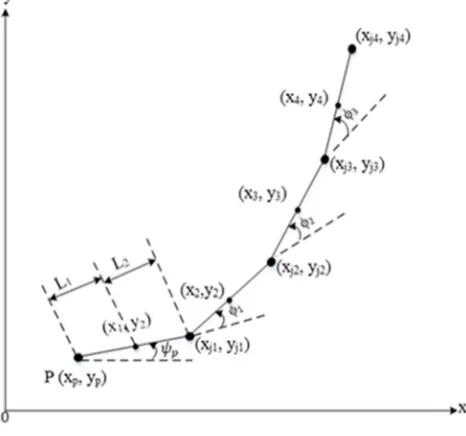
The mathematical model of a snake robot is depended on its design. The different snake robot designs are based on the certain basic properties such as type of joints, degrees of freedom (DOF) and with or without passive caster wheels. Most of the snake-like robots are connected links by revolute joints with one or two degrees of freedom. In this paper, design and control of snake-like robot is based on kinematics model without force. Four links snake robot model is shown in figure 1.
Figure 1. Four links snake-like robot model.
The four links snake-like robot model can be expressed by deriving the kinematic equations. The kinematics model describes the geometrical aspect of motion. The snake robot moves in two directions. It has two degrees of freedom. The snake-like robot is hard to express the actual direction because of the constant twisting of the links. However, the orientation angle of the robot can be defined as the following equation 1. The center of unit i of first link is described in the equation 2 and equation 3.
i 1 p
i k 1φ
ψ
=
ψ
+
∑
−= k (1)(
)
i 1
p 1 p 2 1
i j 1 j j 1
x =x +L cosψ +∑−− L cosψ +L cosψ+ (2)
(
)
i 1
p 1 p 2 1
i j 1 j j 1
y =y +L sinψ +∑−− L sinψ +L sinψ+ (3)
Where ψ1=
ψ
p So, the velocity constraint condition isneed to consider into explanation. The velocity equation for the center of unit i of first link can be obtained in equation 4 and equation 5.
i 1 p
i 1 p p 1 2 j j 1 j 1 j 1
x x L ψ sinψ j−− L ψ sinψ L ψ+ cosψ+
⋅ ⋅ ⋅ ⋅ ⋅
= − −∑ + (4)
i 1 p
1 2 j 1 j 1
i p p j 1 j j 1
y y L ψ cosψ −− L ψ cosψ L ψ+ cosψ+
⋅ ⋅ ⋅ ⋅ ⋅
= + +∑ +
(5)
In order to derive a simple kinematic model for control design, the velocity constraints condition is considered. The velocity equation is expressed in the equation (6).
x cos(α⋅i i+ψ )i +y sin(α⋅i i+ψ )i +r θ sinα⋅i i =0 (6)
According to the above equation, the kinematic model equation can be written in the following equation 7.
A
ω
⋅ =Bu (7)In this model,
ω
=
x y ψ φ φ φ
p p p 1 2 3T is the state vector to be controlled andT
1 2 3 4 1 2 3
u
θ θ θ θ φ φ φ
⋅ ⋅ ⋅ ⋅ ⋅ ⋅ ⋅
=
is control input vector. Thefollowing table show parameter and variables of the model.
Table 1. Parameter and variables that will be used to describe the model.
ω Robot’s state vector u Robot’s control input vector
φi Joint angle
(xp, yp) Position of robot heat
ψ Orientation of first unit with robot head ξ Trajectory of control parameter α The angle of the ith unit
L1, L2 Length between the joint and center of unit θi The absolute angle between ith and x-coordinate α The angle of the ith unit
(xi, yi) The position of ith segment center of unit i
3. Control System of Snake-Like Robot
The system is designed with closed loop feedback control system.
The closed loop system is solved by using Euler’s Method. If the control system does not meet desired tracking, the system is
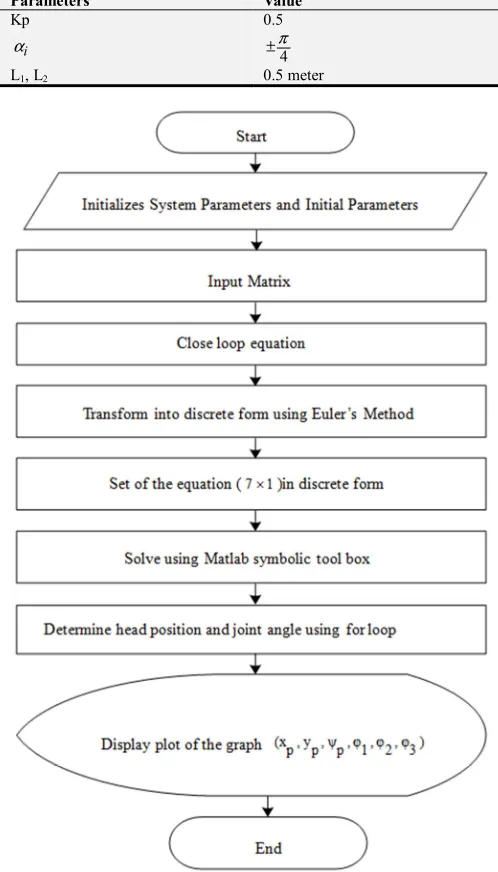
optimized again by using feedback control system. If the system converges desired tracking, the control system is finished. In this system, the goal of the control system is to meet desired trajectory tracking by controlling proportional controller.
Figure 2. Control System of Snake-like Robot.
4. Trajectory Tracking with Proportional
Controller
There are several control techniques used to control a robot arm. The most common control system is the PID control, optimal control, adaptive control and robust control. There are various kinds of controllers are used to move along a target trajectory in a robot arm design. In the proportional control algorithm, the controller output is proportional to the error signal which is the difference between the set point and the process variable.
In the control system, the output of a proportional controller is the multiplication product of the error signal and the proportional gain. Proportional controller is a feedback loop mechanism. This controller is widely used in a variety of other applications. The Proportional controller reduced the error between the desired tracking and the actual target tracking to control the serial links of snake robot.
First step input is applied to the kinematic model to study the characteristics of the system. And then, the closed loop response of the system is obtained by manual tuning controller gain. The trajectory tracking of snake robot is designed with the control law Equation 8. The error is the different between the desired trajectory tracking and the output of the system. Equation 9 shows the error of the system.
1
u=B− A ξ d⋅ −Ke
(8)
e= −ξ ξd (9)
Where
ξ
d is a given target trajectory,ξ
is actual tracking and K is a given proportional gain matrix. The closed-loop equation is described in the following Equation 10.A e K⋅+ p
e
=0 (10)
Table 2. Shows the simulation parameters for trajectory tracking of snake
robot with proportional controller.
Parameters Value
Kp 0.5
i
α ±π4
L1, L2 0.5 meter
5. Implementation
The implementation flow chart for Trajectory Tracking of Snake-Like Robot model is shown in figure 3. This program flow chart initializes symbolic parameters and system
parameters. And then, input matrix [
d d
k,e,ω,
ξ ξ
,
• ] of trajectory tracking is assigned. After, the system is designed with closed loop feedback control theory. According to the closed loop equation, continuous equation is appeared. Euler Method is used to transform continuous equation to discrete equation. Matlab symbolic toolbox is used to solve discrete equation. And then, the position, orientation angles and joint angles are obtained by using for loop. Finally, the value of the position, orientation and joint angles are described by using the graph.6.
Simulation Results
Based on the system flow chart for snake robot model, the simulation result for trajectory tracking of x-y plot of head position could be analyzed. The simulation results are based on feedforward and feedback control system. Figure 4 shows feedforward control system of trajectory tracking for x-y plot of head position. The simulation result is based on feedforward control system. The initial trajectory tracking condition is zero and desire trajectory tracking condition is
π π π π
R cosp t, R sinp t , t ,0,0,0
16 16 16 2
−
in the feedforward
control. The value of Rp is 0.7 meter. According to the
simulation result, the tracking error is found between actual tracking and desired tracking.
Figure 4. X-Y plot of head position (feedforward).
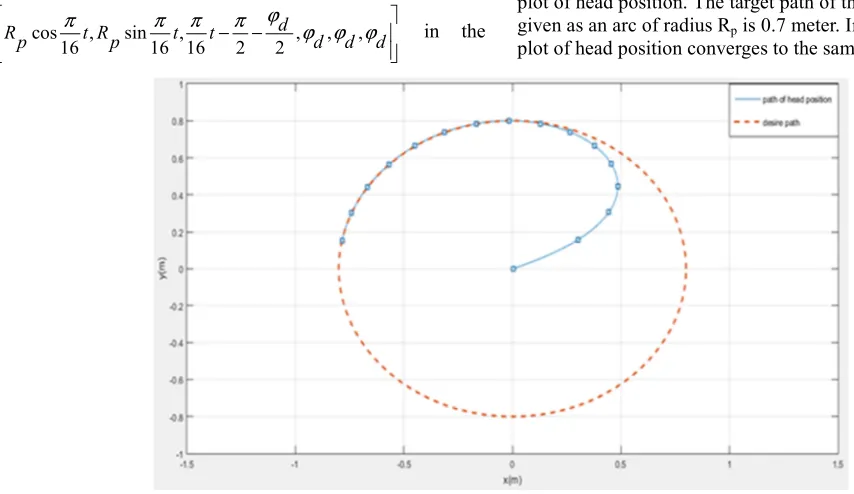
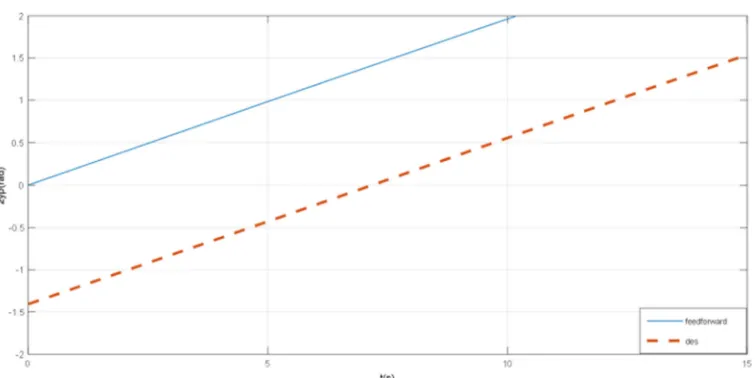
So, All the variables are well controlled to reach target trajectory by applying feedback control system. The initial trajectory condition is zero and desire trajectory condition is
cos , sin , , , ,
16 16 16 2 2
d
Rp π t Rp π πt t π ϕ ϕ ϕ ϕd d d
− −
in the
feedback control system. The value of
d
ϕ is -0.283. Figure 5 shows feedback control system of trajectory tracking for x-y plot of head position. The target path of the head position P is given as an arc of radius Rp is 0.7 meter. In this result, the x-y
plot of head position converges to the same circular path.
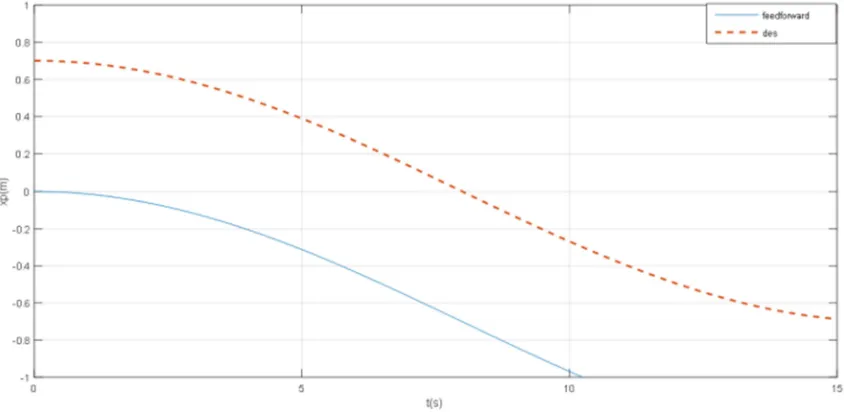
The feedforward control system for time response of head position of x- coordinate is shown in figure 6. In this result, the solid line is actual trajectory tracking of head position of x- coordinate and dashed line is the target trajectory tracking.
According to the simulation result, trajectory tracking for head position of x- coordinate is far away from the target localization. In this result, horizontal axis is time(s) and vertical axis is the value of head position of x-coordinate.
Figure 6. Time response of head position of x-coordinate (Feedforward).
So, the closed loop feedback control system is used to reach the target localization. After controlling proportional controller, trajectory tracking for time response of head position of x-coordinate meet the target localization after seven second. Figure 7 shows feedback control system for time response of head position of x- coordinate.
Figure 7. Time response of head position of x-coordinate (Feedback).
Figure 8 and figure 9 shows time response of head position of y- coordinate for feedforward control system and feedback control system. In this result, the solid line is actual trajectory tracking of head position of y- coordinate and dashed line is the target trajectory tracking. Horizontal axis is time(s) and vertical axis is the value of head position of y- coordinate. Based on the simulation result, trajectory tracking of head position of y- coordinate meet the target localization begin from the initial condition. The time response of y-coordinate is the same in the feedforward control system and feedback
control system.
The feedforward control system for the time response of orientation angle ψp is shown in figure 10. In this result, the solid line is actual trajectory tracking and dashed line is the target trajectory tracking of orientation angle. Horizontal axis is time(s) and vertical axis is the value of orientation angle
Figure 8. Time response of head position of y-coordinate (Feedforward).
Figure 9. Time response of head position of y-coordinate (Feedback).
Figure 10. Time response of orientation angle ψ p (feedforward).
Therefore, closed loop feedback control system is used to reach the target path. The trajectory tracking of orientation angle is arrived the target tracking by using feedback control
angle ψp. In this result, horizontal axis is time (s) and vertical axis is the value of orientation angle ψ p.
Figure 11. Time response of orientation angle ψ p (feedback).
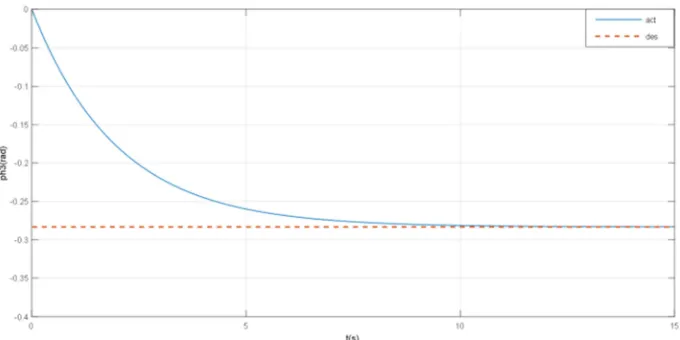
Figure 12 to figure 14 shows feedback control system for time response of joint angles (φ1,φ2,φ3). In this result, the
solid line is actual trajectory tracking and dashed line is the
target trajectory tracking of joint angles. In this figure, horizontal axis is time (s) and vertical axis is the value of joint angle.
Figure 12. Time response of joint angle φ1 (feedback).
According to the simulation result, trajectory tracking of joint angles met to the target localization after ten second. From these result, the state variables are converging to the desire trajectory and the robot moves along the target path. Snake robot is very difficult to control because it has many internal degree of freedom. So, the head position and
orientation angle is controlled to reach the target path by adjusting proportional controller. In this control system, the last three links are automatically moved toward the target trajectory by controlling head position and orientation angle of first link.
Figure 14. Time response of joint angle φ3 (feedback).
7. Conclusion
In this paper, the snake robot is typically composed of four segments links that are connected serially active joints. The kinematic model of snake-like robot is developed and presented with 2 DOF in this paper. By using obtained kinematic model equation, the model of system is simulated in Matlab. The model is based on a set of nonlinear first order differential equation. The Euler method is used to change discrete equation. Modeling, control and numerical simulation of snake robot is carrying out using the Matlab software. Furthermore, this paper has only focused on the cases where the robot does not contact with environment except for the ground which is assumed to be flat and horizontal. Although the kinematic model and the controllers have been presented for 4 link robots with the simulation results. It is possible to extend these results to more general cases of n( 3)≥ links.
Acknowledgements
The author would like to express special thank all the teachers from the Division of Control Engineering, Mandalay Technological University and Technological University (Myitkyina). And also thanks for Dr. Tin Tin Hla, Head of the department.
References
[1] G. Miller, “Snake Robots for Search and Rescue,” In:
Neurotechnology for Biomimetic Robots (MIT PressCambridge, MA, USA, 2002) pp. 271–284.
[2] Aksel Andreas Transeth, Kristin Ytterstad Pettersen and and P°al Liljeb; ack, “A survey on snake robot modeling and locomotion”, March 3, 2009.
[3] TetsushiKamegawa, Tatsuhiro Y amasaki, Hiroki Igarashi, and Fumitoshi Matsuno “Development of the Snake-like Rescue Robot KOHGA” 2004,New Orleans, LA April 2004.
[4] T. Takayama and S. Hirose, “Development of “Souryu I & II”—Connected crawler vehicle for inspection of narrow and
winding space,” J. Robot. Mech., vol. 15, no. 1, pp. 61–69, 2001.
[5] Masaya Hara, Shogo Satomura, Hiroaki Fukushima, Tetsushi Kamegawa, Hiroki Igarashi and Fumitoshi Matsuno, ‘Control of a Snake-like Robot Using the Screw Drive Mechanism,2007 IEEE International Conference on Robotics and Automation Roma, Italy, 10-14 April 2007.
[6] K. Suzumori, S. Wakimoto, and M. Takata, “A miniature inspection robot negotiating pipes of widely varying diameter,” in Proc. IEEE Int. Conf. Robot. Autom. 2003, pp. 2736–2740. [7] A. Kuwada, S. Wakimoto, K. Suzumori, and Y. Adomi,
“Automatic pipe negotiation control for snake-like robot,” in
Proc. IEEE/ASME Int. Conf. Adv. Intell. Mechatron. 2008, pp. 558–563.
[8] F. Matsuno and K. Mogi, “Redundancy controllable system and controlof snake robots based on kinematic model,” in Proc. IEEE Conf. Decis. Control, 2000, pp. 4791–4796.
[9] S. Ma, “Analysis of creeping locomotion of a snake-like robot,”
Adv. Robot., vol. 15, no. 2, pp. 205–224, 2001.
[10] M. Saito, M. Fukaya, and T. Iwasaki, “Serpentine locomotion withrobotic snakes,” IEEE Control Syst. Mag., vol. 22, no. 1, pp. 64–81, Feb. 2002.
[11] T. Kamegawa and F. Matsuno, “Proposition of twisting mode of locomotion and GA based motion planning for transition of locomotion modes of 3-dimensional snake-like robot,” in Proc. IEEE Int. Conf. Robot. Autom. 2002, pp. 1507–1512.
[12] A. A. Transeth, R. I. Leine, C. Glocker, K. Y. Pettersen, and P. Lil Liljeb ack, “Snake robot obstacle-aided locomotion modeling, simulations, and experiments,” IEEE Trans. Robot., vol. 24, no. 1, pp. 88–104, Feb. 2008.
[13] R. L. Hatton and H. Choset, “Generating gaits for snake robots: Annealed chain fitting and keyframe wave extraction,” Auton. Robot. vol. 28, pp. 271–281, 2010.
[14] X. Wu and S. Ma, “Adaptive creeping locomotion of a CPG-controlled snake-like robot to environment change,”
Auton. Robot. vol. 28, pp. 283–294, 2010.