R E V I E W
Open Access
Development and implementation of explicit
computerized protocols for mechanical
ventilation in children
Philippe Jouvet
1,2*, Patrice Hernert
2and Marc Wysocki
2Abstract
Mechanical ventilation can be perceived as a treatment with a very narrow therapeutic window, i.e., highly efficient but with considerable side effects if not used properly and in a timely manner. Protocols and guidelines have been designed to make mechanical ventilation safer and protective for the lung. However, variable effects and low compliance with use of written protocols have been reported repeatedly. Use of explicit computerized protocols for mechanical ventilation might very soon become a“must.” Several closed loop systems are already on the market, and preliminary studies are showing promising results in providing patients with good quality ventilation and eventually weaning them faster from the ventilator. The present paper defines explicit computerized protocols for mechanical ventilation, describes how these protocols are designed, and reports the ones that are available on the market for children.
Introduction
Mechanical ventilation is a sophisticated technique that can keep alive the most severely ill patients; however, it can simultaneously damage the lungs and unfortunately generate unwanted complications [1]. By analogy with pharmacology, mechanical ventilation can be viewed as a treatment with very narrow therapeutic windows, i.e., highly efficient but with considerable side effects if not used properly and in a timely manner. During the past two decades, considerable knowledge has been gained to find the optimal risk/benefit balance for mechanical ven-tilation. For instance, protective ventilation with low tidal volume (VT) and low airway pressure (Paw) has been shown to be safer than ventilation with high VT and Paw in adults with ARDS [2]. However, several pub-lications in adults and children have reported variable effects of written protocols in implementing protective ventilation with relatively low compliance with use of the protocols [3,4] with a significant number of patients still being ventilated with high VT and high Paw [5,6]. Human and organizational factors are at least partially responsible for such poor compliance [7] but so are the
vast diversity of patient types, conditions, and changes over time, which makes one protocol unable to fit all situations.
In addition, expertise and human resources are not always available to make sure that patients receive the best ventilation everywhere and all the time. The ability to make timely adjustments of the ventilator according to the patient’s condition, without much inter-caregiver variability, would certainly improve the safety and effi-ciency of mechanical ventilation especially when resources and expertise are not at the bedside 24 hours per day. In the present paper, we will define an explicit computerized protocol, describe how these protocols are designed and developed currently, report the ones that are available on the market for children, and propose some considerations for future developments in this field.
Definitions
A protocolis a document that is designed to guide deci-sions regarding diagnosis, management, and treatment of specific medical situations. The protocol is based on the medical knowledge acquired from physiological stu-dies, expertise, or evidence and can be generated by individuals or by consensus obtained from a group of physicians or experts. Protocols often are not precise
* Correspondence: [email protected] 1
Pediatric Intensive Care Unit, Department of Pediatrics, University of Montreal, Montreal, Canada
Full list of author information is available at the end of the article
enough to generate a decision at the bedside in a speci-fic situation and thus signispeci-ficant inter-clinician variabil-ity in their application may exist.
An explicit protocol is designed to provide enough details to generate patient-specific therapy instructions that can be performed by different clinicians with no inter-clinician variability [8]. Important individualization of patient therapy can be preserved by explicit protocols when they are driven by individual patient data. Consid-ering the number of clinical situations and inputs from a given patient, explicit protocols rapidly become so complex that computers are required to integrate the large amount of information and provide specific answers to the user.
An explicit computerized protocol (ECP) is an explicit protocol supported by computer science to apply the instruction for a given patient at a given time. ECP might be in a laptop or integrated into the ventilator or monitoring device. The medical knowledge is usually implemented in the ECP through “if... then“ rules. For example: if the SpO2 is < 88%, then increase FiO2 by
10%. The rules can be more complex and based on a validated physiological equation, such as the Otis
equa-tion [9] as used in IntelliVent™ (Hamilton, Bonaduz,
Switzerland).
A rule can be in an open or closed loop. The rule is an open-loop rule if it results in a therapeutic or diag-nostic recommendation displayed on the screen of a device for which caregivers can agree whether to accept the recommendation. According to the previous
defini-tions, a clinical decision support system (CDSS) is
defined as an ECP that uses two or more items of patient data to generate case-specific recommendations through rules that are only in open-loop [10].
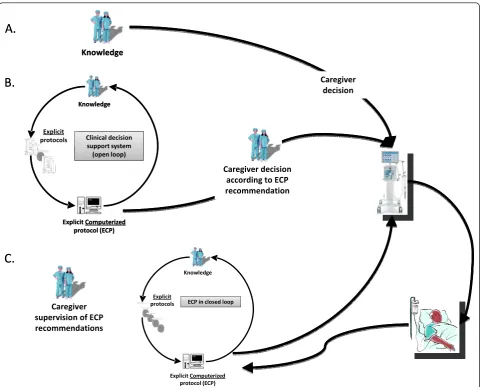
As a step further, a rule that provides a recommenda-tion of modificarecommenda-tion of the ventilator setting and imple-ments this modification without caregiver intervention is a rule in closed-loop. Currently most of the ECPs used commercially for mechanical ventilation involve both open and loop ventilation rules. A closed-loop ECP is arbitrarily designated as an ECP with at least one rule in closed-loop (Figure 1).
Why do we need explicit computerized protocols for mechanical ventilation?
The human brain has a limited ability to incorporate data and information in decision making and human memory can simultaneously retain and optimally utilize only seven plus or minus two data constructs [11]. The amount of data that is retained is even less when care-givers are working at night, with stress and/or time pressure. This limitation contrasts sharply with the clini-cal reality in which hundreds of variables are encoun-tered by the caregivers in the ICU setting and decisions
are made 24 hours per day. To prescribe mechanical ventilation, numerous parameters are considered, including all physiological data provided by the respira-tor, monitors, and clinical data from the charts on diag-nosis and use of sedatives and hemodynamic treatments. The mismatch between human ability and the vast amount of data and information contributes to variation in clinical practice as decisions are made applying differ-ent data constructs and differdiffer-ent knowledge/expertise. In such a complex environment, the help of an ECP is crucial to limit inter-caregiver variability. In a less com-plex environment, the aviation industry confronted human factors responsible for accidents [12] and decided decades ago to develop and implement closed-loop ECP in airplanes to improve safety resulting in a model of safety management today. That being said, in the medical field, the major limitation to developing ECP is to agree on which medical knowledge to implement.
Development of explicit computerized protocols A multidisciplinary approach is needed to generate an ECP; the team should include clinical expert(s) in mechanical ventilation to generate the knowledge and validate ECP in a clinical environment, computer scien-tists to design the ECP platform, biomedical engineers to implement the ECP into medical devices (monitors and/or ventilators) and test ECP robustness and reliabil-ity, and industry to finalize a product that will receive a European Community marking (CE mark) and a U.S. marking (Food and Drug Administration (FDA)) approval.
Generation and validation of medical knowledge implemented in an ECP
The basic component of an ECP is a medical knowl-edge-based rule. In our clinical practice, we continu-ously apply rules. If we take the previous example of the
SpO2/FiO2 rule, caregivers modify FiO2 according to
SpO2routinely. An ECP will recommend (open-loop) or
do (closed-loop) in the same way, as soon as a valid
SpO2 is available. The ECP also will define how often
the FiO2 can be changed, the amplitude of change, and
add additional rules: for example, define what will occur if FiO2is 100% and SpO2still below normal range.
The knowledge needed to develop an ECP able to manage the course of mechanical ventilation in any ICU patient is vast and we all know that“the devil is in the
details.” This knowledge is based on published work on
high-frequency ventilation mode in ARDS patients?) and clin-ical trials to validate ECPs [4,14,15]. A step-by-step approach, including more than one research center, is needed to develop valid, robust, and widely accepted ECPs. For example, the medical knowledge acquired in the past two decades on weaning in pressure support
mode resulted in the development of SmartCare/PS™.
SmartCare/PS™ was developed by one research team,
and more than a decade elapsed from conception to
commercialization [16,17]. ECPs based on SpO2/FiO2
have already been developed for neonates and children and need further clinical validation [14,15].
To shorten development and validation times, one option would be to follow the same development and validation process used in aviation by using a simulated flight environment (wind, temperature...). Medical ECP would need virtual patients with realistic physiological and pathological behaviors for developing and validating
ECPs before clinical trials. Several teams are already working on such platforms, although none are currently commercialized for this purpose [18-20].
ECP platform
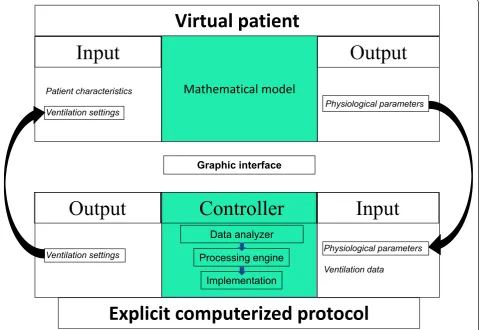
The five technical components (Figure 2) of an ECP are: 1) input data (entered manually or captured electroni-cally from devices); 2) a control unit that analyses the input data to generate orders; 3) output data; 4) an interface that display a recommendation (open-loop) or implements the setting modification (closed-loop); and 5) a virtual patient as mentioned above.
In the SpO2/FiO2 rule already described, the input
data is patient SpO2, the control unit analyses SpO2
and selects the rule that corresponds to SpO2 value (e.
g., increase FiO2if SpO2 is low, decrease FiO2if SpO2is
high (knowing that oxyhemoglobin dissociation curve is flat at SpO2> 97%), or no change if SpO2 is in normal Caregiverdecision
accordingtoECP
recommendation
Caregiver
decision Knowledge
A.
B.
Explicit protocols
Knowledge
ExplicitComputerized protocol(ECP)
Clinicaldecision
supportsystem (openloop)
Caregiver
supervisionofECP
recommendations
Explicit protocols
Knowledge
ExplicitComputerized protocol(ECP)
ECPinclosed loop
C.
Caregiverdecision
accordingtoECP
recommendation
Caregiver
decision Knowledge
A.
B.
Explicit protocols
Knowledge
ExplicitComputerized protocol(ECP)
Clinicaldecision
supportsystem (openloop)
Caregiver
supervisionofECP
recommendations
Explicit protocols
Knowledge
ExplicitComputerized protocol(ECP)
ECPinclosed loop
C.
range), the output data is the FiO2suggestion displayed
on a screen (open-loop) or a setting modification on the respirator (closed-loop).
The input data, whether entered manually by the clini-cian or captured by a medical device, needs to be pro-cessed to discard artefacts and to be clinically relevant before being sent to the control unit [21]. The key point is to input relevant, valid, robust, and stable data for the ECP. For example, the weaning ECP for children
(SmartCare/PS™, Dräger, Germany) transforms
real-time tidal volume, respiratory rate, and end tidal PCO2
(ETPCO2) into mean values during a 2-minute period.
With IntelliVent™ (Hamilton Medical, Switzerland), the
ETPCO2used for the minute ventilation closed-loop is
the second highest breath-by-breath ETPCO2 with
enough quality index during the last 10 breaths [14]. On
the other hand, ETPCO2 is not always a good surrogate
for PaCO2 especially during the acute phase of illness
with high dead space. Such situations must be detected
by the ECP to avoid any misinterpretation of the input data.
The control unit receives clinical information from the patient (input data) and“transforms” this information into orders (output data). The basic structure for pro-cessing information is rule-based (see above). All poten-tial paths and situations should be addressed to lead to specific instructions. It usually requires several set of rules to manage two to three input data each. For exam-ple, a first set of rules could be for pressure support management according to tidal volume, respiratory rate, and ETPCO2[17], a second set of rules could be for FiO2
and PEEP management according to SpO2 [22], and
another set of rules could be for recommending
extuba-tion when pressure support, PEEP, and FiO2 reach
threshold values for a certain length of time (mimicking an extubation readiness test) [4]. Rules are usually“if...
then ...” rules, but some ECPs have been developed
using fuzzy logic [23], i.e., integrating patient’s
Graphic interface
Virtual patient
Mathematical model
Patient characteristics
Ventilation settings Physiological parameters
Input
Output
Controller
Ventilation settings
Explicit computerized protocol
Data analyzer
Processing engine
Implementation
Physiological parameters
Ventilation data
information in a fuzzy way to mimic the human brain [24,25]. Despite the use of fuzzy logic in aircraft autopi-lot and in various other applications [25], to the best of our knowledge, fuzzy logic is not used in commercia-lized medical ECPs.
Output data can be recommendations to the care-givers suggesting new ventilator settings, specific orders such as “patient ready for separation from the ventila-tor,”or ventilator settings being automatically adjusted. During the development phase of an ECP, output data are usually recommendations (open-loop). After exten-sive testing, some rules or sets of rules can be switched to close the loop.
A simple, attractively presented, and intuitive user interface is crucial to facilitate the understanding of the ECP decision process and for knowledge transfer at the bedside [26]. Ideally, the user interface should include educational tools to train caregivers on mechanical ven-tilation management according to the ECP, as done with simulators for aircraft pilots.
As mentioned above, use of a virtual patient mimick-ing patient-ventilator cardiorespiratory interactions also is important for the development of ECPs. As for air-craft autopilot, a virtual patient may help“debug” the very first ECP versions but also aid understanding the complex interactions between rules and achieving precli-nical validation. In addition such virtual patients, which should ideally be incorporated in the medical device (i. e., the ventilator), might be more efficient in training and teaching the eventual users (Figure 2). Currently, the virtual patients used for ECP development are com-puter simulations of the physiologic processes of respiration and circulation, using mathematical models.
Several barriers exist to the development of ECPs: 1) We do not generate enough medical knowledge in mechanical ventilation and most of the time ECPs are targeting a relatively small and regional scientific com-munity. This can be improved by promoting multicenter international collaborations along the lines of the Pedia-tric Acute Lung Injury and Sepsis Investigators Network (PALISI), the European Society of Pediatric Intensive Care Medicine and Collaborative Critical Care Research Network (CCCRN) [5,27]; 2) It is important to be able to capture any refusal of an ECP recommendation and to analyse if an adjustment of the ECP is mandatory. The commercialized ECP described below do not have such reporting systems. In the future, the ECPs should be equipped with a data report system and an expert team should analyze the data to refine the ECP. The versatility and the ease in upgrading and adjusting the ECP are probably key factors in making ECP widely accepted; 3) The manufacturers are unfortunately not ready to share their ECPs, processes and knowledge, for obvious marketing and business reasons. They also may
need more resources and less time-to-market con-straints to innovate further. Consortium(s) like those that exist in aeronautics could be of considerable value in driving forward innovation in this field.
Several barriers also exist to the acceptance and implementation of ECPs. These barriers include the lack of awareness, lack of familiarity with the protocol, lack of agreement, lack of demonstrated safety and efficacy, lack of known improved outcome, lack of ability to overcome the inertia of previous practice, protocol-related barriers (not easy to use, not convenient, cum-bersome, confusing), environment-related barriers (new resources or facilities not accessible) [8]. Among all these barriers, the safety issue is the first and most important one. The safety issue is addressed using the three following principles: 1) ECPs suggests a modifica-tion or modifies ventilamodifica-tion settings only within the alarms prescribed on the respirator; 2) there are stop rules implemented in ECPs that interrupt closed loop protocols in specific situations (if input data are not available for example); 3) Most of the ECPs in closed loop are first developed and tested for the management of the weaning phase. Despite these barriers many set of rules even in closed loop are widely accepted by care-givers. For example, the algorithm of the neurally adjusted ventilatory assist mode (NAVA) includes a rule that automatically adjusts positive inspiratory pressure to patient’s electrical activity of the diaphragm change to deliver ventilation proportional to patient’s needs.
Explicit computerized protocols for mechanical ventilation in children
Saxton and Myers reported the first ECP to adjust the end tidal PCO2by regulating the negative pressure of an
iron lung ventilator in poliomyelitis patients [28]. Pedia-tricians then soon became concerned with adjusting the
FiO2 tightly in order to avoid hypo/hyperoxemia and
their related side effects [29,30]. Dugdale and coworkers [31] reported in 1988 seven neonates with respiratory distress syndrome treated during 48 hours with a
closed-loop FiO2adjustment to keep the PaO2obtained
from an indwelling umbilical artery electrode at 10 kPa.
The time spent by the neonates with PaO2 at ± 1 kPa of
the target PaO2 was 75% with closed-loop control FiO2
compared with 45% with manual adjustment of FiO2.
But the invasiveness of the PaO2monitoring precluded
the development of this ECP. Claure et al. conducted a
research program designed to develop closed-loop FiO2
adjustment using SpO2 [32,33]. These authors recently
conducted a multicenter, randomized, clinical trial that included mechanically ventilated preterm infants who were ventilated during two consecutive 24-hour periods:
one with FiO2 adjusted by caregivers and the other by
FiO2 adjustment improved maintenance of the intended
SpO2 range, and led, significantly, to reduced time with
high SpO2 and more frequent episodes with SpO2
between 80% and 86% [15]. This ECP is now
commer-cialized as CLiO2™(CareFusion, Yorba Linda, US) and
implemented in a respirator.
SmartCare/PS™(Draeger Medical, Lübeck, Germany;
PS stands for pressure support) is an ECP for the closed-loop control of pressure support ventilation. This ECP operates without the need of caregivers interven-tion but under their supervision (Figure 1), the four fol-lowing therapeutic procedures: 1) automatic adaptation of the pressure support level to keep the patient inside a
“zone of respiratory comfort” that corresponds to a
respiratory pattern that is determined by lower and upper thresholds of tidal volume, respiratory rate, and
end tidal PCO2. These thresholds are defined within
acceptable limits as established by a large panel of pediatric intensivists [34]; 2) a strategy to gradually and progressively decrease the level of pressure support level; 3) an automated spontaneous breathing trial (SBT) when the patient reaches a minimum ventilation sup-port; and 4) a recommendation of separation from the ventilator when the SBT is successfully passed (Table 1).
SmartCare/PS™is available on Draeger’s Evita XL and
the latest generation of Draeger Medical ventilators: Evita Infinity V500. Among the first 20 pediatric
patients treated with SmartCare/PS™, median time in
“zone of respiratory comfort”was 91% (range, 0.7-99%) [4]. In a single-center, randomized, clinical trial (RCT), a significant decrease in weaning duration in the
Smart-Care/PS™group (n = 15) was observed compared with
usual care (n = 15), without any modification in wean-ing failure rates [35]. A multicenter RCT should be
conducted because the benefit of SmartCare/PS™ may
vary from one PICU to another as suggested by studies done in adults [16,36]. The major strength of
Smart-Care/PS™is the implementation of an ECP for
mechan-ical ventilation with a user-friendly interface that allows individual customization. There are several
improve-ments to consider for SmartCare/PS™: 1) children with
IBW < 15 kg are excluded. Therefore, another ECP is needed in the same PICU for infants < 15 kg. 2) PEEP
and FiO2are not automatically adjusted by SmartCare/
PS™ but are part of the recommended criteria to
initi-ate a spontaneous breathing trial (SBT).
IntelliVent™ (Hamilton Medical, Bonaduz,
Switzer-land) is an ECP for the automated control of minute
volume, PEEP, and FiO2 in adaptive support ventilation
(ASV). IntelliVent™ manages, with (open-loop) or
with-out the need of caregivers intervention (closed-loop), the four following weaning steps: 1) switch from control ventilation to spontaneous breathing (specific to ASV mode); 2) automatic adaptation of the pressure to main-tain the patient in a range of respiratory rate, end tidal
PCO2 and SpO2; 3) an automated SBT when children
reach minimum ventilation support; and 4) a timer that shows SBT duration (Table 1). IntelliVent™is available on the G5 and S1 generation ventilators from Hamilton Medical that continuously monitor usual mechanical
ventilation parameters plus ETPCO2 and SpO2 [14].
IntelliVent™ has been assessed in one clinical trial on feasibility and safety in children during the weaning
phase. Fifteen children were included and IntelliVent™
was safe and kept patients with body weight≥7 kg in
the “zone of respiratory comfort”comparably to PSV or
ASV [14]. The major strength of IntelliVent™ is the
combination of an ECP and user-friendly interface that
Table 1 Characteristics of the SmartCare/PS™Draeger Medical and IntelliVent™Hamilton Medical explicit computerized protocols
Characteristics SmartCare/PS™ IntelliVent™
Ventilation mode PSV ASV
Type of breath PS PC and PS
Body weight range for use ≥15 kg ≥7 kg
Primary goal of the ECP wean while maintaining ETPCO2, RR, Vt within predefined range
maintaining ETPCO2, RR, Vt, SpO2 within predefined ranges Initial settings IBW, humidification system, medical history IBW, medical history
Clinical decision support Option (open-loop) No Yes
Input data 2 minETPCO2,2 minRR,2 minVt, PEEP, PS level, ETPCO2, RR, Vt, SpO2PEEP, PIP, breath by breath
Output data PS level, MV, PEEP, FiO2
SBT Yes Yes
Recommendation for separation from the ventilator Yes SBT duration displayed
Adapted from Jouvet et al. [39]
allows a certain individual customization of the proto-cols, including automatic recruitment maneuvers. There
are several improvements to consider for IntelliVent™
in children: 1) at present, there is not much clinical experience with ASV and this ECP in children; 2) chil-dren with ideal body weight < 7 kg are excluded, there-fore, another ECP is needed in the same PICU for younger children; 3) automatic PEEP adjustment needs additional validation; 4) IntelliVent limits adjustments of PEEP in the case of hemodynamic instability based on the presence of pulsus paradoxus on pulse oximetry waveform (heart lung index) [37,38]. The accuracy of the waveform assessment and the upper limits of PEEP adjustment need to be validated in children.
New ECP developments
A research program designed to develop and validate an ECP for the management of mechanical ventilation in children with acute lung injury is being conducted by a working group of the PALISI network in collaboration
with CCCRN. This program is based on the following principles: the ECP will be an adaptation of a protocol already developed in adults (ARDS Network); the applic-able type of ventilation will be pressure control mode and high frequency oscillatory (HFOV) mode. The com-puterized protocol will start at initiation of ventilation. The basic structure of the protocol will be that of a closed-loop system with the initial stage of design being open-loop, even for HFOV. The input data will include ventilator data, ETPCO2, SpO2, blood gases, and an
auto-matic analysis of chest x-ray. The output data will be ventilation settings modifications and specific recom-mendations. Several preliminary studies are ongoing to refine the input data [13]. The ECP will be first devel-oped on a laptop. To retain simplicity, the design will be closed-loop, so the final product will require few interventions from caregivers. A data report system will register the reason why the decision was not approved during the open-loop phase and should register other data, including accurate time and version of the protocol
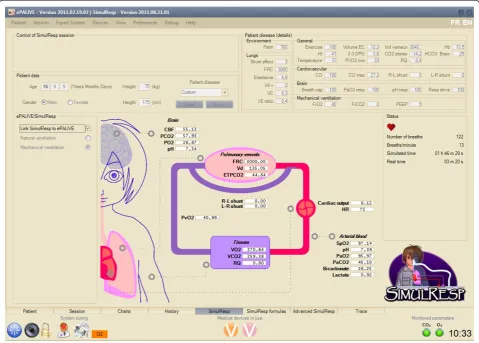
being used. Downloading the data should be possible in a database format and iterative refinement will be per-formed by a consensus committee. Preliminary data on the ECP has already been collected [6] and an ECP plat-form is almost completed (Figure 3).
Conclusions
Considering the current context in the PICU (manpower shortages, increased complexity of care, lack of specific knowledge, needs for quality, safety, and reproducibility), ECP for mechanical ventilation will very soon be a
“must.”Open-loop and decision support systems allow
too much room for inter-physicians variability and may not achieve the goal of providing the best possible care. As in many other fields, safety and quality will be achieved by closing the loop but allowing physicians to retain the role of supervisor, most directly involved with the most severe or atypical patients. Several closed-loop systems are already on the market, and preliminary stu-dies have shown promising results in providing patients with good quality ventilation and eventually weaning them faster from the ventilator.
Acknowledgements
The authors thank Catherine Farrell, MD, for help with the manuscript preparation.
Author details
1Pediatric Intensive Care Unit, Department of Pediatrics, University of Montreal, Montreal, Canada2Research Center, Sainte-Justine Hospital, University of Montreal, Montreal, Canada
Authors’contributions
PJ, PH, and MW drafted the manuscript. All authors read and approved the final manuscript.
Competing interests
PJ has a research salary from the“Fonds de Recherche du Québec - Santé” in respiratory critical care. PJ’s research on virtual patient (SimulResp) is funded by a grant from the“Natural Sciences and Engineering Research Council of Canada.”The clinical research conducted by PJ on SmartCare™ was funded by the Research network of the“Fonds de Recherche du Québec - Santé”and a Ventilator S1 Evita 4 was provided for research purposes by Draeger Medical. The clinical research conducted by PJ on IntelliVent™was funded by a grant from Hamilton Medical, and a respirator S1 was provided for research purposes by Hamilton Medical. PJ was invited twice to present the results of the clinical research on IntelliVent™at international meetings organized by Hamilton Medical. PJ also had a respirator Servo i, provided for research purposes by Maquet Medical. MW was the director of the Research and Development Department of Hamilton Medical. MW is cosharing a patent on IntelliVent™(WO/2007/ 085110 and WO/2007/085108).
PH’s salary came from grants from the Research network of the“Fonds de Recherche du Québec - Santé”and the“Natural Sciences and Engineering Research Council of Canada.”
Received: 19 October 2011 Accepted: 21 December 2011 Published: 21 December 2011
References
1. Tobin MJ:Advances in mechanical ventilation.NEJM2001,344:1986-1996.
2. Putensen C, Theuerkauf N, Zinserling J, Wrigge H, Pelosi P:Meta-analysis: ventilation strategies and outcomes of the acute respiratory distress syndrome and acute lung injury.Ann Intern Med2009,151:566-576. 3. Randolph AG, Wypij D, Venkataraman ST, Hanson JH, Gedeit RG, Meert KL,
et al:Effect of mechanical ventilator weaning protocols on respiratory outcomes in infants and children: a randomized controlled trial.JAMA 2002,288:2561-2568.
4. Jouvet P, Farges C, Hatzakis G, Monir A, Lesage F, Dupic L,et al:Weaning children from mechanical ventilation with a computer-driven system (closed-loop protocol): a pilot study.Pediatr Crit Care Med2007,8:425-432. 5. Santschi M, Jouvet P, Leclerc F, Gauvin F, Newth CJ, Carroll CL,et al:Acute
lung injury in children: therapeutic practice and feasibility of international clinical trials.Pediatr Crit Care Med2010,11:681-689. 6. Khemani RG, Sward K, Morris A, Dean JM, Newth CJ:Variability in usual
care mechanical ventilation for pediatric acute lung injury: the potential benefit of a lung protective computer protocol.Intensive Care Med2011. 7. Rubenfeld GD:Implementing effective ventilator practice at the bedside.
Curr Opin Crit Care2004,10:33-39.
8. Morris AH:Developing and implementing computerized protocols for standardization of clinical decisions.Ann Intern Med2000,132(5):373-383. 9. Otis A, Fenn W, Rahn H:Mechanics of breathing in man.J Appl Physiol
1950,2:592-607.
10. Wyatt J:Computer-based knowledge systems.Lancet1991,338:1431-1436. 11. Miller G:The magical number seven plus or minus two: some limits on
our capacity for processing information.Psychol Rev1956,63:81-97. 12. Higton P:Safety lessons from aviation.Perfusion2005,20:191-193. 13. Eddington A, Jouvet P, Bordessoule A, Emeriaud G, Bruschschwein F,
Wysocki M:Invasive versus non-invasive criteria ventilator setting modification in critically ill children.Pediatr Crit Care Med2011,12(Suppl 3):A78.
14. Jouvet P, Eddington A, Bordessoule A, Emeriaud G, Lopez Gasco R, Wysocki M:Weaning children from mechanical ventilation with an explicit computerized protocol: Intellivent®.Pediatr Crit Care Med2011,
12(Suppl 3):A38.
15. Claure N, Bancalari E, D’Ugard C, Nelin L, Stein M, Ramanathan R,et al:
Multicenter crossover study of automated control of inspired oxygen in ventilated preterm infants.Pediatrics2011,127:e76-e83.
16. Lellouche F, Mancebo J, Jolliet P, Roeseler J, Schortgen F, Dojat M,et al:A multicenter randomized trial of computer-driven protocolized weaning from mechanical ventilation.Am J Respir Crit Care Med2006,174:894-900. 17. Dojat M, Brochard L, Lemaire F, Harf A:A knowledge-based system for
assisted ventilation of patients in intensive care units.Int J Clin Monit Comput1992,9:239-250.
18. Sailors RM, East TD:A model-based simulator for testing rule-based decision support systems for mechanical ventilation of ARDS patients. Proc Annu Symp Comput Appl Med Care1994, 1007.
19. Winkler T, Krause A, Kaiser S:Simulation of mechanical respiration using a multicompartment model for ventilation mechanics and gas exchange. Int J Clin Monit Comput1995,12:231-239.
20. Jouvet P:Un simulateur reproduit les réactions d’un patient pour l’assistance respiratoire.Vecteur2011,10:1.
21. Tehrani FT, Roum JH:Intelligent decision support systems for mechanical ventilation.Artif Intell Med2008,44:171-182.
22. Lellouche F, Hernert P, Jouvet P, Bouchard P, Brochard L:Clinical evaluation of a computer-driven algorithm to automatically set PEEP and FiO2 during mechanical ventilation.Am J Respir Crit Care Med2009,
179:A3652.
23. Olliver S, Davis GM, Hatzakis GE:Weaning infants with respiratory syncytial virus from mechanical ventilation through a fuzzy-logic controller.AMIA Annu Symp Proc2003, 499-503.
24. Bates JH, Young MP:Applying fuzzy logic to medical decision making in the intensive care unit.Am J Respir Crit Care Med2003,167:948-952. 25. Jamshidi M:Tools for intelligent control: fuzzy controllers, neural
networks and genetic algorithms.Philos Transact A Math Phys Eng Sci 2003,361:1781-1808.
26. Wysocki M, Brunner JX:Closed-loop ventilation: an emerging standard of care?Crit Care Clin2007,23:223-240, ix.
27. Khemani RG, Newth CJ:The design of future pediatric mechanical ventilation trials for acute lung injury.Am J Respir Crit Care Med2010,
28. Saxton GA, Myers G:A servomechanism for automatic regulation of pulmonary ventilation.J Appl Physiol1957,11:326-328.
29. Beran AV, Taylor WF, Ackerman BD, Sperling DR, Strauss J:An automatic oxygen control system for infants.Pediatrics1971,48:315-318. 30. Beddis IR, Collins P, Levy NM, Godfrey S, Silverman M:New technique for
servo-control of arterial oxygen tension in preterm infants.Arch Dis Child 1979,54:278-280.
31. Dugdale RE, Cameron RG, Lealman GT:Closed-loop control of the partial pressure of arterial oxygen in neonates.Clin Phys Physiol Meas1988,
9:291-305.
32. Claure N, Gerhardt T, Everett R, Musante G, Herrera C, Bancalari E: Closed-loop controlled inspired oxygen concentration for mechanically ventilated very low birth weight infants with frequent episodes of hypoxemia.Pediatrics2001,107:1120-1124.
33. Claure N, D’Ugard C, Bancalari E:Automated adjustment of inspired oxygen in preterm infants with frequent fluctuations in oxygenation: a pilot clinical trial.J Pediatr2009,155:640-645, e1-2.
34. Santschi M, Gauvin F, Hatzakis G, Lacroix J, Jouvet P:Acceptable respiratory physiologic limits for children during weaning from mechanical ventilation.Intensive Care Med2007,33:319-325.
35. Jouvet P, Payen V, Gauvin F, Santschi M, Eddington A, Lacroix J:Weaning children from mechanical ventilation with a computer-driven explicit protocol: a randomized clinical trial.Am J Respir Crit Care Med2010,181: A3899.
36. Rose L, Presneill JJ, Johnston L, Cade JF:A randomised, controlled trial of conventional versus automated weaning from mechanical ventilation using SmartCare/PS.Intensive Care Med2008,34:1788-1795.
37. Michard F, Chemla D, Richard C, Wysocki M, Pinsky MR, Lecarpentier Y,et al:
Clinical use of respiratory changes in arterial pulse pressure to monitor the hemodynamic effects of PEEP.Am J Respir Crit Care Med1999,
159:935-939.
38. Feissel M, Teboul JL, Merlani P, Badie J, Faller JP, Bendjelid K:
Plethysmographic dynamic indices predict fluid responsiveness in septic ventilated patients.Intens Care Med2007,33:993-999.
39. Jouvet P, Mersmann S, Wysocki M:Automation of weaning in children.In Textbook on Pediatric and Neonatal Mechanical Ventilation.Edited by: Rimensberger P. New York: Springer Verlag; 2012:.
doi:10.1186/2110-5820-1-51
Cite this article as:Jouvetet al.:Development and implementation of explicit computerized protocols for mechanical ventilation in children.
Annals of Intensive Care20111:51.
Submit your manuscript to a
journal and benefi t from:
7Convenient online submission 7Rigorous peer review
7Immediate publication on acceptance 7Open access: articles freely available online 7High visibility within the fi eld
7Retaining the copyright to your article