ORIGINAL ARTICLE
Enar Nordvik · N. Olof Broman
Looking at computer-visualized interior wood: a qualitative assessment
using focus groups
Abstract The objective of this study was to explore and gather human reactions and perceptions on computer visu-alizations of interior wood. The subjective qualities of such products are important because they infl uence the most critical of consumer decisions: to buy or not. To learn more about a phenomenon than quantitative data can provide, qualitative methods are needed. Here, grounded theory was used with focus groups to form a map of 14 people’s experi-ences of wood. Six computer-generated pictures with visible wood were varied into 18 pictures, such that two-by-two comparison resulted in 3500 words. These were combined into a map that was generated earlier, which had found 2000 words. The main dimensions found were light, color, unity, and authenticity. Light is more than brightness; shadows and lighting seemed more important for the wood feeling, and color and contrast gave life and warmth to the material on the screen. Respondents wanted wood that was more “woody” and “warmer” than wood actually is, that is, a hyper-realistic picture. Perhaps smart modifi cation rather than photorealism should be the goal. Distribution of the earlier found activity and harmony was important for most respondents. In addition, many subjects discussed the com-position and/or the context or purpose of the pictures. The impact of wood is not just related to the wood itself; it is also intertwined with its surroundings.
Key words Visualization · Qualitative method · Interior wood · Preferences
Introduction
Background
Wood is a material with esthetic qualities that are the subject of subjective preferences and values. These values tend to
E. Nordvik (*) · N.O. Broman
Division of Wood Technology, Luleå University of Technology, 931 81 Skellefteå, Sweden
Tel. +46-91-058-5373; Fax +46-91-058-5399 e-mail: [email protected]
be seen as “soft” compared with the “hard” features that are easy to weigh, measure, and calculate, and subsequently are treated with less respect. In reality, these values are decisive for the most critical decision: to buy or not.1
It is when wood is used in products where the wood texture is visible that the highest price per cubic meter can be obtained.2
However, in the wood products chain, it is common that knowledge of the preferences of the end cus-tomers is poor, especially concerning the esthetic features of wood,3–5 although more recent studies have been ori-ented toward this subject.6–8
The industry must become better at communicating wood and its features throughout the wood processing chain (from forestry and sawmills to housing and recycling). The effi cacy and validity of using computers for visualization is well known and has been documented.9
It has become more common to use com-puter-generated images to show how a room or a product will look when produced. Computer visualization is a useful tool in “wood communication,” but vital knowledge about what factors are important when visualizing wooden interi-ors is still missing.
Previous work
Considerable work in the fi eld of architecture regarding “experiencing beauty” has been conducted since Rasmus-sen10
took on the whole fi eld of experiencing architecture, and Hesselgren11
used the psychological research approach. The theses of Fridell Anter12
on the perceived color of painted facades and Svedmyr13 on the materiality of painted façades are interesting, but are more directed toward color and paint.
Advances in computer capabilities and improvements in graphics software have made visualization easier and more accurate.14
Results indicate that aspects of computer visual-ization, like resolution and color fi delity, may signifi cantly affect observers’ perceptions, understanding, and judgments. Some features of visualization are known to affect attention and interpretation and to arouse positive and/or negative emotions.15–17
However, these studies deal with visualization DOI 10.1007/s10086-008-1008-y
114
in general or visualization of trees rather than wood and/or wooden interiors. Daniel and Meitner14
discussed the valid-ity of visualization as applied to forestry, but not to wooden interiors.
Tsunetsugu et al.18
showed that a difference in wood ratio in the interior causes different measurable physiologi-cal responses: the 45% ratio room, with the highest scores in subjective “comfortable” feeling, led to a signifi cant decrease in blood pressure and a signifi cant increase in pulse rate, and the 90% room appeared to cause a rapid decrease in brain activity and an increase in pulse rate. The result is interesting, even if Tsunetsugu et al.18
used physical rooms rather than computer visualization.
Nakamura and Kondo19
used eye tracking to objectively quantify the visual inducement of knots, and to compare it with the arrangement of knots on each knotty wall panel image. They showed that many visual impressions of wood wall panels were infl uenced by a complementary effect between the subjective noticeability of knots and the visual inducement of knots.
Sakuragawa et al.20
used semantic differentials and blood pressure measurements to measure psychological and phys-iological impressions of wood panels. They showed that visual stimulation from wood wall panels had an emotional and natural impression upon humans, and that the same visual stimulation induced different physiological responses depending on the values of the individuals.
Objective and scope
The objective of this study was to explore and gather human reactions and perceptions on computer visuali-zations of wood, and also to compare the results with earlier fi ndings by Nordvik and Broman.21
If it is possible to identify what people react to and how they describe it, it should be possible to know which factors should be given extra consideration in computer visualizations of wood.
This study concerns wood qualities involved when wooden interiors are computer visualized. This means wood as a part of the whole, and does not include nonvisual quali-ties (such as tactile or sound features). This study deals with the general questions of both wood and computer visualiza-tion as long as it is adequate for the experience of interior wood.
Theory
Linn22
stated that it is impossible to view a product objec-tively, because it is customers, as subjective beings, that perceive the product. To learn more about a phenomenon than quantitative data can provide, qualitative methods are needed. The idea behind most qualitative research is not to generate generalizable statistics, but to investigate and understand a phenomenon and thereby generate theory from data.
Grounded theory
Glaser and Strauss23
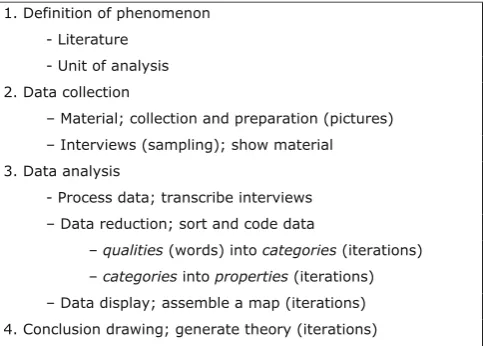
described how grounded theory was developed in sociology as a strategy for handling data in research, providing modes of conceptualization for describ-ing and explaindescrib-ing. Figure 1 provides an overview of the method. Grounded theory is highly applicable to new areas under study when the aim is to generate theory and concep-tualize, because evidence and testing never destroy a theory, but merely modify it. Generating a theory goes hand in hand with verifying it and it involves a process of research. A single case can indicate a general conceptual category or property; a few more cases can confi rm the indication. The researcher’s job is not to provide a perfect description of an area, but to develop a theory that accounts for much of the relevant behavior. Grounded theory can be presented either as a well-codifi ed set of properties or in a theoretical discus-sion using conceptual categories and their properties. The researcher, as Broman24
put it, “starts out in a confused state of noting almost everything he sees because it seems signifi -cant” when he begins to hypothesize with the sole purpose of generating a theory. The researcher is then no longer a passive receiver of impressions but is drawn naturally into actively generating and verifying his hypotheses through comparison of data. When using the type of purposive sam-pling called the maximum variation method,25 the aim is to document unique variations that have emerged in adapting to different conditions. Maximum diversity in data requires dense development of properties and categories, integration of categories and properties, and delimiting scope of theory. An intensive interaction between investigator and object is essential to the formation of sound judgments.
Here, the grounded theory is used to make a map of an unexplored new landscape by dividing a phenomenon into categories, properties, and qualities. The principle26
is to group data under different categories, that is, to sort the explained data into different groups, each consisting of a bundle of qualities of a certain property.
1. Definition of phenomenon
- Literature
- Unit of analysis
2. Data collection
– Material; collection and preparation (pictures)
– Interviews (sampling); show material
3. Data analysis
- Process data; transcribe interviews
– Data reduction; sort and code data
– qualities (words) into categories (iterations)
– categories into properties (iterations)
– Data display; assemble a map (iterations)
4. Conclusion drawing; generate theory (iterations)
Earlier fi ndings from LTU research
Broman24,27
at Luleå University of Technology (LTU) has studied visual impressions of wood with a focus on methods of interrogation. Broman27
indicated the possibility of drawing adequate conclusions about the experience of real wood from computer images of wood, and this was also confi rmed by Bishop and Leahy.28
Broman’s most important fi ndings center on the importance of the qualities of harmony and activity.
In an earlier study,21
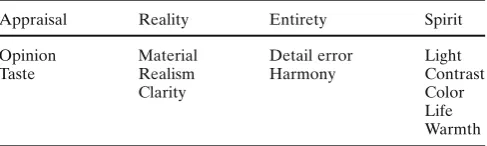
also investigating computer visual-ization of interior wood, the phenomenon was divided in four categories: appraisal, reality, entirety, and spirit (Table 1).
Materials and methods
The pictures
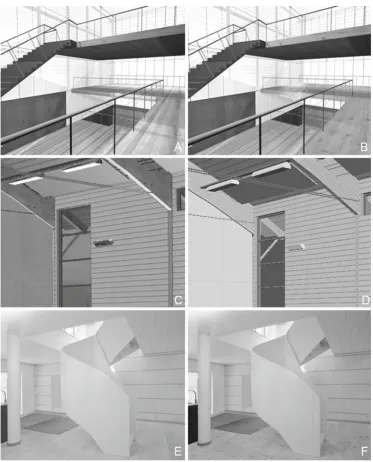
Six computer-generated pictures with visible wood interiors were collected from outside sources such as construction and architectural companies. Each original was varied using image-editing software (Adobe Photoshop 7.0) so as to obtain three versions of each picture with wide, but not extreme, variations in light, shadows, color, contrast, satura-tion (mostly a 10% plus/minus variasatura-tion). Thus, the process ended up with 18 pictures that were scaled down so that one pair would fi ll the screen (roughly 510 × 450 pixels each). Figure 2 shows 3 original pictures (A, C, E) and 3 variations (B, D, F).
A system was prepared on a laptop computer for viewing the pictures two at a time for comparison in pairs. Each original picture was compared with the altered versions of it. The two-by-two comparison strategy was used to provoke opinions, where respondents fi rst had to choose and then also justify their choice.29
Instead of viewing the pictures on a laptop (with biases regarding light and angle conditions, etc.), the pictures were projected on a 2-m-wide screen in a controlled environment to ensure the same experience for all groups, sitting 3 m from the screen.
Interviews
Earlier studies21
(Table 1) had resulted in valuable data (around 2000 words), but it was mostly in single-word form rather than as sentences or expressions. Inspired by the
ideas behind focus groups30,31
for gaining the data input, three groups were put together. The members of the groups were chosen to get three distinct groups: one younger group (20–30 years), one older group (40–60 years), and one expert group (architecture, construction, and wood expertise). All members of the groups were native Swedish speakers. Four or fi ve persons of each sex made up each group and the members were already acquainted and comfortable with each other in accordance with the theory.31
Together, the three groups constituted a broad selection of respon-dents (aged 20–60 years, both sexes, varied education, style, origin, and interests), which the grounded theory requires.23,26 It is usually recommended that focus groups begin with heterogeneous groups and later move toward more homog-enous groups.32
However, because this was the second study on the same topic, the heterogeneity came from the differ-ence between the three groups. Grounded theory points out that instead of representative sampling, a purposive or interactional sampling of cases is appropriate.33,34
The interviews or discussions took place in the same studio in Skellefteå (Sweden), under the same controlled conditions. They lasted just over 1 h each and were recorded on a minidisk recorder; supporting notes were also taken on paper. No video recording was used, because the goal was to fi nd new words and expressions. The study was conducted in accordance with ethical principles.35
One researcher led the discussion and passed the word. In order to infl uence the respondents as little as possible, the wording of the questions was deliberately kept vague, although the purpose was precise. After a short introduction to the study, only one main question was used to evoke responses from the respondents. This question was: “Which picture do you think is better?” Initially, no further explana-tion was provided. To avoid directing the respondent too much, no mention of the wood itself was made in the main question. The comments about wood textures came natu-rally as part of the description of the pictures, because the pictures were dominated by wood objects. Supporting ques-tions, used when needed, consisted of expressions like: (1) “And why do you think this picture is better?”; (2) “Is better the same as more appealing?”; (3) “Is the difference obvious?”
More than 3 h of interviews was recorded, which resulted in about 600 sentences (20 000 characters, 3500 words). According to the grounded theory, the collection of data ends when the answers stop presenting much new data.23
By the end of the third focus group discussion, very few new words and descriptions were used and the amount of data was considered suffi ciently stable to map the expressions such that thoughts of a fourth group were cancelled.
Data processing
Miles and Huberman26
claimed that the data analysis process in qualitative research contains the three subprocesses of data reduction, data display, and conclusion drawing. The data reduction process involves sorting information into categories so that the information begins to form a picture Table 1. Earlier map of qualities of computer-visualized interior
wood
Appraisal Reality Entirety Spirit
Opinion Material Detail error Light
Taste Realism Harmony Contrast
Clarity Color
Life Warmth
116
of the complex phenomenon under study. Data display pres-ents an organized and compressed assembly of information, and helps to understand the phenomenon and draw conclu-sions. The conclusions become increasingly explicit as the data collection and analysis continues.
In order to take in all aspects of the data and to lift them to a generally applicable level, they have to be conceptual-ized.23
Valuable words and phrases were transcribed exactly and then systematically grouped, regrouped, and conceptu-alized into different qualities, categories, and properties describing the phenomenon “computer-visualized interior wood,” all according to the theory.26
As seen in Fig. 1, after defi ning what phenomenon to examine, deciding how to collect data, and then collecting it, the data-analysis step consisted of transcription, reduction, and display. The data reduction was a subdivision and coding process where the qualities (actual words and sentences used) were sorted into
categories (contrast, computer-made, etc.). They were then summarized into properties (light, color, etc.). Thereafter, a map of the qualities, categories, and properties describing the phenomenon was assembled. Joint collection, coding, and analysis of data are the underlying operations when generating theory. This generation requires that all three operations are done together as much as possible.23
The goal is to fi nd a small number of categories, and then a number of properties, which allows each data point to be transferred to one of them, that is, constitute an aspect of the property. Each word was “tagged” with information about what group, picture, and person it was connected to.
This work started after the fi rst group, and was a continu-ous process through the last group. The work was conducted by one researcher, but with continuous support from fellow researchers and literature. Finally, the 2000 words from the earlier study21
were taken into consideration. Thus, the cat-Fig. 2A–F. Example of pictures
egories and properties were determined a posteriori with as few a priori assumptions as possible.
Results
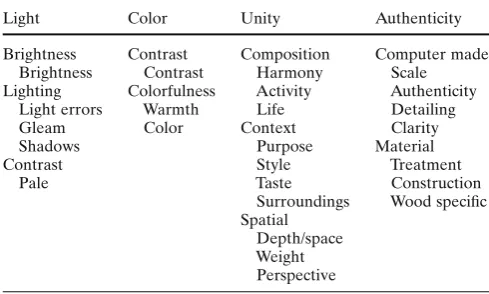
The data was divided into a map of how the comments were sorted. This was not necessarily a map of which factors were of importance when visualizing wood. What people saw and evaluated in a wood surface can be described in four prop-erties: light, color, unity, and authenticity (Table 2). As stated earlier, data display presents an organized and compressed assembly of information, and helps to understand the phenomenon.26
Light was the most common category in all answers and groups. Many respondents described light as the single most important factor, and errors in light matters were of decisive importance. Shadows and lighting seemed to be important for feelings of authenticity, more so than brightness. Exam-ples of this are statements like “very strange shadows” or “wood should give different refl ections.”
The experience of color seems to be very important for the overall “wood feeling,” for instance, when distinguishing wood from painted nonwood materials. The combination of color and contrast was also often the fi rst thing the respon-dents reacted at, at the same time as they decided whether the picture was realistic or not: “The shelves feel wishy-washy”; “Wood is not that color.”
Remarks regarding unity were concentrated on harmony and the composition of the picture, but also the spatial feeling. The context (style, purpose) of the picture was also important. Activity, whether low or high in the wooden pattern (quiet or lively), or more connected to contrast or the distribution of elements (composition issues), seems to be essential for the feeling of life: “Wood doesn’t fi t into that furniture”; “These knots give life.” A quality like con-trast infl ects light and color as well as activity.
Authenticity covers comments regarding the material characteristics as well as the quality of not feeling computer-made, wherefore qualities such as detailing, errors (repeti-tion, scale), and authenticity are of importance. Comments on gleam and refl ections were frequent: “There are no
day-light refl ections on the fl oor, it’s not real,” as well as material issues: “This is mixed heartwood,” and detail errors: “The fl oor boards are the wrong direction.”
Factors outside the nature of wood itself greatly affect our experience of wood. It is hard to draw a distinct line between the appearance of the wood interiors and attitudes relating to other phenomena that infl uence the pictures. The interviews indicated that light, shadows, and colors all interact to provide us with a complete picture; therefore, they also infl uence how we understand wood. However, wood normally exists in a context, which is why an isolated wood study probably would not have given a better map of descriptions. Many respondents asked for the context: the purpose of the picture, and what kind of room it was. Others did not like the room, and therefore found it diffi cult to describe the wood at all or wanted different wood in that surrounding. This suggests that it is impossible for wood to be free from the infl uence of the surroundings when visualized.
The earlier notation21
of respondents demanding wood that was more “woody” and “warmer” than actual wood (a hyper-realistic picture with brighter colors and higher contrasts than real wood) was also found here: “It doesn’t bring out the wood. The color contrast is too small between the wood and the rest.” Maybe photo realism does not do all the work.
Although no decisive differences between the three groups were found, the wording varied according to each group’s professions, with the expert group using more evasive words (“spatiality”), and members of the younger group looking more critically at the visualizations than the other groups.
Discussion
Linn22
stated that when looking at the product from a pro-ducer’s point of view, the central aspect of the concept is the physical product. When viewing the concept through the eyes of the consumer, it is somewhat different: the most central aspect is the consumer’s basic need. Desires of socio-logical and psychosocio-logical nature are also included in the peripherals of the concept.
One could argue that the total of 14 persons participating in the study was not adequate to make a good sample, but because the study was to complete the map from earlier investigations on this phenomenon,21 and the interviews resulted in rather rich data, the number was considered suf-fi cient. This is supported by the richer data from the current study.
If there are typical qualities, there ought to be qualitative differences that explain people’s comments and valuations. This investigation points out two kinds of differences that seem to be of importance: on one side light and color and on the other unity and authenticity. The fi rst kind is easily transferred into technical parameters that are possible to control, whereas the other is more connected to the overall feeling.
Table 2. Experiencing computer-visualized wood: a map of descriptions
Light Color Unity Authenticity
Brightness Contrast Composition Computer made Brightness Contrast Harmony Scale Lighting Colorfulness Activity Authenticity Light errors Warmth Life Detailing
Gleam Color Context Clarity
Shadows Purpose Material
Contrast Style Treatment
Pale Taste Construction
Surroundings Wood specifi c Spatial
118
The current study speaks of brightness and color. While lightness runs from black to white and is perceived refl ec-tance, brightness is a perceived, subjective, luminance.36 Color is usually seen as a colorspace divided into lightness, chroma/saturation, and hue.37
The pictures in this study were not varied using hue, because that would have made the differences too obvious.
The results were not unexpected, even if they sometimes pointed in new directions. In grounded theory it is impor-tant to compare the fi rst maps with later ones. Compared with Nordvik and Broman21
(Table 1), the map is different in the sense that the property “spirit” is divided into light and color, whereas the properties reality/authenticity and entirety/unity are very similar. Remarks on appraisal are sorted under all four properties. Quite a few of the qualities are also different. Context and composition are also seen as valuable for a subject’s judgment.
It seemed diffi cult for viewers to separate what they understood and what they preferred; it could be easier to understand what kind of wood the picture is supposed to communicate, but because of other factors, such as the colors, light, and the picture composition, it might be easier to prefer another picture: “More realistic to the right, but more appealing surroundings to the left.” This is of course something to consider when visualizing wood: “is this a selling or an informative picture?”
Some of these fi ndings are general for all kinds of com-puter visualizations (like shadows and crucial detail errors), but some seem to be specifi c for wood visualization, like the demand for life, warmth, and perhaps even hyper-realistic pictures.
Affi nity between current and earlier fi ndings
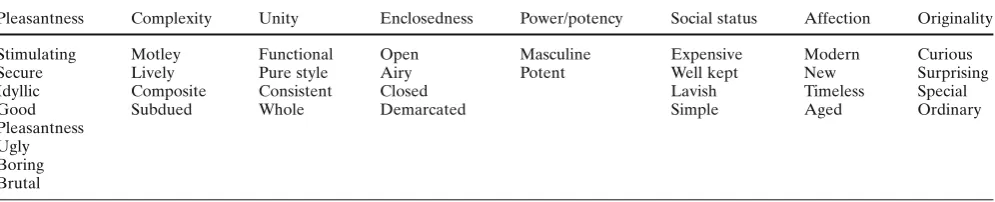
The fi ndings from other studies (Table 3) were added after-ward and used for comparison of the results. None were directed toward computer visualization of interior wood, but related to the experience of architecture, wood, or visu-alization. Table 3 only shows the aspects that do have affi n-ity; as seen in Table 4, there are many more aspects. Albeit these studies are not conducted as grounded theory studies, the aspects found are best described as being on the cate-gory level.
Semantic descriptions of environment (Semantisk miljö-beskrivning, SMB)38
is mainly a tool for examining how people experience architecture, both interior and exterior.
By presenting images, models or fi lms of a chosen environ-ment to volunteer participants, the emotional impression of the different environments can be measured. SMB can be used as planning support for new architectural objects.38 SMB is based on the theories of Osgood et al.39
concerning semantic differentials. In order to get representative words describing architecture, more than 1000 words were col-lected from a dictionary and evaluated on semantic scales and treated with factor analysis. In two steps, the number of words was reduced to 36 and these were considered as suf-fi cient to describe the architectural environment. Compared with Osgood’s factors (evaluation, activity, potency, novelty, and spatial quality), Küller38
could identify eight factors (see Table 4.)
The words and factors from Küller38
were used as valu-able input for the current study. Even if the respondents in the current study also spoke of activity, context, and general appreciation, SMB naturally misses discussion of authentic-ity, because it is directed toward authentic environments.
In a study from the Swedish Pulp and Paper Research Institute (STFI), Jonsson40
used the repertory grid tech-nique41
to fi nd core values for wood. This method could be used to evaluate subjective experiences through individual ways to construct mental conceptions about a number of elements. It is also possible to analyze the data statisti-cally. Jonsson40
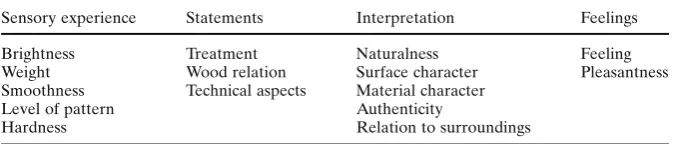
sorted the experiences into four categories (Table 5). When compared with Jonsson, a lot of the direct sensual effects are missing in computer visualization. Three of the qualities that seemed important in the current study, brightness, authenticity, and surroundings, are all directly
Table 4. Factors according to Küller
Pleasantness Complexity Unity Enclosedness Power/potency Social status Affection Originality
Stimulating Motley Functional Open Masculine Expensive Modern Curious
Secure Lively Pure style Airy Potent Well kept New Surprising
Idyllic Composite Consistent Closed Lavish Timeless Special
Good Subdued Whole Demarcated Simple Aged Ordinary
Pleasantness Ugly Boring Brutal
From Küller38
Table 3. Affi nity between current and earlier studies on architecture, wood, and visualization
Current study Küllera Jonssonb LTUc
Activity Complexity Surface character Activity Color Social status Surroundings Color Context Affection Feeling Opinion
Unity Unity Authenticity Harmony
Authenticity Pleasantness Pleasant LoD, realism
Warmth Brightness Taste
Light Lighting
Contrast
LoD, Level of detailing a From Küller38 b From Jonsson40
supported by Jonsson. But where Jonsson has the advantage of using real wood pieces, every experience of visualization is what Jonsson calls an interpretation.
With reference to earlier studies at the Luleå University of Technology (LTU, see Table 3), the qualities of harmony and activity described by Broman24,27 are confi rmed here, as well as color and lighting described by Nordvik and Bromans.21
Fellow LTU researchers reported three-dimensional (3D) computer visualization for communicat-ing esthetics, but for long-span timber structures rather than interior wood.42,43
They showed that the use of 3D computer visualization has great potential to infl uence the decision-making process. The study also showed that the level of detailing (LoD) and lighting are key activities for a success-ful 3D model. Janols44
continued with case studies, surveys, and interviews on this topic.
The concept of Gestalt was fi rst introduced in philosophy and psychology by von Ehrenfels45 in his work Über Gestaltqualitäten. According to Gestalt psychology,46
the whole is different from the sum of its parts. Based upon this belief, Gestalt psychologists developed a set of principles to explain perceptual organization, or how it is natural for humans to group the world and try to make sense of given stimuli. These principles are often referred to as the “laws of perceptual organization” or “Gestalt laws.”
The basic law of Gestalt theory, the Law of Prägnanz, implies that if a perceptual fi eld is disorganized when a human fi rst experiences it, the brain imposes order on the fi eld in a predictable way in the direction of a “good” Gestalt. This is a psychological task that does not necessarily involve a change in the physical environment but one which represents a change in how an organism “sees” its physical environment. A good Gestalt follows the laws of similarity (grouping of similar items), proximity (the nearness of the item’s respective parts), closure (completed items, continu-ity, continuation of a pattern), etc.47
One use of Gestalt laws in the current study could be to explain that the tolerance for disturbing detail errors (shadows/lighting, scale, pattern repetition) was generally low in the current study, because it infl ected the experience of the unity.
To summarize, as seen in Table 3, the current fi ndings are partly supported by the results from earlier studies.
Concluding remarks
The results of this study indicate that to receive a picture that most people would accept, the person visualizing wood
will have to carefully use light and color in the right way. This does not necessarily mean that the photo must be realistic, but perhaps a smart modifi cation providing the feeling of life, contrast, and activity. To achieve this, shadows and daylight (lighting) seem more decisive than brightness and even detailing.
The aspects discussed above seem to be important for the feeling of authenticity and unity, which also needs the right composition (harmony and activity) and context (sur-roundings and purpose), as well as the avoidance of single erroneous details (repetitive patterns and lighting or shad-owing errors). In addition, more important than high resolu-tion is the need for wood to be part of the whole picture and not to stand out or appear more worked than the surroundings.
Visualizing wood in a computer is challenging. A number of the factors (look, feel, smell) that synergize in giving us the impressions we get are missing (“I miss feeling the structure and warmth, wood doesn’t work on a computer screen”). At the same time, a lot of the natural advantages of wood disappear on the screen, while a lot of the disad-vantages of other materials also disappear. For example, the coldness of a stone material is not communicated. Yet how do we communicate the slightly softer echo from walking on a wooden fl oor? Computer visualization provides us with ways to illustrate things not yet built or items too ungainly for a seller to bring to the point of sale. Therefore, computer visualization is a tool for the future and we must learn to communicate what we can and cannot communi-cate through the computer. This result is a roadmap for further research, but it also gives an idea of what should be avoided when using computers for visualizing wood interiors.
Finally, we must not forget that it is impossible to visual-ize wood in computers. Visualization is something that takes place within each viewer’s head and thus is a subjective phenomenon.
References
1. Pakarinen T (1999) Success factors of wood as a furniture material. Forest Prod J 49:79–85
2. Wiklund M (1992) A profi table wood tradition: evaluation of the political prospect of forest products and techniques in wood working industries (in Swedish). Prepared for 1990s Commission on Forest Policy. Report TRITA-TRT-1992-51. KTH, Wood Tech-nology and Processing, Stockholm, Sweden
3. Hansen E, Bush R (1996) Consumer perceptions of softwood lumber quality. Forest Prod J 46:29–34
Table 5. Factors according to Jonsson
Sensory experience Statements Interpretation Feelings
Brightness Treatment Naturalness Feeling
Weight Wood relation Surface character Pleasantness Smoothness Technical aspects Material character
Level of pattern Authenticity
Hardness Relation to surroundings
120
4. Swearingen KA, Hansen EN, Reeb JE (1998) Customer preference for pacifi c northwest hardwoods. Forest Prod J 48:29–33
5. Hansen EN, Weinfurter S (1999) Softwood lumber quality require-ments: examining the supplier/buyer perception gap. Wood Fiber Sci 31:83–94
6. Jahn LG, Bumgardner M, Forbes C, West C (2001) Consumer per-ceptions of character marks on cabinet doors. AG-617. Cooperative extension. North Carolina State University, Raleigh, NC
7. Bumgardner M, Bush RJ, West CD (2001) Knots as an incongruent product feature: a demonstration of the potential for character-marked hardwood furniture. J Inst Wood Sci 15:327–336 8. Donovan GH, Nichols D (2003) Customer preferences and
willing-ness to pay for character-marked cabinets from Alaska birch. Forest Prod J 53:27–32
9. Sheppard SRJ (2000) Visualization as a decision-support tool for managing forest ecosystems. Compiler 16:25–40
10. Rasmussen SE (1962) Experiencing architecture. MIT Press, Cam-bridge, MA, p 245
11. Hesselgren S (1987) On architecture: an architectural theory based on psychological research. Chartwell-Bratt, Bromley, UK, p 310
12. Fridell Anter K (2000) What color is the red house? Perceived color of painted facades. Licentiate thesis, KTH, Stockholm, Sweden, p 338
13. Svedmyr Å (2002) The materiality of the painted surface (in Swedish). Licentiate thesis, KTH Architecture, Stockholm 14. Daniel T, Meitner MM (2001) Representational validity of
land-scape visualizations: the effects of graphical realism on perceived scenic beauty of forest vistas. J Environ Psych 21:61–72
15. Mitchell SA (1983) The effects of visual and emotional advertising: an information processing approach. In: Percy L, Woodside A (eds) Advertising and consumer psychology. Lexington Books. Lexing-ton, MA, pp 197–217
16. Broudy HS (1987) The role of imagery in learning. Getty Center for Education in the Arts, Los Angeles, CA
17. Cox DJ (1990) The art of scientifi c visualization. Acad Comput 4:20–56
18. Tsunetsugu Y, Miyazaki Y, Sato H (2007) Physiological effects in humans induced by the visual stimulation of room interiors with different wood quantities. J Wood Sci 53:11–16
19. Nakamura M, Kondo T (2008) Quantifi cation of visual inducement of knots by eye-tracking. J Wood Sci 54:22–27
20. Sakuragawa S, Miyazaki Y, Kaneko T, Makita T (2005) Infl uence of wood wall panels on physiological and psychological responses. J Wood Sci 51:136–140
21. Nordvik E, Broman O (2005) Visualizing wood interiors: a qualita-tive assessment of what people react to and how they describe it. Forest Prod J 55:81–86
22. Linn CE (1985) Meta product and market (in Swedish). Liber, Malmö
23. Glaser B, Strauss A (1967) The discovery of grounded theory: strat-egies for qualitative research. Aldine, Chicago, p 271
24. Broman NO (1995) Visual impressions of features in Scots pine wood surfaces. Forest Prod J 45:61–66
25. Patton MQ (1980) Qualitative evaluation methods. Sage, Beverly Hills, CA
26. Miles MB, Huberman AM (1994) Qualitative data analysis. An expanded sourcebook. Sage, Thousand Oaks, CA, p 338
27. Broman NO (1995) Two methods for measuring people’s prefer-ences for wood. Mokuzai Gakkaishi 41:994–1005
28. Bishop ID, Leahy PNA (1989) Assessing the visual impact of devel-opment proposals: the validity of computer simulations. Landsc J 8:92–100
29. Silverstein DA, Farrell JE (2001) Effi cient method for paired com-parison. J Electr Imaging 10:394–398
30. Krueger R (1994) Focus groups. A practical guide for applied research, 2nd edn. Sage, Thousand Oaks, CA
31. Morgan D (1998) Focus groups as qualitative research. Sage, Newbury Park, CA
32. Flick U (2002) An introduction to qualitative research. Sage, London, p 310
33. Ford J (1975) Paradigms and fairytales: an introduction to the science of meanings. Routledge and Kegan Paul, London
34. Lincoln YS, Guba EG (1985) Naturalistic inquiry. Sage, Beverly Hills, CA
35. Beauchamp TL, Faden RJ, Wallace RJ, Walter L (1982) Ethical issues in social science research. Johns Hopkins University Press, Baltimore, MD
36. Gilchrist AL (2007) Lightness and brightness. Curr Biol 17: R267–R269
37. Wyszecki G, Stiles WS (2000) Color science – concepts and methods, quantitative data and formulae, 2nd edn. Wiley, New York 38. Küller R (1975) Semantic description of environment (in Swedish).
Psykologiförlaget AB Liber Tryck Stockholm, Stockholm 39. Osgood CE, Suci GJ, Tannenbaum PH (1957) The measurement of
meaning. University of Illinois Press, Chicago, IL
40. Jonsson O (2006) Upplevelse av trä – Studie om människors uppfattning om olika material (Experience of wood, in Swedish), Human product interaction, STFI-Packforsk (Swedish Pulp and Paper Research Institute)/Proteko, Stockholm
41. Jankowicz D (2004) The easy guide to repertory grids. Wiley, Chich-ester, UK
42. Janols H, Stehn L (2004) Utilizing 3D-computer visualization for communicating aesthetics of long-span timber structures. Proceed-ings of the World Conference of Timber Engineering, Lathis, Finland, June 2004
43. Johnsson H, Janols H, Stehn L (2006) 3D computer visualisation in timber construction: some important parameters. Architect Eng Des Manag 2:161–175
44. Janols H (2005) Communicating long-span timber structures with 3D computer visualisation. Licentiate thesis, Luleå University of Technology, Luleå
45. von Ehrenfels C (1890) Über Gestaltqualitäten (On the qualities of form). Vierteljahresschrift für wissenschaftliche Philosophie 14:249–292
46. Wertheimer M (1923) Laws of organization in perceptual forms. First published as Untersuchungen zur Lehre von der Gestalt II, in: Psychologische Forschung 4:301–350. Translation published in: Ellis W (1938) A source book of Gestalt psychology. Routledge and Kegan Paul, London, pp 71–88