N O T E
Coniferin
b-glucosidase is ionically bound to cell wall
in differentiating xylem of poplar
Taku Tsuyama1•Keiji Takabe1
Received: 25 December 2014 / Accepted: 14 April 2015 / Published online: 26 May 2015
ÓThe Japan Wood Research Society 2015
Abstract Lignin is crucial for the growth and persistence of vascular plants in diverse environments. Although biosynthesis and polymerization of lignin precursors have been subjected to in-depth studies, only limited information exists on the ways in which these precursors are trans-ported. Recent research has demonstrated that V-ATPase-dependent transport of coniferyl alcohol glucoside (coniferin) is a major metabolic function in differentiating xylem of both angiosperms and gymnosperms. Localiza-tion ofb-glucosidase involved in the cleavage of coniferin to coniferyl alcohol and glucose is important to clarify the role of coniferin in lignification; nevertheless, only little has been reported in angiosperms. Here, we demonstrated the presence of coniferin b-glucosidase activity in a cell wall ionically bound protein fraction extracted from dif-ferentiating xylem of poplar. Coniferin b-glucosidase lo-calization is very likely in cell wall similar to previous reports in conifers. We identified a putative poplar coniferinb-glucosidase through phylogenetic analysis and named this protein ‘‘PtrBGL6’’. Immunoprecipitation as-says showed that the anti-PtrBGL6 antibody recognizes a coniferin b-glucosidase in a cell wall ionically bound protein fraction. Conserved coniferin b-glucosidases
localized in cell wall in both angiosperm and gymnosperm implies their important roles in the formation of lignified cell wall.
Keywords Coniferinb-glucosidasePoplar Differentiating xylemCell wall
Introduction
Lignin is crucial for the growth and persistence of vascular plants in diverse environments. Lignification proceeds in three steps: biosynthesis of lignin precursors in the cell, transport of the precursors to the cell walls, and dehydro-genative polymerization of the precursors in cell walls [1]. Although biosynthesis and dehydrogenative polymeriza-tion of lignin precursors have been well studied [2–6], much less information has been published on the way in which these precursors are transported.
The transport mechanism of lignin precursors has been investigated previously by biochemical analyses. In rosette leaves of Arabidopsis thaliana (hereafter, Arabidopsis), ABC-like transporters mediate the translocation of mono-lignol and monomono-lignol glucosides [7]. An ABC transporter of Arabidopsis involved in the transport of p-coumaryl alcohol has been characterized [8]. However, rosette leaves of Arabidopsis contain only small amounts of lignin and lignifying tissue, and H lignin derived from p-coumaryl alcohol is a minor lignin component. More recently, Tsuyama et al. [9] demonstrated that transport of coniferyl alcohol glucoside (coniferin) is a major transport mechanism in differentiating xylem undergoing vigorous lignification. The process is dependent on a proton gradient created by V-ATPase, and the mechanism occurs in both angiosperm and gymnosperm. Localization of V-ATPase is
Part of this article has been presented at the 13th Cell Wall Meeting, July 2013, Nantes, France; at the 54th Annual Meeting of the Japanese Society of Plant Physiologists, March 2013, Okayama, Japan; at the 63th Annual Meeting of the Japan Wood Research Society, March 2013, Morioka, Japan.
& Keiji Takabe
1 Laboratory of Tree Cell Biology, Division of Forest and
Biomaterials Science, Graduate School of Agriculture, Kyoto University, Kitashirakawa oiwake-cho, Sakyo-ku,
observed not only to mature vacuoles, but also to endo-somes and the trans-Golgi network [10, 11] that are traf-ficking to and from the plasma membrane. Coniferin might be transported to cell wall by small vesicles that have V-ATPase and coniferin transporter [9]. Knowledge of activity and localization of coniferinb-glucosidase (BGL) is important to investigate whether coniferin is transported to cell wall and involved in lignification of differentiating xylem.
Coniferin BGL has been examined in conifers [12–14], soybean (Glycine max) [15], poplar cell suspension cul-tures [16], silver birch (Betula pendula) [14], and Ara-bidopsis [17]. AraAra-bidopsis has 47 BGLs; both AtBGL45/ BGLU45 and AtBGL46/BGLU46 have been identified as coniferin BGLs [17]. Coniferin BGL from lodgepole pine (Pinus contorta) (PcBGL) was studied in detail and char-acterized by Dharmawardhana et al. [13,18]. Samuels et al. [19] showed that this enzyme is localized in secondary walls of tracheids. However, scarce information exists on coniferin BGL in differentiating xylem of angiosperms. Only low levels of coniferin BGL activity have been re-ported for differentiating xylem in silver birch [14].
Here, we report the presence of coniferin BGL activity in cell wall ionically bound protein (WIB) fraction of poplar differentiating xylem. By phylogenetic analysis, we showed that PtrBGL6 is a putative coniferin BGL in poplar. Our immunoprecipitation assay demonstrated that anti-PtrBGL6 antibody recognizes coniferin BGL. Con-served coniferin b-glucosidases localized in cell wall in both angiosperm and gymnosperm implies their important roles in the formation of lignified cell wall.
Materials and methods
Chemicals
Chemicals were purchased from Nacalai Tesque (Kyoto, Japan). Coniferin and syringin were provided by Dr. N. Terashima (Nagoya University, Japan).
Plant materials
Differentiating xylem of an approximately 40-year-old hybrid poplar (Populus sieboldii9P. grandidentata) was obtained as described in Tsuyama et al. [9].
Enzyme extraction
Frozen xylem tissue (ca. 25 g) was extracted in 50 mL of ice-cold extraction buffer A (10 % (v/v) glycerol, 0.5 % (w/ v) polyvinylpolypyrrolidone, 5 mM ethylenediaminete-traacetic acid (EDTA), and 50 mM MES–KOH adjusted to
pH 6.0) for 15 min. Prior to use, a 3.3 mM dithiothreitol (DTT), and a 1 % (v/v) protease inhibitor cocktail (P9599; Sigma-Aldrich, St. Louis, MO, USA) were added to the buffer. The homogenate was filtered through Miracloth (Merck, Rahway, NJ, USA) and the filtrate was recognized as a soluble protein (Sol) fraction. Cell wall remnants were extracted in 50 mL of extraction buffer B (10 % (v/v) glycerol, 5 mM EDTA, 2 M NaCl, 3.3 mM DTT, 1 % (v/v) protease inhibitor cocktail, and 50 mM MES–KOH ad-justed to pH 6.0) for 1 h. Wall remnants in buffer B were filtered through Miracloth and the extracted solution was recognized as the WIB fraction. Sol and WIB fractions were centrifuged at 122,0009g for 30 min. Supernatants were concentrated to approximately 1 mL volume with a cen-trifugal filter unit [10,000 NMWL (nominal molecular weight limit); Millipore, Billerica, MA, USA]. All of the above procedures were performed on ice or at 4°C.
Glucosidase assays
The activity of BGL was determined by measuring the rate of nitrophenol liberation fromp-nitrophenyl-b-D-glucoside (pNPG) in 100-lL assays containing 10 mM pNPG, 100 mM sodium acetate buffer (pH 5.5), and enzyme. After incubation at 30 °C for 30 min, reactions were ter-minated by adding 1 mL of 0.47 M Na2CO3; the p
-nitro-phenol released was determined spectrophotometrically at 400 nm in conjunction with a standard curve. To determine hydrolase activity toward non-chromogenic substrates, such as coniferin, the fractions were incubated for 30 min at 30 °C in 200-lL assays that contained 5 mM of sub-strate in 100 mM of sodium acetate buffer (pH 5.5). After terminating the reaction by boiling for 10 min, liberated glucose was determined by the glucose oxidase procedure (G3293; Sigma-Aldrich). Glucosidase activity of fractions incubated without substrates were used as background.
Phylogenetic analysis
Expression analysis
Total RNA was extracted from approximately 100 mg of leaf or tangential cryo-section from differentiating xylem of poplar by CTAB method [20]. Total RNA was purified by RNeasy Plant Mini Kit (Quiagen, Hilden, Germany) and treated with DNase I (Promega, Madison, USA). First-s-trand cDNA was synthesized from 0.5lg total RNA using Transcriptor High Fidelity cDNA Synthesis Kit (Roche Applied Science, Mannheim, Germany) according to the manufacture’s instructions. Primers specific for the PtrBGL6 gene or control 18S rRNA were then used to amplify each transcript using 20 PCR cycles (18S rRNA) or 31 cycles (PtrBGL6). The primers used were as follows: PtrBGL6(forward, 50-GGTACCCTCCAGCTCACTGT-30; reverse, 50-TCCATTCCCTCTGGGACCAC-30) and 18S rRNA (forward, 50-AAACGGCTACCACATCCAAG-30; reverse; 50-CCTCCAATGGATCCTCGTTA-30).
Raising antibodies
The peptide sequences NIKNNDNGDIADNH and GFSPPQQNDQVQA were selected from a database of amino acid sequences for PtrBGL6. The peptides were
synthesized, conjugated to carrier protein keyhole limpet hemocyanin (KLH), and used as antigens to raise poly-clonal antibodies in rabbits (Operon Biotechnology, Tokyo, Japan). The antibody raised was purified on a column to-gether with the peptides NIKNNDNGDIADNH and GFSPPQQNDQVQA.
Immunoprecipitation
Seventy microliters of Sol and WIB fractions were separately incubated overnight at 4°C with 20 lL of the antibody (1lg protein/lL). Sol or WIB fractions incubated with distilled water served as controls. Ten microliters of Protein G Mag Sepharose (GE Healthcare, Pittsburgh, PA, USA) were added, followed by incubation for 1 h at room temperature. Beads were precipitated with a magnet, and the supernatant was used for the glucosidase assay.
Results and discussion
Low levels of coniferin BGL activity have been reported for differentiating xylem in silver birch, an angiosperm [14]. However, the protein fraction was extracted as mix-ture of Sol and WIB fractions in that study. In contrast, coniferin BGL activity was detected through a procedure in which Sol and WIB fractions were extracted separately (Fig.1). The presence of coniferin BGL activity was demonstrated in differentiating xylem of poplar, par-ticularly in the WIB fraction. Activity in the WIB fraction clearly increased and became saturated with increasing substrate concentration, whereas activity in the Sol fraction did not track any obvious trend in relation to the
Fig. 1 Coniferin BGL activity in Sol and WIB fractions of differ-entiating xylem from poplar. Both fractions were incubated in each concentration of coniferin for 30 min. Fractions incubated without substrates served as background.Solsoluble protein fraction,WIBcell wall ionically bound protein fraction. Values are mean±SD (n=4 biological replicates)
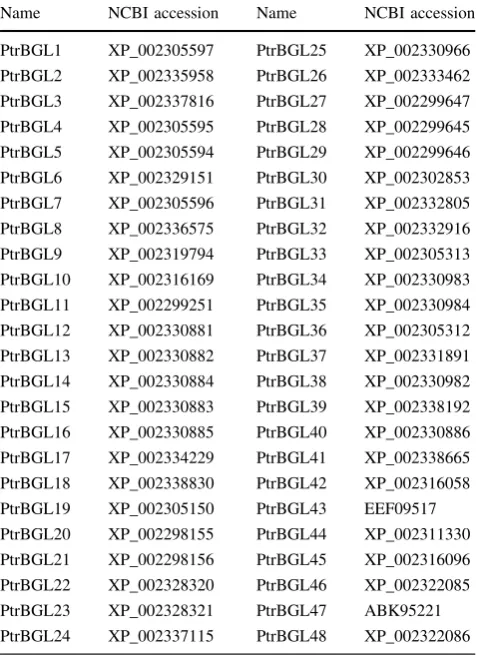
Table 1 Putative BGLs fromPopulus trichocarpa
concentration of coniferin. This result indicates that poplar has a coniferin BGL localized in cell wall.
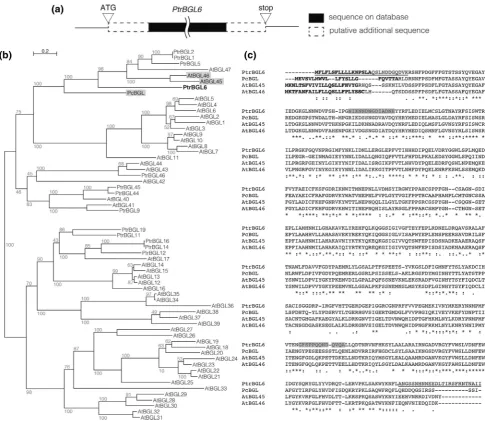
To characterize coniferin BGL further, putative BGL proteins in poplar were searched using amino acid se-quences from Populus trichocarpa. A BLAST search demonstrated thatP. trichocarpahas 48 putative BGLs or glycosyl hydrolase family 1 proteins; this protein group was named as ‘‘PtrBGL1-48’’ (Table1). Phylogenetic analysis showed that characterized coniferin BGLs clus-tered in a single clade that contained a putative BGL
protein of poplar (PtrBGL6) (Fig.2), which suggests that coniferin BGLs are conserved in both gymnosperm and angiosperm. PtrBGL1, PtrBGL2, and PtrBGL5 were also members of the clade, but clustered in a subclade con-taining AtBGL47/BGLU47, which seem to have no func-tion in the hydrolysis of coniferin [21]. Thus, PtrBGL6 was focused for further analyses. PtrBGL6 was 50 % identical and 66 % similar to AtBGL45, and 50 % identical and 68 % similar to PcBGL. Expression of PtrBGL6 in dif-ferentiating xylem was confirmed by semi-quantitative RT-Fig. 2 Phylogenetic analysis of coniferin BGL in angiosperm and
gymnosperm. a Diagram of PtrBGL6 composed by sequence on database and putative additional sequences to begin with start codon (ATG) and end by stop codon. The putative additional sequences were expected by DNA sequence on database without considering additional intron. b Maximum-likelihood phylogeny of BGLs in
Arabidopsis thaliana (At), Pinus contorta (Pc) and Populus tri-chocarpa(Ptr). AtBGL45, AtBGL46, PcBGL (hatched) have been identified as coniferin BGL [17,18]. PtrBGL6 (bold) has similarity
with identified coniferin BGLs. Bootstrapping was performed with 100 replicates. Bootstrap values are in gray type. cAlignment of amino acid sequences of PtrBGL6 and identified coniferin BGLs. All sequences were predicted to have signal peptide by SignalP (http:// www.cbs.dtu.dk/services/SignalP/), which are shown in bold. Pep-tides of hatched sequence were used to raise anti-PtrBGL6 antibody.
PCR (Fig.3), supporting that PtrBGL6 is involved in for-mation of xylem.
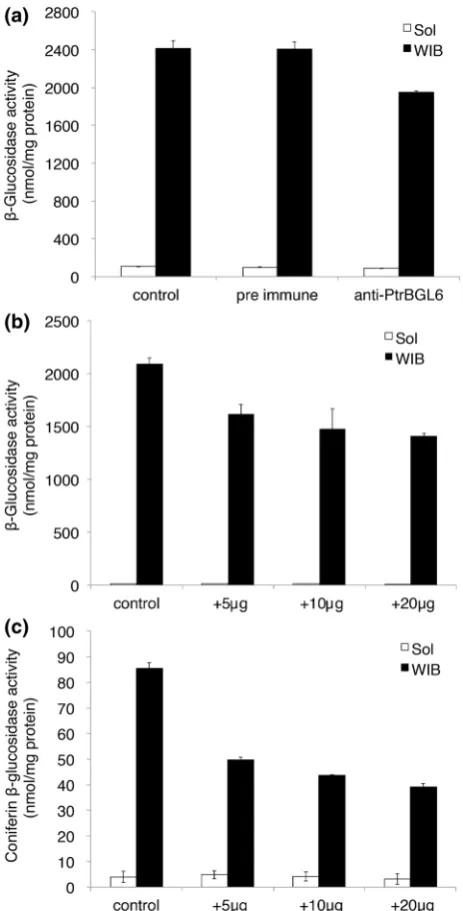
To pursue our line of enquiry on PtrBGL6, a candidate coniferin BGL from poplar, an antibody was raised using specific peptides of PtrBGL6 (Fig.2b). The activity of BGL on pNPG was monitored as a general BGL; this ac-tivity was reduced in the supernatant after immunopre-cipitation by the anti-PtrBGL6 antibody (Fig.4a, b), indicating that the antibody recognized a BGL. Coniferin BGL activity in the WIB fraction also fell in the super-natant after immunoprecipitation (Fig.4c), which suggests that the anti-PtrBGL6 antibody recognizes a coniferin BGL. Glucosidase activities on various substrates were measured in the supernatants before or after immunopre-cipitation using WIB fraction (Fig.5). Only BGL activities for coniferin or syringin were significantly inhibited after immunoprecipitation, and syringin was less favored as a substrate than coniferin. Thus, the antibody specifically recognized a coniferin BGL which may also hydrolyze syringin. Further research on cloning and characterizing, or silencing PtrBGL6 is required to confirm that PtrBGL6 is a homolog of coniferin BGL or the importance of PtrBGL6 in lignification. Still, higher BGL activity for coniferin than other substrates tested in this study (Fig.5) suggests that hydrolysis of coniferin in cell wall has an important physiological function in differentiating xylem of poplar. Besides, very limited amount of coniferin in poplar xylem (ca. 0.2 nM) [22] and increased level of coniferin content in bglu45Arabidopsis mutant [21] imply fast consumption of coniferin by coniferin BGL in angiosperms.
Adding to the biochemical analyses, an in silico analysis predicted that a putative full sequence for PtrBGL6 as well as characterized coniferin BGLs would have a signal peptide (Fig.2b), suggesting that coniferin BGL is secreted to the cell walls. Localization of coniferin BGL in poplar is consistent with coniferin BGL in lodgepole pine that lo-calized in the secondary walls of tracheids [19] and in Arabidopsis that localized in the cell walls of xylem or interfascicular fibers [21]. Localization of coniferin BGLs
in lignifying cell walls seems to be a conserved trait in several plant species, implying that this localization of coniferin BGL is important for the formation of lignified secondary walls in both angiosperms and gymnosperms. Coniferin might be transported to lignifying cell walls [9] and hydrolyzed by coniferin BGL to supply coniferyl Fig. 3 PtrBGL6expression analysis in poplar. a Transcript
abun-dance measured via semi-quantitative RT-PCR of PtrBGL6. 18S rRNA was used as control to ensure equal RNA loading. L leaf,
Xxylem.bData are normalized with respect to 18S rRNA expression and standardized relative to leaf value which have been arbitrarily set to 1
Fig. 4 Glucosidase activities in the supernatant after immunopre-cipitation with the anti-PtrBGL6 antibody. Glucosidase substrates were 10 mM p-nitrophenyl-b-glucoside (a, b) and 5 mM coniferin (c). Glucosidase activity was measured after immunoprecipitation without serum as control. The amounts of antibody indicated were used for immunoprecipitation in b and c. Following immunopre-cipitation, supernatant fractions were incubated with substrate for 30 min. Fractions incubated without substrates served as background.
alcohol for lignification. This hypothesis is congruent with a putative mechanism proposed for gymnosperms [13,19, 23,24].
Several routes may exist for the transport of lignin precursors, which might contribute to the plasticity in lignin accumulation. In lodgepole pine, radiolabeled phenylalanine is incorporated into coniferyl alcohol and lignin; it is not incorporated into coniferin [25], although several studies indicate the incorporation of labeled phenylalanine into coniferin [26–28]. In Arabidopsis, sin-gle mutants of coniferin BGLs are not lignin-deficient, but double mutants have not been checked [21]. Thus, other mechanisms of lignin precursor transport may well exist in xylem. Further research will certainly be crucial for a better understanding of all lignin transport mechanisms that have evolved as plants have adapted to diverse terrestrial environments.
Acknowledgments We thank Dr. Shunzo Inoue, Akita Jujo Che-micals Co., Ltd. for providing hybrid poplar trees; Dr. Noritsugu Terashima, Nagoya University, for providing coniferin and syringin; Dr. Tatsuya Awano and Shota Nishine, Kyoto University, for tech-nical assistance. This work was supported in part by a Grant-in-Aid for Scientific Research on Priority Areas from The Ministry of Education, Culture, Sports, Science and Technology, Japan (Grant no. 11J02570 to T.T.).
References
1. Boudet AM, Lapierre C, Grima-Pettenati J (1995) Biochemistry and molecular biology of lignification. New Phytol 129:203–236 2. Neish AC (1968) Monomeric intermediates in the biosynthesis of lignin. In: Freudenberg K, Neish AC (eds) Constitution and biosynthesis of lignin. Springer-Verlag, New York, pp 3–43
3. Higuchi T (1985) Biosynthesis of lignin. In: Higuchi T (ed) Biosynthesis and biodegradation of wood components. Academic Press, New York, pp 141–160
4. Whetten RW, MacKay JJ, Sederoff RR (1998) Recent advances in understanding lignin biosynthesis. Annu Rev Plant Physiol Plant Mol Biol 49:585–609
5. Boerjan W, Ralph J, Baucher M (2003) Lignin biosynthesis. Annu Rev Plant Biol 54:519–546
6. Vanholme R, Demedts B, Morreel K, Ralph J, Boerjan W (2010) Lignin biosynthesis and structure. Plant Physiol 153:895–905 7. Miao YC, Liu CJ (2010) ATP-binding cassette-like transporters
are involved in the transport of lignin precursors across plasma and vacuolar membranes. Proc Natl Acad Sci USA 107: 22728–22733
8. Alejandro S, Lee Y, Tohge T, Sudre D, Osorio S, Park J, Bovet L, Lee Y, Geldner N, Fernie AR, Martinoia E (2012) AtABCG29 is a monolignol transporter involved in lignin biosynthesis. Curr Biol 22:1207–1212
9. Tsuyama T, Kawai R, Shitan N, Matoh T, Sugiyama J, Yoshinaga A, Takabe K, Fujita M, Yazaki K (2013) Proton-dependent coniferin transport, a common major transport event in differ-entiating xylem tissue of woody plants. Plant Physiol 162: 918–926
10. Herman EM, Li X, Su RT, Larsen P, Hsu H, Sze H (1994) Vacuolar-type H?-ATPase are associated with the endoplasmic
reticulum and provacuoles of root tip cells. Plant Physiol 106:1313–1324
11. Schumacher K, Krebs M (2010) The V-ATPase: small cargo, large effects. Curr Opin Plant Biol 13:724–730
12. Marcinowski S, Grisebach H (1978) Enzymology of lignification. Cell-wall-boundb-glucosidase for coniferin from spruce (Picea abies) seedlings. Eur J Biochem 87:37–44
13. Dharmawardhana DP, Ellis BE, Carlson JE (1995) Ab -glucosi-dase from lodgepole pine xylem specific for the lignin precursor coniferin. Plant Physiol 107:331–339
14. Marjamaa K, Lehtonen M, Lundell T, Toikka M, Sarpanpa¨a¨ P, Fagerstedt KV (2003) Developmental lignification and seasonal variation inb-glucosidase and peroxidase activities in xylem of Scots pine, Norway spruce and silver birch. Tree Physiol 23:977–986
15. Ho¨sel W, Todenhagen R (1980) Characterization of a b -glu-cosidase fromGlycine maxwhich hydrolyses coniferin and sy-ringin. Phytochemistry 19:1349–1353
16. de Sa´ MM, Subramaniam R, Williams FE, Douglas CJ (1992) Rapid activation of phenylpropanoid metabolism in elicitor-treated hybrid poplar (Populus trichocarpa Torr. and Gray9
Populus deltoidesMarsh) suspension-cultured cells. Plant Physiol 98:728–737
17. Escamilla-Trevin˜o LL, Chen W, Card ML, Shih MC, Cheng CL, Poulton JE (2006)Arabidopsis thalianab-glucosidase BGLU45 and BGLU46 hydrolyse monolignol glucosides. Phytochemistry 67:1651–1660
18. Dharmawardhana DP, Ellis BE, Carlson JE (1999) cDNA cloning and heterologous expression of coniferin b-glucosidase. Plant Mol Biol 40:365–372
19. Samuels AL, Rensing KH, Douglas CJ, Mansfield SD, Dhar-mawardhana DP, Ellis BE (2002) Cellular machinery of wood production: differentiation of secondary xylem inPinus contorta
var.latifolia. Planta 216:72–82
20. Chang S, Puryear J, Cairney J (1993) A simple and efficient method for isolating RNA from pine trees. Plant Mol Biol Rep 11:113–116
21. Chapelle A, Morreel K, Vanholme R, Le-Bris P, Morin H, Lapierre C, Boerjan W, Jouanin L, Demont-Caulet N (2012) Impact of the absence of stem-specificb-glucosidases on lignin and monolignols. Plant Physiol 160:1204–1217
22. Tsuyama T, Takabe K (2014) Distribution of lignin and lignin precursors in differentiating xylem of Japanese cypress and poplar. J Wood Sci 60:353–361
23. Whetten R, Sederoff R (1995) Lignin biosynthesis. Plant Cell 7:1001–1013
24. Liu CJ (2012) Deciphering the enigma of lignification: precursor transport, oxidation, and the topochemistry of lignin assembly. Mol Plant 5:304–317
25. Kaneda M, Rensing KH, Wong JCT, Banno B, Mansfield SD, Samuels AL (2008) Tracking monolignols during wood devel-opment in lodgepole pine. Plant Physiol 147:1750–1760
26. Freudenberg K, Torres-Serres J (1967) Conversion of the phenylalanines in lignin-component glucosides (in German). Liebigs Ann Chem 703:225–230
27. Marcinowski S, Grisebach H (1977) Turnover of coniferin in pine seedlings. Phytochemistry 16:1665–1667