
PROSPECTIVE ACTION PLAN FOR DEVELOPING PRODUCT CONTAINING MICROENCAPSULATED PROBIOTICS
5
0
0
Full text
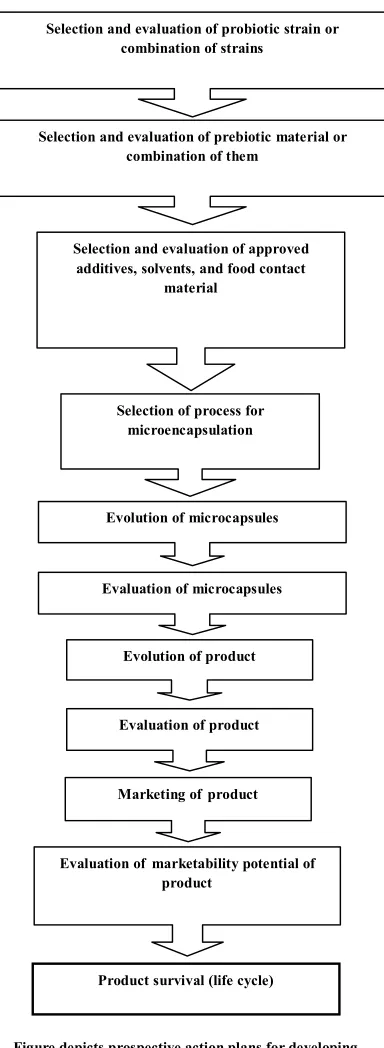
(2) Saikh Mahammed Athar Alli. Int. Res. J. Pharm. 2013, 4 (8) derivatives, waxes, fats, carrageenan, caseinates, gelatine, milk proteins, zein and other proteins, and so on. Commonly used GREC materials are chitosan, carboxymethyl cellulose, hypromellose phthalate, cellulose acetate phthalate, poly-Llysine, palm oil, and so on. Among these, food proteins and polysaccharides are biodegradable polymer whose use will be worthwhile9,16-18. Biodegradable-biopolymers can deliver VPC at site of action and can alter look, texture, stability, and flavour of PCEP but slightly affect their physicochemical features. Basing on wanted features of PCEP, biopolymer particles crafted with wished features. Biopolymer based particulate conception method is unsuited either because of materials of non-food-grade or increased costs of processing9,17,18. Gellan- or pullulan- or xanthan- gum, and jamilan could extends or modifies release profile. Blend of xanthan or jamilan gum and gellan gum, alginate and xanthan or gellan gum mends gastro-protective feature and achieves colon targeting18,19. Calcium alginate is biocompatible, nontoxic, and cheaper; and requires simple processing steps18. Hydrogel of alginate yields porous MCs of PRs but requires GREC and creates scale-up problems. Blending alginate with starch or chitosan and its structural modification can eliminate GREC step. Requirements for 60-80°C to prepare its aqueous solution are major drawback5,18. Starch and resistant starches deliver VPC in large intestine while their prebiotics role has synergistic action. Surface feature of resistant starch improves VoPC and results intestinal targeting18,20. Gelatine alone or in blend with gellan gum or other materials is unable to offer gastro-protection18. Whey proteins and milk proteins improve aesthetic feature18,21,22. Chitosan have inhibitory effects on LAB but result colon targeting12. Carrageenan needs damaging temperature of 4045°C, which increases in-process loss of viability of probiotics (iPVLP). It owes approval from several government agencies18. Hypromellose controls release of PCs, extend their gastric retention time, and improve gut colonization23. Cellulose acetate phthalate and hypromellose phthalate reckoned as safe and yield MCs, water insoluble one18. Method and Procedure MEC of PCs done following spray drying, spray freezedrying, impinging aerosol, extrusion, fluidized-bed coating and agglomeration (FCA), and direct compression encapsulation (DCE) method. Substitutes are dispersion and ionic or enzymatic gelification, dispersion and cold gelation or Extrusion (pulsation or vibrational jet nozzle) (EPV). Novel methods are dispersion and interfacial-polymerization or complex coacervation (DIPC), inter-polymer complex encapsulation with supercritical carbon dioxide (IESCF). These have superiority over each other but have limitations like involvement of organic solvents and high -pressure and or -temperature, scale-up problems, and so on. These factors retards lasting of VoPC throughout shelf life or increases cost1,5,9. Succeeding sections provide their leaning and limits. Spray drying method create MCs with quickness, duplicability, and with low production cost. It’s nonstop processing and superior scale-up potentiality makes it amenable for industrial scale, but fails in protecting iPVLP. The iPVLP can be improved by adding protectants, such as, whey-protein, and resistant and N-Tack starch, in formula5,20,24,25. Spray freeze-drying method results MCs with controlled size and larger specific surface areas. Referring spray drying method, this employs high-energy and long processing time, and have high production cost (30–50 times). and iPVLP. Have improved storage survivability at 4°C and is suitable to control release profile. It’s high iPVLP issue solved by adding protectant, in formula, such as wheyprotein, resistant starch, skimmed milk, and so on18-20,24-26. Dispersion and enzymatic-gelification method results porous MCs with high entrapment efficiency and insignificant iPVLP and feasible for controlling particle size. Produced MCs are water insoluble; provide gastro-protection and favourable micro-milieu for encapsulated PCs but unsuitable for large-scale. Layer-by-layer coating of nanolayers selfassembly of polyelectrolytes on MCs is done with this method5,13,21. DIPC is unsuitable for commercial scale but is suitable to get mucoadhesive MCs, in small-scale5,16,23. Impinging aerosol method holds continuous processing capacity and high scale-up potentiality, lessens iPVLP and protects VoPC in high acid and bile environment, but costly. IESCF method encapsulates VPC with miserly iPVLP, while hold low scale-up potentiality and costlier5,27. The FCA method adapted to give multilayer coatings to VPC including GREC to prepared MCs in same equipment. It prevents loss of VoPC during processing, storage, and GI transit. The method owes high reproducibility and scale-up potential, and is amenable for commercial scale. High iPVLP, higher processing cost, and improved mastering difficulty are major disadvantages5. EPV results MCs with low iPVLP, having loading efficiency up to 96 %. It is considered as a cheap and simple method, and can be carried out under aerobic and anaerobic condition. Involvement for GREC and scale-up problem makes it unalienable for commercial scale. DCE method considered cheapest method that designed for commercial scale production and improving shelf life. It is having low entrapment efficiency and high iPVLP, but retards VPC release in intestinal conditions. These problems can be minimised by using compression pressure below 90 MPa5,9. Prospective Action Plans Innovation considered as business mantra or slogan and ability to continue innovation will be only hope for resulting business survival. Thus evolution of PCEP carried over to fulfil consumer’s expectancy and wish. This act stepwise thought provoking researchers, performing in both scientific and applied-field3,9. Product design aimed to make best formula through optimization of method. This involves determination of optimal levels of key ingredients essential in getting product with suited sensory and physicochemical characteristics, stability, extended shelf life, and reasonable price. Optimization of method is difficult and challenging task, when several causes needed to be achievable, associated with numerous features3,9. Design of PCEP involves several rudiments including huge fund. Various rudiments crucially supervise their marketplace success and survivability, while consumer acceptance is key one. Manufacturers are responsible for supplying products complying prevailing guidelines (global and territorial), informing consumers relating wholesome diet, and improving availability and affordability of nutritious food. Overall, PCEP have suitable sensory and nutritional appeal, worthwhile properties, and extended shelf life. Consensus on strategy for development of prospering PCEP discussed hereunder and presented with Figure 1, while principal redressing points in development of PCEP provided with Table 13,5,9,28,29. Microbial strains with approval, and valid identity and genetic stability has to use. Single or combination multiple PRs strains selected basing on projected worthwhile effects3,6-9,16,29. Page 233.
(3) Saikh Mahammed Athar Alli. Int. Res. J. Pharm. 2013, 4 (8) Selection and evaluation of probiotic strain or combination of strains. Selection and evaluation of prebiotic material or combination of them. Selection and evaluation of approved additives, solvents, and food contact material. Selection of process for microencapsulation. Evolution of microcapsules. Evaluation of microcapsules. Evolution of product. Evaluation of product. Marketing of product. Evaluation of marketability potential of product. Product survival (life cycle). Figure depicts prospective action plans for developing product containing microencapsulated probiotics. CMFMs, GREC materials, solvents, and additives used should hold consent from regulators. They must complying specification for food contact substances limit, estimated daily intake limit, and acceptable daily intakes limit. GREC material or CMFM selected depending on wished physicochemical and surface properties of MCs. Besides, incompatibility and thermo-liability issues considered. CMFM and GREC material having release-controlling and synbiotic feature to use preferably, which synergises the effect. Single GREC material or CMFM is unable to result. MCs which will excel potential for marketability of PCEP. Thus, correct combination of CMFMs, GREC materials, and additives is needed2,9,30. Physicochemical properties of CMFM and GREC material, properties of PCs, concentration of CMFM solution and solution of GREC material, influence efficiency of encapsulation and effectiveness of GREC, need attention. They influence size and size distribution of MCs and iPVLP. Early concentration of PCs in formulation slurry, and limits and conditions of PEN influences all these parameters. Cell loading-efficiency of MCs meliorates with increase in early PCs concentration in dispersion. Thus all of these rudiments to selected, adopted, or fixed, in a judicious way5, 25. Single strain or their combination, single prebiotics or their combination, additives, PEN, and coating method having backing from regulators are to select. Simple and continuous PEN and coating method having low processing cost and time, low iPVLP, superior scale-up potentiality is to adopt. Among all FCA considered being convenient followed by extrusion and DCE. Spray drying method with inclusion of suitable protectant in formula can be wiser. GREC be applied following fluidized-bed coating9. In IESCF method low molecular weight alcohol and or poloxamer and or ethylene oxide-propylene oxide tri-block copolymer used as solubilizer for improving solubility of complementary polymers and inter-polymer complex. Glyceryl monostearate improves viability protecting efficiency of MCs while ethylene oxide-propylene oxide tri-block copolymer and polycaprolactone decreases the same5, 9,27. In alginate-starch system glycerol added in formula to augments survival of VPC during processing and storage while Hi-Maize starch added to improve encapsulation efficiency. Gelatine or gelatine-maltodextrin system requires GREC step. GREC of freeze-dried LAB with fatty acids protects encapsulated PCs from harsh effects of temperature, gastric pH, and compression. Alternately, dual coating of LAB with soy peptides followed by cellulose and gum can be followed9,20. None of MEC method results shelf-stable MCs loaded with required numbers of VPC having lasting viability throughout shelf life. Available instrumentation for PEN is unable to give large quantities of uniform sized MCs, with dwindled iPVLP, having aptness for industrial applications5. Handling issues and laws on contamination and food safety is mandatory while marketing food product. Contamination and safety to addressed through constitution and execution of hazard analysis critical control point regulations. Balancing inactivation of contaminants and maintenance of sensory properties as well challenges the processes3,31. Chemiresistive immunosensors applied for direct detection of viruses with high sensitivity and specificity. Contamination of food borne pathogenic bacteria to detected with high-performance impedance bacteria biosensors. Substitute is optical chemical sensors9, 32. Sensory analysis is a prerequisite for customer espousal and a decisive step in evolution of PCEP, which links evolution of product with marketplace. Quantitative descriptive analysis, free choice profile, discriminative tests, affective tests, time-intensity analysis methods followed to follow with preference. Open-ended question, free-listening, check-all-that-apply approach, sorting, multivariate adaptive regression splines, survival analysis method, and internal preference mapping methods are alternatives. Among them quantitative descriptive analysis is put-up with preference3,14. Control limits to confirmed and followed, in judicious and scientific way, to get product with ideal and wanted performance. Page 234.
(4) Saikh Mahammed Athar Alli. Int. Res. J. Pharm. 2013, 4 (8) Table 1: Principal Redressing Points during Development of PCEP Area Global and territorial rule Development of PCEP. Redressing points Microbial strains with valid identity and genetic stability to be incorporated as probiotics in the product containing probiotics. Viability of probiotic cells within them. Gut colonization of contained VPC be above 109 CFU. Their safety issues, even at the end of shelf life. Getting microcapsules (water-insoluble) that will preserve its integrity within PCEP and can get incorporate in a wide range of products. Having product with projected therapeutic effect and adequate shelf life. Sustaining and releasing VPC (above 109 CFU), metabolically active, in intestine. Passing on binding, complexing, or adherence ability to released VPC with target site, molecule, or micro-organism or absorbing target molecule or micro-organism in intestine.. Where: PCEP stands for product containing microencapsulated probiotics and VPC for viable-probiotics cells.. PCEP presented as drug, cosmetic to complying prevailing rules on Drugs, and Cosmetics, while that presented, as food to comply Food rules9,31. Besides, evaluation of finished product involves assessment of microbial and physical stability, safety, sensory acceptance, cost of health benefit, and other essential sensible properties4,14,28. The storage conditions to decide in scientific way and shelf life to assign with valid stability data in proposed packages5. Labelling want on strain specificity and number of VPC at end of shelf life to comply according to prevailing norm, supported with encouraging clinical, safety, and stability data7,9. PCEP packed, by tradition, in glass containers, as PCs survival in glass bottles ought to be superior to in plastic bags. Biopolymer coated papers will be worthwhile over conventional synthetic paper coatings. Chemical or biosensors based smart-packages, will help in solving safety issue but increase cost of the product. These packing can signal food spoilage, contamination and packaging failure9,32,33. Packaging system had to be used after carrying exposure assessments of leach food contact substances, complying specifications and limit28. CONCLUSION Professionals of this field had to take effort for improving availability of cost-effective PCEP. This can be resulting through evolution of low-cost probiotic strain or strains, and synbiotics combinations. Ascribe are necessary to design and develop novel PCEP with lessened iPVLP while upholding sensory and nutritional quality. Future will evidence novel PCEP that will deliver projected benefit in a cost-effective and sustainable way. REFERENCES 1. Cook MT, Tzortzis G, Charalampopoulos D, Khutoryanskiy VV. Microencapsulation of probiotics for gastrointestinal delivery. J Control Release 2012; 162(1): 56-67. http://dx.doi.org/10.1016 /j.jconrel.201 2.06.003 PMid:22698940 2. Kapka Skrzypczak L, Niedźwiecka J, Wojtyła A, Kruszewski M. Probiotics and prebiotics as a bioactive component of functional food. Pediatr Endocrinol Diabetes Metab 2012; 18(2): 79-83. PMid:22781886 3. Granato D, Branco GF, Nazzaro F, Cruz AG, Faria JAF. Functional foods and nondairy probiotic food development: trends, concepts, and products. Compr Rev Food Sci Food Saf 2010; 9(3): 292–302. http://dx.doi.org/10.1111/j.1541-4337.2010.00110.x 4. Nehir El S, Simsek S. Food technological applications for optimal nutrition: An overview of opportunities for the food industry. Compr Rev Food Sci Food Saf 2012; 11(1): 2–12. http://dx.doi.org/10.1111/ j.1541-4337.2011.00167.x 5. Gbassi GK, Vandamme T. Probiotic encapsulation technology: from microencapsulation to release into the Gut. Pharmaceutics 2012; 4(1): 149-163. http://dx.doi.org/10.3390/pharmaceutics4010149 6. Brooks SP, Kalmokoff ML. Prebiotics and probiotics: some thoughts on demonstration of efficacy within the regulatory sphere. J AOAC Int 2012; 95(1): 2-4. http://dx.doi.org/10.5740 /jaoacint.SGE_Brooks. 7. 8.. 9. 10. 11.. 12.. 13.. 14.. 15.. 16. 17.. 18.. 19.. 20. 21. 22. 23.. ICMR-DBT. ICMR-DBT Guidelines for Evaluation of Probiotics in Food. New Delhi: Director General Indian Council of Medical Research; 2011. Guarner F, Sanders ME, Gibson G, Klaenhammer T, Cabana M, Scott K, et al. Probiotic and prebiotic claims in Europe: seeking a clear roadmap [Letter to the editor]. Br J Nutr 2011; 106(Suppl 2): 17651767.http://dx.doi.org/10.1017/S0007114511002248 PMid:21736772 Saikh MAA. Development of product containing microencapsulated probiotics: an update on issues. J Drug Deliv Ther 2013; 3(5): [In press]. Islam MA, Yun CH, Choi YJ, Cho CS. Microencapsulation of live probiotic bacteria. J Microbiol Biotechnol 2010; 20(10): 1367-1377. http://dx.doi.org/10.4014/jmb.1003.03020 PMid:21030820 Whelan K. Probiotics and prebiotics in the management of irritable bowel syndrome: a review of recent clinical trials and systematic reviews. Curr Opin Clin Nutr Metab Care 2011; 14(6): 581-587. http://dx.doi.org/10.1097/MCO.0b013e32834b8082 PMid:21892075 Chávarri M, Marañón I, Ares R, Ibáñez FC, Marzo F, Villarán MDC. Microencapsulation of a probiotic and prebiotic in alginate-chitosan capsules improves survival in simulated gastro-intestinal conditions. Int J Food Microbiol 2010; 142(1-2): 185-189. http://dx.doi.org/ 10.1016/j.ijfoodmicro.2010.06.022 PMid:20659775 Priya AJ, Vijayalakshmi SP, Raichur AM. Enhanced survival of probiotic Lactobacillus acidophilus by encapsulation with nanostructured polyelectrolyte layers through layer-by-layer approach. J Agric Food Chem 2011; 59(21): 11838-11845. http://dx.doi.org/ 10.1021/jf203378s PMid:21958340 Karimi R, Sohrabvandi S, Mortazavian AM. Review article: sensory characteristics of probiotic cheese. Compr Rev Food Sci Food Saf 2012;11(5):437–452.http://dx.doi.org/10.1111/j.1541-4337.201 2.00194.x Chen S, Zhao Q, Ferguson LR, Shu Q, Weir I, Garg S. Development of a novel probiotic delivery system based on microencapsulation with protectants. Appl Microbiol Biotechnol 2012; 93(4): 1447-1457. http://dx.doi.org/10.1007/s00253-011-3609-4 PMid:21975694 Alli SM. Formulation and evaluation of Bacillus coagulans-loaded hypromellose mucoadhesive microspheres. Int J Nanomedicine 2011; 6: 619-629. PMid:21674019 PMCid:PMC3107721 Huq T, Khan A, Khan RA, Riedl B, Lacroix M. Encapsulation of probiotic bacteria in biopolymeric system. Crit Rev Food Sci Nutr 2013; 53(9): 909-16. http://dx.doi.org/10.1080/10408398.201 1.573152 PMid:23768183 Riaz QU, Masud T. Recent trends and applications of encapsulating materials for probiotic stability. Crit Rev Food Sci Nutr 2013; 53(3): 231-44.http://dx.doi.org/10.1080/10408398.2010.524953 PMid: 23215997 Bajracharya P, Islam MA, Jiang T, Kang SK, Choi YJ, Cho CS. Effect of microencapsulation of Lactobacillus salivarus 29 into alginate/chitosan/alginate microcapsules on viability and cytokine induction. J Microencapsul 2012; 29(5): 429-436. http://dx.doi. org/10.3109/02652048.2012.655332 PMid:22304243 Sajilata MG, Singhal RS, Kulkarni PR. Resistant starch–a review. Compr Rev Food Sci Food Saf 2006; 5(1): 1–17. http://dx.doi .org/10.1111/j.1541-4337.2006.tb00076.x Heidebach T, Först P, Kulozik U. Microencapsulation of probiotic cells by means of rennet-gelation of milk proteins. Food Hydrocolloids 2009; 23(7): 1670–1677. http://dx.doi.org/10.1016 /j.foodhyd.2009.01.006 Livney YD. Milk proteins as vehicles for bioactives. Curr Opin Colloid Interface Sci 2010; 15(1): 73–83. http://dx.doi.org/10.1016 /j.cocis.2 009.11.002 Alli SM. Preparation and characterization of a coacervate extendedrelease microparticulate delivery system for Lactobacillus rhamnosus. Int J Nanomedicine 2011; 6: 1699-1707. PMid:2 1984867 PMCid: PMC3184930. Page 235.
(5) Saikh Mahammed Athar Alli. Int. Res. J. Pharm. 2013, 4 (8) 24. Goderska K, Czarnecki Z. Influence of microencapsulation and spray drying on the viability of Lactobacillus and Bifidobacterium strains. Pol J Microbiol 2008; 57(2): 135-140. PMid:18646401 25. Ying DY, Phoon MC, Sanguansri L, Weerakkody R, Burgar I, Augustin MA. Microencapsulated Lactobacillus rhamnosus GG powders: relationship of powder physical properties to probiotic survival during storage. J Food Sci 2010; 75(9): E588-E595. http://dx.doi.org/ 10.1111/j.1750-3841.2010.01838.x PMid:21535593 26. Dolly P, Anishaparvin A, Joseph GS, Anandharamakrishnan C. Microencapsulation of Lactobacillus plantarum (mtcc 5422) by sprayfreeze-drying method and evaluation of survival in simulated gastrointestinal conditions. J Microencapsul 2011; 28(6): 568-574. http://dx.doi.org/10.3109/02652048.2011.599435 PMid:21827359 27. Moolman FS, Rolfes H, Van Der Merwe TL. Method of encapsulating an active substance. US Patent 7641917; 2010. 28. Alger HM, Maffini MV, Kulkarni NR, Bongard ED, Neltner T. Perspectives on how FDA assesses exposure to food additives when evaluating their safety: workshop proceedings. Compr Rev Food Sci Food Saf 2013; 12(1): 90–119. http://dx.doi.org/10.1111/j.15414337.2012.00216.x 29. Richardson DP, Binns NM, Viner P. Guidelines for an evidence-based review system for the scientific justification of diet and health relationships under Article 13 of the new European legislation on. 30.. 31.. 32.. 33.. nutrition and health claims. Food Sci Tech Bull Funct Foods 2007; 3(8): 81–95. http://dx.doi.org/10.1616/1476-2137.14747 Maffini MV, Alger HM, Bongard ED, Neltner TG. Enhancing FDA's evaluation of science to ensure chemicals added to human food are safe: workshop proceedings. Compr Rev Food Sci Food Saf 2011;10(6):321– 341.http://dx.doi.org/10.1111/j.1541-4337.2011.0 0165.x Holley RA. Food safety challenges within North American free trade agreement (NAFTA) partners. Compr Rev Food Sci Food Saf 2011;10(2):131–142.http://dx.doi.org/10.1111/j.1541-4337.2010. 00143.x Wang Y, Ye Z, Ying Y. New trends in impedimetric biosensors for the detection of foodborne pathogenic bacteria. Sensors (Basel) 2012; 12(3): 3449-3471. http://dx.doi.org/10.3390/s120303449 PMid:22737018 PMCid:PMC3376556 Khwaldia K, Arab-Tehrany E, Desobry S. Biopolymer coatings on paper packaging materials. Compr Rev Food Sci Food Saf 2010; 9(1): 82–91. http://dx.doi.org/10.1111/j.1541-4337.2009.00095.x. Cite this article as: Saikh Mahammed Athar Alli. Prospective action plan for developing product containing microencapsulated probiotics. Int. Res. J. Pharm. 2013; 4(8):232236 http://dx.doi.org/10.7897/2230-8407.04846. Source of support: Nil, Conflict of interest: None Declared. Page 236.
(6)
Figure
Related documents
Follow identification inspection guidelines located in the Inspection Section of the Polk County Manual for Prevention and Control of Bed Bugs.. Implement an Integrated
This was a cross-sectional study where histopathological examination of placentas was carried out to determine the prevalence, factors associated and commonest grade of
Emergency calling procedures and telephone numbers of emergency medical services (EMS), hospitals, police departments, fire departments, and school administrators should
Locate vendor for Electronic Reporting Tool & Central Repository Allows time to review accuracy and completeness of data. Central Repository Track
In terms of infrastructure the Belgian logistics sector is broadly based, and although the road network is still the main driver in location decision-making, the airport and
• Once the final budget from conference is available, the Program Chair, Development Chair, and members of the EC meet to review the budget, income (including exhibitor fees)
The mechanical strength and biological properties of HA composite ceramic is improved by combining the reinforcing effects of graphene and metal-ion
Hargrove will review employment and employer- liability issues involving independent contractors?. BABC labor and employment
