University of Pennsylvania
ScholarlyCommons
Publicly Accessible Penn Dissertations
Winter 12-20-2013
Manifest Contracts
Michael Greenberg
University of Pennsylvania, [email protected]
Follow this and additional works at:http://repository.upenn.edu/edissertations Part of theProgramming Languages and Compilers Commons
This paper is posted at ScholarlyCommons.http://repository.upenn.edu/edissertations/468
For more information, please [email protected]. Recommended Citation
Manifest Contracts
Abstract
Eiffel popularized design by contract, a software design philosophy where programmers specify the
requirements and guarantees of functions via executable pre- and post-conditions written in code. Findler and Felleisen brought contracts to higher-order programming, inspiring the PLT Racket implementation of contracts. Existing approaches for runtime checking lack reasoning principles and stop short of their full potential---most Racket contracts check only simple types. Moreover, the standard algorithm for higher-order contract checking can lead to unbounded space consumption and can destroy tail recursion. In this
dissertation, I develop so-called manifest contract systems which integrate more coherently in the type system, and relate them to Findler-and-Felleisen-style latent contracts. I extend a manifest system with type abstraction and relational parametricity, and also show how to integrate dynamic types and contracts in a space efficient way, i.e., in a way that doesn't destroy tail recursion. I put manifest contracts on a firm type-theoretic footing, showing that they support extensions necessary for real programming. Developing these principles is the first step in designing and implementing higher-order languages with contracts and refinement types.
Degree Type
Dissertation
Degree Name
Doctor of Philosophy (PhD)
Graduate Group
Computer and Information Science
First Advisor
Benjamin C. Pierce
Keywords
type theory, refinement type, precondition, postcondition, runtime checking, logical relations
Subject Categories
MANIFEST CONTRACTS
Michael GreenbergA DISSERTATION in
Computer and Information Science
Presented to the Faculties of the University of Pennsylvania in
Partial Fulfillment of the Requirements for the Degree of Doctor of Philosophy
2013
Supervisor of Dissertation
Benjamin C. Pierce
Henry Salvatori Professor of CIS
Graduate Group Chairperson
Val Tannen Professor of CIS
Dissertation Committee
Stephanie Weirich (Associate Professor of CIS; Committee Chair) Rajeev Alur (Zisman Family Professor of CIS)
Acknowledgments
I know you have faith in me; let me take it with me on the road before me and I will be able to go on forever.
“Tang Qiaodi”
The Gourmet and Other Stories of Modern China
Lu Wenfu
Let me begin by thanking Benjamin Pierce for being a formative collaborator and ally—for his teaching, advice, guidance, and forbearance.
Many people—members of the Penn PL Club and otherwise—have provided help-ful and insighthelp-ful comments along the way: Brian Aydemir and Jo˜ao Belo; Amal Ahmed, C˘at˘alin Hrit¸cu, Taro Sekiyama, Jianzhou Zhao; Ron Garcia, Fritz Henglein, Jeremy Siek, Phil Wadler, and Brent Yorgey. My fellow travelers Chris Casinghino and Adam Aviv have been welcome company. Nate Foster has, on several occasions, helped me remember to stay on the wagon. I hope I have been equally supportive of Arjun Ravi Narayan and Scott Kilpatrick.
Atsushi Igarashi and Stephanie Weirich have been a delight to work with as co-authors, and I have learned a great deal from both. Atsushi and his student, Taro Sekiyama, helped quash some serious bugs while being a pleasure to work with.
I am grateful for the attention, advice, and patience of my committee—Stephanie Weirich (again), Steve Zdancewic, Rajeev Alur, and Greg Morrisett. Their efforts have seriously improved the quality of my thesis.
I am interested in programming languages because of Dan Friedman. Dan insisted that I let loose and have fun in college, and perhaps I’ve taken his advice too much to heart, but he also insisted that I meet with Shriram Krishnamurthi, who formed so much of my early research taste—and helped me find Benjamin in turn.
My friends here in Philadelphia and beyond form a broad family who, along with my actual family, soothed and encouraged me. B2 was effectively my office, and its
baristi kindly put up with me.
ABSTRACT
MANIFEST CONTRACTS
Michael Greenberg
Benjamin Pierce
Eiffel [47] popularized design by contract, a software design philosophy where
programmers specify the requirements and guarantees of functions via executable
pre- and post-conditions written in code. Findler and Felleisen [26] brought
con-tracts to higher-order programming, inspiring the PLT Racket implementation of
contracts [56]. Existing approaches for runtime checking lack reasoning principles
and stop short of their full potential—most Racket contracts check only simple types.
Moreover, the standard algorithm for higher-order contract checking can lead to
un-bounded space consumption and can destroy tail recursion. In this dissertation, I
develop so-called manifest contract systems which integrate more coherently in the
type system, and relate them to Findler-and-Felleisen-stylelatent contracts. I extend
a manifest system with type abstraction and relational parametricity, and also show
how to integrate dynamic types and contracts in a space efficient way, i.e., in a way
that doesn’t destroy tail recursion. I put manifest contracts on a firm type-theoretic
footing, showing that they support extensions necessary for real programming.
De-veloping these principles is the first step in designing and implementing higher-order
languages with contracts and refinement types.
My work has been supported by the National Science Foundation under grants 0534592Linguistic Foundations for XML View Update, and 0915671Contracts for Precise Types.
Contents
1 Introduction 1
1.1 Latent and manifest contracts . . . 5
1.2 Contracts and abstraction . . . 7
1.3 Efficiency and contract checking . . . 8
1.4 Summary . . . 10
1.5 Notation and other conventions . . . 10
2 Contracts made manifest 11 2.1 The nondependent languages . . . 14
2.1.1 The language λC . . . 14
2.1.2 The language λH . . . 17
2.2 The nondependent translations . . . 21
2.3 The dependent languages . . . 23
2.3.1 DependentλC . . . 23
2.3.2 DependentλH . . . 27
2.4 The translations . . . 37
2.4.1 Translating λC to λH: φ . . . 38
2.4.2 Translating λH toλC: ψ . . . 39
2.5 Exact translations . . . 40
2.5.1 Translating picky λC toλH . . . 41
2.5.2 Translating λH to lax λC . . . 44
2.6 Inexact translations . . . 50
2.6.1 Translating lax λC toλH . . . 50
2.6.2 Translating λH to pickyλC . . . 56
2.6.3 Alternative calculi . . . 61
2.7 Conclusion . . . 61
3 Polymorphic manifest contracts 63 3.1 Examples . . . 65
3.2 Defining FH . . . 72
3.3 Parametricity . . . 96
3.6 Conclusion . . . 127
4 Space-efficient manifest contracts 129 4.1 Design philosophy . . . 134
4.2 A cast calculus . . . 136
4.2.1 Syntax and typing . . . 136
4.2.2 Operational semantics . . . 139
4.2.3 Proofs . . . 143
4.3 A na¨ıve coercion calculus . . . 148
4.3.1 Syntax and typing . . . 149
4.3.2 Operational semantics . . . 153
4.3.3 Proofs . . . 157
4.4 Soundness of Naive with regard to Cast . . . 167
4.5 A space-efficient coercion calculus . . . 178
4.5.1 Space-efficient coercions . . . 180
4.5.2 Operational semantics . . . 196
4.5.3 Proofs . . . 196
4.6 Soundness of Efficientwith regard to Naive . . . 200
4.7 Space efficiency . . . 214
4.8 Conclusion . . . 216
5 Related work 217 5.1 Contracts: a survey . . . 217
5.1.1 Refinement types and contracts . . . 219
5.1.2 Situating λH . . . 220
5.2 FH: polymorphism and manifest metatheory . . . 221
5.2.1 Dynamically checked polymorphism . . . 221
5.2.2 FH and other manifest calculi . . . 222
5.3 Space efficiency and gradual types . . . 224
5.3.1 Space efficiency, gradual typing, and refinement types . . . 224
5.3.2 Coercions . . . 228
6 Conclusion and future work 229 6.1 Future work . . . 231
6.1.1 State and effects . . . 231
6.1.2 Datatypes . . . 231
6.1.3 Coercion insertion . . . 232
6.1.4 Theoretical curiosities . . . 232
6.1.5 Extensions forEfficient . . . 233
List of Tables
4.1 Castcast reductions, by type . . . 142
4.2 Canonical coercions . . . 188
5.1 Comparison between contract systems . . . 218
List of Figures
1.1 A queue module in Racket . . . 3
1.2 Contract checking destroys tail recursion . . . 8
2.1 The axis of blame . . . 12
2.2 Base types and constants for λC and λH . . . 14
2.3 Syntax and semantics forλC . . . 15
2.4 Syntax and semantics forλH . . . 18
2.5 Typing rules for λH . . . 19
2.6 Syntax and semantics for dependentλC . . . 24
2.7 Typing rules for dependent λC . . . 25
2.8 Syntax and operational semantics for dependentλH . . . 27
2.9 Typing rules for dependent λH . . . 29
2.10 Type and kind semantics for dependent λH . . . 30
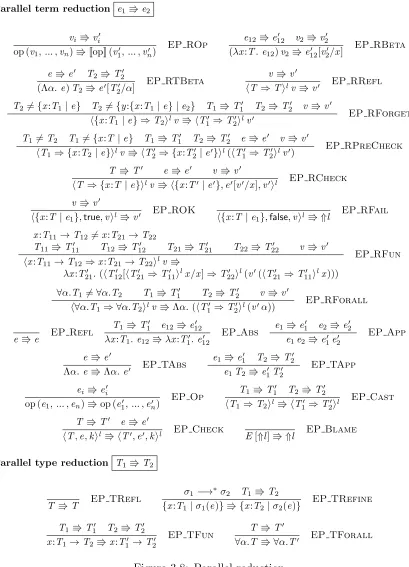
2.11 Parallel reduction for dependent λH . . . 35
2.12 The translation φ from dependent λC to dependent λH . . . 38
2.13 ψ mapping dependent λH to dependent λC . . . 40
2.14 A blame-exact result/term correspondence . . . 40
2.15 Blame-exact correspondence for φ from picky λC . . . 41
2.16 Blame-exact correspondence for ψ into laxλC . . . 45
2.17 Blame-inexact correspondence for φ from lax λC . . . 51
2.18 Blame-inexact correspondence for ψ into picky λC . . . 57
3.1 Syntax for FH . . . 72
3.2 Operational semantics for FH . . . 74
3.3 Typing rules for FH . . . 78
3.4 Type compatibility and conversion for FH. . . 80
3.5 The logical relation for parametricity . . . 97
3.6 Complexity of casts . . . 102
3.7 Subtyping, implication, and closing substitutions . . . 114
3.8 Parallel reduction . . . 124
3.9 Type conversion via common subexpression reduction . . . 125
4.1 The dyn/refine spectrum of cast expressiveness . . . 130
4.2 Space-inefficient reduction . . . 132
4.3 Castsyntax . . . 136
4.4 Typing for Cast, part 1 . . . 137
4.5 Typing for Cast, part 2 . . . 138
4.6 Castoperational semantics (core rules) . . . 140
4.7 Castoperational semantics (cast rules) . . . 141
4.8 Naive syntax . . . 148
4.9 Typing for Naive . . . 150
4.10 Coercion typing . . . 151
4.11 Primitive coercions . . . 152
4.12 Naive operational semantics (core rules) . . . 154
4.13 Naive operational semantics (coercion rules) . . . 155
4.14 Naive reduction . . . 158
4.15 Translating from Cast to Naive . . . 168
4.16 Relating Cast and Naive . . . 169
4.17 Relating casts and Naive coercions . . . 172
4.18 Updated syntax for Efficient . . . 179
4.19 Updated typing rules for Efficient . . . 179
4.20 Coercion rewriting rules . . . 181
4.21 Merging coercions . . . 186
4.22 Efficientoperational semantics . . . 195
4.23 Space-efficient reduction . . . 196
4.24 Relating Naive and Efficient . . . 201
4.25 Canonicalizing Naive terms . . . 203
The technical development in this dissertation comprises three pa-pers: Greenberg et al. [35] (itself an extended version of Greenberg et al. [34]), an extended and corrected version of Belo et al. [8], and a rejected POPL 2013 submission, Greenberg [33].
This document is typeset in LATEX using Computer Modern. There
Chapter 1
Introduction
Master, I’ve filled my contract, wrought in Thy many lands; Not by my sins wilt Thou judge me, but by the work of my hands.
The Song of the Wage-slave
Robert W. Service
Program specifications allow programmers to check their work. Data structure invariants for, e.g., red-black trees, help programmers write correct implementations; input/output specifications, also called pre- and post-conditions, offer a finer grained checking, at the level of individual functions, e.g., is this function an-approximation of the square-root function? Temporal logics allow programmers to specify the be-havior of long-running and non-terminating programs, e.g., does every request packet sent to a server get a response?
It is folklore that the mere act of writing down a specification is enough to help with program correctness. Computer assisted checking adds a stronger guarantee: sound specification checkers can, in an assisted or even entirely automated way, prove that programs meet their specifications. Naturally, there are trade-offs: sound and complete checkers (of nontrivial properties) can’t exist because of the halting problem. As a result, program specification languages exist on a spectrum, where less precise specifications are more robustly checkable—and, therefore, more often used.
Types are perhaps the most common form of program specification, even though their use isn’t universal. Types occupy a sweet spot: they are easy for programmers to understand, allow for compositional reasoning, and are machine checkable, if not inferrable. Types also have a beautiful mathematical theory, and they are compelling to study in their own right.
argument is non-empty. When the program calls pop with an empty stack, an in-formative error message can be printed to the screen—or the debugger can kick in. Eiffel [47] makes pre- and post-conditions an essential part of program development in a method called design by contract. They use software contracts—pre- and post-conditions—extensively, stating precise properties as concrete predicates written in the same language as the rest of the program.
Eiffel’s contracts are first order, designed for an imperative, object-oriented lan-guage. Findler and Felleisen [26] introduced “higher-order contracts” for functional languages. These can take one of two forms: predicate contracts (also known as re-finement types) like{x:Int|x >0}, which denotes the positive numbers; and function contracts like (x:Int)→ {y:Int|y > x}, which denotes functions over the integers that return numbers larger than their inputs. Other examples might require that divisors are non-zero:
div:Real→ {m:Real|m6= 0} →Real
or that the square root function produces answers that are correct (up to some ):
sqrt: (x:Real)→ {y:Real|abs(x−y2)< }
This last is a very strong contract; it entirely specifies the input/output behavior of the sqrt function. We could have given a similarly strong contract for division:
div: (n:Real)→ {m:Real|m 6= 0} → {k:Real|m·k =n}
One feature of contracts is that within the framework of contracts, it’s possible to express a wide range of specifications at varying levels of precision.
In this dissertation, I design higher-order languages combining conven-tional type systems, like the simply typed lambda calculus and System F,
with contracts. Designing type systems supporting contracts bolsters the power
of abstractions defined by types. Before addressing my own work on the topic, I want to discuss the state of the art—PLT Racket’s contract system [55, 56]—and its shortcomings.
PLT Racket contracts are overwhelmingly just simple types. Racket’s
large codebase has many contracts, but 82% of the contracts in their standard library merely recover simple types.1 Findler and Felleisen developed their contract system to add a form of specification to PLT Racket. Racket is a Scheme [69], written in S-expression syntax and dynamically typed. (They have gone on to develop slightly more traditional type systems, Typed Racket [74] in particular.) In using contracts for simple types, Racket contracts fall short of their full potential.
As an anecdote to bolster and clarify the data I collected, consider a typical Racket file, shown in Figure 1.1. The file, adapted from the Racket standard library, defines a queue data structure, and then exports (in Racket parlance, “provides”) several
#lang racket/base
(struct queue (head tail) #:mutable) (struct link (value [tail #:mutable]))
(define (make-queue) (queue #f #f))
(define (queue-empty? q) (not (queue-head q)))
(define (nonempty-queue? v) (and (queue? v) (queue-head v) #t))
(define (enqueue! q v)
(unless (queue? q) (raise-type-error enqueue! "queue" 0 q)) (let ([new (link v #f)])
(if (queue-head q)
(set-link-tail! (queue-tail q) new) (set-queue-head! q new))
(set-queue-tail! q new)))
(define (dequeue! q)
(unless (queue? q) (raise-type-error dequeue! "queue" 0 q)) (let ([old (queue-head q)])
(unless old (error ’dequeue! "empty queue")) (set-queue-head! q (link-tail old))
(link-value old)))
(define queue/c (flat-named-contract "queue" queue?))
(define nonempty-queue/c (flat-named-contract "nonempty-queue" nonempty-queue?))
(provide/contract
[queue/c flat-contract?]
[nonempty-queue/c flat-contract?] [queue? (-> any/c boolean?)] [make-queue (-> queue/c)]
[queue-empty? (-> queue/c boolean?)]) (provide enqueue! dequeue!)
Taken fromcollects/data/queue.rkt, as of November 6th 2011. Some comments have been removed.
things. This is where contracts are typically placed in PLT Racket definitions, for rea-sons described below in Section 1.3. First, there arequeue/candnonempty-queue/c, which are “flat” contracts on values, i.e., predicate contracts a/k/a refinement types. Then the predicate queue? tests whether a given value is a queue: it has a function contract, written in prefix form, that says that queue? accepts any value (any/c) and returns a boolean (the predicate boolean?, which is automatically treated as a contract). The constructor make-queue is a function of zero arguments that returns a value that satisfies the contract queue/c. The predicate queue-empty? checks whether or not the queue is empty: its sole argument must be a queue (queue/c) and it returns a boolean. Notice that this interface isdependent: we providequeue/cand then use it in the contracts for make-queue and queue-empty?.
The queue module also provides two non-contracted identifiers, enqueue! and dequeue!.2 Looking at their definitions,enqueue!expects a queue and returns
what-ever the structure mutator set-queue-tail! returns—a unit value. So a good con-tract for enqueue! would be (-> queue/c any/c). Similarly, dequeue! takes in a queue and returns its head. What’s more, dequeue! expects anon-empty queue—if given an empty queue, it will raise an error. So a good contract for dequeue! would be(-> nonempty-queue/c any/c). The return contract of any/cmakes sense, since we don’t know anything about values in the queue.
As written, the contracts on the queue interface don’t enforce anything
more than a simple type system would, though they define a refined type
(nonempty-queue/c). I would reiterate that this isn’t cherry picking examples: four out of five Racket contracts enforce nothing more than simple types.
PLT Racket’s use of contracts to recover simple types doesn’t teach us much for the design of new languages: it’s already possible to check simple types
completely statically. While Racket’s solution helps with their pre-existing code,
why would a new language would follow suit? Why bother paying the runtime cost of contract checking at runtime when static checking is available?
Dynamically typed languages create a “contracts for simple types bias”. Writing specifications can be hard work—as hard as programming. It’s tempting to stop at “good enough”—which in a dynamically typed language, may mean only simple types. Moreover, dynamic typing and contracts leaves us without empty handed. What are the reasoning principles for contracts? How does contract checking affect execution? Are there limits on how much space and time contract checking can take?
In this dissertation, I explore what contracts look like when we treat
con-tracts as our type system, taking simple types for granted. Suppose we start
with a simply typed lambda calculus. Can we coherently integrate contracts into a type system? In terms of the PLT Racket example above, I’d like to treat queue/c as a type (just as it would be in ML)—and I’d also like to treat nonempty-queue/c as a type. Treating contracts as types has many benefits. First, it gets rid of the low bar for contracts in PLT Racket: if the programmer wants simple types, they
have them as a static check. Next, having contracts as part of type signatures al-lows for operations on built-in abstract types to specify their abstractions totally; dequeue! is a partial operation, and the type queue/c → unit doesn’t adequately capture that partiality; the type nonempty-queue/c → unit does. A similar case applies to built-in operations, e.g., the division operator. Finally, types and contracts combine to yield strong reasoning principles, giving better guarantees to clients and implementors of, e.g., the queue abstraction.
Two issues stand in the way of integrating contracts in types. What should the semantics of a type system with “manifest” contracts be? Are such semantics practical from an efficiency perspective?
The first issue, determining the semantics, is challenging because contracts contain code. If contracts are to be part of the type system, we are left with adependent type system, one where treatingnonempty-queue/cas atypeforces the meaning of types to depend on evaluation. The metatheory of dependent languages is notoriously difficult, and is typically treated in rarified, “pure” settings, e.g., without nontermination or effects. But we are interested in writing specifications forprograms, where programs may diverge or contracts may be unsatisfied—and therefore must signal errors. Early attempts at hybrid type/contract systems had serious issues with the well-foundedness of their definitions. If contracts and types are to coexist, the metatheory must scale to impure core calculi.
The second issue, efficiency, is in fact a challenge for all contract systems. Contract checking can change the asymptotic complexity of programs by accumulating too many checks on functions or on the stack. If contracts are to be a core part of language design, they must not affect the asymptotic complexity of programs.
In this dissertation, I (a) situate type/contract systems in the design space, (b) develop abstraction and reasoning principles (specifically, relational parametricity) for a type/contract system, and (c) resolve issues with space consumption affecting runtime checking of contracts. The rest of this introduction covers more specific technical details. At the end of the introduction, I remark briefly on notations and conventions (Section 1.5).
1.1
Latent and manifest contracts
Findler and Felleisen’s work sparked a resurgence of interest in contracts, and in the intervening years a bewildering variety of related systems have been studied. Broadly, these come in two different sorts. In systems with latent contracts, types and contracts are orthogonal features. Examples of this style include Findler and Felleisen’s original system, Hinze et al. [41], Blume and McAllester [11], Chitil and Huch [16], Guha et al. [37], and Tobin-Hochstadt and Felleisen [74]. By contrast,
style; others include the work of Ou et al. [51], Wadler and Findler [78], and Knowles et al. [45]. (I discuss related work at length in Chapter 5.)
Findler and Felleisen’s latent calculus annotates function definitions with con-tracts; to actually check the contracts, they include terms like h{x:Int | pos x}il,l0 1, in which a boolean predicate, pos, is applied to a run-time value, 1. This term evalu-ates to 1, since pos 1 returns true. On the other hand, the termh{x:Int|pos x}il,l0 0 evaluates to blame, written ⇑l, signaling that a contract with label l has been vio-lated. The other label on the contract, l0, comes into play with function contracts,
c1 7→c2. For example, the term
h{x:Int|nonzero x} 7→ {x:Int|pos x}il,l0 (λx:Int.x − 1)
“wraps” the functionλx:Int.x −1 in a pair of checks: whenever the wrapped function is called, the argument is checked to see whether it is nonzero; if not, the blame term ⇑l0 is produced, signaling that the context of the contracted term violated the expectations of the contract. If the argument check succeeds, then the function is run and its result is checked against the contractpos x, raising ⇑l if this fails (e.g., if the wrapped function is applied to 1).
The key feature of manifest systems is that descriptions like {x:Int | nonzero x}
are incorporated into the type system as refinement types. Values of refinement type are introduced viacasts likeh{x:Int|true} ⇒ {x:Int|nonzerox}il n, which has static type {x:Int|nonzero x} and checks, dynamically, that n really is nonzero, raising ⇑l
otherwise. Similarly, h{x:Int| nonzero x} ⇒ {x:Int | pos x}il n casts an integer that is statically known to be nonzero to one that is statically known to be positive.
The manifest analogue of function contracts is casts between function types. For example, consider:
f = hdInte → dInte ⇒ {x:Int|pos x} → {x:Int|pos x}il (λx:dInte. x − 1), where dInte = {x:Int | true}. The sequence of events when f is applied to some argument n (of type P) is similar to what we saw before:
f n −→h hdInte ⇒ {x:Int|pos x}il ((λx:dInte. x − 1) (h{x:Int|pos x} ⇒ dInteil n))
First,nis cast from{x:Int |posx}todInte(it happens that in this case the cast cannot fail, since the target predicate is just true, but if it did, it would raise ⇑l); then the function body is evaluated; and finally its result is cast fromdInteto {x:Int|pos x}, raising ⇑l if this fails. The domain cast is contravariant and the codomain cast is covariant.
two labels, while casts use one. Informally, a function contract check hc1 7→ c2il,l
0
f
divides responsibility for f’s behavior between its body and its environment: the programmer is saying “If f is ever applied to an argument that does not pass c1, I
refuse responsibility (⇑l0), whereas if f’s result for good arguments does not satisfy
c2, I accept responsibility (⇑l).” In a system with casts, the programmer who writes
hR1 → R2 ⇒ S1 → S2il f is saying “Although all I know statically about f is that
its results satisfy R2 when it is applied to arguments satisfying R1, I assert that it’s
okay to use it on arguments satisfying S1 [because I believe that S1 implies R1] and
that its results will always satisfy S2 [because R2 implies S2].” In the latter case, the
programmer is taking responsibility for both assertions (so ⇑l makes sense in both cases), while the additional responsibility for checking that arguments satisfy S1 will
be discharged elsewhere (by another cast, with a different label).
We compare and contrast the latent and manifest semantics in Chapter 2. This lays the foundation: what are the semantics of contracts, and how do existing seman-tics in the literature relate to each other?
1.2
Contracts and abstraction
In Chapter 3, I study how contracts and type abstraction interact. Type abstraction is an essential part of language design, especially for higher-order languages. If we are going to design programming languages with manifest contracts, it’s important that we know that type abstraction still follows our intuition.
It turns out that manifest contracts not only enjoy relational parametricity, the gold standard property of type abstraction, but that manifest contracts allow pro-grammers to design particularly rich abstractions. Contracts andpolymorphismmake a natural combination: programmers can give strong contracts to abstract types, precisely stating pre- and post-conditions while hiding implementation details—for example, an abstract type of stacks might specify that the pop operation requires non-empty stacks as input, i.e., have the domain type {x:α Stack | not (empty? x)}. That is, just as the type abstraction of ML was used to force sound reasoning in proofs [32], we can use type abstraction to force sound uses of partial operations.
As one simple example, consider the following abstract type for natural numbers:
NAT :∃α. (zero:α)×(succ: (α→α))×(iszero: (α→Bool))×
(pred :{x:α |not(iszerox)} →α).
Contracts have allowed us to specify a very precise type for pred—one which ensures the correctness of the function, sincepred zeroisn’t a natural. Since these aremanifest
contracts, the type system will track which values are known to be non-zero. In Section 3.1, I develop a more extended example of an embedded domain-specific language of transducers based on Boomerang [12].
odd3
−→ (hDyn→Dyn⇒Int→Boolieven) 2
−→ hDyn⇒Booli(even(hInt⇒Dyni2))
−→ hDyn⇒Booli(even2Int!)
−→ hDyn⇒Booli((hInt→Bool⇒Dyn→Dyni(λx:Int. . . .)) 2Int!)
−→ hDyn⇒Booli(hBool⇒Dyni((λx:Int. . . .) (hDyn⇒Inti2Int!)))
−→ hDyn⇒Booli(hBool⇒Dyni((λx:Int. . . .) 2))
−→ hDyn⇒Booli(hBool⇒Dyni(odd1))
−→ hDyn⇒Booli(hBool⇒Dyni((hDyn→Dyn⇒Int→Boolieven) 0))
−→ hDyn⇒Booli(hBool⇒Dyni(hDyn⇒Booli(even(hInt⇒Dyni0))))
−→ hDyn⇒Booli(hBool⇒Dyni(hDyn⇒Booli(even0Int!)))
−→ hDyn⇒Booli(hBool⇒Dyni(hDyn⇒Booli
((hInt→Bool⇒Dyn→Dyni(λx:Int. . . .)) 0Int!)))
−→ hDyn⇒Booli(hBool⇒Dyni(hDyn⇒Booli(hBool⇒Dyni
((λx:Int. . . .) (hDyn⇒Inti0Int!)))))
−→ hDyn⇒Booli(hBool⇒Dyni(hDyn⇒Booli(hBool⇒Dyni
((λx:Int. . . .) 0))))
−→ hDyn⇒Booli(hBool⇒Dyni(hDyn⇒Booli(hBool⇒Dynitrue)))
−→ hDyn⇒Booli(hBool⇒Dyni(hDyn⇒BoolitrueBool!))
−→ hDyn⇒Booli(hBool⇒Dynitrue)
−→ hDyn⇒BoolitrueBool!
−→ true
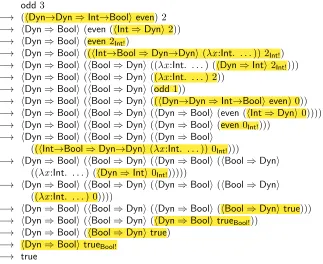
Figure 1.2: Contract checking destroys tail recursion
to representations, deforestation, etc.) and programmers (for formally supported reasoning). These principles are one of the payoffs of the manifest approach.
Finally, our development incorporates a significant technical improvement over earlier presentations of contracts (e.g., Flanagan [28] and Greenberg et al. [34], which is in effect Chapter 2): instead of introducing a denotational model to break a prob-lematic circularity between typing, subtyping, and evaluation, I develop the metathe-ory of contracts in a completely syntactic fashion, omitting subtyping from the core system and recovering it post facto as a derived property.
1.3
Efficiency and contract checking
Since casts and checks have runtime effects, we must ask: what are the costs? Racket’s contracts are essentially checked along the same lines as Findler and Felleisen’s plan, as in the wrap function:3
(define (wrap ctc v)
(if (flat-contract? ctc)
(if ((flat-contract-pred ctc) v)
v
(error (flat-contract-err-info ctc))) (let ([dom (fun-contract-dom ctc)]
[cod (fun-contract-cod ctc)]) (lambda (x)
(wrap cod (v (wrap dom x)))))))
That is, flat contracts (like nonempty-queue/c) just check the predicate; function contracts η-expand their argument, wrapping the input in the domain contract and the return value in the codomain contract. For example, wrapping queue? with its (-> any/c boolean?) contract yields:
(lambda (x)
(wrap boolean? (queue? (wrap any/c x))))
Thisη-expanded lambda is called afunction proxy. In PLT Racket (and all other for-mulations of higher-order contracts), functions can accumulate an unbounded number of function proxies—with serious ramifications for asymptotic space bounds. Simi-larly, the codomain contract check in the function proxy can destroy tail recursion.
One longstanding problem with casts is space efficiency: contract checks, in their na¨ıve formulation, can consume unbounded amounts of space at runtime both through excessive function proxies and through tail-recursion-breaking stack growth. This unbounded use of space can lead to changes in the asymptotic space efficiency of programs. Prior work [39, 40, 65, 68] offers space-efficient solutions exclusively in the domain ofgradual types [67]—type systems integrating simple types and the dynamic type,Dyn.
As an example, take the mutually recursive definition ofevenandoddfrom Herman et al. [39]. Here odd is written in a simply typed style, but even is written in a more dynamically typed style.
even:Dyn→Dyn=hInt→Bool⇒Dyn→Dyni λx:Int.
if x = 0 then true else odd (x −1)
odd:Int→Bool=λx:Int.
if x = 0 then false else (hDyn→Dyn⇒Int→Booli even) (x −1)
We show how odd 3 reduces in Figure 1.2. Note how casts between Bool and Dyn
accumulate. Imagine writing even and odd in a surface language—how predictable is cast insertion? What was written as tail recursive—and ought to use only O(1) space—instead takes O(n) space.
scheme is somewhat limiting: what about libraries with higher-order functions and callbacks?
Following Herman et al. [39], I develop a space efficient scheme for a language with manifest contracts and type Dyn in Chapter 4. We show that space efficiency avoids some checks, failing and diverging less often than na¨ıve calculi—but the two are otherwise observationally equivalent.
1.4
Summary
In this thesis, I show that higher-order contracts are on a firm type-theoretic
footing and that they support extensions necessary for real programming.
Developing these principles is the first step in designing and implementing higher-order languages with contracts and refinement types. In this dissertation, I:
• Study the relationship between the two families of core calculi for contracts (Chapter 2),
• Extend one family so that it admits type abstraction and enjoys relational parametricity (Chapter 3), and
• Resolve a show-stopping space-inefficiency (Chapter 4).
I discuss related work in Chapter 5 and conclude with a discussion of future work in Chapter 6.
1.5
Notation and other conventions
There are many different calculi in this dissertation: five in Chapter 2, one in Chap-ter 3, and three in ChapChap-ter 4. What’s more, all but two of these calculi use manifest contracts, and all but two of those use casts. So there is a significant overlap in nota-tion and names. It is easiest to interpret names as scoped by chapter: there are three different rules named E App, but each is unique in its chapter. Well formedness and
typing rules are named WF ... and T ... (though sometimes also S ...); evaluation
rules are named E ..., but also F ... and G ....
We explain the notation in each chapter, but all of the calculi should be familiar as extensions of the simply typed lambda calculus.
Chapter 2
Contracts made manifest
And something is happening here But you don’t know what it is
Ballad of a Thin Man
Bob Dylan
Recall the distinction between latent and manifest systems made in Section 1.1: latent contracts are orthogonal to the type system (if it exists), while manifest con-tracts conflate concon-tracts and types. While contract checks in latent systems may seem intuitively to be much the same thing as casts in manifest systems, the formal correspondence is not immediate. Manifest contracts used casts hS1 ⇒ S2il with
contravariant checking for functions; latent contracts used obligations hcil,l0 with an invariant rule—but with polarized blame labels. How do these forms of checking and blame relate? These questions have led to some confusion in the community about the nature of contracts. Indeed, as we will see, matters become yet murkier in richer languages with features such as dependency.
Gronski and Flanagan [36] initiated a formal investigation of the connection be-tween the latent and manifest worlds. They defined a core calculus, λC, capturing
the essence of latent contracts in a simply typed lambda-calculus, and an analogous manifest calculus λH. I will follow the naming scheme of their treatment. Both
cal-culi offer contract-like dynamic checks, but they differ in the exact structure of these checks, in their treatment of “blame,” and in how dynamic checks and types interact.
In λC, dynamic checks occur when a contract is applied, as in hcil,l
0
t. The contract checks to make sure that t is treated and behaves like a c. To achieve the same effect, λH applies a cast, hS1 ⇒ S2il s. This cast ensures that s—which used
to behave like an S1—is now treated and behaves like an S2, where S1 and S2 are
(very precise) types. For example, h{x:Int|pos x}il,l0
t ensures thatt evaluates to a positive integer; h{x:Int| nonzero x} ⇒ {x:Int |pos x}il s ensures that s—which we know to be nonzero—is also positive.
To compare these systems, they introduced a type-preserving translation φ from
Exact translations
laxλC λH pickyλC
ψ
φ ψ
φ
Inexact translations, more blame in target language
Figure 2.1: The axis of blame
predicate contracts over base types are mapped to casts between refinements of base type, and function contracts are mapped to function casts. The main result is that
φ preserves behavior, in the sense that if a term t inλC evaluates to a constant k or
blame ⇑l, then its translation φ(t) evaluates similarly.
In this chapter, I extend their work in two directions. First, I strengthen their main result by introducing a new feature-for-feature translationψ fromλH toλC and
proving a similar correspondence theorem for ψ. (I also give a new, more detailed, proof of the correspondence theorem for φ.) These correspondences show that the manifest and latent approaches are effectively equivalent in the nondependent case.
Second, and more significantly, I extend the whole story to allow dependent func-tion contracts in λC and dependent arrow types in λH. Dependency is extremely
handy in contracts, as it allows for precise specifications of how the results of func-tions depend on their arguments. For example, here is a contract that we might use with an implementation of vector concatenation:
z1:Vec7→z2:Vec7→ {z3:Vec|vlen z3 = vlenz1 + vlen z2}
Adding dependent contracts to λC is easy: the dependency is all in the contracts
and the types stay simple. We have just one significant design choice: should domain contracts be rechecked when the bound variable appears in the codomain contract? This choice leads to two dialects of λC, one which does recheck (picky λC) and one
which does not (lax λC). The choice is not clear, so I consider both. The question
of which blame labels belong on this extra check is discussed at length in Dimoulas et al. [22], which introduces indy blame. Indy blame is a variant of picky. I do not consider it in depth here, since it does not affect whether or not blame is raised, only which blame. I discuss this point more in Section 2.6.3. In λH, on the other
hand, dependency significantly complicates the metatheory, requiring the addition of a denotational semantics for types and kinds (a unary logical relation with a term model) to break a potential circularity in the definitions, plus an intricate sequence of technical lemmas involving parallel reduction to establish type soundness.
Surprisingly, the tight correspondence between λC and λH breaks down in the
of blame” (Figure 2.1), where evaluation behavior is preserved exactly when moving left on the axis (from pickyλC toλHto lax λC), but translated terms can blame more
than their pre-images when moving right.1 It is still the case that when a pre-image
raises blame, its translation blames as well—though not necessarily the same label. The discrepancy arises in the case of abusive contracts, such as
f:({x:Int|nonzero x} 7→ {y:Int|true})7→ {z:Int|f 0 = 0}
This rather strange contract has the form f:c1 7→ c2, where c2 uses f in a way that
violates c1! In particular, if we apply it (in lax λC) to λf:Int → Int. 0 and then
apply the result to λx:Int. x and 5, the final result will be 5, since λx:Int. x does satisfy the contract {x:Int | nonzero x} 7→ {y:Int | true} and 5 satisfies the contract
{z:Int | (λx:Int. x) 0 = 0}. However, running the translation of f in λH yields an
extra check, wrapping the occurrence off in the codomain contract with a cast from
{x:Int|nonzerox} → {y:Int|true}to{x:Int|true} → {y:Int|true}, which fails when the wrapped function is applied to 0. I discuss this phenomenon in greater detail in Section 2.3.
We should note at the outset that, like Gronski and Flanagan [36], we are inter-ested in translations that relateλCand λHfeature for feature, i.e., mapping predicate
contracts to predicate contracts and function contracts to function contracts. Trans-lations which don’t map feature for feature can give an exact treatment of blame. Consider the following dependent version of the wrap operator from Findler and Felleisen [26]. There are two cases: one for refinements of base types B, one for dependent function contracts.
φ(h{x:B |t}il,l0) = hdBe ⇒ {x:B |φ(t)}il
φ(hx:c1 7→c2il,l
0
) = λf:dx:c1 7→c2e. λx:dc1e.
φ(hc2il,l
0
) (f (φ(hc1il
0,l )x))
We can define a similar mapping function that implementsλH’s semantics as predicate
contracts in lax or picky λC. It is unsurprising that an exact mapping exists: λC and λH are lambda calculi that feature, among other things, a way to conditionally raise
exceptions. That these languages are interencodable is completely unsurprising. But translations like these do not relate function contracts to function casts at all, so they do not do much to tell us about how semantics of contracts and the semantics of casts relate.
In summary, the main contributions of this chapter are (a) the translation ψ and a symmetric version of Gronski and Flanagan’s behavioral correspondence theorem, (b) the basic metatheory of (CBV, blame-sensitive) dependent λH, (c) dependent
1There might, in principle, be some other way of defining φ and ψ that (a) preserves types,
B ::= Bool | . . . base types
k ::= true | false | . . . first-order constants
Figure 2.2: Base types and constants forλC and λH
versions of φ and ψ and their properties with regard to λH and both dialects of λC, and (d) a weaker behavioral correspondence in the dependent case. I restrict
my attention to strongly normalizing programs, though I believe the results should generalize readily to programs with recursion and nontermination. This chapter is an extended adaptation of Greenberg et al. [34] and Greenberg et al. [35].
2.1
The nondependent languages
We begin in this section by defining the nondependent versions of λC and λH and
continue in Section 2.2 with the translations between them. The dependent lan-guages, dependent translations, and their properties are developed in Sections 2.3, 2.5, and 2.6. Throughout this chapter, rules prefixed with an E or an F are
oper-ational rules for λC and λH, respectively. An initial T is used for λC typing rules;
typing rules beginning with an Sbelong to λH.
All of the languages will share a set of base types and first-order constants, given in Figure 2.2. Let the setKB contain constants of base typeB. We assume thatBool is among the base types, with KBool={true,false}.
2.1.1
The language
λ
CThe language λC is the simply typed lambda calculus straightforwardly augmented
with contracts. Contracts c come in two forms: predicate contracts {x:B | t} over a base type B and higher-order contracts c1 7→ c2, which check the arguments and
results of functions. We can use contracts in terms with thecontract obligationhcil,l0 . Applying a contract obligation hcil,l0 to a term t dynamically ensures that t and its surrounding context satisfy c. If t does not satisfy c, then the positive label l will be blamed and the whole term will reduce to ⇑l; on the other hand, if the context does not treat hcil,l0 t as c demands, then the negative label l0 will be blamed and
the term will reduce to ⇑l0. In contexts where it is unambiguous, I refer to contract obligations simply as contracts.
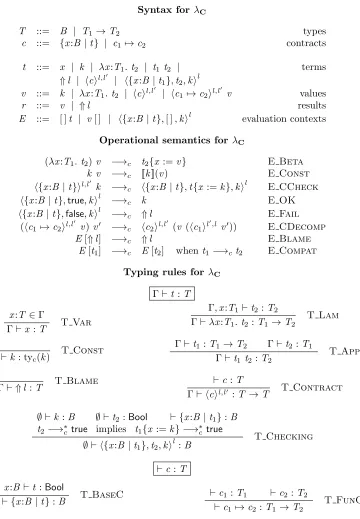
The syntax and semantics of λC appears in Figure 2.3, with some common
defi-nitions (shared with λH) in Figure 2.2. Besides the contract term hcil,l
0
, λC includes
first-order constants k, blame, and active checks h{x:B |t1},t2,kil. Active checks do
Syntax for λC
T ::= B | T1→T2 types
c ::= {x:B|t} | c17→c2 contracts
t ::= x | k | λx:T1.t2 | t1t2 | terms
⇑l | hcil,l0 | h{x:B|t
1},t2,ki l
v ::= k | λx:T1.t2 | hcil,l
0
| hc17→c2il,l
0
v values
r ::= v | ⇑l results
E ::= [ ]t | v[ ] | h{x:B |t},[ ],kil evaluation contexts
Operational semantics forλC
(λx:T1.t2)v −→c t2{x :=v} E Beta
k v −→c [[k]](v) E Const
h{x:B|t}il,l0 k −→c h{x:B|t},t{x :=k},kil
E CCheck h{x:B|t},true,kil −→c k E OK h{x:B |t},false,kil −→c ⇑l E Fail
(hc17→c2il,l
0
v)v0 −→c hc2il,l
0
(v (hc1il
0,l
v0)) E CDecomp
E[⇑l] −→c ⇑l E Blame
E[t1] −→c E[t2] whent1−→ct2 E Compat
Typing rules for λC
Γ`t:T
x:T∈Γ
Γ`x :T T Var
Γ`k: tyc(k) T Const
Γ` ⇑l:T T Blame
Γ,x:T1`t2:T2
Γ`λx:T1.t2:T1→T2 T Lam
Γ`t1:T1→T2 Γ`t2:T1
Γ`t1 t2:T2 T App
`c:T
Γ` hcil,l0
:T →T T Contract
∅ `k :B ∅ `t2:Bool ` {x:B|t1}:B
t2−→∗c true implies t1{x :=k} −→∗c true ∅ ` h{x:B|t1},t2,ki
l
:B T Checking
`c:T
x:B`t :Bool
` {x:B|t}:B T BaseC `c1:T1 `c2:T2
`c17→c2:T1→T2 T FunC
nonzero x}, but not predicate contracts over functions themselves, like {f:Bool →
Bool|f true=f false}.
Valuesv include constants, abstractions, contracts, and function contracts applied to values (more on these later); a result r is either a value or ⇑l for some l. We interpret constants using two constructions: the type-assignment function tyc, which
maps constants to first-order types of the form B1 →B2 →. . .→ Bn (and which is
assumed to agree withKB); and the denotation function [[−]], which maps constants to functions from constants to constants (or blame, to allow for partiality). Denotations must agree with tyc, i.e., if tyc(k) = B1 →B2, then [[k]](k1)∈ KB2 if k1 ∈ KB1.
The operational semantics is given in Figure 2.3. It includes six rules for basic (small-step, call-by-value) reductions, plus two rules that involve evaluation contexts
E (Figure 2.3). The evaluation contexts implement left-to-right evaluation for func-tion applicafunc-tion. If ⇑l appears in the active position of an evaluation context, it is propagated to the top level, like an uncatchable exception. As usual, values (and results) do not step.
The first two basic rules are standard, implementing primitive reductions and
β-reductions for abstractions. In these rules, arguments must be valuesv. Since con-stants are first-order, we know that whenE Constreduces a well-typed application, the argument is not just a value, but a constant.
The rulesE CCheck,E OK,E Failand E CDecomp, describe the semantics
of contracts. In E CCheck, predicate contracts applied to constants step to an active check. Active checks include the original contract, the current state of the check, the constant being checked, and a label to blame if necessary. I hold on to the original contract as a technical device for the translation φ from λC to λH,
since λH needs to know the target type of an active check. If the check evaluates
to true, then E OK returns the initial constant. If false, the check has failed and a
contract has been violated, so E Fail steps the term to ⇑l. Higher-order contracts on a value v wait to be applied to an additional argument. This is why function contracts applied to values are values. There is no substantial difference between this approach and expanding function contracts into new lambdas. When that argument has also been reduced to a valuev0,E CDecompdecomposes the function cast: the
argument value is checked with the argument part of the contract (switching positive and negative blame, since the context is responsible for the argument), and the result of the application is checked with the result contract.
The typing rules for λC (Figure 2.3) are mostly standard. We give types to
constants using the type-assignment function tyc. Blame expressions have all types.
Contracts are checked for well-formedness using the judgment ` c : T, comprising the rules T BaseC, which requires that the checking term in a predicate contract
The T Checking rule only applies in the empty context (active checks are only
created at the top level during evaluation). The rule ensures that the contract{x:B |
t1} has the right base type for the constant k, that the check expression t2 has a
boolean type, and that the check is actually checking the right contract. The latter condition is formalized by the implication: t2 −→∗c true implies t1{x :=k} −→∗c true
asserts that if t2 evaluates to true, then the original check t1{x := k} must also
evaluate to true. This requirement is needed for two reasons: first, nonsensical terms likeh{x:Int|pos x},true,0il should not be well typed; and second, I use this property in showing that the translations are type preserving (see Section 2.5). One may think that this rule makes typechecking for the full “internal language” with checks undecidable—I certainly did—but in fact the entire language is strongly normalizing.2 I could give a more precise condition—for example, that t1{x := k} −→∗c t2—but
there is no need. We will find that this condition is more useful in the metatheory of Chapters 3 and 4.
The language enjoys standard preservation and progress theorems. Together, these ensure that evaluating a well-typed term to a normal form always yields a result r, which is either blame or a value of the appropriate type.
2.1.2
The language
λ
HThe second calculus, nondependent λH, extends the simply typed lambda-calculus
with refinement types and cast expressions. The definitions appear in Figure 2.4 (syntax and semantics) and Figure 2.5. Unlike λC, which separates contracts from
types, λH combines them into refined base types {x:B |s1} and function types S1 →
S2. As for λC, I do not allow refinement types over functions nor refinements of
refinements. (We add these features to a dependent λH in Chapter 3.) Unrefined
base types B are not valid types; they must be wrapped in a trivial refinement, as the raw type{x:B |true}. The terms of the language are mostly standard, including variables, the same first-order constants asλC, blame, abstractions, and applications.
The cast expression hS1 ⇒S2i
l
dynamically checks that a term of type S1 can be
given type S2. LikeλC, active checks are used to give a small-step semantics to cast
expressions.
The values ofλHinclude constants, abstractions, casts, and function casts applied
to values. Results are either values or blame. We give meaning to constants as we did in λC, reusing [[−]]. Type assignment is via tyh, which we assume produces
well-formed types (defined in Figure 2.5). To keep the languages in sync, I require that tyh and tyc agree on “type skeletons”: if tyc(k) = B1 → B2, then tyh(k) = {x:B1 |
s1} → {x:B2 |s2}.
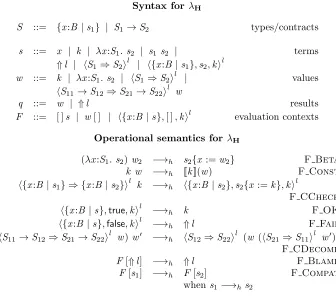
The small-step, call-by-value semantics in Figure 2.4 comprises six basic rules and two rules involving evaluation contexts F. Each rule corresponds closely to its λC
counterpart.
Syntax for λH
S ::= {x:B|s1} | S1→S2 types/contracts
s ::= x | k | λx:S1.s2 | s1 s2 | terms
⇑l | hS1⇒S2i l
| h{x:B |s1},s2,ki l
w ::= k | λx:S1.s2 | hS1⇒S2il | values
hS11→S12⇒S21→S22i l
w
q ::= w | ⇑l results
F ::= [ ]s | w[ ] | h{x:B |s},[ ],kil evaluation contexts
Operational semantics for λH
(λx:S1.s2)w2 −→h s2{x :=w2} F Beta
k w −→h [[k]](w) F Const
h{x:B|s1} ⇒ {x:B |s2}i l
k −→h h{x:B|s2},s2{x:=k},ki l
F CCheck
h{x:B|s},true,kil −→h k F OK
h{x:B |s},false,kil −→h ⇑l F Fail
(hS11→S12⇒S21→S22i l
w)w0 −→h hS12⇒S22i l
(w (hS21⇒S11i l
w0))
F CDecomp
F[⇑l] −→h ⇑l F Blame
F[s1] −→h F[s2] F Compat
whens1−→hs2
Typing rules for λH
∆`s:S
x:S ∈∆
∆`x :S S Var
∆`k : tyh(k) S Const
`S
∆` ⇑l :S S Blame
`S1 ∆,x:S1`s2:S2
∆`λx:S1. s2:S1→S2 S Lam
∆`s1:S1→S2 ∆`s2:S1
∆`s1 s2:S2 S App
`S1 `S2 bS1c=bS2c
∆` hS1⇒S2il :S1→S2
S Cast
∆`s:S1 `S2 `S1<:S2
∆`s:S2 S Sub
∅ `k:{x:B|true} ∅ `s2:{x:Bool|true} ` {x:B|s1}
s2−→∗htrue implies s1{x:=k} −→∗htrue ∅ ` h{x:B|s1},s2,ki
l
:{x:B|s1}
S Checking
`S1<:S2
∀k∈ KB.(s1{x :=k} −→h∗ true implies s2{x :=k} −→∗htrue)
` {x:B|s1}<:{x:B |s2} SSub Refine
`S21<:S11 `S12<:S22
`S11→S12<:S21→S22 SSub Fun
`S
` {x:B|true} SWF Raw
`S1 `S2
`S1→S2 SWF Fun
x:{x:B|true} `s :{x:Bool|true}
` {x:B |s} SWF Refine
Notice how the decomposition rules compare. In λC, the term (hc1 7→c2il,l
0
v) v0
decomposes into two contract checks: c1 checks the argument v0 and c2 checks the
result of the application. In λH the term (hS11→S12 ⇒S21 →S22il w) w0
decom-poses into two casts: a contravariant cast on the argument and a covariant cast on theresult. The contravariant cast hS21⇒S11il w0 makes w0 a suitable input for
w, while hS12⇒S22il casts the result from w applied to (the cast) w0. Suppose
S21 ={x:Int| pos x} and S11 ={x:B |nonzero x}. Then the check on the argument
ensures that nonzero x −→∗
h true—not, as one might expect, that pos w0 −→∗h true.
While it is easy to read off from a λC contract exactly which checks will occur at
runtime, a λH cast must be carefully inspected to see exactly which checks will take
place. On the other hand, which label will be blamed is clearer with casts—there’s only one!
The typing rules for λH (Figure 2.5) are also similar to those of λC. Just as the λC rule T Contract checks to make sure that the contract has the right form, the λH rule S Cast ensures that the two types in a cast are well-formed and have the
same simple-type skeleton, defined as b−c:S →T (pronounced “erase S”):
b{x:B |s}c = B
bS1 →S2c = bS1c → bS2c
This prevents “stupid” casts, likehdInte ⇒ dBooleil. I define a similar operator,d−e:
S →S (pronounced “raw S”), which trivializes all refinements:
d{x:B |s}e = {x:B |true} dS1 →S2e = dS1e → dS2e
These operations apply to λC contracts and types in the natural way. Type
well-formedness in λH is similar to contract well-formedness in λC, though the WF Raw
case needs to be added to get things off the ground.
The active check rule S Checking plays a role analogous to the T Checking rule in λC, again using an implication to guarantee that we only have sensible terms
in the predicate position. Note that we retain the target type in the active check, and that S Checking gives active checks that type—technical moves necessary for preservation.
An important difference is that λH has subtyping. The S Sub rule allows an
ex-pression to be promoted to any well-formed supertype. Refinement types are super-types if, for all constants of the base type, their condition evaluates totrue whenever the subtype’s condition evaluates to true. For function types, we use the standard contravariant subtyping rule. I do not consider source programs with subtyping, since subtyping makes type checking undecidable3; subtyping is just a technical device for
ensuring type preservation. Consider the following reduction:
h{x:Int|true} ⇒ {x:Int|pos x}il 1−→∗h 1
3Flanagan [28] and Knowles and Flanagan [44] discuss trade-offs between static and dynamic
The source term is well-typed at{x:Int|posx}. Since it evaluates to 1, we would like to have ∆`1 : {x:Int|pos x}. To have type preservation in general, though, tyh(1)
must be a subtype of {x:Int | s} whenever s{x := 1} −→∗
h true. That is, constants
of base type must have “most-specific” types. One way to satisfy this requirement is to set tyh(k) = {x:B | x = k} for k ∈ KB; then if s{x := k} −→∗h true, we have
`tyh(k)<:{x:B |s}. This approach is taken in Knowles and Flanagan [44] and Ou
et al. [51].
Standard progress and preservation theorems hold for λH. We can also obtain
a semantic type soundness theorem as a restriction of the one for dependent λH
(Theorem 2.3.12).
2.2
The nondependent translations
The latent and manifest calculi differ in a few respects. Obviously, λC uses contract
application and λH uses casts. Second, λC contracts have two labels—positive and
negative—whereλHcontracts have a single label. Finally, λH has a much richer type
system than λC. The translation ψ from λH to λC and Gronski and Flanagan’s φ
fromλC toλHmust account for these differences while carefully mapping “feature for
feature”.
Since I give the translations for the dependent languages in full in Section 2.3, I merely sketch the main ideas here.
The interesting parts of the translations deal with contracts and casts. Everything else is translated homomorphically, though the type annotation on lambdas must be chosen carefully. The full definitions of these translations are in Section 2.4; the nondependent definitions are a straightforward restriction, so I omit them.
For ψ, translating from λH’s rich types to λC’s simple types is easy: we just
erase the types to their simple skeletons. The interesting case is translating the cast
hS1 ⇒S2i
l
to a contract by translating the pair of types together, hψ(S1,S2)il,l. I
define ψ as two mutually recursive functions: ψ(s) translates λH terms to λC terms; ψ(S1,S2) translates a pair of λH types—effectively, a cast—to a λC contract. The
latter function is defined as follows:
ψ({x:B |s1},{x:B |s2}) = {x:B |ψ(s2)}
ψ(S11 →S12,S21→S22) = ψ(S21,S11)7→ψ(S12,S22)
We use the single label on the cast in both the positive and negative positions of the resulting contract, i.e.:
ψ(hS1 ⇒S2il) =hψ(S1,S2)il,l.
When we translate a pair of refinement types, we produce a contract that will check the predicate of the target type (likeF CCheck); when translating a pair of function
types, we translate the domain contravariantly (like F CDecomp). For example,
translates to h{x:Int|nonzero x} 7→ {y:Int|pos y}il,l.
Translating from λC to λH, we are moving from a simple type system to a rich
one. The translation φ (essentially the same as Gronski and Flanagan’s) generates terms inλH withrawtypes—λHtypes with trivial refinements, corresponding toλC’s
simple types. Since the translation targets raw types, the type preservation theorem is stated as “if Γ`t :T then dΓe `φ(t) :dTe” (see Section 2.6.1).
Whereas the difficulty with ψ is ensuring that the checks match up, the difficulty withφis ensuring that the terms inλC andλHwill blame the same labels. I deal with
this problem by translating a single contract with two blame labels into two separate casts. Intuitively, the cast carrying the negative blame label will run all of the checks in negative positions in the contract, while the cast with the positive blame label will run the positive checks. Let
φ(hcil,l0) =λx:dce. hφ(c)⇒ dceil0
(hdce ⇒φ(c)il x),
where the translation of contracts to refined types is:
φ({x:B |t}) = {x:B |φ(t)}
φ(c1 7→c2) = φ(c1)→φ(c2)
The operation of casting into and out of raw types is a kind of “bulletproofing.” Bulletproofing maintains the raw-type invariant: the positive cast takes the argument out of dce and the negative cast returns it there. For example,
h{x:Int |nonzerox} 7→ {y:Int|pos y}il,l0
translates to the λH term
λf:dInt→Inte.
h{x:Int|nonzero x} → {y:Int|pos y} ⇒ dInt→Inteil0
(hdInt→Inte ⇒ {x:Int|nonzero x} → {y:Int|pos y}il f).
Unfolding the domain parts of the casts on f, the domain of the negative cast en-sures that f’s argument is nonzero with hdInte ⇒ {x:Int|nonzero x}il0; the domain of the positive cast does nothing, since h{x:Int|nonzero x} ⇒ dInteil has no effect. Similarly, the codomain of the negative cast does nothing while the codomain of the positive cast checks that the result is positive. Separating the checks allows λH to
keep track of blame labels, mimicking λC. Put more generally, in the positive cast,
the positive positions may fail because they are “down casts”, whereas the negative positions are “up casts”, so they cannot fail. The opposite is true of the negative cast. This embodies the idea of contracts as pairs of projections [25]. Note that bul-letproofing is “overkill” at base type: for example, h{x:Int |nonzero x}il,l0 translates to
λx:dInte.
h{x:Int|nonzero x} ⇒ dInteil0
Only the positive cast does anything—the negative cast into dInte always succeeds. This asymmetry is consistent with λC, where predicate contracts also ignore the
negative label. In Section 2.3 I extend the bulletproofing translation to dependent contracts—one of my main contributions.
Both φ and ψ preserve behavior in a strong sense: if Γ ` t : B, then either t
and φ(t) both evaluate to the same constant k or they both raise ⇑l for the same l; and conversely for ψ. Interestingly, we need to set up this behavioral correspondence
before we can prove that the translations preserve well-typedness, because of the
T Checking and S Checking rules.
2.3
The dependent languages
We now extend λC to dependent function contracts and λH to dependent functions.
Very little needs to be changed in λC, since contracts and types barely interact; the
changes to E CDecompand T FunC are the important ones. Adding dependency
to λH is more involved. In particular, adding contexts to the subtyping judgment
entails adding contexts to SSub Refine. To avoid a dangerous circularity, I define closing substitutions in terms of a separate type semantics. Additionally, the new
F CDecomp rule has a slightly tricky (but necessary) asymmetry, explained below.
2.3.1
Dependent
λ
CDependent λC has been studied since Findler and Felleisen [26]; it received a very
thorough treatment (with an untyped host language) in Blume and McAllester [11], was ported to Haskell by Hinze et al. [41] and Chitil and Huch [16], and was used as a specification language in Xu et al. [80]. Type soundness is not particularly difficult, since types and contracts are kept separate. My formulation follows Findler and Felleisen [26], with a few technical changes to make the proofs for φ easier.
We have marked the changed rules with a • next to their names. The new
T RefineC,T FunC, andE CDecomprules in Figure 2.7 (typing) and Figure 2.6
(syntax and semantics) suffice to add dependency to λC. To help us work with the
translations, we also make some small changes to the bindings in contexts, adding a new binding form to track the labels on a contract check throughout the contract well-formedness judgment. Note that T FunCadds x:c1l
0,l
to the context when checking the codomain of a function contract, swapping blame labels. I add a new variable rule, T VarC, that treats x:cl,l0 as if it were its skeleton, x:bcc. While unnecessary
for λC’s metatheory, this new binding form helps φ preserve types when translating
fromλH to picky λC; see Section 2.6.1.
Two different variants of the E CDecomp rule can be found in the literature:
they are lax and picky. The original rule in Findler and Felleisen [26] is lax (like most other contract calculi): it does not recheck c1 when substituting v0 into c2.
Syntax for dependent λC
T ::= B | T1→T2 types
c ::= {x:B|t} | x:c17→c2 contracts•
Γ ::= ∅ | Γ,x:T | Γ,x:cl,l0 typing contexts•
t ::= x | k | λx:T1.t2 | t1 t2 | ⇑l | hcil,l
0
| h{x:B |t1},t2,kil terms
v ::= k | λx:T1.t2 | hcil,l
0
| hx:c17→c2il,l
0
v values•
r ::= v | ⇑l results
E ::= [ ]t | v[ ] | h{x:B |t},[ ],kil evaluation contexts
Operational semantics for dependent λC t1−→ct2
(λx:T1.t2)v −→c t2{x :=v} E Beta
k v −→c [[k]](v) E Const
h{x:B |t}il,l0 k −→c h{x:B |t},t{x :=k},kil
E CCheck
(hx:c17→c2il,l
0
v)v0 −→lax hc2{x :=v0}il,l
0
(v (hc1il
0,l
v0))
E CDecompLax•
(hx:c17→c2il,l
0
v)v0 −→picky hc2{x :=hc1il
0,l
v0}il,l0 (v (hc 1il
0,l
v0))
E CDecompPicky•
h{x:B|t},true,kil −→c k
E OK h{x:B|t},false,kil −→c ⇑l
E Fail
E[⇑l] −→c ⇑l E Blame
E[t1] −→c E[t2] whent1−→ct2 E Compat
Contract erasure
b{x:B |t}c=B bx:c17→c2c=bc1c → bc2c
Typing rules for dependent λC
`Γ
` ∅ T Empty `Γ
` Γ,x:T T ExtVarT•
`Γ
`Γ,x:T T ExtVarT•
Γ`t:T
x:T ∈Γ
Γ`x :T T VarT
x:cl,l0 ∈Γ
Γ`x :bcc T VarC• Γ`k : tyc(k) T Const
Γ,x:T1`t2:T2
Γ`λx:T1. t2:T1→T2 T Lam
Γ`l,l0 c:T
Γ` hcil,l0
:T →T T Contract•
Γ`t1:T1→T2 Γ`t2:T1
Γ`t1 t2:T2 T App
Γ` ⇑l :T T Blame
`Γ ∅ `k :B ∅ `t2:Bool ∅ `l,l
0
{x:B|t1}:B
t2−→c∗true implies t1{x :=k} −→c∗true
Γ` h{x:B|t1},t2,kil :B T Checking
Γ`l,l0 c:T
Γ,x:B`t:Bool
Γ`l,l0
{x:B|t}:B T RefineC
Γ`l0,l c
1:T1 Γ,x:c1l
0,l
`l,l0 c 2:T2
Γ`l,l0
x:c17→c2:T1→T2 T FunC
from Findler and Felleisen; Hinze et al. [41] choose to be picky as well, substituting
hc1il
0,l
v0 into c2 because it makes their conjunction contract idempotent. We can
show (straightforwardly) that both enjoy standard progress and preservation prop-erties. Below, we consider translations to and from both dialects of λC: picky λC
using only E CDecompPicky in Sections 2.5.1 and 2.6.2, and lax λC using only E CDecompLax in Sections 2.5.2 and 2.6.1. Accordingly, I give two sets of
evalu-ation rules: −→lax and −→picky. When I write −→c, the metavariable c ranges over
pickyandlax. I complete the type soundness proofs here generically, writing−→cfor
the evaluation relation. For the translations in Section 2.4, I specify which evaluation relation we use.
I make a standard assumption about constant denotations being well typed: if Γ`k v :T then Γ`[[k]](v) :T.
2.3.1 Theorem [Progress]: If ∅ ` t : T then either t −→c t0 or t = r (i.e., t = v
ort =⇑l).
Proof: By induction on the typing derivation.
For preservation, we prove confluence and substitution lemmas. Note that our substitution lemma must now also cover contracts, since they are no longer closed.
2.3.2 Lemma [Determinacy]: Let −→c be either −→picky or −→lax. If t −→c t0
and t −→ct00, then t0 =t0.
2.3.3 Corollary [Cotermination]: If Let−→cbe either−→picky or−→lax. t −→c∗
r and t −→c∗ t0, then t0 −→c∗ r.
2.3.4 Lemma [Term and contract substitution]: If ∅ `v :T0, then
1. if Γ,x:T0,Γ0 `t :T then Γ,Γ0{x :=v} `t{x :=v}:T, and 2. if Γ,x:T0,Γ0 `l,l0 c :T then Γ,Γ0{x :=v} `l,l0 c{x :=v}:T.
Proof: By mutual induction on the typing derivations for t and c.
We omit the proof for x:cl,l0 bindings, which is similar.
2.3.5 Theorem [Preservation]: If ∅ `t :T and t −→ct0 then ∅ `t0 :T.
Proof: By induction on the typing derivation. This proof is straightforward because