
ESTIMATION OF INPUT IMPEDANCE
OF MICROSTRIP PATCH ANTENNA
USING FUZZY NEURAL NETWORK
VANDANA VIKAS THAKARE1
1
Deptt. of Electronics and Instrumentation Engg., Anand Engineering College, Keetham, Agra, 282007, India PRAMOD KUMAR SINGHAL2
2
Deptt. of Electronics Engineering ,Madhav Institute of Technology & Science, Near Gola Ka Mandir, Gwalior, 474005, India .
Abstract:
The paper presents the use of fuzzy neural network (FNN) as a fast and better technique for the determination of input impedance of coaxial feed rectangular microstrip antenna. The fuzzy parameter ensures better performance as compared to three layer multilayered perceptron feed forward back propagation artificial neural network (MLPFFBP ANN) and radial basis function artificial neural network (RBF ANN) in the determination of input impedance of the coaxial feed microstrip antenna.
Keywords: Microstrip antenna; input impedance; feed position; fuzzy neural network;, MLPFFBP; RBF; ANN; modeling.
1. Introduction
In past neuro-fuzzy networks [1-4] had been introduced to evaluate the resonant frequency and patch dimensions of microstrip antennas. The proposed methodology investigates a new approach utilizing a fuzzy ANN [5-6] for estimating the input impedance of microstrip antenna. Fuzzifying feed positions into linguistic categories using non-linear membership functions enables efficient modeling of uncertainty and inaccuracy associated with input data.
The input impedance plays a very important role in the design of microstrip antenna. The input impedance depends on the dimensions of the patch and the feed position as well. The error in calculation of input impedance can affect the antenna design considerably because the microstrip antennas have very narrow bandwidth and can work efficiently only close to their resonant frequency. The FNN employs feed position as a fuzzy variable and finds the antenna input impedance taking into consideration the noise or uncertainty involved in data preparation. Therefore a fuzzy neural network (FNN) is developed and compared with two ANNs for the estimation of input impedance of a coaxial feed rectangular microstrip antenna for the given values of feed positions.
2. Design and Data Generation
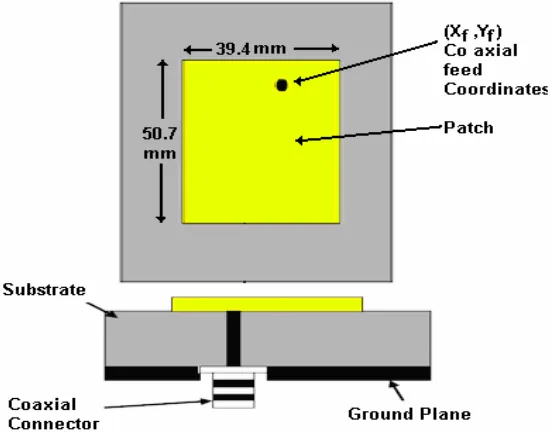
A coaxial feed microstrip antennas is simulated in IE3D simulator and is resonating at 1.8 GHz frequency with the design parameter values i.e. dielectric constant (εr) = 4.4, substrate thickness ( h) = 1.5 mm, Length (L) = 39.4 mm and Width (W) = 50.7 mm on a ground plane as shown in fig.1. The feed point must be located at that point on the patch, where the input impedance is 50 ohms for the specified resonant frequency. The width and the length of the patch are calculated initially by the electromagnetic relationships (1), (2), (3) and (4) given in [7].
1
2
2
r r
f
v
W
(1)
L
f
v
L
reff r
2
2
(2)
8
.
0
258
.
0
264
.
0
3
.
0
412
.
0
h
W
h
W
h
L
reff reff
(3)where
L
is extension in length due to fringing effects and effective dielectric constant is given by 2 / 112
1
2
1
2
1
W
h
r r reff
(4)
The center of the patch is taken as the origin and the feed point location is given by the co-ordinates (Xf & Yf ) from the origin. For different locations of the feed point coordinates in the specified range i.e. 9.5 mm ≤ Xf ≤ 16 mm with fixed Yf =12 mm the example antenna is simulated in IE3D and the corresponding values of input impedance Zi is recorded. Hence the data is generated for training and testing of the developed FNN, MLPFFBP ANN and RBF ANN.
3. Applying the Neuro Fuzzy Computational Technique
The objective of fuzzification of feed position is that fuzzy representation gives a kind of probabilistic representation [5-6] of feed position taking into consideration the noise and uncertainty involved in measurement while generating data. As the input impedance is very sensitive to feed position, even a small error in this crucial input i,e, feed position will affect the output parameter i.e. input impedance. With this in view and to allow for the inaccuracy and uncertainty in the data fuzzy modeling is used because fuzzy data is given in the form of possibility distributions where the membership values can be derived from qualitative assessment, linguistic declarations, past experiences or heuristics.
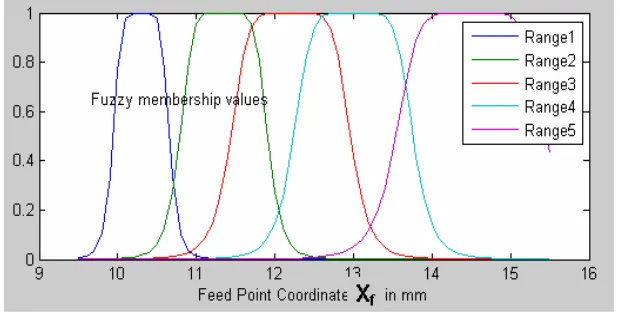
Uncertainty or human error in the determination of feed positions is modeled by representing it as a fuzzy variable with memberships in different classes linguistically expressed as range 1 (very very small), range 2 (very small), range 3( (small), range 4 (medium), range 5 (large). The boundaries of these categories are fuzzified based on intuition and experience. Every position value in the crisp (binary) set is assigned membership values (between 0 and 1) that represent the possibility of feed positions being in that category. The membership value (
i) is calculated by the equation (5) defined in [4].4
1
1
)
(
i i i
b
a
Fp
Fp
(5)where
i is the membership function of the feed position in ith linguistic category Fp is the feed position i.e the value of Xf in mm in this particular example as Yf is kept constant in this particular example. Parametera
i determines the centre value andb
i the width of the category. The values used in this work are given in Table 1.Table 1. Fuzzy Parameters
a
iandb
iused for feed position coordinate (Xf)Linguistic category
for Fp Range 1 Range 2 Range 3 Range 4 Range 5
i
a
10.3 11.35 12.20 13.0 14.50i
b
0.36 0.56 0.76 0.76 0.96Due to the smooth transition from one category to the other, non-linear membership functions are found to be more suitable for representing feed positions compared to common triangular or trapezoidal functions. The fuzzy representation of feed position in five ranges is shown in fig. 2.
Fig. 2. The fuzzification of feed position coordinates (Xf) in mm
3.1 The Fuzzy Neural Network (FNN)
Fig. 3. Graph showing the training performance to achieve minimum mean square error level with Levenberg – Marquardt (LM) as a training algorithm in case of Fuzzy neural network (FNN)
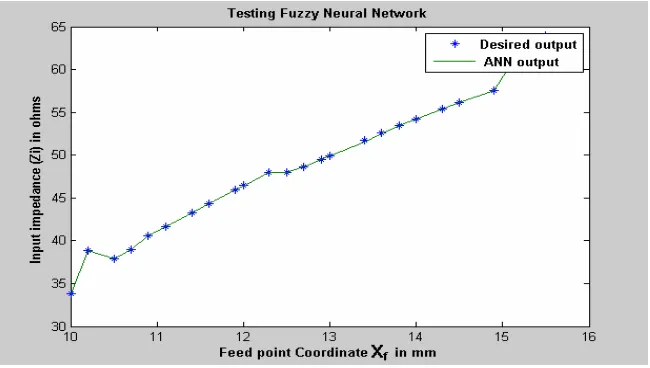
Using IE3D [8] software 80 patterns were generated in the specified range. The fuzzy neural network is trained with 56 inputs –output patterns pattern, cross validated with 20% of training data and tested with 24 patterns. The performance function percentage root mean square (%RMSE) has been used to evaluate the accuracy achieved while testing the developed FNN in the estimation of input impedance for the given fuzzified input values of feed positions. Plot between target value and the estimated value of input impedance with respect to feed position coordinate (Xf) for validating the developed three layer fuzzy neural network (FNN) with Levenberg – Marquardt (LM) as a training algorithm is shown in fig. 4.
Fig. 4. Graph showing the training performance to achieve minimum mean square error level with Levenberg – Marquardt (LM) as a training algorithm in case of fuzzy neural network (FNN)
Fig. 5. Graph showing the training performance to achieve minimum mean square error level in case of MLPFFBP neural network with Levenberg – Marquardt (LM) as a training algorithm
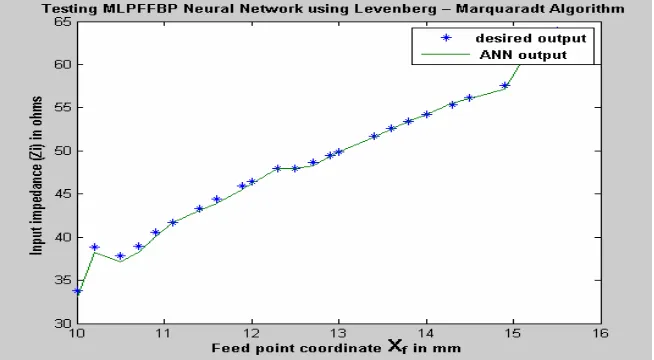
The MLPFFBP neural network is also trained with 56 inputs –output patterns, cross validated with 20% of training data and tested with 24 patterns. The performance function percentage root mean square (%RMSE) has been used to evaluate the accuracy achieved while testing the developed MLPFFBP ANN in the estimation of input impedance for the given fuzzified input values of feed positions. Plot between target value and the estimated value of input impedance with respect to feed position coordinate (Xf) for validating the developed three layer MLPFFBP neural network with Levenberg – Marquardt (LM) as a training algorithm is shown in fig. 6.
Fig. 6. Plot between target value and the estimated value of of input impedance with respect to feed position coordinate (Xf) for MLPFFBP
ANN with Levenberg – Marquardt (LM) as a training algorithm
Fig. 7. Graph showing the training performance to achieve minimum mean square error level in case of Radial basis function (RBF) neural network
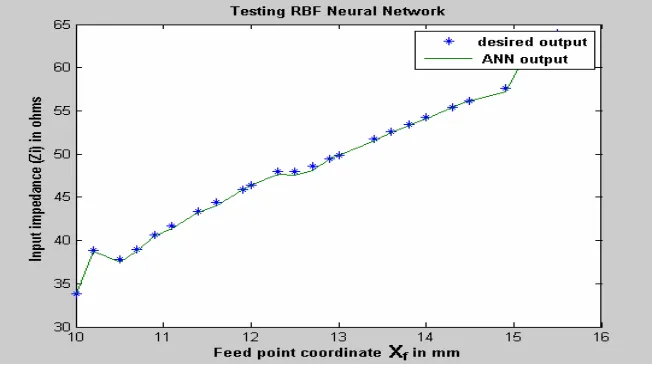
Fig. 8. Plot between target value and the estimated value of input impedance with respect to feed position coordinate (Xf) for Radial basis
function (RBF) neural network
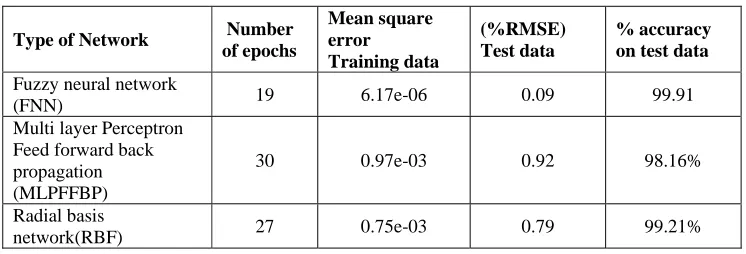
The performance function preferred to evaluate the accuracy achieved for the above developed three networks is percentage root mean squire error (% RMSE) also known as percentage average error. The proposed three networks are compared for their performance in terms of accuracy achieved.
4. Results and Discussions
Table 2. Performance evaluation of three different neural networks
The average error calculated in case of FNN is 0.09 % which is quite less as compared to what calculated in case of MLPFFBP ANN i.e. 0.92% and RBF ANN i.e. 0.79 % when compared to simulation findings from IE3D simulator. The FNN network gets trained in 19 epochs to the accuracy of 6.1769e-06 (MSE) which is far better as concluded from table 2.
5. Concluding Remarks
Fuzzification of feed position into 5 categories before applying as a input to neural network has improved the performance of neural network in the estimation of input impedance is established through this work. In past [10] input impedance is analysed using feed forward back propagation neural network to the accuracy of 98.64% but the use of FNN has further reduce the average error in the estimation of input impedance and achieving the accuracy of 99.91% as compared to MLPFFBP and RBF neural network. The implication of fuzzy in the determination of input impedance of a microstrip antenna is not attempted so far.
Fuzzy logic enables the user to get more insight and flexibility in the system design and helps in exploiting the tolerance to slight imprecision so that the overall performance may be improved both in terms of speed and accuracy as well.
References
[1] Angiulli G. and Versaci M. (2003), “Resonant frequency evaluation of microstrip antennas using a neural-fuzzy approach”, IEEE Transactions on Magnetics, vol.39, no.3, pp.1333 – 1336.
[2] Rahouyi E. B.; Hinojosa J. and Garrigos J. (2006), "Neuro-fuzzy modeling techniques for microwave components," IEEE Microwave & Wireless Components Lett., vol. 16, no. 2, pp.72-74.
[3] Sathi V.; Ghobadi Ch. and Nourinia J. (2005), “An efficient CAD method to design dual-band probe-fed microstrip antennas using a fuzzy approach”, Proceedings of the 3rd Annual Communication Networks and Services Research Conference (CNSR’05), pp. 91-96. [4] Pandit Nayla; Mishra Utsav; .Singhal P.K. and Pandit Manjaree (2009), “Design of microstrip antenna using fuzzy neural network”,
International Symposium on Microwave and Optical Technology 2009, India, pp.1043-1046.
[5] Rao V. and Rao H. (1996), ”C++,“Neural Networks and Fuzzy Logic”,BPB Publications, pp. 123-176. [6] Lin C. T. and Lee C. S. G. (1996), “Neural Fuzzy Systems”, Prentice Hall.
[7] Balanis C. A. (1997), “Antenna theory”, John Wiley & Sons, Inc.. [8] IE3D Software Release-8, Developed by M/S Zeland Software Inc. [9] Haykins Simon (2000), “Neural networks”, second edition, pHI.
[10] Devi S.; Panda D. C. and Pattnaik S. S. (2002), “A novel method of using artificial neural networks to calculate input impedance of circular microstrip antenna”, Antennas and Propagation Society International Symposium, vol.3, pp. 462– 465.
Type of Network Number of epochs
Mean square error
Training data
(%RMSE) Test data
% accuracy on test data
Fuzzy neural network
(FNN) 19 6.17e-06 0.09 99.91
Multi layer Perceptron Feed forward back propagation (MLPFFBP)
30 0.97e-03 0.92 98.16%
Radial basis
![Improvement of Power System Performance Using Fuzzy Logic Based Interline Power Flow Controller [IPFC]](data:image/gif;base64,R0lGODlhAQABAIAAAP///wAAACH5BAEAAAAALAAAAAABAAEAAAICRAEAOw==)