Identi
fi
cation of Barriers to Pediatric
Care in Limited-Resource Settings:
A Simulation Study
Nicole Shilkofski, MD, MEda,b, Elizabeth A. Hunt, MD, MPH, PhDa,b,c
abstract
OBJECTIVES:Eighty percent of the 10 million annual deaths in children aged,5 years indeveloping countries are estimated to be avoidable, with improvements in education for pediatric emergency management being a key factor. Education must take into account cultural considerations to be effective. Study objectives were: (1) to use simulation to identify factors posing barriers to patient care in limited resource settings (LRS); and (2) to understand how simulations in LRS can affect communication and decision-making processes.
METHODS:A qualitative study was conducted at 17 different sites in 12 developing countries in
Asia, Latin America, and Africa. Data from observations of 68 in situ simulated pediatric emergencies were coded for thematic analysis. Sixty-two different“key informants”were interviewed regarding perceived benefit of simulations.
RESULTS:Coding of observations and interviews yielded common themes: impact of culture on
team hierarchy, impact of communication and language barriers on situational awareness, systematic emergency procedures, role delineation, shared cognition and resource awareness through simulation, logistic barriers to patient care, and use of recognition-primed decision-making by experienced clinicians. Changes in clinical environments were implemented as a result of simulations.
CONCLUSIONS:Ad hoc teams in LRS face challenges in caring safely for patients; these include
language and cultural barriers, as well as environmental and resource constraints. Engaging teams in simulations may promote improved communication, identification of systems issues and latent threats to target for remediation. There may be a role for training novices in use of recognition-primed or algorithmic decision-making strategies to improve rapidity and efficiency of decisions in LRS.
WHAT’S KNOWN ON THIS SUBJECT:Previous studies in limited resource settings have demonstrated that multidisciplinary team training in simulated trauma and newborn resuscitations improves team performance and resuscitation knowledge and, in some cases, reduces patient mortality regionally in some developing countries.
WHAT THIS STUDY ADDS:In situ simulation in limited resource settings identified latent threats to effective pediatric patient care and provided a vehicle to develop shared mental models among multicultural and multidisciplinary teams, despite cultural differences in conceptualization of leadership and emergency decision-making.
Departments ofaAnesthesiology and Critical Care Medicine,bPediatrics, andcHealth Informatics, Johns Hopkins
University School of Medicine, Baltimore, Maryland
Dr Shilkofski conceptualized and designed the study, coordinated data collection at several sites, and drafted the initial manuscript; Dr Hunt coordinated and supervised data collection at several sites, and critically reviewed and revised the manuscript; and both authors approved thefinal manuscript as submitted and agree to be accountable for all aspects of the work.
www.pediatrics.org/cgi/doi/10.1542/peds.2015-2677
DOI:10.1542/peds.2015-2677 Accepted for publication Sep 2, 2015
Address correspondence to Nicole Shilkofski, MD, MEd, Department of Anesthesiology and Critical Care Medicine, Johns Hopkins University School of Medicine, Charlotte R. Bloomberg Children’s Center, Room 6349, 1800 Orleans St, Baltimore, MD 21287. E-mail: [email protected]
PEDIATRICS (ISSN Numbers: Print, 0031-4005; Online, 1098-4275).
Ten million deaths occur annually in children aged,5 years in limited resource settings (LRS) in developing countries. Eighty percent of these deaths are estimated to be avoidable.1
Most practitioners in LRS are not specifically trained in the management of critically ill
children.2–6It is not well understood
how these practitioners make clinical decisions in caring for patients in LRS or what barriers exist for teams functioning in LRS that affect decision-making. A major problem for teams in LRS is the wide range of physiologic, psychological, and psychosocial factors affecting clinical care.7Lack of technology, language
barriers, and the growing frequency of multicultural teams are several factors that influence the“situational awareness” of teams in stressful situations.8Previous studies have
documented that team performance is improved when members
continually assess their environment and update each other in a process called‘‘shared cognition.’’9Situational
awareness allows teams to maintain an overall view of the situation and therefore should be a target of cognitive intervention when training teams. However, this goal is
challenging if cultural and language barriers prohibit creation of shared cognition. Some previous studies in LRS have shown that
multidisciplinary team training in simulated trauma and newborn resuscitations improved team performance and resuscitation knowledge and, in some cases, was shown to reduce mortality.10–15One
of these studies found that a low-cost educational intervention can affect knowledge constructs among international teams.10Identification
and removal of barriers to teamwork and efficiency of decision-making processes become more salient in LRS.
The objectives of the present study were to use in situ simulations of emergency situations to: (1) identify factors posing barriers to effective
and safe patient care in LRS; and (2) understand communication and decision-making processes of clinicians practicing in LRS during emergency care of children and how these processes can be affected by simulation. This information can then subsequently inform the design of educational interventions in pediatric emergency care in LRS.
METHODS
Study Design
This study used a qualitative design and an ethnographicfield approach to assess multicultural/interdisciplinary teams in situ. Although qualitative research sometimes explores phenomena that may seem intuitive, using rigorous methods minimizes the chance of systematic bias (ie, in the interview approach and analysis if these differ significantly between groups). A rigorous approach also optimizes chances that each important theme is identified and explored. Valid results subsequently equip educators involved in
curriculum development processes and are synergistic with quantitative analyses. In this study, the Klein model of naturalistic decision-making (NDM) was used as a framework to construct questions within semi-structured interviews with key informants16(Supplemental
Appendix). The study observations and interviews focused on the following: (1) the processes and barriers to ad hoc team integration, assimilation, and decision-making during simulated in situ pediatric emergencies in LRS; and (2) the analysis of individual clinicians’ thought processes involved in NDM in LRS. The study was approved by the institutional review board of Johns Hopkins School of Medicine.
Description of Sites and Participants
Qualitative observations were conducted over a 24-month period, with each visit to clinical care areas lasting∼2 weeks. Observations were
made during team preparations for surgical and medical humanitarian missions occurring in rural hospitals in LRS. The 17 hospital sites were in 12 developing countries: Uganda, Kenya, Egypt, Thailand, China, Philippines, Vietnam, Nepal, India, Papua New Guinea, Guyana, and Honduras. Participating clinicians were local and international volunteers functioning together as ad hoc teams during missions. The teams were multidisciplinary, ranging from clinicians who regularly care for children to those with limited experience with pediatric patients. Interviews were conducted with at least 3 clinicians at each hospital who were considered“key informants,” representing physician and nursing team leaders who participated in simulations (N= 62).
Data Collection Strategies
Simulations
Observations of clinical teams were conducted during 68 different in situ simulated emergencies in inpatient clinical settings in wards, recovery rooms, emergency departments, and operating theaters. Simulations used low- or medium-fidelity mannequins and focused on: (1)fluid resuscitation in a child with hypovolemic or hemorrhagic shock; and (2) management of a critically ill child with respiratory distress and subsequent dysrhythmia. Observers developed categories/themes to classify data and then attempted to saturate these categories. Data analysis used the constant comparative method (ie, occurred concurrently with observations) to develop conceptual density (ie, well-developed thematic categories that are conceptually linked); these processes are consistent with qualitative methods as defined by Glaser and Strauss.17The simulated
Interviews
Interviews were conducted within several hours of completion of simulation sessions in a 1-on-1 private setting. The interviews were conducted in English, with skilled interpreters when needed. The research team conducted
observations and collectedfield notes and audio recordings for later transcription. The semi-structured interviews included checklists of questions based on the NDM model to assess cognitive underpinnings for decisions made during the course of patient care. Questions attempted to assess how simulations aided in uncovering barriers to patient care and in discovering educational targets for remediation. The questions were designed to understand patterns and functional relationships used by interviewees to assemble data for decision-making, as well as to understand what problems existed in the environment that could be latent threats to patient care. Questions were structured to distinguish whether“lead”clinicians were using skill-, rule-, or knowledge-based paradigms within the context of their decision trees and the creation of heuristic pathways (ie, mental shortcuts) used when treating patients. Interviews also assessed participant experience with caring for children in LRS, among other issues (Supplemental Appendix).
The thematic coding process was used to generate hypotheses
constructed from the data collected to understand how NDM is used to care for pediatric patients in LRS and how simulations can be used as an educational method in these settings. Thematic categories were derived from both observations during in situ simulations and key informant interviews.
RESULTS
Sixty-eight discrete simulated emergencies were observed, and 62 interviews were conducted at 17
different sites. All interviews were audiotaped, and 66 of 68 simulations were videotaped. Team members participating in simulations represented 22 different countries and 16 linguistic origins. Key informants represented 15 different countries; they ranged from native English speakers from North America, Ireland, and Australia to nonnative English speakers from Asia (China, Vietnam, Philippines, India, and Thailand), Central/South America (Honduras), Europe (Italy and France), and Africa (Kenya, Egypt, and Uganda). Key informants represented multiple specialties: surgery, anesthesiology, pediatrics, critical care, general medicine, and nursing. Both genders were equally represented as key informants in interviews (31 male subjects and 31 female subjects). Results are presented in the following discussions according to thematic category.
Impact of Culture on Team Hierarchy and Leadership Models
The results revealed that participants’ culture and country of origin have major effects on conceptualization of team hierarchy and organization, particularly related to development of leadership/followership models within a team’s structure. Key informants consistently reported reluctance to question the decisions of designated“leaders,”even within simulated emergencies, particularly among those from Africa and Asia. Some informants commented that the gender of team leaders played a role in their contemplation of challenging decision-making processes, even if they perceived a threat to patient safety. Researcher observations during simulations supported these findings. In 1 instance, a simulated patient was in a pulseless rhythm, and the team leader (a senior male anesthesiologist from Kenya) asked for epinephrine to be given but did not initiate cardiopulmonary
resuscitation (CPR). None of the other
team members (all of whom were African or Asian) made any motion to discuss initiation of CPR. During debriefing, 11 of 12 medical providers in the room reported that they knew CPR was indicated but expressed discomfort in questioning the team leader and thought perhaps he“knew better,”despite their personal knowledge of correct algorithms for a pulseless patient.
The theme of leadership/followership was a consistent one during
interviews, regardless of culture or nationality of team members. Several informants related reluctance to challenge authority gradients (ie, nurses challenging the“authority”of a physician). Thisfinding was particularly true among Asian key informants. When asked about this reluctance, there were consistent answer variants of: (1) allowing physicians to“save face,”particularly within a group dynamic; and (2) maintaining a sense of“belonging”as a group member and not wanting to be perceived as oppositional or defiant to team leaders.
During researcher observations, the theme of cultural impact on
communication style of team leaders also emerged. Leaders from Eastern cultures were observed to be subtle and indirect in their communications and frequently more soft-spoken, even in emergency situations. They often used third parties in decision-making and frequently took a more collective approach to decisions during crisis situations. Team leaders from Western cultures were observed to have more direct styles of communication, often using a louder tone/volume of voice. These leaders consulted other team members less during their approach to emergencies. The theme of
individualistic versus collectivistic approaches to team dynamics and leadership being dependent on culture and nationality was consistent in both interviews and observations.
impact on conceptualization of gender egalitarianism, which in turn influenced team leadership models and organizational norms. One female American pediatrician commented,
“I felt uncomfortable here in India acting as team leader in a culture that is seemingly so patriarchal, especially in medicine. It made me less assertive in decision-making than normal because I didn’t want to be perceived as disrespectful.”Several other comments during interviews fell into this category of “deference” to other clinicians and use of
“mitigated speech”based on cultural interpretations of gender
egalitarianism and team roles.
Impact of Communication and Language Barriers on Situational Awareness
Closely intertwined with the aforementioned theme was the impact of language differences on teams’situational awareness and resultant medical errors. Team members within the study all spoke English to some degree, but for most members, it was their second or third language. As a result, observers witnessed communication difficulties during simulations due to various factors, some of which were subtleties of language used within clinical conversations. Ineffective communication was sometimes a hindrance to shared understanding of a situation. Key informants frequently reported that accents, pronunciation styles, differing colloquialisms, or frank language barriers resulted in misunderstandings.
There were multiple instances during simulations when clinicians reverted to their native language to express something to another nonnative English speaker, unintentionally creating silos of communication within team constructs. One Filipina nurse stated,“At times I have to revert [to my own language] to express something to a superior
respectfully…English does not have equivalent ways to signify respect or
speech formality with a superior.” This language switch was also common in observations and interviews in Latin American countries, when native Spanish speakers reported reverting to Spanish for use of the“Usted” formality of speaking with senior clinicians as a sign of respect.
Identification of Equipment and Logistic Barriers to Patient Care
During simulations, observers and participants identified barriers and latent threats to patient care that were highlighted in situ. These included: absence of necessary medications (eg, adenosine being absent in emergency drug boxes during simulated supraventricular tachycardia), expired medications in emergency drug boxes, inability of oxygen tubing to reach the emergency bed in a recovery room setting, and lack of availability of appropriately sized resuscitation equipment for pediatric patients. The topic of latent threats to patient care due to lack of equipment was a common theme raised by multiple interviewees.
Systematic Emergency Procedures
Simulations highlighted that teams often lacked formal emergency procedures in the event of patient decompensation (eg, to get help quickly, to rapidly obtain blood products in cases of hemorrhagic shock). Observers witnessed the lack of clear role delineation during simulated emergencies. There was frequently no clearly defined team leader. The converse was also true in some instances, when several people seemed to vie for a position of leadership, which frequently resulted in communication chaos.
Shared Cognition and Resource Awareness Through Simulation Participation
Teams functioned more efficiently during successive simulations due to awareness of their resources (or lack thereof). The opportunity to“try
again”was provided by using the Rapid Cycle Deliberate Practice approach to simulation.18In several
instances, teams were able to better address pharmacologic treatment plans during debriefings, based on what they learned they did and did not have available to them
therapeutically. Teams were able to build in“work- arounds”and improvise solutions to problems as a result of participation in successive simulations.
Use of Recognition-Primed Decision-Making by Expert Clinicians
When asked about their approach to making clinical decisions during simulations, interviewee’s responses, regardless of culture or nationality, were consistent with the NDM model.16Clinicians who had
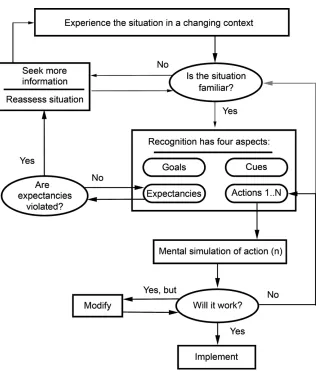
significant experience caring for either pediatric or critically ill patients consistently reported a decision-making process consistent with recognition-primed decision-making (RPDM); that is, they recognized a pattern of illness and acted quickly and intuitively, with little mental rehearsal or option weighing (Fig 1). In contrast, novice clinicians who had little experience in caring for pediatric patients (both at the nursing and physician level) reported less use of RPDM paradigms. Novice clinicians reported more analytical approaches in which they mentally weighed the pros and cons of options and underwent mental rehearsal to a greater extent. Experienced clinicians were noted within simulations to make decisions faster and more authoritatively than those who were self-reported novices in the care of pediatric patients.
DISCUSSION
For ad hoc teams to learn and work together, group members require effective communication and shared understanding.19Collaborative
interview comments andfindings within the present study. The results suggest that in situ simulation may be a method of promoting shared understanding within multicultural teams in LRS.
Culture can be conceptualized as
“shared motives, values, beliefs, identities, and interpretations or meanings of significant events that result from common experiences of members of collectives that are transmitted across generations.”20
The literature clearly documents an existing dichotomy between Western and non-Western cultures in ways of learning and conceptualizing entities such as the team construct and learning within teams.21Our results
suggest that culture and nationality of
origin have an impact on
conceptualization of different team constructs, including hierarchy, leadership/followership models, and role delineation within teams during emergencies in LRS. This conceptualization may be influenced by different cultural interpretation of values, such as the stereotypically Western“individualism”compared with more Eastern“collectivistic” approaches to team dynamics and learning.
There are cultures that value communal learning and others in which learning is an individual enterprise.20In ad hoc teams with
members from different cultures and nations such as those in the present study, this dichotomy can create
barriers to communication and effective patient care. This cultural diversity in communication style and learning must be considered during implementation of structured programs.22However, we observed
that participation in team simulations helped to improve communication and create a shared mental model that reached beyond cultural bounds. As a form of experiential learning, simulation can appeal to diverse types of learners within team constructs. Our results support the idea that simulation can improve several areas of team functionality, including membership, role, context, process, and action taking. In situ simulation in LRS can also provide a means of identifying barriers to patient care resulting from latent threats in the environment. These include identification of faulty or missing equipment, as well as awareness of resource limitations, with a resulting plan to address these limitations.
The idea that simulation can be used to help teams build shared mental models or shared cognition is not a new concept.9However, to our
knowledge, the present study is the first to examine this phenomenon in a qualitative manner within LRS, when teams can be largely ad hoc in nature. The improvement in a shared strategy was a frequently mentioned
“lesson-learned”by key informants. It is likely that this concept of building shared mental models may be one of the most valuable aspects of
simulations that will be conducted within future educational efforts.
Our study results also indicate that experienced clinicians use more intuitive approaches such as RPDM as primary strategies in emergencies. Thisfinding is supported by previous research in naturalistic decision-making, diagnostic reasoning, and cognitive task analysis.16,23–25In LRS,
it may be beneficial to use this type of decision-making paradigm to teach novices how to think and make
FIGURE 1
decisions, particularly when clinicians are faced with tasks in which cognitive load is high (eg, as with pediatric patients experiencing an acute decompensation). The implications for development of educational interventions are numerous, including use of algorithmic models, pattern
recognition and heuristics, structured cognitive aids, and Rapid Cycle Deliberate Practice models.18,25
These pedagogies and modalities should be further investigated by using simulations in future studies within LRS.
Study observations and interviews were based on limited numbers of simulated emergencies and took place over the course of∼2 weeks in each country. Therefore, the main limitation in the study is
generalizability to all populations and cultures. In addition, observations were made during simulated emergencies, and it is impossible to
know if participants would act in the same way in actual emergencies, although several participants commented on the“realism”of simulations. As a qualitative study, there are additional limitations of observer bias based on the observers’ own cultural viewpoints and
resultant conclusions.
CONCLUSIONS
Ad hoc teams in LRS face challenges in caring for patients safely; these challenges include language and cultural barriers, as well as environmental and resource constraints. Therefore, any educational intervention using simulation or introduction of
cognitive aids must take into account cultural norms and the impact of culture on preferred learning and communication styles to be effective, particularly in LRS. A team-based curriculum using simulation as a
pedagogy can: (1) provide systematic educational interventions for teams of clinicians in LRS to identify systems issues and latent threats that can be targeted for educational remediation; (2) promote shared cognitive models and improved teamwork dynamics; and (3) ultimately improve care for pediatric patients. In addition, there may be a role within such curricula for training novice team members to use
recognition-primed or algorithmic decision-making strategies to improve the rapidity and efficiency of decisions in LRS.
ABBREVIATIONS
CPR: cardiopulmonary resuscitation
LRS: limited resource settings NDM: naturalistic decision-making RPDM: recognition primed
decision-making
FINANCIAL DISCLOSURE:Dr Shilkofski has received grant support from the Laerdal Foundation for Acute Medicine, although the grant funding was received after completion of this study and was not used to support or fund any aspect of the study. Dr Hunt has received grant support from the Laerdal Foundation for Acute Medicine and the Hartwell Foundation, but those funds were not related to the content of this study.
FUNDING:No external funding.
POTENTIAL CONFLICT OF INTEREST:The authors have indicated they have no potential conflicts of interest to disclose.
REFERENCES
1. Jones G, Steketee RW, Black RE, Bhutta ZA, Morris SS; Bellagio Child Survival Study Group. How many child deaths can we prevent this year?Lancet. 2003; 362(9377):65–71
2. Nolan T, Angos P, Cunha AJ, et al. Quality of hospital care for seriously ill children in less-developed countries.Lancet. 2001;357(9250):106–110
3. English M, Esamai F, Wasunna A, et al. Assessment of inpatient paediatric care infirst referral level hospitals in 13 districts in Kenya.Lancet. 2004; 363(9425):1948–1953
4. Khan AN, Rubin DH. International pediatric emergency care: establishment of a new specialty in a developing country.Pediatr Emerg Care. 2003;19(3): 181–184
5. Kapadia FN. Code 99—an international perspective.Chest. 1999;115(5):1483
6. Meaney PA, Topjian AA, Chandler HK, et al. Resuscitation training in developing countries: a systematic review.Resuscitation. 2010;81(11): 1462–1472
7. Bishop SL. Evaluating teams in extreme environments: from issues to answers. Aviat Space Environ Med. 2004;75(suppl 7):C14–C21
8. Ralston ME, Day LT, Slusher TM, Musa NL, Doss HS. Global paediatric advanced life support: improving child survival in limited-resource settings.Lancet. 2013; 381(9862):256–265
9. Hunt EA, Shilkofski NA, Stavroudis TA, Nelson KL. Simulation: translation to
improved team performance. Anesthesiol Clin. 2007;25(2):301–319
10. Bergman S, Deckelbaum D, Lett R, et al. Assessing the impact of the trauma team training program in Tanzania.J Trauma. 2008;65(4):879–883
11. Tchorz KM, Thomas N, Jesudassan S, et al. Teaching trauma care in India: an educational pilot study from Bangalore. J Surg Res. 2007;142(2):373–377
12. Husum H, Gilbert M, Wisborg T, Van Heng Y, Murad M. Rural prehospital trauma systems improve trauma outcome in low-income countries: a prospective study from North Iraq and Cambodia. J Trauma. 2003;54(6):1188–1196
advanced trauma life support program in a developing country.J Trauma. 1993; 34(6):890–898, discussion 898–899
14. Deorari AK, Paul VK, Singh M, Vidyasagar D; Medical Colleges Network. Impact of education and training on neonatal resuscitation practices in 14 teaching hospitals in India.Ann Trop Paediatr. 2001;21(1):29–33
15. Chomba E, McClure EM, Wright LL, Carlo WA, Chakraborty H, Harris H. Effect of WHO newborn care training on neonatal mortality by education.Ambul Pediatr. 2008;8(5):300–304
16. Klein G. Naturalistic decision making. Hum Factors. 2008;50(3):456–460
17. Glaser BG, Strauss AL.The Discovery of Grounded Theory: Strategies for Qualitative Research. Chicago, IL: Aldine Publishing Company; 1967
18. Hunt EA, Duval-Arnould JM, Nelson-McMillan KL, et al. Pediatric resident resuscitation skills improve after“rapid cycle deliberate practice”training. Resuscitation. 2014;85(7):945–951
19. Kayes A, Kayes D, Kolb D. Experiential learning in teams.Simul Gaming. 2005; 36(3):330–354
20. Yamazaki Y. Learning styles and typologies of cultural differences: a theoretical and empirical comparison. Int J Intercult Relat. 2005;29(5):521–548
21. Joy S, Kolb D. Are there cultural differences in learning style?Int J Intercult Relat. 2009;33(1):69–85
22. Chung HS, Dieckmann P, Issenberg SB. It is time to consider cultural differences in debriefing.Simul Healthc. 2013;8(3): 166–170
23. Croskerry P. A universal model of diagnostic reasoning.Acad Med. 2009; 84(8):1022–1028
24. Lipshitz R, Klein G, Orasanu J, Salas E. Focus article: taking stock of naturalistic decision making.J Behav Decis Making. 2001;14(5):331–352
DOI: 10.1542/peds.2015-2677 originally published online November 9, 2015;
2015;136;e1569
Pediatrics
Nicole Shilkofski and Elizabeth A. Hunt
Simulation Study
Identification of Barriers to Pediatric Care in Limited-Resource Settings: A
Services
Updated Information &
http://pediatrics.aappublications.org/content/136/6/e1569
including high resolution figures, can be found at:
References
http://pediatrics.aappublications.org/content/136/6/e1569#BIBL
This article cites 24 articles, 0 of which you can access for free at:
Subspecialty Collections
http://www.aappublications.org/cgi/collection/critical_care_sub
Critical Care
dev_sub
http://www.aappublications.org/cgi/collection/teaching_curriculum_
Teaching/Curriculum Development
b
http://www.aappublications.org/cgi/collection/medical_education_su
Medical Education
following collection(s):
This article, along with others on similar topics, appears in the
Permissions & Licensing
http://www.aappublications.org/site/misc/Permissions.xhtml
in its entirety can be found online at:
Information about reproducing this article in parts (figures, tables) or
Reprints
http://www.aappublications.org/site/misc/reprints.xhtml
DOI: 10.1542/peds.2015-2677 originally published online November 9, 2015;
2015;136;e1569
Pediatrics
Nicole Shilkofski and Elizabeth A. Hunt
Simulation Study
Identification of Barriers to Pediatric Care in Limited-Resource Settings: A
http://pediatrics.aappublications.org/content/136/6/e1569
located on the World Wide Web at:
The online version of this article, along with updated information and services, is
http://pediatrics.aappublications.org/content/suppl/2015/11/04/peds.2015-2677.DCSupplemental
Data Supplement at:
by the American Academy of Pediatrics. All rights reserved. Print ISSN: 1073-0397.