Original Research Article
Awareness of diabetes among patients with type 2 diabetes mellitus
attending a rural health and training center
V. Aljin*, R. Umadevi, V. M. Anantha Eashwar
INTRODUCTION
Type 2 diabetes mellitus (T2DM), one of the major non-communicable diseases (NCD) poses a major public health problem throughout the world. About 422 million adult people worldwide have diabetes mellitus that accounts about 8.5% of total world’s population.1
Its prevalence has been rising more rapidly in middle- and low-income countries. Also diabetes is a major cause of blindness, kidney failure, heart attacks, stroke and lower limb amputation.2 In 2015, an estimated 1.6 million
deaths were directly caused by diabetes mellitus. Another 2.2 million deaths were attributable to high blood glucose in 2012. Diabetes caused 1.5 million deaths in 2012 and many of these deaths (43%) occurred under the age of 70.2 World Health Organization (WHO) projects that diabetes will be the seventh leading cause of death in 2030.1 World Health Organization’s South-East Asian Region has seen a recent dramatic increase in the prevalence of DM. An estimated 96 million people have diabetes in this region with 90% of them having T2DM, which is preventable. Most of the T2DM cases remain
ABSTRACT
Background: Diabetes mellitus (DM), a major threat to both developing and developed countries, which can be easily prevented by lifestyle modifications. Because of lack of awareness, the occurrence of diabetes and its complications is showing a steady increase. Empowering the patients with knowledge about diabetic self-care is expected to have better outcome of the disease. Thus this study was planned to assess the awareness and knowledge about diabetes among the patients with type 2 diabetes mellitus attending rural health care center. The objective of the study was to assess the awareness of diabetes among patients with type 2 diabetes mellitus attending a rural health and training centre (RHTC).
Methods: A Cross sectional study was conducted to assess the awareness about diabetes among patients with type 2 diabetes, attending RHTC in Tamil Nadu. The study was conducted in outpatient clinic in RHTC, during the month of November and December 2017 and 258 patients with diabetes who gave written consent were included in the study. Data was collected using a pre-tested structured questionnaire through one-to-one interviews. Data entry and analysis was done using SPSS version 16.
Results: It was found that, 63.1% of the participants had adequate knowledge regarding T2DM and family history of T2DM was one of the important determinant of having adequate knowledge regarding T2DM.
Conclusions: Knowledge about diabetes is fair but still their practice on control of glycemic levels needs to be improved. This shows that there is a necessary to health educate the patients in order to prevent or postpone the complications of diabetes mellitus.
Keywords: Diabetes, Awareness, Complications, Rural health
Department ofCommunity Medicine, Sree Balaji Medical College and Hospital, Chennai, Tamil Nadu, India
Received: 14 August 2018
Revised: 17 September 2018 Accepted: 20 September 2018
*Correspondence:
Dr. V. Aljin,
E-mail: [email protected]
Copyright: © the author(s), publisher and licensee Medip Academy. This is an open-access article distributed under the terms of the Creative Commons Attribution Non-Commercial License, which permits unrestricted non-commercial use, distribution, and reproduction in any medium, provided the original work is properly cited.
undiagnosed; underscoring the need for rapid, low-cost solutions to reach the region’s underserved areas.3
According to International Diabetic Federation, India has 72 million cases of diabetes in 2017.4
The risk of type 2 diabetes is determined by interplay of genetic and metabolic factors. Ethnicity, previous history of gestational diabetes, family history of diabetes combined with older age, overweight, obesity, unhealthy diet, physical inactivity and smoking increases the risk of developing T2DM. Excess body fat, unhealthy diet and sedentary lifestyle are among the strongest risk factors for the development of T2DM both in terms of clearest evidence based and largest relative risk. Overweight and obesity, together with physical inactivity, are estimated to cause a large proportion of the global diabetes burden.5 Several dietary practices are linked to unhealthy body weight and/or type 2 diabetes risks, including high intake of saturated fatty acids, high total fat intake and inadequate consumption of dietary fiber.6 High intake of sugar sweetened beverages, which contain considerable amounts of free sugars, increases the likelihood of being overweight or obese, particularly among children.7 Recent evidence further suggests an association between high consumption of sugar-sweetened beverages and increased risk of type 2 diabetes.6 Active (as distinct from passive) smoking increases the risk of type 2 diabetes, with the highest risk among heavy smokers.8 Risk remains elevated for about 10 years after smoking cessation, falling more quickly for lighter smokers.9 Diabetes and its complications bring about substantial economic loss to people with diabetes and their families and to health systems and national economies through direct medical costs and loss of work and wages. While the major drivers of cost are hospital and outpatient care, a contributing factor is the rise in cost of analogue insulin which are increasingly prescribed despite little evidence that they provide significant advantages over cheaper human insulin.
Considering all these facts, in order to reduce the prevalence of non-communicable diseases, the target set by the WHO in SDG 3 was, “by 2030, reduce by one third premature mortality from non-communicable diseases through prevention and treatment and promote mental health and well-being”.10 One of the reasons for the poor outcome in diabetic individuals is the lack of involvement in the treatment of the disease which in turn occurs due to lack of awareness about the disease. Thus this study was planned to assess the awareness about the diabetes among the patients with diabetes.
Aims and objectives
To assess the awareness of diabetes among patients with type 2 diabetes, attending rural health and training centre (RHTC).
METHODS
A descriptive cross sectional study was conducted to assess the awareness of T2DM and its complications among patients with type 2 diabetes, attending RHTC of Sree Balaji Medical College and Hospital, Sripuram, Chennai, belonging to Alandur block in Kanchipuram district, Tamil Nadu. The study was conducted in the outpatient department (OPD) of RHTC, during the months of November and December 2017. By convenient sampling technique, 258 patients with type 2 diabetes mellitus who attended OPD during the study period were included in the study. Patients with Type 1 diabetes mellitus and gestational diabetes mellitus (GDM) were excluded.
The principal investigator explained the purpose of conducting the study to each participant prior to the commencement of the study. The study was conducted using a questionnaire in the English language, which was translated to Tamil for better understanding of the participants and then their responses were again translated to English. A pre-tested structured questionnaire was used to collect data regarding the socio-demographic details, clinical profile regarding their diabetic status and their awareness regarding T2DM. Data collection was done through one-to-one interviews. Data entry and analysis was done using Statistical Package for Social Sciences (SPSS) version 16 using descriptive and analytical statistics using chi square and odd’s ratios to find out the strength of association between the variables and socio-demographic characteristics.
RESULTS
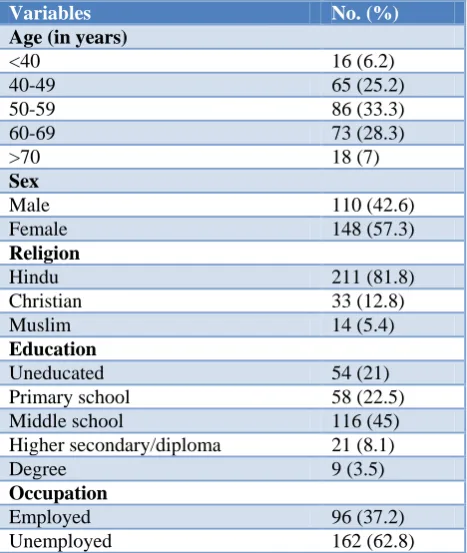
The mean age of study participants was 53 and more than half (57.3%) of them, were female and around 21% were illiterate. The proportion of participants who had diabetes for less than one year, 1-5 years, 5-9 years and more than 10 years were 12.8%, 41.9%, 26.7% and 18.6% respectively. Around, 43.4% of them gave positive family history of T2DM. Among the chronic diseases, majority of the participants (72.5%) had only T2DM (no other chronic illnesses) and 19.8% has both T2DM and Hypertension. Cardiac illness and bronchial asthma were reported among 5% and 2.7% of the participants with DM, respectively. The diabetes related risk factors like tobacco use and alcohol consumption were reported among 11.6% and 15.9% of the study participants respectively. Majority of the participants (95%) were taking oral hypoglycemic drugs and the rest of them were taking both insulin and oral hypoglycemic drugs (Table 1 and 2).
practices like proper foot care. Among the study participants those who were aware of complications like diabetic retinopathy, neuropathy and nephropathy due to T2DM were only 63.2% and only 24% were aware that moderate physical activity can help keep the blood sugar levels under control. It was found that, 69%of the study participants were aware that they need a modification in the dietary pattern after diagnosis of T2DM and only 19.8% of the participants felt that they need to screen regularly for complications due to T2DM like diabetic retinopathy and nephropathy (Table 3).
Table 1: Socio-demographic profile of the participants (n=258).
Variables No. (%)
Age (in years)
<40 16 (6.2)
40-49 65 (25.2)
50-59 86 (33.3)
60-69 73 (28.3)
>70 18 (7)
Sex
Male 110 (42.6)
Female 148 (57.3)
Religion
Hindu 211 (81.8)
Christian 33 (12.8)
Muslim 14 (5.4)
Education
Uneducated 54 (21)
Primary school 58 (22.5) Middle school 116 (45) Higher secondary/diploma 21 (8.1)
Degree 9 (3.5)
Occupation
Employed 96 (37.2)
Unemployed 162 (62.8)
Table 2: Clinical profile and habits of the participants (n=258).
Variables No. (%)
Duration of DM (in years)
<1 33 (12.8)
1-5 108 (41.9)
5-9 69 (26.7)
>10 48 (18.6)
Family history of DM 112 (43.4) Consumption of tobacco in any form 30 (11.6) Alcohol consumption 41 (15.9)
Treated with
Oral hypoglycemic agents (OHAs) 245 (95) OHAs and Insulin 13 (5)
Other chronic illnesses
Hypertension 51 (19.8)
Bronchial asthma 7 (2.7) Cardiac illness 13 (5)
None 187 (72.5)
Table 3: Knowledge regarding T2DM among the study participants.
Variables
Correct responses in no. (%) Are you aware of the risk factors for
developing T2DM 221 (85.7)
Are you aware of the Symptoms of
T2DM 236 (91.5)
Are you aware that taking
medications regularly can help keep the blood sugars under control?
212 (82.2)
Are you aware of self-care practices to
be followed in T2DM? 36 (14)
Are you aware that moderate physical activity can help keep the blood sugars under control?
62 (24)
Are you aware of the complications of
T2DM? 163 (63.2)
Does regular exercise help in control
of T2DM? 220 (85.3)
Do you need to check your blood
sugars regularly? 156 (60.5)
Do you need a modification in the dietary pattern after diagnosis of T2DM?
178 (69)
Do you need to screen regularly for
complications due to T2DM? 51 (19.8)
Figure 1: Knowledge regarding type 2 diabetes mellitus among the study participants.
Among the ten questions which were asked to assess the knowledge and awareness regarding T2DM, those who were able to answer a minimum of 5 questions correctly were regarded as having adequate knowledge regarding T2DM. It was found that, 163 (63.17%) of the study participants had adequate knowledge regarding T2DM (Figure 1).
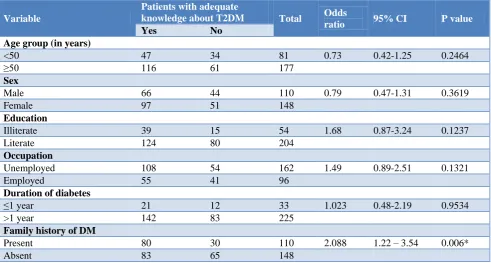
It was found that, those who had a family history of T2DM were found were two times more likely to be well informed and having adequate knowledge regarding T2DM and the association was also found to be statistically significant (p<0.05). Rest of the variables was not found to be associated with knowledge regarding T2DM.
63.17% 36.83%
Table 4: Association between knowledge and other variables.
Variable
Patients with adequate
knowledge about T2DM Total Odds
ratio 95% CI P value
Yes No
Age group (in years)
<50 47 34 81 0.73 0.42-1.25 0.2464
≥50 116 61 177
Sex
Male 66 44 110 0.79 0.47-1.31 0.3619
Female 97 51 148
Education
Illiterate 39 15 54 1.68 0.87-3.24 0.1237
Literate 124 80 204
Occupation
Unemployed 108 54 162 1.49 0.89-2.51 0.1321
Employed 55 41 96
Duration of diabetes
≤1 year 21 12 33 1.023 0.48-2.19 0.9534
>1 year 142 83 225
Family history of DM
Present 80 30 110 2.088 1.22 – 3.54 0.006*
Absent 83 65 148
DISCUSSION
This study was undertaken among type 2 diabetes mellitus patients, to assess their awareness about diabetes. Type 2 diabetes is much more common type of diabetes than type 1 diabetes. In developed countries, most people with diabetes are above the age of retirement, whereas in developing countries those most frequently affected are aged between 35 and 64.
In this study, around 21% were illiterates and majorities (62.8%) were unemployed. This could be due to the reason that this study was conducted in the rural area with predominant female participants, who were house wives. The diabetes related risk factors were common among diabetic patients; 11.6% reported to have been using tobacco, 15.9% consumed alcohol and 76% reported lack of moderate physical exercise. Whereas the study which was conducted by Anju et al in Nepal reported similar proportion of smokers (9.8%) and alcohol users (16%).11 In this study, adequate knowledge regarding T2DM was found to be present in 63.17% of the study participants. Similar results were obtained in studies conducted by Konduru et al, Muninarayana et al and Hussain et al where nearly half of the study participants had medium to good knowledge regarding T2DM.12-14 In this study, around 85% of the study participants were aware that regular exercise can play a role in keeping T2DM under control. Around 63.3% of the study participants were aware of the complications due to T2DM like retinopathy and neuropathy. Similar results were obtained in a study done Shah et al.15
In this study about 43.4% had positive family history of diabetes and was found to be associated with knowledge regarding T2DM. Also there are several studies which proved that level of awareness depends on socioeconomic gradient, culture and ethnic variation.16-18
The results of the present study were similar to the findings of study conducted on knowledge on risk factors of diabetes in a different population.19 Also similar results were reported by another study done in Thiruvallur district in Tamil Nadu.20
Strengths and limitations
Strength of this study is that it was conducted in rural area of Kancheepuram district in Tamil Nadu, where not many studies were done to assess the knowledge and perception of diabetes and its complications. There were some limitations in this study that should be noted. This study was a small study conducted with the participants who attended the outpatient department in one rural health care center. Multi centric studies are much better in finding the exact awareness about diabetes. Therefore the reports here may not be representative of the entire diabetic patients in rural area, as there may be diabetics who do not visit the hospital.
CONCLUSION
patients aware about their health illnesses and eventually change their attitude towards the diabetes, which in turn results in good lifestyle practices by the patients with diabetes, resulting in reduction of burden that occurs due to its complications.
Recommendations
Efforts to improve capacity for diagnosis and treatment of diabetes should occur in the context of integrated NCD management to yield better outcomes. At a minimum, diabetes and cardiovascular disease management can be combined. Integrated management of diabetes and tuberculosis and/or HIV/AIDS can be considered where there is high prevalence of these diseases.
ACKNOWLEDGEMENTS
I would like to thank all, who has guided me by extending their knowledge and experience right from the inception to the completion of the work. Also, I would like to acknowledge the Medical Officer and all the staff of the RHTC, for their support during the data collection period. Last but not least I am thankful to my study participants, without whom, this study would not have been possible.
Funding: No funding sources Conflict of interest: None declared
Ethical approval: The study was approved by the Institutional Ethics Committee
REFERENCES
1. Mathers CD, Loncar D. Projections of global mortality and burden of disease from 2002 to 2030. PLoS Med. 2006;3(11):442.
2. World Health Organization. Global Report on Diabetes. Isbn. 2016;978:88. Available at: http://www.who.int/about/licensing/%5Cnhttp://app s.who.int/iris/bitstream/10665/204871/1/978924156 5257_eng.pdf. Accessed on 3 June 2018.
3. World Health Organization. Addressing Asia’s fast growing diabetes epidemic. Available at: http://www.who.int/bulletin/volumes/95/8/17-020817/en/. Accessed on 3 June 2018.
4. International Diabetic Federation report on burden of diabetes in South East Asia (SEA). Available at:
https://www.idf.org/our-network/regions-members/south-east-asia/members/94-india.html. Accessed on 3 June 2018.
5. GBD 2013 Risk Factors Collaborators. Global, regional, and national comparative risk assessment of 79 behavioural, environmental and occupational, and metabolic risks or clusters of risks in 188 countries, 1990–2013: a systematic analysis for the Global Burden of Disease Study 2013. Lancet. 2015;386(10010):2287–323.
6. Ley SH, Hamdy, O, Mohan V, Hu FB. Prevention and management of type 2 diabetes: dietary
components and nutritional strategies. Lancet. 2014;383(9933):1999–2007.
7. WHO Guideline: sugars intake in adults and children. Geneva: World Health Organization; 2015. 8. Willi C, Bodenmann P, Ghali WA, Faris PD, Cornuz J. Active smoking and the risk of type 2 diabetes: a systematic review and meta-analysis. J Am Med Assoc. 2007;298(22):2654–64.
9. Luo J, Rossouw J, Tong E, Giovino GA, Lee CC, Chen C, et al. Smoking and diabetes: does the increased risk ever go away? Am J Epidemiol. 2013;178(6):937–45.
10. Health in 2015: from MDGs, Millennium Development Goals to SDGs, Sustainable Development Goals. World Health Organization 2015.
11. Gautam A, Bhatta DN, Aryal UR. Diabetes related health knowledge, attitude and practice among diabetic patients in Nepal. BMC Endocrine Disorders. 2015;15:25.
12. Konduru SS, Ranjan A, Karthik SM, Shaik S, Vakkapatla LS. Assessment of diabetes related knowledge, attitude and practice among diabetics and non-diabetics using self-prepared questionnaire for awareness of health promotion. Indian J Pharm Pract. 2017;10(1):32-8.
13. Muninarayana C, Balachandra G, Hiremath SG, Iyengar K, Anil NS. Prevalence and awareness regarding diabetes mellitus in rural Tamaka, Kolar. Int J Diab Dev Ctries. 2010;30(1):18-21.
14. Hussain R, Rajesh B, Giridhar A, Gopalakrishnan M, Sadasivan S, James J, et al. Knowledge and awareness about diabetes mellitus and diabetic retinopathy in suburban population of a south Indian state and its practice among the patients with diabetes mellitus: a population-based study. Indian J Ophthalmol. 2016;64(4):272-6.
15. Shah VN, Kamdar PK, Shah N. Assessing the knowledge, attitudes and practice of type 2 diabetes among patients of Saurashtra region, Gujarat. Int J Diab Dev Ctries. 2009;29(3):118.
16. Rani PK, Raman R, Subramani S, Perumal G, Kumaramanickavel G, Sharma T: Knowledge of diabetes and diabetic retinopathy among rural populations in India, and the influence of knowledge of diabetic retinopathy on attitude and practice. Rural Remote Health. 2008;8:838.
17. Mario S, Diez RAV, Boykin S, Sarpong D, Gebreab Samson Y, Wyatt Sharon B, et al. The socioeconomic gradient of diabetes prevalence, awareness, treatment, and control among African Americans in the Jackson heart study. Ann Epidemiol. 2011;21:892–8.
18. Wee HL, Ho HK, Li SC. Public awareness of diabetes mellitus in Singapore. Singapore Med J. 2002;43(3):128–34.
20. Srisanthanakrishnan V, Shah PB. Knowledge and perception of diabetes among patients with type 2 diabetes mellitus attending rural health care centre, Tamil Nadu, India. Int J Community Med Public Health. 2016;3:2538-42.