Original Research Article
An epidemiological study of asthma and its risk factors in school going
children in Bhavnagar city, Gujarat, India
Mohnish N. Tundia, Dhara V. Thakrar*
INTRODUCTION
Asthma is a common disease worldwide with significant ethnic and regional variations. An increasing morbidity and mortality, as well as health care burden from asthma has been recognized lately. There has been a change in the epidemiology and clinical spectrum of asthma with an apparent increase in the overall prevalence. Asthma is a chronic inflammatory disorder causing increase in airway hyper-responsiveness.1 The prevalence of asthma worldwide is around 200 million with a mortality of around 0.2 million per year. Asthma is the most common
chronic disease among children causing substantial morbidity. Increases in the rates of hospital admission and primary care contacts for asthma in childhood have led to concern that the prevalence or severity of wheezing illness may be increasing in children. Asthma is not just a public health problem for high income countries: it occurs in all countries regardless of level of development. Asthma was the 25th leading cause of disability-adjusted life years (DALYs) lost worldwide in 2001.1-3
In India, rough estimates indicate a prevalence between 10% to 15% in 5 to 11 year old children. An estimated 57,000 deaths were attributed to Asthma in 2004. There
ABSTRACT
Background: Asthma is a common disease worldwide with significant ethnic and regional variations. This study will
provide evidence about the prevalence of asthma and will highlight level of problem in community. The objective of the study was to estimate prevalence of asthma and determine the presence of environmental risk factors among children with asthma.
Methods: This study was conducted in school-going children of standard 5 to 8 in Bhavnagar city in 2015. Sample
size was 1428. All schools of Bhavnagar city were listed and required number of schools were selected randomly and approached for consent. Study forms were filled up by personal interview and physical examination followed by house to house visits. Data entry and analysis were done using software Epi info 7. Chi square test was calculated. Multiple logistic regression was carried out by backward step-wise Likelihood Ratio (LR) method. Adjusted OR for significant variable was then calculated.
Results: Total prevalence of asthma was 9% (129/1428). Out of these, 61.18% were female and 38.82% were male
children. It was found 36.43% in age group of 11 years and 47.3% in children of lower socio economic class. The adjusted odds ratio for male gender was 0.631 and for smoking were 2.353.
Conclusions: Female children are 1.58 times more likely to develop asthma than male children. Children whose family members smoke are 2.35 times more likely to develop asthma.
Keywords: Asthma, Prevalence, Gender, Passive smoking, Multiple logistic regression, Adjustedodds ratio
Department ofCommunity Medicine, American International Institute of Medical Sciences, Udaipur, Rajasthan, India
Received: 24 January 2018
Accepted: 06 March 2018
*Correspondence:
Dr. Dhara V. Thakrar,
E-mail: [email protected]
Copyright: © the author(s), publisher and licensee Medip Academy. This is an open-access article distributed under
the terms of the Creative Commons Attribution Non-Commercial License, which permits unrestricted non-commercial use, distribution, and reproduction in any medium, provided the original work is properly cited.
has been a constant increase in asthma prevalence worldwide in the last two decades, and the same is being observed in India. Asthma creates a substantial burden on individuals and families as it is more often under-diagnosed and under- treated. An estimated 1.9 DALYs are lost every year due to asthma per children under 15 years of age in India.4,5 There were only few data on asthma prevalence from developing countries. Then after the International Study of Asthma and Allergies in Childhood (ISAAC), has provided valuable data on the prevalence of the symptoms of childhood asthma, rhinoconjunctivitis and eczema for international comparison from countries with different socio-economic backgrounds.6
This study will provide evidence about the prevalence of asthma which will help in further etiological research and to obtain measures for assessment of future trends in prevalence. Looking at current scenario and increase in number of asthmatic conditions in children with lack of data at state level this study will highlight level of problem in community and thus will help health planner and policy makers to channelize resources to address this problem at community level. The prevalence rate of asthma in this study will help to obtain baseline measures for assessment of future trends in prevalence and severity of childhood asthma.
Objectives
To estimate prevalence of asthma among study subjects.
To determine the presence of environmental risk factors among children with asthma.
METHODS
The present study was carried out in Bhavnagar city, Gujarat. Cross sectional study was conducted in Schools of urban area of Bhavnagar Municipal Corporation (BMC). Study duration was from November 2014 to August 2015. As of 25% prevalence was found from various studies, it was taken 25 and calculated sample size from the formula 4PQ/L2 was 1260 including 5% non response rate. To overcome recall bias and sampling error, final sample size of 1428 was taken.
Study was submitted for ethical and IRB approval to Institutional Review Board, Govt. Medical College, Bhavnagar. Out of total 17 wards of Bhavnagar, 6 were selected by Multi Stage Sampling Method. Personal interviews were done with all the subjects defined under study protocol. All schools of Bhavnagar city were listed and required number of schools was selected randomly. Out of the total schools selected from six wards, 12 schools were running under BMC and two schools were private. Selected schools were approached for consent to conduct this study in their premises. After consent from school authorities school children were approached for parent’s written consent. After obtaining it, study form was filled up by personal interview and physical
examination. Whenever necessary, parents were communicated for further clarification and getting right information. The school going children in this study were not clinically assessed for asthma. In this study asthma prevalence was based on self-reports of the parents of children, so there might be chances of malreporting of asthma status of their children. This study was carried out by interviewing the respondents, so there may be chances of interviewer bias and respondent’s bias. These might be the limitations of current study. Data entry and analysis were done using software Epi info 7. Chi square test was calculated.
Multiple logistic regression was carried out by backward step-wise likelihood ratio (LR) method.
Testing for multi-colinearity for the variables entered in step 1 of multiple logistic regression
Multi-colinearity diagnostic checking through tolerance and variance inflation factor (VIF) has been done before estimating the coefficient and it was observed that none of these variables had multi-colinearity problem. Multi-colinearity between the variables entered at Step 1 of MLR was checked by collinearity diagnostics statistics. There are two statistics under this, namely, tolerance and variance inflation factor (VIF). Table 3 shows the values of these statistics.
Considering asthma in child as the dependent variable and following variables as the independent variables (predictors predicting childhood asthma) in Step 1: age (in years), gender (male or female), total income of family, family history of asthma (present or not), smoking in family members (yes or no), kitchen type (traditional or modern), kitchen place (in living room or separate), window in kitchen (present or not), cross ventilation in kitchen (present or not), pets in house (yes or no), socio-economic class (lower or upper). After adjusting for confounders, the model stopped at Step 10.
The variables were removed from the model as follows:
Step 2: total income was removed; Step 3: age was removed;
Step 4: kitchen type (traditional or modern) was removed; Step 5: pets in house (yes or no) was removed;
Step 6: socio-economic class (lower or upper) was removed;
Step 7: family history of asthma (present or not) was removed;
Step 8: cross ventilation in kitchen (present or not) was removed;
Step 9: window in kitchen (present or not) was removed; Step 10: kitchen place (in living room or separate) was removed.
At step 10, only two variables were found to significant independent predictors of childhood asthma: gender (male or female) and smoking in family members (yes or no).
The adjusted ORs of these variables are given in Table 4.
RESULTS
Asthma is a disease with wide variation in its prevalence. Various studies have been carried out to measure its prevalence.
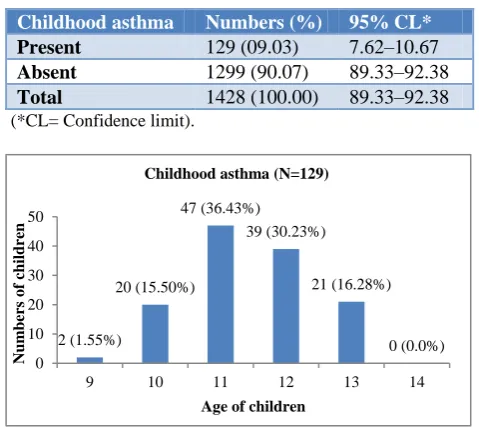
Table 1: Prevalence of asthma among study subjects.
Childhood asthma Numbers (%) 95% CL*
Present 129 (09.03) 7.62–10.67
Absent 1299 (90.07) 89.33–92.38
Total 1428 (100.00) 89.33–92.38
(*CL= Confidence limit).
Figure 1: Distribution of childhood asthma according to age (year).
Prevalence of asthma in school going children was 9.03%. Figure 1 shows age wise distribution of asthma in children. Maximum prevalence was observed in children of age of 11 years and that was 36.43%, followed by 1.55%, 15.50%, 16.28% and 30.23% in age groups of 09, 10, 13-14 and 12 years respectively (Figure 1).
Figure 2: Distribution of childhood asthma according to sex.
Prevalence of asthma was observed higher in female children (61.18%) as compared to male children (38.82%) (Figure 2). Most of the children in study were from middle or lower socio-economical class. Prevalence of asthma was also found higher in this class. It was found that 47.29% of students having asthma were from class-4 according to socio-economical classification. Whereas, the prevalence was 2.33%, 9.30% and 41.09% in class-2, 3 and 5 respectively (Figure 3).
Table 2: Distribution of childhood asthma related symptoms.
Sr.
No. Symptoms of asthma
Frequency (%) (n=1428)
1 Wheezing in past 129 (9.03)
2
Wheezing in last 12 months 23 (1.61) a)1 to 3 attacks of wheezing 19 (1.33) b)4 to 12 attacks of wheezing 03(0.21) c)> 12 attacks of wheezing 01(0.07)
3 Cough at night 21 (1.47)
4 Wheezing after/during exercise 17 (1.19)
5 Speech limitation 04 (0.28)
6
sleep disturbance 03 (0.21) a)One night affected 02 (0.14) b)More than One night affected 01 (0.07)
Table 3: Tolerance and VIF values for variables entered in Step 1 (n=1428).
Variable Tolerance
Variance inflation factor (VIF)
Age 0.967 1.034
Sex 0.977 1.024
Total income 0.581 1.721
Family asthma 0.964 1.037
Smoking 0.904 1.106
Kitchen type 0.156 6.39
Kitchen place 0.151 6.625
Window 0.239 4.18
Cross ventilation 0.294 3.405
Pets 0.983 1.017
Socioeconomic class 0.617 1.62
2 (1.55%)
20 (15.50%) 47 (36.43%)
39 (30.23%)
21 (16.28%)
0 (0.0%) 0
10 20 30 40 50
9 10 11 12 13 14
Num
bers
o
f
children
Age of children Childhood asthma (N=129)
50 (38.82%)
79 (61.18%)
0 10 20 30 40 50 60 70 80 90
Male Female
Num
bers
o
f
children
Sex of Children Frequency of Asthma (N=129)
Frequency of Asthma
0 (0.0%) 3 (2.33%) 12 (9.30%)
61 (47.29%) 53 (41.09%)
Childhood asthma (N=129)
Class-1
Class-2
Class-3
Class-4
Ever experience of wheezing or whistling in past was found in almost all children who gave positive history of asthma. Prevalence of wheezing during anytime in past was 9%. Frequency of other symptoms like wheezing in last 12 month, cough at night, wheezing during or after exercise, speech disturbance, sleep disturbance were found 1.61%, 1.47%, 1.19%, 0.28%, 0.21% respectively. Children who have problem of wheezing during last 12 months were further classified in three groups according to the number of attacks of asthma in last 12 months. Out of 23 children who experience wheezing in last 12 months, 19 children had 1 to 3 attacks of wheezing in last 12 months. Three children came in the group with 4 to 12 attacks of wheezing, whereas only one child had been presented with more than 12 attacks of wheezing. Sleep disturbance was further divided on the basis of how often, on an average, has their sleep been disturbed due to wheezing weekly. There were two children who had complained of disturbed sleep due to wheezing twice a week and one child with weekly disturbance of sleep. Four children with limitation of speech were not able to
speak whole sentence in one breath or they had to stop to take breath after speaking two or three words at a time (Table 2).
Tolerance value of <0.1 almost certainly indicates a serious collinearity problem. Also, VIF value of > 10 is cause for concern of a collinearity problem. But here, the value of VIF and tolerance suggest that there was no multi-colinearity between the variables entered at Step 1 of MLR. It shows that each of the variable were independent of each other and were not influencing each other towards the outcome variable (Table 3).
The adjusted odds ratio of 0.631 for male gender suggests that female children are 1.58 (inverse of 0.631) times more likely to develop asthma than male children. Those children’s whose family members smoke are 2.35 times more likely to develop asthma in childhood than those children whose family members do not smoke (Table 4).
Table 4: Significant variables of study with adjusted OR.
Variables Beta coefficients Wald Adjusted OR# 95% CI* P value
Gender (male) -0.46 5.857 0.631 0.435-0.916 0.016
Smoking in family members
present 0.856 16.515 2.353 1.557-3.555 <0.001
Constant -2.287 301.608 0.102 - <0.001
(*CI=Confidence Interval, #Odds Ratio)
DISCUSSION
Asthma is an important public health problem in today’s ever developing society. Asthma in children not only resulted in death but also affect their study by school abstinence due to breathlessness, which will become burden for family and the society as well. India is a south Asian developing country, here poverty and unemployment push the people towards the urban area, is undergoing demographic, epidemiological and economical transition, which has changed the health scenario in significant way. This transition has resulted in problems in non-communicable diseases including asthma to the forefront of the health care delivery system.
The present study shows 9% prevalence of asthma in school going children of 5 to 8 standard in Bhavnagar city in 2015, which is consistent with other studies carried out at different time and places. Same prevalence was observed in study from Uttar Pradesh. Lower prevalence than our study was observed in Sharma et al and Prasad et al.7,8 Higher prevalence was observed in study from Manipal.9
In this study the prevalence of asthma was more in children between the age-group of 11-12 years (66.66%) as compare to children of age-group between 9-10 years (17.05%) which was reliable with the findings of study carried out by Ganesh et al in Puducherry, who found higher prevalence (6.5%) of asthma in 12-13 years of
age-group.10 Study over school going children in Jaipur, found prevalence of asthma 8.11%, 7.65% and 7.19% in age-group of 5-8, 9-11 and 12-15 years respectively.11 Cheraghi et al study in Pune found that prevalence was 7% in 6-7 years of age and 6.3% in 10-13 years of age.12
Most of the children in current study were from middle or lower socioeconomical class. Prevalence of asthma was also found higher in this class. Observed difference found no statistical association between socioeconomical class of family and asthma causation. The result of this study is steady with Al–Dawood et al. who also did not found significant association between socioeconomical class and development of asthma in children.13 Jain et al in their study found some contentious findings showing higher prevalence in children from high socio economical class as compared to the children from lower class but it was not significant statistically.9
disturbance and sleep disturbance. Sharma et al found higher prevalence of recurrent cough, sleep disturbance, wheezing during playing and dry cough at night.7 Chakravarthy et al also have the similar type of pattern for asthmatic symptoms showing higher prevalence for speech disturbance, wheezing during playing and dry cough at night.15
In current study, out of 23 children who experience wheezing in last 12 months, 19 children had 1 to 3 attacks of wheezing in last 12 months, 3 children had 4 to 12 attacks of wheezing, whereas only 1 child had been presented with more than 12 attacks of wheezing. Stout J et al in their comparative study detected more than four attacks of wheezing in 3.4% for children of Washington and more than four attacks of wheezing in 3.0% for children of Alaska.16
In current study, female children are 1.58 times more likely to develop asthma than male children. Those children’s whose family members smoke are 2.35 times more likely to develop asthma in childhood than those children whose family members do not smoke. A study was conducted by Ganesh et al found significant association in case of family history of smoking.10 Cheraghi et al in their study in Pune in 2008-2009 found that the prevalence of asthma in children was associated significantly with presence of smoker at home.12 Al– Dawood et al has the similar finding like my study who observed significant association between smoking by any of family member and chances of occurrence of asthma (61%).13 Pokharel et al found significant association with passive smoking (0.004). There was no association with family history of asthma (0.17).17
CONCLUSION
Present study concludes that the prevalence of asthma was more in Girls, in age group of 11-12 years and children from lower socio economical class. There was significant association found between smoking by family member and asthma in children. Asthma can be prevented by lifestyle modification. By avoiding contact with the factors responsible for occurrence of asthma. Keep mouth covered where somebody is smoking around.
ACKNOWLEDGEMENTS
We are thankful to school management to give permission to carry out study in their premises. We are also thankful to children and their parents to take participation in this study.
Funding: No funding sources Conflict of interest: None declared
Ethical approval: The study was approved by the Institutional Ethics Committee of Govt. Medical College, Bhavnagar
REFERENCES
1. Asthma guidelines.pdf. Available at: http://www.indiachest.org/pdf_files/Asthma%20gui delines.pdf. Accessed on 31 July 2015.
2. Available at: http://sphinxsai.com/vol3.no2/pharm/ pharmpdf/PT=49(934-937)AJ11.pdf. Accessed on 1 August 2015.
3. Masoli M, Fabian D, Holt S, Beasley R, Global Initiative for Asthma (GINA) Program. The global burden of asthma: executive summary of the GINA Dissemination Committee Report. Allergy. 2004;59(5):469–78.
4. WHO. Bronchial asthma. WHO. Available at: http://www.who.int/mediacentre/factsheets/fs206/en / Accessed on 13 September 2015.
5. George CE, Chopra H, Garg SK, Bano T, Jain S, Kumar A. Early childhood determinants of bronchial asthma: a cross-sectional study from western Uttar Pradesh. Int J Contemp Pediatr. 2014;1:160-3.
6. Lai CKW, Beasley R, Crane J, Foliaki S, Shah J, Weiland S, et al. Global variation in the prevalence and severity of asthma symptoms: phase three of the International Study of Asthma and Allergies in Childhood (ISAAC). Thorax. 2009;64(6):476–83. 7. Sharma CM. Prevalence of asthma in school
children of rural areas of Kanpur, Uttar Pradesh. JEMDS. 2013;29(2):5298-01.
8. Iact07i1p15.pdf. Available at: http://medind.nic.in/ iac/t07/i1/iact07i1p15.pdf Accessed on 26 August 2015.
9. Jain A. Prevalence of Bronchial Asthma in Rural Indian Children: A Cross Sectional Study from South India. Indian J Pediatr. 2010;77(1):31–5. 10. Kumar GS, Roy G, Subitha L, Sahu SK. Prevalence
of bronchial asthma and its associated factors among school children in urban Puducherry, India. J Nat Sci Biol Med. 2014;5(1):59–62.
11. Prevalence of Asthma in Urban School Children in Jaipur, Rajasthan. Available at: http://www. indianpediatrics.net/oct2012/oct-835-836.htm. Accessed on 13 April 2014.
12. Cheraghi M, Dadgarinejad A, Salvi S, Cheraghi M, Dadgarinejad A, Salvi S. A Cross-Sectional Study to Find Prevalence and Risk Factors for Childhood Asthma. 2012;2012:361456.
13. Al-Dawood KM. Schoolboys with bronchial asthma in Al-Khobar City, Saudi Arabia: are they at increased risk of school absenteeism? J Asthma Off J Assoc Care Asthma. 2002;39(5):413–20.
14. Moncayo AL, Vaca M, Oviedo G, Erazo S, Quinzo I, Fiaccone RL, et al. Risk factors for atopic and non-atopic asthma in a rural area of Ecuador. Thorax. 2010;65(5):409–16.
15. Shibi Chakravarthy RBS. Prevalence of bronchial asthma in urban and rural children in Tamil Nadu, India. Natl Med J India. 2002;15(5):260–3.
prevalence between samples of American Indian and Alaska Native children. Public Health Rep Wash DC 1974. 2001;116(1):51–7.
17. Pokharel PK, Kabra SK, Kapoor SK, Pandey RM. Risk factors associated with bronchial asthma in school going children of rural Haryana. Indian J Pediatr. 2001;68(2):103–6.
Cite this article as: Tundia MN, Thakrar DV.An