ISSN: 2395-3519
www.ijatca.com 6
International Journal of Advanced Trends in
Computer Applications
www.ijatca.com
Event-Driven Node Localization by IR fingerprint
in Wireless Sensor Networks
1
Gurpreet Kaur, 2Sangeet Pal Kaur 1,2
Deptt. Of ECE, Punjabi University Patiala, Punjab, India
1
[email protected], 2[email protected]
Abstract:
Sensor node localization is one of the ultimate challenging obstacles in the wireless sensor network field. Although countless admirable works have been done for the sensor node positioning concern, it is stock-still an open problem. Wireless sensor networks are enormously being used in different habitat to perform diversified auditoring responsibility such as search, rescue, disaster relief, target tracking and a number of tasks in crafty environments. Countless applications in wireless sensor networks desire sensor nodes to obtain their outright geographical positions. This paper properly describes, compositions, implements, and evaluates a novel localization scheme called Spotlight. The scheme uses spatiotemporal worth of well-controlled incident in the network; light in this canister, to obtain region of sensor nodes. Achievement of the system is figure out through deployments of Mica2 and XSM motes in a rustic environment, where 20 cm localization error is achieved. The simulations pageants that our proposed localization algorithm has improve performance. Here, event DRIVEN node localization by IR fingerprint is used in wireless sensor network. For the implementation of this proposed work we use the Communication Tool within the MATLAB Software..
I. INTRODUCTION
Many localization algorithms have been recommended for wireless sensor network. They focus on localization for static sensor network, but not for mobile one. With the development of sensor and network technology, a wireless sensor network with mobile sensor nodes becomes suitable. A wireless sensor network (WSN) consists of sensor nodes that may shift often. Conventional localization algorithms for static sensor networks are not suitable to WSN. WSN applications need new localization algorithms. This paper survey various approaches and techniques used in wireless sensor networks and correlate the results of individual algorithms. A wireless sensor network (WSN) dwell of spatially distributed autonomous sensors to auditor physical or environmental circumstances, such as temperature, sound, pressure, etc. and to cooperatively pass their testimony over the network to a preeminent location.
Localization for mobile wireless sensor networks has not paid as enough scrutiny as that for static sensor networks. Utmost of location algorithms for static WSNs are inefficient and ineffective for mobile sensor networks. The initial idea to pinpoint mobile sensor nodes is using a Global Positioning System (GPS) on each one mobile sensor node. But seeing the cost and
power utilization, the GPS solution is not acceptable in too many applications. Wireless Sensor Network (WSN) is a turn up technology that received enough attention from research community in the new recent years. It contributes the possibility to auditor divergent kind of environment by sensing physical anomaly. However the utilization of energy by WSN mechanism is considered as one of significant issues that need to be aware due to the batteries lifetime. In this context, many researchers have fixated on mechanisms of reducing energy utilization of WSN nodes. Mobile sensor networks can be restricted into one, two, or three layer network architectures.
Fingerprinting:
ISSN: 2395-3519
www.ijatca.com 7 Wireless Sensor Networks (WSNs):
Wireless sensor networks (WSNs) can quietly be defined as the wireless sensor network (WSN) in which the sensor nodes are like as mobile. WSN is a shorter, emerging field of research in disparity to their well established predecessor. WSNs are more versatile than the static sensor networks as they can be deployed in any type of scenario and cope with in hasty topology changes. However, abounding of their applications is complementary, such as environment auditory or surveillance. More often than the nodes are consist of a radio transceiver and a microcontroller powered by a battery. As well as a few kind of sensor for detecting light, heat, humidity, temperature, etc. Since there is no immovable topology in these networks, one of the terrible challenges is routing testimony from its source to the destination. Ordinarily these routing protocols draw influence from two fields; WSNs and mobile ad hoc networks (MANETs). WSN routing protocols hand over the required functionality but cannot stem the high frequency of topology changes. Whereas, MANET routing protocols can contract with flexibility in the network but they are designed for two way communication that in sensor networks is often not needed. Protocols designed precisely for WSNs are virtually always multi-hop and consistently adaptations of existent protocols. For example, Angle-based Dynamic Source Routing (ADSR) is a transformation of the wireless mesh network protocol Dynamic Source Routing (DSR) for MWSNs. ADSR uses location intelligence to work out the angle between the node determining to send, potential forwarding nodes and the sink.
II. LITERATURE REVIEW
Wireless Sensor Network (WSN) is advanced developing technology that received much attention from research community in the recent years. It provides the possibility to auditor different kind of environment by sensing physical anomaly. However the utilization of energy by WSN mechanism is considered as one of significant issues that need to be aware due to the batteries lifetime. In this context, many researchers have fixated on mechanisms of reducing energy utilization of WSN nodes.
Cheung.k et al. (April 2004) planned Localization of mobile phones of noticeable interest in wireless technology. In this symmetry, two algorithms were matured for exact mobile position applying the time-of-arrival measurements of the signal from the mobile station collected at three or extra base stations. The initial algorithm is an informal least squares (LS) estimator that has execution directness. The other algorithm resolves a no convex constrained they sighted
least squares (CWLS) issue for developing
approximation efficiency. It is defined that the CWLS estimator yields improved performance as that of LS way and gains both the Crame´r-Rao lower bound and the optimal circular error possibility at adequately high signal-to-noise ratio circumstances.
S. Kim et al. (Oct 2007) planned that the communication strength and location of the basic user in cognitive radio (CR) is really valued info because info of the basic user resolving the spatial resource. This opportunistic spatial resource is feasible for alternate users to exploit it. To estimate the location of the basic user, they effort to utilize current positioning or localization strategies related to ranging methods but those need the basic user's communication strength. Since maximum basic users in CR are legacy schemes, there are no beacon protocols to disclose valuable info like communication strength. Few of the current localization strategies don’t have need of communication strength, but they don’t work in Outer case that the basic user is out of convex hull of alternate user's relates. They planned strained optimization way to approximate communication strength and location without preceding info of communication strength. As a result, simulations on two leading cases of network formation. It is verified that the planned strained optimization way raise the performance in mean squared error (MSE) among the true and the approximated values of communication strength and that location.
B. Zhang et al. (June 2008) shows an energy effective localization algorithmic rule for wireless sensor networks utilizing a mobile anchor node. It is based on the area dimension with additional hardware. The mobile node is set up with a GPS receiver, RF (radio frequency) and ultrasonic transmitter. Every fixed sensor node is set up with a RF and ultrasonic receiver. The mobile node repeatedly telecasts its position info, and fixed sensor nodes take the present location of the mobile node as a basic anchor point. The position of a sensor node is estimated by calculating the area to the basic anchor point using TDOA (time variation of arriving) technique.
ISSN: 2395-3519
www.ijatca.com 8
the info position or be utilized to compute the initial non convex highest similar algorithmic rule.
B. Zhang et al. ( June 2009) analyzes directional antenna that present many profits for wireless sensor networks like raised dimensional repeated ratio and decreased energy usage. After inspecting of directional antenna on wireless sensor networks, sensor position can be approximated employing geometric features on a 2-D plane. The mobile anchor node shifts over the sensor space to telecast beacons. Fixed sensor nodes utilize the info to examine their positions.
III. METHODOLOGY
The methodology is defined as the steps followed for performing the proposed research work. Following steps explain the methodology, algorithms techniques that are used to implement this work.
Phase 1: Firstly we develop the code for the GUI and after that we develop a code for the creation of the mobile sensor nodes and anchor nodes in the editor window of the MATLAB.
Phase 2: After that we develop a code for the localization for sensor nodes.
Phase 3: Develop a code for the providing the position information. After that we develop code for Mica2 and XSM motes.
Phase 4: After that we do code for the
EVENT-DRIVEN LOCALIZATION Algorithm based on IR
fingerprint.
Phase 5: Lastly we develop the code for the calculation
of the performances and the comparison of
implementation.
IV. EXPERIMENTAL RESULTS
Implementation is finished on MATLAB. Experimental results of intermediate steps show the efficiency of the projected approach. Inside the subsequent figures, results of all the intermediate steps of the projected formula highlighted.
In this section of paper, different parameters are discussed and predicted that are farther used for the comparing the proposed approach in this paper with the approaches formerly used.
A. Performance Measures of WSN Localization: These are used to reconciliation the localization in
Matlab simulator. Communication system toolbox of Maltab is utilized for implementation operation. Accordingly the computation of the performance and determination is executed on the basis of several criterions such as RMSE, average localization error, and energy effectiveness for comparison with earlier algorithms.
6.1 Average localization error: This affirms the accuracy of location which is extracted. It construe that higher the accuracy, lower will be the average localization error.
6.2 RMSE (Root mean square error): This parameter is a most commonly used for measuring the differences among values anticipated by an estimator. The values literally observed and if less error is shown than it interpret good accuracy and certainty. Root mean square error can be estimated by using the following equation;
RMSE = sqrt (1/MNΣ Σ (R(m, n)F(m, n)) Nn=1 𝑀
𝑚=1 y
6.3 Energy Efficiency: The efficiency here delineated the life span of network and nodes and if the inadequacy and reduction of energy efficiency decelerate the network's lifespan.
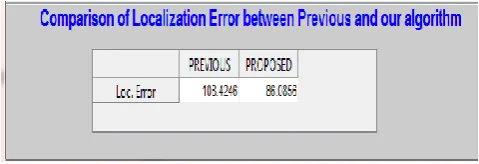
B. Experimental Outcomes: Here, in this segment of paper, the experiments are executed and finished. The figures shown below shows the result obtained from the proposed approach. Following figures shows the graphical representation of RMSE, average localization error, and energy efficient between the previous and proposed approach.
Figure 1: Comparison of Localization b/w Previous and Our
Algorithm
Figure 2: Comparison of Time taken b/w Previous and Our
ISSN: 2395-3519
www.ijatca.com 9
Figure 2 shows that over algorithm take less time of find the exact location of the nodes as compared to the previous algorithm.
Figure 3: Comparison of RMSE b/w Previous and Our
Algorithm
Figure 3 shows that the comparison of RMSE between previous algorithm and our algorithm in which the value of RMSE of our algorithm is less compared to the previous algorithm. If RMSE error is less than it interpret good accuracy and certainty.
Figure 4: Comparison of Distance b/w Previous and Our
Algorithm
Figure 4 shows that our algorithm takes less time to find the node location as compared to the previous time.
Figure 5: Graphical representation of RMSE
Figure 5 shows the graphical comparison of root mean square error for both previous and proposed work. Green line shows the values for previous work and blue line shows the values for proposed work. From the graph it is shown that the value of RMSE in case of proposed work is much lesser than the previous work. That means the proposed approach is more efficient and reliable than the previously used approach.
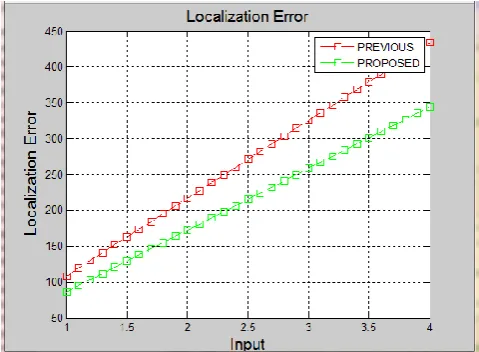
Figure 6: Graphical Representation of Localization Error
Figure 6 shows the graphical comparison of localization error for both previous and proposed work. Red line shows the values for previous work and green line shows the values for proposed work. It shown that if value of localization error is less than high accuracy will be achieved.
V.CONCLUSION
The event driven localization technique for locating the sensor node by calculating its distance from the base station was implemented using the IR fingerprint in Wireless Sensor Networks Localizing the sensor nodes randomly deployed in the network is still an open and challenging problem in the WSN field. It is an open problem because there is not a single solution which could achieve desirable features including good accuracy, low cost, fast speed, high confidence and etc, simultaneously for all applications. It is a challenging problem because of the extremely limited resource and cost constraints at the sensor node side. This chapter introduces one kind of taxonomy for the sensor node localization methods. Nevertheless, any solution itself is always an issue about trade-off between system cost and localization performance including accuracy, speed, and etc.
References
[1] Cheung K., So H., Ma W. K., and Chan Y, “Least squares algorithms for time-of-arrival-based mobile location”, IEEE Trans. Signal Process, vol. 52, issue no. 4, pp. 1121–1130, Apr. 2004.
[2] Kim S., Jeon H., and Ma. J., “Robust localization with unknown transmission power for cognitive radio”, in Proc. IEEE Mil. Commun. Conf., Oct. 2007, pp. 1–6.
[3] B. Zhang and F. Yu, “An energy efficient localization algorithm for wireless sensor networks using a mobile anchor node”, International conference on information and automation, June 2008.
ISSN: 2395-3519
www.ijatca.com 10 Sensor Networks", IEEE transaction on Signal Processing
Letters, IEEE, vol. no. 15, pp.253-256, 2008.
[5] B. Zhang and F. Yu, “A high energy efficient localization algorithm for wireless sensor networks using directional antenna”, International conference on high performance computing and communications, June 2009. [6] Anushiya A Kannan, Guoqiang Mao and Branka Vucetic, “Simulated Annealing based Wireless Sensor Network Localization”, Journal of Computers, Vol. 1, No. 2, pp 15-22, May 2006.
[7] Cesare Alippi, Giovanni Vanini, “A RSSI-based and calibrated centralized localization technique for Wireless Sensor Networks”, in Proceedings of Fourth IEEE International Conference on Pervasive Computing and Communications Workshops (PERCOMW’06), Pisa, Italy, March 2006, pp. 301-305.
[8] T. He, C. Huang, B. Blum, J. Stankovic, and T. Abdelzaher, “Range-free localization schemes in large scale sensor networks”, In Proceedings of the Ninth Annual International Conference on Mobile Computing and Networking (MobiCom'03), September 2003, San Diego, CA, USA, pp. 81-95.
[9] A. Savvides, H. Park, and M. Srivastava, “The bits and flops of the n-hop multilateration primitive for node localization problems”, In Proceedings of the 1st ACM international Workshop on Wireless Sensor Networks and Applications (WSNA'02), September 2002, Atlanta, Georgia, USA, pp. 112-121.
[10] S. Simic and S. Sastry, “Distributed localization in wireless ad hoc networks”, Technical Report UCB/ERL M02/26, UC Berkeley, 2002, Available HTTP.
[11] J. Bachrach, R. Nagpal, M. Salib and H. Shrobe, “Experimental Results for and Theoretical Analysis of a Self-Organizing a Global Coordinate System from Ad Hoc Sensor Networks”, Telecommunications System Journal, Vol. 26, No. 2-4, pp. 213-233, June 2004.
[12] N. Priyantha, H. Balakrishnan, E. Demaine, and S. Teller, “Anchor-free distributed localization in sensor networks”, MIT Laboratory for Computer Science, Technical Report TR-892, April 2003.
[13] C. Savarese, J. Rabaey, and J. Beutel, “Locationing in distributed ad-hoc wireless sensor networks”, in Proceedings of IEEE International Conference on Acoustics, Speech, and Signal Processing (ICASSP'01), May 2001, Salt Lake City, Utah, USA, vol. 4, pp. 2037-2040.
[14] David Moore, John Leonard, Daniela Rus, and Seth Teller, “Robust distributed network localization with noisy range measurements”, in Proceedings of the Second ACM Conference on Embedded Networked Sensor Systems (SenSys'04), November 2004, Baltimore, MD, pp. 50-61. [15] K.F. Su, C.H. Ou, and H.C. Jiau, “Localization with mobile anchor points in wireless sensor networks,” IEEE Trans, vol. 54, no. 3, pp. 1187-1197, May 2005.
[16] G. Yu, F. Yu, and L. Feng, “A three dimensional localization algorithm using a mobile anchor node under wireless channel”, IEEE world congress on computational intelligence, June, 2008.
[17] B. Zhang and F. Yu, “An energy efficient localization algorithm for wireless sensor networks using a mobile anchor node”, International conference on information and automation, June 2008.
[18] B. Zhang and F. Yu, “A high energy efficient localization algorithm for wireless sensor networks using directional antenna”, International conference on high performance computing and communications, June 2009. [19] N. Swangmuang and P. Krishnamurthy, “An effective location fingerprint model for wireless indoor localization”, Pervasive and Mobile Computing, pp. 836-850, 2008. [20] Gholami M. R., Vaghefi R. M. and Strom E. G., "RSS-Based Sensor Localization in the Presence of Unknown Channel Parameters", IEEE transaction on Signal Processing, volume no. 61, pp. 3752-3759, Aug.1,2013. [21]Jehn Ruey, Jiang Chih, Ming Lin, Feng Yi Lin and Shing Tsaan Huang, "ALRD: AoA localization with RSSI differences of directional antennas for wireless sensor networks”, Information Society (i-Society), pp.304-309, 25-28 June 2012.
[22] Hing Cheung So., Lanxin Lin, "Linear Least Squares Approach for Accurate Received Signal Strength Based Source Localization", IEEE transaction on Signal Processing, vol.no.59, pp.4035-4040,Aug.2011.