A Cluster Based Routing Protocol in
Wireless Sensor Network for Energy
Consumption
M.ShanthiResearch Scholar, Department of Computer Science, NGM College, Pollachi, India Email: [email protected]
Dr.E.RamaDevi
Assistant Professor, Department of Computer Science, NGM College, Pollachi, India Email: [email protected]
---ABSTRACT---
Wireless sensor network (WSN) is a new and fast advancing technology, which is opening up many opportunities in the field of remote sensing and data monitoring. Even though the advances in embedded systems, the energy consumption is still open issue in WSNs. Recently there has been growing interest in the applications of sensor networks. The radio transmission and reception consumes a lot of energy, one of the important issues in wireless sensor network is the inherent limited battery power within network sensor nodes. Since sensors are generally constrained in on-board energy supply, efficient management of the network is crucial in extending the life of the sensor. In addition to maximizing the lifespan of sensor nodes, it is preferable to distribute the energy dissipated throughout the wireless sensor network in order to maximize overall network performance. In this paper, the focus is mainly driven over the survey of the hierarchical cluster-based available routings in Wireless Sensor Network for energy consumption. Low-Energy Adaptive Clustering Hierarchy (LEACH) protocol is one of the best hierarchical protocols utilizing the probabilistic model to manage the energy consumption of WSN. Simulation results, shows the energy consumption over time of three nodes with distance to the Base Station.
Keywords - Architecture, Clustering Routing Protocols, Hierarchical Clustering Routing Protocol, LEACH, Wireless sensor Network.
--- Date of Submission: February 18, 2014 Date of Acceptance: March 20, 2014
---
1. IntroductionS
ensor networks are becoming a major technology because of its sensing application and process the data to the user at regular time periods. With advances in wireless communications, embedded microprocessors and low-power electronics, wireless sensor networks (WSN) are emerging for various applications due to attributes such as small size, low-cost, low power, and multi-functions. This phenomenon is used in many fields such as industrial applications, military applications, home applications, agriculture and medical applications. But these sensing applications are battery oriented [1] lifetime. Therefore, one of the main issues in WSNs is how to prolong the overall network lifetime with limited energy source. All aspects, including circuits, architecture, algorithms and protocols, must be made energy-efficient to maximize the lifetime of the sensor node. In some applications it is very critical to change the battery if it totally drained off, which leads to network failure or the messages cannot be reached to the user. More energy is needed when the node is transferring data to user. Keeping all this in mind, manyrouting protocols have been designed. Hence for an efficient routing protocol it must consume less energy for routing the data to the user. Some of the major characteristics of WSN are [9]:
• Network Lifetime-In WSN, nodes uses limited power supply by using batteries, which is difficult to replace in certain environment. Alternatively using solar cells provides recharging of batteries in such environment. But this is not effective enough, so energy requirement is the major factor in WSN.
• Fault Tolerance-In WSN the nodes may run out of energy or damaged through environment changes. So it must tolerate to all such conditions. For overcoming this redundant deployment of nodes should be done by scalability. Since the nodes can be deployed in larger geographical regions, so the protocols must be scalable depending upon the architecture.
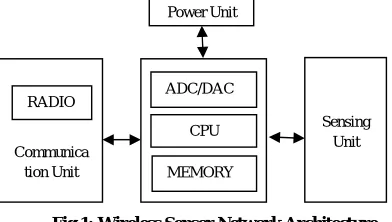
Fig 1, illustrates the generic architecture of a sensor node. It is composed of a power unit, Processing unit, sensing unit and communication unit. The processing unit is responsible to collect, process signals captured from sensors and transmit them to the network. The processing unit is used to compute and process the data locally. Sensors are the devices that produce a measurable response to a change in a physical condition like temperature and pressure. The wireless communication channel provides a medium to transfer signals from sensors to the external world or to a computer networks and helps to establish and maintain wireless sensor network which is usually adhoc.
Each of the sensors is a separate data source that consists of node location, time stamp, sensor type and the value of the reading. Sensor data might contain noise and it is not often possible to obtain accurate results; but it is possible to obtain accurate results by fusing data from several sensors. Aggregation of raw sensor data is thus more useful in sensor applications than individual sensor readings. For example, when monitoring the pressure of a fluid flow in an industry, one possible query is to measure the average value of all sensor readings in that region, and report whenever it is higher than some predefined threshold.
Battery life of a sensor node is 2 to 3 years which operates in 2.4GHz frequency. It can transmit data at the rate of 250K bits/sec. To conserve energy, most of the nodes are in sleep state except few nodes which needs to be in active state. Sensor nodes can cover 300m without repeaters.
Fig 1: Wireless Sensor Network Architecture 3. Clustering Overview
Given the unique characteristic of WSNs, cluster-based protocols show significant advantages over flat strategies. Followings are several advantages of clustering schemes that introduce them as the most compatible protocols with WSNs attributes:
• Minimizing the total transmission power.
• Balancing the energy-exhausting load among all nodes.
• Reducing the bandwidth demand and efficient use of limited channel bandwidth.
• Lessening routing and topology maintenance overhead.
• Eliminating the redundant and highly correlated data in aggregation process.
• Reducing data collision and interference in data transmission process by use of multi-power levels in cluster-scale and network-scale communications.
• Localizing the route setup within the cluster boundaries and thus generating small-size routing tables.
• Increasing the manageability and scalability of the network. Cluster-based routing protocols consist of four stages: cluster head selection, cluster formation, data aggregation and data communication.
As it is seen in Figure 2, the setup state starts by the cluster head selection stage and proceeds by constructing clusters. The setup state is followed by the steady data transmission state, which is subdivided into data aggregation and data transmission phases. The setup and steady data transmission states form one round of running a cluster-based protocol, which iterates throughout the time of running the protocol or the network lifetime. Based on the role, sensor nodes in clustering algorithms may be grouped into four categories:
• Cluster head (CH): Coordination of a group of nodes located within the boundaries of the cluster, aggregating the sensed data by the cluster members and transmission of the aggregated data to the next hop are the main duties of a CH.
• Base station (BS): Given the high processing capabilities and unlimited source of energy, BS may be the coordinator of the network and/or the sink node where all the aggregated data are processed according to the type of the application and demands of the end user.
• Relay node (RN): Groups of nodes in multi-hop data transmission schemes responsible for relaying sensed or aggregated data by other nodes towards the destination
• General node (GN): Majority of nodes in the network, which only provide the sensed data based on the type application.
Fig 2: The composition of one round of the clustering process.
Setup State Steady Data Transmission State Cluster Head
Selection
Round
Cluster Formation
Data Aggregation
Data Communication Power Unit
Sensing Unit ADC/DAC
CPU MEMORY Communica
4. Energy-Efficient Clustering Structures in WSN
Traditional routing protocols for WSN may not be optimal in terms of energy consumption. Clustering can be used in energy-efficient communication protocol. The objectives of clustering are to minimize the total transmission power aggregated over the nodes in the selected path, and to balance the load among the nodes for prolonging the network lifetime. Clustering is a sample of layered protocols in which a network is composed of several clumps (or clusters) of sensors. As shown in Figure 3, each clump or cluster is managed by a special node or leader, called cluster head (CH), which is responsible for coordinating the data transmission activities of all sensors in its clump. All sensors in a cluster communicate with a cluster head that acts as a local coordinator or sink for performing intra-transmission arrangement and data aggregation. Cluster heads in tern transmits the sensed data to the global sink. The transmission distance, over which the sensors send their data to their cluster head, is smaller compared to their respective distances to the global sink. Since a network is characterized by its limited wireless channel bandwidth, it would be beneficial if the amount of data transmitted to the sink can be reduced. To achieve this goal, a local collaboration between the sensors in a cluster is required in order to reduce bandwidth demands.
Fig 3: Clustering of Sensor Nodes
As shown in Fig 3 clustering usually localizes the routing setup within the cluster and therefore it reduces the routing overhead by each node and the topology maintenance overhead. Using clustering, the network appears smaller and more stable. The information, generated from neighbouring sensor nodes, is often redundant and highly correlated, so data aggregation by each cluster head conserves communication bandwidth as well.
5. Hierarchical Cluster Routing Protocols
Many research projects in the last few years have explored hierarchical clustering in WSN from different perspectives[4]. Clustering is an energy-efficient communication protocol that can be used by the sensors to report their sensed data to the sink. A sample of
layered protocol is described with several different clusters of sensors [4]. Each cluster is managed by a special node, called cluster head, which is responsible for coordinating the data transmission activities of all sensors in its cluster.
Fig 4: Cluster-Based Hierarchical Model
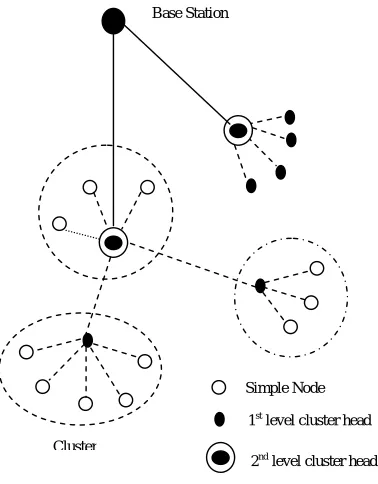
As shown in fig 4, a hierarchical approach breaks the network into clustered layers .Nodes are grouped into clusters with a cluster head that has the responsibility of routing from one cluster to the other cluster heads or base stations. Data travel from a lower clustered layer to a higher one. Although, it hops from one node to another, but as it hops from one layer to another it covers larger distances. This moves the data faster to the base station. Clustering provides hierarchical-based routing protocols for WSNs. LEACH is one of the clustering hierarchical routing protocols in WSN.
Low-energy adaptive clustering hierarchy (LEACH)
LEACH [5], [6] is the first and most popular energy efficient hierarchical clustering algorithm for WSNs that was proposed for reducing power consumption. In LEACH, the clustering task is rotated among the nodes, based on duration. Direct communication is used by each CH to forward the data to the base station (BS). It is an application-specific data dissemination protocol that uses clusters to prolong the life of the wireless sensor network. LEACH is based on an aggregation (or fusion) technique that combines or aggregates the original data into a smaller size of data that carry only meaningful information to all individual sensors. LEACH divides the a network into several cluster of sensors, which are constructed by using localized
Base Station
Simple Node 1st
level cluster head 2nd
coordination and control not only to reduce the amount of data that are transmitted to the sink, but also to make routing and data dissemination more scalable and robust.
Given that energy dissipation of the sensor depends on the distance and the data size to be transmitted, LEACH attempts to transmit data over short distances and reduce the number of transmission and reception operations. The key features of LEACH are: (i) randomized rotation of the CH and corresponding clusters, (ii) local compression to reduce global communication, (iii) and localized coordination and control for cluster set-up and operation. LEACH uses a randomize rotation of high-energy CH position rather than selecting in static manner, to give a chance to all sensors to act as CHs and avoid the battery depletion of an individual sensor and dying quickly. The operation of LEACH is divided into rounds, each of which has mainly two phases namely
(i) A setup phase to organize the network into clusters, CH advertisement, and transmission schedule creation and
(ii) A steady-state phase for data aggregation, compression, and transmission to the sink. Cluster heads (CHs) use CSMA MAC protocol to advertise their status. Thus, all non-cluster head sensors must keep their receivers ON during the setup phase in order to hear the advertisements sent by the CHs. These CHs are selected with some probability by themselves and broadcast their statuses to the other sensors in the network.
LEACH achieves over a factor of 7x and 8x reduction in energy dissipation compared to direct communication and a factor of 4x and 8x compared to the minimum transmission energy (MTE) routing protocol. The nodes die randomly and dynamic clustering increases system lifetime in case of LEACH as compared to direct transmission, MTE routing, and static clustering. LEACH is completely distributed and requires no global knowledge of network. LEACH reduces energy consumption by (a) minimizing the communication cost between sensors and their cluster heads and (b) turning off non-head nodes as much as possible [38].It has major characteristics such as (i) it rotates the cluster heads in a randomized fashion to achieve balanced energy consumption, (ii) sensors have synchronized clocks so that they know the beginning of a new cycle, (iii) sensors do not need to know location or distance information, (iv) the time duration of the set-up phase is non-deterministic, and if the duration is too long due to collisions, sensing services are interrupted. In such cases, LEACH may be unstable during the set-up phase depending on the density of sensors. LEACH uses single-hop routing where each node can transmit directly to the cluster-head and the sink. Therefore, it is not applicable to networks deployed in large regions.
Furthermore, the idea of dynamic clustering brings extra overhead, e.g. head changes, advertisements etc., which may diminish the gain in energy consumption. While LEACH helps the sensors within their cluster dissipate their energy slowly, the CHs consume a larger amount of energy when they are located farther away from the sink. Also, LEACH clustering terminates in a finite number of iterations, but does not guarantee good CH distribution and assumes uniform energy consumption for CHs.
Enhanced Low-Energy Adaptive Clustering Hierarchy (ELEACH)
E-LEACH [3] further improved LEACH in two major aspects. E-LEACH proposes a cluster head selection algorithm for sensor networks that have non-uniform starting energy level among the sensors. However, this algorithm assumes that sensors have global information about other sensors remaining energy. E-LEACH also determines that, under certain assumptions, the required number of cluster heads has to scale as the square root of the total number of sensor nodes to minimize the total energy consumption. Other aspects of E-LEACH are the same as LEACH.
LEACH-Centralized (LEACHC)
LEACH-C uses a centralized clustering algorithm and same steady-state protocol. During the set-up phase of LEACH-C, each node sends information about current location and energy level to base station (BS). The BS will determine clusters, CH node and non-CH nodes of each cluster. The BS utilizes its global information of the network to produce better clusters that require less energy for data transmission. The number of CHs in each round of LEACH-C equals a predetermined optimal value, whereas for LEACH the number of CHs varies from round due to the lack of global coordination among nodes.
Multi-hop LEACH (M-LEACH)
allowing a reduction in the total transmitted and forwarded data in the network.
LEACH with Fixed Cluster (LEACH-F)
LEACH-F [10] is the further development of LEACH, which is based on clusters that are formed once and then fixed. Then, the cluster head position rotates among the nodes within the cluster. The advantage with this is that, once the clusters are formed, there is no set-up overhead at the beginning of each round. To decide clusters, LEACH-F uses the same centralized cluster formation algorithm as LEACH-C. The fixed clusters in LEACH-F do not allow new nodes to be added to the system and do not adjust their behaviour based on nodes dying.
6. Energy Consumption Using LEACH
In LEACH, the operation of the whole network is divided into many rounds. Every round includes set-up phase and steady-state phase. The latter is divided into many frames. During the period of set-up phase all nodes are organized into some clusters through communicating with short messages and one node becomes cluster head. Every cluster head sets up a TDMA schedule for all member nodes of its cluster. All nodes broadcast short messages using carrier sense multiple access (CSMA) MAC protocol. Following the set-up phase, the data are transferred from member nodes to cluster heads according to the TDMA schedule during a frame, aggregated to reduce redundant data and then passed on to the base station (BS) at the end of each frame.
A potential problem with LEACH protocol is that all cluster heads send the compressed data to the BS directly. If all sensor nodes are pervasive in a large area, some clusters are far from the BS and others are close to the BS. After the network operates for some rounds there will be considerable difference on energy consumption between the nodes near the BS and those far from the BS. If all nodes begin at the same energy storage, the nodes far from the BS will use up their energy before those near the BS. [11] As a result the network will be partitioned into regions with live nodes and dead nodes and hence the performance of the network will decline.
7. Simulation and Results
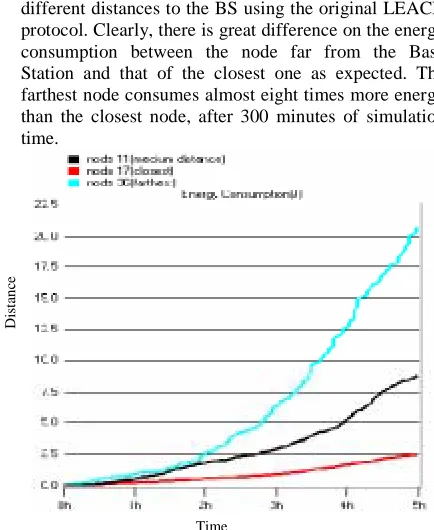
The simulation of LEACH protocol is done by using the network simulator OPNET .OPNET [12] provides a fairly realistic simulation environment for WSN among the available network simulators. Especially it takes into account the effect of noise on the performance of networks. The simulation is based on a network with 3 nodes distributed in a 1km*1km area. Fig 5 shows the energy consumptions over time of three nodes with
different distances to the BS using the original LEACH protocol. Clearly, there is great difference on the energy consumption between the node far from the Base Station and that of the closest one as expected. The farthest node consumes almost eight times more energy than the closest node, after 300 minutes of simulation time.
Fig 5: Energy consumption over time of three nodes with LEACH
8. Conclusion
Due to the scarce energy resources of sensors, energy efficiency is one of the main challenges in the design of protocols for WSNs. The ultimate objective behind the protocol design is to keep the sensors operating for as long as possible, thus extending the network lifetime. In this paper we have surveyed and summarized recent research works focused mainly on the energy efficient hierarchical cluster-based routing protocols for WSNs. The protocols discussed in this paper have individual advantages and pitfalls. Another interesting issue for routing protocols is the integration of WSNs with wired networks. More specifically, most of the applications in environmental monitoring require the data, gathered from the sensor nodes, to be transmitted to a server, so that further analysis can be done. On the other hand, the requests from the users side should be made to the BS through Internet. Since the energy-efficiency routing requirements of each environment are quite different, further research is needed to face this kind of situations.
REFERENCES
[1]. F. Akyildiz et al. , Wireless sensor networks: a survey , Computer Networks, Vol. 38, pp. 393-422, March 2002.
[2]. G. Gupta and M. Younis, Performance evaluation of load-balanced clustering of wireless sensor networks,Telecommunications, 2003. ICT 2003. 10th International Conference on Volume 2.
D
is
tan
ce
[3]. H.Chan and A.Perrig, ACE: An Emergent Algorithm for Highly Uniform Cluster Formation, Proc 1st Euro, Eksp, Sensor Networks, Jan 2004, pp.154-71.
[4]. Jamil Ibriq and lmad Mahgoub, Cluster-based Routing in Wireless Sensor Networks: Issues and Challenges , SPECTS.04, pp. 759-766.
[5]. Kemal Akkaya, Mohamed Younis, Survey on routing protocols for wireless sensor networks Kemal, ELSEVIER Ad hoc Networks 3(2005) pp:325349.
[6]. N.A.Pantazis, and D.D.Vergados, A survey on power control issues in wireless sensor networks, IEEE Communications Surveys & Tutorials, 2007,vol.9,no.9,no.4,pp.86-107.
[7]. Shio Kumar Singh , M P Singh , and D K Singh, Routing Protocols in Wireless Sensor Networks- A Survey, International Journal of Computer Science & Engineering Survey, vol.1, no.2, pp.63-83, Nov 2010.
[8]. V. Mhatre and C. Rosenberg, Homogeneous vs heterogeneous clustered sensor networks: a comparative study , Communications, 2004 IEEE International Conference on, 6, 2004.
[9]. W.R. Heinzelman, Application-Specific Protocol Architecture for Wireless Networks, PhD Thesis, Massachusetts Institute of Technology, June 2000.
[10].W.R. Heinzelman, A. Chandrakasan, and H.Balakrishnan, An Application-Specific Protocol Architecture for Wireless Microsensor Networks , IEEE Transactions on Wireless Communications (October 2002), vol. 1(4), pp. 660-670.
[11].W.R. Heinzelman, A. Chandrakasan, and H. Balakrishnan, Energy-efficient Communication Protocol for Wireless Microsensor Networks , in IEEE Computer Society Proceedings of the Thirty Third Hawaii International Conference on System Sciences (HICSS '00), Washington, DC, USA, Jan. 2000, vol. 8, pp. 8020.
[12].OPNET Technologies, Inc., “OPNET MODELER”, http://www.opnet.com/products/ modeler/home.html, 2004
Authors Biography
M.Shanthi received M.Sc degree in Computer Science from Bharathiar University, Coimbatore. Currently she is doing M.Phil Degree in Computer Science at Bharathiar University, Coimbatore. Her research interest lies in the area of Networking and Data security.
Dr.E.RamaDevi received PhD degree in Computer Science from Mother Teresa Womens University, Kodaikanal. Currently she is an Assistant Professor in Computer science at NGM College, Pollachi, India. She has got 13 years of research experience and has more than 18 years of teaching experience. Her research