A Novel Smart-Card Based Authentication Scheme Using
Proactive Secret Sharing
Yuesheng Zhu, Bojun Wang
*, Cheng Cai
Lab of Communication and Information Security, Institute of Big Data Technologies, Shenzhen Graduate School, Peking University, Shenzhen, 518052, China.
* Corresponding author. Email: [email protected] Manuscript submitted October 3, 2014; accepted June 1, 2015. doi: 10.17706/ijcce.2016.5.3.196-205
Abstract: Traditional smart-card oriented authentication schemes provide a secure method for authorized users to login a remote server through insecure networks. Many modified schemes are presented to enhance the security properties, which include mutual authentication, various attacks resistance, table-free in server, etc. However, the authentication procedures become complicated with abovementioned enhancements, so these enhanced schemes are not practical solutions for the smart card based authentication system. Moreover, since the master key stored in a single server is a sensitive and long-lived secrecy, it is vulnerable to an adversary's agelong attack. Therefore, in this paper, we present an efficient mutual authentication scheme, which provides a practical solution for an industrial application system using smart cards. In addition, our scheme implements the proactive secret sharing method, namely, the master key is divided into several distributed keys, which are separately stored in different servers. Our scheme provides a mechanism to update all distributed keys in every time interval, and detect and then recover the corrupted distributed keys, as well.
Key words: Distributed key, mutual authentication, proactive secret sharing, smart cards.
1.
Introduction
T. C. Wu [1] proposed a smart-card oriented authentication scheme based on some properties of Euclidean geometry. This scheme can achieve the login and authentication phase easily. However, M. S. Hwang found the weakness [2] of T. C. Wu's scheme and then improved the security in the authentication process [3] by using ElGamal's public key cryptosystem [4]. Many modified methods [5]-[10] based on Hwang 's scheme were presented to enhance the security.
Secret sharing scheme is first proposed by Shamir [14], which can be applied to manage important information. Blakley [15], C. Asmuth, and J. Bloom [16] also present different secret sharing methods. Later, many modified secret sharing schemes were presented. The first verifiable secret sharing (VSS) was proposed by B. chor et al. [17]. Also, Feldman [18] and Pedersen [19] improved VSS to two different non-interactive VSS schemes. Amir Herzberg et al. [20] proposed a proactive secret sharing scheme, in which provides protocols of share renewal, corrupted share detection, and corrupted share recovery. In the smart card based authentication process, another crucial issue is about master key, which is possessed by only one server. However, the master key is invariable information, so it can be leak under the continuous attack of an adversary. Therefore, the traditional proactive secret sharing method can be used to manage the master key.
2.
Related Theories
2.1.
ElGamal's Public Key Cryptosystem
Submit your manuscript electronically for review. ElGamal's cryptosystem is based on the asymmetric cryptographic algorithm. For example, user A wants to send a message M to user B using ElGamal's cryptosystem. In the cryptosystem, p, g are two public parameters. Here p is a large prime number and g < p.
x is user B's private key and ygk mod p is user B's public key. To encrypt the message M, A selects a
random number k satisfies gcd( ,k p 1) 1 and computes a, b to send to the user B.
a=gk
mod p
b= ykM
modp
After user B receives a, b, he can get the secret message M by computing Mb a/ x(mod )p .
2.2.
Cryptographic Tools
Our scheme requires asymmetrical encryption [21] and unforgettable signatures [22]. E.g., a sender S
wants to send a message to a receiver R, S using R's public key to encrypt this message is denoted by
(message)
R PU
Enc . In addition, S sends a message with his or her signature using S's private key. This
signature is denoted by (message)
S PR
Sig .
3.
A Smart Card Based Mutual Authentication Scheme
Derived Keys of Smart Cards
3.1.
Any attacker can thoroughly analyze a smart card since it can be easily got [23]. If the master key is stored in a smart card, the attacker can access the smart card's content and read out the master key. Therefore, a derived key should be present in the smart card instead of the master key. The derived key is generated using a cryptographic algorithm. The smart card's number and the smart key are inputted in this algorithm as parameters. The derived key is unique and can be used to identify the smart card in the entire system, because the smart card's number is unique when the card is manufactured. The derived key can be got by the following function.
Derived key = Enc (card number, master key) (2)
For example, in registration phase, the AS computes the derived keys Ki of each card i, using the function
above to encrypt the information of card number IDi and its master key Ks. The derived key stored in the
card i is Ks
i i
K ID . It is stored as a security file in the smart card. Any device cannot read it before smart
card authenticates the remote server successfully. The derived key stored in the card is used to lock data in the card and serves to complete the mutual authentication process with the remote server.
Protocol of Smart Card Based Mutual Authentication Scheme
3.2.
Before the communication between the smart card and the remote server, the mutual authentication has to be performed between the two parties. The smart card authenticates the server fist to confirm it is a legal server. After that, the remote server requests the AS to authenticate smart card.
In traditional authentication scheme, master key is possessed by AS. Yet the master key can be leak under malicious attack or be lost when the AS shuts down. In our authentication scheme, master key is stored neither in smart cards nor the AS, so an attacker cannot get the master key by attacking smart cards and the AS. Our authentication scheme implements the proactive secret sharing method [20]. The master key is split into several pieces (distributed keys) using Shamir's secret sharing method [14], and each sub-server has only one distributed key. Once there is a request from a smart card, the AS will start the master key recovery process. The sub-servers send their distributed keys and reconstruct the original master key. In addition, the AS will manage the renewal process of distributed keys and the detection and recovery process of corrupted distributed keys.
We introduce our new authentication scheme using smart cards in this section, which has the feature of mutual authentication and can resist the masquerade attack. The security of our mutual authentication is based on ElGamal's public key cryptosystem and intractability of discrete log problem. To make our scheme be easily understood, we introduce proactive secret sharing method of AS in Section 4.
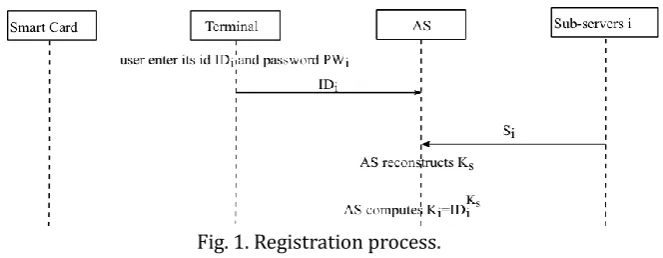
1) Registration phase (see Fig. 1)
Fig. 1. Registration process.
A smart card is registered in an AS before it is assigned to a user. Namely, the AS uses its master key to generate a derived key and stores this key as a security file in the smart card. In the registration and authentication processes, the interaction between smart cards and AS relies on a terminal device, which is an interactive medium between the smart card and the AS. The user just needs to insert the smart card into a terminal device.
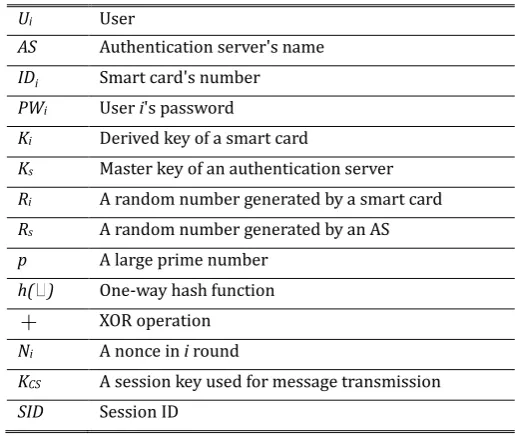
We present our protocol in the registration phase and the authentication phase. The notations used in our scheme are listed in the Table 1.
Step 1: If a user Uiwants to register his or her card in AS, he or she has to input the password in AS's
terminal. Then the terminal reads the card number IDi and then sends IDi, PWi to AS.
Step 2: The AS uses its master key Ks to compute Ui's derived key Ksmod
i i
K ID p and stores p, h(g),
h(PWi) in the smart card. In addition, Ki is stored as a security file in the smart card. It locks the data p, h(g),
h(PWi) with a program, so any device cannot access the locked data before be successful authenticated by
Table 1. Notations in Our Scheme
Ui User
AS Authentication server's name
IDi Smart card's number PWi User i's password
Ki Derived key of a smart card
Ks Master key of an authentication server
Ri A random number generated by a smart card
Rs A random number generated by an AS
p A large prime number
h( ) One-way hash function
+ XOR operation Ni A nonce in i round
KCS A session key used for message transmission
SID Session ID
2) Authenticationphase
Before the communication between the smart card and the remote server, the mutual authentication has to be performed between the two parties. The smart card authenticates the server fist to confirm it is a legal server. If this authentication is successful, then the remote server requests AS to authenticate smart card. We describe the mutual authentication between the smart card and the server, respectively.
Smart Card authenticates AS (see Fig. 2)
Fig. 2. The smart card authenticates the AS.
Step 1: The smart card generates a random number Ri in GF(p) and sends the challenge ( Rimod ) ( )
i i
c ID p h PW to AS through the terminal. Here Ri satisfies gcd( ,R pi 1) 1. Then the user
input his or her password in the terminal.
Step 2: The terminal sends a challenge ( ) Rimod
i i
c c h PW ID p to AS. Then the AS computes
( )Ks R Ki smod
i
r c ID p and sends r and a nonce Ni to the smart card through the terminal.
Step 3: The smart card computes Ri i
K
to verify weather Ri R Ki s( )
Ksi i
K
ID
c
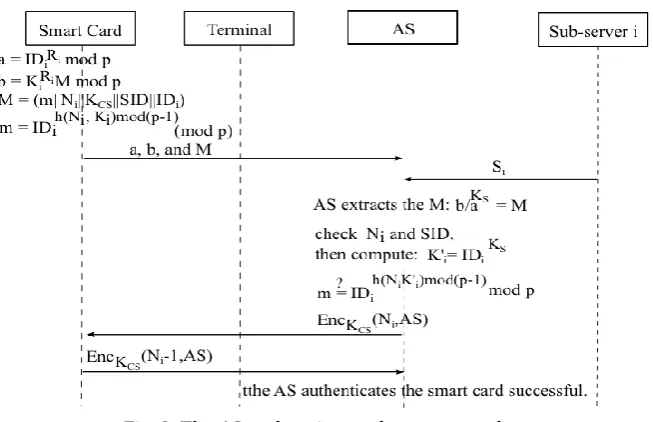
. If it holds, the smart card authenticates the AS successfully.Fig. 3. The AS authenticates the smart card.
After the smart card successfully authenticates the AS, the AS can access the data p, h(g), h(PWi). The data
can be used to authenticate the smart card.
Step 1: The smart card generates a random number Riin GF p( ) and sends the messages a, b, M to the
AS.
( ) mod( 1)
mod
mod
( )
mod i
i
i i
R i
R i
i CS i
h N K p
i
a ID p
b K M p
M m N K SID ID
m ID p
(3)
Here, M is the secret message that the smart card wants to send to the AS for authentication purpose. Step 2: The AS computes M b a/ Ks and then check weather N
i, SID are fresh. If they are fresh, then the
AS computes Ks
i i
K ID and then checks weather h N( i Ki') mod(p1)mod i
mID p.
Step 3: If step 2 holds, the ASsends ( , )
CS
K i
Enc N AS to the smart card. Then the smart card replies a
message ( 1, )
CS
K i
Enc N AS . At this time, the AS authenticates the smart card successfully.
4.
Distributed Keys Based on Proactive Secret Sharing
4.1.
Master Key Management
In the initialization phase, the system constructs a random polynomial f of degree at most k-1 with
coefficient in, 2 1
0 1 2 1
( ) ... k k mod
f x x x x q, in which 0 Ks. The master key Ks is divided
into n pieces S S1, 2,...,Sn and distributed to n sub-servers P P1, 2,...,Pn, respectively. There are nsub-servers
1 2
{ , ,..., n}
P P P P share a master key Ks based on Shamir's (k, n)-threshold secret sharing scheme. An
attacker cannot learn the master key Ks even if he or she knows k-1 distributed keys, and any k of the
sub-servers can still reconstruct the original master key even if n-k sub-servers are corrupted because of the attackers or the sub-servers' normally shutdown.
4.2.
Periodic Distributed Keys Renewal Protocol
Using threshold secret sharing to manage master key improves the security of master key, because an attacker has to get k distributed key. However, the master key is inherently long-lived secrecy, so the attacker can spend his or her whole lifetime collecting the distributed key. As a result, the traditional secret sharing scheme is not sufficient.
In our scheme, the sub-servers periodically refresh their distributed keys. The entire system time is divided into a series of time periods. At the beginning of every time period, the AS requests for the renewal of distributed keys. All sub-servers then update their distributed keys according to the periodic distributed key renewal protocol. For example, a weekly renewal of distributed keys can reduce the time for the attacker to get k distributed keys from entire lifetime to one week. In addition, the attacker needs to destroy
n-k distributed keys in a single time interval.
The communication among sub-servers is multicast group communication. That is, each sub-server broadcasts information to all the sub-servers in the group. The protocol of periodic distributed key renewal is illustrated as follows.
Step 1: In period t-1, the master key Ks is split into the distributed keys with the polynomial
( 1) ( )
t f x .
In the period t, every sub-server Pi chooses a random polynomial
( ) ( ) ( ) 2 ( ) 1
,1 ,2 ,( 1)
( ) ...
t t t t k
i i i i k
G x a xa x a x
mod q, such that ( ) (0) 0
t i
G .
Step 2: Every sub-server Pi computes
( )t ( )t( ),1 , ,
ij i
u G j i jn i j and sends ( ( )) j
t
PU ij
Enc u to
sub-servers Pj,1i j, n i, j respectively. Meanwhile, the sub-server broadcasts the poof
( ) ,
mod , 1, 2,..., 1 t
i w a j
C g q w k . The receiver Pj can verify the correctness of the renewal information by
checking ( ) 1 1( )
t w
ij
u k j
w w
g C .
Step 3: After every sub-serverPi receives all the other renewal information
( )
, 1 , ,
t ij
u i jn i j, the
sub-server Pi needs verify the validity of the renewal information as described above. If the verification
succeeds, the sub-server Pi broadcasts the acceptance message represents that all the renewal
information is valid.
Step 4: If the sub-server Pi receives all the other sub-servers' acceptance messages, Pi computes his
new distributed key as Eq. 4 and erases the previous distributed key (t1)
i S .
( ) ( 1) ( ) ( ) ( )
1 2
...
mod
t t t t t
i i i i ni
S
S
u
u
u
q
(4)Analysis: k updated distributed keys can be used to reconstruct the polynomial
( 1) ( ) ( ) ( )
1 2
( ) ( ) ( ) ... ( )
t t t t
n
( 1) ( ) ( ) ( )
1 2
( 1) ( 1)
(0) (0) (0) ... (0)
(0) 0 ... 0 (0)
t t t t
n
t t
s
f G G G
f f K
(5)
4.3.
Detection of Corrupted Distributed Keys
A corruption of a certain sub-server can be easily detected in some cases. That is because a corrupted key can be detected by the verification process of the distributed key renewal phase. However, after the update phase, once an attacker successfully attacks a sub-server, he or she can modify the distributed key stored in this sub-server or change server's behavior. Also, it is possible that a sub-server has normal severe problem (e.g., disconnection, power failures etc.). All the situations above will cause distributed key's corruption. Therefore, it is necessary to periodically detect corrupted distributed keys. The protocol of corrupted distributed keys detection is introduced as follows.
Step 1: Each sub-server Pi stores ( ) ( )
mod , (1... ) t
j S t j
y g p j n . In the initial period, each sub-server
stores ( 0) (0)
, (1... ) j
S j
y g j n .
Step 2: In the update phase, each sub-server Pi updates its set
( )
{yjt}, j(1... )n by computing Eq. 6. Set
i
B represents the set of sub-server that sends incorrect renewal information.
( 1) ( 1) ( 1) ( 1)
1 2
( ) ( 1)
,
t t t t
j j kj nj
u u u u
t t
j j i
y y g g g g kB (6)
Step 3: Each sub-server broadcasts the value of the set ( )
{yjt}, j(1... )n to the other sub-servers,
together with its signature ( )
( ), (1... ) i
t
PR j
Sig y j n on these values.
Step 4: After receiving all the messages from the other sub-servers, each sub-server checks the signature on these values. For each sub-server Pi, according to the received messages, it can update its set Bi by
majority principle. That means every sub-server can judge which sub-server holds a corrupted distributed key.
4.4.
Recovery of Corrupted Distributed Keys
If corrupted sub-servers in set B hold corrupted distributed keys, the other non-faulty sub-servers in set
D = A – B have to implement the recovery protocol to recover the correct distributed keys. A straightforward way to recover the corrupted distributed keys ( )
( ),
t r
S f r rB is each sub-server in set D sending its
distributed keys to Pr. However, this method could expose the master key to sub-server Pr, because Pr
could collect more than k distributed keys and use them to reconstruct the master key. Therefore, the recovery protocol is presented as follows, in which each sub-server in set D generates a new distributed key and then sends it to Pr. Pr can use these new distributed keys to recover its distributed key without
learning about the original distributed keys { },Si iD. The detail of the recovery protocol is illustrated as
follows.
Step 1: Each sub-server P ii, D picks a random polynomial of degree at most k-1 with coefficient in
2 1
,0 ,1 ,2 , 1
( ) ... k mod
i x i i x i x i k x q
2 1
,0 ,1 ,2 , 1
( ) ... k mod
i x i i x i x i k x q
such that i( )r 0
and 2 1
,0 ( ,1 ,2 ... , 1 ) mod {1... } , (mod )
k j
i i r i r i k r q j k i jr q
.
Step 2: Each sub-server P ii, D broadcasts{ ( ( ))}
j
PU i
Enc j jD.
Step 3:Each sub-server P ii, D creates its new distributed key by computing
'
( )
i i j D j
then sending '
( ), r
PU i
Enc S rB to P rr, B.
Step 4: P rr, Bdecrypts these new distributed keys and uses them to recover its original distributed
keySr.
Analysis: The new distributed keys are as follows.
'
1 2
( ) ( ) ( ) ... ( ) ... ( ),
i i j D j i k n
S S i S i i i i kD (7)
Therefore, Pr can use these new distributed keys to reconstruct the polynomial
1 2
( ) ( ) ( ) ( ) ... k( ) ... n( ),
F x f x x x x x kD, so Pr can successfully recover its original distributed
keySr by computing Eq. 8.
1 2
( ) ( ) ( ) ( ) ... k( ) ... n( ), ( ) 0 ... 0 ( ) r
F r f r r r r r k D f r f r S (8)
4.5.
Master Key Reconstruction
When the AS authenticates a smart card, the master key has to be reconstructed. Each distributed key stored in a sub-server is sent to the AS and the master key is reconstructed in AS.
After all sub-servers have sent the distributed keys, the AS can verify these submitted keys by
( ) ( )
mod , (1... ) t
j S t j
y g p j n in the phase of corrupted key detection. After that, the AS can choose k correct
distributed keys to reconstruct the master key Ks by Eq. 9.
1
1
( ) ( ) ( )
(0) ( ) ( )
k
j j
j l j l j
k
j
s j
j l j j l
x i
f x f i
i i
i
K f f i
i i
(9)In this paper, we have introduced our efficient mutual authentication scheme for smart cards. The specific management of the master key using proactive secret sharing method has also been presented. The master key is reconstructed when a smart card requests to access the remote server. In addition, the distributed keys are periodically updated so that it is more difficult for an adversary to get enough distributed keys in one-time interval. The protocols in our scheme can also detect the corrupted distributed keys and then recover them.
References
[1] Wu, T. C. (1995). Remote login authentication scheme based on a geometric approach. Computer
Communications, 18(12), 959–963.
[2] Hwang, M. S. (1999). Cryptanalysis of a remote login authentication scheme. Computer Communications.
22(8), 742–744.
[3] Hwang, M. S., & Li, L.-H. (2000). A new remote user authentication scheme using smart cards. IEEE
Transactions on Consumer Electronics, 46(1), 28–30.
[4] ElGamal, T. (1985). A public key cryptosystem and a signature scheme based on discrete logarithms.
Advances in Cryptology, 10–18.
[5] Lee, C. C., Hwang, M. S., & Yang, W. P. (2002). A flexible remote user authentication scheme using smart cards. ACM SIGOPS Operating Systems Review, 36(3), 46–52.
[6] Lee, C. C., Li, L. H., & Hwang, M. S. (2002). A remote user authentication scheme using hash functions.
ACM SIGOPS Operating Systems Review, 36(4), 23–29.
[7] Li, L. H., Lin, I. C., & Hwang, M. S. (2001). A remote password authentication scheme for multiserver architecture using neural networks. IEEE Transactions on Neural Networks, 12(6), 1498–1504.
[8] Hwang, M. S., Lee, C. C., & Tang, Y. L. (2002). A simple remote user authentication scheme. Mathematical
and Computer Modeling, 36(1-2), 103–107.
[9] Peyravian, M., & Zunic, N. (2000). Methods for protecting password trans mission. Computers & Security,
19(5), 466–469.
[10]Manber, U. (1996). A simple scheme to make passwords based on one-way functions much harder to crack. Computers & Security, 15(2), 171–176.
[11]Chan, C. K., & Cheng, L. M. (Nov. 2000). Cryptanalysis of a remote user authentication scheme using smart cards. IEEE Transactions on Consumer Electronics, 46(4), 992–993.
[12]Shen, J. J., Lin, C. W., & Hwang M. S. (2003). A modified remote user authentication scheme using smart cards. IEEE Transactions on Consumer Electronics, 49(2), 414–416.
[13]Li, C. T., & Hwang, M. S. (2010). An efficient biometrics-based remote user authentication scheme using smart cards. Journal of Network and Computer Applications, 33(1), 1–5.
[14]Shamir, A. (1979). How to share a secret. Communications of the ACM, 22(11), 612–613.
[15]Blakley, G. R. (1979). Safeguarding cryptographic keys. Proceedings of Managing Requirements
Knowledge, Int. Workshop (pp. 313–317). Los Alamitos, CA, USA.
[16]Asmuth, C., & Bloom, J. (Mar. 1983). A modular approach to key safeguarding. IEEE Trans. Inf. Theory,
29(2), 208–210.
[17]Chor, B., Goldwasser, S., Micali, S., Awerbuch, B. (Oct. 1985). Verifiable secret sharing and achieving simultaneity in the presence of faults. Proceedings of26th Annu. Symp. on Foundations of Computer
Science (pp. 383–395).Portland, OR, USA.
[18]Feldman, P. (Oct. 1987). A practical scheme for non-interactive verifiable secret sharing. Proceedings of
28th Annu. Symp. on Foundations of Computer Science (pp. 427–438). Los Angeles, CA, USA.
[19]Pedersen, T. P. (1992). Non-interactive and information-theoretic secure verifiable secret sharing,
Proceedings of the 11th Annu. Int. Cryptology Conf. on Advances in Cryptology, ser. CRYPTO ’91 (pp. 129–
140). London, UK.
[20]Herzberg, A., Jarecki, S., Krawczyk, H., Yung, M. (1995). Proactive secret sharing or: How to cope with perpetual leakage. Advances in Cryptology, 339-352.
[21]Goldwksser, S., & Micali, S. (1984). Probabilistic encryption. Journal of Computer and System Sciences,
28(2), 270-299.
[22]Goldwasser, S., Micali, S., & Rivest, R. (1988). A digital signature scheme secure against adaptive chosen-message attacks. SIAM Journal on Computing, 17(2), 281-308.
[23]Rankl, W., & Effing, W. (2010). Smart Card Handbook. John Wiley & Sons.
interests include communication and information security, digital signal processing, multimedia technology.
Bojun Wang was born in Jiangsu province of China, in 1990. She received the B.S. degree in networking engineering from College of Computer Science, Chongqing University, Chongqing, China. She is currently pursuing the M.S. degree in computer application technology at theLab of Communication and Information Security, Shenzhen Graduate School, Peking University. Her research interests include information security and its applications, secret sharing and game theory.