* To whom all correspondence should be addressed.
The Relationship between Performance Audit and
Increased Management Efficiency
Seyyed Mirbakhsh Kamrani Mousavi* and Babak Jamshidi Navid
Department of Accounting, Kermanshah Branch, Islamic Azad university, Kermanshah, Iran. DOI: http://dx.doi.org/10.13005/bbra/1613
(Received: 05 February 2015; accepted: 10 March 2015)
The use of different controls to increase effectiveness, efficiency and economy is of great importance in today’s world. The success of organizations and enterprises is largely dependent on the success of management and employees in realizing this goal. On the other hand, achieving efficient and effective operation is the management responsibility, thus the structure of management system as well as management control should be designed in order to achieve this goal. Performance audit is a clear example of management consulting services which helps the enterprise to achieve efficient and effective operations. This type of audit involves a systematic evaluation of an organization’s activities or certain parts of it to attain specific objectives. While strengthening the positive aspects of management, performance audit solves problems, overcomes challenges and improves the quality of business entities. In other words, this type of audit evaluates and improves effectiveness, economy and efficiency of an organization’s operational procedures through identifying opportunities and problem areas. The present study examines the relationship between the performance audit and management interest to work toward achieving organizational goals. It also investigates whether the performance audit encourages increased management efforts to achieve organizational goals through its controls and procedures or vice versa? The results of statistical data analysis showed that all considered hypotheses are accepted. In other words, according to the respondents, there is a significant relationship between performance audit and increased management efficiency.
Key words: Audit, Performance Audit, Effectiveness, Efficiency, Economy.
There is a breathless and intense competition among enterprises to reach the objectives in various fields of economic activities in both private and public sectors. Consequently, issues such as economy compliance, cost-savings and cost control on the one hand, and increased effectiveness and efficiency (i.e. do a good job and do things good) on the other hand, are vital for all enterprises. Therefore, nowadays most organizations are looking to improve the above
conditions. Briefly, applying different controls to increase the effectiveness, efficiency and economy is of great importance. Thus, the success of organizations and enterprises is largely dependent on the success of an organization’s management and staff in realizing this goal1-3. Management is
the knowledge of effectively and efficiently use of resources to achieve organizational goals4. These
resources typically include capital, labor and resources within an organization5. A manager must
organize and control organizational operations to achieve maximum planning benefits4. In today’s
utilizing the services of experts outside the organization to identify problems and provide solutions to achieve more widespread success6.
In recent years, the focus and scope of many audits in both private and public sectors were subjected to changes. Since the financial statements do not meet management information needs alone, managers in both public and private sectors are looking for more information to evaluate and judge the quality of operations and operational improvements. As a result of development of such areas, the need for performance audit techniques for evaluating the effectiveness, efficiency and economy of operations has increased dramatically7.
Problem Definition
The economic system of a country is significantly dependent on management decisions in economic entities. Obviously, such decisions have an important role in economic revenues and effectiveness of activities as well as optimum utilization of production and service facilities of both profit and non-profit organizations8. Thus,
the shareholders or their representatives always want to know whether executives adopt correct decisions or not? Whether or not they have been able to take maximum advantage of the available resources? Whether increased efficiency and cost savings have been realized or not? 7 In competitive
environment, the managers should appropriately direct issues toward progress to achieve the goals and strategies of the organization in an informed manner using performance evaluation process. Due to rapid changes and increasing competitive capabilities of companies and organizations in today’s world, the performance utility of organized individual components and overall desirability yield of the may be a very important measure of the success of an organization. They can be used to assess the current status of the organization’s strategic plans and the performance of its working components as well as to take action to improve their effectiveness and efficiency9. Performance
audit is used as a tool for evaluating efficiency, effectiveness and economy. Performance audit identifies the available opportunities to improve executive procedures through a comprehensive review, assessment analysis, interviewing with qualified and competent persons (intra and inter-organizational), monitoring operations, reviewing current and past reports, transactions, the main
indicators of success, strategic plan, strategic initiatives, comparing to industry standards and competitors, professional judgment and so forth based on experience and other appropriate rational means10-12. Due to its numerous benefits,
performance audit as a proper consulting service and an efficient tool to assess and improve performance should be primarily recognized as one of the most important managers’ stimuli for extra endeavors and it should be significantly welcomed by the managers of economic organizations and entities13. Therefore, the present study examines
the relationship between performance audit and increased management efficiency in several enterprises in Kermanshah including Biston Dairy, Biston Sugar, Manizan Dairy and Sahra Dairy. Objectives
The main objective of this study is to investigate the role of performance audit in increasing managers’ efforts to achieve organizational goals. It seems that different perceptions of the goals, scope and execution of the audit process can have different effects on the level of management efforts. In addition, since performance audit is an integrated process consisted of components, indicators, criteria and so on, some other objectives can be considered for this study. For example, the present study also examines whether each of the components and benefits of operational audits such as suggestions to improve operations, identify opportunities, capabilities and improvement solutions can affect increased efforts of managers or not14?
Literature Review
always asked to provide these services with their technical skills and given similar activities in many stages of the financial and operational audits, the term “audit” is generally used to describe this type of operation rather than “review”15. Megs (1989)
divided the performance audit into two parts including operational audit (Audit Management) and plan audit (Effectiveness Audit). According to Megs, operational or management audit evaluates the efficiency of resource use and the internal management structure and systems while plan or effectiveness audit examines the compliance of laws and regulations adopted by the plan. The plan is evaluated with the actual achievement or the result of work done by the economic unit16.
According to Tongren (1997), a member of Operational Audit Committee and the Head of American Institute of Chartered Accountants, the objectives of operational auditing by companies is directing the operation toward optimality through performance audit, identifying opportunities and providing effective suggestions to improve operations. Furthermore, the management performance will be impartially evaluated given facilities and limiting factors. The efficacy, effectiveness, and economy of unit operation as well as structural conditions of managerial controls including administrative, organization and control structures will be assessed17.
Hypotheses
The present study examines a main hypothesis and four sub-hypotheses as follows: The first main hypothesis
There is a significant relationship between performance audit and increased management efforts to achieve organizational goals.
The first sub-hypothesis
The auditor’s opinion about identifying opportunities and improvement of company’s operational activities affects management efforts to increase the management efficiency.
The second sub-hypothesis
The auditor’s opinion about identifying difficulties and providing solutions for its improvement affects increased management efficiency.
The third sub-hypothesis
The auditor ’s opinion about identification, evaluation and establishment of
management information control systems affects increased management efforts to achieve organizational goals.
The fourth sub-hypotheses
The auditor’s opinion about identifying company’s targets, policies and operational objectives affects increased management efforts to achieve organizational goals.
Research Methodology
The methods used in this research were field and desk study. First, in order to become familiar with the subject, preliminary studies, writing theoretical foundations, describing topics, domestic and foreign literature on performance audit were reviewed. Then, by designing a standard questionnaire and presenting it to the sample and summarizing the received questionnaires, the hypotheses were tested and the results were generalized to the community. Library information including scientific literature in the field of management and auditing and related professional issues, especially the new articles in line with the research hypotheses was used at all stages of the research.
The population consisted of the industrial companies of Kermanshah. The sample included the members of the Board of Directors of these companies. Of the 79 distributed questionnaires, 53 questionnaires have been collected. Among them, 45 questionnaires have been fully completed, so they were used to test the hypothesis (18-20). Sample Size and Sampling Method
and q is 80% and 20% respectively). These have been estimated based on the results of preliminary studies:
In which:
N = size of the population based on a questionnaire sent to 79 people (including 30 members of Board of Directors, 35 senior executives and 14 executive managers).
n = sample size
P = success proportion of hypotheses q = the failure proportion of hypotheses d = estimation error of sample
Substituting the above numbers in the formula, the minimum sample size is estimated as follows:
As the above estimation shows, at the confidence level of 95% and estimation error of 5%, the sample size must be at least 17 people. Adopting the sample size, it can be argued that the sample has all characteristics of the population. In this study, the questionnaire was sent to 79 managers and the members of Board of Directors. Finally, 45 questionnaires were collected21, 22.
Data Collection
Field and desk study methods were used for theoretical expression and data collection. In the desk study method, tables were used to describe theoretical principles. In the field method, a questionnaire was used to collect data used to confirm or reject the hypothesis. The results obtained through questionnaires distributed among managers and the members of Board of Directors of industrial companies in Kermanshah were used for conclusions and recommendations 18-20.
Statistical Tests
In general, the statistical methods can be divided into descriptive statistics and inferential statistics. Both methods were used for summarizing data. The data were described using descriptive statistics and frequency tables as well as appropriate graphs. The following analytical methods were used. Statistical analysis was performed using SPSS18.
t – Student Test
The t–student test wad used to confirm or reject hypotheses. In this case, the mean responses were tested using options’ mediocrity, i.e. the average value of (3).
The statistical analysis is as follows:
First step: the null and conflicting hypotheses are statistically written as follows:
Second step: the test statistic and its statistical distribution are calculated. The test statistic has a t- distribution (approximately a normal distribution for these data). The t-distribution is calculated as follows:
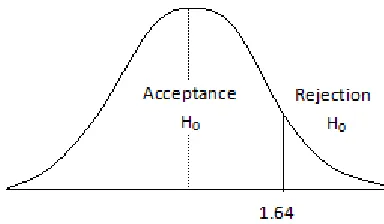
Third step: the rejection region of the null hypothesis is determined considering the statistical distribution and the acceptable error rate as well as the confidence level. A confidence level of 95% was considered (Figure 1)
Fourth step: in this step, the test statistic is compared with a critical value. If the test statistic is in H0 region, the H0 is accepted at the desired confidence level, otherwise it will be rejected21, 22.
RESULTS
Hypotheses Testing
The first hypothesis
H0: The auditor’s opinion about identifying opportunities and improvement of the company’s operational activities does not affect management efforts to increase the efficiency of management. H1: The auditor’s opinion about identifying opportunities and improvement of the company’s operational activities affects management efforts to increase the efficiency of management.
Since the test statistic is greater than the critical value (t=5.09>1.64), the function is in the rejection region of the null hypothesis. Therefore, the null hypothesis is rejected. It can be said with a confidence of 95% that:
The auditor’s opinion about identifying opportunities and improvement of the company’s operational activities does not have any effect on management efforts to reach the organization goals. .
The second hypothesis
H0: The auditor’s opinion about identifying difficulties and providing solutions for its improvement does not affect increased management efficiency.
H1: The auditor’s opinion about identifying difficulties and providing solutions for its improvement affects increased management efficiency.
Since the test statistic is greater than the critical value (t=5.09>1.64), so the function is located in the rejection region of the null hypothesis. Therefore, the null hypothesis is rejected. It can be said with a confidence of 95% that:
The auditor’s opinion about identifying difficulties and providing solutions for its improvement does not have any effect on management efforts to reach the organization goals. The third hypothesis
H0: The auditor’s opinion about identification, evaluation and establishment of management information control systems does not affect increased management efforts to achieve organizational goals.
H1: The auditor’s opinion about identification, evaluation and establishment of management information control systems affects increased management efforts to achieve organizational goals.
Since the value of the test statistic is in the critical region, in other words, since t=5.18 is greater than the value contained in the table (t=5.18>1.64), H0 is rejected. It can be said with a confidence of 95% that:
The auditor ’s opinion about identification, evaluation and establishment of management information control systems affects increased management efforts to achieve organizational goals.
Research hypotheses Critical value Value t Result
The auditor's opinion about identifying opportunities and improvement 1.64 5.09 Rejected
of the company's operational activities does not have any effect on management efforts to reach the organization goals
The auditor's opinion about identifying difficulties and providing solutions 1.64 6.99 Rejected
for its improvement does not have any effect on management efforts to reach the organization goals.
The auditor's opinion about identification, evaluation and establishment 1.64 5.18 Rejected
of management control information does not have any effect on management efforts to reach the organization goals..
The auditor's opinion about identification of the company's targets, 1.64 5.09 Rejected
policies and operational objectives does not have any effect on management efforts to reach the organization goals.
The fourth hypothesis
H0: The auditor’s opinion about identification of the company’s targets, policies and operational objectives does not affect increased management efforts to achieve organizational goals.
H1: The auditor’s opinion about identification of the company’s targets, policies and operational objectives affects increased management efforts to achieve organizational goals.
Since the value of the test statistic is in the critical region, in other words, since t=5.18 is greater than the value contained in the table (t=5.18>1.64), H0 is rejected. It can be said with a confidence of 95% that:
The auditor’s opinion about identification of the company’s targets, policies and operational objectives affects increased management efforts to achieve organizational goals.
CONCLUSIONS
According to the results obtained in the present study and hypotheses tests, the following suggestions are provided:
→ The main objective of identifying opportunities and improving operational activities is to achieve long-term and short-term goals of the company. It means that identifying potential opportunities of the company and presenting it to management and decision-making bodies facilitate rational decisions and improves the activities of company. This advantage of the performance audit improves operational activities and thereby the owners are satisfied. These in turn motivates managers and increase their efforts. Hence, addressing this issue by operational auditor may be more helpful.
→ When an operational auditor identifies weak and vulnerable points of a system and reports them to the management, there is no fuss or objector to performance management, but it is an advisory measure to improve the system performance and to achieve pre-determined goals. Thus, this feature of the performance audit should be received too much attention.
→ The present study shows that evaluation of
management performance by higher management as well as the use of the methods of compensation and reward and punish according to the results of assessments can be effective in motivation of managers and their efforts for optimum utilization of available resources.
→ In the case of the fourth hypothesis,
identification of policies, targets and operational objectives of the company by the auditor and presenting them to management can be effective in aligning corporate objectives and management. It may also increase management efforts to achieve organizational goals.
This can be a ground for further research. The following issues can be addressed in future studies:
→ Identifying the cause of lack of performance audit development in Iran
→ Identifying the factors improving performance
audit
→ Comparing adoption and implementation of
performance audit in Iran and other countries
→ The consequences of management performance
audit
→ Other similar issues
REFERENCES
1. R. Shabahang. Management Performance Audit,.
1st Edition ed. Tehran: Audit Organization Publications; 1994.
2. N. Naserzadeh. The Obstacle of Operational
Audits in Iran, : Islamic Azad University,Tehran Central Branch,; 2004.
3. Williams Brown, Gallagher. Auditing
Performance in Government,1982.
4. A. Nokhbeh Fallah. Performance and Operational Audit,. Tadbir Journal, . 2005; XVI(165).
5. M. Hosseinzadeh. Performance Audit,. Tadbir
Journal,. 2008;19th Year(194).
6. A. H. Hasanvand. Obstacles to the Development of Risk-based Auditing in Iran, : Islamic Azad University, Boroojerd Branch,; 2010.
7. M. A. Khatami. Management Performance
Audit,. Hesabdar Journal, 1996 (116).
8. Operational Audit Committee of Audit
Organization. Introduction to Operational Audits,. Hesabras Journal,. 2001;3rd Year, (No. 10).
9. H. Kasiri. Management Performance Audit in
Ireland and its Relationship with the Control System, Hesabras Journal, 1996(No. 4).
10. H. R. Ryder. A Comprehensive Guide to
Operational Auditing,. Tehran: Audit Organization; 2001.
11. M.R. Bani Fatemeh. Introduction to Some
Concepts of Operational Audits, Hesabras Journal, 2003; 5th Year(21).
12. N. Rahimian. Operational Audit Terminology,.
Hesabras Journal, 2003;19.
13. Auditing Standards Committee of Audit
ed. Tehran: Audit Organization,; 2008. 14. W.A. Broadus, Joseph D. Comtoic. Performance
auditing. AICPA. 1998.
15. Herry R. Rider. the complete guide to operational Auditing New York,1994.
16. Megs. Principle of Auditing: IRWIN; 1989. 17. Operational Audit TNOAT, Coactive connection
.com, . Tongren & Associates. 1997-2001 18. M. Iran-Nejad. Research Methods in the Social
Sciences,. 3rd Edition, ed. Tehran: MODIRAN Publication. ; 2006.
19. M.R. Hafeznia. Introduction to Research
Methods in the Humanities, . 3rd Edition, ed: SAMT Publication.; 2008.
20. A. Delavar. Research Methods in Psychology
and Education,. 23rd Edition, ed. Tehran: Virayesh Publication. ; 2007.
21. A. Azar, M. Momeni. Statistics and its
Application in Management,. 10th Edition, ed. Tehran: SAMT Publication.; 2001.