Original Research Article
Internet gaming disorder: a public health concern
Aruna Marati Savanthe*, Cynthia Subhaprada Savolu
INTRODUCTION
Use of the Internet, computers, smart phones and other electronic devices has dramatically increased over recent decades, and this increase is associated not only with clear and tremendous benefits to the users, but also with documented cases of excessive use which often has negative health consequences. In an increasing number of countries, the problem has reached the magnitude of a significant public health concern.1
In the 11th Revision of the International Classification of Diseases (ICD-11) released by World Health
Organization in mid-2018 Gaming disorder is defined as a pattern of gaming behaviour (“digital-gaming” or “video-gaming”) characterized by impaired control over gaming, increasing priority given to gaming over other activities to the extent that gaming takes precedence over other interests and daily activities, and continuation or escalation of gaming despite the occurrence of negative consequences. For gaming disorder to be diagnosed, the behaviour pattern must be of sufficient severity to result in significant impairment in personal, family, social, educational, occupational or other important areas of functioning and would normally have been evident for at least 12 months.2
ABSTRACT
Background: Internet gaming disorder is the public health concern globally due to its detrimental effects on the youth to an extreme of provoking them to suicide. As we lack studies in India highlighting this issue we have taken up a study to assess internet gaming disorder among medical graduates and validate the Internet gaming disorder-20 (IGD-20) scale.
Methods: A cross-sectional study done on 200 first and second year medical students of Kurnool Medical College, Kurnool during February and March, 2019 using self-administered questionnaire containing IGD-20 which satisfies Griffith’s biopsychosocial component model and questions to assess socio behaviour changes. Data entered and analysed using SPSS version 23. Descriptive analysis, reliability tests, correlation and other appropriate significant tests used.
Results: Prevalence of internet gaming disorder was 10%, more in male and who spend more than 30 hours per week on gaming which was statistically significant. Internal consistency of the IGD-20 was 0.91 Cronbach’s alpha. Socio-behavioural changes like aggressiveness, irritability and change in food patterns were significantly associated with excessive disordered gaming habit.
Conclusions: Advanced technology as electronic gadgets, easily accessible networks are attracting the generation and making them addicted to it. Stress of the competitive world, loneliness is triggering this behaviour. Timely detection and management of the disordered gamers, scrutiny of parents on the internet gaming usage pattern of their kids, self-realisation and motivation towards physical games could help the youth to succumb the internet gaming disorder.
Keywords: Internet gaming disorder, Medical undergraduates, Prevalence, Public health Department of Community Medicine, Kurnool Medical College, Kurnool, Andhra Pradesh, India
Received: 31 May 2019
Revised: 13 July 2019
Accepted: 15 July 2019
*Correspondence:
Dr. Aruna Marati Savanthe,
E-mail: [email protected]
Copyright: © the author(s), publisher and licensee Medip Academy. This is an open-access article distributed under the terms of the Creative Commons Attribution Non-Commercial License, which permits unrestricted non-commercial use, distribution, and reproduction in any medium, provided the original work is properly cited.
In the past decade, extensive research has been done to examine the negative effects of Internet gaming disorder, especially in association with physical and mental health. In particular, Internet gaming addictions were associated with poor academic performance, the development of increased aggression, social reclusion, violent delinquency and anti-social behaviors, depression and anxiety, and poor psychological well-being.3-12 Researchers also noticed that some heavy gamers are exhibiting symptoms of behavioural addiction, in particular Griffith’s six biopsychosocial components model of addiction, including withdrawal symptoms, salience, tolerance, mood modification, conflict, and relapse.13 Prevalence of internet gaming disorder worldwide ranged from 1.2 to 14.6 percent approximately.14,15 This variance in the rates may be due to different scales to assess IGD and use of same scale but at different cut-off thresholds. Researches revealed IGD more among male older adolescents and emerging adults.14
Among the various addictions, we are now interested on the gaming habit over computer, mobile or play station of the youth for hours together disturbing their daily routines and affecting their health. We have very few researches on Internet gaming disorder to date especially in India. Internet gaming disorder involves both online and offline games as well. With the latest news of increasing suicides and psychological disturbances in youth addicted to Blue Whale and “Players unknown battle ground PUBG games etc., present situation is warranting for screening and timely action on this issue. Government of India has also banned games like PUBG. Thus we have taken up this study in our college students so that they can be rehabilitated in-time and lead a successful professional and personal life. We have taken up this study with an objective to assess the prevalence of internet gaming disorder among medical students, to validate internet gaming disorder-20 (IGD-20) test and to assess the association between behaviour changes with the internet gaming disorder.
METHODS
A cross sectional study was conducted on first year and second year MBBS students of Kurnool Medical College, Kurnool during February and March, 2019. 100 students from each year (n=200) were randomly selected after getting an informed consent from them and assuring of maintaining confidentiality throughout the study. Addiction levels are assessed using a pretested, structured questionnaire- Internet Gaming Disorder-20. Internet Gaming Disorder Test (IGD-20 Test) was developed using a sample of 1003 English-speaking gamers from 58 different countries. The IGD-20 Test is an instrument for measuring the severity of gaming disorder throughout 20 items rated on a 5-point Likert scale (1‘Strongly disagree’ to 5 ‘Strongly agree’). This scale reflects the nine criteria of IGD as stated in the DSM-5 and incorporates the
theoretical framework of the components model of addiction. The IGD-20 Test is a reliable and valid psychometric tool comprising six dimensions (i.e. salience, mood modification, tolerance, withdrawal symptoms, conflict, and relapse). Based on the study done by Pontes and Griffith, an optimal cut-off of 71 points (out of 100) for distinguishing between disordered and non-disordered gamers was used.13,16 After obtaining institutional ethical committee approval, the study purpose was briefed to students and filled self-administered questionnaire were collected after 20 minutes. Further assessment of their disorder level done and educated all the students regarding the hazards of excessive gaming on their health and career. We have made an attempt to motivate the disordered gamers to accept the medical aid and mould themselves to betterment. Data entered in Microsoft Excel version 2007 and analysed in IBM SPSS version 23. Validity tests, confirmatory factor analysis and appropriate significant tests done on the data and presented.
RESULTS
A cross-sectional study planned on 200 first and second year medical students of Kurnool Medical College to assess the internet gaming disorder using IGD-20 scale showed 10 percent (n=20) prevalence of Internet gaming disorder taking 71 score as cut off which was been validated by other study.13
Table 1 shows that majority of the students were adolescents (78%), male (51%), spend less than 30 hours on gaming per week (95%). Internet gaming disorder was seen mostly in adolescents (80 %), male (90 %), second year students (55%) and spend less than 30 hours on gaming per week (80%) while statistical significant correlation was seen between gender, hours spent on gaming per week and internet gaming disorder.
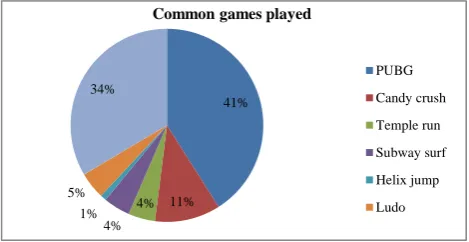
Figure 1:Online/offline games commonly played.
Figure 1 depicts the most common and popular games played by the study participants. Majority (41%) of the students are fascinated to and playing PUBG, 11% candy crush variants while 34% play other games like clash of clans, online chess, cricket, Pokemon Go, rummy/teen patti etc.
41%
11% 4% 4% 1% 5%
34%
Common games played
Table 1:General information of the participants.
Variable Non IGD students (n=180) IGD students (n=20) Total (n=200) Correlation P value Age: Mean age : 18.86±1.08 years
17-19 140 (77.8) 16 (80) 156 (78)
-0.016 0.82
20-22 40 (22.2) 4 (20) 44 (22)
Gender
Male 84 (46.7) 18 (90) 102 (51)
-0.26 0.0002*
Female 96 (53.3) 2 (10) 98 (49)
Year of study
First 91 (50.55) 9 (45) 100 (50)
0.033 0.639
Second 89 (49.44) 11 (55) 100 (50)
Hours spent on gaming per week: Mean hrs of play:12.47 ±10.8 hours
≤30 174 (96.7) 16 (80) 190 (95)
0.229 0.001*
>30 6 (3.3) 4 (20) 10 (5)
*Statistically significant. Percentages in parenthesis, column percentages.
Table 2:Descriptives of the six components.
Variable Salience Mood
modification Tolerance
Withdrawal
symptoms Conflict Relapse Total
Mean 2.43 3.16 2.31 2.01 2.32 2.44 48.72
SD 1.11 0.99 1 0.98 0.84 1.07 15.78
Cronbach’s
Alpha 0.74 0.58 0.68 0.77 0.66 0.73 0.91
ANOVA 1.95 9.2 41.5 2.43 16.53 2.9 29.9
P value 0.144 <0.0001* <0.001* 0.089 <0.001* 0.054 <0.001*
*Statistically significant.
Table 3: Factor analysis of each item with 6 components.
Question Salience Mood
modification Tolerance
Withdrawal
symptoms Conflict Relapse
Item 1 0.752 *
Item 7 0.849 *
Item 13 0.839 *
Item 2R 0.623 *
Item 8 0.800 *
Item 14 0.786 *
Item 3 0.788 *
Item 9 0.767 *
Item 15 0.776 *
Item 4 0.811 *
Item 10 0.868 *
Item 16 0.812 *
Item 5 0.711 *
Item 11 0.717 *
Item 17 0.714 *
Item 19R 0.393
Item 20 0.73 *
Item 6 0.77 *
Item 12 0.828 *
Item 18 0.825 *
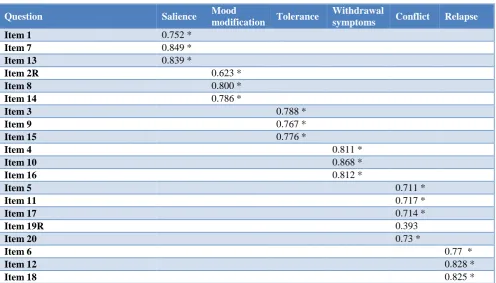
Table 2 shows mean values of all the six components of gaming disorder. 48.72±15.78 mean score of the IGD 20 scale was seen. Reliability of the scale was tested by Cronbach’s alpha. IGD-20 scale showed internal consistency of 0.91 by Cronbach’s alpha which means highly reliable scale. Salience, withdrawal symptoms and relapse components showed more than 0.7 Cronbach’s alpha which means scale is acceptable. Mood modification, tolerance and conflict component along with our IGD-20 scale was statistically significant. Factor analysis of all 20 items using SPSS version 23 has showed statistical significance with Griffiths’s six component model except item 19 in table 3.
Table 3 shows, the principal components analysis (PCA) extraction method was implemented on the 20-item IGD-20 Test by using the Oblimin with the Kaiser Normalization rotation method. Inspection of the correlation matrix revealed the presence of many (70.5%) coefficients of 0.3 and above. The Kaiser-Meyer-Olkin measure of sampling adequacy (MSA) was 0.918, and Bartlett‟s test of sphericity reached statistical significance (approx Chi-square 1764.0, df 190, p <0.0001) supporting the factorability of the correlation matrix. In fact, PCA revealed the presence of four components with eigen values exceeding 1, explaining 39.9 percent, 7.5 percent, 6.3 percent and 5.7 percent of the variance
respectively. Table 4: Summary of factor analysis.
Variable Salience Mood
modification Tolerance
Withdrawal
symptoms Conflict Relapse Total
Salience 1 0.50 0.71 0.55 0.63 0.70 0.85
Mood modification 1 0.37 0.32 0.37 0.51 0.63
Tolerance 1 0.60 0.54 0.63 0.79
Withdrawal symptoms 1 0.64 0.62 0.77
Conflict 1 0.73 0.84
Relapse 1 0.87
Total 1
Factor determinant=0.035; Kaiser-Meyer-Olkin measure:0.858; Bartlett’s test of sphericity; Chi-square:658.73, df=15, p<0.0001. *Correlation statistically significant at p<0.0001.
Table 5: Association of recent social behaviour change with gaming disorder.
Variable Non IGD
students (n=180)
IGD students (n=20)
Total (n=200)
Chi– square
value P value
Often data booster recharge done 29 (16.1 ) 14 (70) 43 (21.5) 30.97 <0.001*
Irritable/ restlessness on losing or
unable to clear the game level 69 (38.3) 15 (75) 84 (42) 9.93 0.002* Engaged in fights on interrupting
game 41 (22.7) 14 (70) 55 (27.5) 27.07 <0.001*
Altered food habits 48 (26.6) 13 (65) 61(30.5) 12.99 0.002*
Missed lectures to play 30(16.6) 15 (75) 45 (22.5) 35.12 <0.001*
Played games during lectures in
classroom 102 (56.6) 18 (90) 120 (60) 8.33 0.004*
Adopted sedentary lifestyle 48 (26.6) 11 (55) 59 (29.5) 7.34 0.025*
*Statistically significant. Parenthesis in column indicates percentage.
Table 6: Association of history of symptoms with internet gaming disorder.
Symptoms Non IGD students (180)
IGD students (20)
Total (200)
Chi- square
value P value
Frequent
headache 74 (41.1) 17 (85) 91 (45.5) 13.98 <0.001*
Refractive errors 45 (25) 15 (75) 60 (30) 21.43 <0.001*
Sleeplessness 51 (28.3) 18 (90) 69 (34.5) 30.29 <0.001*
Watering of eyes 76 (42.2) 16 (80) 92 (46) 10.34 0.001*
Fatigue 54 (30) 15 (75) 69 (34.5) 16.13 <0.001*
Table 7: Correlation of factors with components of gaming disorder.
Factor Salience Mood
modification Tolerance Withdrawal Conflict Relapse Total
Age R 0.002 -0.06 -0.014 0.084 0.087 -0.061 -0.034
P 0.98 0.388 0.84 0.24 0.22 0.388 0.63
Gender R -0.38 -0.27 -0.33 -0.26 -0.27 -0.31 -0.26
P <0.001* <0.001* <0.001* <0.001* <0.001* <0.001* <0.001*
Year R 0.14 -0.004 0.12 0.215 0.173 0.07 0.033
P 0.048* 0.96 0.078 0.002* 0.014* 0.33 0.64
Games R -0.216 -0.2 -0.17 -0.26 -0.266 -0.23 -0.13
P 0.002* 0.004* 0.015* 0.002* <0.001* 0.001* 0.07
Hr/week R 0.439 0.175 0.43 0.36 0.386 0.39 0.311
P <0.001* 0.013* <0.001* <0.001* <0.001* <0.001* <0.001*
*Statistically significant; R=R value; P=P value.
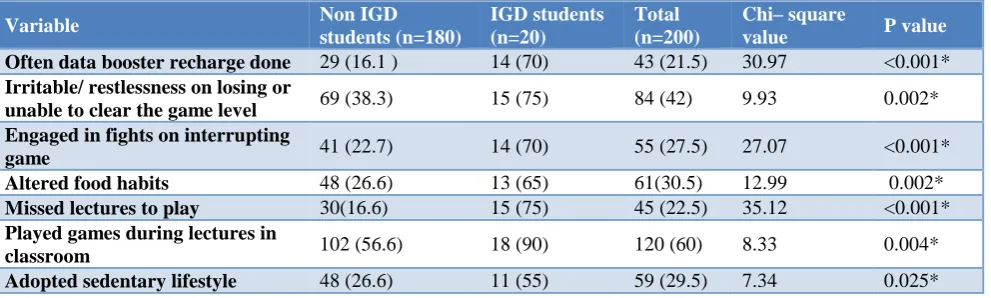
Table 5 shows that majority (60%) of the students uncontrollably started playing online/offline games during the lectures in the classroom. Majority of the disordered gamers showed the entire recently altered social behaviour changes enquired among which 90 % showed tendency of playing in classroom. All the behavioural changes were statistically significant among disordered gamers.
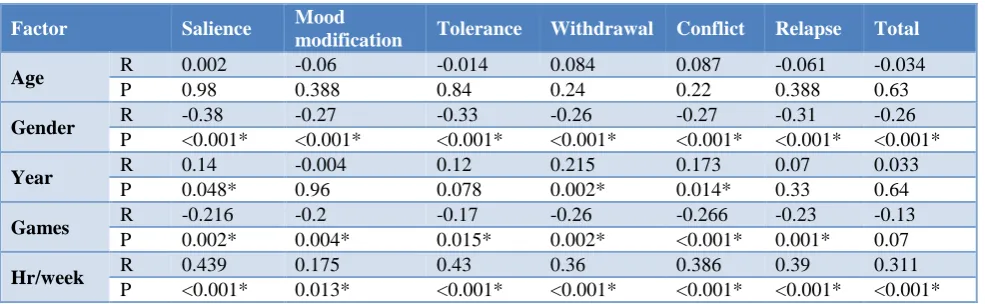
Table 6 shows statistical significance between internet gaming disorder and history of symptoms suffered by participants like frequent headache, refractive errors, sleeplessness, watering or irritation of eyes, easy fatigability as illustrated by them during last 12 months. Table 7 illustrates statistically significant positive correlation between hours spent on gaming per week (more than 30 hours/week) with six components and gaming disorder and statistically significant negative correlation between gender and games with six components of gaming disorder i.e., male and PUBG game players are more prone for disordered gaming. Second year students are positively correlated with salience, withdrawal symptoms and conflict component
DISCUSSION
Prevalence of internet gaming disorder among first and second year Kurnool Medical College, Kurnool medical undergraduates was 10%. Though wide range of prevalence rates of IGD using different scales all over the world are demonstrated, with IGD 20 test 2.6-9.2 % was seen by other studies.17-19 According to Kyle A Faust prevalence may be underestimated due to low response (surveys take time away from gaming) and underreporting (a criterion of IGD is hiding one's extent of internet gaming).20
21st century is an era of widespread tremendous explosion of technological advancement. Increasing technology has inadvertently endangered our lives. Technology is a boon and bane to the present generation. One of the present lives prime requisite is smart phones, with or without
internet. Advanced technology in terms of electronic gadgets, easily accessible networks are attracting the generation making them addicted to it. Competitive business world has made various mobile networks come up with newer internet plans that fascinated the generation Z making them addicted to phones, games, online shopping, social media like facebook, twitter, instagram.
Internal consistency of the scale in our study was 0.91 Cronbach’s alpha which was similar to other studies and better than original one of 0.88.17-19,21 Next, the principal components analysis (PCA) extraction method showed similar results like other study validating on Arabic version of IGD-20 where the Kaiser-Meyer-Olkin measure of sampling adequacy (MSA) was 0.910, and Bartlett’s test of sphericity reached statistical significance but revealed the presence of four components with eigenvalues exceeding 1, while our study revealed six components.21
Mean age of our students participated was 18.86 years and other studies too concentrated more on older adolescents and emerging adults i.e., from 16.26-26.5 years.17-19 Age of the participants didn’t show any significant change among the disordered and non- disordered groups while gender showed significant difference. Study done by Lemmens et al didn’t show any statistical difference between and gender.22 Mean hours spent on gaming per week was 12.47 hours in our study while in other study it was 19.46 hours with more than 21% spending more than 30 hrs per week.17,18 Time spent on games showed significant difference among IGD groups like other studies.17,19,22
consequences in India. Many developed countries have published about the intensity of this evil in their respective countries and our country lacks the data.
CONCLUSION
IGD 20 test scale was found to be highly reliable and a validated scale. Prevalence of the internet gaming disorder in our study was more in male and significant socio-behavioural changes was seen in the disordered group with significant symptoms which have been neglected for a long time. The situation warrants necessary action immediately as treatment is still in its infancy but the consequences are disturbing.
Recommendations
Though the internet gaming addiction rate looks small in numbers the issue is alarming. The problem has increased exponentially due to technological advances with more sophisticated, immersive and rewarding game structures and use on comfortable, handy smartphones. The disordered gamers need to be identified as earlier as possible and timely counselling and help from de-addiction centres should be provided. Parents should monitor their children’s internet gaming activities over mobile, computer, play station and indulge them more in physical games. Self-motivation and self-realisation are the crucial behavioural pattern that can make youth stay away from mobile games and save their lives from the thrall of these online/offline games. Educational institutes should strictly implement rules on usage of smartphones during lectures and child lock limit should be done. Technology and internet should aid in the amelioration of our lives but not vitiate our future.
Limitations
In order to study any disorder with a low prevalence rate such as gaming addiction, large sample pools are necessary for providing reliable estimates of prevalence rates amongst a population. Fear of consequences might have led to biased responses, hiding the real intensity of gaming habit. Long term follow up of the subjects necessary to study the outcome. Additionally, more research clinically too needed to assess whether IGD is a secondary component.
ACKNOWLEDGEMENTS
The authors would like to thank the medical students of Kurnool Medical College for their participation in the study. Also special thanks to Dr. G.S. Rama Prasad, Principal, Dr. A. Sreedevi, Professor and Head of the Department of Community Medicine for supporting and guiding us in carrying out the study.
Funding: No funding sources Conflict of interest: None declared
Ethical approval: The study was approved by the Institutional Ethics Committee
REFERENCES
1. WHO. Public health implications of excessive use of the Internet and other communication and gaming platforms, 2018. Available at https://www.who.int/ substance_abuse/ activities/ addictive_ behaviours/en/ Accessed 8 April 2019.
2. WHO. Gaming disorder, 2018. Available at https://www.who.int/ features/qa/gaming-disorder /en/. Accessed 8 April 2019.
3. Hawi NS, Samaha M. To excel or not to excel: strong evidence on the adverse effect of smartphone addiction on academic performance. Comput Educ. 2016;98:81-9.
4. Linda AJ, Alexander VE, Edward AW, Yong Z, Hiram EF. A longitudinal study of the effects of Internet use and videogame playing on academic performance and the roles of gender, race and income in these relationships. Comp Hum Behav. 2011;27(1):228-39.
5. Gentile DA, Coyne S, Walsh DA. Media violence, physical aggression, and relational aggression in school age children: a short-term longitudinal study. Aggress Behav. 2011;37(2):193-206.
6. Gitter SA, Ewell PJ, Guadagno RE, Stillman TF, Baumeister RF. Virtually justifiable homicide: the effects of prosocial contexts on the link between violent video games, aggression, and pro social and hostile cognition. Aggress Behav. 2013;39(5):346-54.
7. Veenhof B. Wellman B, Quell C, Hogan B. How Canadians’ use of the Internet affects social life and civic participation. Connectedness series. ON: Science, Innovation and Electronic Information Division (SIEID). Ottawa, Statistics Canada: 2008. 8. DeLisi M, Vaughn MG, Gentile DA, Anderson CA,
and Shook JJ. Violent video games, delinquency, and youth violence new evidence. Youth Violence and Juvenile Justice. 2013;11(2):132-42.
9. Tortolero SR, Peskin MF, Baumler ER, Cuccaro PM, Elliott MN, Davies SL et al. Daily violent video game playing and depression in preadolescent youth. Cyberpsychol Behav Social Network. 2014;17(9):609-15.
10. Kim J, LaRose R, Peng W. Loneliness as the cause and the effect of problematic Internet use: the relationship between Internet use and psychological well-being. CyberPsychol Behavior 2009;12(4):451-5.
11. Page AS, Cooper AR, Griew P, Jago R. Children’s screen viewing is related to psychological difficulties irrespective of physical activity. Pediatr. 2010;126(5):1011-7.
performance, and satisfaction with life. Comput Human Behav. 2016;57:321-5.
13. Griffiths MDA ‘components’ model of addiction within a biopsychosocial framework. J Substance Use. 2005;10(4):191-7.
14. Rehbein F, Psych G, Kleimann M, Mediasci G, Moble T. Prevalence and risk factors of video game dependency in adolescence: results of a German nationwide survey. Cyberpsychol Behav Soc Netw. 2010;13(3):269-77.
15. Lopez-Fernandez O, Honrubia-Serrano ML, Baguley T, Griffiths MD. Pathological video game playing in Spanish and British adolescents: Towards the exploration of Internet gaming disorder symptomatology. Comput Human Behav. 2014;41:304-12.
16. Pontes.HM, Griffith MD. Assessment of Internet Gaming Disorder in Clinical Research: Past and present perspectives. Clin Res Regul Aff. 2014;31(2-4):35-48.
17. Pontes HM, Kiraly O, Demetrovics Z, Griffiths MD. The conceptualisation and measurement of DSM-5 Internet gaming disorder: The development of the IGD-20 Test. PLoS One. 2014;9(10):e110137.
18. Fuster H, Carbonell X, Pontes HM, Griffiths MD. Spanish validation of the Internet Gaming Disorder-20 (IGD-Disorder-20) Test. Comput Human Behav. 2016;56:215-24.
19. Hawai NS, Samaha M, Griffiths MD. Internet gaming disorder in Lebanon: Relationships with age, sleep habits, and academic achievement. J Behav Addict. 2018;7(1):70-8.
20. Faust KA, Prochaska JJ. Internet gaming disorder: A sign of the times or time for our attention. Addict Behav. 2018;77:272-4.
21. Hawi NS, Samaha M. Validation of the Arabic Version of the Internet Gaming Disorder-20 Test. Cyberpsychol Behav Soc Netw. 2017;20(4):268-72. 22. Lemmens, JS, Valkenburg, PM, Gentile DA,
Reynolds CR. The internet gaming disorder scale. Psychol Assess. 2015;27(2):567-82.