Integrating IPA with Kano Model for Analyzing Service Quality
Elements of Mobile Ride-Hailing App
Anindita Ayu Pratiwi1 and Widya Silfianti2
1, 2 Department of Computer Science and Information Technology, Universitas Gunadarma, Depok, Indonesia
1
[email protected], [email protected]
ABSTRACT
Mobile ride-hailing apps have taken center stage around the world, especially in Indonesia. Mobile ride-hailing apps are revolutionizing urban transport in Indonesia since 2013. This study uses an integrated approach of IPA-Kano model to analyze the service quality and performance of mobile ride-hailing apps and providing specific strategies for attributes in each category that should be prioritized for the development. A total of 400 valid data were collected by distributing online questionnaires. Based on thirteen attributes analyzed with IPA-Kano model, the results showed that attributes can be categorized by their different quality attributes. Five most important features perceived by mobile ride-hailing users were; 1) motorbike service, 2) food delivery service, 3) courier service, 4) chat service, and 5) driver information.
Keywords: Importance-Performance Analysis, IPA-Kano, Kano Model, Mobile Ride-Hailing, Service Quality.
1. INTRODUCTION
Transportation service application is an application that provides various services for vehicle sharing system at once and in a short time [1]. In Indonesia, companies engaged in online transportation services shall be governed by a letter issued by the Minister of
Transportation of Indonesia, number
UM.3012/1/21/Phb/2015, dated November 9, 2015 [2] and Transportation Ministerial Regulation No. 108/2017 on the operation of non-route public transportation. [3]. The transportation business in Indonesia is growing rapidly. In recent years, Indonesia has undergone a transformation in transportation. Currently, people who live in Indonesia have facilitated in terms of booking public transportation services with the presence of online-based transport service application.
User satisfaction of service and performance will greatly affect the image of ride-hailing service company, so this should be an important concern for the fast growing ride-hailing service provider in Indonesia. The presence of this online ride-hailing innovation needs to be supported by the availability of quality applications to support the needs and satisfaction of its users.
Analyzing the level of user satisfaction can be done with an integrated approach of Importance-Performance Analysis (IPA) and Kano Model. IPA is a technique for prioritizing attributes for improvement based on user evaluations [4]. Kano model classified customer
requirements into five categories (must-be, one-dimensional, attractive, indifferent, and reverse) [5][6][7] IPA-Kano model is proposed to identify the strength or weakness and the satisfaction factor simultaneously for a particular item by the same questionnaire.
In this study, the application of online ride-hailing services serve as the object of research that will be measured the level of user satisfaction. The level of user satisfaction measured by an integrated approach of IPA and Kano model. The results of the analysis can be recommended for application developers of online ride-hailing service company in order to improve the services of the application features and to know the priority of any features that need to be maintained and developed.
2. LITERATURE REVIEW
2.1 Ride-Hailing Services in Indonesia
market in 2009, and in 2012 through Lyft. Both of them provided an app connecting to drivers and riders. Online ride-hailing services in Indonesia have officially legalized by The Minister of Transportation by introducing a regulation number 108/2017 on the operation of non-route public transportation. The issuance of such regulation is a response to the revocation of 14 main articles in the previous Regulation No. 26/2017 by the Supreme Court [9].
2.2 Importance-Performance Analysis (IPA)
IPA was first introduced by Martilla and James to identify the strengths and weaknesses of a company [10]. Sihombing et al., said the main purpose of the IPA is as a diagnostic tool to facilitate the identification of attributes, given their importance, products or services of poor performance or over performs [11]. Moreover, according to Wu et al. (2010), IPA is able to identify the most important attributes to the customer with the highest impact on customer satisfaction and the low performance attributes required to be improved immediately [12]. To represent the importance and performance pairs for each quality attribute, a matrix is plotted. The interpretation is presented graphically on a grid divided into four quadrants.
Fig. 1. IPA Matrix [10]
According to figure 1, four quadrants consist of “Keep up the good work” as Quadrant I (high importance, high performance), “Concentrate here” as Quadrant II (high importance, low performance), “Low priority” as Quadrant III (low importance, low performance), and “Possible overkill” as Quadrant IV (low importance, high performance).
2.3 Kano Model
Kano model is a useful diagram to identify which customer requirements of a particular product or service might bring more proportional satisfaction to customer [12]. Kano classifies attributes based on how they are perceived by customer and their effect on customer satisfaction. Based on Kano model, customer requirements can be classified into five categories [5][6][7]:
1.
Must-be quality element: The must-be requirements fulfill the basic functions of product. If these requirements are not present, customers will be extremely dissatisfied.2.
One-dimensional quality element: customer satisfaction is proportional to one-dimensional quality. The higher the one-dimensional quality element, the higher satisfaction will be and vice versa.3.
Attractive quality element: High level of attractive quality performance creates feelings of delight for a customer. On the contrary, low level of performance creates feelings of indifference to the requirement. These requirements are not demanded nor expected by customer.4.
Indifferent quality element: Customer will be indifferent whether or not the quality is present.5.
Reverse quality element: Customer will be dissatisfied when the quality element is present and vice versa.Kano model uses a pair of questions by asking the respondent to evaluate which customer requirements do not bring satisfaction when present as well as bring dissatisfaction when these requirements are not met. A pair of the Kano model question is as follows [10]:
1.
Functional question: How would you feel if this product or service feature were present?2.
Dysfunctional question: How would you feel if this product or service were not present?Table 1: Kano Evaluation Table [13]
M = Must-be; O = One-dimensional; A = Attractive; I = Indifferent; R = Reverse; Q = Questionable
To determine a product or service feature in an appropriate Kano’s category from a group or respondents, a formula is depicted as follows [5]:
1.
Maximum (A, O, M) if A + O + M > I + R + Q2.
Maximum (I, R, Q) if A +O + M ≤ I + R + Q2.4 An Integrated Approach of IPA-Kano
This model formulates the priority development strategy of each service attribute. Performance and importance are based on customer perceptions, and both can be improved by making an effort. An integrated approach of IPA-Kano is proposed to identify the strengths or weaknesses and the satisfaction factor simultaneously for a particular item by the same questionnaire. A Hybrid Kano questionnaire can be implemented in an IPA to replace the self-stated importance. IPA-Kano model can be seen in figure 2.
Fig. 2. IPA –Kano Model [12]
Development priorities are obtained by combining the IPA matrix classification results and Kano model classification of each service attribute and classifying them into 12 categories with their respective priority level as shown in table 2.
Table 2: Series, Categories, and Strategic Priorities of IPA-Kano [12]
3. METHOD
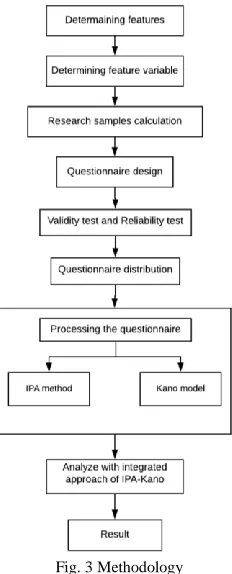
This study begins by defining the main features of ride-hailing app to be analyzed, specifies the variable name for each feature attribute, determine the number of samples, design the questionnaire based on IPA-Kano, and analyze the data to get the results (see figure 3).
3.1 Ride-Hailing App Main Features
Fig. 3 Methodology
3.2 Sample
The sample was selected from mobile ride-hailing apps users in Indonesia. The number of sample taken is 400 respondents. Online form questionnaires were distributed to users domiciled in Jakarta, Bogor, Depok, Tangerang, Bekasi, and other areas of Indonesia with minimum of senior high school or equivalent education and at least more than one time using the app.
3.3 General Characteristics of Respondents
Based on data collected, the number of female respondents as much as 221 persons with a percentage of 55.25% and the number of male respondents as much as 179 persons with a percentage of 44.75%. 63.25% of respondents (235 persons) use the app about 1 - 5 times a week, 22.5% of respondents (90 persons) use 5 - 10 times a week, and 14.25% of respondents (57 persons) use more than 10 times a week.
4. RESULT
4.1 Importance-Performance Analysis
The importance and performance level are done by calculating the average of importance and actual
performance level of each attribute based on user perception. Based on table 3, Motorbike service (S1) attribute has the highest importance level (4.45) and Taxi service (S3) has the lowest importance level (3.63).
Table 3: The Mean Values of Perceived Importance and Performance of Mobile Ride-Hailing App
No Dimension Attribute Importance Performance
1 Service S1 4.45 4.07
2 Service S2 4.09 4.01
3 Service S3 3.63 3.65
4 Service S4 4.25 4.16
5 Service S5 4.25 4.13
6 Service S6 4.18 4.07
7 Service S7 4.64 4.30
8 Service S8 4.25 4.02
9 Information I1 4.11 3.96
10 Information I2 4.19 3.97
11 Information I3 4.40 3.97
12 Information I4 4.80 4.29
13 Information I5 3.92 3.80
Mean 4.24 4.03
From thirteen analyzed attributes, Motorbike service (S1), Food delivery (S4), Courier service (S5), Chat service (S7), and Driver information (S7) are located in quadrant I. These five attributes are the main strengths owned by ride-hailing apps in Indonesia. In contrast to the main strength, the Online payment (S6) attribute is in quadrant IV, which indicates the ride-hailing app is not performing well based on user perceptions for this attribute.
The average value of each attribute for actual importance and performance is illustrated in the IPA matrix as shown in figure 4. There are five attributes in quadrant I. Attributes in this quadrant have high level of importance and high level of performance. The five attributes are; Motorbike service (S1), Food delivery (S4), Courier service (S5), Chat service (S7), and Driver information (I4).
Attributes that are in quadrant II have high level of importance, but the performance level tends to be low. The attributes that placed in the quadrant II are; Rewards (S8) and Help center (I3).
Fig. 4. The Perceived Importance-Performance Analysis of Mobile Ride-Hailing App
Attributes that are placed in quadrant IV are attributes with low level of importance, but high level of performance. Online payment (S6) is the only attribute that placed in quadrant IV.
4.2 Classification of the Two-Dimensional Quality
Model (Kano Model)
Kano model is used to classify every main attributes on the app. The existing attributes can be classified into one of six categories; attractive (A), one-dimensional (O), must-be (M), indifferent (I), reverse (R), and questionable (Q), by combining two answers (functional and dysfunctional) by using Kano evaluation table [13]. After categorizing 400 responses as A, O, M, I, R, or Q, the number of each category on each pair of question is calculated (see table 4).
Table 4: Recapitulation with Kano Model
Attribut e
A O M I R Q Category
S1 161 180 24 32 0 3 O
S2 160 126 22 84 3 5 A
S3 73 63 14 245 2 3 I
S4 141 152 10 88 1 8 O
S5 134 136 21 100 3 6 O
S6 121 116 23 126 5 9 A
S7 106 182 32 75 1 4 O
S8 88 91 25 187 5 4 O
I1 65 81 43 204 2 5 I
I2 76 101 42 124 3 4 O
I3 58 123 68 144 1 6 O
I4 40 195 101 56 3 5 O
I5 89 71 22 215 0 3 I
From table 4, Private car service (S2) and Online payment (S6) are categorized as Attractive. Attributes with this category can be developed as an innovative
process. Motorbike service (S1), Food delivery (S4), Courier service (S5), Chat service (S7), Rewards (S8), Notifications (I2), Help center (I3), and Driver information (I4) are categorized as One-dimensional quality element. Attributes with One-dimensional category can be interpreted that if these attributes are not present, then the user will be feeling more dissatisfied, but if these attributes are present, then the user will be feeling more satisfied.
In this study, there is no attribute categorized as Must-be and Reverse quality element. There are three attributes categorized as Indifferent quality element. Attributes with this category can be regarded as a less significant attribute to user satisfaction. The user is neutral towards this category. The three attributes are; Taxi service (S3), History (I1), and Favorites (I5).
4.3. Integrated IPA-Kano
Figure 5 summarizes specific integration of IPA and types of quality categories based on Kano model. The attributes placed in quadrant I and quadrant II are viewed as strengths. The attributes included in the Attractive category should be placed at the highest priority in order to gain competitiveness. The One-dimensional and Must-be categories are respectively placed on the second and third priorities.
Fig. 5. Attributes Classification by Kano Category, Importance Level, and Quadrant
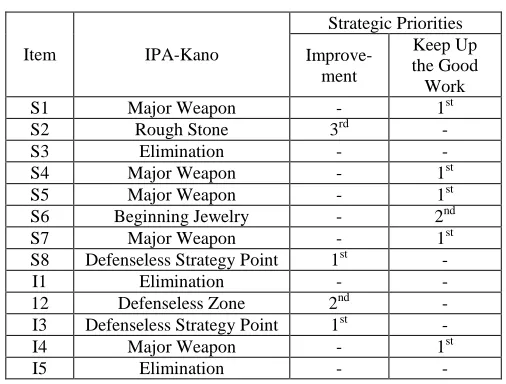
at the highest priority. The results of attributes classification with IPA-Kano can be seen in table 5. Based on the integration of IPA-Kano model, Motorbike service (S1), Food delivery (S4), Courier service (S5), Chat service (S7), and Driver information (I4) are categorized as “Major Weapon”. These five attributes are like the main weapon used by ride-hailing companies in the competition. Companies must strive to maintain attributes performance to be a tough competitor.
Rewards (S8) and Help center (I3) are placed in the “Defenseless Strategy Point” category. These attributes have low performance but high importance and one-dimensional category. S8 and I3 should be third ranked in the list of improvements. After the improvement, attributes in “Defenseless Strategy Point” can serve as a useful and well-preserved weapon.
Private car service (S2), Taxi service (S3), History (I1), Notifications (I2), and Favorites (I5) are placed in quadrant III based on IPA matrix or categorized as “Low Priority”. Based on IPA-Kano analysis, S2 placed in the “Rough Stone” category which means it has a low performance, low importance, and placed in Attractive quality element. The increase of attribute with this category is not given a high priority, because it has a low importance level. Thus, S2 is placed last on the list of improvements. I2 is categorized as “Defenseless Zone” (low performance, low importance, and One-dimensional).
Table 5: IPA-Kano Classification
Attribute IPA Kano IPA-Kano
S1 Quadrant I O Major Weapon
S2 Quadrant III A Rough Stone
S3 Quadrant III I Elimination
S4 Quadrant I O Major Weapon
S5 Quadrant I O Major Weapon
S6 Quadrant IV A Beginning Jewelry
S7 Quadrant I O Major Weapon
S8 Quadrant II O Defenseless Strategy Point
I1 Quadrant III I Elimination
I2 Quadrant III O Defenseless Zone
I3 Quadrant II O Defenseless Strategy Point
I4 Quadrant I O Major Weapon
I5 Quadrant III I Elimination
Attribute I2 is the fourth ranked on list of improvement because it gives less influence to user satisfaction. S3, I1, and I5 are categorized as “Elimination” because these three attributes are included in the Indifferent category based on the IPA matrix. These attributes should be analyzed again about their existence, whether the user has understood the functions and benefits of these attributes.
Online payment (S6) is the only attribute that placed in the “Possible Overkill” area or quadrant IV on the IPA matrix. Under IPA, the reduction of resources allocated in S6 can be considered, however, based on the IPA-Kano model, S6 is categorized as “Beginning Jewelry” (high performance, low importance, and Attractive). If available resources, companies may use media manipulation or placement marketing to increase the importance level of S6, but if available resources are inadequate, companies may consider reducing investment in this attribute.
Table 6: Strategic Priorities
Item IPA-Kano
Strategic Priorities
Improve-ment
Keep Up the Good Work
S1 Major Weapon - 1st
S2 Rough Stone 3rd -
S3 Elimination - -
S4 Major Weapon - 1st
S5 Major Weapon - 1st
S6 Beginning Jewelry - 2nd
S7 Major Weapon - 1st
S8 Defenseless Strategy Point 1st -
I1 Elimination - -
12 Defenseless Zone 2nd -
I3 Defenseless Strategy Point 1st -
I4 Major Weapon - 1st
I5 Elimination - -
5. CONCLUSIONS
The analysis of importance, performance, and user satisfaction towards ride-hailing app in Indonesia has been successfully done by using the integrated approach of IPA-Kano model. From thirteen main attributes of ride-hailing services, there are four attributes that need to be improved in order to gain user satisfaction and six attributes that already have good performance. The other three attributes need to be considered again its presence and function because those are placed in the “Elimination” category based on IPA-Kano model. Attributes S8 and I3 are placed in the first ranked attributes need to be improved because S8 and I3 are placed in the One-dimensional category and have high importance, but low performance. The second priority to be improved is I2. This attribute is placed in the One-dimensional category with an equally low level of importance and performance. Attribute S2 placed in the third ranked of priority in the improvement. S2 placed in the Attractive category based on Kano model, but low performance and low importance.
Attributes that have good performance and must be maintained are Motorbike service (S1), Food delivery (S4), Courier service (S5), Online payment (S6), Chat service (S7), and Driver information (I4). Driver information (I4), Chat service (S7), Motorbike service (S1), Food delivery (S4), and Courier service (S5) are placed in the first rank on keep up the good work list, while Online payment (S6) in the second rank.
History (I1), Favorites (I5), and Taxi service (S3) are not included in the determination of strategic priorities because placed in the “Elimination” category based on IPA-Kano.
REFERENCES
[1] Internet Live Stats (2017). Internet Live Stats. [Online]. Available at http://www.internetlivestats.com/. [2] Roger, S. P. (2012). Rekayasa perangkat lunak
(pendekatan praktisi) edisi 7: Buku 1. Yogyakarta: Andi.
[3] Lewis, W. E. (2000). Software Testing and Continuous Quality Improvement.CRC Press.
[4] [4] Myers, G. J., Sandler, C., and Badgett, T. (2012). The Art of Software Testing. John Wiley & Sons, Inc, third edition edition.
[5] Shubhmeet Kaur, “A Review of Software Development Life Cycle Models”, International Journal of Advanced Research in Computer Science and Software Engineering, Volume 5, Issue 11, November 2015 ISSN: 2277 128X.
[6] Drabick, R. D. (2013). Best practices for the formal software testing process: A menu of testing tasks. Pearson Education.
[7] Lewis, W. E. (2000). Software Testing and Continuous Quality Improvement.CRC Press.
[8] Kumar, D. and Mishra, K. (2016). The impacts of test automation on software’s cost, quality and time to market. Procedia Computer Science, 79:8–15.
[9] Dustin, E. (2002). Effective Software Testing: 50 Ways to Improve Your Software Testing. Addison-Wesley Longman Publishing Co., Inc.
[10] Team, S. D. (2010). Selenium Documentation Release 1.0. [Online]. Available at: http://bit.ly/2oSj061. [11] Muthukadan, B. (2017). Selenium Python Binding
Release 2. [Online]. Available at:
![Fig. 1. IPA Matrix [10]](https://thumb-us.123doks.com/thumbv2/123dok_us/1326241.1640767/2.612.101.271.402.586/fig-ipa-matrix.webp)
![Table 1: Kano Evaluation Table [13]](https://thumb-us.123doks.com/thumbv2/123dok_us/1326241.1640767/3.612.84.287.501.654/table-kano-evaluation-table.webp)