Original Research Article
Utilization of antenatal services by JSY beneficiaries in rural area of
Pune district of Maharashtra
Sachin Gupta
1, Prasad Pore
2*, Arvind Athavale
1INTRODUCTION
Health in its broad sense is not merely the absence of disease or provision of diagnostic or curative services.1 In India, the government believes that health maintenance of people is a fundamental human right, does continuous efforts to reduce mortality and morbidity among vulnerable population. Maternal and child health issues in India remain in forefront of national health policies and programmes.
WHO, UNICEF, UNFPA had reported that in 2015 India and Nigeria account for one third of maternal deaths worldwide.2 India during 2015 alone accounts for 15% of maternal deaths worldwide.2
One of the major concerns of the reproductive and child health (RCH) Program phase II, is the extremely low percentage of institutional deliveries in India. Initially in 2006 the number of institutional deliveries was almost negligible among women living below poverty line
ABSTRACT
Background: To combat the reproductive and child health (RCH) problems, National Rural Health Mission (NRHM) had launched Janani Suraksha Yojana (JSY) in April 2005 in all states and union territories to promote institutional deliveries among the poor population through provision of antenatal, intra-natal and post-natal care services for women to have healthy outcomes of pregnancy and child birth. Hence this study has been undertaken on one of the important aspect of services that is antenatal care services with the objective to assess the utilization of antenatal care services among JSY beneficiaries in rural area.
Methods: Cross sectional observational study done in the area under rural health training centre of a private medical college of Pune district. 1st October 2014 to 30th September 2015. Study sample: All JSY beneficiaries who delivered during study period (1st October 2014 to 30th September 2015). One to one interview with the all 155 beneficiaries was conducted using the pretested, questionnaire. The interview was timed at minimum 6 week interval after the delivery. Data analysis was done by using SPSS 20.0 statistical software.
Results: Majority 78 (50.3%) of beneficiaries out of 155 got registered themselves within 12 weeks of pregnancy. Antenatal coverage was quite good. Coverage of injection tetanus toxoid was 100% and all essential investigation have been carried out. Association between literacy level (up to higher secondary level) of beneficiaries and number of ANC visits was found statistically significant (p<0.001).
Conclusions: In present study utilization of ANC services was found to be good.
Keywords: Antenatal care services, Janani Suraksha Yojana, JSY beneficiaries
Department of Community Medicine, 1Chirayu Medical College and Hospital, Bhopal, Madhya Pradesh, 2Bharati Vidyapeeth Deemed to be University, Medical College Pune, Maharashtra, India
Received: 06 May 2019 Accepted: 14 June 2019
*Correspondence: Dr. Prasad Pore,
E-mail: [email protected]
Copyright: © the author(s), publisher and licensee Medip Academy. This is an open-access article distributed under the terms of the Creative Commons Attribution Non-Commercial License, which permits unrestricted non-commercial use, distribution, and reproduction in any medium, provided the original work is properly cited.
(BPL) and remote villages.3 Saving mothers lives is not only imperative, but a sound investment that benefits their children, families, community and the country.
To combat the problem, National Rural Health Mission (NRHM) had launched Janani Suraksha Yojana (JSY) in April 2005 in all states and union territories to promote institutional deliveries among the poor population through provision of referral, transport, and cash assistance with delivery and post-delivery care for women to have healthy outcomes of pregnancy and child birth.
The JSY is a conditional cash transfer scheme fully sponsored by central government. Under JSY woman is given cash assistance if she delivers her baby in a medical facility such as-in Government health centres, like sub centre (SC), primary health centre (PHC), community health centres (CHCs) or general ward of district or state hospital, government medical colleges or accredited private institutions.4
The success of the JSY scheme is to be assessed by the increase in institutional deliveries by using JSY scheme in Maharashtra. Hence this study has been undertaken to assess one of the important aspect of JSY i.e., antenatal care services utilization among JSY beneficiaries.
METHODS
The study conducted in the area under rural health training centre of a private medical college of Pune district.
Study design
Cross sectional study.
Study area
Rural health training centre (RHTC) of private medical college which is situated in Mulshi block of Pune district 25 kilometres away from the medical college.
Study period
1st October 2014 to 30th September 2015.
Study sample
All JSY beneficiaries who delivered during study period (1st October 2014 to 30th September 2015) were included in the study.
Methodology
Of the 4 primary health centres (PHCs) under Mulshi Block (RHTC area of private medical college, Pune) two
PHCs were randomly selected for study purpose: PHC 1 and PHC 2.
Prerequisites done before initiation of data collection
Institutional ethical committee clearance was obtained prior to the start of the study.
Permission from district health officer (DHO) Pune was obtained for conducting the study in PHCs of Mulshi block.
The concerned medical officers of two selected PHCs were contacted and the study was discussed with them.
List of all JSY beneficiaries under the jurisdiction of accredited social health activist (ASHA) was obtained from auxiliary nurse midwifery (ANM) of concerned PHCs.
After obtaining JSY beneficiaries list from PHC, supervisor of ASHA was contacted and meeting was arranged with ASHA at the concerned PHC. The main purpose of meeting was to enlist aid of
ASHA in identification of JSY beneficiary’s residential address and contact details.
In the meeting the study was discussed with all ASHA of respective PHC briefly.
Data collection was carried out in the following way
Home visits for data collection were planned once or twice weekly as per the availability of JSY beneficiaries.
Prior to day of visit ASHA was contacted to fix a meeting with JSY beneficiaries at their place as per beneficiaries’ convenient time. Sometime visits were made on Saturday or Sunday which was suitable time to meet with beneficiaries at their place.
On the day of visit, principal investigator went along with ASHA to identify beneficiaries’ address. After identifying addresses of beneficiaries, ASHA left the premises to carry out her own duties. JSY beneficiaries were explained the purpose of the
study and were assured of maintaining confidentiality of all the personal information. Written informed consent was obtained.
One to one interview with the beneficiaries was conducted using the predesigned, pretested, questionnaire.
Responses of JSY beneficiaries were verified from Mother Child Health (MCH) Card or Health facility records in case they were unable to recall of any event.
Selection of study sample
There were 204 JSY beneficiaries across PHC 1and PHC 2 PHCs during study period (1st October 2014 to 30th September 2015). 90 out of 204, were from PHC 1 and 114 from PHC 2 PHCs.
Inclusion criteria
All JSY beneficiaries who have taken ANC, intra-natal and post-natal services from concerned PHCs were included in the study.
Exclusion criteria
JSY beneficiaries who could not be contacted even after 3 home visits were excluded from the study. Those who shifted out permanently shortly after
delivery.
Total expected respondent beneficiaries = 204.
Interviewed beneficiaries= 155 {65- PHC 1+ 90- PHC 2}.
Out of 204 beneficiaries 15 beneficiaries(9-PHC 1+6 PHC 2) could not be approached due to non-availability of them in spite of 3 home visits, 34(16-PHC 1+18-PHC 2) who got delivered at PHC but did not avail ANC services and PNC services from respective PHCs. For example beneficiaries who delivered at their parents’ home place and shifted out shortly after delivery to their husband’s home place. So final sample for this study was 155.
Study tool
A predesigned pretested questionnaire was used to collect information from the study participants. The questionnaire used in an earlier study done by Karnataka State Health System Resource centre Bangalore in collaboration with Jagruti, Dharwad4 was modified as per the requirement. The questionnaire was pretested.
Questionnaire consisted of 2 parts: first part consists of general information regarding socio demographic characteristics. e.g., age of women and husband, type of family, occupation, education of women and husband etc. Second part consists of utilization of antenatal services. e.g., no. of ANC visits, BP monitoring, weight measurement, iron folic acid tablets taken etc.
Data analysis
Data analysis was done by using SPSS 20.0 Statistical software. Qualitative data were expressed by using frequency and percentage. Fisher’s exact and chi square test was used to find the association between utilization of antenatal services and socio demographic variables. P-value of <0.05 was considered as significant.
RESULTS
Mean age of women was 23.38 years (SD= 3.06) across both the PHCs. Maximum number of women were educated up to secondary standard 54 (34.8%) followed by primary standard 38 (24.5%). Study shows that 51 (32.9%) husbands were educated up to secondary level followed by 35 (22.6%) with middle standard. Husband illiteracy was found slightly less than women. Present study showed that maximum number of beneficiaries 70 (45.2%) belonged to nuclear family. Study shows that, there were 17 beneficiaries who had more than 2 living children (Table 1).
Table 1: Distribution of JSY beneficiaries as per socio demographic variables (n=155).
Socio-demographic variables
Number of beneficiaries N (%)
Age group (in years)
≤18 3 (1.93)
19-23 90 (58.07) 24-28 56 (36.13) >28 6 (3.87)
Education of beneficiaries
Illiterate 11 (7.1) Primary 38 (24.5) Middle 30 (19.4) Secondary 54 (34.8) Higher
Secondary 16 (10.3) Graduate 5 (3.2) Post
graduate 1 (0.7)
Education of beneficiary’s husband
Illiterate 9 (5.8) Primary 22 (14.2) Middle 35 (22.6) Secondary 51 (32.9) Higher
Secondary 28 (18.0) Graduate 10 (6.5) Post
graduate 0
Family type
Nuclear 70 (45.2) Joint 56 (36.1) Three
Generation 29 (18.7)
Number of living children
1 64 (41.29)
2 74 (47.74)
3 16 (10.32)
4 1 (0.7)
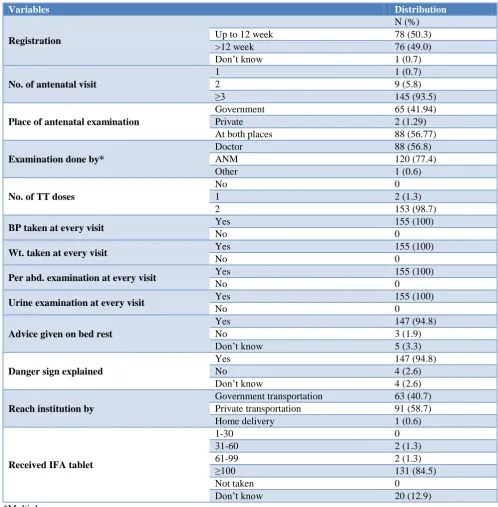
ANM, while 88 (56.89%) beneficiaries were examined by doctor and 1 (0.6%) beneficiary was examined by other health care personnel (not by ANM or doctor) (Multiple responses given by beneficiaries). All 155 beneficiaries took TT injection and also all essential investigation have been carried out (Weight taken, BP taken, Urine examination and per abdomen examination etc.) at every ANC visits. Advice had been given on bed rest to majority 147 (94.8%) of beneficiaries while 5 (3.3%) beneficiaries did not remember regarding advice.
147 (94.8%) beneficiaries were explained about danger signs during pregnancy by health worker while 4 (2.6%) did not remember regarding danger sign explanation. At the time of labour, majority 91 (58.7%) beneficiaries reached by private transportation and 63 (40.7%) used government facilities to reach institute. All 155 beneficiaries took IFA tablets, out of which 131 (84.5%) took ≥100 IFA tablets and 20 (12.9%) did not remember the number of tablets taken (Table 2).
Table 2: Distribution according to utilization of ANC services under JSY (n=155).
Variables Distribution
Registration
N (%)
Up to 12 week 78 (50.3)
>12 week 76 (49.0)
Don’t know 1 (0.7)
No. of antenatal visit
1 1 (0.7)
2 9 (5.8)
≥3 145 (93.5)
Place of antenatal examination
Government 65 (41.94)
Private 2 (1.29)
At both places 88 (56.77)
Examination done by*
Doctor 88 (56.8)
ANM 120 (77.4)
Other 1 (0.6)
No. of TT doses
No 0
1 2 (1.3)
2 153 (98.7)
BP taken at every visit Yes 155 (100)
No 0
Wt. taken at every visit Yes 155 (100)
No 0
Per abd. examination at every visit Yes 155 (100)
No 0
Urine examination at every visit Yes 155 (100)
No 0
Advice given on bed rest
Yes 147 (94.8)
No 3 (1.9)
Don’t know 5 (3.3)
Danger sign explained
Yes 147 (94.8)
No 4 (2.6)
Don’t know 4 (2.6)
Reach institution by
Government transportation 63 (40.7)
Private transportation 91 (58.7)
Home delivery 1 (0.6)
Received IFA tablet
1-30 0
31-60 2 (1.3)
61-99 2 (1.3)
≥100 131 (84.5)
Not taken 0
Don’t know 20 (12.9)
*Multiple responses.
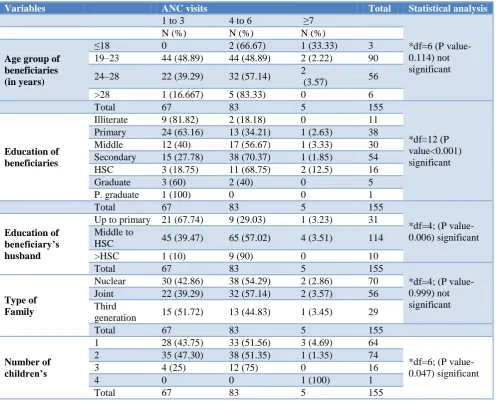
Table 3 shows that, as age increases the number of ANC visits substantially increases that is, in the age group of in 19-23 years 48.89% beneficiaries had done 4-6 ANC
years age group 83.33% (5 out of 6) had done 4-6 ANC visits.
Beneficiaries who were less than or equal to 18 year of age, 2 (66.67%) had done four to six ANC visits out of 3 beneficiaries. Table 3 showed that as literacy increases, number of ANC visits also increased. Out of total 49 beneficiaries educated up to primary school only 15 (30.6%) had done four to six ANC visits while in contrast to it, out of total 100 beneficiaries educated up to middle to higher secondary (HSC) 66 (66.0%) had done four to six ANC visits which was found statistically significant (p<0.001). But when beneficiaries go to more than higher
secondary education group their number of ANC visits falls down because they might have busy in their work. There is constant rising trend and positive association between number of ANC visits and education status of husbands which was found statistically significant (p=0.006). Table also shows that beneficiaries who lived in nuclear and joint family, majority had done four to six ANC visits respectively. The proportion of four to six ANC visits was significantly improved to 12 (75%) out of 16 among beneficiaries who had 3 living children. The above improvement in number of ANC visits among beneficiaries who had more than 2 children was found statistically significant (0.047) (Table 3).
Table 3: Association between sociodemographic variables and ANC visits done by beneficiaries.
Variables ANC visits Total Statistical analysis
1 to 3 4 to 6 ≥7
*df=6 (P value-0.114) not significant
N (%) N (%) N (%)
Age group of beneficiaries (in years)
≤18 0 2 (66.67) 1 (33.33) 3
19–23 44 (48.89) 44 (48.89) 2 (2.22) 90
24–28 22 (39.29) 32 (57.14) 2
(3.57) 56
>28 1 (16.667) 5 (83.33) 0 6
Total 67 83 5 155
*df=12 (P value<0.001) significant Education of
beneficiaries
Illiterate 9 (81.82) 2 (18.18) 0 11
Primary 24 (63.16) 13 (34.21) 1 (2.63) 38
Middle 12 (40) 17 (56.67) 1 (3.33) 30
Secondary 15 (27.78) 38 (70.37) 1 (1.85) 54
HSC 3 (18.75) 11 (68.75) 2 (12.5) 16
Graduate 3 (60) 2 (40) 0 5
P. graduate 1 (100) 0 0 1
Total 67 83 5 155
*df=4; (P value-0.006) significant Education of
beneficiary’s husband
Up to primary 21 (67.74) 9 (29.03) 1 (3.23) 31 Middle to
HSC 45 (39.47) 65 (57.02) 4 (3.51) 114
>HSC 1 (10) 9 (90) 0 10
Total 67 83 5 155
*df=4; (P value-0.999) not significant Type of
Family
Nuclear 30 (42.86) 38 (54.29) 2 (2.86) 70
Joint 22 (39.29) 32 (57.14) 2 (3.57) 56
Third
generation 15 (51.72) 13 (44.83) 1 (3.45) 29
Total 67 83 5 155
Number of children’s
1 28 (43.75) 33 (51.56) 3 (4.69) 64
*df=6; (P value-0.047) significant
2 35 (47.30) 38 (51.35) 1 (1.35) 74
3 4 (25) 12 (75) 0 16
4 0 0 1 (100) 1
Total 67 83 5 155
* Fisher’s exact test.
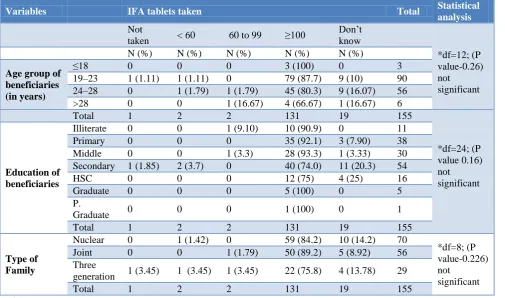
At PHC 2 no. of 4-6 ANC visits done by majority of beneficiaries as compared to PHC 1, this trends of ANC visits for respective PHC was found statistically significant (<0.001) (Table 4). Out of 90 beneficiaries of age group 19 to 23 year, majority 79 (87.78%) had taken ≥100 IFA tablets followed by 45 (80.36%) beneficiaries of age group 24 to 28 year. Out of 90 beneficiaries of age group 19 to 23 year, 9 (10%) beneficiaries did not
7.90%. Although this observation was found to be statistically not significant (p=0.16). Among beneficiaries who lived in three generation family, proportion of beneficiaries who had taken ≥100 IFA was found on
lower side that is 22 (75.86%) out of 29 as compared to beneficiaries who lived in joint and nuclear family. It was also found that 1 (3.45%) beneficiaries of this group did not take even single IFA Tablet (Table 5).
Table 4: PHC wise number of antenatal visits.
Name of PHC ANC visits Total P value
1 to 3 4 to 6 ≥7
N (%) N (%) N (%) N (%)
PHC 1 52 (80) 13 (20) 0 65
<0.001
PHC 2 15 (16.67) 70 (77.78) 5 (5.56) 90
Total 67 83 5 155 (100)
Fisher’s exact test, df=2; (P value <0.001) significant.
Table 5: Association between socio-demographic variables and IFA tablets taken done by beneficiaries.
Variables IFA tablets taken Total Statistical
analysis Not
taken < 60 60 to 99 ≥100
Don’t know
*df=12; (P value-0.26) not significant
N (%) N (%) N (%) N (%) N (%)
Age group of beneficiaries (in years)
≤18 0 0 0 3 (100) 0 3
19–23 1 (1.11) 1 (1.11) 0 79 (87.7) 9 (10) 90
24–28 0 1 (1.79) 1 (1.79) 45 (80.3) 9 (16.07) 56
>28 0 0 1 (16.67) 4 (66.67) 1 (16.67) 6
Total 1 2 2 131 19 155
*df=24; (P value 0.16) not significant Education of
beneficiaries
Illiterate 0 0 1 (9.10) 10 (90.9) 0 11
Primary 0 0 0 35 (92.1) 3 (7.90) 38
Middle 0 0 1 (3.3) 28 (93.3) 1 (3.33) 30
Secondary 1 (1.85) 2 (3.7) 0 40 (74.0) 11 (20.3) 54
HSC 0 0 0 12 (75) 4 (25) 16
Graduate 0 0 0 5 (100) 0 5
P.
Graduate 0 0 0 1 (100) 0 1
Total 1 2 2 131 19 155
Type of Family
Nuclear 0 1 (1.42) 0 59 (84.2) 10 (14.2) 70
*df=8; (P value-0.226) not
significant
Joint 0 0 1 (1.79) 50 (89.2) 5 (8.92) 56
Three
generation 1 (3.45) 1 (3.45) 1 (3.45) 22 (75.8) 4 (13.78) 29
Total 1 2 2 131 19 155
* Fisher’s exact test.
DISCUSSION
In our study Mean age of women was 23.38 (SD=3.06) across both the PHCs, similarly as per the Gundbowdi et al Panja et al study, majority (61.5%) of the women belonged to the age group 20-24 years with a mean age of 23.44±3.27 years & more than two thirds women (68.8%) belonged to the age group of 19-25 years respectively.5,6 Patel et al also revealed that the mean age of the women was 24.6 years. In present study >28 years old women percentage is very low in contrast to Patel et al study, where there were higher number of older women that is one-sixth (18.2%) were aged 30 years or more.7
In present study only 7.1% women were illiterate as compared to the study done by Gundbowdi et al who showed high proportions (96%) of literate women and very few (4%) women were illiterate. Santra et al found that 4.2% mothers were Illiterate.5,8
Higher proportion of illiteracy was may be due to cultural factors like gender bias in rural areas due to orthodox thinking in these studies.
In present study, husbands were educated up to secondary level followed by 35(22.6%) with 5.8% husband found illiterate. In contrast to our study Singh et al found that two-third of husbands were educated up to high school and 132 (9.5%) were illiterate.11 Patel et al revealed that among husbands of the study subjects 39 (15.6%) were illiterate, 73 (29.2%) were educated up to primary level, 108 (43.2%) were educated up to secondary level, 26 (10.4%) were educated up to PUC/diploma and only 4(1.6%) had completed graduation.12 These contrast results may be due to orthodox thinking.
Present study showed that maximum number of beneficiaries 70 (45.2%) belonged to nuclear family similarly Patel et al study revealed that 146 (58.4%) belonged to nuclear families, 94 (37.6%) belonged to joint families and 10 (4%) belonged to third generation family.12 None belonged to broken family. Gundbowdi et al and Sutanuka et al found contrast result, which shows that large proportion 77.7% and 68.1% of the participants lived in joint family respectively.5,8
Chauhan et al study also revealed contrast result from our study i.e. most of the beneficiaries 56 (71.79%) belonged to joint families.13
Inconsistent results may be because of in our study majority of participants are migrant workers so they belong to nuclear family.
Present study shows that, there were 17 beneficiaries who had more than 2 living children. Kaur et al revealed that at the time of study 38.9% had one living child while 43.2% had 2 living children and 17.9% had 3 or more than 3 living children.8,9 Patel et al revealed that on average, the beneficiaries had 1.9 children (on average 0.8 sons and 1.1 daughters).14
In present study, majority 78 (50.3%) got registered themselves within 12 weeks of pregnancy and in present study 93.5% had done equal to or more than 3 ANC visits. All 155 beneficiaries took TT injection and also all essential investigation have been carried out. All 155 beneficiaries took IFA tablets, out of which 131(84.5%) took ≥100 IFA tablets. In present study 65(41.94%) Out of 155, beneficiaries had done their all ANC examination at government health care facilities.
Panja et al study observed same findings, that 40.0% of women registered early (<12 weeks of gestation) out of total eligible women. 90% women had at least three antenatal check-ups done by the skilled birth attendants. Similarly around 97% women received adequate tetanus prophylaxis irrespective of their eligibility status for JSY.6
Study by Sutanuka et al revealed that all mothers received at least four antenatal check-up and two doses of tetanus toxoid (TT) injection. About 77% mothers had antenatal registration within 12 weeks of gestational period. About 87% mothers consumed 100 or more iron and folic acid tablets.8
Kaur et al also found that out of registered pregnancies more than half (54.6%) got the registration done in 2nd trimester, 24.3% in 1st trimester and 8.1% in 3rd trimester. Antenatal services were received by 58.9% beneficiaries in government dispensaries, 22.2% in private hospitals & 5.9% in government hospitals. All beneficiaries received TT injection. Out of 185 beneficiaries 55.7% of beneficiaries had 4 or more than 4 ANC visits, 32.4% had less than 4 visits, while in contrast to our study 11.9% had no ANC visit.9
Similar to present study Chauhan et al revealed that 42 (53.85%) of them registered their name in health institution during the first trimester pregnancy.13 Out of total 78 beneficiaries 44 (56.4%) and 15 (19.23%) underwent three and four antenatal check-ups (ANCs), respectively. 100% beneficiaries got TT injection. In contrast to present study, Gundbowdi et al study shows that most of the pregnant women (83.8%) consumed only 25-50 IFA tablets.5 Panja et al study mentioned that the proportion of women who consumed at least 100 IFA tablets was lowest in non-eligible group and highest (46%) in women who were eligible.6 Kaur et al also shows contrasting result with respect to IFA tablets consumption that is out of 185 beneficiaries 36.2% consumed 100 tablets, 48.1% of consumed less than 100 tablets and intake was irregular and 15.7% beneficiaries not taken IFA tablets.9
Chauhan et al revealed that 52 (66.66%) beneficiaries received 100 IFA tablets.13 Study done by Dolma et al revealed that 86% consumed recommended iron folic acid tablets i.e., 100 tablets while 14% did not.10
It means that the beneficiaries of present study are more aware about consequence of not taking IFA tablets, it also shows that good counselling have been done by health workers among present study’s beneficiaries as compared to these studies. Moreover in our study all the 155 beneficiaries (100%) had one or more ANC visit. 93.5% having got 3 or more ANC visits.
In present study only 50.3% beneficiaries got registered within 12 week in comparison to study done by Dolma et al which shows that 86.53% women got registered in 1st trimester, 13.46% in 2nd trimester.10 In contrast to present study, where all beneficiaries had weight measurement and blood pressure check-ups done at every ANC visits, study done by Dolma et al shows that weight measurement at every visit was done for only 39.4% of women.10 Majority (84.3%) had their blood pressure checked at every antenatal visit. Which tells that services provided at health facility is appropriate and comprehensive in our study.
In contrast to present study, all the parameter of ANC services utilization is not as per recommendation in JSY scheme in study done by Singh et al which shows that majority of the study subjects were registered between 12-26 weeks of pregnancy.11 81.6% pregnancies registered at Sub-centre, in comparison to PHC (17.1%) and CHC (1.5%). Around 25% of mothers did not receive the recommended minimum three antenatal check-ups. Weight measurement, was done in two-third mothers during all ANC visits. Majority of the mothers (97.4%) received 100 tablets of IFA, however less than half (45.3%) of them consumed all the tablets.
As Haryana comes under low performing state, this might be the reason behind this between present and this study in ANC parameters. It also indicates that health care provider as well as beneficiaries should take initiative in reducing maternal mortality as well as morbidity by enhancing utilization rate of JSY.
Present study’s result found consistent with studies done by Kaur et al, Patel et al, Mumbare et al, Mangulikar et al and Madna et al which show that education had a statistically significant relation with ANC check-up.
9,12,15-17 It means that education have direct impact on
utilization of ANC services which is one of the most important phase during pregnancy, where we can intervene and avoid any danger to pregnant lady prior to its occurrence. By increasing literacy we can reduce maternal mortality and morbidity significantly.
Mumbare et al and Mangulikar et al shows consistent results with present study, their study show that utilization of ANC services was not significantly associated with the type of the family (P>0.05).15,16 Madna et al show contrast result i.e., ANC services was significantly associated with the type of the family type of family (p<0.05).17
Present study finding is consistent with that of study done by Mangulikar K et al which shows that the adequate utilization of ANC services was significantly associated with parity of mother (p<0.05).16
Similar to present study, Mumbare et al and Mangulikar et al also did not find significant association (p>0.05)
between adequate utilization of ANC services (IFA tablet consumption) and age of mother.15,16
In contrast to present study, Kaur et al and Mumbare et al found statistically significant relation of education with adequate utilization of ANC services (required IFA tablet consumption) (p <0.05).9,15
Present study results are also not consistent with the study done by Mangulikar et al which shows significant association (p-0.03) between education of beneficiaries and adequate utilization of ANC services (consumption of 100 IFA tablets).16
Even Though present study differs in terms of statistically significance from other studies, in present study very few beneficiaries had not taken IFA tablet or took inadequate tablets.
The reason behind this might be that in present study many beneficiaries who were not able to recall the number of IFA tablets, which indirectly pointing out that either beneficiaries were not aware the importance of IFA tablets or beneficiaries were unable to give appropriate answer during study.
Mumbare et al and Mangulikar et al found consistent results with the present study, which shows that the adequate utilization of ANC services (IFA tablet consumption) was not significantly associated with type of the family (P>0.05). Study shows that among beneficiaries who lived in three generation family, proportion of beneficiaries who had taken ≥100 IFA was found on lower side.15,16
Overall based on the findings of the present study it can be concluded that, in present study utilization of ANC services is good.
ACKNOWLEDGEMENTS
We would like to thank Dr. G. S. Grewal Ex professor of Department of Community Medicine, Bharati Vidyapeeth Deemed to be University, Medical College Pune, Maharashtra, India.
Funding: No funding sources Conflict of interest: None declared
Ethical approval: The study was approved by the Institutional Ethics Committee
REFERENCES
1. Park K. Preventive and social medicine. 23rd edition. Jabalpur: Banarsidas Bhanot; 2015: 683-684.
handle/10665/194254/9789241565141_eng.pdf;jses sionid=946FB34C42841D9A2DFDE173854D1131 ?sequence=1. Accessed on 02 April 2019.
3. Voucher scheme for institutional delivery and immunization, Jharkhand. Government of India Central Bureau of Health Intelligence, Directorate General of Health Services. Ministry of health and family welfare. Health sector Policy Reform options database (HS-PROD)-INDIA. Available at: http://hsprodindia.nic.in/listdetails.asp?roid=122. Accessed on 22 September 2014.
4. JSY exploratory study Karnataka State health Resource Centre Bangalore Available from http://www.academia.edu/3555194/Janani_Suraksha _Yojana_JSY_Karnataka_-an_exploratory_study_ April_2012. Accessed on 02 April 2019.
5. Gundbowdi KD, Angolkar M, Kumar Sah J, Agre DH. Maternal and child health care service utilization among the mothers of Ganebail PHC, Belagavi district. India Int J Adv Res. 2015;3(7):117-25.
6. Panja TK, Mukhopadhyay DK, Sinha N, Saren AB, Sinhababu A, Biswas AB. Are institutional deliveries promoted by Janani Suraksha Yojana in a district of West Bengal, India. Indian J Public Health. 2012;56:69-72.
7. Patel BU, et al .Assessment of ASHA and Janani Suraksha Yojana (JSY) in Rajasthan by UNFPA and
New Delhi 2007. Available at:
http://www.cortindia.in/RP%5CRP-2007-0302.pdf. Accessed on 02 April 2019.
8. Santra S, Lahiri S, Biswas A, Srivastava P. Utilization of maternal health care services with special emphasis on Janani Suraksha Yojana in a slum of Kolkata, West Bengal. Int J Med Public Health. 2015;5(3):225-7.
9. Kaur H, Kaur A, Devgun P. A study of utilization of Janani Suraksha Yojana (JSY) scheme, among beneficiaries in a rural area of Punjab. National Journal of Research in Community Medicine. 2015;4(1):114-23.
10. Dolma Y, Munshi IH Thesis on Evaluation of Janani Suraksha Yojana under National Rural Health Mission in Kashmir Valley published in
International Journal of Advanced Research In 2014. Available at: http://www.journalijar.com/ uploads/260_THESIS-0795.pdf. Accessed on 02 April 2019.
11. Singh J M, Kalhan M, Punia A, Sachdeva S, Behera BK. Utilization of Health Services under Janani Suraksha Yojana in Rural Haryana. Int J Med Public Health. 2013;3(3):176-9.
12. Patel HK. Thesis on Awareness And Utilization Of Janani Suraksha Yojana in Rural Area, a Cross Sectional Study from KLE University, Belgaum, Karnataka. 2012.
13. Chauhan PL, Dhadwal D, Mahajan A. Knowledge, awareness, and utilization pattern of services under Janani Suraksha Yojana among beneficiaries in rural area of Himachal Pradesh. CHRISMED J Health Res. 2015;2:324-8.
14. Patel BU, Vasant U, Chakrawar BB, Sharma J, Shahane S. Concurrent Assessment of Janani Suraksha Yojana (JSY) in Uttar Pradesh by UNICEF and New Delhi 2008. Available in URL http://www.cortindia.in/RP%5CRP-2007-0702.pdf. Accessed on 02 April 2019.
15. Mumbare SS, Rege R. Ante Natal Care Services Utilization, Delivery Practices and Factors Affecting Them in Tribal Area of North Maharashtra. Indian J Community Med. 2011;36(4):287–90.
16. Mangulikar SK, Howal PV, Kagne KP. A cross-sectional study of antenatal care services utilization, delivery practices and factors affecting them in urban slum area of India in 2015. Int J Res Med Sci. 2016;4(5):1501-5.
17. Madna P, Bedre R, Solanki H. A study of Ante Natal Care Service Utilization & Factors Affecting Them in Rural Bidar, Karnataka. NJIRM. 2014;5(1):31-6.